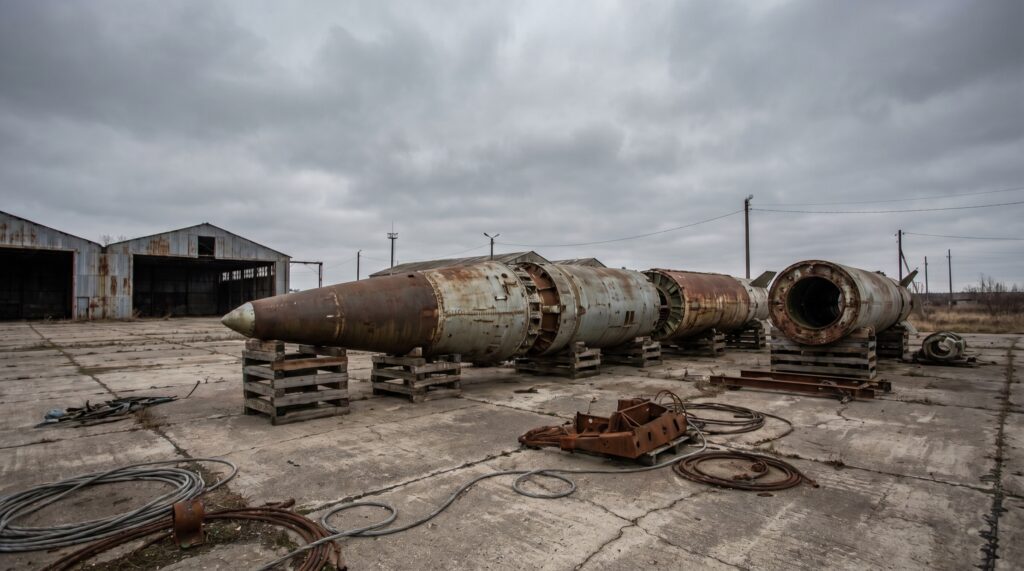
Arms-control treaties normally do one thing: they count. They set a ceiling, both sides stay under it, and everyone congratulates themselves on a number. The Intermediate-Range Nuclear Forces Treaty did something no treaty before it had done. It took an entire class of weapons, every ground-launched missile that could fly between 500 and 5,500 km, and abolished it. Not capped. Abolished. Both sides destroyed the missiles, watched each other do it, and let inspectors camp outside each other’s missile factories for thirteen years to make sure nobody rebuilt them.
Then, thirty-one years after signing, it died in a fight over a single Russian cruise missile and a set of American launchers in Romania, with a third country that had never signed anything sitting quietly in the background building exactly the weapons the treaty had banned. Why the INF Treaty collapsed matters more than what it contained, because the collapse is the reason the missile map of Asia looks the way it does now.
What the INF Treaty actually did
The INF Treaty was a bilateral agreement between the United States and the Soviet Union, signed in Washington on 8 December 1987 by Ronald Reagan and Mikhail Gorbachev, and in force from 1 June 1988. It required both sides to destroy all their ground-launched ballistic missiles and ground-launched cruise missiles with ranges from 500 to 5,500 km, along with the launchers, support structures and support equipment that went with them.
The band was split into two tiers, which is worth knowing because the treaty’s nickname depends on it. Shorter-range meant 500 to 1,000 km. Intermediate-range meant 1,000 to 5,500 km. Scrapping both tiers, everywhere in the world rather than just in Europe, is why negotiators called the deal the global double zero.
The numbers are what make the treaty exceptional rather than symbolic. By the destruction deadline of 1 June 1991, the two sides had eliminated 2,692 missiles: 846 American and 1,846 Soviet. The Soviet Union destroyed more than twice as many as the United States did, which tells you who was giving up more and hints at why the treaty later became unpopular in Moscow.
And it didn’t run on trust. It ran on on-site inspection, close to unthinkable in 1987. Inspectors were allowed onto the other side’s bases, and each side stationed inspectors permanently outside a missile production plant, the Americans at Votkinsk in the Soviet Union and the Soviets at Magna, Utah, watching what came out of the gates. That portal monitoring ran until 31 May 2001. If you want the single reason INF is treated as the gold standard of verification, it’s that: for over a decade, each superpower had officials of the other standing at its factory door.
The Euromissile crisis: why Europe needed this
The treaty exists because Europe spent the late 1970s and early 1980s convinced it was about to become the place where a nuclear war got fought and confined. That fear had one cause: the Soviet SS-20 Saber, deployed from 1976.
The SS-20’s details explain the panic better than any adjective. It was mobile, so it couldn’t be reliably found and destroyed first. It carried three warheads on a MIRV bus, so one missile hit three cities. Its range of roughly 5,000 km covered every capital in Western Europe from Soviet territory. And it could not reach the United States. That last point is the whole crisis in one line. A weapon that threatened Bonn, Paris and Rome but not Washington raised the question that haunted NATO: would an American President really trade New York for Hamburg? If not, the Soviet Union could hold Europe hostage at a level of violence the United States would never answer.
NATO’s response, in December 1979, was the dual-track decision, and it was exactly what the name says. Track one: offer to negotiate the missiles away. Track two: if the talks fail, deploy American Pershing II ballistic missiles and ground-launched cruise missiles in Western Europe to match them. In November 1981 Reagan put the zero option on the table, blunt to the point of provocation: the United States would cancel its planned deployments if the Soviet Union dismantled every SS-20, SS-4 and SS-5 it had. Moscow rejected it, and many Western analysts assumed Washington had proposed it precisely because Moscow would.
Talks failed. Deployments began in 1983, and Europe erupted, with hundreds of thousands marching in West Germany, Britain, Italy and the Netherlands. The Soviets walked out of the negotiations. The Pershing II was the sharpest edge of the fear, because its flight time from West Germany to Soviet command targets ran to six to ten minutes, short enough that Moscow might have to decide on a nuclear response before it could confirm what was incoming. Nineteen eighty-three is now generally reckoned the most dangerous year of the Cold War after the Cuban missile crisis, and what made it dangerous was shrinking decision time on top of total mutual distrust.
What broke the deadlock was Gorbachev. At Reykjavik in October 1986, he and Reagan came startlingly close to abolishing all nuclear weapons, and the summit collapsed over Reagan’s refusal to confine his Strategic Defense Initiative to the laboratory. It looked like failure. It wasn’t. The intermediate-range piece had been worked out in the room, and Gorbachev later accepted the zero option Moscow had scorned five years earlier. The treaty came from the failed summit, not a successful one.
Why this treaty was different from everything before it
Every arms-control agreement before INF managed weapons. INF removed them, and that distinction is the single most useful thing to carry from this topic.
Look at what came before. SALT I in 1972 froze the number of launchers. SALT II in 1979 set ceilings on delivery vehicles. Both were accounting exercises, and accounting exercises leave the weapons in the field, in their silos, aimed. They restrain an arms race; they don’t reverse one. INF reversed one. On 1 June 1991, not one deployed American or Soviet ground-launched missile in the 500 to 5,500 km band existed anywhere on earth, because they’d all been cut up, crushed or blown up under the other side’s eyes.
Here’s the objection a careful reader forms about now, and it’s the right one. If both sides scrapped these weapons, didn’t that make everyone safer by definition? Not quite. The missiles eliminated were a small fraction of either arsenal, and INF never touched strategic forces, so the intercontinental weapons stayed exactly where they were. What INF removed was one unusually dangerous category: fast, short-flight-time, ground-based weapons sitting close to the enemy, which compress a leader’s decision time to minutes and make a war more likely to start by accident than by intent. The treaty’s value was never about tonnage. It was about buying back time to think, the scarcest commodity in a nuclear crisis and the one no amount of warhead-counting protects.
The verification regime deserves the same reframing. It mattered not because inspectors found violations, but because thirteen years at Votkinsk and Magna built a habit no treaty had previously proved was politically survivable. When the regime lapsed in 2001, the two countries lost a routine as much as a rulebook, and by the time accusations started flying in 2014 neither side had inspectors in place to settle them.
What the treaty did not cover
The INF Treaty banned ground-launched missiles only, and everything that followed flows from that one word.
Sea-launched cruise missiles were untouched, so a Tomahawk fired from a destroyer or a submarine was perfectly legal and the United States kept building them. Air-launched cruise missiles were untouched too, so the same missile dropped from a bomber broke no rule. Only the launcher on the ground was illegal, which meant a treaty about missile ranges was actually a treaty about basing modes.
That looks like a loophole and it wasn’t quite. The logic was defensible: a ground-launched missile in Europe sits close, fixed to a place, ready in minutes, and it’s the one that compresses warning time. A ship or a bomber takes hours to get into position and can be seen moving. The treaty targeted the property that made these weapons destabilising, not the missile bodies as such. But the asymmetry had consequences. The United States, with the world’s largest navy, could put the same capability to sea and keep it. Russia, a land power with a much smaller blue-water fleet, could not. Moscow gave up a capability it relied on and watched Washington retain the naval version of it. If you want one structural reason Russia soured on INF, that’s it, and it has nothing to do with anybody cheating. The difference between cruise and ballistic missiles is worth being solid on here, because the treaty banned both types but only from one launch platform.
The second uncovered thing was bigger than any loophole: the rest of the world. INF was bilateral. Every other state on earth stayed free to build ground-launched missiles in the 500 to 5,500 km band, and several did.
| Year | Development |
|---|---|
| 1976 | Soviet Union begins deploying the mobile, MIRVed SS-20 against Western Europe |
| 1979 | NATO’s dual-track decision: negotiate, and deploy Pershing II and cruise missiles if talks fail |
| 1981 | Reagan proposes the zero option; Moscow rejects it |
| 1983 | Pershing II and ground-launched cruise missiles arrive in Europe; Soviets quit the talks |
| 1986 | Reykjavik summit collapses over missile defence but settles the intermediate-range terms |
| 1987 | INF Treaty signed in Washington on 8 December |
| 1988 | Treaty enters into force on 1 June |
| 1991 | Destruction complete: 2,692 missiles eliminated, 846 American and 1,846 Soviet |
| 2001 | On-site portal monitoring at Votkinsk and Magna ends on 31 May |
| 2014 | The United States formally alleges Russian violation over a new cruise missile |
| 2019 | Washington suspends obligations in February and the treaty terminates on 2 August |
| 2019 | The United States tests a ground-launched Tomahawk in August and an intermediate-range ballistic missile in December |
| 2024 | US Typhon launchers arrive in the Philippines; Russia fires the Oreshnik at Dnipro |
How it collapsed: the 9M729, the launchers in Romania, and two sets of accusations
The treaty fell apart over a dispute neither side could win, because by then neither had any way to check the other’s claim.
The American charge concerned a Russian ground-launched cruise missile designated the 9M729 (NATO calls it the SSC-8 Screwdriver), a relative of the Iskander-K family. Washington first formally alleged a violation in July 2014, in a State Department compliance report, saying Russia had tested and later deployed the missile at ranges inside the banned band. Successive American reports said battalions had been fielded.
Russia denied it flatly. Moscow’s position was that the 9M729’s maximum range is 480 km, just below the treaty floor, and that the United States had never produced the evidence behind its assertion. Russia displayed the missile canister for foreign attachés in January 2019; the United States and most NATO states declined to attend or dismissed the display as staged, since a canister shows you nothing about range.
And Russia had counter-charges of its own, which any fair account has to state rather than skip. Moscow argued that the American Aegis Ashore missile-defence sites at Deveselu in Romania (operational 2016) and Redzikowo in Poland use Mk-41 vertical launch cells, the same family that fires Tomahawk cruise missiles from US warships, and that a Tomahawk-capable launcher planted on land is a ground-launched cruise missile launcher whatever its stated purpose. Washington replied that the ashore variant is configured for interceptors and cannot fire Tomahawks. Russia also objected that American target missiles used in defence tests, and armed drones, met the treaty’s definitions.
The honest position on the merits is more useful than picking a side. Neither claim was ever tested by a neutral inspector, because the inspection regime had ended in 2001 and neither party would submit the dispute to a third party. The Americans wouldn’t publish the intelligence, since that would expose how they collected it. The Russians wouldn’t open the 9M729 to a range demonstration that would have settled it in an afternoon. NATO governments reviewed the American evidence and endorsed the finding. Independent analysts outside government could not, and mostly said so.
The end came quickly. In October 2018 the United States announced its intent to withdraw. On 2 February 2019 it suspended its obligations and gave formal six-month notice; Russia suspended its own the following day. The treaty terminated on 2 August 2019.
Then Washington did something that tells you a lot about what had been going on. On 18 August 2019, sixteen days after termination, it flight-tested a ground-launched Tomahawk from a Mk-41 launcher on San Nicolas Island, and in December it tested a ground-launched intermediate-range ballistic missile. Sixteen days is not enough time to design a test programme, so the hardware had been in preparation for a while, which Russia seized on as proof that the withdrawal was about capability rather than compliance. That’s an inference, not a confession, but it’s a reasonable one and it belongs in any serious account.
The country that was never in the room
The unstated factor in the treaty’s collapse was China, which never signed, was never asked to, and spent three decades building exactly the weapons it banned.
The scale is what makes this decisive rather than incidental. American officials have repeatedly put roughly 95 percent of China’s missile inventory inside the 500 to 5,500 km band, meaning almost the entire arsenal of the PLA Rocket Force consists of systems the United States and Russia were forbidden to own. The named ones matter: the DF-21, at roughly 1,500 to 1,700 km, whose DF-21D variant is built to hit moving aircraft carriers; the DF-26, at roughly 4,000 km, dual-capable and nicknamed the Guam killer because that’s what it reaches; and the DF-17, which carries a hypersonic glide vehicle designed to defeat missile defences.
The American argument, then, wrote itself. A treaty signed to solve a European problem had become, by the 2010s, a self-imposed handicap in the Pacific, binding one Pacific power and leaving the other free. Washington proposed trilateralising it. Beijing refused, and its reasoning is worth understanding rather than dismissing: China’s arsenal is a fraction of the American and Russian ones, its ground-based intermediate-range missiles are the core of its regional deterrent, and it has no navy-sized alternative to move them to sea. Asking China to scrap them while the United States keeps a fleet full of Tomahawks would not be arms control. It would be disarmament of one party. Whether or not you accept that, it explains why trilateral INF was never going to happen, and it’s the same logic that shapes India’s own China calculus.
So the deeper cause of the collapse isn’t the 9M729 or the Mk-41 at all. It’s that a bilateral treaty stopped making sense in a world with nine nuclear-armed states. The 9M729 was the argument. China was the reason.
What the collapse means for arms control, and for India
The end of INF removed a norm, not just a rule, and the difference shows in what happened next.
Look at the wider architecture, which is now nearly bare. The ABM Treaty ended when the United States withdrew in 2002. The Open Skies Treaty lost the United States in 2020 and Russia in 2021. Russia completed its exit from the CFE Treaty in 2023 and suspended participation in New START the same year. INF died in 2019. New START, the last cap on American and Russian strategic warheads, ran out its term in February 2026, and couldn’t be extended again because it had used its single permitted five-year extension in 2021. Sixty years of treaty-building, and what’s left standing between the two largest arsenals is essentially nothing. That’s the context in which the NPT and CTBT debate now sits.
The practical consequences arrived fast. The United States began fielding ground-launched intermediate-range systems: the Typhon Mid-Range Capability launcher, which appeared in the Philippines in 2024 and has stayed, and the Dark Eagle hypersonic system. Russia declared its unilateral moratorium on such deployments over, and in November 2024 fired a new intermediate-range missile it calls Oreshnik at Dnipro in Ukraine, a strike whose military value was small and whose signalling value was the entire point.
For India, this isn’t a distant European story, and the reason is arithmetic. The 500 to 5,500 km band is India’s deterrent. The Agni family lives almost entirely inside it: Agni-I at roughly 700 to 900 km, Agni-II at about 2,000 km, Agni-III at about 3,000 km, Agni-IV at about 4,000 km. The BrahMos sits below the floor in its original form and pushes toward it in extended-range variants. Pakistan’s Shaheen-II and Shaheen-III occupy the same band from the other direction. So an INF-style ban replicated in Asia would eliminate most of India’s usable deterrent while leaving China’s intercontinental systems and America’s sea-based forces intact. India was never a party, has no interest in becoming one, and its position has consistently been that disarmament must be universal, verifiable and non-discriminatory rather than regional and selective. That looks far less abstract once you see which missiles a regional INF would take away, and it’s why India’s nuclear triad, specifically the sea leg, matters more as the ground-launched band gets crowded.
The second-order effect is the one to watch. With the normative bar gone, ground-launched intermediate-range missiles are ordinary equipment now, and the Indo-Pacific is where they’re going. More American launchers in the Philippines mean more Chinese systems aimed at them, more Chinese systems mean more Indian exposure to a theatre India didn’t choose, and none of it is bounded by any agreement anyone has signed.
How to study this
Hold the treaty on four hinges rather than a chronology, because the hinges survive revision and the dates hang off them by themselves.
The SS-20 and the dual-track decision explain why the treaty was needed: a weapon that threatened Europe but not America split the alliance’s nerve, and NATO answered with matching missiles plus an offer to talk. The 1987 signing and the 1991 destruction of 2,692 missiles explain what made it unique: the first treaty to eliminate a class rather than count one, verified at each other’s factory gates. The 9M729 and the Mk-41 dispute explain the mechanics of the collapse: two unverifiable accusations after the inspection regime had lapsed. China’s absence explains the real cause.
Then get the framing right, because that’s where answers go wrong. Don’t write that the treaty banned all intermediate-range missiles; it banned ground-launched ones, which is why the American sea leg survived and why Russia felt the deal aged badly. Don’t present the collapse as one side’s fault; the United States alleged and NATO endorsed, Russia denied and counter-alleged, and no neutral body adjudicated. Don’t treat the withdrawal as the beginning of the end; the ABM exit in 2002 started the unravelling.
One contrast locks it in place. Set INF against the NPT. INF was bilateral, eliminated a category, verified intrusively, and it’s dead. The NPT is near-universal, eliminates nothing, verifies unevenly, and it survives. A treaty that asks a lot of two parties is fragile in a way one that asks little of many is not, and that trade-off is the live question in every disarmament debate now running.
Frequently Asked Questions
What was the INF Treaty?
The Intermediate-Range Nuclear Forces Treaty was a bilateral agreement signed by the United States and the Soviet Union on 8 December 1987 and in force from 1 June 1988. It required both sides to destroy all ground-launched ballistic and cruise missiles with ranges of 500 to 5,500 km, together with their launchers.
Who signed the INF Treaty?
Ronald Reagan for the United States and Mikhail Gorbachev for the Soviet Union, in Washington. After the Soviet collapse, Russia, Belarus, Kazakhstan and Ukraine were treated as the successors to the Soviet obligations.
Why was the INF Treaty considered so important?
It was the first arms-control treaty to eliminate an entire class of weapons rather than cap numbers. By the deadline of 1 June 1991 the two sides had destroyed 2,692 missiles, 846 American and 1,846 Soviet, and it introduced on-site inspection including permanent monitoring outside missile plants at Votkinsk and Magna, Utah, until 2001.
What did the INF Treaty not cover?
Only ground-launched missiles were banned. Sea-launched and air-launched missiles in the same range band remained legal, which favoured the United States and its large navy. The treaty was also bilateral, so no other country was bound by it.
Why did the INF Treaty collapse?
The United States alleged from 2014 that Russia had tested and deployed the 9M729 ground-launched cruise missile within the banned range. Russia denied it, said the missile’s range is 480 km, and counter-alleged that American Mk-41 launchers at Aegis Ashore sites in Romania and Poland could fire Tomahawks. The United States announced withdrawal in 2018 and the treaty terminated on 2 August 2019.
What role did China play in the INF Treaty’s end?
China was never a party and built ground-launched missiles in the banned band freely, including the DF-21, DF-26 and DF-17. American officials have put roughly 95 percent of China’s missile inventory inside the 500 to 5,500 km range. Washington argued the treaty handicapped it in the Pacific and proposed including China, which Beijing refused.
How does the INF Treaty’s collapse affect India?
India was never a party, and the 500 to 5,500 km band is where most of India’s deterrent sits, including the Agni-I through Agni-IV. A regional version of the treaty would remove India’s usable missiles while leaving intercontinental and sea-based systems untouched. The collapse also removed the norm against such missiles, accelerating deployments across the Indo-Pacific.
What is left of nuclear arms control now?
Very little between the two largest arsenals. The ABM Treaty ended in 2002, Open Skies in 2020 and 2021, the CFE Treaty in 2023, and INF in 2019. New START, the last cap on American and Russian strategic warheads, ran out its term in February 2026 and could not be extended again. The NPT remains, but it caps nothing.
Practice Questions
1. The INF Treaty of 1987 required the elimination of:
a) All nuclear warheads held by the United States and the Soviet Union
b) Ground-launched ballistic and cruise missiles with ranges of 500 to 5,500 km
c) All intermediate-range missiles regardless of launch platform
d) Intercontinental ballistic missiles above 5,500 km
Answer: b) Ground-launched ballistic and cruise missiles with ranges of 500 to 5,500 km
2. The INF Treaty was signed between:
a) The United States, the Soviet Union and China
b) All five nuclear-weapon states recognised under the NPT
c) The United States and the Soviet Union only
d) NATO and the Warsaw Pact as blocs
Answer: c) The United States and the Soviet Union only
3. Which of the following made the INF Treaty distinct from the SALT agreements?
a) It capped the number of launchers each side could deploy
b) It eliminated an entire category of weapons rather than setting ceilings
c) It relied entirely on national technical means with no inspections
d) It covered sea-launched and air-launched missiles as well
Answer: b) It eliminated an entire category of weapons rather than setting ceilings
4. The immediate dispute that led to the United States withdrawing from the INF Treaty concerned:
a) The Russian 9M729 ground-launched cruise missile
b) The Chinese DF-26 ballistic missile
c) Russian intercontinental ballistic missile tests
d) The deployment of the SS-20 in Europe
Answer: a) The Russian 9M729 ground-launched cruise missile
5. Consider the following statements about the INF Treaty:
1. It banned sea-launched cruise missiles in the 500 to 5,500 km range. 2. China was not a party to the treaty and was free to build missiles in that range band. Which of the statements is/are correct?
a) 1 only
b) 2 only
c) Both 1 and 2
d) Neither 1 nor 2
Answer: b) 2 only
Mains-style questions
1. “The INF Treaty solved a European problem and later became a Pacific handicap.” Critically examine the reasons for the treaty’s collapse.
2. Explain why the INF Treaty is regarded as a landmark in arms control, with reference to its scope and its verification regime, and assess what its termination costs the global non-proliferation order.
3. The INF Treaty banned ground-launched missiles alone. Discuss the strategic logic behind that restriction and the asymmetries it created between the signatories.
4. Evaluate the consequences of the erosion of the bilateral arms-control architecture for a multipolar nuclear order, and suggest what a workable successor framework would need to address.
5. “India has good reasons to welcome the INF Treaty in principle and to resist its replication in Asia.” Examine this proposition with reference to India’s deterrent posture and its declared position on disarmament.
The easy reading of the INF Treaty is a tragedy: two leaders did something extraordinary, their successors wrecked it, and the world is worse off. The harder reading is that the treaty was always shaped to one moment, two superpowers facing each other across Germany, and that moment ended long before the treaty did. Its collapse doesn’t prove arms control fails. It proves that a bilateral instrument can’t govern a multipolar problem, and that a treaty with no way to settle a factual dispute won’t survive its first serious one. Those are engineering lessons, not moral ones, and they’re the ones that matter now, because the missiles the treaty banned are being built again by more countries than ever signed it, and there’s nothing on the table to stop them.
Tell Google you want more of this.
Add Anantam IAS as a preferred sourceOne tap, and this site shows up more often in your own Top Stories, AI Overviews and AI Mode. Remove it any time.