The Central Water Commission, CWC, is the apex technical body in India for water resources. It is not a statutory body. It is an attached office of the Ministry of Jal Shakti, set up in 1945 and reorganised several times since. Despite its non-statutory status, CWC has become indispensable to every major water decision in the country. No large irrigation, hydropower, or multipurpose river-valley project can move forward without its technical clearance. The country’s flood warning system runs on its forecasts. Every interstate river water dispute draws on its hydrological data. For UPSC GS-III, the Central Water Commission sits at the centre of the water-resources syllabus and shows up in mains questions on flood management, river-linking projects, and federal water governance.
The unusual feature of CWC is that it carries enormous practical authority without a statute behind it. Its power flows from technical credibility, institutional history, and the fact that the Ministry of Jal Shakti routes most central decisions through it. That makes the CWC a textbook case in a recurring UPSC theme, the difference between de jure and de facto authority in Indian governance.
Quick Facts on the Central Water Commission
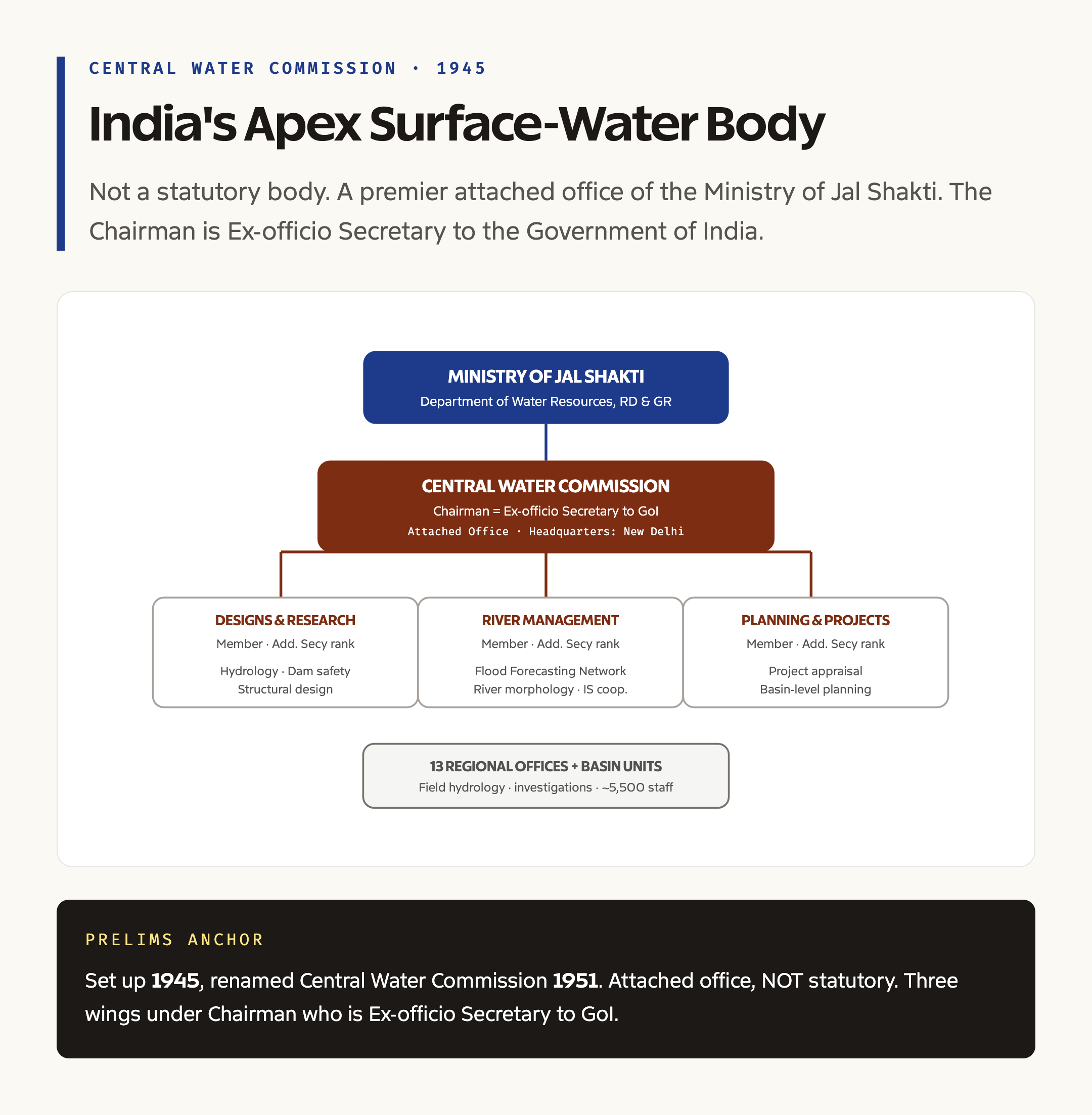
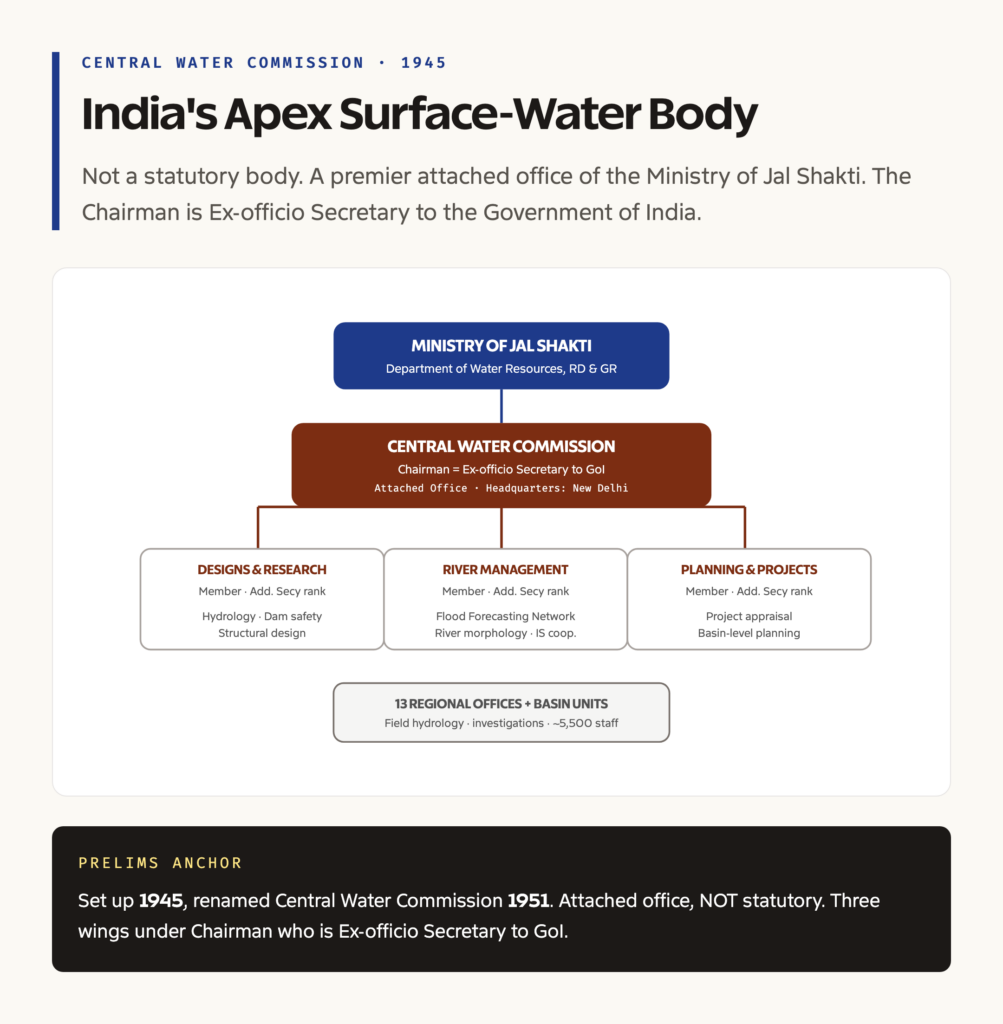
The Central Water Commission was established in 1945, originally as the Central Waterways, Irrigation and Navigation Commission, and was renamed the Central Water Commission in 1951. It functions under the Department of Water Resources, River Development and Ganga Rejuvenation in the Ministry of Jal Shakti. The headquarters is in New Delhi. The Commission is headed by a Chairman who is also the Ex-officio Secretary to the Government of India, a configuration that gives the Chair direct access to ministerial decision-making.
CWC is not a statutory body. It is a premier attached office of the Ministry, created by an executive order. Its mandate covers the initiation, coordination, and implementation of schemes for the conservation, control, and utilisation of water resources for irrigation, flood management, drinking water supply, hydropower, and navigation. Three functional wings handle the work, the Designs and Research Wing, the River Management Wing, and the Water Planning and Projects Wing, each headed by a Member with Additional Secretary status.
What the Central Water Commission Is
The Central Water Commission is the technical arm of the Government of India in the field of surface water resources. It does not own or operate dams, canals, or hydropower stations. Those sit with state water resources departments, the Bhakra Beas Management Board, the National Hydroelectric Power Corporation, the Damodar Valley Corporation, and similar implementing agencies. CWC’s job is to provide the technical brain and the data spine. It evaluates projects on hydrology, structural design, economic viability, and environmental impact. It maintains the country’s primary hydrological observation network. It runs the national flood forecasting system. It advises the Centre, the states, and tribunals on water-balance questions.
The Commission’s unique configuration is the Chairman as Ex-officio Secretary. In most attached offices, the head reports to a Secretary who reports to the Minister. In CWC, the Chairman holds the Secretary rank directly, which collapses one tier of the hierarchy and gives CWC’s technical positions equal weight with the policy positions of the Ministry. This structural choice is the reason CWC carries such weight in practice despite the absence of a statute.
Background and Historical Context
The Central Waterways, Irrigation and Navigation Commission was set up in 1945 under the chairmanship of Dr. K.L. Rao, a major Indian engineer of the colonial and post-Independence period. The original mandate was to plan large irrigation works in a country whose food-security situation had collapsed under famine and wartime requisition. The Bhakra-Nangal project, the Hirakud project, and the Damodar Valley Corporation were all conceived in or just after this period, and CWC’s design and hydrological work fed directly into them.
The Commission was reorganised and renamed the Central Water Commission in 1951. The 1956 reorganisation gave it the structure of three wings that survives today. The 1980s and 1990s saw a major expansion of the Flood Forecasting Network, with the first computerised flood-warning models introduced in the late 1980s. The post-2000 period brought a digital transformation, with real-time hydrological telemetry, satellite-based snow-cover monitoring, and integrated decision-support systems for flood management. The 2019 creation of the Ministry of Jal Shakti, which merged the Ministry of Water Resources and the Ministry of Drinking Water and Sanitation, brought CWC and the Central Ground Water Board under a single ministry for the first time. For the parallel groundwater body, read the guide on the Central Ground Water Authority.
Key Functions of the Central Water Commission
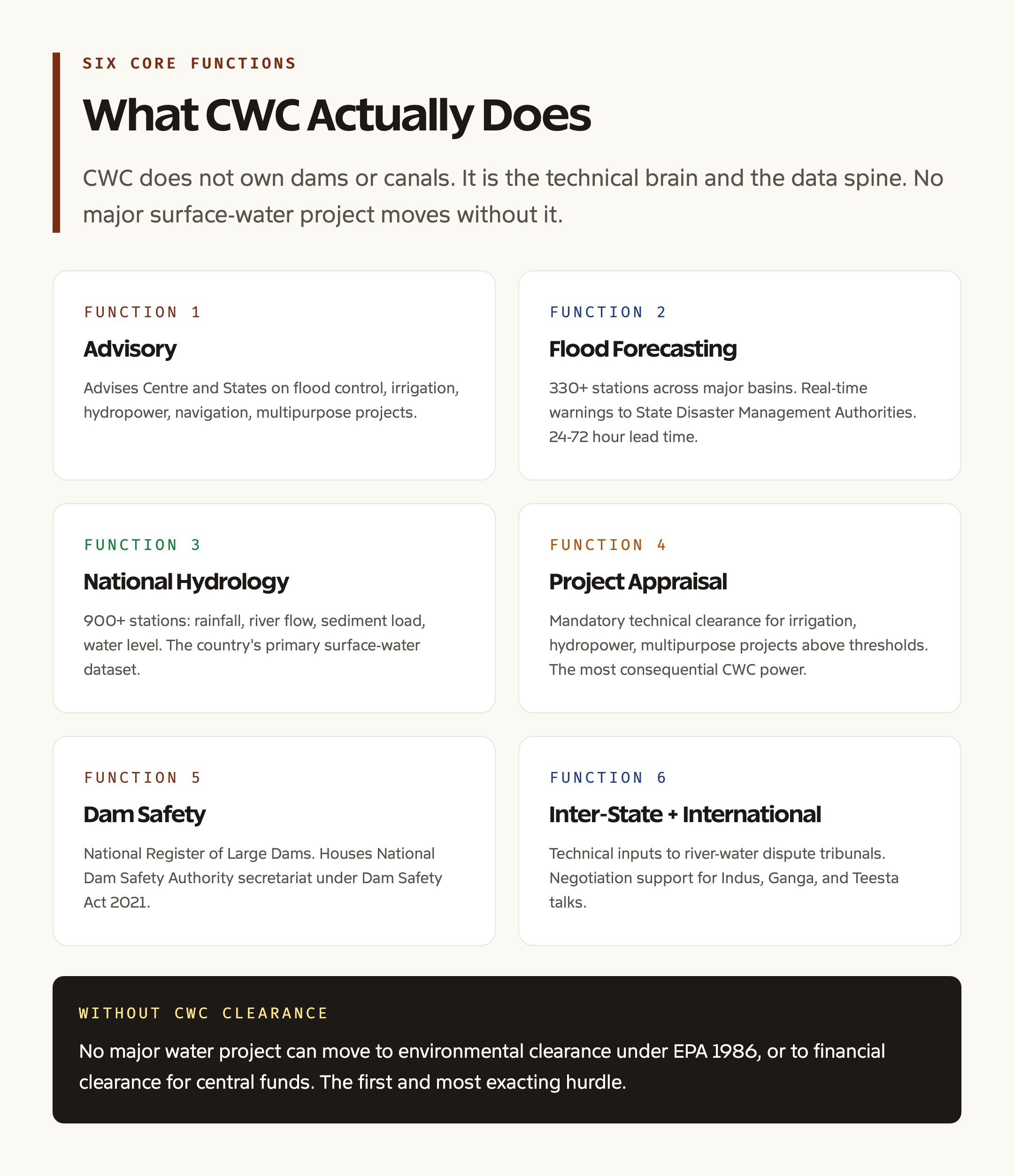
CWC’s mandate covers six broad function areas. The first is advisory. It advises the Centre and the states on flood control, irrigation, hydropower, navigation, and multipurpose river-valley projects. State water resources departments routinely route project proposals through CWC for technical clearance, even when no central funds are involved.
The second is flood forecasting. CWC operates the Flood Forecasting Network, which covers more than 330 forecasting stations across major river basins. The network issues real-time flood warnings to state governments, district administrations, and the Indian public during the monsoon, and integrates with the India Meteorological Department‘s rainfall forecasts and satellite-derived inputs.
The third is hydrology. CWC maintains the national hydrological observation network, which monitors rainfall, river flow, sediment load, and water-level data at more than 900 stations across the country. The data feeds into water-balance studies, flood forecasting, project planning, and inter-state water-sharing assessments.
The fourth is project appraisal. CWC carries out mandatory technical appraisal of irrigation projects, hydropower projects, and multipurpose river-valley projects above specified size thresholds. Without CWC clearance, no major water project can proceed to central funding or to environmental clearance under the Environment Protection Act and related notifications. This appraisal authority is the single most important practical power of CWC.
The fifth is dam safety. CWC maintains the National Register of Large Dams, conducts dam-safety inspections, and supports the implementation of the Dam Safety Act 2021, which is the first statutory framework for dam safety in the country. CWC houses the National Dam Safety Authority secretariat under that Act.
The sixth is international and inter-state. CWC provides technical inputs to inter-state river water dispute tribunals, supports India’s positions in negotiations with neighbouring countries on shared rivers, and represents the country in international hydrological organisations.
Why the Central Water Commission Matters
The CWC matters first because it is the gatekeeper for large water projects. Its technical clearance is a non-negotiable step for irrigation, hydropower, and multipurpose schemes above the threshold. The clearance process examines the hydrological yield, the structural design, the economic viability, and the environmental and social impacts. A project that fails CWC scrutiny cannot move forward, regardless of state-government political backing.
It matters second because it operates the country’s flood warning system. The Flood Forecasting Network covers the Brahmaputra, Ganga, Indus, Mahanadi, Godavari, Krishna, and other major river basins. During the monsoon, CWC issues hundreds of advisories every week to state and district authorities. The lead time for these forecasts has improved from a few hours in the 1980s to 24 to 72 hours for many stations today, and the corresponding reduction in flood-related deaths and damage is among the largest concrete public-safety achievements of any technical body in India.
It matters third because it owns the country’s primary surface-water dataset. The CWC observation network, combined with the IMD rainfall network and the Survey of India topographic data, forms the foundation on which every Indian water-resource calculation is built. Inter-state river-water dispute tribunals draw on CWC data. Climate-change adaptation studies use CWC time series. National water-balance assessments and the country’s reporting under the United Nations Watercourses Convention all rest on CWC numbers.
Detailed Analysis: Organisational Structure
CWC is organised into three functional wings under the Chairman. The Designs and Research Wing handles the structural and engineering design of dams, barrages, canals, and hydropower works, runs the hydrology and remote sensing directorates, and houses the dam safety unit. The River Management Wing handles flood management, the Flood Forecasting Network, river morphology, and inter-state and international water cooperation. The Water Planning and Projects Wing handles project appraisal, water-resource planning, basin-level studies, and the management of the National Water Information System.
Each wing is headed by a Member with the rank of Additional Secretary to the Government of India, and each Member oversees a set of Chief Engineers and Directors. CWC’s field presence runs through 13 regional offices and basin-level units that collect hydrological data and conduct field investigations. Total staff strength is around 5,500.
Project Appraisal in Practice
The technical appraisal process is the single most consequential CWC function for large infrastructure. A state water resources department submits a Detailed Project Report, and CWC’s Project Appraisal Organisation evaluates the report on hydrology, structural design, economic viability, and environmental and social impacts. The appraisal flags inadequate hydrological yield, design weaknesses, cost-benefit problems, and environmental risks.
After CWC clearance, the project moves to the Ministry of Environment, Forest and Climate Change for environmental clearance under the Environment Protection Act 1986, and to the Public Investment Board or the Cabinet Committee on Economic Affairs for financial clearance. The technical appraisal at CWC is therefore the first hurdle and often the most exacting one. Several major projects have been redesigned, scaled down, or abandoned at this stage. For the broader policy context, read the guide on water resources in India and on India’s river systems.
CWC and the Flood Forecasting Network
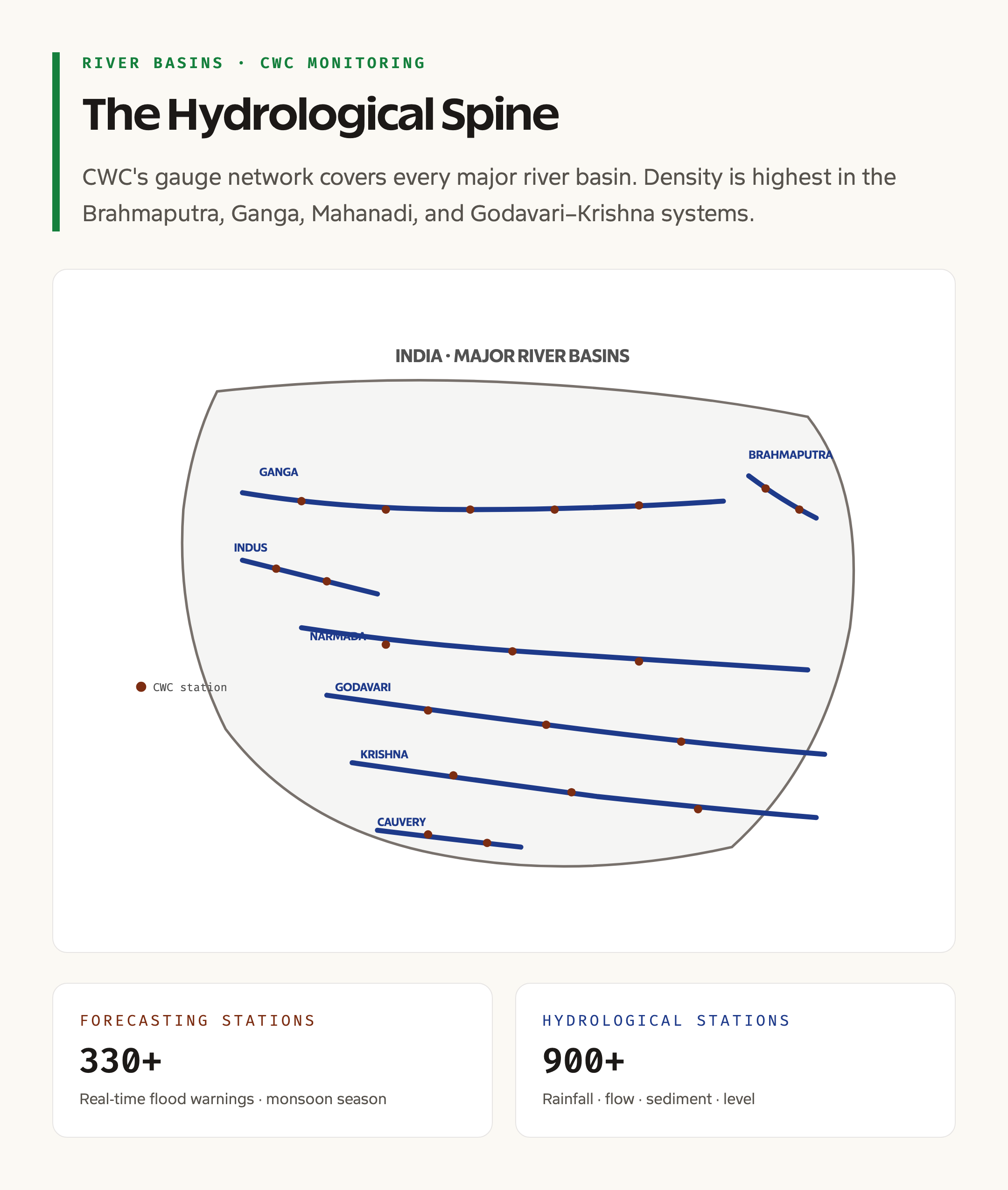
The Flood Forecasting Network is CWC’s most visible public-facing system. It runs more than 330 forecasting stations across the country, of which over 200 are level forecasting stations and the rest are inflow forecasting stations for major dams. The network covers the Brahmaputra, Ganga, Indus, Mahanadi, Godavari, Krishna, Cauvery, Tapi, Narmada, Subarnarekha, and other basins.
Forecasts are issued at lead times of 24 to 72 hours for level forecasts and 12 to 24 hours for inflow forecasts. The system integrates rainfall data from the IMD, satellite-based estimates, dam-release information from operators, and CWC’s own gauge readings. The output is an integrated bulletin that goes to the State Disaster Management Authorities, the Central Water Commission’s flood-management division, and the public through the website and mobile applications.
CWC, CGWA, and the Surface-Groundwater Divide
The Indian water bureaucracy splits surface water and groundwater into two technical bodies. CWC handles surface water. The Central Ground Water Authority handles groundwater. Both now sit under the same Ministry of Jal Shakti since 2019, but their mandates do not overlap. CWC studies the Ganga’s flow at Farakka. CGWA studies the Ganga basin’s aquifer recharge in Bihar. CWC clears a hydropower project on a mountain river. CGWA notifies an over-exploited block in Punjab.
The cleaner integration of surface and groundwater data has been a consistent recommendation of expert committees, including the Mihir Shah committee on water reform. The recommendation is to merge CWC and the Central Ground Water Board into a single National Water Commission. The proposal has been on file since 2016 and has not yet been implemented, but every UPSC question on water-resource governance now carries this debate as a reference. For the parallel guide on the groundwater regulator, read Central Ground Water Authority.
Connections With Related UPSC Topics
The CWC connects with several recurring UPSC themes. It connects with water resources in India as the apex technical body. It connects with river systems of India through the basin-level monitoring and management framework. It connects with environmental laws in India through the project appraisal and environmental clearance interface. It connects with the State of India Environment 2026 report where the latest data on the country’s water balance and dam infrastructure are tabulated. And it connects with the Dam Safety Act 2021 through the National Dam Safety Authority secretariat.
For prelims, anchor four facts. First, CWC was set up in 1945 and renamed in 1951, functions under the Ministry of Jal Shakti, and is an attached office, not a statutory body. Second, it is headed by a Chairman who is also Ex-officio Secretary to the Government of India. Third, the Commission has three wings, Designs and Research, River Management, and Water Planning and Projects. Fourth, CWC’s mandatory technical appraisal is required for all major irrigation, hydropower, and multipurpose river-valley projects.
Frequently Asked Questions
Is the Central Water Commission a statutory body?
No. The Central Water Commission is an attached office of the Ministry of Jal Shakti. It was set up by executive order in 1945 and reorganised by executive notification in 1951. Despite its non-statutory status, CWC carries substantial practical authority because of the technical clearance powers vested in it and the Chairman’s status as Ex-officio Secretary to the Government of India.
Which ministry does CWC come under?
CWC functions under the Department of Water Resources, River Development and Ganga Rejuvenation in the Ministry of Jal Shakti. The Ministry of Jal Shakti was created in 2019 by merging the Ministry of Water Resources and the Ministry of Drinking Water and Sanitation.
Who heads the Central Water Commission?
The CWC is headed by a Chairman who holds the rank of Ex-officio Secretary to the Government of India. This dual designation gives the Chairman direct access to ministerial decision-making and places the technical positions of CWC at par with the policy positions of the Ministry. The Chairman is supported by three Members at Additional Secretary rank, one for each wing.
What is the Flood Forecasting Network?
The Flood Forecasting Network is the country’s primary flood-warning system, operated by CWC. It runs more than 330 forecasting stations across major river basins, integrates rainfall and satellite data, and issues forecasts at lead times of 24 to 72 hours. The forecasts go to State Disaster Management Authorities, district administrations, and the public.
What is the difference between CWC and CGWA?
CWC handles surface water. The Central Ground Water Authority handles groundwater regulation. CWC is an attached office under the Ministry of Jal Shakti. CGWA is a statutory body constituted under the Environment Protection Act 1986. CWC clears large surface-water projects. CGWA notifies over-exploited blocks and regulates groundwater extraction. The Mihir Shah committee has recommended merging the two into a single National Water Commission, but the proposal has not been implemented.
Why is CWC clearance important for water projects?
CWC carries out mandatory technical appraisal of irrigation, hydropower, and multipurpose river-valley projects above specified size thresholds. The appraisal evaluates hydrology, structural design, economic viability, and environmental and social impacts. Without CWC clearance, a project cannot move forward to environmental clearance under the Environment Protection Act or to financial clearance for central funds. This makes CWC the first and most exacting technical hurdle for any major water project.
Tell Google you want more of this.
Add Anantam IAS as a preferred sourceOne tap, and this site shows up more often in your own Top Stories, AI Overviews and AI Mode. Remove it any time.