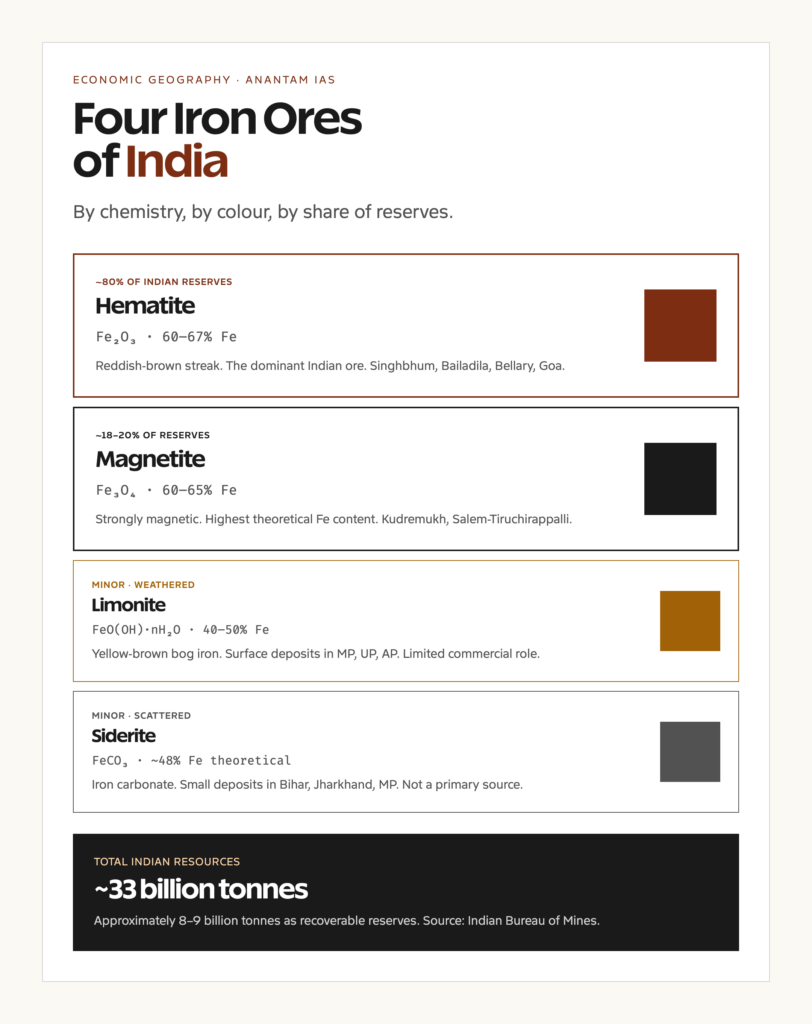
Iron ores in India are the backbone of the country’s heavy industry, the second-largest iron ore producer in the world after Australia in some years, and the foundation of every major steel plant from Bhilai to Bokaro. India sits on roughly 33 billion tonnes of iron ore resources by the Indian Bureau of Mines reckoning, with hematite as the dominant variety and magnetite forming the bulk of the magnetic-grade reserves in the southern peninsula. The country also has the institutional muscle, with NMDC as the public-sector mining giant, SAIL as the public-sector steel maker, and a steady stream of private players from Tata Steel to JSW that operate captive mines or off-take from public-sector mines.
The geography of iron ore in India is concentrated and tells a story about the deep geological past. The Singhbhum-Bonai-Keonjhar belt of Odisha and Jharkhand, the Bailadila range of Chhattisgarh, the Bellary-Hospet-Sandur belt of Karnataka, the Goa coastal hematite deposits, and the Kudremukh magnetite belt of Karnataka together account for almost all of the country’s commercial production. Each of these belts traces back to Precambrian banded iron formations and other ancient iron-rich sedimentary and metamorphic rocks. The political economy of mining sits on top of this geological inheritance.
This piece walks through the four main types of iron ore, the geological context, the top producing states with their characteristic deposits, the institutional architecture of NMDC and SAIL, the regulatory framework under the Mines and Minerals (Development and Regulation) Act, and the policy questions around export, value addition, and environmental clearance. It’s pitched for UPSC GS Paper 1 economic geography and GS Paper 3 economy and resources.
Quick Facts at a Glance
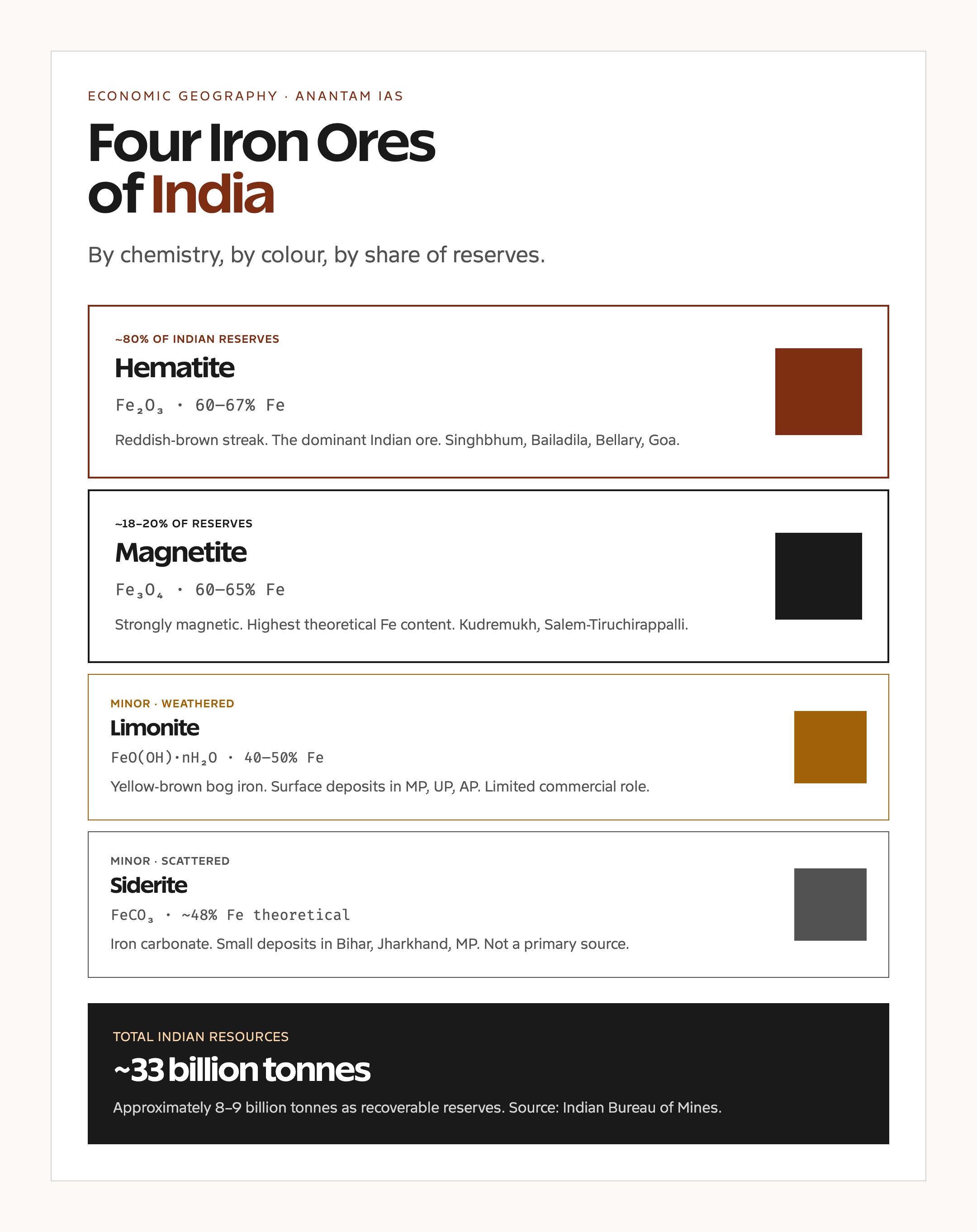
- India’s iron ore resources: Approximately 33 billion tonnes (Indian Bureau of Mines, latest National Mineral Inventory)
- Total recoverable reserves: Around 8 to 9 billion tonnes
- Dominant ore type: Hematite, accounting for roughly 80 percent of reserves
- Magnetite share: Roughly 18 to 20 percent, concentrated in southern India
- Top producing state: Odisha, with over 50 percent of national production
- Other major producers: Chhattisgarh, Karnataka, Jharkhand, Goa, Andhra Pradesh, Maharashtra
- Public-sector miner: NMDC Limited, the largest single iron-ore producing company in India
- Public-sector steel maker: Steel Authority of India Limited (SAIL), formed 1973
- Regulatory framework: Mines and Minerals (Development and Regulation) Act 1957, amended 2015, 2020, 2021
- India’s global rank: Among the top three or four iron ore producing countries in the world
Hematite, Magnetite, Limonite, Siderite: The Four Main Iron Ores
Iron occurs in nature primarily as four ore minerals. The percentage of iron in each, called the iron content or Fe percent, varies, and the commercial value of an ore depends on this iron content along with impurity levels of silica, alumina, sulphur, and phosphorus.
Hematite is the most abundant and commercially important iron ore in India. Its chemical formula is Fe2O3, ferric oxide, and the pure form contains about 70 percent iron by weight. Indian hematites typically run between 60 and 67 percent Fe. The ore is reddish to steel-grey, sometimes black, and has a characteristic reddish-brown streak when scratched. The Singhbhum-Bonai-Keonjhar belt, Bailadila, Bellary-Hospet, and Goa deposits are all dominantly hematite. Hematite is the preferred feed for blast furnaces because of its high iron content and relatively low impurity profile.
Magnetite is the second most abundant ore. Its formula is Fe3O4, an iron oxide containing both ferrous and ferric iron, and the pure form contains about 72 percent iron by weight. Indian magnetites typically run between 60 and 65 percent Fe. The ore is black or dark grey and is strongly magnetic, which is the standard field test for distinguishing it from hematite. The Kudremukh belt of Karnataka and parts of Tamil Nadu, including the Salem-Tiruchirappalli belt, hold most of India’s magnetite reserves.
Limonite is a hydrated iron oxide, FeO(OH)·nH2O, that forms by chemical weathering of other iron-bearing minerals. Pure limonite contains about 60 percent iron, but commercial limonite ores typically have only 40 to 50 percent Fe. The ore is yellow-brown to brown and is found mainly as bog iron and as weathered surface deposits in parts of Madhya Pradesh, Uttar Pradesh, and Andhra Pradesh. Limonite is of limited commercial importance in India today.
Siderite is iron carbonate, FeCO3, with a theoretical iron content of about 48 percent. Indian siderites are scattered and typically run lower. Siderite is found in small quantities in Bihar, Jharkhand, and Madhya Pradesh. It is not a primary commercial source in India.
Background and Historical Context
India has a long iron-using history. Archaeological evidence from the Painted Grey Ware sites of the Indo-Gangetic plain shows iron use from around 1200 BCE, and the Megalithic culture of peninsular India developed iron technology around the same period. The wootz steel produced in Telangana, Tamil Nadu, and Karnataka was exported to West Asia and Europe and is the parent of the famous Damascus steel.
The modern iron and steel industry in India began with the Bengal Iron and Steel Company at Kulti in 1875 and the Tata Iron and Steel Company at Sakchi, now Jamshedpur, in 1907. Tata’s first steel was produced in 1912 from Singhbhum iron ore. The Mysore Iron and Steel Works at Bhadravati, founded in 1923, used Bababudan hematite. The Indian Iron and Steel Company at Burnpur and the Steel Corporation of Bengal followed in the same belt.
The post-independence expansion was state-led. The Hindustan Steel Limited, set up in 1954, established the Bhilai plant in collaboration with the USSR, Rourkela with West Germany, and Durgapur with the UK. The Bokaro plant followed in the 1960s. Hindustan Steel was reorganized as Steel Authority of India Limited in 1973, consolidating the public-sector steel sector. NMDC was set up in 1958 specifically for iron ore mining at scale and now operates major mines at Bailadila and Donimalai.
The 1991 liberalization opened the sector to private investment. The Tata Steel acquisition of Corus in 2007 and the rise of JSW Steel made India a globally significant steel producer. The 2011 Karnataka mining ban after the Lokayukta’s findings on illegal mining at Bellary, the 2014 Goa mining ban after the Justice Shah commission report, and the 2017 reform of mineral auctions reshaped the political economy of iron mining in the subsequent decade.
Geological Setting: Where Iron Ore Comes From
Indian iron ore deposits are dominantly associated with Precambrian banded iron formations, the BIFs, which are layered sedimentary rocks formed in shallow seas between roughly 3.8 and 1.8 billion years ago. The iron-rich layers in these formations precipitated from seawater during a critical interval in earth history when atmospheric oxygen levels were rising. The Singhbhum craton, the Bastar craton, the Dharwar craton, and the Cuddapah basin are the geological provinces that contain almost all of India’s commercial iron ore.
The Singhbhum craton in Odisha-Jharkhand hosts the Iron Ore Group sedimentary sequence, with the BIFs of the Bonai-Keonjhar belt running for over 200 kilometres along strike. The Bastar craton in Chhattisgarh hosts the Bailadila Group BIFs that supply NMDC’s flagship mines. The Dharwar craton in Karnataka holds the Sandur schist belt with the Bellary-Hospet hematite and the Bababudan-Kudremukh magnetite. The Goa hematite is associated with the Dharwar Supergroup. The Cuddapah basin in Andhra Pradesh hosts smaller iron-ore deposits.
The Precambrian origin is the reason Indian iron ore is concentrated in the peninsular shield and almost entirely absent from the Indo-Gangetic plain and the Himalayan belt. The shield is a geologically stable continental nucleus that preserves rocks billions of years old, while the Gangetic plain is a young alluvial cover and the Himalayan belt is a complex thrust system without the right depositional setting for BIFs.
Why It Matters
Iron ore matters for three reasons. The first is steel. India is the second-largest steel producer in the world after China, with crude steel output of about 140 million tonnes a year. The National Steel Policy 2017 set a target of 300 million tonnes of crude steel capacity by 2030. Every additional tonne of crude steel requires roughly 1.6 tonnes of iron ore feed for the blast-furnace route or roughly 1.4 tonnes of pellet feed for the direct-reduction route. The domestic iron ore base is what makes the steel policy targets feasible.
The second is export and revenue. Iron ore is one of India’s significant mineral exports, particularly the fines and pellets that are surplus to domestic blast-furnace demand. The export of iron ore lumps has fluctuated under successive policy regimes including export-duty changes and Karnataka and Goa mining bans. The royalty and contributions to the District Mineral Foundation are major sources of revenue for mining states. Odisha alone collects several thousand crore rupees a year in iron-ore-related revenues.
The third is the environmental and social cost. Iron mining in central and eastern India sits on top of the ecologically rich and tribal-population-dense forests of the Eastern Ghats, the Chotanagpur plateau, and the Bailadila range. The Kudremukh National Park mining closure in 2006, the Saranda forest controversies in Jharkhand, and the ongoing disputes around Bailadila Deposit 13 highlight the tension between mineral extraction and the rights of forest-dependent communities under the Forest Rights Act 2006 and the PESA framework.
Top Producing States in Detail
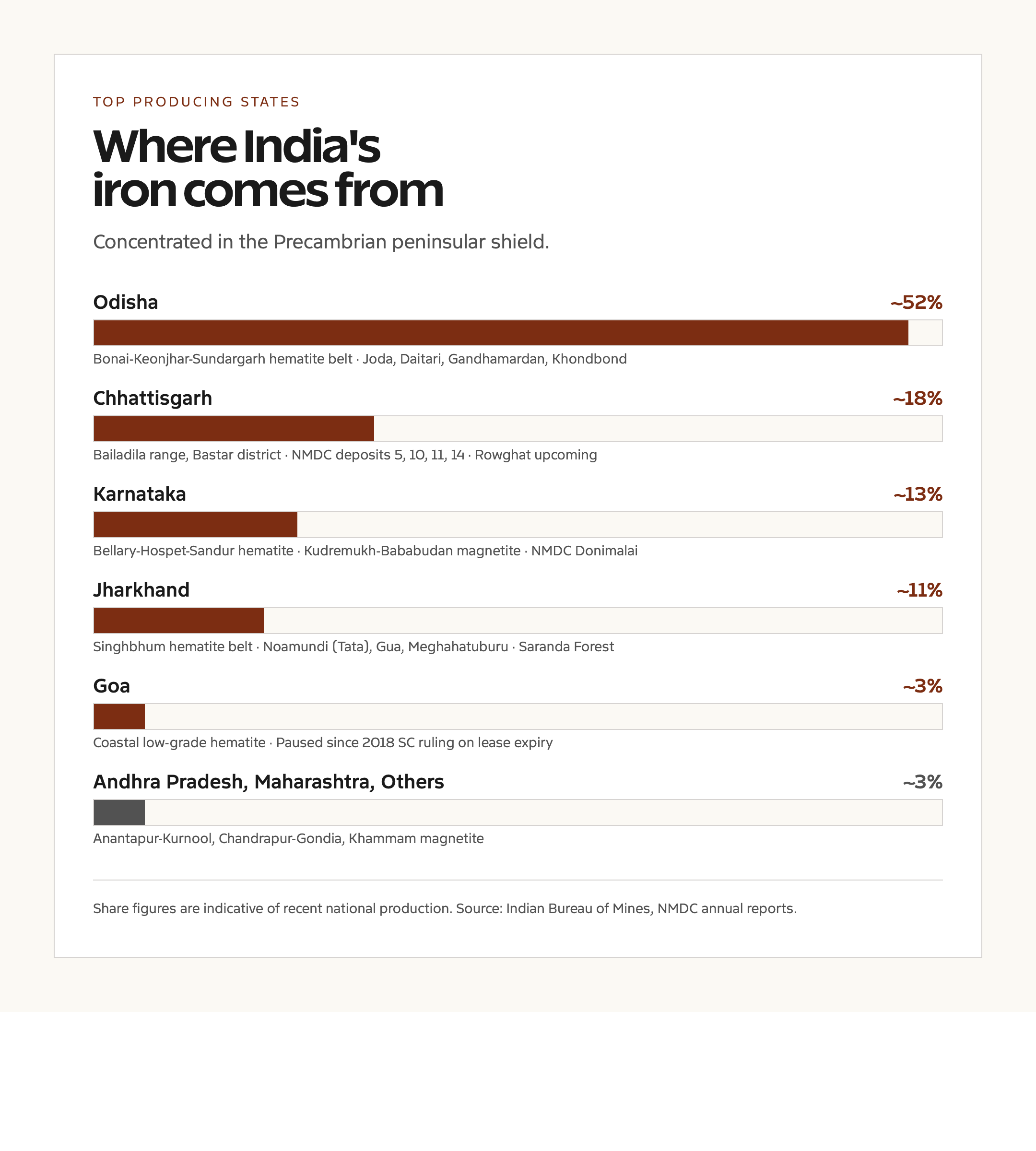
Odisha is the dominant iron ore state, producing over half the country’s iron ore in most recent years. The Bonai-Keonjhar-Sundargarh belt holds large hematite deposits, with the Joda mines, the Daitari deposits, the Gandhamardan range, and the Khondbond mines as major operating sites. NMDC, OMC, Tata Steel, and the public-sector ESL operate in Odisha. The state government’s auction-based allotment of merchant mines since the 2015 amendment of the MMDR Act has produced premium revenues for the state.
Chhattisgarh holds the Bailadila iron ore range in the Bastar district, with deposits 5, 10, 11, 11B, 14, and 14NMZ as the main producers. NMDC operates the largest mines here, supplying both domestic steel makers and exports. The Rowghat deposit in Kanker district is the upcoming captive source for the SAIL Bhilai expansion. Chhattisgarh production has hovered around 40 to 45 million tonnes a year in recent reckoning.
Karnataka holds the Bellary-Hospet-Sandur belt, principally hematite, and the Kudremukh-Bababudan belt, principally magnetite. NMDC operates the Donimalai mine. The Bellary district mining was paused under the Supreme Court order following the Lokayukta report and resumed in a controlled manner from 2013. The Kudremukh open-pit mine was closed in 2006 after the Supreme Court ruling on mining inside a national park.
Jharkhand has the Singhbhum hematite belt, with the Noamundi mine of Tata Steel as the historic anchor, the Gua mine, and the Meghahatuburu mine. The Saranda Forest controversy and the displacement of tribal communities have shaped recent debates around expansion.
Goa was a major exporter of low-grade hematite fines, mainly to China, before the 2012 mining ban and the subsequent 2018 Supreme Court ruling on lease expiry. The Goa iron ore sector has been operating below capacity since.
Andhra Pradesh and Maharashtra produce smaller volumes from the Anantapur-Kurnool belt and the Chandrapur-Gondia belt respectively. Telangana has a small magnetite presence in the Khammam district.
The Institutional Framework: NMDC and SAIL
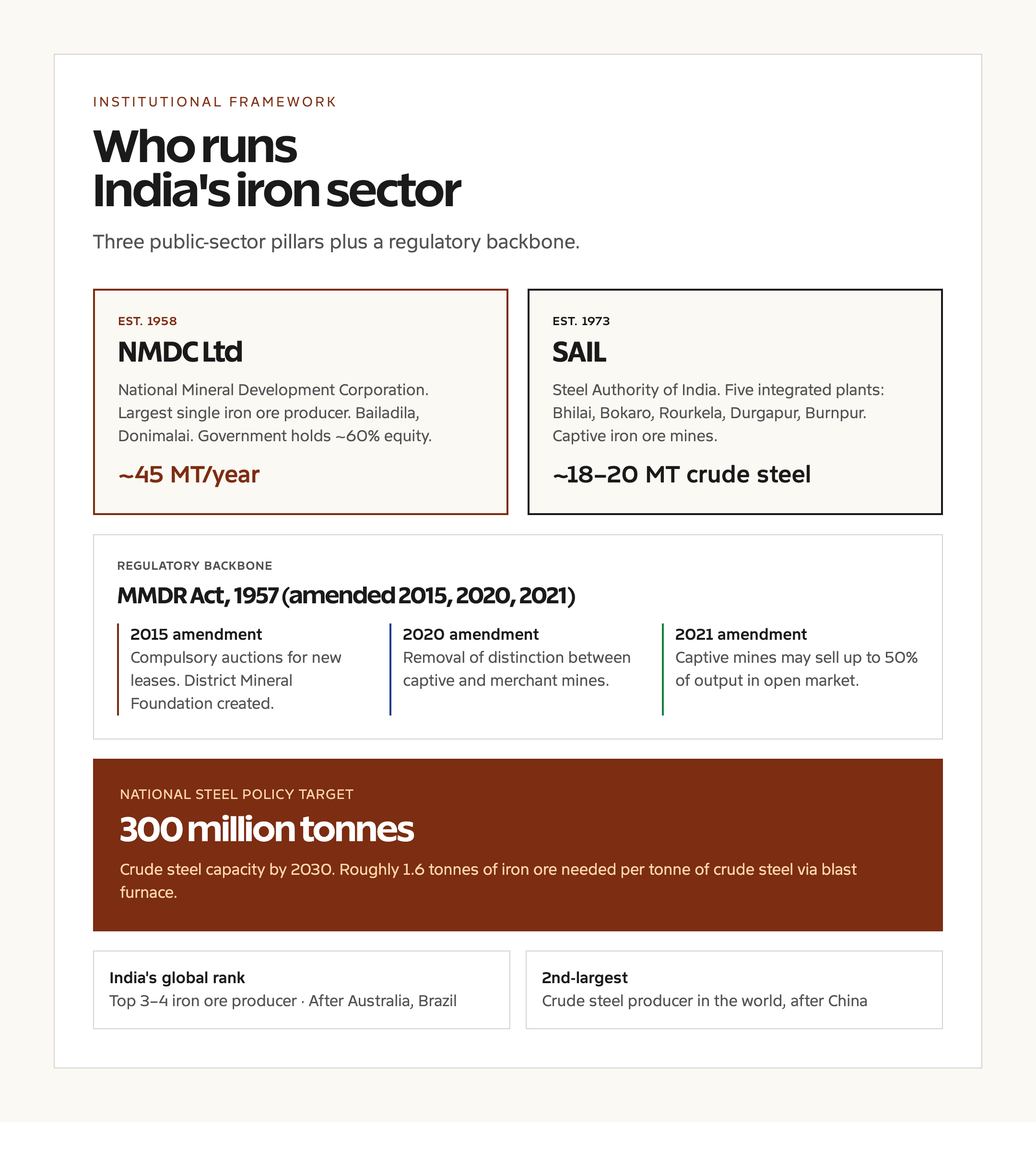
NMDC Limited, formerly the National Mineral Development Corporation, is the largest iron ore producer in India. Founded in 1958, it operates the Bailadila mines in Chhattisgarh and the Donimalai mine in Karnataka, with diamonds, copper, and tungsten as smaller business lines. NMDC produced over 45 million tonnes of iron ore in recent years and is the price-leader for domestic iron ore. The Government of India holds about 60 percent of the equity.
SAIL, the Steel Authority of India Limited, is the principal public-sector steel maker, operating five integrated steel plants at Bhilai, Bokaro, Rourkela, Durgapur, and Burnpur, plus the Salem stainless steel plant and the Bhadravati alloy steel plant. SAIL has captive iron ore mines at Kiriburu, Meghahatuburu, Bolani, Gua, Manoharpur, Topa-Dalli, and Rajhara. The captive supply meets the bulk of SAIL’s iron ore needs without external purchase.
The 2015 amendment of the MMDR Act introduced compulsory auctions for new mineral concessions and created the District Mineral Foundation, into which a percentage of royalty payments flows for the welfare of mining-affected districts. The 2021 amendment removed the captive-mine restriction and allowed open-market sale of up to 50 percent of captive mine output, partially liberalizing the iron ore market.
Prelims Pointers
- India holds approximately 33 billion tonnes of iron ore resources, with around 8 to 9 billion tonnes as recoverable reserves
- Hematite (Fe2O3) accounts for roughly 80 percent of Indian reserves, with iron content typically 60 to 67 percent Fe
- Magnetite (Fe3O4) accounts for roughly 18 to 20 percent, concentrated in Karnataka and Tamil Nadu
- Limonite (hydrated iron oxide) and siderite (iron carbonate) are minor sources
- Odisha is the largest producing state, with over 50 percent of national output
- Bailadila in Chhattisgarh is NMDC’s flagship mine
- Donimalai in Karnataka is another NMDC mine
- Kudremukh National Park magnetite mining was closed in 2006 by Supreme Court order
- Goa iron mining was halted in 2012 and effectively paused since 2018
- The MMDR Act 1957, amended 2015, governs mineral concessions and auctions
- NMDC was founded in 1958 and is the largest single iron ore producer in India
- SAIL was formed in 1973 and operates five integrated steel plants
- The National Steel Policy 2017 targets 300 million tonnes of crude steel capacity by 2030
- Indian iron ore is associated with Precambrian banded iron formations of the Singhbhum, Bastar, and Dharwar cratons
Mains Practice Questions
- Discuss the geographical distribution of iron ore in India and explain the geological reasons for its concentration in the peninsular shield. (GS Paper 1, 250 words)
- The 2015 amendment of the MMDR Act introduced compulsory auctions for mineral concessions. Examine the impact on iron ore mining and state revenues. (GS Paper 3, 250 words)
- Iron ore mining in central and eastern India sits at the intersection of resource extraction and tribal rights under PESA and the Forest Rights Act. Critically examine the policy challenges involved. (GS Paper 3, 250 words)
- Compare the roles of NMDC and SAIL in India’s iron and steel sector and discuss the implications of captive-mine reform under the 2021 MMDR amendment. (GS Paper 3, 250 words)
Way Forward
The first priority is value addition. India still exports a significant share of its iron ore output as fines and low-grade lumps. The shift to pelletization, beneficiation, and direct-reduction technology can capture more of the value chain inside the country. The Steel Ministry’s pellet incentives and the National Steel Policy targets point in this direction, but the implementation gap remains real.
The second priority is environmental and social compliance. The Forest Rights Act 2006, the PESA Act 1996, and the District Mineral Foundation framework set out the rights and benefits owed to mining-affected communities. The District Mineral Foundation funds have not always reached the communities most affected, and the implementation needs to be tightened state by state. The Comptroller and Auditor General audits of DMF utilization have flagged repeated gaps in Odisha, Jharkhand, and Chhattisgarh.
The third priority is the green-steel transition. India’s commitment to net-zero by 2070 includes a steel sector pathway that involves hydrogen-based direct reduction, carbon capture, and electric arc furnaces fed by renewable power. The iron ore demand profile in this transition shifts toward higher-grade pellet feed and away from blast-furnace lump. The mining policy framework needs to adapt, with grade-classification reform and a pellet-incentive structure that rewards low-emission supply chains. Useful related references include the Kudankulam Nuclear Power Plant for the parallel question of energy infrastructure planning, the greater one-horned rhinoceros habitat in Kaziranga as a model for environmental clearance near sensitive ecosystems, and the coal power in India framework for the broader fossil-fuel transition that ties into iron ore demand.
Frequently Asked Questions
What are the main types of iron ores found in India?
The four main types are hematite, magnetite, limonite, and siderite. Hematite, Fe2O3, accounts for roughly 80 percent of Indian reserves and is the dominant commercial ore. Magnetite, Fe3O4, accounts for roughly 18 to 20 percent and is concentrated in southern India. Limonite and siderite are minor sources of limited commercial importance.
Which state is the largest producer of iron ore in India?
Odisha is the largest producer, accounting for over half of national iron ore output in most recent years. The Bonai-Keonjhar-Sundargarh belt holds the major hematite deposits, with Joda, Daitari, Gandhamardan, and Khondbond as the leading mining sites. Chhattisgarh, Karnataka, Jharkhand, and Goa are the other major producing states.
What is the difference between hematite and magnetite?
Hematite is Fe2O3, ferric oxide, with about 70 percent iron in the pure form and a reddish-brown streak. Magnetite is Fe3O4, an iron oxide containing both ferrous and ferric iron, with about 72 percent iron in the pure form and strongly magnetic properties. The simple field test is a magnet, which sticks to magnetite but not to hematite.
Why is iron ore concentrated in the Indian peninsular shield?
The peninsular shield contains the Precambrian banded iron formations from which most Indian iron ore is derived. These BIFs formed in shallow seas roughly 2 to 3 billion years ago, when atmospheric oxygen levels were rising and dissolved iron precipitated out of seawater. The Singhbhum, Bastar, Dharwar, and Cuddapah cratons preserve these ancient rocks. The Indo-Gangetic plain and the Himalayan belt are too young to contain BIFs.
What is NMDC and what role does it play?
NMDC Limited is the National Mineral Development Corporation, founded in 1958, and the largest iron ore producer in India. It operates the Bailadila mines in Chhattisgarh and the Donimalai mine in Karnataka. NMDC is a public-sector enterprise with the Government of India holding about 60 percent of the equity, and it is the price-leader for domestic iron ore.
What is the MMDR Act and how has it shaped iron ore mining?
The Mines and Minerals (Development and Regulation) Act 1957 is the principal law governing mineral concessions in India. The 2015 amendment introduced compulsory auctions for new mineral leases and created the District Mineral Foundation for welfare in mining-affected districts. The 2021 amendment allowed captive mines to sell up to 50 percent of output in the open market.
Why was the Kudremukh National Park iron mining stopped?
The Supreme Court ordered the closure of Kudremukh Iron Ore Company’s open-pit mine inside the Kudremukh National Park in 2006, citing the conflict between mining and the protected-area status under the Wild Life Protection Act. The mine had been operating since 1976. The closure remains a leading example of judicial intervention in environmental and mining policy.
How does the Forest Rights Act 2006 affect iron ore mining?
The Forest Rights Act 2006 recognizes the rights of forest-dwelling Scheduled Tribes and other traditional forest dwellers to forest land and resources. Iron ore mining in the Saranda forest of Jharkhand, the Bailadila range in Chhattisgarh, and the Bonai belt of Odisha overlaps with FRA areas, and the consent of Gram Sabhas is a legal requirement for diversion of forest land for mining. The implementation has been uneven across states.
What is the role of SAIL in the Indian steel industry?
The Steel Authority of India Limited, formed in 1973, is the largest public-sector steel maker in India. SAIL operates five integrated steel plants at Bhilai, Bokaro, Rourkela, Durgapur, and Burnpur, plus the Salem stainless plant and the Bhadravati alloy plant. SAIL has captive iron ore mines and produces around 18 to 20 million tonnes of crude steel a year.
What is India’s position in the global iron ore market?
India is among the top three or four iron ore producing countries in the world by tonnage, behind Australia and Brazil, and at par with China in some years. Indian iron ore exports, mainly fines and pellets, go primarily to China, Japan, South Korea, and Southeast Asia. The export profile has fluctuated under changes in export duty, mining bans, and domestic steel-policy targets.
Tell Google you want more of this.
Add Anantam IAS as a preferred sourceOne tap, and this site shows up more often in your own Top Stories, AI Overviews and AI Mode. Remove it any time.