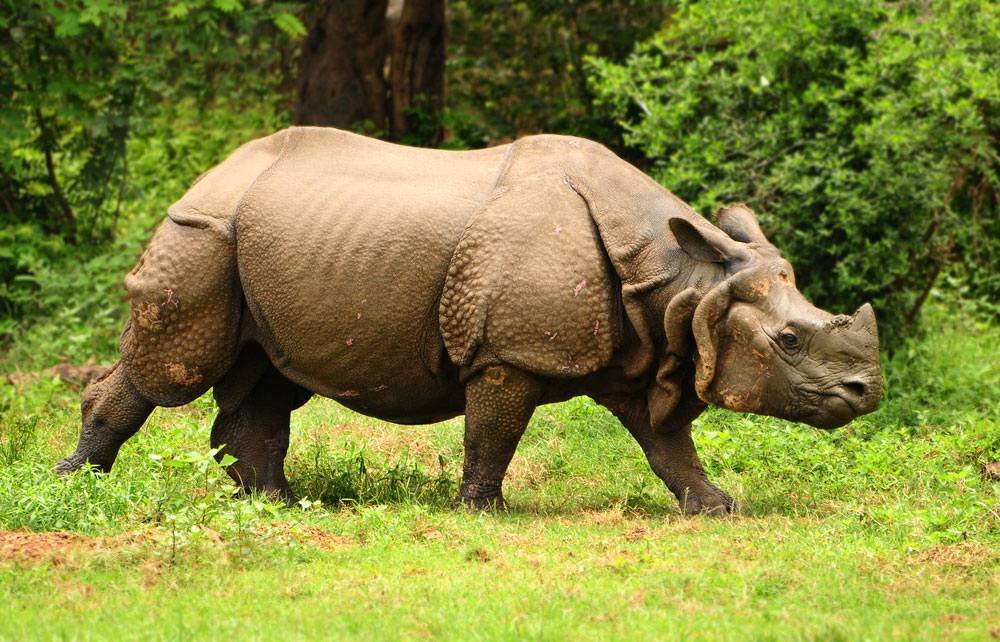
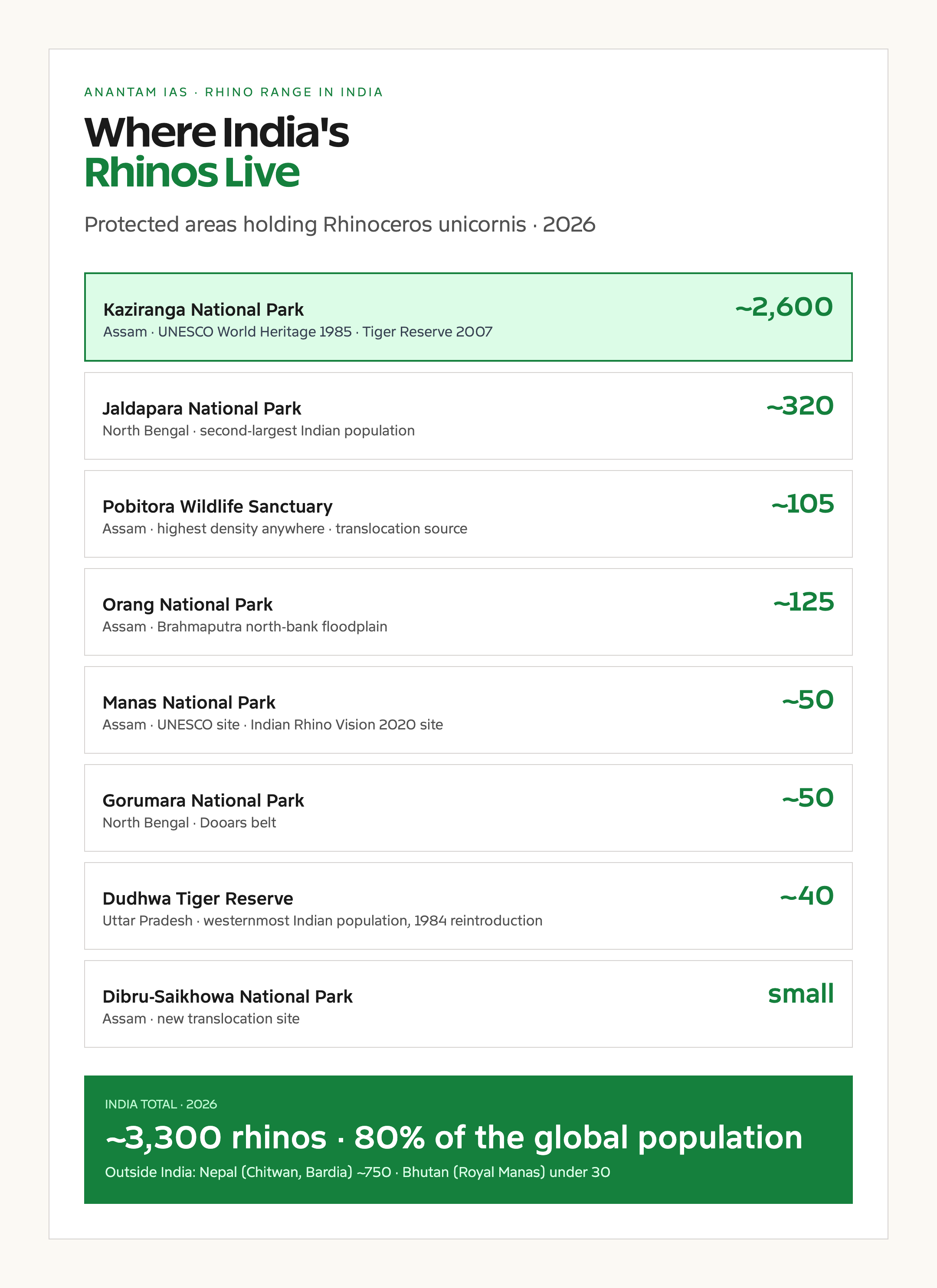
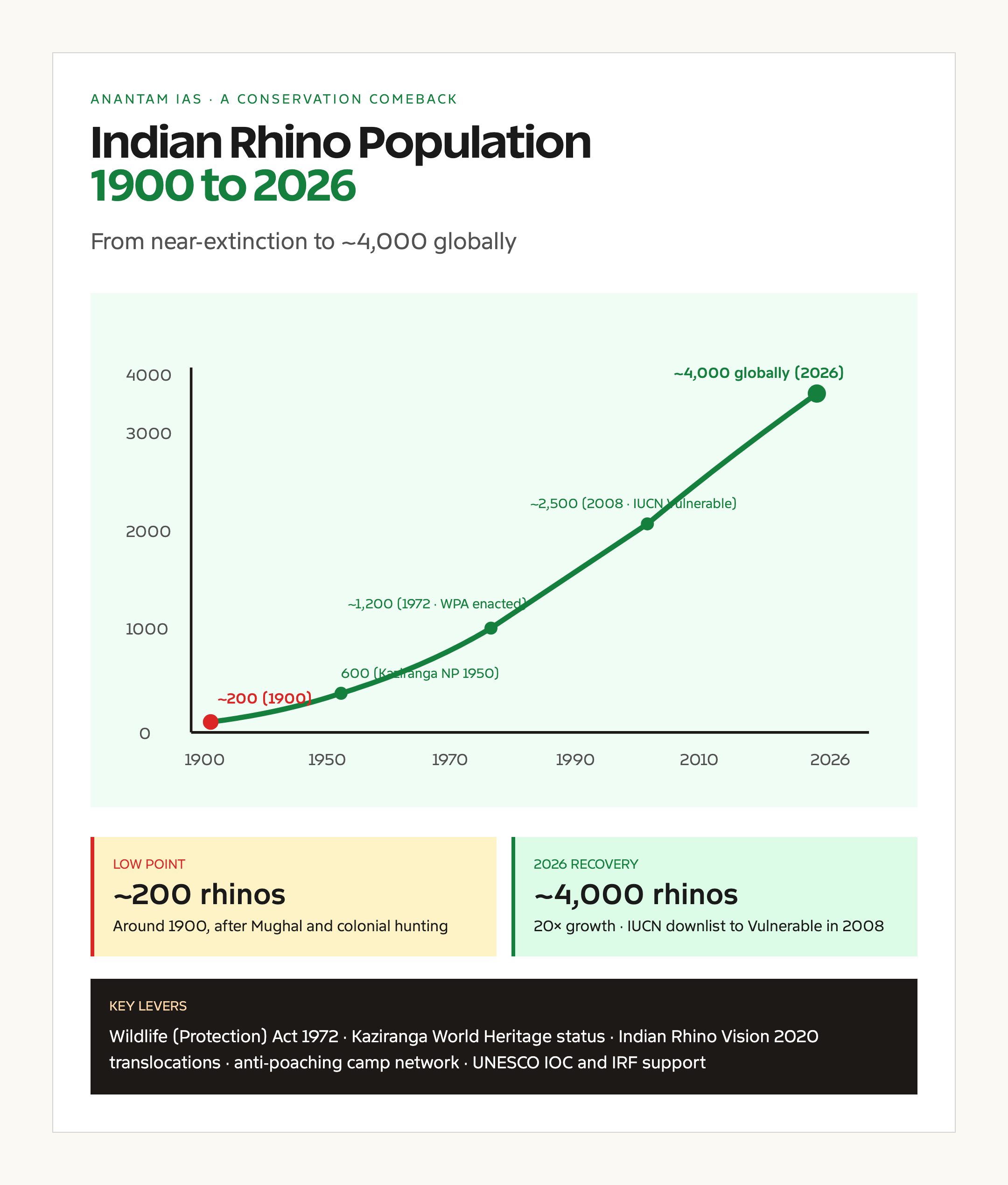
The Greater One-Horned Rhinoceros is India’s most visible conservation success. The species, also called the Indian Rhinoceros and known scientifically as Rhinoceros unicornis, has come back from fewer than 200 individuals at the start of the 20th century to roughly 4,000 today. Kaziranga National Park in Assam holds around three-quarters of the global population. The remaining animals are distributed across Manas, Orang, Pobitora, and a small new population at Dibru-Saikhowa in Assam, plus Jaldapara and Gorumara in northern West Bengal, and Dudhwa Tiger Reserve in Uttar Pradesh.
The species is classified as Vulnerable on the IUCN Red List, having been downlisted from Endangered in 2008 thanks to the Indian and Nepali recovery. India holds approximately 80 percent of the global population; the rest is in Nepal’s Chitwan and Bardia National Parks and a tiny remnant in Bhutan’s Royal Manas National Park. The Schedule I listing under the Wildlife (Protection) Act 1972 gives the species the highest level of legal protection in India.
The Greater One-Horned Rhinoceros is the largest of the three Asian rhino species (the other two being the Sumatran and Javan rhinos, both far more endangered) and is second in size globally only to the White Rhino of Africa. The species’ recovery is held up as a model for what determined protection, habitat restoration, and translocation programmes can achieve. The shadow over the story is poaching, which has spiked and dropped in waves over the decades, and habitat fragmentation, which keeps the population dependent on a handful of protected areas.
Quick Facts at a Glance
- Scientific name: Rhinoceros unicornis
- Common names: Greater One-Horned Rhinoceros, Indian Rhinoceros
- IUCN Red List status: Vulnerable (downlisted from Endangered in 2008)
- CITES status: Appendix I (highest international trade ban)
- Wildlife (Protection) Act 1972 status: Schedule I (highest protection)
- Global population (2026): Approximately 4,000 individuals
- Indian population (2026): Around 3,300; Nepal around 750; Bhutan fewer than 30
- Largest population: Kaziranga National Park, Assam, with around 2,600 rhinos (2022 census)
- Other Indian rhino sites: Manas, Orang, Pobitora, Dibru-Saikhowa (Assam); Jaldapara, Gorumara (West Bengal); Dudhwa Tiger Reserve (Uttar Pradesh)
- Average weight: 1,800 to 2,500 kg (adults)
- Shoulder height: 1.7 to 1.9 m
- Horn length: 20 to 60 cm, single horn made of keratin
- Lifespan: 35 to 45 years in the wild
- Gestation: Around 15 to 16 months; single calf per birth
What the Greater One-Horned Rhinoceros Is
The animal is unmistakable. Its skin is grey, thick, and folded into plates that look like riveted armour, with a knobbly tubercle pattern on the shoulders, flanks, and hindquarters. A single horn rises from the snout, made of compressed keratin (the same material as human fingernails) rather than bone. The horn averages 20 to 60 cm in length and is shorter than that of African rhinos. The animal has a prehensile upper lip, which it uses to grasp grass and aquatic vegetation. Males are slightly larger than females.
The species is a grazer, feeding primarily on tall grasses (especially the elephant-grass complex of Saccharum species) and aquatic plants. It also browses on shrubs, twigs, and fruit when grass is scarce. A typical adult eats around 50 to 60 kg of forage a day. It needs water daily, both for drinking and for wallowing in mud, which keeps it cool and removes parasites.
Despite its size and apparent slowness, the rhino can charge at up to 50 km per hour. It has poor vision but excellent hearing and smell. Adults are solitary except for mating pairs and mother-calf groups. Territorial behaviour is moderate; males will fight for mating access, and these fights can be fatal. Rhinos communicate through a wide range of vocalisations (snorts, honks, bleats) and through scent-marking with dung piles and urine sprays.
The reproductive cycle is slow. Females reach sexual maturity at five to seven years, males at around ten. The gestation period of 15 to 16 months is one of the longest among land mammals. Females give birth to a single calf every three to four years. This slow reproductive rate is the central conservation problem: even at zero poaching, the population grows only at around 3 percent per year.
Background and Historical Context
The species’ range historically extended across the entire Indo-Gangetic plain, from Pakistan in the west to Myanmar in the east, including the Brahmaputra valley, the Ganges floodplain, the Terai grasslands of Nepal, and parts of West Bengal and Bihar. Mughal-era hunting records describe rhinos in the Terai-Duar belt as common. Babur, in the Baburnama, recorded hunting them in 16th-century Punjab.
The decline came in three phases. The first was Mughal and early-colonial hunting, which removed rhinos from the western and central parts of the range. The second was 19th-century British sport hunting, which reduced the population sharply, especially in the United Provinces and Bengal. The third was agricultural expansion in the late 19th and early 20th centuries, which converted floodplain grasslands into rice paddies. By 1900, the species was confined to Assam and the Nepal Terai, with perhaps 200 individuals left in the wild.
The Assam Forest Regulation of 1891 and the establishment of the Kaziranga Reserved Forest in 1905 marked the start of organised protection. Mary Curzon, wife of Viceroy Curzon, is credited with persuading her husband to create the reserve after a visit during which she failed to see any rhinos. Kaziranga became a wildlife sanctuary in 1950 and a national park in 1974. It was declared a UNESCO World Heritage Site in 1985.
The population recovery accelerated after Indian independence and especially after the Wildlife (Protection) Act of 1972. By 1991, Kaziranga held around 1,200 rhinos. The 2018 census recorded 2,413 and the 2022 census 2,613. Pobitora has the highest rhino density anywhere in India, with around 100 rhinos in just 38 sq km, far above ecological carrying capacity.
Key Features of the Conservation Programme
Kaziranga National Park is the flagship site. The park covers around 1,090 sq km of Brahmaputra floodplain, with grasslands, wetlands, and forest patches. The annual floods, which inundate large parts of the park, are essential for grassland regeneration but also drive rhinos into the highlands south of the highway, where they face poachers and vehicle collisions. The park is jointly managed under the Wildlife (Protection) Act, Tiger Reserve designation (since 2007), and the World Heritage framework. Anti-poaching is the headline operation, with around 200 anti-poaching camps and a forest guard force authorised to use lethal force.
Manas National Park is the second priority. It lost virtually all its rhinos during the 1990s Bodo insurgency, when patrolling broke down. The Indian Rhino Vision 2020 (IRV 2020) programme, launched in 2005 by Assam Forest Department with WWF and IRF support, translocated rhinos from Kaziranga and Pobitora to Manas. The population has rebuilt to around 50 by 2026.
Orang and Pobitora in Assam hold smaller but stable populations. Pobitora’s overcrowding has been a recurrent translocation source.
Jaldapara National Park in northern West Bengal holds around 320 rhinos. Gorumara National Park in the same belt holds around 50. The Bengal populations are descendants of historical Terai rhinos.
Dudhwa Tiger Reserve in Uttar Pradesh holds around 40 rhinos. These animals are descendants of a small introduction in 1984 from Assam and Nepal. The Dudhwa population is the westernmost in India.
The cross-cutting framework includes Schedule I protection under the Wildlife (Protection) Act, the CITES Appendix I trade ban, India’s National Conservation Strategy for the Greater One-Horned Rhinoceros (2019), and the Indian Rhino Vision 2020 successor programmes.
Why the Greater One-Horned Rhinoceros Matters
The species is a flagship and an umbrella. Its conservation requires the protection of large grassland and floodplain ecosystems, which in turn support tigers, elephants, swamp deer (the Eastern Swamp Deer is largely confined to Kaziranga), hog deer, wild buffalo (Kaziranga has India’s largest wild water buffalo population), and several threatened bird species including the Bengal Florican and the Indian Skimmer.
The rhino is also a cultural symbol. It appears in Assamese poetry, in the state’s tourism branding, and in the political iconography of the Brahmaputra valley. The horn appears in folklore as a magical object, though this same folklore drives poaching for Chinese and Vietnamese black markets, where powdered horn is sold as a traditional medicine and a status symbol. There is no scientific evidence for any pharmacological value.
For UPSC General Studies Paper 3, the Greater One-Horned Rhinoceros is a recurring case study in flagship species conservation, the Wildlife (Protection) Act 1972, the role of tiger reserves in India in multi-species protection, and the biosphere reserves in India framework. The species is also linked to the Convention on International Trade in Endangered Species (CITES), the Convention on Biological Diversity, and the International Rhino Foundation.
Detailed Analysis: Poaching, Translocation, and Climate Risk
Poaching has been the most variable threat over the past three decades. Annual poaching deaths in Assam peaked at 41 in 2013 and 25 in 2014. They have come down sharply since, partly due to improved patrolling and partly due to community-informer networks. The annual poaching number in Kaziranga was zero in 2022 and remained in single digits in recent years.
The poaching demand chain runs from Chinese and Vietnamese end consumers through Myanmar-Manipur transit, with Nagaland and the Indo-Bhutan border as occasional routes. The Wildlife Crime Control Bureau (under MoEFCC) coordinates with state forest departments and the Border Security Force.
Translocations have been the principal demographic management tool. The Indian Rhino Vision 2020 programme moved animals from Kaziranga and Pobitora to Manas, with the goal of establishing seven viable Assam populations of 100 plus rhinos each. The successor programme since 2021 continues the work, including translocations from Kaziranga to Manas and to a possible new site at Laokhowa-Burachapori. Each translocation involves immobilisation, transport in custom trucks, and post-release monitoring with radio collars.
Floods and climate change pose growing risk. The Brahmaputra’s annual flood is essential for grassland regeneration, but the intensity and unpredictability have grown. The 2022 floods killed around 12 rhinos in Kaziranga and displaced many more. Climate models project more frequent extreme floods over the next two decades. The park’s management has invested in highlands (artificial mounds where rhinos can take refuge during peak floods) and in the National Highway 37 corridor upgrade to reduce vehicle collisions when animals move south.
Comparative View: Asian Rhino Species
| Species | Range | IUCN Status | Population |
|---|---|---|---|
| Greater One-Horned Rhinoceros (Rhinoceros unicornis) | India, Nepal, Bhutan | Vulnerable | ~4,000 |
| Sumatran Rhinoceros (Dicerorhinus sumatrensis) | Indonesia (Sumatra, Kalimantan) | Critically Endangered | Fewer than 80 |
| Javan Rhinoceros (Rhinoceros sondaicus) | Indonesia (Ujung Kulon) | Critically Endangered | Around 75 |
| White Rhinoceros (Ceratotherium simum) | Africa | Near Threatened | ~16,000 |
| Black Rhinoceros (Diceros bicornis) | Africa | Critically Endangered | ~6,200 |
The Greater One-Horned Rhinoceros is the only Asian species not classified as Critically Endangered. The Sumatran and Javan rhinos may already be functionally extinct in viable population terms, with both reduced to single-site populations.
Challenges That Remain
Single-site concentration. Three-quarters of the global population is in Kaziranga alone. A disease outbreak, a catastrophic flood, or a renewed poaching wave at this one site could be devastating. The translocation programmes are explicitly designed to address this risk by building secondary populations.
Habitat loss outside protected areas. The corridors connecting Assam’s rhino populations to Bhutan and to the Brahmaputra-bordering reserves are under pressure from tea garden expansion, road infrastructure, and human settlement. The Karbi Anglong highlands, used by Kaziranga rhinos during peak floods, have seen forest clearance.
Human-wildlife conflict. Rhinos that wander out of Kaziranga damage crops and occasionally injure people. Compensation schemes are slow and underfunded. Local tolerance for rhinos is dropping in some buffer-zone villages.
Border issues. Rhinos in the Manas-Bhutan complex cross the international border. Cooperation with Bhutan’s Royal Manas National Park is generally good, but enforcement coordination remains a work in progress.
Genetic bottleneck. The 1900 population of perhaps 200 went through a severe genetic bottleneck. Modern populations have lower genetic diversity than would be ideal. Cross-population breeding through translocation helps but does not fully reverse the bottleneck.
Prelims Pointers
- The Greater One-Horned Rhinoceros is Rhinoceros unicornis, the largest of the three Asian rhino species.
- The species is on IUCN Red List Vulnerable, on CITES Appendix I, and on Schedule I of the Wildlife (Protection) Act 1972.
- Global population is approximately 4,000, with India holding around 80 percent.
- Kaziranga National Park in Assam holds the largest population, around 2,600, and is a UNESCO World Heritage Site (1985) and a Tiger Reserve (2007).
- Other Indian sites: Manas, Orang, Pobitora, Dibru-Saikhowa (Assam), Jaldapara, Gorumara (West Bengal), Dudhwa Tiger Reserve (Uttar Pradesh).
- Outside India, the species is in Chitwan and Bardia National Parks (Nepal) and Royal Manas National Park (Bhutan).
- The horn is made of keratin, not bone.
- The species was downlisted from Endangered to Vulnerable in 2008.
- The Indian Rhino Vision 2020 programme aimed for seven Assam populations of 100 plus rhinos each.
- The species is R-strategist in classical demography terms, K-strategist in technical terms (slow reproduction, large body size, long lifespan).
Mains Practice Questions
- “The Greater One-Horned Rhinoceros is India’s most cited conservation success and also its most cited cautionary tale.” Examine this statement with reference to recovery, threats, and the single-site concentration problem. (GS Paper 3, Environment, 250 words)
- Discuss the role of flagship species in Indian conservation policy. Has the focus on the Greater One-Horned Rhinoceros, the Tiger, and the Asian Elephant strengthened or distracted from broader biodiversity protection? (GS Paper 3, 250 words)
- Examine the role of the Indian Rhino Vision 2020 programme in re-establishing the species in Manas National Park. What are the lessons for translocation-based conservation? (GS Paper 3, 150 words)
- Analyse the threat of climate change to the Greater One-Horned Rhinoceros, with particular reference to the Brahmaputra floodplain. (GS Paper 3, 250 words)
Way Forward
The recovery to 4,000 individuals is real, but the species is not safe. Four priorities define the next decade.
First, continue translocation. The aim should be to establish at least three viable populations of 200 plus animals each, in addition to Kaziranga. Manas needs to grow to 200, Jaldapara should be allowed to expand, and a new Assam site at Laokhowa-Burachapori should be developed.
Second, strengthen anti-poaching technology. Drone surveillance, real-time camera networks, and informer networks have driven the recent poaching decline. The investment needs to continue, especially as black-market prices recover.
Third, community engagement in buffer zones. The buffer-zone villages around Kaziranga and Manas are the front line. Compensation schemes, alternative livelihoods, and community-led tourism need expansion. The Assam Forest Department’s Vana Suraksha Samitis are a useful model.
Fourth, flood resilience. Highlands within Kaziranga, the National Highway 37 underpass upgrade, and coordinated flood-response protocols with the State Disaster Management Authority are all in progress. Climate-adapted park management is now central to species survival.
The Greater One-Horned Rhinoceros story is one of the strongest cases for the proposition that determined protection works. The next ten years are about consolidating the gains and reducing the single-site risk.
Frequently Asked Questions
What is the scientific name of the Greater One-Horned Rhinoceros?
Rhinoceros unicornis. It is also called the Indian Rhinoceros or simply the Indian Rhino.
What is the IUCN status of the Greater One-Horned Rhinoceros?
Vulnerable. The species was downlisted from Endangered in 2008 after sustained population recovery in India and Nepal.
Where do Greater One-Horned Rhinoceroses live in India?
Primarily in Assam (Kaziranga, Manas, Orang, Pobitora, Dibru-Saikhowa), in northern West Bengal (Jaldapara, Gorumara), and at Dudhwa Tiger Reserve in Uttar Pradesh.
How many rhinos are there in India?
Approximately 3,300 as of 2026, with Kaziranga National Park alone holding around 2,600. The exact figure depends on the census year.
Why is the rhino’s horn valuable on the black market?
The horn is in demand in traditional Chinese and Vietnamese medicine markets, where it is sold as a treatment for various ailments and as a status symbol. There is no scientific evidence for any pharmacological effect; the horn is made of keratin, the same protein as human fingernails.
What is the Wildlife (Protection) Act status of the species?
The Greater One-Horned Rhinoceros is on Schedule I of the Wildlife (Protection) Act 1972, the highest protection category. Hunting attracts a minimum of three years’ imprisonment.
What is Indian Rhino Vision 2020?
A programme launched in 2005 by the Assam Forest Department with WWF-India and the International Rhino Foundation to establish seven viable populations of at least 100 rhinos each in Assam. The programme has continued under a successor framework since 2021.
Why is Kaziranga National Park so important for rhinos?
Kaziranga holds around three-quarters of the global population. The park’s Brahmaputra floodplain grasslands are the species’ optimal habitat. The park is also a UNESCO World Heritage Site (1985) and a Tiger Reserve (2007).
How long does a Greater One-Horned Rhinoceros live?
Around 35 to 45 years in the wild. Captive rhinos have lived past 50.
What is the difference between the Indian and African rhinos?
The Indian Rhinoceros (Rhinoceros unicornis) has a single horn and armoured skin folds. African rhinos (White and Black) have two horns and smoother skin. The Indian rhino is the third-largest land mammal after the African elephant and the Indian elephant.
Tell Google you want more of this.
Add Anantam IAS as a preferred sourceOne tap, and this site shows up more often in your own Top Stories, AI Overviews and AI Mode. Remove it any time.