Jainism is usually studied as history — the tradition of the Tirthankaras, Mahavira’s reform, the schism into Digambara and Svetambara. It is almost never studied as ethics, which understates it badly. Two of its doctrines do work that nothing else in the syllabus does.
The first is aparigraha, non-possession, which treats accumulation itself as a moral problem rather than a neutral fact about which one may be generous or stingy. The second is anekantavada, the doctrine of many-sidedness, which is the only formal Indian machinery for saying that two people can both be describing the same thing correctly from different standpoints — without sliding into the position that every claim is as good as every other. For a paper full of dilemmas involving parties who each have a genuine point, that is a working tool rather than a piece of decoration.
The Five Vows
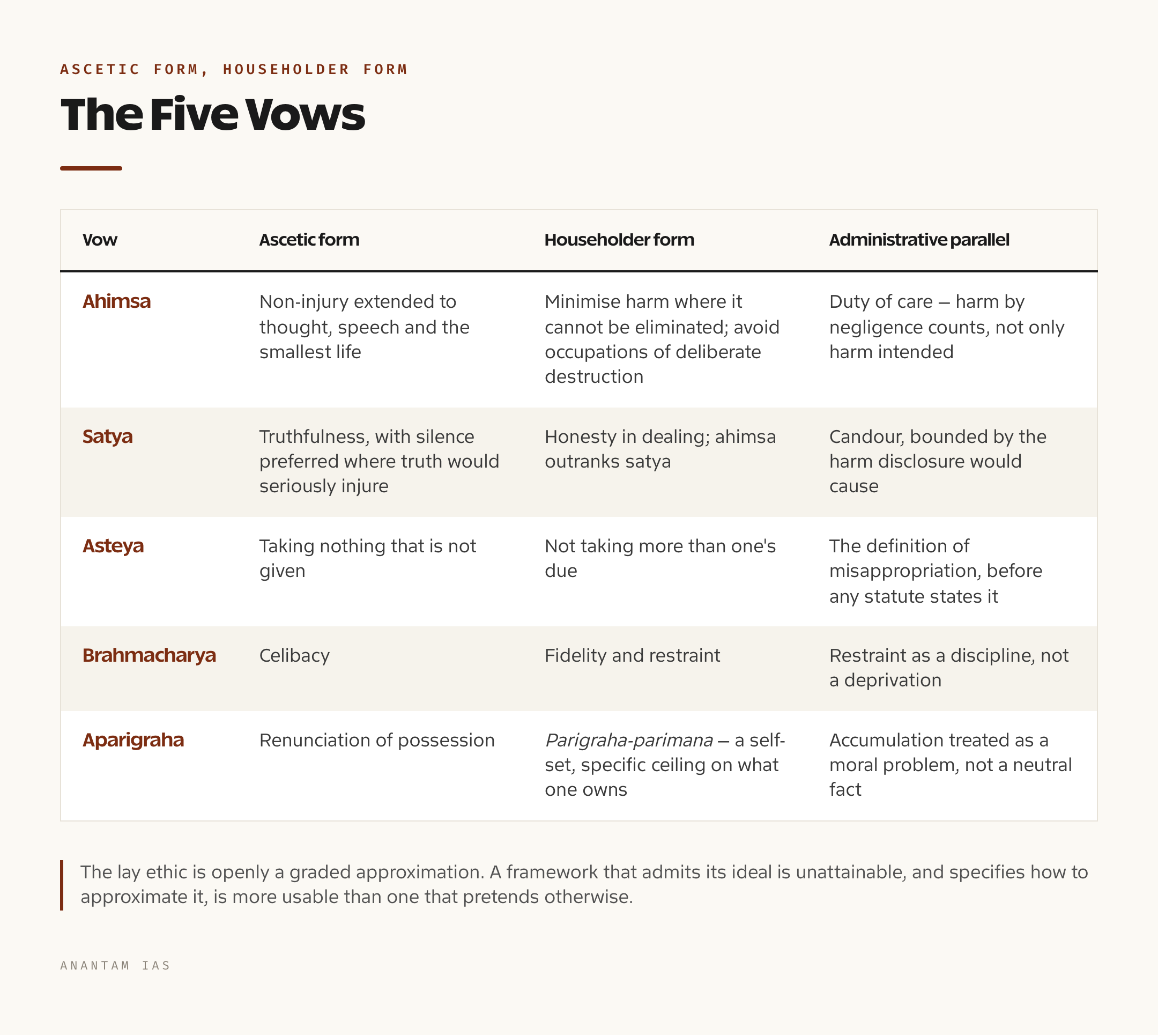
Jain ethics is organised around five vows, taken in a rigorous form by ascetics as mahavratas and in a graded, practicable form by laypeople as anuvratas. The historical setting — Rishabhanatha, the twenty-four Tirthankaras and Mahavira’s reform — is covered separately in the article on the founding of Jainism.
Ahimsa — non-injury, extended further here than in any other tradition. Harm includes harm by thought and speech, harm through carelessness, and harm to the smallest living forms; the graded classification of life by number of senses exists precisely so that unavoidable harm can be minimised rather than ignored.
Satya — truthfulness, with the significant qualification that a truth which causes serious harm may require silence rather than utterance, since ahimsa outranks it.
Asteya — non-stealing, understood broadly to include taking more than one’s due and taking what has not been given.
Brahmacharya — celibacy for the ascetic, fidelity and restraint for the householder.
Aparigraha — non-possession, or in the lay form parigraha-parimana, the voluntary setting of a limit on what one will own.
Underneath the five sit the three jewels: samyak darshana (right faith or right perspective), samyak jnana (right knowledge) and samyak charitra (right conduct). The ordering is deliberate. Conduct without correct perspective is treated as unreliable, and perspective is where anekantavada does its work.
Ahimsa Taken to Its Limit
Jain ahimsa is worth studying precisely because it is uncompromising, and because the tradition then has to deal honestly with the consequences.
Its most useful contribution is the recognition that harm is caused by negligence as much as by intention. Monastic practice — sweeping the path, straining water, restricting movement in the monsoon when small life proliferates — is a discipline of attention to harm one is not trying to cause. Translated out of its religious setting, this is the moral basis of the duty of care: an official who did not intend the consequence but did not check is not exonerated by the absence of malice. Most administrative harm in India is of this kind. Nobody intends the file to sit for two years.
Its second contribution is the acknowledgement that complete non-injury is impossible for anyone in the world, which is why the ascetic form and the lay form differ. The lay ethic is explicitly a graded approximation, with occupations that involve deliberate destruction of life discouraged and violence minimised where it cannot be eliminated. A framework that admits its own ideal is unattainable and specifies how to approximate it is more usable than one that pretends otherwise.
Gandhi’s debt here is direct rather than atmospheric. He credited the Jain scholar Raychandbhai Mehta as one of the three people who shaped his thinking, and the ahimsa he built satyagraha on carries the Jain emphasis on purity of means — the position examined in the ethics of protest.
Aparigraha: Limitation, Not Renunciation
For a householder, aparigraha is not the abandonment of property. It is parigraha-parimana — deciding for oneself a ceiling on possessions and staying under it. Two things follow that make it more interesting than a counsel of simplicity.
First, the vow is self-imposed and specific. It is not “be moderate” but a stated limit, which makes it checkable. Where a limit is set is left to the individual’s capacity, which allows the same principle to bind a farmer and an industrialist.
Second, the underlying claim is that attachment to possession is itself a form of harm, both to the possessor and, through the competition it generates, to others. This is an argument about the structure of desire rather than about the fair distribution of goods, and it reaches conclusions that redistribution alone does not.
That gives Indian environmental ethics a domestic vocabulary it otherwise borrows. The critique of consumption-led growth, the “sufficiency” argument against unlimited want, and the case that restraint is a duty rather than a sacrifice all have a precise Indian precedent here — worth pairing with the frameworks compared in environmental ethics. The lineage runs into modern Indian thought as well: the trusteeship idea, in which wealth is held rather than owned, is aparigraha translated into economics.
Anekantavada: The Doctrine That Earns Its Keep
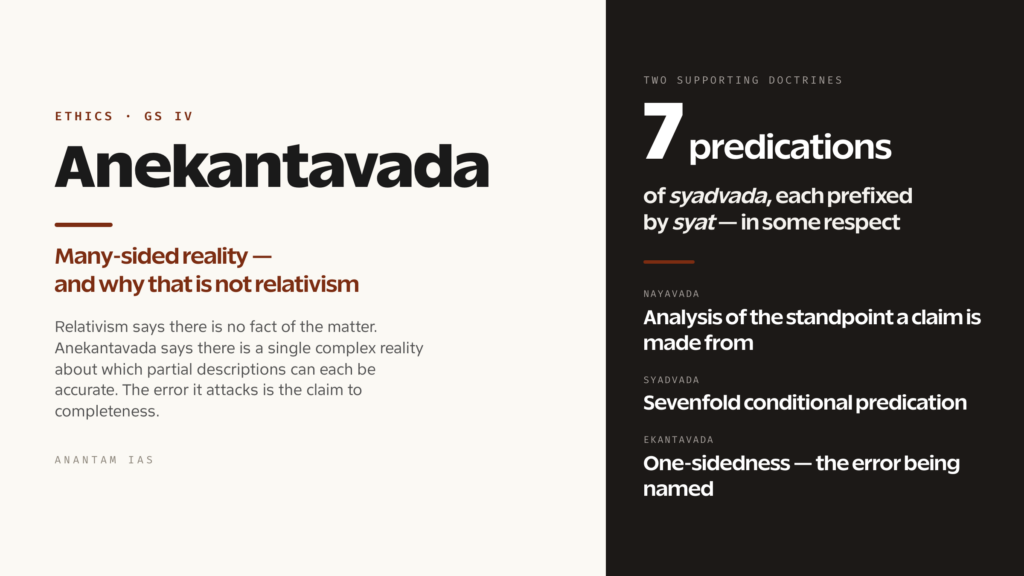
Anekantavada holds that reality is many-sided, that no single proposition captures a thing completely, and that claims are true relative to a standpoint which should be stated. It is supported by two further doctrines.
Nayavada is the analysis of standpoints. Any assertion is made from a particular viewpoint — from the perspective of substance or of momentary state, of the general or the particular, of name or of function. A claim that omits its standpoint is incomplete rather than simply wrong.
Syadvada is the sevenfold predication that formalises this: a proposition may be asserted, denied, both asserted and denied from different standpoints, or declared inexpressible, in seven permutations, each prefixed by syat — “in some respect”. The point of the apparatus is that “in some respect it is, and in some respect it is not” is a complete answer rather than a fudge.
The parable of the blind men and the elephant is the standard illustration, and the usual telling gets the moral wrong. The point is not that everyone is blind and nothing can be known. It is that each report is accurate about what it touched and false only in its implicit claim to describe the whole animal. The correction is to add the standpoint, not to abandon the description.
The distinction worth carrying into an answer is this: anekantavada is not relativism. Relativism says there is no fact of the matter. Anekantavada says there is a single complex reality about which partial descriptions can be individually accurate, and that the error is the claim to completeness — ekantavada, one-sidedness. Truth is not abolished; the monopoly on it is.
Where Anekantavada Actually Helps
This is the part of Jain ethics with direct administrative purchase.
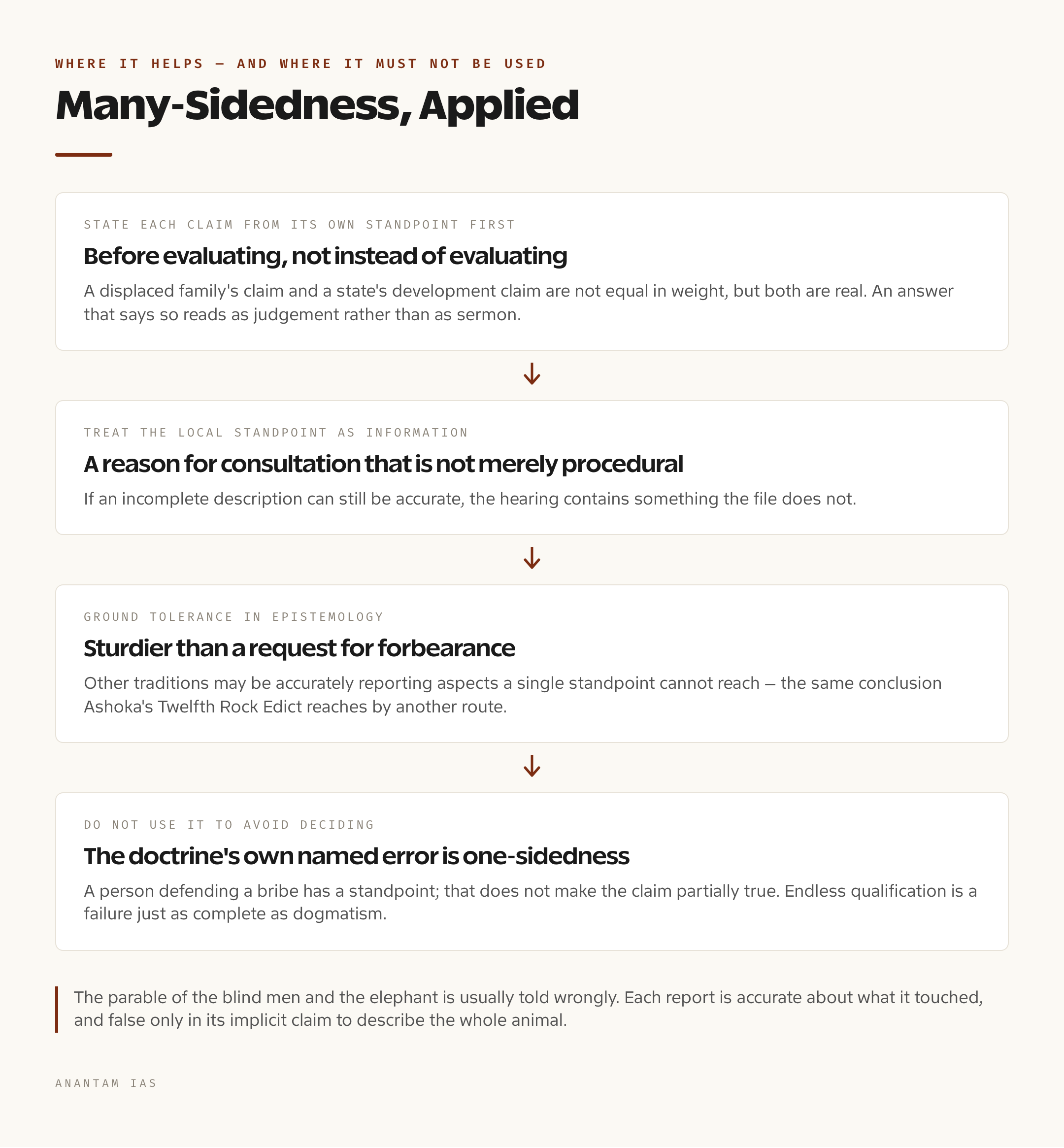
In dilemmas where both sides have a genuine point. The instinct in an ethics answer is to identify the correct party. Anekantavada supplies the discipline of first stating each party’s claim in its strongest form, from its own standpoint, before evaluating. A displaced family’s claim and a state’s development claim are not symmetrical in weight, but they are both real, and an answer that acknowledges this reads as judgement rather than as sermon. This is precisely the editorial rule the solved sets in GS IV case studies are built on — separate the legitimate concern from the illegitimate route.
In consultation and deliberation. A doctrine that treats an incomplete description as partially true gives a reason to hold public hearings that is not merely procedural: the local standpoint contains information the file does not.
In pluralism and religious tolerance. Anekantavada grounds tolerance in epistemology rather than in politeness — other traditions may be accurately reporting aspects of something my own standpoint does not reach. That is a sturdier basis than a request for mutual forbearance, and it converges with Ashoka’s Twelfth Rock Edict from a different direction.
In dissent within institutions. The doctrine gives a junior officer a respectable frame for disagreement: not “you are wrong” but “from this standpoint the file looks different”, which is often the only form in which dissent survives contact with hierarchy.
Where it must not be used. Many-sidedness cannot be invoked to avoid a decision, and it does not make all standpoints equally weighty. A person defending a bribe has a standpoint; that does not make it partially true. Used carelessly, anekantavada becomes a licence for endless qualification — which is the failure mode to state explicitly if you deploy it.
The Honest Difficulties
The ethic is designed around withdrawal. Its most complete form requires an ascetic life, and its rigour has to be diluted for anyone who farms, builds, polices or governs. The lay ethic is admitted to be a graded compromise.
Rigour can shift harm rather than reduce it. An absolute rule against occupations involving injury pushes those occupations onto other people. A framework of restraint operating inside a society that still requires the harmful work has to face the distributional question honestly.
Sallekhana is genuinely contested. The Jain practice of a voluntary fast unto death at the end of life was held to amount to suicide by the Rajasthan High Court in 2015; the Supreme Court stayed that order the same year, and the matter has remained unsettled since. The case sits at the intersection of religious freedom, autonomy and the state’s interest in preserving life, and it is the sharpest available illustration of a rigorous ethic colliding with a modern legal order. Say what the state of the law is, and do not assert a settled position that does not exist.
Anekantavada can be abused. Its own tradition treats one-sidedness as the error; a doctrine of many-sidedness that never concludes has committed a different error just as complete.
FAQ
What does anekantavada mean? Literally the doctrine of “not one-sidedness” — that reality has many aspects, that any single proposition captures only part of it, and that claims should be qualified by the standpoint from which they are made.
Is anekantavada the same as relativism? No. Relativism denies there is a fact of the matter. Anekantavada asserts a single complex reality about which partial descriptions can each be accurate; the error it targets is the claim to completeness, not the claim to truth.
What are nayavada and syadvada? Nayavada is the analysis of standpoints from which claims are made. Syadvada is the sevenfold scheme of conditional predication that formalises it, each proposition prefixed by syat, “in some respect”.
What is aparigraha? Non-possession. For an ascetic it means renunciation; for a householder it takes the form of parigraha-parimana, a self-imposed and specific limit on what one will own.
What are the five mahavratas? Ahimsa (non-injury), satya (truthfulness), asteya (non-stealing), brahmacharya (celibacy or fidelity) and aparigraha (non-possession). Laypeople observe graded versions called anuvratas.
Why is Jain ahimsa relevant to administrative ethics? Because it treats harm caused by negligence and inattention as morally serious, not only harm that was intended. That is the basis of a duty of care, and most administrative harm is of the unintended kind.
Practice Questions
Prelims MCQs
- Syadvada refers to: (a) The doctrine that the soul is bound by karmic matter (b) A sevenfold scheme of conditional predication qualifying claims by standpoint (c) The vow of limiting one’s possessions (d) The classification of living beings by number of senses — Answer: (b) each of its seven forms is prefixed by syat, “in some respect”, and it formalises the standpoint analysis of nayavada.
- In the lay Jain ethic, parigraha-parimana means: (a) Total renunciation of property (b) Redistribution of surplus wealth to the community (c) A self-imposed limit on possessions (d) Refusal of occupations involving trade — Answer: (c) the limit is specific and chosen by the individual, which is what makes the vow checkable.
- The three jewels of Jainism are: (a) Right faith, right knowledge and right conduct (b) Non-violence, truth and non-stealing (c) Understanding, compassion and equality (d) Prudence, justice and beneficence — Answer: (a) samyak darshana, samyak jnana and samyak charitra, in that order, with perspective treated as prior to conduct.
- Which statement best captures the difference between anekantavada and relativism? (a) Anekantavada denies that objective reality exists (b) Anekantavada holds that all claims are equally valid (c) Anekantavada holds that partial descriptions can each be accurate about a single complex reality (d) Anekantavada applies only to religious claims — Answer: (c) the doctrine attacks the claim to completeness, called ekantavada, rather than the possibility of truth.
- In Jain ethics, when truthfulness and non-injury conflict, the tradition generally holds that: (a) Truth must be spoken regardless of consequence (b) Non-injury takes precedence, which may require silence (c) The conflict is impossible by definition (d) The decision rests with the community elders — Answer: (b) ahimsa outranks satya, so a truth that causes serious harm may call for silence rather than utterance.
Mains Practice Questions
- “Anekantavada grounds tolerance in epistemology rather than in politeness.” Examine this claim and its usefulness in a plural society. (150 words)
- Aparigraha treats accumulation itself as a moral problem rather than a question of fair distribution. Discuss its relevance to debates on sustainable consumption. (250 words)
- Jain ahimsa treats harm by negligence as morally serious. Analyse the implications of this position for administrative accountability. (150 words)
- How can the doctrine of many-sidedness be applied when resolving a dispute in which both parties have a legitimate claim? Illustrate with an administrative example, and state the limits of the approach. (250 words)
- “A rigorous ethic of restraint designed for renouncers cannot guide those who must exercise power.” Critically examine with reference to Jain ethics. (250 words)
Tell Google you want more of this.
Add Anantam IAS as a preferred sourceOne tap, and this site shows up more often in your own Top Stories, AI Overviews and AI Mode. Remove it any time.