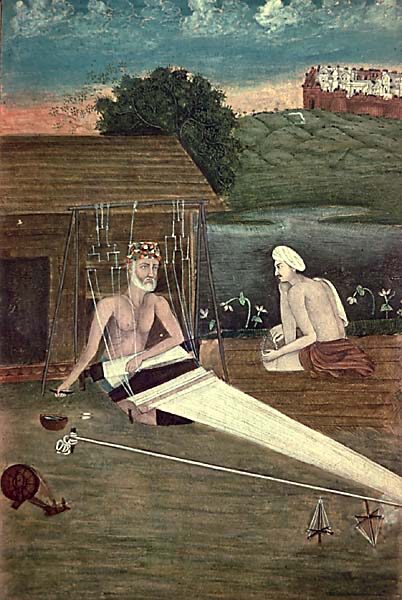
Kabir Das, the weaver-saint of Banaras, was the most radical voice of medieval Indian devotion. Born around 1440 and dying around 1518, Kabir Das spent his entire life inside the holiest Hindu city in India and used that vantage point to ridicule its priests, its temples, its scripture, its pilgrimage economy — and the parallel apparatus of the Banaras qazis and mullahs. He worked all his life as a julaha, a low-caste Muslim weaver. He composed in colloquial Hindi rather than Sanskrit or Persian. He left no organisation behind — yet the Kabir Panth he never founded, the Sikh scripture he never joined, and the Bijak compiled by followers he never met have together carried his voice for five hundred years.
The teaching of Kabir Das has three parts. There is one formless god — call it Ram or call it Khuda or call it nothing — who lives in the breath and the heart, not in the temple or the mosque. The path to that god is direct, requires no priest and no ritual, and is open to anyone who can sing. The brahmanical and mullah-led apparatus that sells the soul a route to salvation is fraud.
This article reads Kabir Das with a UPSC History and Art-and-Culture lens. It traces his obscure birth in Banaras, his discipleship under Ramananda, the weaver’s loom that grounded his theology, the literary forms of doha and sakhi, the Bijak and the Adi Granth, and the Kabir Panth that survives him.
Birth and Early Life
The historical record on Kabir Das is thin. The hagiographic literature — the Anant Das Parchai, the Kabir Manshur, the Niranjan Vani — places his birth around 1440 in Banaras. Tradition holds that he was found as an infant floating on a lotus leaf in the Lahartara tank by a Muslim weaver couple, Niru and Nima, who raised him as their own. Whatever the biographical facts, what is certain is that Kabir Das grew up Muslim by community, Hindu by city, and weaver by profession.
He worked the loom all his life. The weaver caste in fifteenth-century Banaras was a recent conversion from low-caste Hindu communities, and Kabir Das was thus doubly marginal — Muslim to the Hindu majority, and a low convert to the Ashraf Muslim elite. This double exclusion is the structural ground of his theology. He could not afford to belong fully to either tradition. He used both vocabularies, mocked both establishments, and refused both communities’ claims on him.
Discipleship Under Ramananda
The dominant tradition holds that Kabir Das was a disciple of Ramananda, the fifteenth-century Vaishnava reformer of Banaras who accepted disciples from all castes. The story is that Kabir Das, knowing Ramananda would not formally accept a Muslim disciple, lay across the ghat steps in the dark predawn. Ramananda, descending for his morning bath, stumbled over him and uttered “Ram Ram” in shock. Kabir Das immediately seized this as initiation and refused to recognise any further objection.
Whether or not the encounter occurred as described, Ramananda’s influence is visible. Kabir Das uses Ram as his preferred name for the divine — but pointedly not Ram the son of Dasharatha, the avatar of Vishnu. Kabir’s Ram is the Nirguna Ram — formless, unborn, identical to the divine ground in every human heart. This is the doctrinal move that separates Kabir Das from Tulsidas, Surdas, and the Saguna Bhakti mainstream.
The Theological Core: Nirguna Ram
Kabir Das was an uncompromising monotheist of the Nirguna kind. God for Kabir has no form, no name, no birth, no body. The Vedas, the Puranas, the Qur’an, the Hadith — all are texts. They may be useful, but they are not god. The temple, the mosque, the Ganga, the Ka’aba — all are places. They may be useful, but they are not god. God lives in the breath. God lives in the heart. God lives in the act of weaving cloth. The path to god is the satguru — the true teacher who illuminates the inner light — and the practice of remembering the Name.
Kabir Das’s most famous doha captures this:
Moko kahan dhoondhe re bandey, Main to tere paas mein —
Where do you search for me, my friend? I am beside you.
He is hostile, almost violently, to the priestly apparatus on both sides. The pandit who studies Sanskrit but does not see god in front of him is mocked. The mullah who calls from the minaret as though god were hard of hearing is mocked. The pilgrim who travels to Mecca or Mathura is mocked — god is not at Mecca, god is not at Mathura, god is here. Caste he treats with the same contempt: who asks the river its caste, who asks the rain its caste, who asks the breath its caste.
This radicalism is what makes Kabir Das unassimilable to either organised Hinduism or organised Islam, and what made him eventually claimable by the Sikh Gurus, the Kabir Panthis, and the modern reform movements.
Literary Forms: Doha, Sakhi, Ramaini, Pad
Kabir Das composed in three principal forms.
Doha — the rhyming couplet of two lines, twenty-four matras each. Compact, aphoristic, biting. The doha is the form in which Kabir Das is most widely remembered. School textbooks, calendars, WhatsApp forwards, political speeches — the Kabir doha is the single most quoted piece of medieval Indian poetry.
Sakhi — literally “witness,” a dohra-form testimonial verse, slightly longer than a doha. Sakhis are the dominant form in the Bijak.
Ramaini — a chaupai-form composition, four lines, longer narrative possibilities.
Pad — the song, intended for kirtan and bhajan performance.
Kabir Das composed in Sadhukkadi — the trader’s-language of the Hindi belt, a mix of Khari Boli, Avadhi, Bhojpuri, Rajasthani, Punjabi, and Persian-Arabic vocabulary. This deliberate hybridity is itself a theological statement. He refuses to belong to any one linguistic community.
The Bijak
The principal scripture of the Kabir Panth is the Bijak — “seed-text” — a collection of Kabir’s verses divided into Ramainis, Shabdas, and Sakhis. The Bijak was compiled probably in the seventeenth century by the eastern branch of the Kabir Panth headquartered at Dhanauti and later at Kabir Chaura in Banaras.
The Bijak differs from the Kabir verses in the Adi Granth and from the Rajasthani Kabir Granthavali. These three textual traditions — Bijak (eastern Kabir Panth), Adi Granth (Sikh), and Granthavali (Dadu Panth) — share a core but diverge in many details. Modern scholarship is cautious about attributing every doha in these collections to the historical Kabir Das.
Inclusion in the Adi Granth
Guru Arjan Dev Ji, the fifth Sikh Guru, included 541 verses by Kabir Das in the Adi Granth when he compiled the Sikh scripture in 1604. This is the largest single body of work by any non-Sikh saint in the Granth, and second only to the Gurus themselves in volume. The inclusion places Kabir Das at the heart of Sikh scriptural devotion. Every Sikh worldwide who follows the daily reading of the Guru Granth Sahib encounters Kabir Das in their morning prayer.
This canonisation is what saved a substantial body of Kabir’s compositions from textual drift. The Adi Granth versions, written down within a century of his death, are the most reliable record we have.
Death and the Maghar Legend
Kabir Das died around 1518. The tradition is unanimous on the place — Maghar, a town about 240 km east of Banaras — and on Kabir’s deliberate choice to die there. Banaras tradition held that anyone who died in the city went straight to liberation. Maghar tradition held that anyone who died there was reborn as a donkey. Kabir Das, refusing to give the priestly establishment any victory, walked to Maghar to die.
The death legend itself is the great Kabir story. Hindus and Muslims gathered around his body to fight over the disposal — Hindus wanting cremation, Muslims wanting burial. They lifted the shroud and found only flowers. The Hindus took half and cremated them; the Muslims took half and buried them. The mazar and the samadhi exist side by side at Maghar to this day.
Whether the story is true or hagiographic, it is the perfect Kabir parable. Even at death, he refuses to belong to either community.
The Kabir Panth
The Kabir Panth is the institutional descendant Kabir Das did not intend. It crystallised in the seventeenth century into two main branches — the eastern Bijak tradition headquartered at Kabir Chaura in Banaras and at Dhanauti, and the western Rajasthani tradition associated with Dharamdasi disciples. The Kabir Panth claims a lakh-plus following, drawn historically from low-caste communities — julahas, chamars, koris — for whom Kabir Das remains an icon of caste rejection.
The modern Dalit movement has reclaimed Kabir Das as one of its foundational voices. B.R. Ambedkar listed Kabir alongside the Buddha and Mahatma Phule as his three gurus. Modern Hindi literary criticism, from Hazariprasad Dwivedi onward, treats Kabir Das as the founder of the Bhakti movement in north India and as the central figure of the Sant tradition.
Critique of Ritualism
Kabir Das’s anti-ritual position is the sharpest in medieval Indian literature. A few representative dohas:
On image worship:
Pahaan poojai Hari mile, to main poojoon pahaar —
If god could be reached by worshipping stones, I would worship a whole mountain.
On the mosque’s azan:
Kankar paathar jor ke masjid layi banaay,
Ta chadhi mulla baang dey, kya behra hua khuday —
They piled bricks and stones to build a mosque,
the mullah climbs up and shouts the call — is god deaf?
On caste:
Jaati na poocho sadhu ki, pooch leejiye gyan —
Don’t ask the saint his caste, ask his wisdom.
On scripture:
Pothi padh padh jag mua, pandit bhayo na koy,
Dhai akhar prem ka padhe so pandit hoy —
Reading book after book the world has died, no one became wise;
Read the two-and-a-half letters of love — that is the only wisdom.
This anti-ritual radicalism is what makes Kabir Das structurally different from Tulsidas, Surdas, and Meerabai. They sing of god with form, within the temple economy. Kabir Das sings outside the temple, against the temple.
Relationship with Sufism
Kabir Das is sometimes claimed by Sufi tradition. The vocabulary of the inner heart, the divine beloved, the wine of love, fana in the divine — these are shared with the Sufi movement. Some hagiographies make Kabir Das a disciple of the Chishti saint Sheikh Taqi alongside his Hindu discipleship under Ramananda. The historical evidence is thin, but the resonance is real. The Sant tradition — Kabir, Nanak, Dadu, Raidas — was the cultural space where Bhakti and Sufi met, mixed, and produced something new.
Legacy and UPSC Relevance
Kabir Das is one of the four or five most important figures in medieval Indian cultural history. He shaped:
- Hindi literature — modern Hindi literary criticism treats him as foundational.
- Sikh scripture — 541 verses in the Adi Granth.
- Dalit movement — adopted as proto-anti-caste reformer.
- Bhakti studies — the central figure of Nirguna Sant tradition.
- Indian secular vocabulary — the Kabir doha is the standard reference for syncretic, anti-communal Indian identity.
For UPSC GS-I he appears in Medieval History, Art and Culture, and Indian Society. Expected coverage: the Nirguna stream of Bhakti, the literary forms (doha, sakhi), the Adi Granth inclusion, the relationship with Sufism, the critique of caste and ritual, and the Maghar death legend. Like other foundational saints of medieval India whose memory has been institutionalised — including the rulers and reformers whose memorials and lineages run through monuments like the temples and dargahs of the era — Kabir Das survives because his words refused to belong to anyone, and so everyone could claim him.
Frequently Asked Questions
When was Kabir Das born?
Kabir Das was born around 1440 in Banaras. The exact date is uncertain — the hagiographic tradition places his life between 1398 and 1518, but modern scholarship favours roughly 1440 to 1518. He was raised by a Muslim weaver couple, Niru and Nima, in Banaras.
Was Kabir Das Hindu or Muslim?
Kabir Das was born into a Muslim weaver family but was a disciple of the Hindu Vaishnava reformer Ramananda. He used the vocabulary of both traditions, mocked both establishments, and refused to belong fully to either. The Maghar death legend, where his body turns to flowers and is divided between Hindus and Muslims, captures his refusal to be claimed by one community.
What is the Bijak?
The Bijak is the principal scripture of the Kabir Panth, containing Kabir Das’s verses arranged as Ramainis, Shabdas, and Sakhis. It was compiled probably in the seventeenth century by the eastern branch of the Kabir Panth at Kabir Chaura in Banaras. The Bijak differs from the Kabir verses preserved in the Sikh Adi Granth and in the Rajasthani Granthavali.
Why are Kabir’s verses in the Sikh Adi Granth?
Guru Arjan Dev Ji, the fifth Sikh Guru, included 541 verses by Kabir Das in the Adi Granth when he compiled the Sikh scripture in 1604. This is the largest single body of work by any non-Sikh saint in the Granth. The inclusion reflects shared Nirguna theology and saved a substantial body of Kabir’s compositions from textual loss.
What is Nirguna Bhakti?
Nirguna Bhakti is the stream of the Bhakti movement that worships a formless, attributeless god. Unlike Saguna Bhakti (which worships Rama, Krishna, or other deities with form), Nirguna saints like Kabir Das, Guru Nanak, Dadu Dayal, and Raidas reject image worship, caste, and ritual. Kabir Das is the most radical voice of this tradition.
What is the significance of the Maghar legend?
Kabir Das chose to die at Maghar, a town considered inauspicious for death, rather than at Banaras, considered auspicious — refusing to give the priestly establishment any victory. The legend that his body turned to flowers and was divided equally between Hindus and Muslims captures his lifelong refusal to belong to either community.
Who founded the Kabir Panth?
Kabir Das himself did not found the Kabir Panth. It crystallised after his death in the seventeenth century, with two main branches — the eastern Bijak tradition at Kabir Chaura, Banaras, and the western Rajasthani Dharamdasi tradition. The Kabir Panth claims a lakh-plus following drawn historically from low-caste communities.
Why is Kabir Das important for UPSC?
Kabir Das is central to UPSC GS-I Medieval History and Art and Culture. Questions cover the Nirguna stream of the Bhakti movement, his literary forms (doha, sakhi), his inclusion in the Sikh Adi Granth, the critique of caste and ritual, the relationship with Sufism, and the Kabir Panth. He also figures in Indian Society modules on caste reform and syncretism.
Tell Google you want more of this.
Add Anantam IAS as a preferred sourceOne tap, and this site shows up more often in your own Top Stories, AI Overviews and AI Mode. Remove it any time.