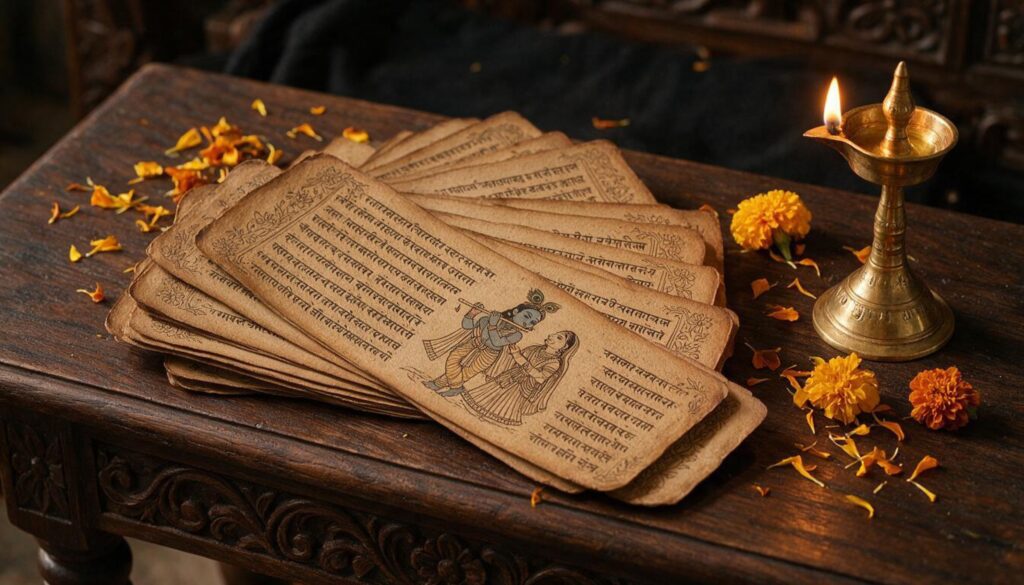
Ask most aspirants what Tulsidas did and you’ll hear “he wrote the Ramayana in Hindi.” That’s not wrong, but it misses the whole point, and it costs marks. The Sanskrit Ramayana already existed. What Tulsidas did was take a story locked inside a priestly language most people couldn’t read, and rewrite it in the tongue spoken in the fields of the Gangetic plain. That single act of translation, from the elite to the everyone, is why he belongs in the Bhakti movement and not just in a literature syllabus.
Get that framing and Tulsidas becomes a clean, high-yield topic that pays out in both Art and Culture and Medieval History. He’s also the cleanest way to understand one half of the Bhakti movement, the devotional stream that centred on a God with form. Here’s what the flashcards leave out.
Who Tulsidas was, and why he matters beyond “wrote the Ramayana”
Tulsidas was a saint-poet of sixteenth-century North India, a devotee of Rama whose Awadhi retelling of the Ramayana became the most widely read and recited text in the Hindi-speaking belt. Tradition places his birth around 1511 CE, though some accounts give 1497 or 1532, and his death at Banaras in 1623 CE. He lived through the reign of Akbar, and the Mughal court and his own poetry belong to the same century, a useful anchor for placing him in medieval Indian history.
His importance rests on one lever: language. For centuries the Ramayana of Valmiki circulated in Sanskrit, which meant it reached the small minority who could read the sacred language, mostly Brahmins. Tulsidas broke that monopoly. He composed his great work in Awadhi, a dialect of the eastern Hindi region around Ayodhya, so that a farmer, a weaver, or a woman shut out of Sanskrit learning could hear the whole epic and follow it. The scholar George Grierson later called the resulting text the working scripture of a hundred million people in North India, and that reach is the fact to hold onto.
Here’s the objection worth pre-empting: wasn’t putting scripture in the vernacular exactly what other Bhakti saints were doing too? Yes, and that’s the point. Tulsidas wasn’t a lone genius; he was the North Indian, Rama-centred peak of a movement that ran from Tamil country to Punjab, all of it insisting that devotion in one’s mother tongue mattered more than ritual in a language you couldn’t understand.
It helps to place him in his moment. The devotional wave that Tulsidas rode had travelled north over centuries, beginning with the Tamil Alvars and Nayanars of the early medieval south and spreading up the subcontinent, so that by the sixteenth century the Hindi belt was full of poets singing to God in their own speech. That same century was the age of Akbar and the consolidating Mughal empire, a time when a Persian-speaking court sat over a countryside that worshipped in a dozen local tongues. Vernacular devotion offered ordinary people a faith they owned, in language they lived in, and Tulsidas gave that impulse its grandest single monument. Tradition also names his teacher, Narharidas, and wraps his turn to renunciation in a well-known legend about his wife Ratnavali rebuking his attachment, stories worth knowing as tradition rather than documented fact.
The Ramcharitmanas: a Ramayana in the people’s tongue
The Ramcharitmanas is Tulsidas’s masterwork, an epic poem in Awadhi that retells the story of Rama as an act of devotion rather than a courtly narrative. He began composing it in Ayodhya in 1574 CE (Vikram Samvat 1631), on Rama Navami by tradition, and finished it around 1577, much of the later work done at Banaras. The title translates roughly as “the lake of the deeds of Rama,” and Tulsidas structured it as a sacred lake with descending steps, an image of devotion the reader wades into.
The poem is organized into seven kandas, or books, following the broad arc of Valmiki’s Sanskrit epic: Bala Kanda, Ayodhya Kanda, Aranya Kanda, Kishkindha Kanda, Sundara Kanda, Lanka Kanda, and Uttara Kanda. But the retelling isn’t a copy. Tulsidas recasts Rama not merely as a hero-prince but as the supreme God in human form, and he shifts the emotional centre to bhakti, loving surrender, over kingly duty. The devotional Rama of the North Indian household, worshipped rather than merely admired, is largely his creation.
Two consequences flowed from writing it in Awadhi, and both are testable. First, the linguistic one: the Ramcharitmanas became a foundation stone of modern Hindi literature and helped standardize a literary register the whole belt could share, the way Prithviraj Raso sits in the Braj and Rajasthani story of early Hindi. Second, the social one: because anyone could understand it, the epic escaped the temple and the Sanskrit school and entered the home, the street, and the annual Ramlila performances, the community dramatizations of Rama’s life staged across North India to this day. The Ramnagar Ramlila near Banaras, one of the most famous, draws its script and spirit directly from his text.
That’s the move to underline. Tulsidas didn’t just translate a story. He put a scripture into circulation among people the old religious order had kept outside the gate, and he did it without directly attacking that order, which is part of why his work was absorbed so completely rather than resisted.
The cultural afterlife proves the point better than any praise. The Ramcharitmanas became so central that the British administrator and linguist George Grierson described it as the working Bible of the whole of North India, read and quoted by tens of millions who never opened a Sanskrit text. Its verses turned into everyday proverbs; its scenes became the annual public theatre of the Ramlila; its image of Rama as the ideal king and Sita as the ideal wife shaped North Indian social ideals for centuries, for better and, later critics would argue, in ways that hardened gender norms too. A single poem rarely does that much cultural work. This one did it because it was written to be heard aloud by people who couldn’t read, which is exactly why it travelled.
Saguna bhakti: where Tulsidas stands in the Bhakti movement
Tulsidas belongs to the saguna stream of the Bhakti movement, the devotees who worshipped God with attributes and form, and specifically to Rama bhakti, devotion to Rama as the personal, embodied Supreme. That single classification unlocks his whole place in the tradition, so it’s worth slowing down on.
The Bhakti movement split, broadly, into two devotional temperaments, and the cleanest way to remember Tulsidas is to see him against his opposite. Name the two terms and translate them at once. Nirguna bhakti worships a formless, attribute-less God who can’t be captured in an image or a name; saguna bhakti worships a God with qualities, form, and story, one you can picture, name, and love as a person. Kabir sits at the nirguna pole; Tulsidas sits at the saguna one.
| Nirguna stream | Saguna stream | |
|---|---|---|
| Idea of God | Formless, without attributes | With form, name, and qualities |
| Attitude to images/temples | Often rejected | Embraced |
| Representative saint | Kabir | Tulsidas (Rama), Surdas (Krishna) |
| Language | Vernacular | Vernacular |
Within the saguna camp there’s a further split by chosen deity, and this trips up a lot of students. Rama bhakti, Tulsidas’s stream, centres on Rama and the ideal of maryada, righteous conduct within limits. Krishna bhakti, the other great saguna stream, centres on Krishna and the mood of playful, passionate love, and its great Awadhi-belt voice is Surdas. So the standard exam pairing is Tulsidas with Rama, Surdas with Krishna, both saguna, both writing in the people’s tongue. Compare this whole devotional world with the parallel Sufi movement, and you get the fuller picture of medieval India’s bhakti and Sufi ferment, two traditions pushing, from different directions, toward a personal and accessible faith.
One nuance keeps Tulsidas from being simply the “conservative” saint some notes make him. He upheld the varna order and Brahminical authority far more than Kabir did, which is true. But by giving the whole society direct access to sacred story in its own language, he still widened who could participate in devotional life, even while leaving the social hierarchy standing. Hold both halves; examiners reward the student who does.
The Hanuman Chalisa, Vinaya Patrika, and the rest of the corpus
Tulsidas wrote far more than the Ramcharitmanas, and two other works in particular carry into everyday Hindu practice and into the exam. Traditionally about a dozen works are attributed to him, and the pattern across them is the same: devotion to Rama and his great devotee Hanuman, in a language ordinary worshippers could use.
The Hanuman Chalisa is the most recited of them all, a devotional hymn of forty verses (the word chalisa comes from chalis, forty) in praise of Hanuman, composed in Awadhi. Its reach today dwarfs almost any other single religious text in India by sheer number of daily recitations. If you know one Tulsidas work besides the Ramcharitmanas, know this one, and know it is his.
The Vinaya Patrika, “the petition of humility,” is the more personal and literarily prized of his lyric works, a collection of hymns cast as a plea addressed to Rama, in the Braj register. Where the Ramcharitmanas tells a story, the Vinaya Patrika is Tulsidas’s own voice praying, and it’s often held up as the emotional high point of his poetry.
Beyond these, recognize the titles even if you don’t read them: the Kavitavali and Gitavali, which retell episodes of Rama’s life in different metres and moods; the Dohavali, a gathering of his couplets carrying compressed moral and devotional wisdom; and shorter works such as the Barvai Ramayana, Janaki Mangal, and Parvati Mangal. What ties the whole corpus together is that Tulsidas wrote for the ear, in metres like the doha and chaupai that a listener could catch and carry home, which is exactly why so many of his lines survive as everyday sayings rather than library texts. The one-line takeaway for revision: Ramcharitmanas is the epic, Hanuman Chalisa is the popular hymn, Vinaya Patrika is the personal devotional lyric, and the rest are supporting titles to attribute correctly.
Banaras: the city that shaped him and that he shaped
Tulsidas spent most of his life in Banaras, modern Varanasi, and the city is stitched into both his biography and the map you can still walk today. He is said to have completed much of the Ramcharitmanas there and to have died there around 1623, and the traces he left have made him part of the city’s identity, not just its history.
Two sites carry his name directly. Tulsi Ghat, on the bank of the Ganga, is named after him and traditionally marks where he lived and worked in his later years. And he is credited with founding the Sankat Mochan Hanuman Temple, believed to stand at the spot where, by tradition, he had a vision of Hanuman. That temple remains one of Varanasi’s most visited, which tells you how alive his legacy stays in the city’s daily worship rather than sitting only in textbooks. Varanasi’s long standing as a centre of learning and devotion, home also to modern institutions and sites like the Swarved Mandir, is the setting his work both drew on and deepened.
Banaras matters for more than trivia. It was a hub where the vernacular devotional culture Tulsidas represented met the older Sanskritic learning of the city’s pandits, and the friction between them is part of his story: tradition holds that some orthodox scholars resented a sacred epic written in “common” Awadhi rather than Sanskrit. That tension, between guarding scripture and opening it, is exactly the Bhakti movement’s central drama, playing out in one city and one poet’s life.
The relationship also cut the other way, and that’s the interesting part. Tulsidas didn’t reject the Sanskrit tradition; he mastered it and then re-voiced it. His Awadhi carries the learning of the pandits inside the rhythms of ordinary speech, which is why even orthodox critics eventually embraced the text rather than banning it. He proved you could honour the old scripture and still hand it to the crowd, and that resolution, reverent and popular at once, is the model of cultural change he leaves behind. It’s a gentler template than Kabir’s open defiance, and arguably a more durable one, given how completely North India absorbed his Rama.
How to study Tulsidas, and how he is tested
For the exam, don’t try to master Tulsidas as literature; master him as a hinge between three things examiners love to connect: the Bhakti movement, the growth of vernacular languages, and the social history of medieval India. Once you see him as that hinge, the facts organize themselves.
Fix the spine first. Tulsidas, sixteenth to early seventeenth century, saguna Rama bhakti, wrote the Ramcharitmanas in Awadhi, plus the Hanuman Chalisa and Vinaya Patrika, and is tied to Banaras. If you can say that in one breath, you have the factual core. Then attach the two arguments that turn facts into marks: that writing in Awadhi democratized access to sacred story, and that he represents the saguna, form-full pole of Bhakti as against Kabir’s nirguna, formless one.
Slot him against neighbours so comparison questions don’t catch you out. In the Bhakti map, pair him with Kabir for the saguna-versus-nirguna contrast, and with Surdas for the Rama-versus-Krishna contrast within saguna, so revise him alongside the Kabir profile and, for the wider devotional and reform current, Guru Nanak. If you’re weighing an optional, this same terrain is core to the Hindi Literature optional, where Tulsidas is a central author rather than a single fact.
The trap to avoid is treating Tulsidas as purely a religious poet with no social significance. That reading loses the marks. His significance is precisely that a devotional act, retelling Rama’s story in the vernacular, had social and linguistic consequences: it shaped Hindi, it carried into public Ramlila performances, and it opened scripture to people the older order had shut out, all without dismantling the hierarchy itself. Whenever a question asks about the “impact” of a Bhakti saint, that chain, language to access to society, is the answer structure to reach for.
Frequently Asked Questions
Who was Tulsidas?
Tulsidas was a sixteenth-century saint-poet of North India and a devotee of Rama. He wrote the Ramcharitmanas, an Awadhi retelling of the Ramayana that became the most widely read devotional text in the Hindi-speaking region, and he belongs to the saguna, or form-based, stream of the Bhakti movement.
What is the Ramcharitmanas and why is it important?
It is Tulsidas’s epic retelling of the Ramayana, composed in the Awadhi vernacular from about 1574 CE. Its importance is that it took a story previously locked in Sanskrit and made it accessible to ordinary people, which shaped modern Hindi literature, fed the tradition of Ramlila performances, and spread Rama devotion across North India.
Which language did Tulsidas write in?
His major work, the Ramcharitmanas, is in Awadhi, an eastern dialect of Hindi spoken around Ayodhya. Some of his other devotional poetry, such as the Vinaya Patrika, uses the Braj register. Choosing the vernacular over Sanskrit was central to his impact.
Did Tulsidas write the Hanuman Chalisa?
Yes. The Hanuman Chalisa, a forty-verse devotional hymn to Hanuman in Awadhi, is traditionally attributed to Tulsidas. It is among the most frequently recited religious texts in India today.
What is the difference between saguna and nirguna bhakti, and where does Tulsidas fit?
Saguna bhakti worships God with form, name, and attributes; nirguna bhakti worships a formless, attribute-less God. Tulsidas belongs to the saguna stream, worshipping Rama as the personal Supreme, which places him opposite Kabir, a leading nirguna saint.
How is Tulsidas connected to Varanasi?
Tulsidas spent much of his life in Banaras (Varanasi), where he is said to have completed the Ramcharitmanas and died around 1623 CE. Tulsi Ghat on the Ganga is named after him, and he is credited with founding the Sankat Mochan Hanuman Temple there.
What are the other major works of Tulsidas?
Besides the Ramcharitmanas and the Hanuman Chalisa, his important works include the Vinaya Patrika, a personal devotional lyric, along with the Kavitavali, Gitavali, and Dohavali. About a dozen works in total are traditionally attributed to him.
Practice Questions
1. Tulsidas composed the Ramcharitmanas primarily in which language?
a) Sanskrit
b) Awadhi
c) Braj
d) Maithili
Answer: b) Awadhi
2. Tulsidas is best described as a saint of which devotional stream?
a) Nirguna bhakti
b) Saguna bhakti, centred on Rama
c) Sufi silsila tradition
d) Saguna bhakti, centred on Krishna
Answer: b) Saguna bhakti, centred on Rama
3. Which of the following works is traditionally attributed to Tulsidas?
a) Sur Sagar
b) Bijak
c) Hanuman Chalisa
d) Gita Govinda
Answer: c) Hanuman Chalisa
4. With which city is the later life and death of Tulsidas most closely associated?
a) Ayodhya
b) Mathura
c) Prayag
d) Banaras (Varanasi)
Answer: d) Banaras (Varanasi)
5. Consider the following pairs of saint and devotional focus. Which is correctly matched?
a) Kabir and saguna Rama bhakti
b) Surdas and Krishna bhakti
c) Tulsidas and nirguna bhakti
d) Guru Nanak and Rama bhakti
Answer: b) Surdas and Krishna bhakti
Mains-style questions
- “Tulsidas’s Ramcharitmanas was as much a social act as a literary one.” Discuss how his choice of the vernacular shaped devotional life and language in North India.
- Distinguish between the saguna and nirguna streams of the Bhakti movement, using Tulsidas and Kabir as representative figures.
- Examine the contribution of Tulsidas to the development of Hindi literature and to the popularization of Rama devotion.
- The Bhakti movement is often credited with challenging social hierarchy. Critically assess this claim with reference to Tulsidas, who both widened access to scripture and upheld the existing order.
- Discuss the role of vernacular devotional literature in fostering a shared cultural identity in medieval North India, with special reference to Tulsidas.
Tulsidas is easy to under-rate, because “wrote a devotional poem” sounds small next to battles and empires. But a single poet who put a scripture into the language of the fields did something an army couldn’t: he changed what an ordinary person could read, recite, and belong to. That’s the sentence to carry into the exam hall, because it turns a name on a list into an argument about how faith, language, and society move together.
Tell Google you want more of this.
Add Anantam IAS as a preferred sourceOne tap, and this site shows up more often in your own Top Stories, AI Overviews and AI Mode. Remove it any time.