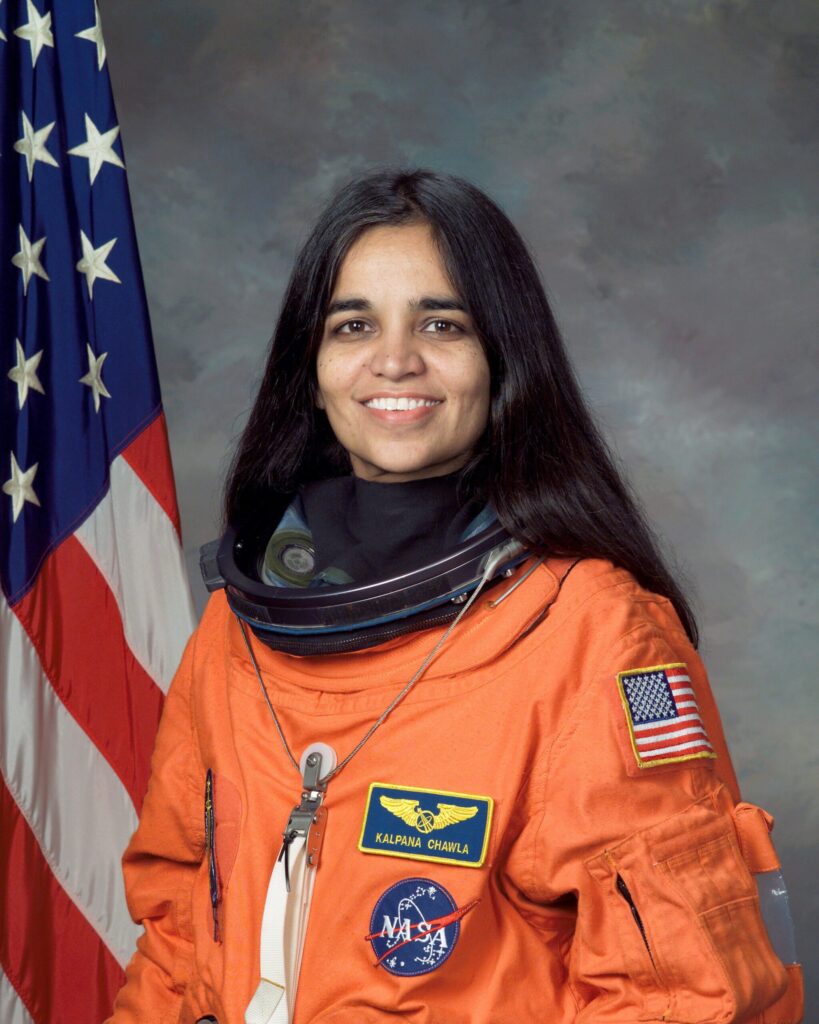
Kalpana Chawla was the first Indian-origin woman to fly in space and one of the seven crew members who lost their lives when the Space Shuttle Columbia disintegrated on re-entry on 1 February 2003. Her first mission, STS-87, launched on 19 November 1997, made her — at the age of 35 — the first woman of Indian origin to leave the Earth’s atmosphere. Her second mission, STS-107, was her last.
Kalpana Chawla is a recurring name in school textbooks, ISRO outreach material, and the kind of GS-III science-and-technology questions where examiners want to test whether candidates can talk about Indian achievements in space beyond ISRO alone. She is also a case study in scientific migration, women in STEM, and the institutional culture of NASA in the post-Challenger era.
This explainer covers Kalpana Chawla’s early life in Karnal, her undergraduate years at Punjab Engineering College, her doctoral research in the United States, her two missions on Space Shuttle Columbia, the STS-107 disaster, and her legacy across schools, satellites and public memory.
Early Life and Family
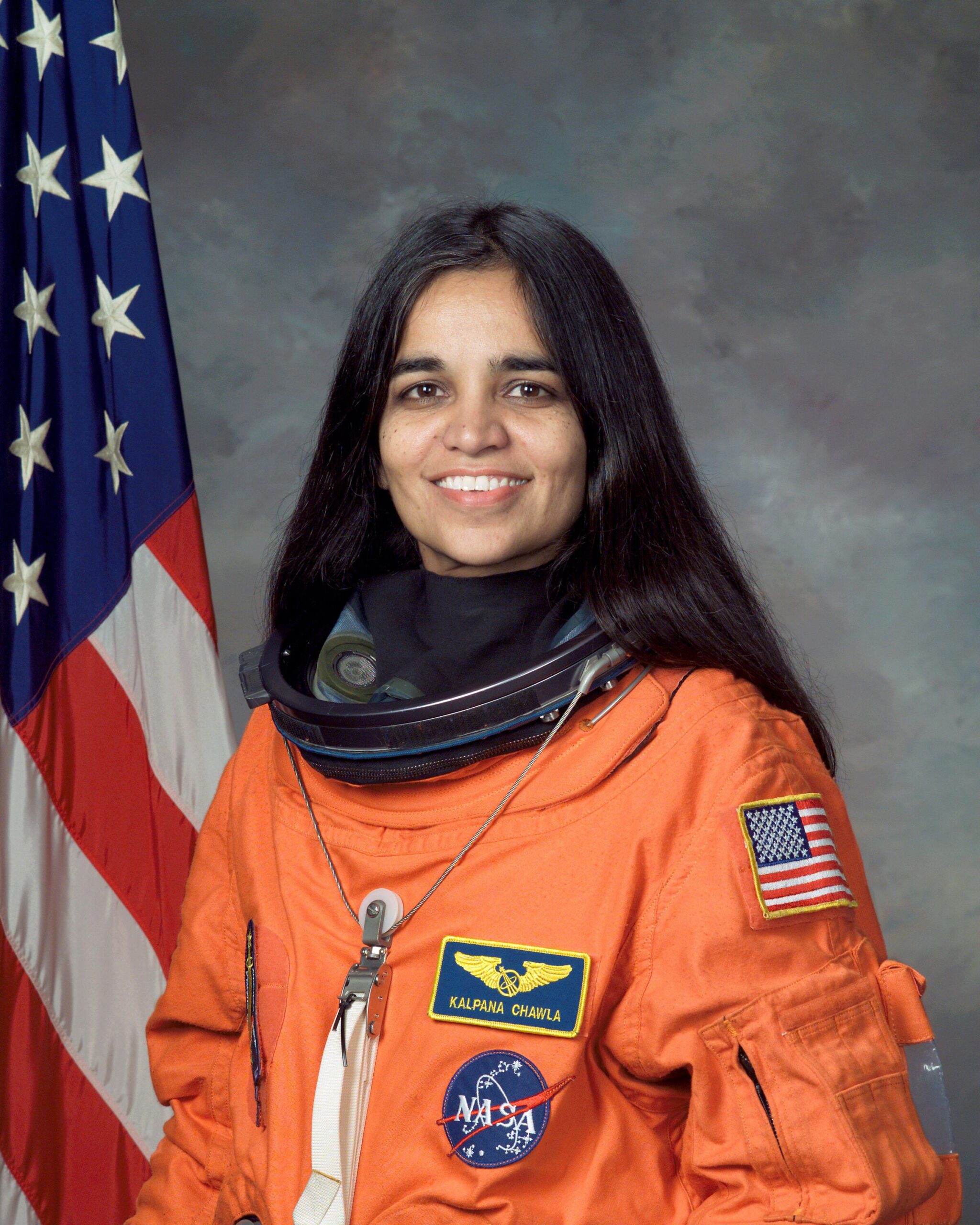
Kalpana Chawla was born on 17 March 1962 in Karnal, Haryana — though some family accounts give 1 July 1961, with 17 March recorded for school admission purposes. Her father, Banarasi Lal Chawla, was a partition refugee from Multan who built a tyre-manufacturing business in Karnal, and her mother Sanjyothi Chawla raised four children.
Schooling
She was the youngest of four siblings. She attended Tagore Baal Niketan Senior Secondary School in Karnal, and from an early age she was fascinated with the aeroplanes that flew over the Karnal Flying Club. Her elder brother Sanjay Chawla recalled that she would point at the sky and ask whether the planes could fly to the stars.
Choosing engineering
In a small-town middle-class household of the 1970s, the expectation was that girls would pursue medicine or teaching. Kalpana Chawla insisted on aeronautical engineering — a stream then dominated by men — and her father initially resisted before relenting.
Education in India and the United States
She joined Punjab Engineering College in Chandigarh in 1978 and graduated with a Bachelor of Engineering in Aeronautical Engineering in 1982. She was one of very few women in her batch.
Move to the United States
She moved to the United States in 1982 and joined the University of Texas at Arlington for a Master of Science in Aerospace Engineering, completing it in 1984. She earned a second master’s degree and then a PhD in Aerospace Engineering from the University of Colorado Boulder in 1988. Her doctoral research focused on computational fluid dynamics related to vertical / short take-off and landing aircraft.
Joining NASA Ames
After her PhD she joined NASA’s Ames Research Center in California in 1988 as a researcher in computational fluid dynamics, working on powered-lift computational fluid simulations. In 1993 she joined Overset Methods Inc. as a vice-president and research scientist, continuing CFD research on flow over rotors and bodies of revolution. She became a naturalised United States citizen in April 1991.
Selection as Astronaut
Kalpana Chawla was selected by NASA in December 1994 as part of the 15th group of astronaut candidates — Group 15, nicknamed “The Flying Escargot” — and reported to the Johnson Space Center in March 1995. After a year of basic training and evaluation, she was qualified as a mission specialist and assigned to her first space mission in 1996.
STS-87: The First Mission
Kalpana Chawla’s first spaceflight was STS-87, a 16-day mission on Space Shuttle Columbia.
Launch and crew
Columbia launched on 19 November 1997 from Kennedy Space Center, Florida, with a six-member crew commanded by Kevin Kregel. The mission was the fourth United States Microgravity Payload (USMP-4) flight, focused on materials science, fluid physics and combustion experiments in microgravity.
Her role
Kalpana Chawla served as mission specialist and prime robotic-arm operator. Her primary task was the deployment of the Spartan-201 free-flying solar observation satellite, which was meant to study the Sun’s corona. The deployment did not go as planned — Spartan failed to capture solar data and had to be retrieved manually in an unplanned EVA (extra-vehicular activity) by astronauts Winston Scott and Takao Doi. A subsequent NASA review concluded that errors in software and crew procedures, not Chawla individually, were responsible. She was reassigned to technical roles in the Astronaut Office while NASA completed the review.
Time in orbit
The first mission lasted 15 days, 16 hours and 34 minutes, covering 6.5 million miles and 252 orbits of Earth. At its conclusion, Kalpana Chawla had logged 376 hours and 34 minutes in space and become the first Indian-origin woman to fly in space and the second Indian after cosmonaut Rakesh Sharma (1984).
STS-107: The Final Mission
After several years of technical assignments at NASA, Kalpana Chawla was reassigned to flight duty as a mission specialist on STS-107, a dedicated 16-day microgravity research flight.
Launch
Columbia launched on 16 January 2003 with a seven-member crew commanded by Rick Husband. The crew was divided into two shifts so experiments could run around the clock — 80 in all, covering Earth and space sciences, advanced technology development and astronaut health and safety.
The disaster
On re-entry, on 1 February 2003, Columbia disintegrated over Texas and Louisiana about 16 minutes before its scheduled landing at Kennedy Space Center. All seven crew members died. The Columbia Accident Investigation Board (CAIB), chaired by Admiral Harold Gehman, concluded that a piece of foam insulation had broken off the external tank during launch and struck the leading edge of Columbia’s left wing, damaging the thermal protection system. During re-entry, super-heated atmospheric gases penetrated the wing structure and caused the vehicle to break apart.
Crew of seven
Rick Husband (commander), William McCool (pilot), Michael Anderson, David Brown, Laurel Clark, Kalpana Chawla and Israeli astronaut Ilan Ramon. Kalpana Chawla had logged a combined 30 days, 14 hours and 54 minutes in space across her two missions.
Recognition and Legacy
Kalpana Chawla was posthumously awarded the Congressional Space Medal of Honor, the NASA Space Flight Medal and the NASA Distinguished Service Medal in 2003. The Government of India honoured her by renaming the first of ISRO’s MetSat series of meteorological satellites as Kalpana-1 after her death.
Memorials and institutions
The asteroid 51826 Kalpanachawla was named in her honour. NASA dedicated a supercomputer at the Ames Research Center to her memory. The hostel at Punjab Engineering College, Chandigarh, was renamed Kalpana Chawla Hostel, and the institute set up the Kalpana Chawla Memorial Scholarship for aeronautical engineering. The CUNY College of Staten Island created the Kalpana Chawla Recreation Center. The Haryana government renamed the Karnal Medical College as Kalpana Chawla Government Medical College in 2006.
In popular memory
Roads, schools, planetariums and an entire generation of Indian science textbooks now carry her name. The 2021 NASA-Northrop Grumman Cygnus cargo spacecraft NG-14 was named SS Kalpana Chawla, marking the first time a Cygnus craft was named after a woman.
Why Kalpana Chawla Matters for UPSC
Three syllabus connections are worth committing to memory.
Kalpana Chawla represents the institutional story of Indian scientists in the United States — the wave of post-1965 emigration that built much of America’s research economy and that ISRO and DST now actively try to engage through diaspora outreach. Aspirants writing on India’s “brain drain” or “brain gain” can use her as a counter-example.
She represents women in STEM in the second half of the twentieth century, alongside figures such as boxer Mary Kom and shuttler P. V. Sindhu in sport, Sucheta Kripalani in politics, and Droupadi Murmu at the Rashtrapati Bhavan. She is also part of a longer Indian tradition of women breaking ceilings, from Rani Laxmibai in the nineteenth century to the present.
Her death in the STS-107 disaster is a case study in safety, organisational learning and the relationship between scientific ambition and human risk — an angle that connects directly to GS-IV ethics questions on tolerance of risk in public-funded science.
Frequently Asked Questions
Who was Kalpana Chawla?
Kalpana Chawla was an Indian-American astronaut and aerospace engineer. She was the first Indian-origin woman to fly in space, on Space Shuttle Columbia mission STS-87 in November 1997, and died in the Columbia disaster of 1 February 2003.
When was Kalpana Chawla born?
She was born on 17 March 1962 in Karnal, Haryana. Some family accounts give 1 July 1961, with 17 March used for school records.
Where did Kalpana Chawla study?
She earned her Bachelor of Engineering in Aeronautical Engineering from Punjab Engineering College, Chandigarh, in 1982. She then completed a master’s in aerospace engineering at the University of Texas at Arlington and a PhD at the University of Colorado Boulder in 1988.
How many times did Kalpana Chawla go to space?
She flew to space twice — on STS-87 (Columbia, November 1997) and on STS-107 (Columbia, January 2003). Her combined time in space was 30 days, 14 hours and 54 minutes.
What happened to Kalpana Chawla on the Columbia mission?
On 1 February 2003, Space Shuttle Columbia broke apart during re-entry over Texas and Louisiana, about 16 minutes before its scheduled landing. All seven crew members of STS-107, including Kalpana Chawla, died. The Columbia Accident Investigation Board found that foam insulation from the external tank had damaged the orbiter’s left wing during launch.
How has Kalpana Chawla been honoured?
She received the Congressional Space Medal of Honor, the NASA Space Flight Medal and the NASA Distinguished Service Medal posthumously. ISRO’s first MetSat was renamed Kalpana-1, and an asteroid (51826 Kalpanachawla) bears her name. The Karnal Government Medical College, hostels at PEC Chandigarh, scholarships and a NASA supercomputer have been named after her.
Was Kalpana Chawla an Indian or American citizen?
She was born an Indian citizen and remained one until April 1991, when she took naturalised United States citizenship — a requirement for joining NASA as an astronaut candidate.
Why is Kalpana Chawla important for UPSC?
She is referenced in GS-III (science and technology, Indian space programme), GS-I (Indian society and the diaspora) and GS-IV (ethics of risk in public-funded science). She is also a standing example used in essay papers on women in STEM and on the Indian diaspora.
Tell Google you want more of this.
Add Anantam IAS as a preferred sourceOne tap, and this site shows up more often in your own Top Stories, AI Overviews and AI Mode. Remove it any time.