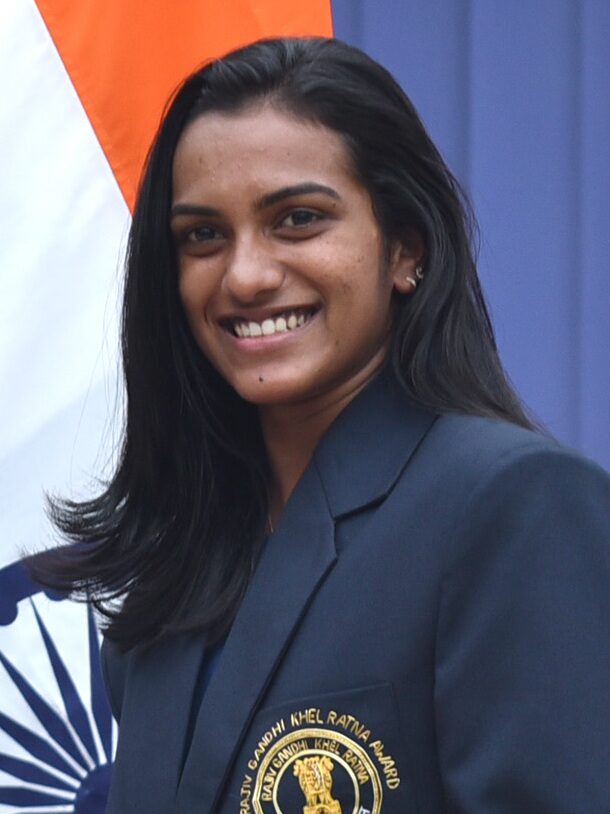
P. V. Sindhu is the most decorated Indian badminton player in modern Olympic history and the first Indian woman to win two individual Olympic medals — silver at Rio 2016 and bronze at Tokyo 2020. In 2019 she became the first Indian to be crowned BWF World Champion. Across the Olympic, World and Asian circuits, P. V. Sindhu has built a career that helped move Indian women’s badminton from periodic upsets into a steady presence on the international podium.
P. V. Sindhu’s name appears in UPSC sports questions, in the standard sports-honours tables and in essay material on women in Indian sport. She is also the first sports-marketing figure of her scale to come out of southern India after Sania Mirza, with brand endorsements that consistently place her among the highest-paid women athletes in the world.
This explainer covers P. V. Sindhu’s early life, her years at the Pullela Gopichand Academy in Hyderabad, her Olympic medals at Rio and Tokyo, her 2019 World Championship title, her Commonwealth and Asian Games record, her major civilian honours, and her recent life off the court.
Early Life and Family
Pusarla Venkata Sindhu was born on 5 July 1995 in Hyderabad. Sport was already in the family — both her parents played volleyball at the national level. Her father, P. V. Ramana, was a member of the Indian men’s volleyball team that won the bronze medal at the 1986 Seoul Asian Games and was awarded the Arjuna Award in 2000. Her mother, P. Vijaya, also represented India in volleyball.
Why badminton
Despite her parents’ background, P. V. Sindhu took up badminton at the age of eight, inspired by the All-England Open triumph of Pullela Gopichand in 2001. She began at the Indian Railway Institute of Signal Engineering and Telecommunications under the coaching of Mehboob Ali, and later moved to the Pullela Gopichand Badminton Academy in Hyderabad in 2004.
Training under Gopichand
The Gopichand Academy became central to her career. P. V. Sindhu has often spoken about her early years there — the 4 a.m. commute, the long contact hours, the strict diet — and the way Gopichand and his coaches built her capacity for long rallies. Her height (1.79 m), reach and physical strength made her a natural fit for the modern, attacking style that Gopichand was teaching.
Breakthrough Years (2009 to 2013)
P. V. Sindhu first came into national attention by winning the under-10 and under-14 titles in domestic competition. Her international breakthrough came in 2009, when she won bronze at the Sub-Junior Asian Badminton Championships in Colombo.
First senior title
She won her first senior international title at the 2013 Malaysian Open Grand Prix Gold. The same year, at the 2013 BWF World Championships in Guangzhou, she became the first Indian woman to win a singles medal at the world championships, taking bronze. She backed it up with another bronze at the 2014 Worlds in Copenhagen.
Padma Shri in 2015
The Government of India conferred the Padma Shri on her in 2015, making her one of the youngest recipients of the honour for sport.
Rio 2016: The Silver Medal
The Rio Olympics turned P. V. Sindhu into a household name across India. She entered the games as the world No. 10 and seeded ninth, after a year of injury and rebuilding under Gopichand.
Path to the final
She defeated Hungary’s Laura Sarosi, Canada’s Michelle Li, Chinese Taipei’s Tai Tzu Ying, China’s Wang Yihan and Japan’s Nozomi Okuhara on her way to the final — beating the world No. 1, No. 6 and No. 2 in successive rounds. In the final on 19 August 2016, she lost to Spain’s Carolina Marin 21-19, 12-21, 15-21 in a 1-hour-23-minute three-setter.
Significance
P. V. Sindhu’s Rio silver was India’s only silver of the games and only the fourth Olympic medal won by an Indian woman, after Karnam Malleswari (weightlifting, Sydney 2000), Mary Kom (boxing, London 2012) and Saina Nehwal (badminton, London 2012). She was 21.
World Championship Triumph: 2019
P. V. Sindhu had been runner-up at three consecutive World Championships — bronze in 2014, silver in 2017, silver in 2018. In 2019 in Basel, she finally broke through.
The final
On 25 August 2019, she defeated Japan’s Nozomi Okuhara 21-7, 21-7 in the final — the most lopsided women’s singles final in BWF World Championship history. In 38 minutes she became the first Indian to be crowned BWF World Champion and only the fourth Indian to win any colour of World Championship medal.
Tokyo 2020: The Second Olympic Medal
Tokyo (held in 2021 because of the COVID-19 pandemic) confirmed P. V. Sindhu’s status as India’s most consistent Olympic competitor.
Bronze medal match
After losing in the semi-final to Tai Tzu Ying, she defeated China’s He Bingjiao 21-13, 21-15 in the bronze-medal match on 1 August 2021 to win her second Olympic medal. The 26-year-old became the first Indian woman athlete and only the second Indian after wrestler Sushil Kumar to win two Olympic medals.
Padma Bhushan
The Government of India conferred the Padma Bhushan on her in 2020 in recognition of the 2019 World Championship and Olympic record. She had already received the Khel Ratna in 2016.
Other Major Honours
P. V. Sindhu’s medals across the major non-Olympic circuit complete the case for her position as India’s leading women’s shuttler.
Asian Games and Commonwealth Games
She won silver at the 2018 Asian Games (Jakarta-Palembang), losing the final to Tai Tzu Ying, and silver at the 2014 Glasgow Commonwealth Games and gold at the 2022 Birmingham Commonwealth Games in women’s singles. She has also been part of the Indian mixed-team gold-winning squad at the 2022 CWG.
BWF World Tour
She has won several Superseries / World Tour titles, including the 2017 India Open, 2017 Korea Open, 2018 BWF World Tour Finals (the first Indian shuttler to win it), 2019 Indonesia Open, 2022 Singapore Open and 2025 China Masters.
Civilian and sporting awards
Arjuna Award (2013), Padma Shri (2015), Khel Ratna (formerly Rajiv Gandhi Khel Ratna, 2016), Padma Bhushan (2020). She has also received honorary doctorates from a number of Indian universities.
Life Off the Court
P. V. Sindhu has been a brand ambassador for a long list of consumer companies — Bridgestone, JBL, Visa, Gatorade, Bank of Baroda — and Forbes has consistently listed her among the world’s highest-paid female athletes.
Marriage
She married Venkata Datta Sai, a business executive from Hyderabad, on 22 December 2024 at a private ceremony in Udaipur, with a wider reception in Hyderabad. She has continued on the international tour after the wedding.
Sport infrastructure
She has also been visible in public-sector sport initiatives — Khelo India, Target Olympic Podium Scheme, Fit India Movement — and has spoken in public about gaps in women’s sport infrastructure outside the metros.
Why P. V. Sindhu Matters for UPSC
P. V. Sindhu sits at the intersection of three syllabus areas. In GS-II (governance and welfare), her career illustrates how state academies like the Pullela Gopichand Academy, public training infrastructure like the Sports Authority of India, and the Khelo India ecosystem combine to produce world-level athletes from a city like Hyderabad.
In GS-I (Indian society), she is part of a wave of southern Indian women in elite sport that begins with Karnam Malleswari and Sania Mirza and continues today. Aspirants can place her alongside boxer Mary Kom, India’s other Olympic medallist in women’s individual sport, and in a wider tradition of women breaking ceilings that includes Kalpana Chawla in science, Sucheta Kripalani in politics, and Droupadi Murmu at the Rashtrapati Bhavan — running back to nineteenth-century figures like Rani Laxmibai.
In essay papers and ethics (GS-IV), P. V. Sindhu’s discipline, training schedule, and approach to the long four-year Olympic cycle is the kind of material that supports value-based arguments about persistence, mentorship and the role of long-term coaches in shaping public-funded sport.
Frequently Asked Questions
Who is P. V. Sindhu?
P. V. Sindhu is an Indian badminton player. She is a two-time Olympic medallist (silver at Rio 2016 and bronze at Tokyo 2020), the 2019 BWF World Champion, and one of India’s most decorated shuttlers.
When was P. V. Sindhu born?
She was born on 5 July 1995 in Hyderabad, into a family of national-level volleyball players.
Who coached P. V. Sindhu?
She was coached primarily by Pullela Gopichand at the Pullela Gopichand Badminton Academy in Hyderabad, with assistance from Mulyo Handoyo, Kim Ji-hyun, Park Tae Sang and others during different phases.
How many Olympic medals has P. V. Sindhu won?
She has won two Olympic medals — silver in women’s singles at the Rio 2016 Olympics and bronze in women’s singles at the Tokyo 2020 Olympics (held in 2021). She is the first Indian woman to win two Olympic medals.
What is P. V. Sindhu’s World Championship record?
She has won five World Championship medals — bronze (2013), bronze (2014), silver (2017), silver (2018) and gold (2019) — the highest by any Indian shuttler, male or female. Her 2019 gold made her the first Indian to be crowned BWF World Champion.
What awards has P. V. Sindhu received?
She has received the Arjuna Award (2013), Padma Shri (2015), Major Dhyan Chand Khel Ratna (2016) and Padma Bhushan (2020), among others.
Is P. V. Sindhu married?
Yes — she married business executive Venkata Datta Sai on 22 December 2024 at a private ceremony in Udaipur.
Why is P. V. Sindhu important for UPSC?
Her career is referenced in GS-II (sports policy, Khelo India, TOPS), GS-I (Indian society and women in sport) and GS-IV / essay (value-based questions on persistence and mentorship), as well as in standard sports-honours tables.
Tell Google you want more of this.
Add Anantam IAS as a preferred sourceOne tap, and this site shows up more often in your own Top Stories, AI Overviews and AI Mode. Remove it any time.