Ask most people what the Kashi Vishwanath Temple is and you get one line: a famous Shiva temple in Varanasi. That is true and it misses almost everything that matters. The confusion worth clearing up first is that the building you see today is not ancient. The current temple was raised in 1780, which makes it younger than the United States. Yet the site under it, the worship of Shiva as Vishwanath, and the pull the place exerts on Hindu belief are among the oldest continuous things in India. Between those two facts, a 240-year-old structure standing on a spot revered for well over a thousand years, sits a hard, layered story of destruction, rebuilding, royal patronage, and, most recently, one of the largest religious construction projects independent India has attempted. Understanding the temple means holding all of that at once.
What is the Kashi Vishwanath Temple, and why is it a Jyotirlinga?
The Kashi Vishwanath Temple is the principal Hindu shrine of Varanasi (Kashi), dedicated to Shiva in his form as Vishwanath or Vishweshwara, meaning “Lord of the Universe.” It stands on the western bank of the Ganga, tucked into the dense lanes of the old city, and its sanctum holds not an image but a lingam, a smooth dark stone that in Shaiva worship represents Shiva as formless, infinite reality rather than a human figure. Pilgrims do not look at a statue here. They pour Ganga water and offerings over the stone, which is the whole grammar of the ritual.
What lifts this shrine above the thousands of other Shiva temples in India is its status as a Jyotirlinga. The tradition holds twelve Jyotirlingas across the country, from Somnath in Gujarat to Rameshwaram in the south, each believed to be a place where Shiva manifested as a pillar of light, a *jyoti*. Kashi Vishwanath is counted among these twelve, and for many devotees it is the foremost of them. If you want the wider frame, the twelve Jyotirlingas form a devotional map of the subcontinent, and Kashi sits at its symbolic centre because of what the city itself is believed to be.
Here is the part that trips up newcomers to the topic. “Kashi,” “Varanasi,” and “Banaras” are three names for one place, and the temple carries the weight of the city’s own sacred reputation. Kashi means “the city of light,” and Hindu belief treats it as the holiest of the seven sacred cities, a place where dying is considered auspicious because it is thought to grant *moksha*, release from the cycle of rebirth. The temple is the beating heart of that belief, which is why its fortunes have never been a purely local matter.
The layered history: destruction, rebuilding, and 1780
The single most important thing to grasp about this temple is that it has been destroyed and rebuilt several times, and the present building is only the latest layer. This is not a shrine that has stood untouched for centuries. It is a site whose sanctity survived even when its structures did not, which is a different and more interesting kind of endurance.
Early temples on or near the site were damaged during the medieval invasions of northern India. A temple here was demolished around 1194 in the campaigns that followed the establishment of Turkic power in the Gangetic plain, part of the same wave that founded the Delhi Sultanate. Temples were rebuilt and destroyed again more than once over the following centuries as political control of the region shifted. The most consequential demolition came in 1669, when the Mughal emperor Aurangzeb ordered the temple pulled down and the Gyanvapi Mosque raised on the spot. The mosque still stands immediately beside the present temple, and the surviving fragments of older temple structure visible in its fabric are why the two sites remain physically and legally entangled to this day. This is best stated plainly and studied soberly: it is a real and contested part of the historical record, not a slogan.
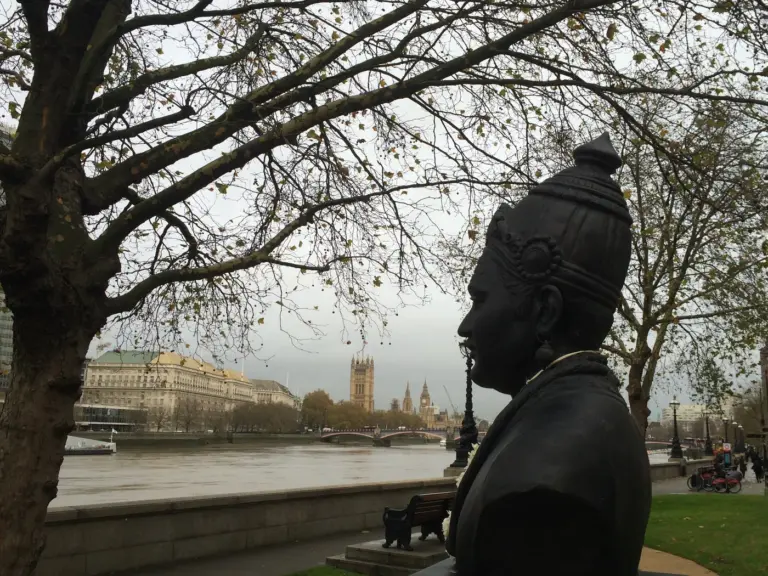
The temple you can visit now came more than a century later, and it came from an unexpected quarter. It was Ahilyabai Holkar, the Maratha queen of Indore in Malwa, who had the present temple built in 1780 on a plot adjacent to the mosque. Ahilyabai is one of the most remarkable rulers of eighteenth-century India, a widow who governed Malwa for three decades and funded the construction and repair of temples, ghats, wells, and rest houses across the country, from Somnath to Gaya. Kashi Vishwanath is her most famous commission. So the temple’s rebirth is a story of Maratha patronage stepping in where Mughal policy had torn down, and of a woman ruler doing what emperors had not.
The gold came later still. In the 1830s, Maharaja Ranjit Singh, the founder of the Sikh empire in Punjab, is credited with donating close to a tonne of gold to plate the temple’s two spires. That golden covering is why Kashi Vishwanath is sometimes called the “Golden Temple” of Varanasi, not to be confused with the Sikh shrine at Amritsar. Three layers, then, in the building alone: an ancient and repeatedly contested site, an eighteenth-century Maratha temple, and a nineteenth-century Sikh gift of gold.
The architecture and the sacred geography of Kashi
Architecturally, the 1780 temple is a compact Nagara-style structure, the north Indian temple form defined by its curving spire, and it is far smaller and plainer than its fame suggests. The main temple is modest in footprint, built around the sanctum housing the lingam, crowned by a shikhara (the tower over the sanctum) and topped by the gilded spires. There is a smaller dome and a *mandapa*, a pillared hall, in front. If you have studied the grand temple complexes of the classical Indian architectural styles, the surprise here is how unassuming the actual shrine is. Its power was never in scale. It was in location and meaning.
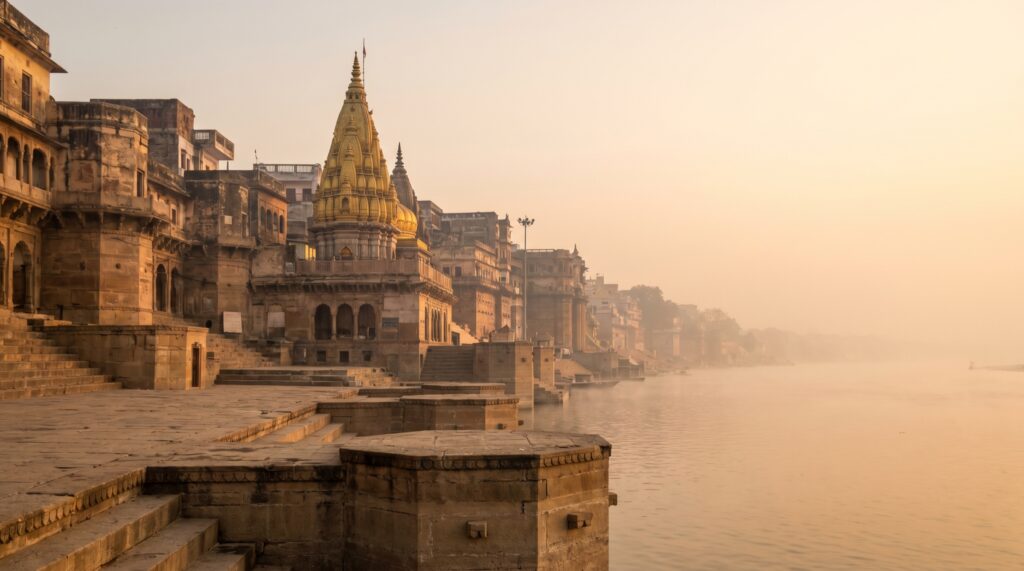
That location is the key. The temple sits inside the oldest core of Varanasi, one of the world’s continuously inhabited cities, on the western bank of the Ganga where the river, unusually, flows northward. For much of its recent history the shrine was hemmed in on all sides by a tangle of narrow lanes and houses built right up against it, so that pilgrims reached it through a maze barely wide enough for two people. You could stand a few metres away and not see it. That physical crowding, the temple buried inside the city rather than commanding it, is exactly what the Corridor project set out to change.
The wider frame is what devotees call the sacred geography of Kashi. The city is understood as a *tirtha*, a crossing place between the mortal and the divine, mapped by the Panchkroshi pilgrimage route that circles it and studded with dozens of temples, shrines, and the famous ghats stepping down to the river. Two ghats matter most in the temple’s story: Manikarnika, the great cremation ghat where the dead are burned in the belief that death in Kashi brings liberation, and Lalita Ghat nearby. The temple and the river are two poles of a single religious idea, and until recently there was no dignified, direct way to walk between them.
The Kashi Vishwanath Corridor (Dham): connecting temple to river
The Kashi Vishwanath Dham, commonly called the Kashi Vishwanath Corridor, is a large redevelopment project inaugurated in December 2021 that cleared the congested lanes around the temple and built a wide, planned pathway linking the shrine directly to the Ganga ghats. In practical terms, it demolished several hundred cramped buildings that had grown up around the temple over generations, opened the shrine to view, and created a walkable complex of roughly 5 lakh square feet running from the temple down to Lalita Ghat on the river. Where pilgrims once squeezed through blind alleys, there is now an open corridor from the water to the sanctum.
The project was substantial in cost and scope, reported in the region of ₹900 crore across its phases, and it added pilgrim facilities that the old cramped site simply could not hold: prayer halls, a *mumukshu bhavan* and guest houses for pilgrims, a Vedic centre, museums and galleries, food courts, and covered waiting areas. During the clearing of the surrounding buildings, dozens of small older shrines that had been swallowed up inside private houses over the centuries were rediscovered and restored, which is a genuinely striking detail. The corridor did not just build new space. It uncovered old sacred structures that had literally been walled into people’s homes.
The redevelopment was not without debate, and it is fair to record that. Clearing the dense old fabric around the temple meant relocating families and businesses and demolishing historic urban texture, and heritage-minded critics questioned the scale of the intervention in one of the world’s oldest living cityscapes. Supporters counter that the site had become dangerously overcrowded and inaccessible, and that pilgrim numbers have risen sharply since the corridor opened, with footfall reported in the crores annually. Both things are true at once: the corridor transformed access and the experience of visiting, and it did so by remaking a piece of the ancient city. A balanced study of the project holds the gain and the cost together rather than picking one.
Who manages the temple, and its civilizational significance
The temple has been administered by the Shri Kashi Vishwanath Temple Trust under a state law, the Uttar Pradesh Sri Kashi Vishwanath Temple Act of 1983, which brought the shrine and its endowments under government-supervised management rather than private priestly control. This is a common arrangement for major Hindu temples in India and it is worth knowing, because temple governance, who controls the funds, the priests, and the land, is a live subject in Indian public life.
Beyond administration, the temple’s real significance is civilizational. Kashi has been a centre of Sanskrit learning, philosophy, music, and pilgrimage for well over two thousand years, drawing scholars and seekers from across the subcontinent, and the Vishwanath temple has stood at its devotional core through every political upheaval the region has seen. The pattern of the temple, torn down, rebuilt, gilded, buried in the city, then reopened to the river, is in a sense the pattern of Indian religious continuity itself: not an unbroken building, but an unbroken belief that kept finding new stone to stand on. That is the frame worth carrying away.
Quick facts: Kashi Vishwanath Temple at a glance
| Feature | Detail |
|---|---|
| Deity | Shiva as Vishwanath / Vishweshwara (“Lord of the Universe”) |
| Object of worship | Jyotirlinga (a lingam, not an idol) |
| Status | One of the twelve Jyotirlingas; foremost for many devotees |
| Location | Varanasi (Kashi), Uttar Pradesh, western bank of the Ganga |
| Present temple built by | Ahilyabai Holkar, queen of Indore, in 1780 |
| Major demolition | 1669, under Aurangzeb; Gyanvapi Mosque built adjacent |
| Gold plating | Attributed to Maharaja Ranjit Singh, 1830s (about a tonne of gold) |
| Architectural style | Nagara (north Indian), with shikhara and gilded spires |
| Corridor (Dham) inaugurated | December 2021, linking temple to Lalita Ghat on the Ganga |
| Corridor area | Roughly 5 lakh square feet |
| Managing body | Shri Kashi Vishwanath Temple Trust (UP Act, 1983) |
How to study and remember this
Do not memorise a flat list of dates. Anchor the topic on one idea, continuity through destruction, and hang three clusters off it. First, the what: Shiva as Vishwanath, worshipped as a Jyotirlinga, a lingam not an idol, in the holiest of the sacred cities. Second, the history as a relay: an ancient contested site, demolished under Aurangzeb in 1669 with the Gyanvapi Mosque built beside it, rebuilt by Ahilyabai Holkar in 1780, gilded by Ranjit Singh in the 1830s. Learn those four figures as a chain and the timeline holds itself together.
Third, the modern chapter: the Corridor of 2021, which linked the temple to the Ganga, and the debate that came with it. If a question asks you to reflect rather than recall, that debate, access and scale versus heritage and displacement, is where the marks are. Pair this temple with a wider read on the Ganga and the cities along it, because Kashi Vishwanath only makes full sense as a river shrine, one pole of a sacred landscape whose other pole is the burning ghat by the water.
Frequently Asked Questions
Where is the Kashi Vishwanath Temple located?
It stands in Varanasi (Kashi), Uttar Pradesh, on the western bank of the Ganga, inside the old core of the city. Varanasi, Kashi, and Banaras are three names for the same place.
Why is the Kashi Vishwanath Temple important?
It is one of the twelve Jyotirlingas of Shiva and, for many Hindus, the foremost among them. It sits at the devotional heart of Kashi, believed to be the holiest of the seven sacred cities and a place where death is thought to grant liberation.
Who built the present Kashi Vishwanath Temple?
The current structure was built in 1780 by Ahilyabai Holkar, the Maratha queen of Indore, on a site adjacent to the Gyanvapi Mosque. Earlier temples on the site were destroyed and rebuilt several times.
Why is it sometimes called the Golden Temple of Varanasi?
Because Maharaja Ranjit Singh of the Sikh empire is credited with donating close to a tonne of gold in the 1830s to plate the temple’s spires. It is a different site from the Sikh Golden Temple at Amritsar.
What is the Kashi Vishwanath Corridor?
The Kashi Vishwanath Dham, inaugurated in December 2021, is a large redevelopment that cleared the congested lanes around the temple and built an open pathway of roughly 5 lakh square feet connecting the shrine directly to the Ganga ghats, along with pilgrim facilities.
What is worshipped inside the sanctum?
A lingam, a smooth dark stone that represents Shiva as formless, infinite reality. There is no human image or statue. Devotees offer Ganga water and flowers over the stone.
Who manages the temple today?
The Shri Kashi Vishwanath Temple Trust, constituted under the Uttar Pradesh Sri Kashi Vishwanath Temple Act of 1983, administers the shrine and its endowments under state supervision.
Practice Questions
1. The Kashi Vishwanath Temple is dedicated to which deity?
a) Vishnu
b) Shiva
c) Surya
d) Ganesha
Answer: b) Shiva
2. The present Kashi Vishwanath Temple, built in 1780, was commissioned by:
a) Emperor Aurangzeb
b) Maharaja Ranjit Singh
c) Ahilyabai Holkar
d) Rani Lakshmibai
Answer: c) Ahilyabai Holkar
3. The Kashi Vishwanath Temple is counted among the:
a) Char Dham
b) Twelve Jyotirlingas
c) Seven Moksha-puris only
d) Ashta Vinayak
Answer: b) Twelve Jyotirlingas
4. The gold plating of the temple’s spires is attributed to:
a) Ahilyabai Holkar
b) Akbar
c) Maharaja Ranjit Singh
d) Guru Gobind Singh
Answer: c) Maharaja Ranjit Singh
5. The Kashi Vishwanath Corridor (Dham), inaugurated in 2021, primarily connects the temple to:
a) The Varanasi railway station
b) The Ganga ghats
c) Sarnath
d) The Banaras Hindu University campus
Answer: b) The Ganga ghats
Mains-style questions
1. The Kashi Vishwanath Temple has been destroyed and rebuilt several times, yet its sanctity endured. Discuss what this pattern reveals about the nature of religious continuity in India.
2. Examine the role of Ahilyabai Holkar as a temple builder and administrator in eighteenth-century India, with reference to the reconstruction of Kashi Vishwanath.
3. The Kashi Vishwanath Corridor transformed access to the temple but drew criticism for its scale. Critically evaluate the project, weighing pilgrim access against heritage and displacement concerns.
4. Explain the concept of a Jyotirlinga and situate the Kashi Vishwanath Temple within the sacred geography of Varanasi.
5. Discuss how government legislation, such as the Uttar Pradesh Sri Kashi Vishwanath Temple Act of 1983, shapes the management of major Hindu temples in India.
Read the temple the way you would read a palimpsest, a page written over many times, and it stops being a date to memorise. The dark lingam is old beyond reliable dating, the walls around it are Ahilyabai’s from 1780, the gold on the spire is Ranjit Singh’s from the 1830s, and the open corridor down to the river is barely a few years old. Every layer was laid by a different hand in a different century, and the belief running through all of them never broke. That is the real subject here: not a building, but a continuity that kept rebuilding its own house.
Tell Google you want more of this.
Add Anantam IAS as a preferred sourceOne tap, and this site shows up more often in your own Top Stories, AI Overviews and AI Mode. Remove it any time.