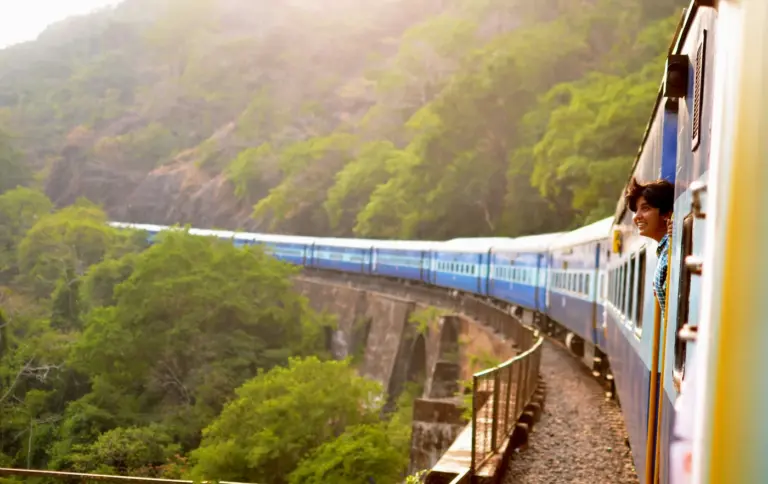
Most people picture the Konkan Railway climbing the Western Ghats, hauling itself up hairpin gradients through the Sahyadris. It doesn’t. It never climbs the Ghats at all. The line runs on the narrow coastal shelf between the Ghats and the Arabian Sea, staying low the whole way, and that’s precisely what made it the hardest railway India has ever built. Not the height. The geometry.
Here’s the fact that reorganises everything else. The Western Ghats run north to south, parallel to the coast. Every river draining off them, the Vashishti, the Savitri, the Zuari, the Mandovi, the Kali, the Sharavati, runs west across that shelf into the sea. The railway also runs north to south. So it cuts across the grain of the land at right angles, crossing every river and every laterite spur poking westward from the Ghats. Nothing lines up with the direction you want to travel. That’s the whole secret, and it explains the 91 tunnels better than any adjective about difficulty.
What the Konkan Railway is, and where it runs
The Konkan Railway is a 741 km broad-gauge line from Roha, in Maharashtra’s Raigad district, to Thokur, about 20 km north of Mangaluru in Karnataka, running through Maharashtra, Goa and Karnataka. It was commissioned on 26 January 1998, seven years and three months after construction began in October 1990.
What it replaced is the point. Before the line existed, a train from Mumbai to Mangaluru had to swing far inland, up and over the Ghats via Pune, Miraj, Londa and Hubli, then back down. The Konkan Railway cut that journey by roughly 1,127 km and about 26 hours, turning a day and a half into an overnight run. For a coastal strip that had spent a century watching the trunk routes pass on the far side of a mountain wall, that wasn’t an upgrade. It was the first time the Konkan was properly connected to anything, and if your notes on Indian Railways file projects by era, this is the hinge between the old budget-funded model and everything after it.
| Attribute | Detail |
|---|---|
| Route | Roha (Maharashtra) to Thokur (Karnataka), via Goa |
| Length | About 741 km, broad gauge |
| Executing body | Konkan Railway Corporation Limited (KRCL), incorporated 19 July 1990 |
| Equity split | Ministry of Railways 51%; Maharashtra 22%; Karnataka 15%; Goa 6%; Kerala 6% |
| First Chairman and MD | E. Sreedharan (1990 to 1997) |
| Construction | October 1990 to January 1998 |
| Tunnels | About 91, totalling roughly 84 km |
| Bridges | Close to 2,000, of which 179 are major |
| Longest tunnel | Karbude, about 6.5 km, near Ratnagiri |
| Tallest viaduct | Panval Nadi, piers up to about 64 m, near Ratnagiri |
| Cost | Estimated about Rs 1,400 crore; completed at about Rs 3,550 crore |
| Financing | Build-operate-transfer, funded largely by tax-free public bonds |
| Distance saved | Mumbai to Mangaluru shortened by about 1,127 km and 26 hours |
Why the coast, not the Ghats, made this so hard
The Konkan coast punishes railway builders in four ways at once, and only one of them is terrain.
The land runs the wrong way. Where the ground cooperates, you follow a valley for 40 km. Here you get maybe two, then a spur to tunnel through and a river to bridge. The tunnel and bridge counts aren’t a flourish. They’re the only way to go straight.
The rock is unreliable. The Konkan sits on laterite, soft, iron-rich, weathered rock that looks solid and behaves badly. Hard rock is a gift to a tunneller: it holds its own roof while you work. Soft ground doesn’t. The Pernem tunnel in Goa became the project’s most notorious stretch, hitting ground so soft it flowed rather than held, and it swallowed over three years on its own.
The water arrives all at once. The Konkan takes 3,000 to 4,000 mm of rain in a single season, most of it across four months. Delhi gets roughly 700 mm in a whole year. Sit those numbers side by side and you stop treating drainage and slope stability as afterthoughts. They were the design.
The land was already occupied. This coast is densely settled, with fragmented smallholdings held in families for generations, and the project had to acquire land across something like 42,000 plots. Land acquisition was arguably the harder problem, and KRCL’s choice to negotiate settlements rather than fight through courts is a large part of why the line finished in seven years instead of twenty. Anyone studying why Indian infrastructure under PPP and SPV models stalls should look at that column first.
The signature structures: Panval Nadi viaduct and Karbude tunnel
Two structures carry the line’s reputation, and each solved a different problem.
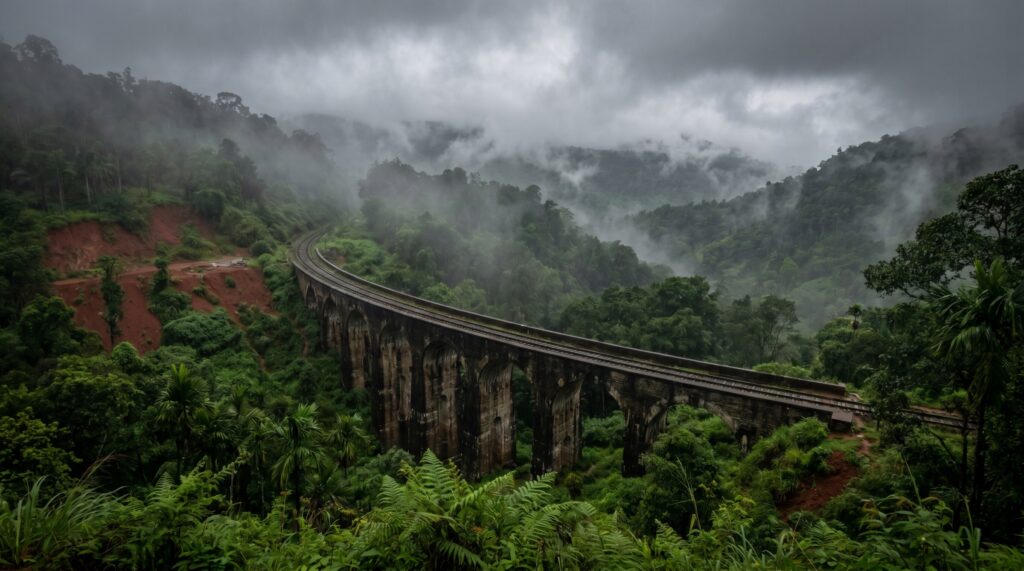
The Panval Nadi viaduct, near Ratnagiri, is the tallest viaduct in India, with piers rising about 64 m, roughly a 20-storey building, across a 424 m span. What makes it a teaching example isn’t the height. It’s the method. It was built by incremental launching: rather than assemble the deck in mid-air over a gorge, the crew cast segments on the bank and pushed the whole deck out horizontally across the piers, like sliding a plank over a gap instead of carrying it out. When you can’t get heavy cranes into a river gorge in a rainforest, that choice is the engineering.
The Karbude tunnel, also near Ratnagiri, runs about 6.5 km and was the longest railway tunnel in India when it opened. It has since been beaten by the Pir Panjal tunnel on the Jammu line at 11.2 km, which is a satisfying footnote: KRCL was the executing agency for Pir Panjal too. It built the thing that broke its own record, because by then it was who the country called when a tunnel looked impossible. The Sharavati bridge near Honnavar, at roughly 2 km, is the longest on the route. Tall viaduct, long tunnel, long bridge, each answering a different way the coast says no.
KRCL: a corporation that is not a railway zone, and the money that built it
Konkan Railway Corporation Limited was incorporated on 19 July 1990 as a PSU under the Ministry of Railways, and here’s the structural oddity that still shapes it: KRCL is not a zone of Indian Railways. It’s a separate company that owns and maintains the track, while Indian Railways’ zones run the trains over it. Equity went to the Ministry of Railways at 51%, Maharashtra 22%, Karnataka 15%, and Goa and Kerala at 6% each. Notice Kerala, which put money in although not one kilometre runs through the state, because it had everything to gain from a fast link north.
The financing was the real innovation, and it’s why the line exists. Railway projects were traditionally paid for from the railway budget, which meant they moved at the speed of annual allocations, which is to say slowly. This one was structured on a build-operate-transfer basis, with KRCL raising most of the money itself through tax-free bonds sold to the public. Ordinary savers funded a railway. That bought speed: freed from waiting for budget lines, the project finished in seven years under first Chairman and Managing Director E. Sreedharan, who took the same playbook to the Delhi Metro. As a template for funding infrastructure through a special purpose vehicle instead of a ministry’s annual budget, it’s the ancestor of much of what followed, and any list of public sector undertakings that changed how the state builds has to include it.
Now the part the celebratory version leaves out. The same bonds that got the line built fast left KRCL carrying heavy debt from the day it opened, and a single coastal line was never going to service that quickly. Because it isn’t a zone, it doesn’t get the budget support a zone gets, and its staff don’t sit on Indian Railways’ pay and pension terms. Karnataka and Kerala have pushed for years to merge KRCL into Indian Railways; Maharashtra and Goa have been cooler. My read: the trade was still worth taking, because a railway that exists and struggles financially beats a fully funded one still sitting on a file. But teach it as a trade-off, not a triumph.
Three experiments: the anti-collision device, the Sky Bus, and RoRo
KRCL didn’t stop at building the line, and its three best-known experiments landed very differently. Take them honestly, including the one that failed.
The Anti-Collision Device, or ACD, was KRCL’s own GPS-based system, patented and branded Raksha Kavach. Each locomotive carried a unit that talked to others nearby and braked automatically if two trains closed on the same track. It ran on the Konkan route and on the Northeast Frontier Railway. Be precise here, because these two get muddled: the Kavach system now being rolled out across Indian Railways is TCAS, developed later by the RDSO, and it’s a different system. KRCL’s ACD was the earlier indigenous attempt, and its contribution was proving an Indian organisation could field automatic train protection at all.
The Sky Bus Metro was the swing that missed. Sreedharan’s concept hung a coach beneath an elevated concrete box, so the track rode above the traffic and the coach couldn’t derail sideways. A 1.6 km test track was built at Madgaon in Goa and a prototype ran in 2004. Then a trial went wrong in September 2004, a technician was killed, and the project was shelved. Carry this one, because a case study where the celebrated engineer’s bold idea didn’t work teaches more than another success would.
The Roll-on Roll-off service, launched in January 1999, was the quiet winner. Loaded trucks drive onto flat wagons, ride between Kolad and Verna, and drive off at the other end, drivers travelling alongside. It pulled truck traffic off the coastal highway, cut diesel burn and accidents, and became dependable revenue. First of its kind in India, and it worked precisely because it was unglamorous. It just noticed that a road ran parallel to a railway and asked why both had to carry the same trucks.
What the line changed for the west coast
The Konkan Railway made the coastal strip economically legible, and the effects stack in three layers.
Goods. The line links Jawaharlal Nehru Port near Mumbai, Mormugao in Goa and New Mangalore into one corridor, moving iron ore, cement, fertiliser, fish and horticulture. Alphonso mangoes, cashew and the Konkan’s fish now reach Mumbai and Delhi while still worth selling, a small sentence with a large income attached for coastal Maharashtra.
People. The Konkan has sent workers to Mumbai for over a century. The railway turned a punishing two-day trip into an overnight one, which is why the Ganpati rush sees KRCL run dozens of extra trains, and why ridership spikes around a festival rather than a holiday.
Strategy. The corridor runs past the naval base at Karwar, INS Kadamba, and links the western ports to each other by rail rather than by a single highway. A coast with one road is a coast with one point of failure, and the Arabian Sea frontage matters enough that a redundant land link counts as strategic infrastructure. The line has been fully electrified from Roha to Thokur since around 2022, and doubling is proceeding in sections: boring, essential follow-through, because a single-track line has a hard ceiling on how many trains it can run.
The monsoon problem, and why it still rules the timetable
The Konkan Railway runs a separate monsoon timetable every year, roughly 10 June to 31 October, with reduced speeds and intensified patrolling. That isn’t caution left over from the 1990s. It was bought with lives.
On 22 June 2003, a landslide near Vaibhavwadi derailed a train and killed around 51 people. On 16 June 2004, the Matsyagandha Express derailed in the same broad stretch, killing about 20. Both in the monsoon, both on slopes cut through soft laterite and then soaked for weeks. The mechanism is what you’d predict: sustained rain saturates the weathered rock, pore pressure rises, the shear strength of the slope drops, and the cut face lets go onto the track. It’s the same physics behind landslides across India, concentrated on a railway that had to cut through hundreds of unstable spurs to exist.
KRCL’s response was systematic rather than cosmetic: self-drilling rock anchors, wire mesh netting to catch boulders, retaining walls, better drainage, and a network of watchmen and patrolmen through the season. The monsoon timetable is a permanent tax on this line, not a bug awaiting a fix. You can’t re-engineer 3,500 mm of seasonal rain out of the Indian monsoon, and you can’t un-cut hundreds of laterite slopes on the flank of the Western Ghats. What you can do is monitor, stabilise, slow down and patrol. Read the slow timetable as competence, not failure.
How to study the Konkan Railway
Hang the whole topic on one geographical insight and the details stop being a list. The insight: the line runs across the grain of the land. The tunnels follow, the bridges follow, the laterite trouble follows, the landslides follow, the cost overrun follows. Say that sentence and you can rebuild this article from it.
Then attach four anchors. Geography: Roha to Thokur, 741 km, three states, coastal shelf not Ghats. Engineering: Karbude 6.5 km, Panval Nadi 64 m by incremental launching, about 91 tunnels and 2,000 bridges. Institutions and finance: KRCL as a non-zone PSU from 1990, 51:22:15:6:6 equity, BOT funded by tax-free bonds, Sreedharan, and the debt hangover. Operations: ACD, the Sky Bus failure, RoRo, and the monsoon timetable.
Two precision traps. First, the line does not cross the Western Ghats, it runs along their western foot; saying it “climbs the Sahyadris” gives away that you learned the topic from a caption. Second, KRCL’s Anti-Collision Device is not the Kavach system being deployed today. Related in purpose, different in origin. Getting that pair right does more for an answer than another statistic ever would.
Frequently Asked Questions
What is the route of the Konkan Railway?
It runs about 741 km from Roha in Maharashtra’s Raigad district to Thokur, roughly 20 km north of Mangaluru in Karnataka, passing through Maharashtra, Goa and Karnataka along the coastal strip.
Why was the Konkan Railway considered an engineering feat?
Because it crosses the grain of the land. The Ghats and the rivers draining off them run at right angles to the route, so the line needed about 91 tunnels covering roughly 84 km and close to 2,000 bridges, built through soft laterite in a region that gets 3,000 to 4,000 mm of rain a season.
What is the Panval Nadi viaduct?
The tallest viaduct in India, near Ratnagiri, with piers rising about 64 m across a 424 m span. It was built by incremental launching, where the deck is cast on the bank and pushed out horizontally over the piers rather than assembled in mid-air.
What is the longest tunnel on the Konkan Railway?
The Karbude tunnel near Ratnagiri, about 6.5 km long. It was India’s longest railway tunnel when it opened, until the 11.2 km Pir Panjal tunnel on the Jammu line took the title. KRCL was the executing agency for Pir Panjal as well.
Who owns and runs the Konkan Railway?
Konkan Railway Corporation Limited, a PSU incorporated on 19 July 1990. The Ministry of Railways holds 51%, Maharashtra 22%, Karnataka 15%, and Goa and Kerala 6% each. KRCL is not a zone of Indian Railways, which is why merger proposals keep resurfacing.
How was the Konkan Railway financed?
On a build-operate-transfer basis, with KRCL raising most of the money through tax-free bonds sold to the public rather than depending on the railway budget. That got the line built in seven years, but left the corporation servicing heavy debt from the day it opened.
Why does the Konkan Railway run a separate monsoon timetable?
Because saturated laterite slopes fail in heavy rain. After landslide-related accidents in 2003 and 2004, KRCL adopted a monsoon timetable running roughly from 10 June to 31 October, with reduced speeds, slope anchoring, boulder netting and continuous patrolling.
Practice Questions
1. The Konkan Railway runs between:
a) Mumbai and Mangaluru
b) Roha and Thokur
c) Panvel and Madgaon
d) Pune and Karwar
Answer: b
2. The main engineering challenge of the Konkan Railway was that:
a) The line had to climb steep gradients over the Western Ghats
b) The route crossed the rivers and ridges of the Ghats at right angles, through soft laterite and heavy rain
c) The terrain was desert with no water for construction
d) The alignment passed through permafrost
Answer: b
3. The Panval Nadi viaduct is notable as:
a) India’s longest railway bridge
b) India’s tallest railway viaduct, built by incremental launching
c) The first cable-stayed rail bridge in Asia
d) The longest tunnel on the Konkan route
Answer: b
4. Which statement about Konkan Railway Corporation Limited is correct?
a) It is a zone of Indian Railways
b) It is a PSU in which the Ministry of Railways holds 51% and four states hold the rest
c) It is wholly owned by the Government of Maharashtra
d) It is a private company operating under a concession
Answer: b
5. The Roll-on Roll-off service of the Konkan Railway involves:
a) Carrying loaded trucks on flat wagons between terminals
b) Rolling stock manufactured on the Konkan coast
c) A ferry link across the Arabian Sea
d) Automatic braking of trains on curves
Answer: a
Mains-style questions
1. Explain how the physiography of the Konkan coast and the drainage pattern of the Western Ghats determined the engineering design of the Konkan Railway. 2. “The Konkan Railway’s financing model was both its greatest achievement and its lasting burden.” Critically examine. 3. Discuss the economic and strategic significance of the Konkan Railway for India’s western seaboard. 4. Analyse the causes of monsoon landslides along the Konkan Railway and evaluate the mitigation measures adopted by KRCL. 5. Assess the case for and against merging Konkan Railway Corporation Limited with Indian Railways, considering the interests of the stakeholder states.
The Konkan Railway earns its reputation twice over, for opposite reasons. It’s an engineering achievement: 741 km of tunnels and viaducts driven across a coast that refused to lie flat in the useful direction, finished in seven years by an organisation that had to invent its own funding to exist. But it’s also an argument about how India builds. A special purpose vehicle raised money from the public, negotiated with 42,000 landowners instead of litigating with them, shipped, and then spent two decades paying for the privilege while the states it serves argue over who should absorb it. Learn the tunnels if you want the trivia. Learn the trade-off if you want to say something worth reading about how the country actually gets things built.
Tell Google you want more of this.
Add Anantam IAS as a preferred sourceOne tap, and this site shows up more often in your own Top Stories, AI Overviews and AI Mode. Remove it any time.