Introduction
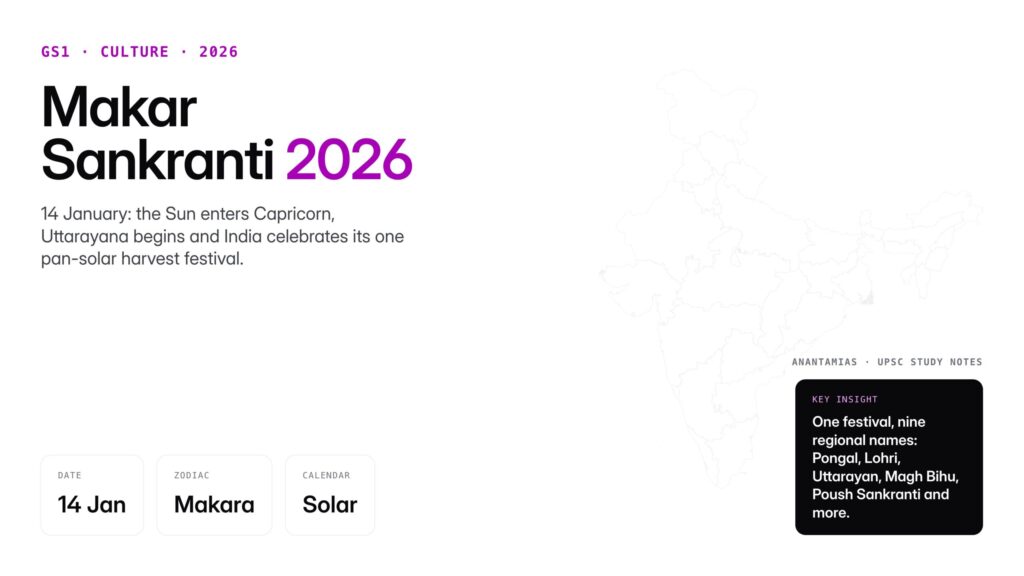
Makar Sankranti is one of the few Hindu festivals tied to the solar calendar rather than the lunar cycle, which is why its date remains almost fixed every year. In 2026, Makar Sankranti falls on Wednesday, 14 January, marking the Sun’s transition into Makara (Capricorn) and the onset of Uttarayana, the six-month northward journey of the Sun. For UPSC aspirants, the festival is a compact case study in Indian astronomy, agrarian cycles and the cultural diversity that stitches together states as varied as Punjab, Tamil Nadu, Assam and Gujarat.
Beyond kite-flying in Ahmedabad or til-gud in Maharashtra, Makar Sankranti touches syllabus themes across GS Paper 1 — Indian culture, fairs and festivals, solar astronomy and regional harvest traditions. This note unpacks the 2026 date, astronomical basis, regional names, rituals, historical roots and examination-ready angles aspirants can use in both Prelims and Mains.
Quick Facts at a Glance
| Attribute | Detail |
|---|---|
| Date in 2026 | Wednesday, 14 January 2026 |
| Punya Kaal Muhurat | Approx. 07:15 AM to 05:45 PM (IST) |
| Maha Punya Kaal | Approx. 07:15 AM to 09:00 AM (IST) |
| Solar Event | Sun enters Makara (Capricorn) rashi |
| Astronomical Name | Winter solstice harvest festival; start of Uttarayana |
| Calendar Type | Solar (Saura) calendar, not lunar |
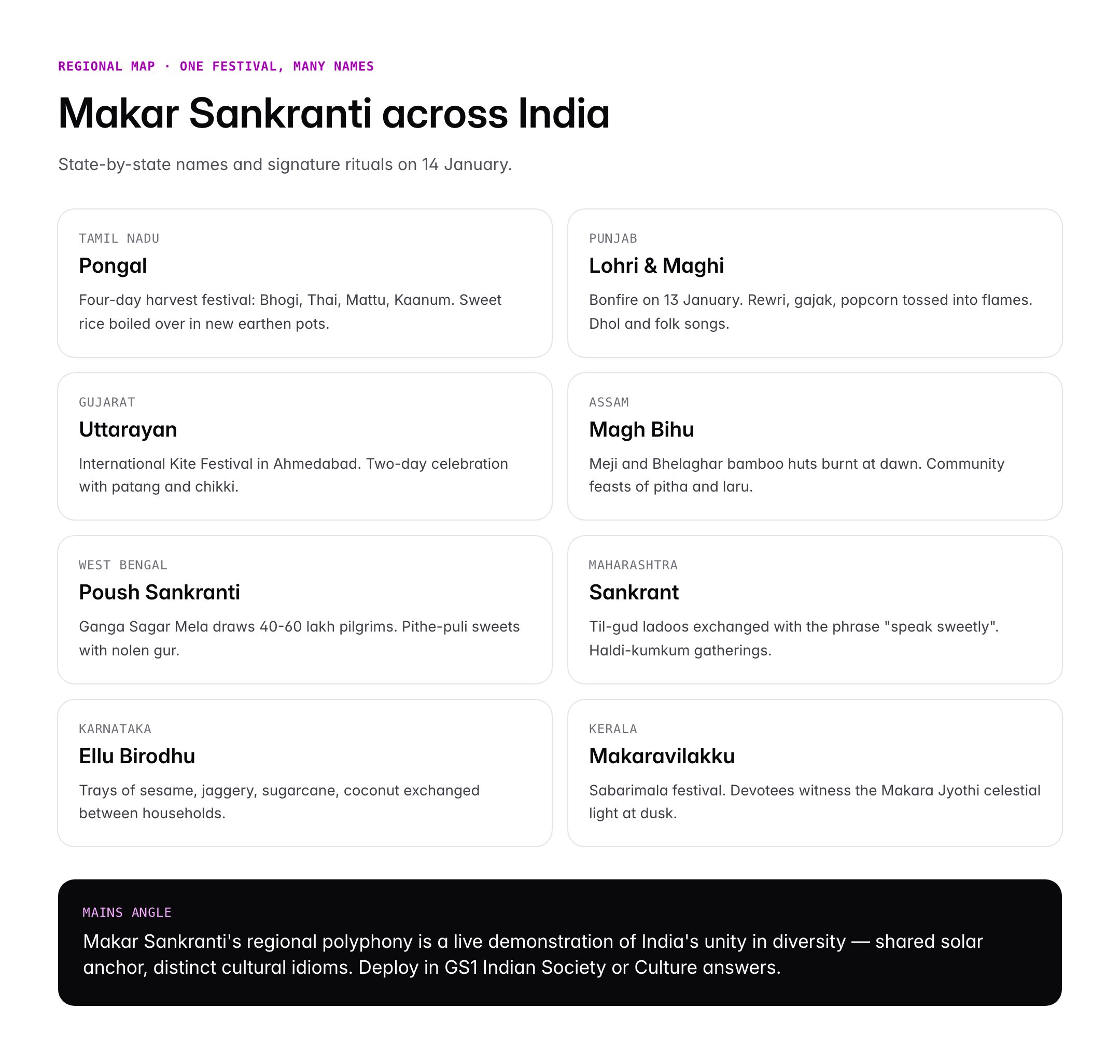
| Also Called | Uttarayan, Pongal, Lohri, Magh Bihu, Poush Sankranti |
| Harvest Crops Celebrated | Paddy, sugarcane, sesame |
| Religious Texts | Mahabharata, Vishnu Purana, Bhagavata Purana |
Background and Historical Context
The festival’s origins can be traced to the Vedic reverence for Surya (the Sun god) and to the astronomical observation that the Sun begins its northward journey after the winter solstice. Classical Sanskrit texts such as the Mahabharata link Makar Sankranti to Bhishma Pitamah, who is said to have waited for Uttarayana on his bed of arrows before relinquishing his life, believing the northward path of the Sun was the auspicious route to moksha.
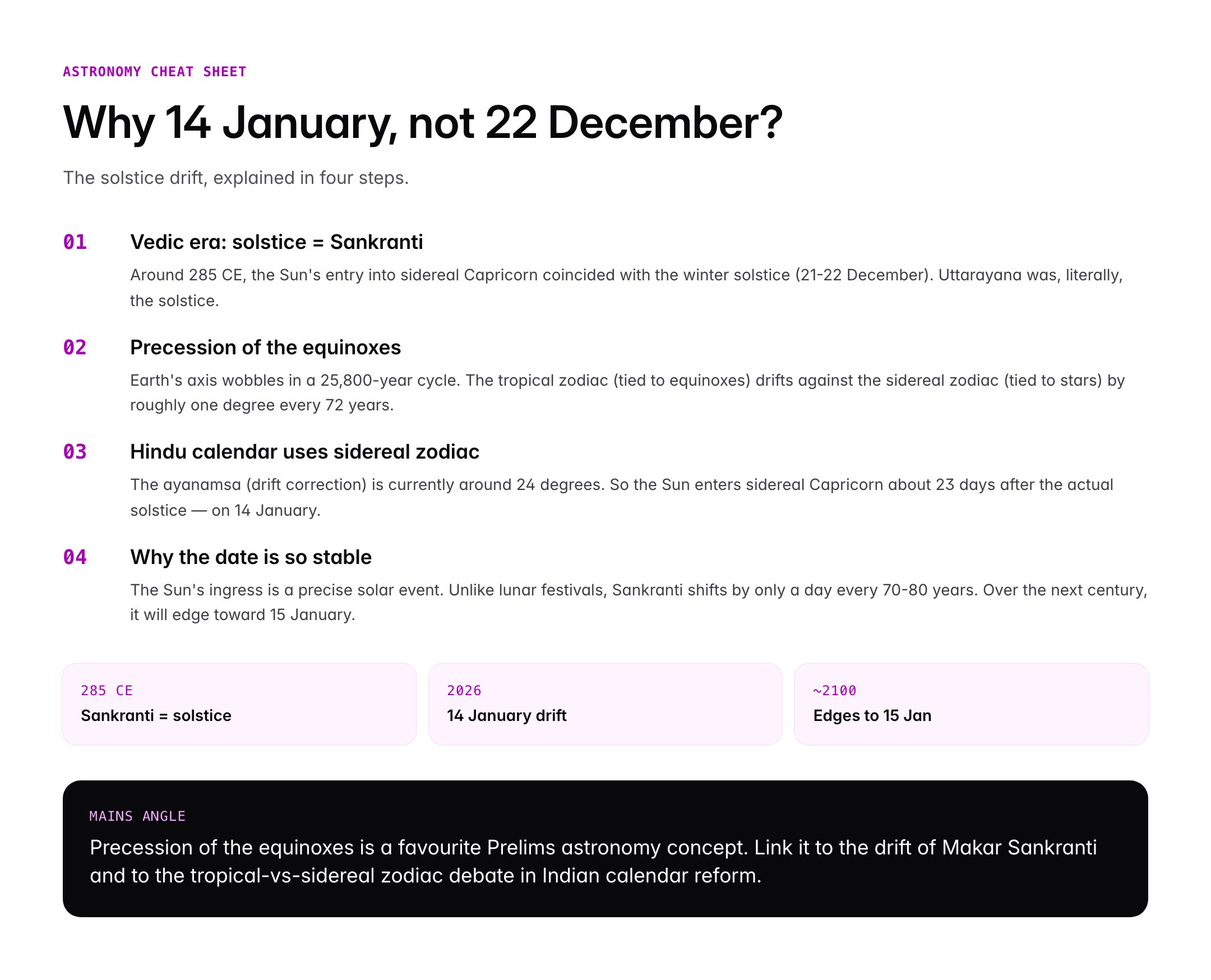
The Surya Siddhanta, an early astronomical treatise dated between the 4th and 5th centuries CE, defined the twelve Sankrantis — the Sun’s transit into each zodiac sign. Makar Sankranti, the transition into Capricorn, gained primacy because it coincided with the end of the inauspicious Dhanurmas and the resumption of weddings, temple consecrations and other samskaras. Over centuries the date has drifted slightly due to the precession of the equinoxes. In Vedic times, Makar Sankranti coincided with the winter solstice around 21-22 December, but today it falls on 14 January because the Hindu calendar uses the sidereal zodiac rather than the tropical zodiac.
By the medieval period, Makar Sankranti had acquired a dense layer of regional harvest customs. In Tamil Nadu it fused with Pongal, a four-day Dravidian harvest thanksgiving. In Punjab, Lohri on the eve of Sankranti celebrated the rabi crop’s ripening. In Assam, Magh Bihu marked the end of the harvesting season with community feasts at makeshift Meji huts. Bengal’s Poush Sankranti centred on the Ganga Sagar Mela at the confluence of the Hooghly and the Bay of Bengal, which even today draws one of the largest annual pilgrim gatherings in India.
Key Features
Astronomical Significance
Makar Sankranti marks the Sun’s entry into the Makara rashi (Capricorn) and the start of Uttarayana, when the Sun’s apparent path shifts northward. In the Hindu tradition, Uttarayana is deemed the Devayana (path of the gods) and is considered spiritually auspicious. The festival is one of the twelve Sankrantis in a solar year, but the only one celebrated as a pan-Indian festival.
Solar Calendar Anchor
Unlike Diwali or Holi, which move across the Gregorian calendar because they follow the lunar cycle, Makar Sankranti is pinned to the solar ingress. It therefore falls on 14 January (occasionally 15 January in leap-year-affected reckonings) almost every year. This makes it one of the most date-stable festivals in the Hindu calendar.
Agrarian and Harvest Symbolism
The festival coincides with the harvest of rabi crops in most of India. Farmers thank the Sun, the earth and the cattle that power agriculture. The traditional foods — sesame (til), jaggery (gud), rice (pongal), khichdi and sugarcane — are markers of the winter harvest. The exchange of til-gud ladoos in Maharashtra carries the phrase “til-gud ghya, god god bola” — accept this sweet and speak sweetly.
Pilgrimage and Ritual Bathing
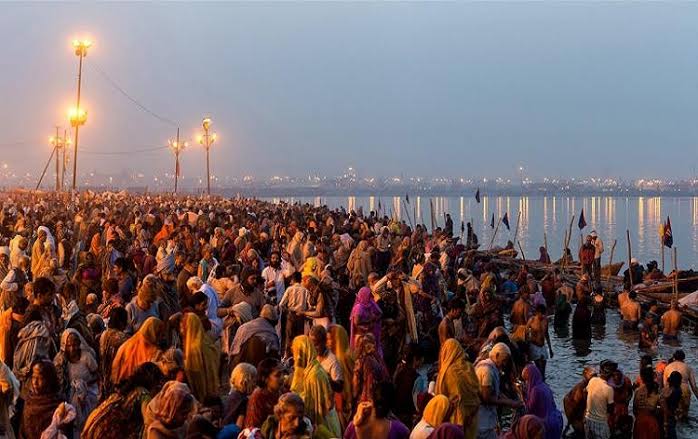
A holy dip at the confluence of sacred rivers is central to the festival. The Ganga Sagar Mela in West Bengal is the largest such gathering, with the Kumbh Mela cities of Prayagraj, Haridwar, Nashik and Ujjain also drawing lakhs. In 2025 the Maha Kumbh at Prayagraj saw its most auspicious shahi snan on Makar Sankranti.
Kite Festival and Community Rituals
Gujarat’s Uttarayan is famous for the International Kite Festival in Ahmedabad, which the state promotes as a tourism event. Community bonfires (Lohri), communal cooking of pongal in clay pots, Meji huts in Assam and cattle-decoration rituals such as Mattu Pongal showcase the festival’s social dimension.
Intangible Cultural Heritage
Several Sankranti-linked traditions — Pongal’s kolam art, Lohri’s folk songs and Bihu’s Husori dances — are recognised by state cultural departments as intangible heritage. These traditions feed into India’s soft-power narrative abroad, where Indian diaspora communities in the US, UK, Mauritius and Fiji celebrate the festival publicly.
Significance for UPSC and General Knowledge
- Makar Sankranti is a textbook example of a festival tied to the solar calendar, useful in explaining differences between lunar, solar and lunisolar calendars in Indian astronomy.
- The festival connects to the precession of the equinoxes — a concept that recurs in GS Paper 1 and Science & Technology questions on astronomy.
- Its regional variations demonstrate India’s unity in diversity, a recurring Mains theme under Indian Society.
- Ganga Sagar Mela, Kumbh and other pilgrim gatherings raise questions of crowd management, disaster management and public health — relevant to GS Paper 3.
- The festival’s agrarian core ties into the Rabi cropping cycle and minimum support price debates in GS Paper 3.
- Kite-flying festivals and bird injuries raise questions of wildlife protection and municipal regulation under GS Paper 3 Environment.
Detailed Analysis: Regional Names and Rituals Across India
The festival’s cultural plurality is best understood through its regional avatars, each with a distinct name, food and ritual idiom.
Tamil Nadu — Pongal: A four-day festival starting on the day before Makar Sankranti. Bhogi Pongal is for discarding old items and bonfires; Thai Pongal sees the preparation of sweet rice in new earthen pots allowed to boil over as a symbol of prosperity; Mattu Pongal venerates cattle; Kaanum Pongal is for family reunions.
Punjab and Haryana — Lohri and Maghi: Lohri falls on 13 January, the eve of Sankranti. Families gather around bonfires, toss puffed rice, rewri and popcorn into the flames and sing dhols like Sunder Mundriye. Maghi the next day is marked by the 40 Sikh martyrs of the Battle of Muktsar.
Gujarat — Uttarayan: A two-day kite festival (Uttarayan on 14 January and Vasi Uttarayan on 15 January). Ahmedabad’s International Kite Festival draws kite-makers from over 40 countries and is a major state-promoted tourism event.
Maharashtra — Sankrant: The exchange of til-gud ladoos binds the community. Women host haldi-kumkum gatherings. Black attire is customary to absorb winter warmth.
Assam — Magh Bihu / Bhogali Bihu: Community Meji and Bhelaghar huts are built from bamboo and burnt at dawn. Pitha and laru sweets dominate the feast.
West Bengal and Odisha — Poush Sankranti / Makar Chaula: The Ganga Sagar Mela attracts 40-60 lakh pilgrims annually. Pithe-puli sweets, date-palm jaggery (nolen gur) and harvested rice are offered.
Uttar Pradesh and Bihar — Khichdi Parva: Ritual bathing at the Magh Mela in Prayagraj and Kumbh cities. Khichdi, made from rice and urad dal, is the festival’s signature food.
Karnataka — Suggi / Ellu Birodhu: Women exchange trays of sesame, jaggery, sugarcane and coconut with the phrase “Ellu bella thindu, olle maathu aadi” (eat sesame-jaggery and speak sweetly).
Kerala — Makaravilakku: The Sabarimala temple hosts the Makaravilakku festival, where devotees witness the Makara Jyothi celestial light.
Himachal Pradesh — Magha Saaji: Ritual bathing in streams at dawn, followed by community khichdi and folk songs.
Comparative Perspective
Makar Sankranti sits within a broader global family of solar harvest festivals. Comparing it with international parallels highlights shared human themes around the Sun and agrarian cycles.
| Festival | Country / Region | Astronomical Basis | Common Theme |
|---|---|---|---|
| Makar Sankranti | India | Sun’s entry into Capricorn; Uttarayana | Harvest, solar worship, charity |
| Chinese New Year | China, East Asia | Lunisolar, first new moon after winter solstice | Harvest, family reunion |
| Yule / Winter Solstice | Northern Europe | 21-22 December solstice | Sun’s rebirth, bonfires |
| Dongzhi | China | Winter solstice | Family gathering, tangyuan |
| Imbolc | Ireland | Cross-quarter day between solstice and equinox | Agricultural renewal |
| Songkran | Thailand | Sun’s entry into Aries (April) | Water festival, new year |
| Nowruz | Iran, Central Asia | Vernal equinox | Solar new year, renewal |
The comparison underlines that solar festivals emerge wherever agrarian societies track the Sun. India is distinct because almost every state has a version of the same festival, each with its own linguistic and culinary fingerprint.
Challenges and Criticisms
Makar Sankranti’s scale and rituals do raise concerns worth balancing in a Mains answer. Kite-flying with Chinese manja — nylon and glass-coated string — has caused fatalities and bird injuries. The National Green Tribunal banned manja in 2016, but enforcement remains patchy. Every Sankranti, wildlife rescue groups in Gujarat, Rajasthan and Delhi treat hundreds of injured birds, including vultures, eagles and peacocks.
The Ganga Sagar Mela and Kumbh Sankranti snans draw immense crowds that strain civic infrastructure, sanitation and water quality. Stampede risk is an ever-present concern; the Union Home Ministry’s Bureau of Police Research and Development has issued crowd-management SOPs specifically for mass religious gatherings. Public health worries include hypothermia among elderly pilgrims and water-borne disease after mass bathing.
There is also a gendered dimension. Rituals like Maharashtra’s haldi-kumkum are restricted to married women, reinforcing traditional norms. Reformers argue festivals should be inclusive of widows and unmarried women. Environmentalists flag that bonfires during Lohri and Magh Bihu contribute to particulate matter during North India’s worst air-quality window, an issue that has begun to shape CPCB and state pollution board advisories.
Prelims Pointers
- Makar Sankranti 2026 date: 14 January 2026 (Wednesday).
- Marks Sun’s entry into Makara (Capricorn) rashi and start of Uttarayana.
- One of the few Hindu festivals on the solar calendar.
- Bhishma Pitamah chose Uttarayana for his death, per the Mahabharata.
- Ganga Sagar Mela is held at Sagar Island, West Bengal.
- Pongal is a four-day Tamil harvest festival: Bhogi, Thai, Mattu, Kaanum.
- Lohri is observed on 13 January, the eve of Sankranti.
- Gujarat’s Uttarayan features the International Kite Festival in Ahmedabad.
- Assam’s Magh Bihu involves Meji and Bhelaghar bamboo huts.
- Karnataka’s ritual is called Ellu Birodhu (sharing sesame and jaggery).
- Kerala’s Makaravilakku festival is held at Sabarimala temple.
- NGT banned Chinese manja in 2016 due to wildlife and human injuries.
Mains Practice Questions
- Discuss how Makar Sankranti reflects the unity in diversity of Indian cultural traditions. (150 words, GS1)
- Outline the festival’s pan-Indian character anchored in the solar calendar and Sun worship.
- Map regional avatars (Pongal, Lohri, Bihu, Uttarayan, Poush Sankranti) with distinctive rituals.
- Conclude with how shared agrarian roots generate diverse cultural expressions without fracturing identity.
- Mass religious gatherings like the Ganga Sagar Mela and Kumbh Sankranti snans pose administrative challenges. Examine with suggestions. (250 words, GS3)
- Identify issues: crowd management, sanitation, water quality, health infrastructure, stampede risk.
- Discuss institutional responses: BPR&D SOPs, NDMA guidelines, river-front development plans.
- Suggest technology-enabled crowd analytics, decentralised ghats, pre-positioned medical camps.
Conclusion
Makar Sankranti 2026 will fall on 14 January, offering aspirants a chance to revisit a festival that sits at the intersection of astronomy, agriculture and cultural memory. Its solar anchor, its regional polyphony and its agrarian soul make it one of the most instructive entries for the Indian Heritage and Culture syllabus component of GS Paper 1.
More than a ritual calendar entry, Makar Sankranti is a live case study in how Indian society organises time, food, pilgrimage and community around the Sun. Aspirants who can weave together its astronomical basis, regional forms and contemporary challenges — from Chinese manja bans to Ganga Sagar crowd management — will be able to deploy it across multiple GS papers with confidence.
Frequently Asked Questions
What is Makar Sankranti 2026 date?
Makar Sankranti 2026 falls on Wednesday, 14 January 2026. The festival is anchored to the solar calendar and marks the Sun’s entry into the Makara (Capricorn) zodiac sign, signalling the start of Uttarayana, the Sun’s apparent northward journey that lasts for the next six months.
Why is Makar Sankranti important for UPSC?
For UPSC, Makar Sankranti is a compact case study in Indian astronomy, agrarian cycles and regional cultural diversity under GS Paper 1. It also links to crowd management at Ganga Sagar and Kumbh, rabi cropping cycles, NGT bans on Chinese manja, and the precession of the equinoxes — all recurring Prelims and Mains themes.
How is Makar Sankranti related to Uttarayana and the winter solstice?
Makar Sankranti marks the beginning of Uttarayana, but it no longer coincides with the winter solstice. Due to the precession of the equinoxes, the sidereal zodiac used by the Hindu calendar has drifted by about 23 days, so the festival now falls on 14 January rather than the astronomical solstice on 21-22 December.
What are the regional names of Makar Sankranti across India?
Regional names include Pongal in Tamil Nadu, Lohri and Maghi in Punjab, Uttarayan in Gujarat, Magh Bihu or Bhogali Bihu in Assam, Poush Sankranti in West Bengal, Makar Chaula in Odisha, Khichdi Parva in Uttar Pradesh and Bihar, Suggi or Ellu Birodhu in Karnataka, and Makaravilakku in Kerala.
Why is Makar Sankranti date almost fixed every year?
Most Hindu festivals follow the lunar or lunisolar calendar, which is why Diwali and Holi shift across the Gregorian calendar. Makar Sankranti is pinned to the Sun’s ingress into Capricorn — a solar event — so it almost always falls on 14 January, occasionally shifting to 15 January due to leap-year adjustments in the sidereal reckoning.
What is the significance of Ganga Sagar Mela on Makar Sankranti?
The Ganga Sagar Mela at Sagar Island in West Bengal is one of India’s largest pilgrim gatherings after the Kumbh Mela. Devotees take a holy dip at the confluence of the Hooghly and the Bay of Bengal on Makar Sankranti, believing the Uttarayana snan cleanses sins. The mela draws 40 to 60 lakh pilgrims annually and is a major administrative challenge for the West Bengal government.
What foods are traditionally eaten on Makar Sankranti?
Traditional foods are winter-harvest-linked: til-gud ladoos in Maharashtra, pongal (sweet rice) in Tamil Nadu, rewri and gajak at Lohri, pitha and laru in Assam, pithe-puli and nolen gur in Bengal, khichdi in Uttar Pradesh and Bihar, and ellu-bella (sesame-jaggery mix) in Karnataka. Sesame, jaggery, rice and sugarcane are the common ingredients.
Why is Chinese manja banned on Makar Sankranti?
Chinese manja, a nylon string coated with glass and metal, causes severe injuries to humans (especially two-wheeler riders), birds and animals during kite-flying on Uttarayan. The National Green Tribunal banned its manufacture, sale and use in 2016 citing wildlife and public safety concerns. Enforcement remains inconsistent, and rescue groups still treat thousands of injured birds around Sankranti each year.
Tell Google you want more of this.
Add Anantam IAS as a preferred sourceOne tap, and this site shows up more often in your own Top Stories, AI Overviews and AI Mode. Remove it any time.