Just war theory is the oldest continuously argued framework in applied ethics, and it survives because it refuses to settle the question of war with a single verdict. It splits the problem in two — whether fighting is justified at all, and how one may fight — and insists the two answers are logically independent. A just cause licenses no method it pleases. A scrupulous method does not redeem an unjust war. Soldiers on the losing side of an aggressive war are not automatically guilty of war crimes, and soldiers on the right side are not automatically innocent of them.
Remote and increasingly autonomous weapons do not create new moral categories. They put pressure on the old ones in a specific and identifiable place: on the assumption that the person who kills also stands to be killed, on the political cost that used to restrain the decision to use force, and on the requirement that a human being make the judgement of proportionality. Each of those is worth examining separately, because the popular debate runs them together and reaches conclusions faster than the arguments allow.
The Two Halves, and the Third
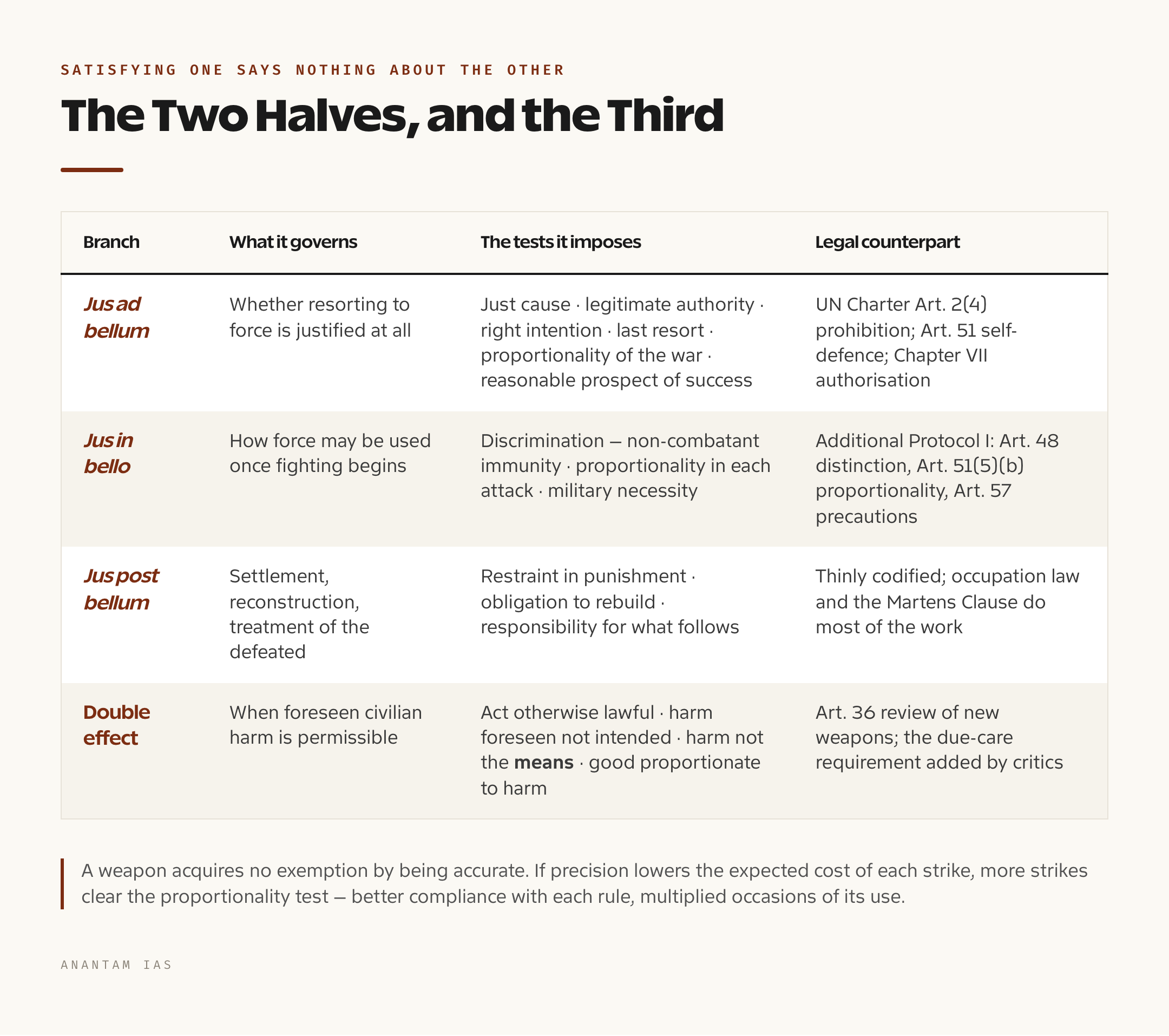
Jus ad bellum governs the resort to force and asks six things. Just cause — self-defence against an armed attack is the paradigm; punishment of a wrong and the protection of populations are contested extensions. Legitimate authority — a decision taken by a body competent to take it, which in the modern setting means a constitutionally authorised state organ and, for force beyond self-defence, the Security Council. Right intention — the stated cause must be the operative one, not a cover for territory or advantage. Last resort — not literally every alternative exhausted, but every alternative with a reasonable chance considered and honestly assessed. Proportionality of the war as a whole — the total expected harm weighed against the good sought. Reasonable prospect of success — a hopeless war inflicts destruction for nothing, which makes futility a moral objection rather than a strategic one.
Jus in bello governs conduct within war and reduces to three. Discrimination, or non-combatant immunity: attacks may be directed only at combatants and military objectives. Proportionality in each attack: incidental civilian harm must not be excessive in relation to the concrete military advantage anticipated from that attack. Military necessity: only force actually required for a legitimate military purpose is permitted, which rules out destruction that serves no purpose beyond destruction.
Jus post bellum is the later addition and the least developed — obligations of settlement, reconstruction, restraint in punishment, and the treatment of the defeated population. It is the part most often ignored, and the part whose neglect turns a successful intervention into a longer disaster. The lineage from Augustine and Aquinas through Vitoria and Grotius to the twentieth-century revival is traced alongside the other frameworks in Western moral philosophy.
Double Effect Does the Heavy Lifting
Every serious argument about civilian deaths in war runs through the doctrine of double effect, and it is worth stating precisely rather than gesturing at.
The doctrine, in the form Aquinas gave it, permits an act with a foreseen bad effect on four conditions: the act itself must be permissible independently of the bad effect; the bad effect must not be intended, only foreseen; the bad effect must not be the means by which the good effect is produced; and the good must be proportionate to the bad. The third condition is the load-bearing one. Bombing a munitions plant and foreseeing that people living beside it will die is different in kind from bombing a residential block in order that public morale collapses. In the first case the deaths are a side effect of striking the target. In the second they are the mechanism.
Two honest problems follow. The first is that intention is invisible and self-reported, so the doctrine is easy to abuse — a commander can always describe an intended effect as a foreseen one. The critical response is to add a requirement of due care: the agent must accept risk to reduce civilian harm, not merely refrain from aiming at civilians. That converts a claim about mental states into a claim about conduct, which can be examined. The second is that “not excessive in relation to the military advantage anticipated” contains no unit of measurement. There is no exchange rate between civilian lives and military advantage, and there never has been. Proportionality is a judgement made by a responsible person who can be asked to explain it, which is precisely why it resists being written as a rule.
What the Law Requires, and Where Ethics Goes Further
International humanitarian law codifies the jus in bello triad in recognisable form. Distinction appears in Article 48 of Additional Protocol I of 1977. Proportionality appears in Article 51(5)(b), which prohibits attacks expected to cause incidental civilian loss excessive in relation to the concrete and direct military advantage anticipated. Precautions in attack appear in Article 57 — verify the target, choose means and methods to minimise incidental harm, cancel or suspend an attack when it becomes apparent the target is protected or the harm would be excessive. Article 36 obliges a state to determine, when studying or acquiring a new weapon, whether its use would be prohibited.
The difference between a legal and an ethical analysis matters and is usually skipped. Law asks whether a specific prohibition was breached, and where it is silent, conduct is lawful. Ethics asks whether the act was right, and silence in the rulebook is not an answer. The Martens Clause, which holds that in cases not covered by treaty rules, civilians remain under the protection of the principles of humanity and the dictates of public conscience, is the point at which the legal instrument itself concedes this. A state can act lawfully and badly. Anyone arguing about new weapons should be clear about which claim they are making.
What Remote Warfare Changes
Risk symmetry collapses. The laws of war grew up around belligerents who each faced danger from the other, and the warrior ethic — courage exercised at personal risk, restraint owed to an adversary who could kill you — depends on that reciprocity. An operator thousands of kilometres away faces none. That does not make a strike unlawful; distinction and proportionality say nothing about the attacker’s exposure. It does dissolve part of the moral texture that made the soldier a figure owed respect, and it invites the objection that killing without risk is closer to execution than to combat.
The “PlayStation mentality” objection — the phrase entered the literature through a 2010 report to the UN Human Rights Council on targeted killings — holds that distance and a screen produce moral disengagement. The available evidence complicates it. Peer-reviewed studies of remotely piloted aircraft crews through the 2010s found rates of occupational stress and mental-health diagnoses broadly comparable to those of deployed manned-aircraft crews, and clinicians working with operators describe moral injury rather than indifference: sustained surveillance of a person’s ordinary life before killing them, then a drive home. The objection may be wrong about the operators and right about the institution.
The political threshold falls. No body bags returning, no prisoners taken, no parliamentary vote on deployment. The restraint that democratic accountability once imposed on the use of force operated partly through the cost paid by citizens. Remove the cost and force becomes cheap, which is a jus ad bellum problem — last resort is harder to satisfy honestly when the resort is easy.
Signature strikes. Targeting by observed behaviour pattern rather than by confirmed identity is the sharpest ethical break. Distinction requires that the person attacked be a combatant. A pattern of movement, association and activity is evidence of that, but it is inferential, and the inference is drawn from surveillance data by analysts working under uncertainty. The category admits of degrees — some patterns are near-conclusive, others are little more than demographic profiling — and the practice is defensible only where the standard applied is stated and reviewable.
The accountability gap outside declared conflict. Where a strike occurs away from an acknowledged armed conflict, it falls into a space between two legal regimes: human rights law, under which lethal force is permissible only as an absolutely necessary response to an imminent threat to life, and humanitarian law, which permits targeting combatants. Which regime applies is genuinely unsettled, and the practical consequence is that no forum reliably reviews the decision. The general architecture of answerability — who reports to whom, and what a review is for — is set out in accountability and responsibility.
Sovereignty, Consent and Article 51
A strike on the territory of another state is a use of force against that state unless it consents or unless the acting state has an independent legal basis. Article 2(4) of the UN Charter prohibits the threat or use of force against the territorial integrity of any state. Article 51 preserves the inherent right of self-defence “if an armed attack occurs”.
Three contested extensions sit on top of that text. Anticipatory self-defence against an imminent attack draws on the Caroline correspondence of 1842, which required necessity, imminence and proportionality — a threat “instant, overwhelming, leaving no choice of means”. Pre-emptive or preventive self-defence against a threat that is not imminent has no comparable support; the UN High-Level Panel of 2004 accepted the first and rejected the second, holding that a state with a longer-range concern should go to the Security Council. The unwilling or unable doctrine holds that force may be used against non-state actors on the territory of a state that will not or cannot suppress them. It is asserted by some states and rejected by others, and it has no settled status. Write that it is unsettled rather than choosing a side.
Consent complicates rather than resolves. Consent given privately while the strike is publicly protested is consent of a kind, but it removes the domestic political check that made sovereignty meaningful for the population affected. The same tension runs through domestic security operations under special legal regimes, examined in India’s internal security forces.
Autonomy: Where the Human Stands
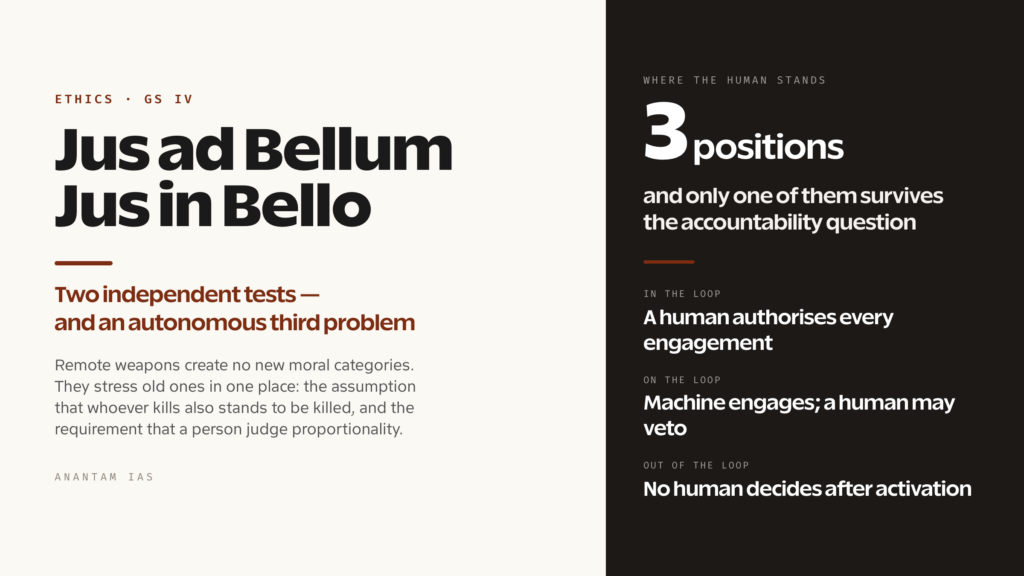
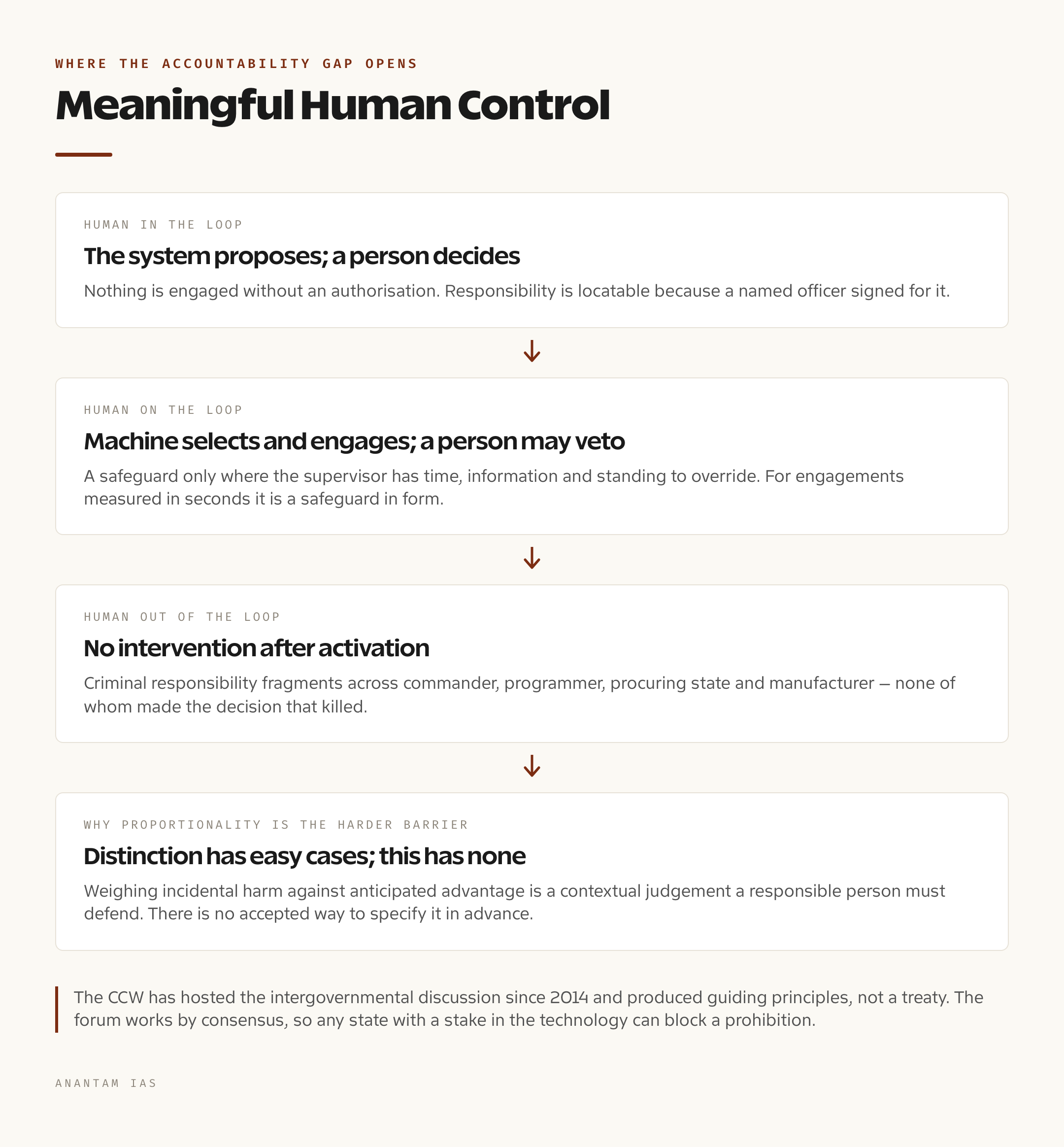
The standard taxonomy has three positions. Human in the loop: the system identifies a target and a human authorises engagement; nothing fires without a decision. Human on the loop: the system selects and engages, and a human supervises with power to veto — a real safeguard only if the supervisor has time, information and the standing to override, which for engagements measured in seconds is often a fiction. Human out of the loop: the system selects and engages targets without intervention once activated.
Meaningful human control has become the operative standard in the debate, and the adjective carries the weight. A control that consists of pressing accept on a machine-generated list under time pressure is control in form. Meaningful control requires that the human understands the situation, has the information needed to judge it, has time to deliberate, and is accountable for the outcome. A 2012 United States directive, since revised, expressed a related requirement as “appropriate levels of human judgment over the use of force” — the choice of “appropriate” over “meaningful” was not accidental.
Three objections to full autonomy deserve stating in their strongest form. First, the accountability gap: if no human decided, criminal responsibility becomes hard to locate. The commander who deployed the system, the programmer, the procuring state and the manufacturer each hold a piece, and existing doctrines of command responsibility and product liability were not designed for a distributed decision. Second, distinction and proportionality may not be computable. Distinction has narrow cases a machine might handle and hard ones — a person laying down a weapon, a civilian carrying a tool, a wounded combatant — that turn on context and intention. Proportionality is worse: it requires weighing incommensurable things against an anticipated advantage, in a specific situation, and defending the weighting. That is a judgement, not a calculation, and there is no defensible way to specify it in advance. Third, the dignity argument: a decision to end a life should be taken by someone capable of understanding what they are doing, and a person killed by a process rather than by a decision has been treated as a data point.
The argument on the other side is serious and usually caricatured. Machines do not panic, tire, seek revenge, or shoot because a friend was killed an hour ago. A substantial share of civilian harm in war comes from fear, exhaustion and retaliation, and a system without those states could in principle be more restrained than a frightened conscript. Autonomous systems can also be designed to hold fire under uncertainty in a way a human under threat will not. Whether this potential is realised depends entirely on procurement incentives, which historically favour speed over restraint. The parallel questions about delegating consequential judgements to systems are worked through in the ethics of automation.
The CCW — the 1980 Convention on Certain Conventional Weapons — has hosted the intergovernmental discussion since informal meetings began in 2014 and a Group of Governmental Experts was established in 2016. It has produced a set of guiding principles and no treaty. The reason is structural: the forum works by consensus, so any state with a stake in the technology can block a prohibition, and the states with the largest stake favour national policy over binding law. The unsettled definitional question of what counts as an autonomous weapon is a genuine obstacle as well as a convenient one.
Duties of a State That Acquires These Systems
The ethical obligations are institutional rather than attitudinal, and they are checkable.
Doctrine before capability. Deciding what a system is for, and what it is not for, before it is fielded — because doctrine written after acquisition tends to be written to justify use. Rules of engagement that specify positive identification standards, weapon release authority and restrictions by target category, issued in a form an operator can apply under stress. Legal review of new weapons under the Article 36 obligation, conducted before procurement and repeated when a system is modified, with autonomy in target selection treated as a modification. Targeting review with a documented collateral damage estimate, an identified authorising officer at a level matched to the expected harm, and a written record. Post-strike investigation that is triggered automatically by credible allegations of civilian harm, conducted by people outside the chain that ordered the strike, and capable of producing consequences. Training in the duty to refuse a manifestly unlawful order, which Nuremberg Principle IV and Article 33 of the Rome Statute both recognise.
The cost of that last duty is not theoretical. Hugh Thompson, the helicopter pilot who landed between American soldiers and Vietnamese civilians at My Lai in 1968 and evacuated survivors, was shunned within the service, received hate mail for years, and was decorated only in 1998, thirty years later. Ian Fishback, the US Army captain who wrote to a senator in 2005 about detainee treatment after internal channels failed, saw his career suffer and died in 2021. Moral courage in a hierarchy is not free, and any account of military ethics that presents refusal as a simple option is lying to the reader about what it costs.
The Honest Difficulties
The debate is conducted between two indefensible poles. One side treats remote strikes as inherently assassination and refuses the comparison with the alternatives. The other treats them as a technical improvement in precision and declines to examine what precision changes about the decision to use force at all. Neither position survives contact with the criteria. A weapon that reduces harm per engagement while increasing the number of engagements has not obviously reduced harm.
The empirical questions are genuinely contested. Whether remote strikes reduce total civilian harm relative to the alternatives — artillery, ground operations, manned air strikes — depends on comparisons no one can run cleanly. Whether they radicalise affected populations, and whether the effect outweighs the tactical gain, is argued in the literature without resolution, partly because the data are held by the actors with an interest in the answer. Say the evidence is contested; do not import a number you cannot defend.
Precision may be self-defeating. If accuracy lowers the expected civilian cost of a given strike, the proportionality test becomes easier to satisfy, and more strikes clear it. A technology that improves compliance with each rule while multiplying the occasions of its application has an ambiguous moral record.
No accountability mechanism has been built. The proposals — an international register, mandatory post-strike investigation, a treaty on autonomy — have been on the table for over a decade without adoption. Naming the gap is honest; asserting that a solution is imminent is not. The same pattern of capability outrunning governance appears in the militarisation of space.
FAQ
What is the difference between jus ad bellum and jus in bello? Jus ad bellum governs whether resorting to war is justified — just cause, legitimate authority, right intention, last resort, proportionality overall, reasonable prospect of success. Jus in bello governs conduct within war — discrimination, proportionality in each attack, military necessity. The two are independent: a just war can be fought criminally, and an unjust war can be fought within the rules.
What is the doctrine of double effect? The position that an act with a foreseen harmful side effect can be permissible if the act is otherwise legitimate, the harm is foreseen rather than intended, the harm is not the means by which the good is achieved, and the good is proportionate to the harm. The third condition does most of the work.
What does “meaningful human control” require? That a human understands the situation, has the information needed to judge it, has enough time to deliberate, retains real authority to withhold force, and is accountable afterwards. Approving a machine-generated target list under time pressure satisfies the form and not the substance.
Why has the CCW not produced a treaty on autonomous weapons? The forum operates by consensus, so any state with a significant stake in the technology can block a binding instrument. The definitional question — what counts as autonomy in target selection — is also genuinely difficult, and serves as a reason for delay as well as a real obstacle.
Can an autonomous system satisfy the proportionality rule? Proportionality requires weighing expected civilian harm against anticipated military advantage in a specific situation and being able to defend the weighting. That is a contextual judgement rather than a computation, and no accepted method exists for specifying it in advance. Distinction has cases a machine can handle; proportionality is the harder barrier.
Is a cross-border strike lawful if the territorial state consents? Consent removes the objection based on that state’s sovereignty. It does not answer the jus in bello questions about the strike itself, and where consent is given privately while the strike is publicly protested, it removes the political check that made sovereignty meaningful for the affected population.
Practice Questions
Prelims MCQs
- The principle of distinction in international humanitarian law is codified in: (a) Article 2(4) of the UN Charter (b) Article 48 of Additional Protocol I of 1977 (c) Article 33 of the Rome Statute (d) The Martens Clause — Answer: (b) Article 48 requires parties to distinguish between the civilian population and combatants and between civilian objects and military objectives.
- Under the doctrine of double effect, which condition rules out attacking civilians to break enemy morale? (a) The act must be otherwise permissible (b) The harm must be foreseen rather than intended (c) The harm must not be the means by which the good effect is produced (d) The good must be proportionate to the harm — Answer: (c) in a morale-breaking attack the civilian deaths are the mechanism of the intended effect, not a side effect of striking a target.
- “Human on the loop” describes a system in which: (a) A human must authorise every engagement (b) The system selects and engages while a human supervises with power to veto (c) The system operates with no human involvement after activation (d) A human programmes the target list months in advance — Answer: (b) the safeguard is real only if the supervisor has time, information and standing to override.
- Article 36 of Additional Protocol I obliges a state to: (a) Investigate every allegation of civilian harm (b) Determine whether a new weapon’s use would be prohibited by international law (c) Publish its rules of engagement (d) Seek Security Council approval before acquiring a weapon — Answer: (b) the review duty attaches when a new weapon or means of warfare is studied, developed, acquired or adopted.
- The Caroline criteria are associated with: (a) Preventive war against distant threats (b) Anticipatory self-defence against an imminent attack (c) The responsibility to protect civilian populations (d) Command responsibility for subordinates’ crimes — Answer: (b) the 1842 correspondence required necessity, imminence and proportionality, and is invoked for anticipatory rather than preventive action.
Mains Practice Questions
- “A just cause does not license any method, and a scrupulous method does not redeem an unjust war.” Explain the independence of jus ad bellum and jus in bello with examples. (150 words)
- The doctrine of double effect is criticised as too easy to abuse because intention is self-reported. Examine this objection and the “due care” response to it. (250 words)
- Remote warfare removes risk from one side of an engagement. Analyse the ethical consequences of this asymmetry for the warrior ethic and for the political threshold of using force. (250 words)
- “Proportionality is a judgement, not a computation.” Discuss what this implies for the delegation of targeting decisions to autonomous systems. (150 words)
- Set out the institutional duties a state assumes when it acquires armed remote or autonomous systems, and explain why doctrine must precede capability. (250 words)
Tell Google you want more of this.
Add Anantam IAS as a preferred sourceOne tap, and this site shows up more often in your own Top Stories, AI Overviews and AI Mode. Remove it any time.