Disclosure: this guide contains Amazon affiliate links. As an Amazon Associate, Anantam IAS earns from qualifying purchases — at no extra cost to you.
The Maharashtra Public Service Commission, known to every aspirant simply as MPSC, is the constitutional body that recruits officers for the Maharashtra state administration. Its flagship test is the Rajyaseva or Combined State Services Examination — the route to becoming a Deputy Collector, a Deputy Superintendent of Police, or a Tahsildar in one of India’s largest and most industrialised states.
If you’ve been preparing the old way, pause. MPSC has overhauled the Rajyaseva Mains into a UPSC-style descriptive exam, and that single change reshapes how you should study. This guide walks through the new pattern, the syllabus with its heavy Maharashtra focus, eligibility including the Marathi requirement, the posts on offer, and a preparation plan built for the descriptive era.
What Is MPSC?
The Maharashtra Public Service Commission is a body created under Article 315 of the Constitution to conduct recruitment for the state’s civil services. It runs several examinations, but the Rajyaseva (State Services) Examination is the one that draws lakhs of graduates each year because it leads to the senior administrative and police posts that shape districts.
The Rajyaseva selects for Group A and Group B gazetted positions — Deputy Collector, Deputy Superintendent of Police (DySP), Tahsildar, Assistant Commissioner of State Tax, Block Development Officer and several allied services through a single combined notification. In structure and prestige it’s the state-level counterpart to what the Union Public Service Commission runs nationally.
Key Facts
- Conducting authority: Maharashtra Public Service Commission (MPSC)
- Exam: Rajyaseva / Combined State Services Examination
- Top posts: Deputy Collector, DySP, Tahsildar, Assistant State Tax Commissioner, BDO
- Stages: Prelims (objective) → Mains (descriptive) → Interview
- Frequency: Usually once a year, vacancy-driven
- Scale: Lakhs of applicants competing for a few hundred posts in a typical cycle
MPSC Exam Pattern
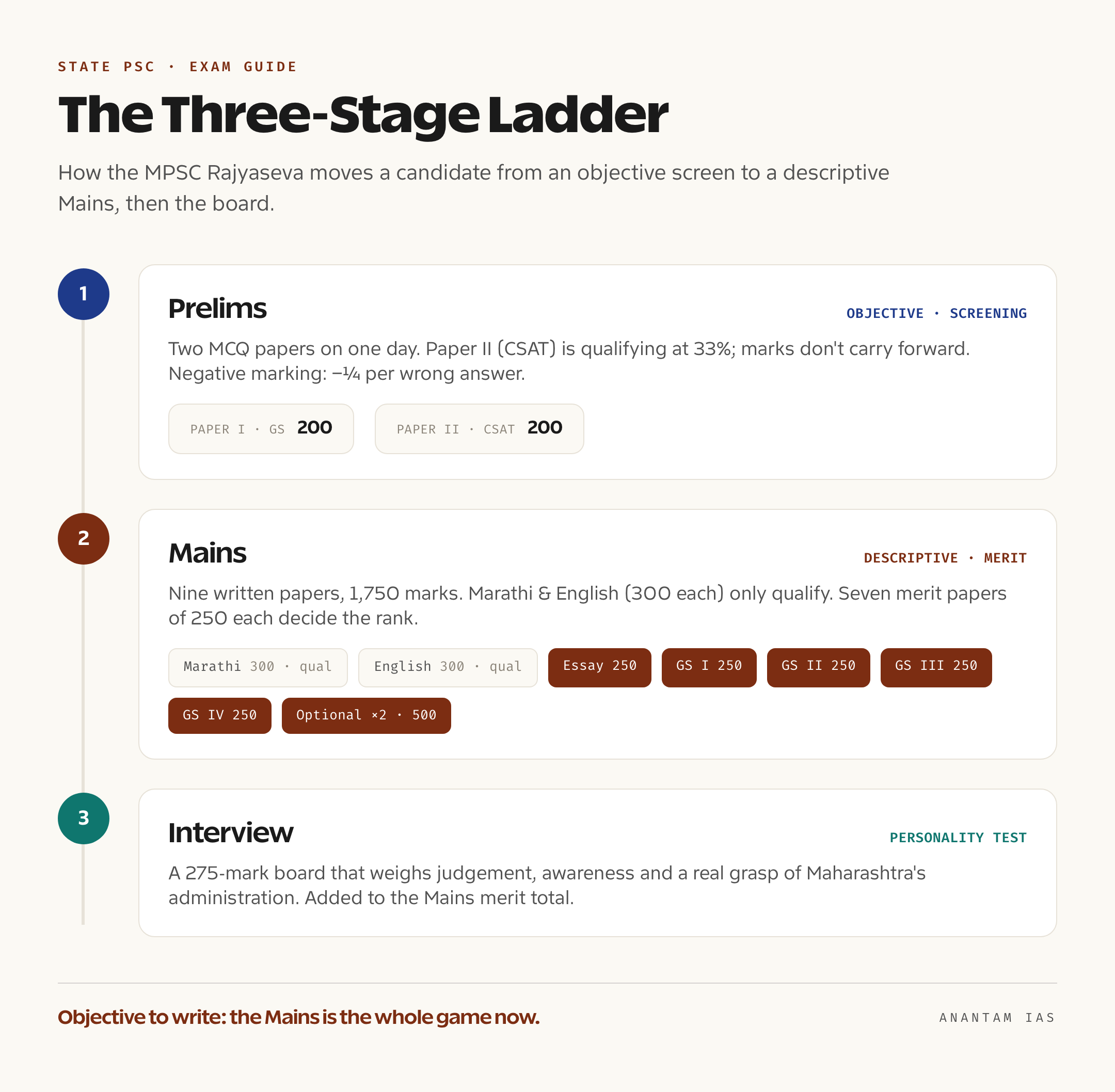
The Rajyaseva runs in three stages. The headline news is the Mains: MPSC has moved it from a largely objective format to a fully descriptive one, mirroring the UPSC Civil Services design. Plan your year around this change.
Prelims
The Preliminary Examination is purely a screening test. It has two objective (MCQ) papers, both held on the same day, and the marks you score here do not carry into the final merit list.
| Paper | Subject | Marks | Duration |
|---|---|---|---|
| Paper I | General Studies | 200 | 2 hours |
| Paper II | CSAT (Aptitude) | 200 | 2 hours |
Paper II is the CSAT — an aptitude paper that is qualifying only. You must clear roughly 33% in it to stay eligible, but its score doesn’t add to your rank, exactly like UPSC’s CSAT. Paper I (General Studies) is the merit-deciding screen for who advances. Both papers carry negative marking: one-fourth of the marks for a question is deducted for a wrong answer, so reckless guessing hurts.
Mains
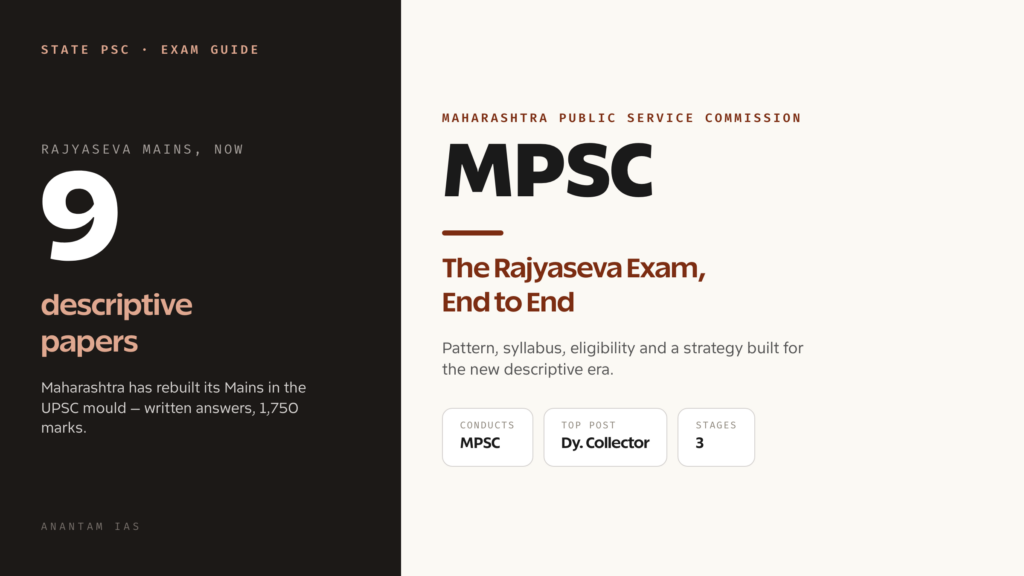
This is where MPSC now looks like UPSC. The revamped Rajyaseva Mains has nine descriptive papers totalling 1,750 marks — a big jump from the old objective Mains. Two of those nine are language papers that only qualify; the other seven decide your merit.
| Paper | Subject | Marks | Status |
|---|---|---|---|
| Paper 1 | Marathi (language) | 300 | Qualifying |
| Paper 2 | English (language) | 300 | Qualifying |
| Paper 3 | Essay | 250 | Merit |
| Paper 4 | General Studies I | 250 | Merit |
| Paper 5 | General Studies II | 250 | Merit |
| Paper 6 | General Studies III | 250 | Merit |
| Paper 7 | General Studies IV (Ethics) | 250 | Merit |
| Paper 8 | Optional Subject — Paper I | 250 | Merit |
| Paper 9 | Optional Subject — Paper II | 250 | Merit |
The Marathi and English papers need a minimum qualifying score (typically 25%) but don’t count toward rank. The Essay, four General Studies papers, and two optional-subject papers — seven papers, 1,750 merit marks — are what build your score. Each paper runs three hours and demands written answers, so answer-writing is no longer optional skill, it’s the whole game.
Interview / Personality Test
Candidates who clear the Mains cut-off are called for the Personality Test, worth 275 marks. Final ranks combine the Mains merit papers with this interview. The board assesses awareness, judgement, and a genuine connection to Maharashtra’s administrative realities rather than rote knowledge.
MPSC Eligibility
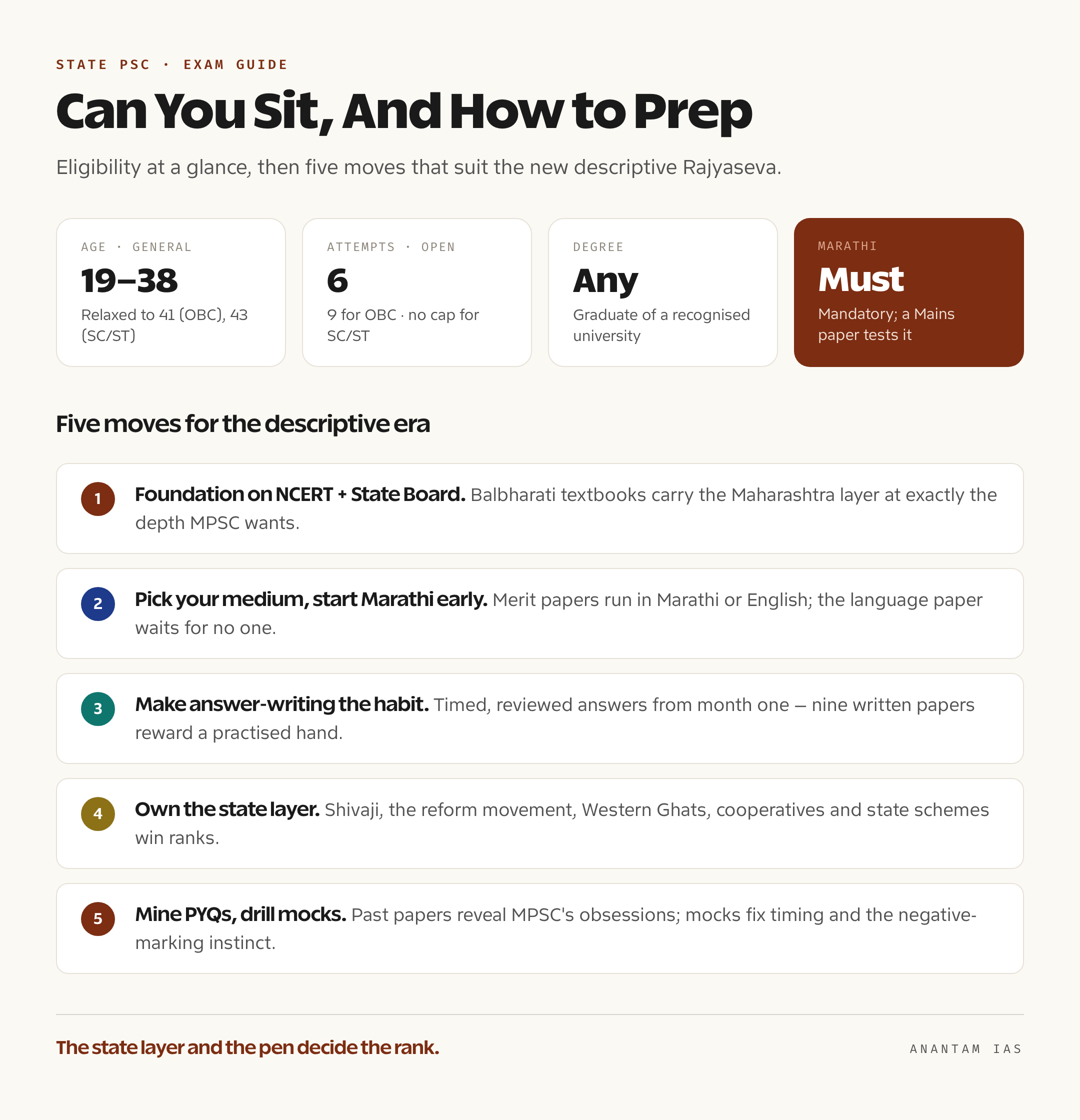
Before you build a study plan, confirm you actually qualify. The Rajyaseva has clear rules on citizenship, age, attempts, and — uniquely for a state service — language.
- Nationality: Indian citizen.
- Education: A bachelor’s degree from a recognised university. Final-year students can usually apply, subject to producing the degree before the interview.
- Age: Generally 19 to 38 years for the open category. Reserved categories get relaxation — OBC candidates up to 41 and SC/ST candidates up to 43 years, with further concessions for ex-servicemen and persons with disabilities. Always check the year’s notification, as the upper limit has shifted in recent cycles.
- Attempts: Open category candidates get six attempts; OBC candidates nine; SC/ST candidates have no attempt cap.
- Domicile: Reservation benefits and category relaxations require Maharashtra domicile. Open-category aspirants may apply more broadly, but the posts are Maharashtra-cadre.
- Marathi requirement: This is the differentiator. Knowledge of Marathi — reading, writing, and speaking — is mandatory. A whole Mains language paper tests it, and candidates may have to clear a Marathi competency check. English-medium aspirants cannot skip this.
MPSC Syllabus
The MPSC syllabus overlaps heavily with UPSC on the general subjects, but it adds a thick layer of Maharashtra-specific material. That state layer is where ranks are won and lost, because most candidates already cover the national portions.
Prelims Syllabus
Paper I — General Studies spans:
- History of India and the Indian freedom movement, with strong weight on Maharashtra’s history
- Geography of India and Maharashtra — physical, social, and economic
- Indian polity and governance, Panchayati Raj, public policy
- Economic and social development, sustainable development, demographics
- Environment, ecology, and biodiversity
- General science
- Current events of state, national, and international importance
Paper II — CSAT (Aptitude) covers comprehension, logical reasoning and analytical ability, decision-making, basic numeracy at the Class X level, and data interpretation. It’s qualifying, but candidates from non-quant backgrounds still need disciplined practice to clear the 33% floor.
Mains Syllabus
With the descriptive shift, the four General Studies papers broadly track the UPSC GS template:
- GS I: History (with Maharashtra emphasis), heritage and culture, geography, and society
- GS II: Constitution, polity, governance, social justice, and welfare administration
- GS III: Economy, agriculture, science and technology, environment, and disaster management
- GS IV: Ethics, integrity, and aptitude — including case studies, mirroring UPSC’s GS-IV
The Essay paper asks for structured, argued writing in Marathi or English. The two optional-subject papers are chosen from a list of subjects, and they carry 500 merit marks together, so the choice deserves the same care a UPSC aspirant gives it.
State-Specific Focus
This is the heart of MPSC. Examiners reward candidates who know Maharashtra deeply:
- History: The rise of Chhatrapati Shivaji Maharaj and the Maratha empire, the Peshwa period, and the nineteenth-century social-reform movement — Jyotirao and Savitribai Phule, Mahatma Phule’s Satyashodhak Samaj, B. R. Ambedkar’s work, Maharshi Karve, and Shahu Maharaj of Kolhapur. The Samyukta Maharashtra Movement that created the state in 1960 is a recurring theme.
- Geography: The Western Ghats, the Deccan plateau, the Konkan coast, major rivers (Godavari, Krishna, Bhima), the cotton and sugarcane belts, and Maharashtra’s industrial corridors.
- Polity and administration: The state’s district and divisional structure, local self-government, and Maharashtra-specific governance institutions.
- Economy and schemes: Maharashtra’s agriculture, cooperative sugar sector, industrial policy, and flagship state schemes — agrarian support, women and child welfare, and rural development programmes.
- Current affairs: State-level developments alongside national news, drawn from Maharashtra-focused sources.
MPSC Preparation Strategy
The descriptive Mains rewrites the playbook. Here’s how to organise the year.
Build the Foundation on NCERT and State Textbooks
Start with NCERT textbooks for history, geography, polity, and economy — the same backbone UPSC aspirants use, because the GS overlap is large. Then layer Maharashtra State Board textbooks (Balbharati) on top, especially for state history and geography. These board books are written exactly to the depth MPSC expects and are the single most efficient state-specific resource.
Treat the Marathi Medium as an Advantage
You can write the merit papers in Marathi or English. If Marathi is your stronger language, use it — examiners value precise, idiomatic Marathi, and the state-board material is richest in Marathi. Either way, the mandatory Marathi language paper means English-medium candidates must start Marathi writing practice early, not in the final weeks.
Master Answer-Writing Above All
The move to nine descriptive papers makes answer-writing the decisive skill. Practise structured introductions, point-wise bodies, and crisp conclusions from the first months, not the last. Write timed answers to previous patterns, get them reviewed, and build a personal bank of intros and diagrams for high-frequency themes. The Essay paper and GS-IV case studies especially reward a practised hand.
Work the State Layer and Current Affairs
Dedicate a continuous block — six to eight weeks — to immersing in Maharashtra history, geography, polity, economy, and schemes. For current affairs, pair a national daily with a Maharashtra-focused source so state developments don’t slip through. Maintain running notes on state schemes, because examiners ask about them directly.
Mine the Previous Year Questions
Previous year papers reveal MPSC’s recurring obsessions — Shivaji and the Marathas, the social-reform movement, the Western Ghats, cooperative agriculture, and state schemes show up again and again. Analyse PYQs to weight your effort, and use them to calibrate how much Maharashtra-specific depth each topic needs.
Drill with Mock Tests and Revision
For Prelims, take regular full-length mocks under negative-marking conditions to sharpen elimination and time management. For Mains, simulate the three-hour descriptive papers. Build a revision cycle so the volume of seven merit papers stays under control as the exam nears.
Posts, Salary and Career
The Rajyaseva opens the door to Maharashtra’s senior field administration. The headline posts include:
- Deputy Collector — the most coveted, a revenue and general-administration officer overseeing sub-divisions
- Deputy Superintendent of Police (DySP) — gazetted police leadership
- Tahsildar — the executive head of a taluka
- Assistant Commissioner of State Tax — revenue and taxation administration
- Block Development Officer and other allied state-service roles
Group A posts such as Deputy Collector sit at Pay Matrix Level 10 and above under the 7th Pay Commission, with a basic pay starting around Rs. 56,100 per month. With dearness allowance, house-rent allowance (higher in Mumbai and Pune), and travel allowance, the gross monthly compensation for a fresh Deputy Collector typically runs in the Rs. 85,000 to Rs. 1,10,000 range, rising with seniority. Beyond pay, these roles carry real authority over revenue, law and order, and development work — and a clear promotion ladder within the state cadre.
Books for MPSC Rajyaseva
Most of what you read for UPSC transfers to MPSC Rajyaseva: polity, economy, modern history and the NCERT base. What does not transfer is the Maharashtra section, and that is where the selection is decided. One state book, read three times, beats five read once.

General Studies Companion for Maharashtra Civil Services — Disha
- 888 pages, Disha Publications
- GS for MPSC Prelims and Mains with Maharashtra-specific chapters
- English-medium, which the English page readers asked for

Lucent's General Knowledge 2026 — English (15th revised edition)
- 460 pages, Lucent Publications
- Static GK in the compressed, list-heavy format state PSC prelims reward
- Overrated for UPSC, right for this exam
- Indian Polity, M. Laxmikanth (Amazon.in). The polity questions are the same exam everywhere.
- Lucent’s General Knowledge (Amazon.in). Overrated for UPSC, right for the static questions here.
- Indian Economy, Ramesh Singh (Amazon.in). Read the concept chapters; the state budget goes on top.
- A Brief History of Modern India, Spectrum (Amazon.in). The freedom-struggle questions come straight from here.
- General Studies Companion for Maharashtra Civil Services — Disha (Amazon.in): the Maharashtra-focused GS book for Rajyaseva Prelims and Mains.
- NCERTs, Classes 6 to 12, for history, geography and science. Free from NCERT; nothing to buy.
Skip the coaching compilations until you have finished these. They summarise books you have not read yet.
Frequently Asked Questions
What is the new MPSC Rajyaseva Mains pattern?
MPSC has moved the Rajyaseva Mains to a UPSC-style descriptive format with nine papers worth 1,750 marks. Two language papers (Marathi and English, 300 marks each) are qualifying only, while the Essay, four General Studies papers, and two optional-subject papers — seven papers of 250 marks each — count toward merit. The Personality Test adds 275 marks.
Is Marathi compulsory for the MPSC exam?
Yes. Knowledge of Marathi is mandatory for the Rajyaseva. The Mains includes a qualifying Marathi language paper, and candidates may need to clear a Marathi competency check. You can write the merit papers in Marathi or English, but you can’t avoid Marathi altogether, so English-medium aspirants should start writing practice early.
What is the age limit and number of attempts for MPSC?
The general-category age range is typically 19 to 38 years, with relaxation up to 41 for OBC and 43 for SC/ST candidates. Open-category candidates get six attempts, OBC candidates nine, and SC/ST candidates have no attempt cap. The exact upper age limit has shifted in recent cycles, so confirm it in the current notification.
How much does MPSC preparation overlap with UPSC?
The general-studies overlap is substantial — history, geography, polity, economy, environment, and ethics all appear in both, and the descriptive Mains now mirrors UPSC’s design closely. The unique MPSC investment is the deep Maharashtra-specific layer (state history, geography, schemes, current affairs) plus the mandatory Marathi language work, neither of which has a UPSC equivalent.
Tell Google you want more of this.
Add Anantam IAS as a preferred sourceOne tap, and this site shows up more often in your own Top Stories, AI Overviews and AI Mode. Remove it any time.