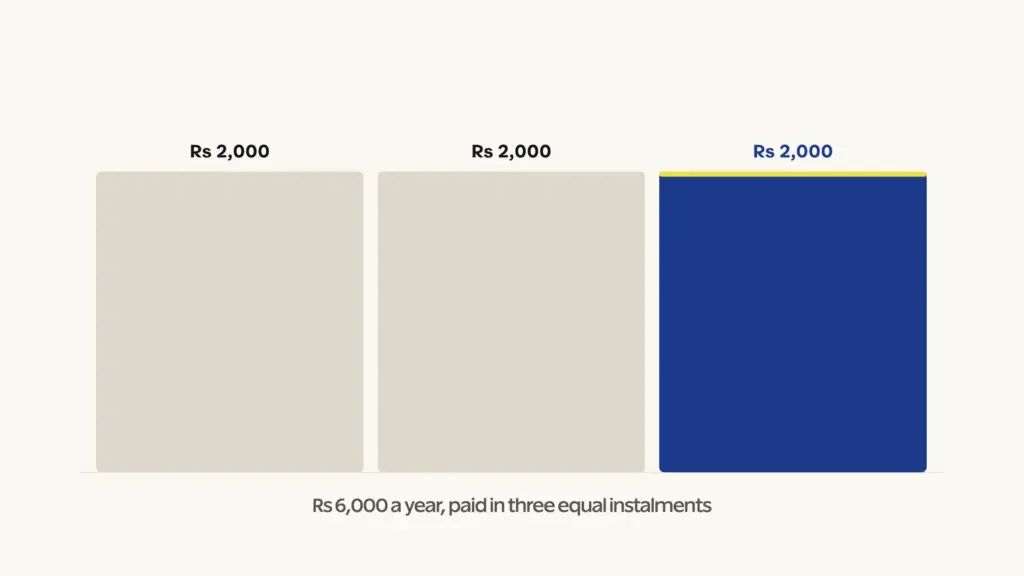
Namo Shetkari Mahasanman Nidhi Yojana is Maharashtra’s own income-support scheme for farmers. It pays ₹6,000 a year in three instalments of ₹2,000, on top of the ₹6,000 a year that the same farmer already receives from the central PM-KISAN scheme — so an eligible household in Maharashtra draws ₹12,000 a year in direct transfers. There is no separate application form: if you are a live PM-KISAN beneficiary in Maharashtra, you are in.
What the scheme is
The Maharashtra government approved the scheme by a government resolution dated 15 June 2023, and it is run by the Department of Agriculture through the Commissionerate of Agriculture, Pune. The design is deliberately parasitic on PM-KISAN in the useful sense: it uses the same beneficiary database, the same Aadhaar-seeded bank accounts, the same eligibility filters and the same three-instalment rhythm, so the state does not have to build or verify a list of its own.
The amount has remained ₹6,000 a year since the scheme began (verified July 2026). If you come across a higher figure, check it against the government resolutions published on the official NSMNY portal before believing it.
| Element | Namo Shetkari Mahasanman Nidhi |
|---|---|
| Implementing government | Government of Maharashtra, Department of Agriculture |
| Annual benefit | ₹6,000 |
| Instalment | ₹2,000, three times a year (roughly every four months) |
| Mode of payment | Direct Benefit Transfer to the Aadhaar-seeded bank account |
| Eligibility base | Farmers already receiving PM-KISAN in Maharashtra |
| Separate application | Not required |
| Portal | nsmny.mahait.org |
| Combined support with PM-KISAN | ₹12,000 a year |
Who gets it
The rule is short: every farmer receiving PM-KISAN in Maharashtra is eligible. In practice that means all of the following have to be true.
- The farmer holds cultivable agricultural land in their own name in Maharashtra, with the land record (7/12 and 8-A) updated to reflect it.
- The farmer is registered and active under PM-KISAN, not merely applied.
- eKYC is complete. PM-KISAN makes eKYC mandatory, and a beneficiary whose eKYC is pending will be skipped for both the central and the state instalment.
- The bank account is Aadhaar-seeded and mapped in the NPCI mapper. This is the single most common reason a payment fails.
The PM-KISAN exclusion list applies as it stands. Institutional landholders, serving and retired government employees above the lowest grades, income-tax payers in the previous assessment year, pensioners drawing above the prescribed monthly pension, professionals such as doctors, engineers, lawyers and chartered accountants in practice, and holders of constitutional posts are outside the scheme — and being excluded from PM-KISAN automatically means being excluded here.
How the instalments work
Instalments follow the PM-KISAN cycle rather than a calendar of their own, which is why the state release usually lands within a few weeks of the central one. The Department of Agriculture issues a separate government resolution for each instalment, and those circulars are published on the NSMNY portal — circulars up to the seventh instalment are listed there as of July 2026.
On the central side, the 23rd PM-KISAN instalment was released on 20 June 2026 from Tarakeswar in Hooghly, West Bengal. If your PM-KISAN instalment has arrived and the state one has not, the usual answer is timing, not eligibility — the state release follows separately.
The detailed guide to PM-KISAN Samman Nidhi covers registration, eKYC and the central eligibility rules that decide your Namo Shetkari status too.
How to check your beneficiary status
- Open nsmny.mahait.org.
- Click Beneficiary Status on the home page. You do not need to log in for this — the login box on the same page is for departmental users.
- Enter your identifier (Aadhaar number or registered mobile number, as prompted) and the captcha text.
- Read the payment history. It shows which instalments were released, the date, and whether the credit succeeded or was returned.
- If a payment shows as failed or undisbursed, note the error code shown against it. The portal has a dedicated Undisbursed Fund Error code details page that explains each code and the exact action you have to take.
The same portal also carries an Online Refund option, used when money has been credited to someone who was not eligible and has to be returned, and a Track On Notice section for beneficiaries who have been issued a notice.
Common failures and how to fix them
The portal’s own error-code list is the most useful troubleshooting document the department publishes. The recurring ones:
- Aadhaar not mapped to the account number — visit the bank and get Aadhaar seeded or re-seeded in the NPCI mapper. Simply having Aadhaar “linked” for KYC is not the same thing.
- Aadhaar de-seeded from the NPCI mapper by the bank — this happens when an account is closed or stops being eligible for credits. Contact the bank to re-seed.
- Account closed, inoperative, or blocked/frozen — get the account made operative, or give a different savings account that is Aadhaar-seeded.
- Account holder expired — the legal heir’s account number has to be updated in the database before any further instalment can be pushed.
- Invalid account number in PFMS — the account details on record are wrong; correct them through the bank and the agriculture office.
- Invalid Aadhaar number — the number entered in the record is wrong and must be corrected.
Where the record itself is at fault rather than the bank, the correction goes through the taluka agriculture officer or the village-level operator who handles PM-KISAN data. For a scheme with no application form, that office is your only real service counter.
Where to complain
The Commissionerate of Agriculture publishes its contact details on the portal: Namo Shetakari Mahasanman Nidhi Yojana, Commissionerate of Agriculture, Kaveri Hall, Sixth Floor, DTC Centre, near Mhatre Bridge, Erandawane, Pune 411004, phone 020-25538755, email [email protected] (verified July 2026).
Take the grievance in the right order: bank first if the error code points to the account, taluka agriculture office if it points to the record, and the Commissionerate only after those two have been tried and documented.
What else a farming household can draw
Namo Shetkari sits on top of PM-KISAN, and neither one blocks other benefits. Crop insurance, subsidised inputs and food security support are separate tracks with separate eligibility. Food-support schemes such as Annapurna Yojana run on entirely different criteria, and a household may qualify for several at once. The consolidated list of government schemes is a useful place to check what else applies.
Frequently Asked Questions
Do I have to apply for Namo Shetkari Yojana separately?
No. There is no separate application form, online or offline. The beneficiary list is drawn from the PM-KISAN database for Maharashtra. Your effort should go into keeping your PM-KISAN record clean — eKYC done, Aadhaar seeded, land record updated.
How much do I get in total each year?
₹6,000 a year from Namo Shetkari Mahasanman Nidhi, in three instalments of ₹2,000, plus ₹6,000 a year from PM-KISAN in three instalments of ₹2,000 — ₹12,000 a year in all for an eligible Maharashtra farmer.
My PM-KISAN money came but the Namo Shetkari instalment did not. Why?
The two are released separately, by two different governments, from two different budgets. A gap of a few weeks is normal. If the gap runs into months, check your beneficiary status on the state portal and read the error code shown against the payment.
Can a tenant farmer or a farm labourer get this?
No. Both PM-KISAN and Namo Shetkari require cultivable land held in the beneficiary’s own name. A tenant cultivating someone else’s land, or a landless agricultural labourer, does not qualify under the current rules.
Both my father and I are in the family. Can we both get it?
Only one member of a family — defined as husband, wife and minor children — can receive the benefit for the same landholding. PM-KISAN has been withholding benefits in cases where more than one member of a family was found to be drawing it, pending physical verification. The same exclusion carries into the state scheme.
What if my instalment shows as “undisbursed”?
Open the Undisbursed Fund Error code details page on nsmny.mahait.org, find your error code, and follow the prescribed action. Most of these are bank-side problems — a de-seeded Aadhaar, a frozen account, a closed account — and are fixed at the bank branch, not the agriculture office.
Is the amount going to be increased?
The annual benefit has been ₹6,000 since the scheme started and remains ₹6,000 as of July 2026. Any change would be notified through a government resolution published on the NSMNY portal, which is the only place worth checking.
Tell Google you want more of this.
Add Anantam IAS as a preferred sourceOne tap, and this site shows up more often in your own Top Stories, AI Overviews and AI Mode. Remove it any time.