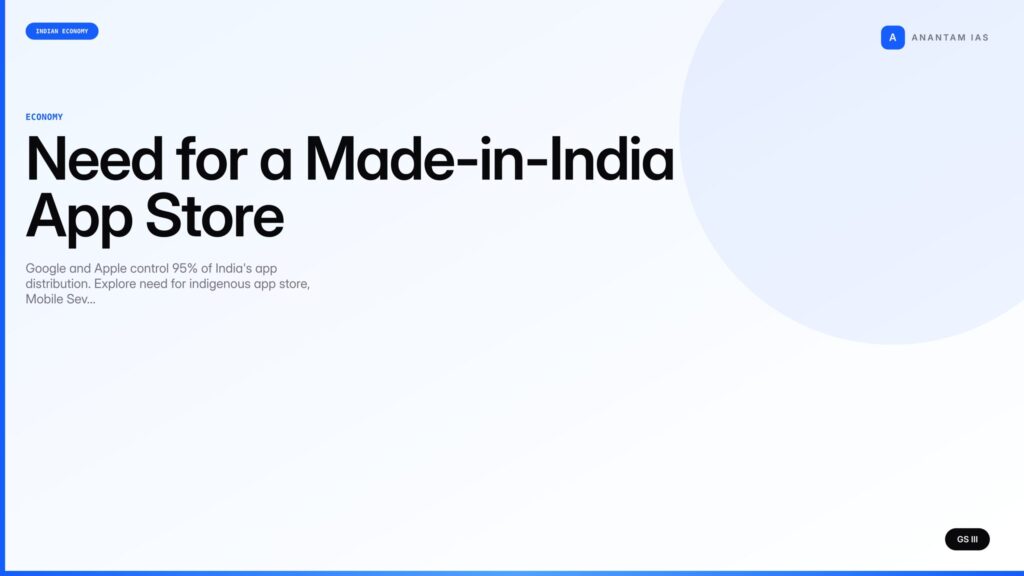
India has one of the largest smartphone markets in the world with over 750 million users, a thriving developer community and world-leading digital public infrastructure. Yet the gateway through which Indian developers reach Indian consumers is controlled almost entirely by two American corporations – Google via its Play Store (nearly 95 per cent of the Android market) and Apple via the App Store (iOS ecosystem). This asymmetry raises three concerns: the high commission extracted on in-app transactions, the dependence of Indian developers on foreign gatekeepers, and the strategic question of digital sovereignty. A home-grown app store, or a small constellation of compliant alternatives, has become a live policy conversation.
The Gatekeeper Problem
Globally there are over 300 app stores including Google Play, Apple App Store, Samsung Galaxy Store, Amazon Appstore and Huawei AppGallery. In practice, the Android and iOS duopoly captures the vast majority of downloads, installs and payments.
Unfair practices
- Commission extraction: Apple's App Store charges 15-30 per cent on in-app purchases. Google Play's billing system was similar until Indian regulators forced changes.
- Mandatory billing: Developers must use the platform's payment system, blocking alternative gateways.
- Anti-steering: Apps cannot direct users to cheaper out-of-app purchase flows.
- Discretionary delisting: Apps can be removed without detailed reasoning or redress.
- Policy opacity: Frequent rule changes create compliance uncertainty.
Consumer and developer costs
- Indian developers report that the 30 per cent commission substantially erodes margins, particularly in subscription and gaming verticals.
- Consumers ultimately pay higher prices because the commission is passed through.
- Startups cannot route around the duopoly because hardware comes pre-installed with the default store.
Setback to the Domestic App Ecosystem
The Prime Minister has repeatedly called on Indian entrepreneurs to build world-class apps – especially in gaming, education, health and fintech. But in the current ecosystem:
- Developers pay listing and commission fees to reach Indian users.
- They must comply with gatekeeper rules set in Mountain View and Cupertino.
- There is limited recourse to an Indian regulator when an app is delisted or throttled.
- Revenue leakage: a meaningful share of domestic digital payments flows offshore through App Store commissions.
An indigenously developed or domestically regulated App Store would address these issues and restore developer-consumer value within India's digital economy.
Options for India
Mobile Seva App Store
Launched by the Ministry of Electronics and IT (MeitY), the Mobile Seva App Store hosts mobile applications for government services and private-sector apps. It needs significant investment in discoverability, consumer awareness, developer outreach and payments integration to compete with Play Store or App Store.
Indus Appstore
Launched in 2024 by PhonePe (Walmart-backed), the Indus Appstore is India's first consumer-facing Android alternative. It offers:
- Zero listing fee for the first year.
- No commission on in-app purchases.
- Multilingual interface in 12 Indian languages.
- UPI-first payments.
Mini-app stores
Paytm's Mini-App Store, Tata Neu, and similar super-app platforms host apps within a parent app. Benefits include:
- No separate download – saves phone storage.
- Lower data consumption.
- Consolidated identity and payments.
Indigenous handset ecosystems
Chinese brands (Xiaomi, Realme, Vivo, Oppo) dominate Indian smartphone sales and come pre-loaded with their own apps and stores. Encouraging Indian brands (Micromax, Lava) and PLI-driven Apple/Samsung manufacturing in India could shift the pre-installed mix if paired with policy guidance on default apps.
Regulatory Levers
Competition Commission of India
CCI has already ruled against Google's Play Store billing policies. It imposed a penalty of Rs 936 crore and directed Google to permit third-party billing with a reduced commission. Apple is under investigation.
Digital Competition Bill
Modelled on the EU Digital Markets Act, the 2024 draft proposes to designate large platforms as Systemically Significant Digital Enterprises, obliging them to:
- Allow third-party app stores and sideloading.
- Permit alternative payment systems.
- Prohibit self-preferencing.
- Enable interoperability.
Open Network for Digital Commerce (ONDC)
Though focused on commerce, ONDC shows how open, state-backed protocols can disintermediate platform monopolies in related domains.
DPDP Act and DPI
The DPDP Act 2023 and Digital Public Infrastructure (Aadhaar, UPI, DigiLocker) provide the rails on which a domestic app distribution ecosystem can be built with privacy and consent safeguards.
Challenges
- Consumer inertia: Users are deeply habituated to Play Store and App Store.
- Trust and security: Indian app stores must demonstrate rigorous malware screening and refund mechanisms.
- iOS constraints: Apple's hardware-software lock-in makes a pure alternative nearly impossible without regulatory force.
- Developer economics: Must justify additional distribution overhead for dual-listing.
- Global comparability: Indian apps targeting the world still need Play Store and App Store.
Learnings from Abroad
- European Union: DMA forced Apple to allow third-party app stores and alternative payments in 2024.
- South Korea: Requires app stores to permit third-party payment systems.
- China: Dozens of indigenous app stores – Huawei, Xiaomi, OPPO, Tencent – dominate because Google Play is absent.
- Japan: Smartphone Act under discussion to curb Apple and Google gatekeeping.
Latest developments (2024-26)
- Indus Appstore launched: PhonePe's zero-commission Indian app store went live in February 2024.
- Apple CCI probe: Ongoing investigation into Apple's App Store billing policy in India.
- Digital Competition Bill: Draft circulated in 2024; expected to be tabled in Parliament in 2025-26 with ex-ante rules for gatekeepers.
- Google Play changes: Forced to allow third-party billing in India with a 4-11 per cent reduced commission.
- UPI international: UPI now live in France, UAE, Singapore, Bhutan, Nepal, Mauritius – pushing India's payment rails outside the Apple-Google pipe.
- PLI expansion: Apple's India manufacturing topped USD 14 billion in FY25; sets up conditions for deeper localisation of the full stack.
- Budget 2025-26: Reinforced digital public infrastructure allocations.
- MPI and MSME linkages: Rising rural app adoption and MSME-led app-driven businesses make a competitive app-distribution layer strategically important.
Way Forward
- Pass the Digital Competition Bill with clear gatekeeper obligations.
- Scale the Mobile Seva Appstore with consumer-grade UX and multilingual support.
- Support Indus Appstore and mini-app models with procurement preferences.
- Integrate domestic app stores with UPI, ONDC and DigiLocker.
- Mandate default-app choice screens for consumers on new devices.
- Continue CCI enforcement to check abuse of dominance.
UPSC Relevance
Indigenous app stores intersect GS II (government policy, regulation) and GS III (economy, technology, IT). Mains prompts link the theme to digital sovereignty, competition policy and start-up ecosystems. Prelims can test the CCI Google Android and Play Store rulings, ONDC, DPDP Act, and the Digital Competition Bill. Candidates should internalise the commission structure, Indus Appstore launch, and 2024-25 EU DMA comparisons to build a forward-looking, globally contextualised answer.
Tell Google you want more of this.
Add Anantam IAS as a preferred sourceOne tap, and this site shows up more often in your own Top Stories, AI Overviews and AI Mode. Remove it any time.