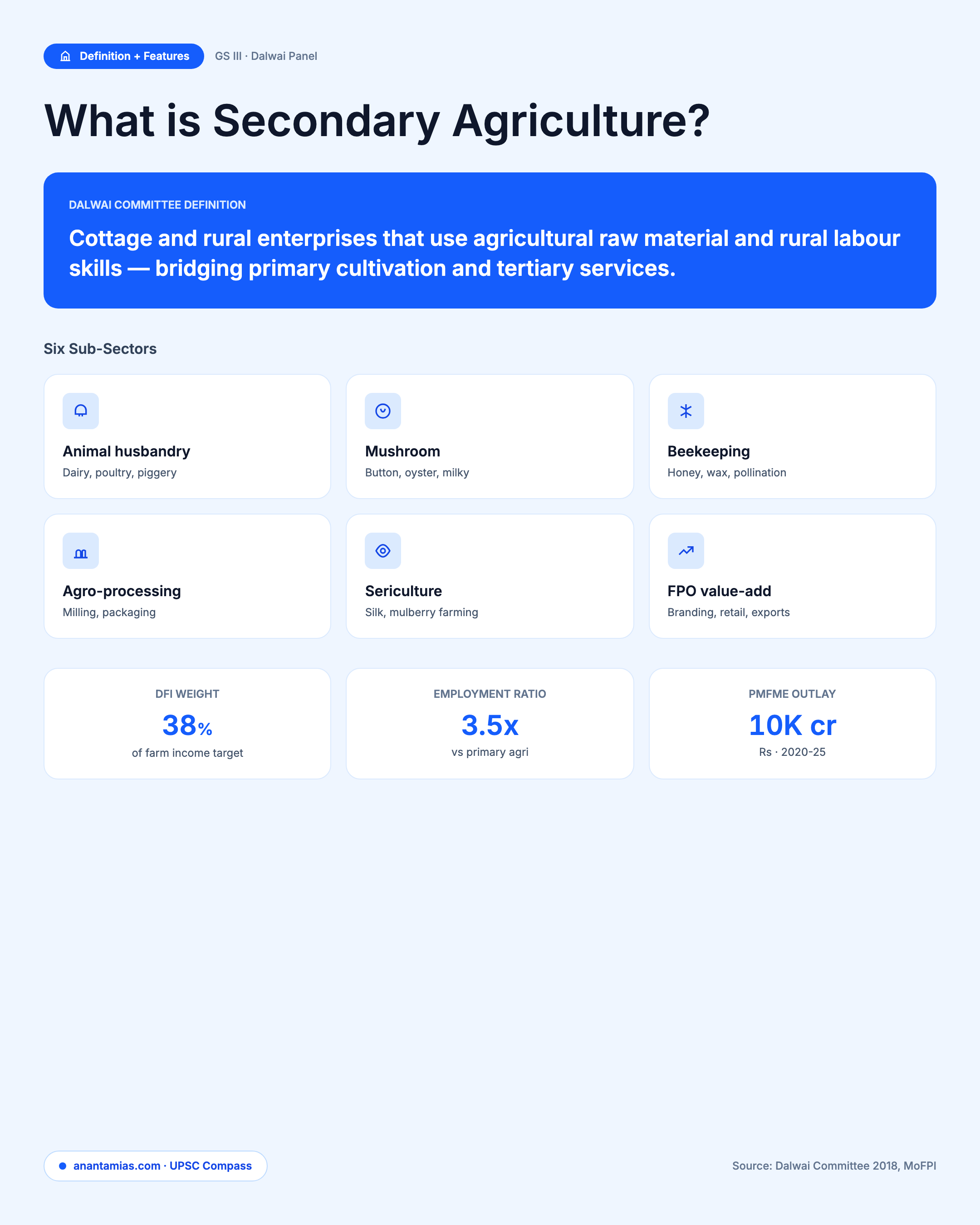
Secondary agriculture is the cluster of cottage and MSME-scale enterprises that use primary agricultural produce as raw material, deploy locally available skills, and operate from villages or rural towns. The term gained policy currency through the Dalwai Committee on Doubling Farmers' Income (DFI), which defined secondary agriculture as economic activity that (a) uses agricultural produce as raw material, (b) leverages locally available skills, and (c) qualifies as a Micro, Small or Medium Enterprise (MSME). The Dalwai Committee saw secondary agriculture as the single biggest opportunity to double farmers' incomes — because direct farming income is constrained by land size, while value addition can scale without proportional land.
For UPSC, secondary agriculture is a recurring GS-III topic, intersecting with doubling farmers' income, MSME, food processing, employment generation, women empowerment, rural livelihoods, ODOP, and PMFME. Prelims has tested the Dalwai Committee definition and examples (mushroom, beekeeping, dairy, poultry, agro-processing). Mains has asked about why agriculture alone cannot generate enough income for 86% small/marginal farmers and how secondary agriculture closes the gap.
What is Secondary Agriculture?
Secondary agriculture is cottage industry built on the agricultural value chain. Examples cut across:
- Honey production and beekeeping (apiculture).
- Mushroom cultivation.
- Backyard poultry, duck-rearing, quail farming.
- Goat, sheep, pig, rabbit rearing.
- Fish farming, ornamental fisheries, sericulture (silk).
- Dairy and milk-product processing — paneer, ghee, khoa, yoghurt.
- Agro-processing — flour milling, dal milling, oil pressing, jaggery, pickling, jam, papad.
- Bamboo crafts, jute products, coir products.
- Floriculture by-products — essential oils, dyes.
- Spice processing and packaging.
- Meat and poultry processing units.
- Fruit and vegetable preservation, jams, juices, dehydrated products.
- Bio-fertiliser, vermi-compost, biopesticide manufacture.
Distinction from Primary and Tertiary Agriculture
| Type | Activity | Examples |
|---|---|---|
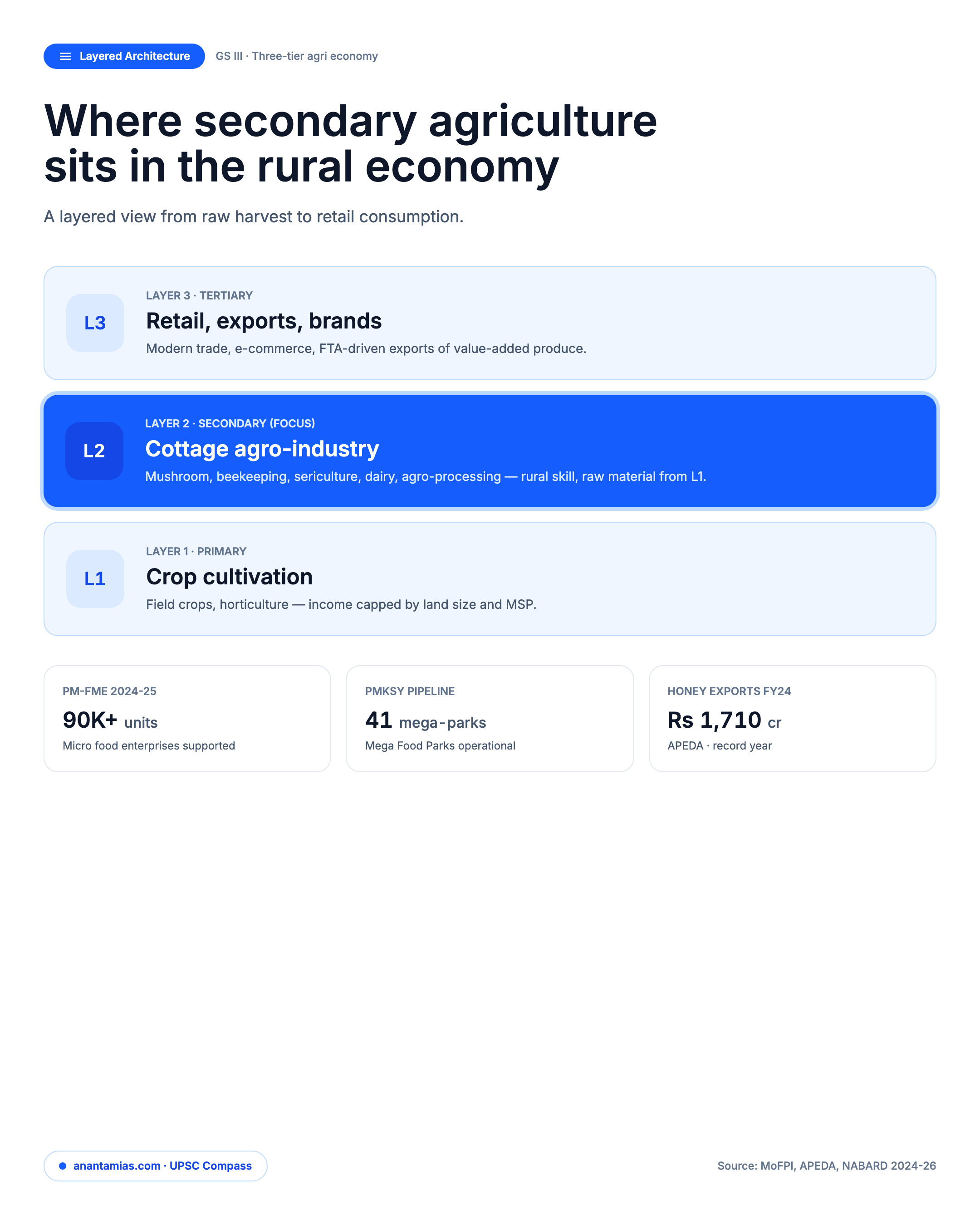
| Primary agriculture | Crop and livestock production | Wheat, paddy, milk, eggs |
| Secondary agriculture | Value addition, processing, allied | Flour mills, dal mills, dairy plants, mushroom units, beekeeping |
| Tertiary agriculture | Trading, services, marketing | Mandis, e-NAM trading, agri-fintech, advisory, agri-tourism |
Background: Why Secondary Agriculture Matters
Income Cap on Primary Agriculture
The Indian average operational landholding is 1.08 hectares; 86% of farmers are small or marginal (less than 2 ha). Even with the best agronomy, paddy-wheat farming on 1 ha yields about Rs 50,000-1,00,000 net annually — insufficient to lift households above poverty.
Doubling Farmers' Income (DFI) Calculation
The Dalwai Committee (2017-18) computed that to double the real income of farmers between 2015-16 and 2022-23 required 10.4% annual growth in farm income. Realistically, this could only come from:
- Productivity gains (~25% contribution).
- Resource use efficiency (~25% contribution).
- Diversification toward high-value crops (~25% contribution).
- Diversification into secondary agriculture and non-farm employment (~25% contribution).
The last quartile is where secondary agriculture sits — and it is where most policy traction lies because it scales without land.
Employment Multiplier
The NSSO Periodic Labour Force Survey shows agriculture absorbs ~46% of India's workforce but contributes only ~17% of GDP. Migration of workers to secondary agriculture-based MSMEs in rural areas can:
- Raise rural wages.
- Reduce distress migration to cities.
- Build climate resilience (multiple income sources).
Linkages with Existing Schemes
- PMFME (PM Formalisation of Micro Food Processing Enterprises) — One District One Product approach.
- Pradhan Mantri Kisan Sampada Yojana — cold chain, food parks.
- MGNREGA — wage labour for agro-processing infrastructure.
- NRLM — women-led SHG enterprises.
- MUDRA, Stand-Up India — credit for rural MSMEs.
Components: Sub-Sectors of Secondary Agriculture
1. Allied Animal Husbandry
Beekeeping, backyard poultry, goatery, piggery, fishery, rabbitry. Department of Animal Husbandry & Dairying runs Rashtriya Gokul Mission, NLM, PMMSY to support these.
2. Mushroom and Speciality Cultivation
India produces ~1.5 lakh tonnes of mushrooms annually; demand growing 20% YoY. Punjab, Haryana, Maharashtra, UP lead.
3. Agro-Processing
Includes:
- Cereal milling — atta, suji, maida.
- Pulse milling — dal mills.
- Oilseed crushing — oil expellers, kachi ghani.
- Spice grinding and packaging.
- Fruit and vegetable processing — pickles, jams, juices, dehydrated products.
- Dairy products — paneer, ghee, khoa, lassi, dahi, ice cream.
- Meat and poultry processing.
4. Bio-Inputs Manufacture
- Vermi-compost units.
- Bio-fertilisers — Rhizobium, Azotobacter, PSB.
- Biopesticides — neem-based, Trichoderma, Beauveria.
5. Handicrafts and Cottage Goods from Agri Raw Materials
- Bamboo, cane, coir products.
- Jute crafts.
- Sericulture (silk reeling and weaving).
- Wool products from sheep rearing.
6. Specialty Niche Products
- Honey, royal jelly, propolis.
- Essential oils from aromatic plants (lavender, lemongrass).
- Saffron processing.
- Vanilla curing.
Benefits of Secondary Agriculture
- Holistic rural development — transforms rural areas from raw-produce suppliers to value-added producers.
- Efficient utilisation of resources — engages family labour, marginal land, idle hours.
- Reduces post-harvest losses — local processing prevents perishable wastage (currently 20-25% of horticulture).
- Provides agricultural inputs — bio-fertilisers, vermi-compost, bio-pesticides reduce chemical dependence.
- Develops human capital — replicates the Start-up India model at village level.
- Captures bigger share of consumer rupee — currently farmers get 25-30%; secondary agriculture can lift this to 40-55%.
- Creates non-seasonal employment — primary farming is seasonal; agro-processing operates year-round.
- Empowers women — many secondary agriculture activities (mushroom, beekeeping, processing) are women-led.
- Climate adaptation — diversified income smooths weather shocks.
- Export earnings — processed honey, dehydrated mushrooms, IQF vegetables, organic spices command premium prices abroad.
- Entrepreneurship at village scale — converts farmers into agri-entrepreneurs.
Challenges and Criticism
- Credit access — small rural enterprises struggle to access institutional credit; collateral requirements high.
- Skill gaps — lack of training in food safety, quality assurance, packaging, branding.
- Marketing barriers — branding, distribution, e-commerce listing not accessible to micro enterprises.
- Quality and food safety compliance — FSSAI registration is challenging for unorganised units.
- Infrastructure deficits — power, water, road connectivity in rural clusters.
- Cold chain gaps — perishables-based secondary agriculture stalled by lack of cold storage.
- Competition from organised sector — branded packaged food displaces small units.
- Limited awareness of schemes like PMFME, ODOP among target beneficiaries.
- Fragmented schemes — PMFME, MIDH, NLM, PMMSY, NRLM operate in silos.
- Low GI uptake — niche regional products underbranded.
Special Support Needed for Secondary Agriculture
The Dalwai Committee specifically recommended:
- Priority sector status for institutional credit to secondary agriculture units.
- Low-cost skilling and knowledge-based exposure through KVKs, NIESBUD, ASCI.
- Specialised extension services for women-owned enterprises.
- Priority under rural electrification — secondary agriculture units need reliable power.
- Fast-track procedures to access ongoing central and state scheme benefits.
- Geographical Indication (GI) tags for products from village-scale secondary production.
- Common Facility Centres (CFCs) for shared processing equipment.
- Tax incentives under MSME framework.
- Digital marketing platforms — ONDC integration, Amazon Saheli, ekart B2B.
Recent Developments (2024-2026)
| Year | Update |
|---|---|
| 2020 | PMFME launched — Rs 10,000 crore for 5 years; ODOP approach |
| 2023 | PM Vishwakarma Yojana launched — supports rural artisans including agro-processors |
| 2024 | PMFME beneficiary count crosses 2.4 lakh micro-enterprises |
| Budget 2024-25 | Rs 700 crore for PMFME; new ODOP focus on millets |
| 2025 | One District One Product expanded to 700+ districts; ~70% are secondary agriculture |
| 2025 | Bharat AgriTech Foundation launched to support agro-processing startups |
| Budget 2025-26 | Rs 1,000 crore PMFME outlay; new credit-linked subsidy under Mudra |
| 2025-26 | National Mission on Natural Farming scaled up; bio-input manufacture as secondary agriculture priority |
| 2026 | Cooperative-led food parks in 50 districts under National Cooperative Policy |
Reforms and Way Forward
- Single-window clearance for secondary agriculture enterprises.
- Priority sector lending status as recommended by Dalwai.
- GI tagging for regional speciality products — accelerated under "GI Saksham".
- Common Facility Centres at every cluster — pack-houses, dryers, milling units, cold rooms.
- PMFME convergence with MGNREGA, NRLM, MUDRA for full life-cycle support.
- Women-led FPO incentives in secondary agriculture.
- Skill development — short courses at KVKs, IRMA, MANAGE, ICAR institutes.
- Quality assurance — FSSAI compliance simplification, common testing labs.
- ONDC integration — e-commerce visibility for micro-enterprises.
- Cluster-based development — One District One Product scaled to ODBP (Block Product).
- Climate-smart secondary agriculture — solar-powered processing, biogas plants.
- Agri-tourism integration — homestays + processing units + farm visits.
- Export incentives through APEDA-MSME convergence.
Government Schemes and Budget Allocations (2025-26)
- PMFME: Rs 1,000 crore; ODOP framework.
- Pradhan Mantri Kisan Sampada Yojana (PMKSY): cold chain, food parks; Rs 4,000 crore.
- National Livestock Mission (NLM): poultry, goatery, piggery; Rs 2,000+ crore.
- PMMSY (Fisheries): Rs 20,050 crore over 5 years.
- MIDH: cluster development for horticulture-based secondary agriculture.
- NBHM: beekeeping.
- NRLM: SHG-led rural enterprises.
- MUDRA / Stand-Up India: micro-loans for agro-processors.
- PM Vishwakarma: artisans support.
- Cooperative Policy 2023: 2 lakh PACS as multipurpose cooperatives.
Mains Answer Hook
A high-scoring GS-III answer should: (a) define secondary agriculture per the Dalwai Committee; (b) establish why primary agriculture cannot double farmer income alone — 1.08 ha average holding, 86% small/marginal; (c) describe PMFME-NLM-PMKSY-PMMSY-MIDH policy stack; (d) cite 20-25% post-harvest loss as the immediate problem secondary agriculture solves; (e) propose reforms — priority sector status, GI tags, CFCs, ONDC integration.
Use: "Primary agriculture feeds the country; secondary agriculture monetises it. Doubling farmer income hinges on which Indian villages climb the value chain."
Prelims Pointers
- Definition source: Dalwai Committee on Doubling Farmers' Income.
- Three criteria: agri raw material + local skills + MSME scale.
- Examples: mushroom, beekeeping, dairy, poultry, agro-processing, vermi-compost, sericulture, bamboo crafts.
- PMFME: PM Formalisation of Micro Food Processing Enterprises; Rs 1,000 crore in 2025-26.
- ODOP: One District One Product; ~70% of products are secondary agriculture.
- PMKSY (Sampada): cold chain and food parks.
- Average operational landholding: 1.08 hectares.
- 86% of farmers: small or marginal.
- DFI required growth rate: 10.4% per annum.
FAQ on Secondary Agriculture
What is secondary agriculture?
Cottage and MSME-scale enterprises that process agricultural produce using local skills — mushroom, beekeeping, dairy, agro-processing, bio-input manufacture, sericulture.
Who defined secondary agriculture officially?
The Dalwai Committee on Doubling Farmers' Income.
Why is secondary agriculture important?
Primary farming income is capped by land size (1.08 ha average). Secondary agriculture scales without land, captures more of the consumer rupee, and creates year-round employment.
Which scheme directly supports it?
PMFME (PM Formalisation of Micro Food Processing Enterprises) launched 2020 under the Ministry of Food Processing Industries.
What is ODOP?
One District One Product — a focused intervention identifying one signature product per district for end-to-end value chain development.
How does secondary agriculture help women?
Many activities (mushroom, beekeeping, dairy, food processing) are inherently women-friendly; PMFME, NRLM, PM Vishwakarma have dedicated women SHG components.
Secondary agriculture is the second engine of farm income — and arguably the more important one for the next decade. For UPSC, anchor your answers in the Dalwai definition, the PMFME-ODOP policy stack, the 1.08 ha landholding constraint, and the 25-30% farmer share of consumer rupee. Pair these with the priority-sector lending and GI-tag reforms for a Mains-grade answer.
Tell Google you want more of this.
Add Anantam IAS as a preferred sourceOne tap, and this site shows up more often in your own Top Stories, AI Overviews and AI Mode. Remove it any time.