The Union Territory of Ladakh has lived through one of the most consequential constitutional transitions any Indian region has faced in recent memory. In August 2019, Parliament read down Article 370, bifurcated the former state of Jammu and Kashmir, and carved Ladakh out as a separate Union Territory without a legislature. What looked like a long-awaited recognition for Leh and Kargil quickly turned into a different anxiety. With Article 35A gone, every protection on land, jobs, and culture that residents had taken for granted under the J&K Constitution disappeared overnight. Six years of protests, hunger strikes, and negotiations followed.
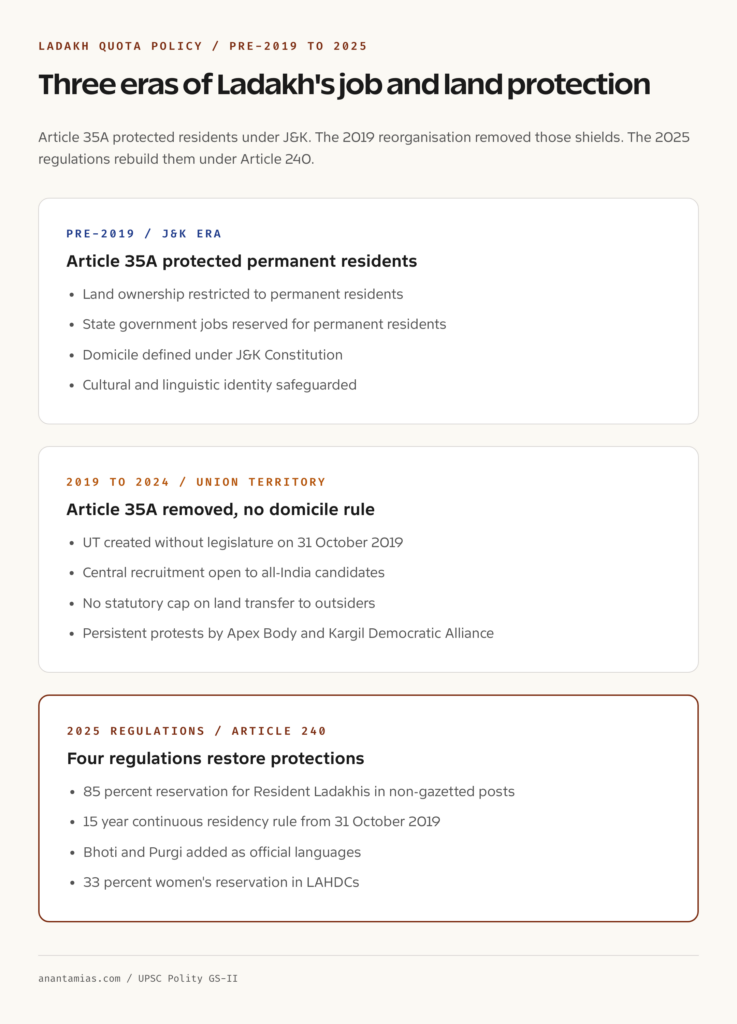
In late 2025, the President of India notified four regulations under Article 240 of the Constitution that finally addressed the core demands of Ladakhi groups. The package introduces an 85% domicile-based reservation in non-gazetted government jobs, sets a 15-year continuous residency rule for the domicile certificate, recognises Bhoti and Purgi as official languages alongside Hindi, English, and Urdu, and mandates 33% reservation for women in the Leh and Kargil Autonomous Hill Development Councils. These are not policy circulars. They are regulations issued under a power that gives them the same force as an Act of Parliament.
This guide walks through what the 2025 regulations actually say, how they sit inside the Article 240 framework, why the Sixth Schedule demand is still alive, and what the constitutional and federal questions look like for the years ahead.
Quick Facts on the Ladakh 2025 Regulations
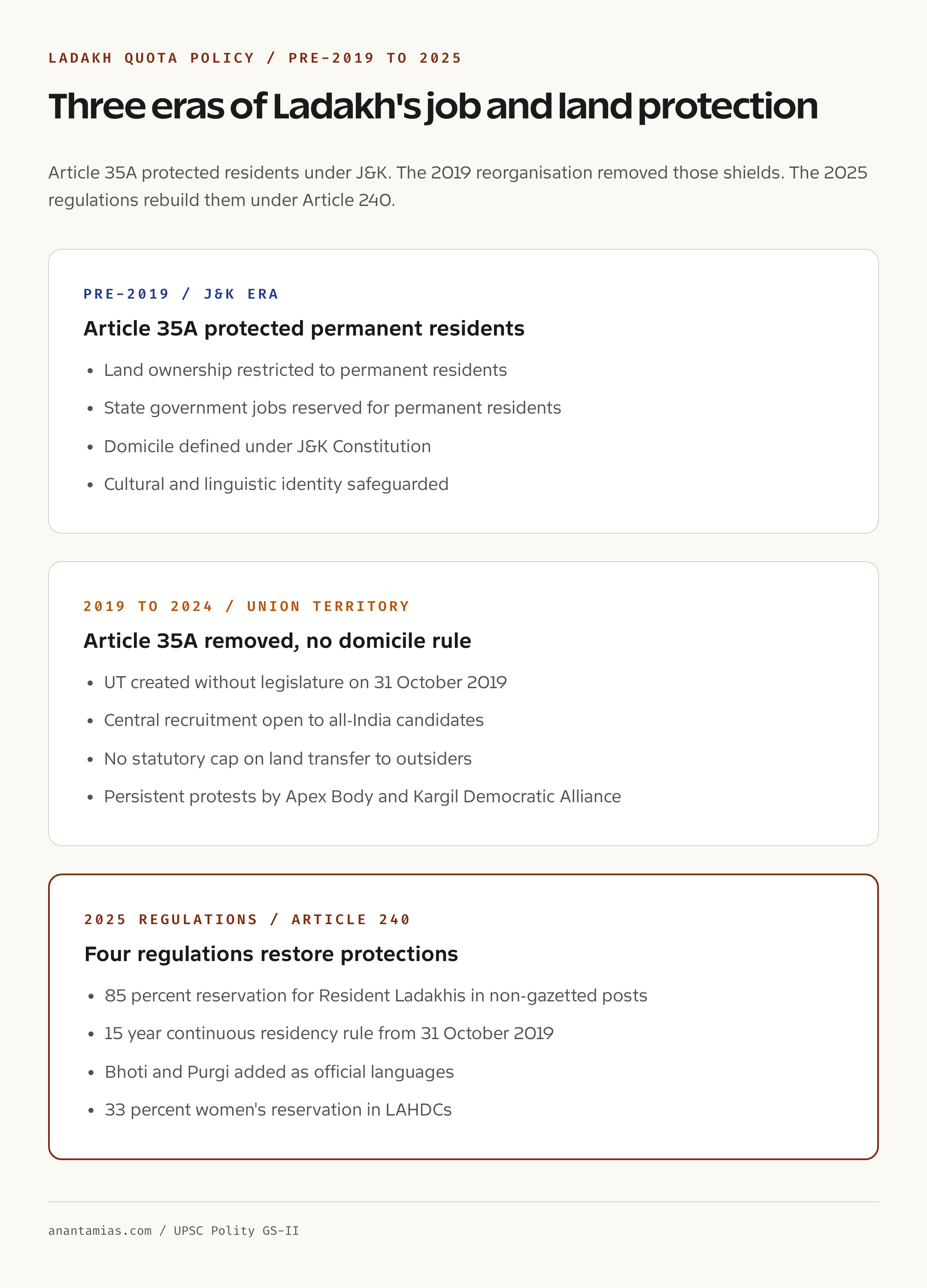
The President of India issued four regulations for Ladakh in 2025 under Article 240 of the Constitution, which empowers the President to make regulations for the peace, progress, and good government of certain Union Territories. The Ladakh Civil Services Decentralisation and Recruitment (Amendment) Regulation, 2025 reserves 85% of non-gazetted posts for Resident Ladakhis, with the existing 10% Economically Weaker Sections quota taking effective local protection close to 95%. The Union Territory of Ladakh Reservation (Amendment) Regulation, 2025 fixes a 15-year continuous residency requirement, calculated from October 31, 2019, for non-locals who seek a domicile-based quota. The Ladakh Official Languages Regulation, 2025 adds Bhoti and Purgi to the list of official languages alongside Hindi, English, and Urdu. The Ladakh Autonomous Hill Development Councils (Amendment) Regulation, 2025 introduces 33% reservation for women in the Leh and Kargil councils. None of these regulations grants statehood, none extends the Sixth Schedule of the Constitution to Ladakh, and the LAHDCs continue to be statutory bodies under a 1997 Jammu and Kashmir Act rather than constitutional bodies.
What the 2025 Regulations Actually Do
The 85% non-gazetted job quota is the most visible piece of the package. Non-gazetted government posts in Ladakh, which include clerical, technical, and lower administrative categories, are now reserved for residents of the UT. Combined with the 10% EWS quota, which is open to Ladakhis as well, the effective share of jobs available to non-domiciled candidates shrinks to about 5%. This number is high by national standards. Most state-level domicile policies cap local reservation around 75% to 80% to stay within the Indra Sawhney ceiling of 50% for caste-based reservations, with the EWS quota added on top. Ladakh’s 85% sits at the upper edge of what current jurisprudence treats as constitutionally tolerable for a domicile quota.
The 15-year residency rule is structured to define the local in a way that includes long-settled non-Ladakhi families, not just those with Ladakhi ancestry. The starting date of October 31, 2019 is the day Ladakh became a Union Territory. The clock runs from there. A migrant who entered Ladakh in 2010 already has more than a decade and a half of residence, but the regulation is forward-looking. Future migration into Ladakh will require a 15-year track record before a domicile certificate is issued.
The official languages regulation is a recognition piece. Bhoti, the umbrella term used in Ladakh for the Tibetan-derived languages spoken in Leh, and Purgi, the language spoken across most of Kargil, now sit alongside Hindi, English, and Urdu. The practical effect is that government communication, official forms, signage, and educational materials must be available in these languages. The political effect is symbolic recognition of Ladakhi cultural identity, which has been a central demand of both the Leh-based Apex Body and the Kargil Democratic Alliance.
The LAHDC women’s reservation is a federal nudge. Local self-government in India is supposed to be governed by the Seventy-third and Seventy-fourth Constitutional Amendments, which mandate 33% reservation for women in panchayats and municipalities and which most states have since taken to 50%. The LAHDCs, being statutory rather than constitutional bodies, were not bound by these provisions. The 2025 regulation closes that gap and brings Ladakh’s local councils in line with the women’s reservation regime now standard across India.
Background and Historical Context: J&K to Union Territory
Before August 2019, Ladakh was administered as part of the state of Jammu and Kashmir, which enjoyed a special constitutional status under Article 370 and the protections of Article 35A. Article 35A, inserted by a Presidential Order in 1954, allowed the J&K legislature to define “permanent residents” and reserve land, jobs, scholarships, and aid exclusively for them. Outsiders, including Indian citizens from other states, could not buy land in J&K or claim government jobs there. This permanent-resident framework was the de facto domicile protection that Ladakhis lived under.
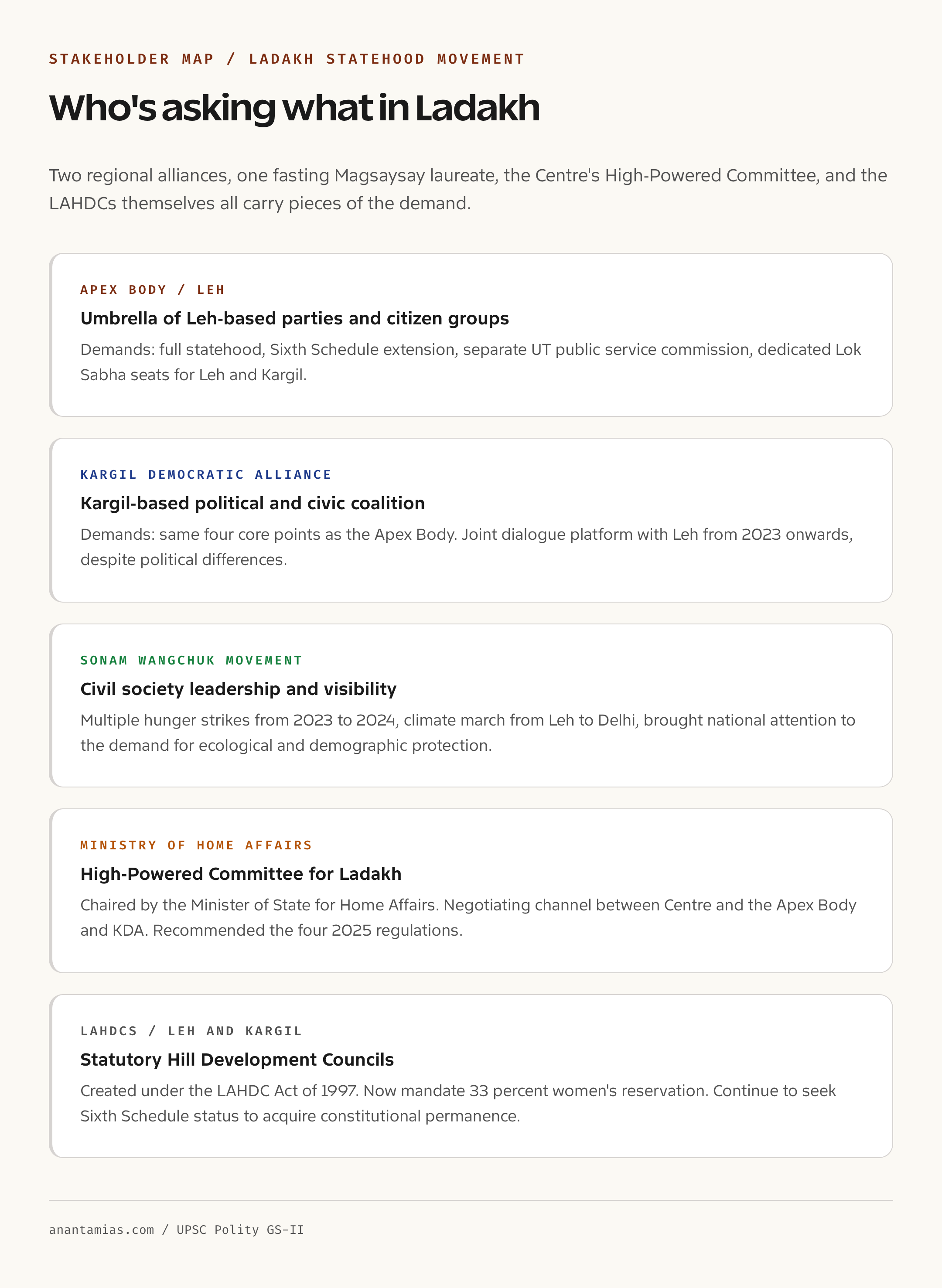
The Jammu and Kashmir Reorganisation Act of 2019 dissolved the state, created the UT of Jammu and Kashmir with a legislative assembly, and a separate UT of Ladakh without one. Article 35A vanished along with the state. Without a state legislature and without 35A, Ladakh now had no legal mechanism to protect local jobs, land, or culture. Central government recruitment became open to candidates from all over India. Tourism, mining, and real estate interests from outside the region looked at Ladakh’s land with fresh eyes. Sonam Wangchuk’s hunger strikes and Leh’s Apex Body, along with the Kargil Democratic Alliance, drew tens of thousands into protests through 2023 and 2024.
The High-Powered Committee constituted by the Ministry of Home Affairs under the Minister of State for Home Affairs began talks with both Apex Body and Kargil Democratic Alliance representatives. Four core demands took shape: full statehood for Ladakh, extension of the Sixth Schedule of the Constitution to provide tribal autonomy, a separate public service commission and job reservation policy, and dedicated parliamentary representation for Leh and Kargil. The 2025 regulations are the first concrete legal response to the second, third, and fourth demands. Statehood and the Sixth Schedule remain unresolved.
Article 240 of the Constitution: The Authority Behind the Regulations
Article 240 sits in Part VIII of the Constitution and empowers the President of India to make regulations for “the peace, progress and good government” of five Union Territories: Andaman and Nicobar Islands, Lakshadweep, Dadra and Nagar Haveli and Daman and Diu, Puducherry (only when its assembly is suspended or dissolved), and Ladakh. Regulations made under Article 240 may repeal or amend any Act of Parliament that applies to the territory and have the same force as an Act of Parliament. Importantly, this is a Presidential law-making power available only because these UTs do not have, or do not currently have, a functioning legislature of their own.
For Ladakh, this is the only available legislative route. Without a UT assembly, the only ways to legislate for the territory are an Act of Parliament or a Presidential regulation under Article 240. The 2025 changes were notified through the regulation route, which is faster and avoids parliamentary debate. This procedural choice has not been free of criticism. Critics argue that decisions of this scale, affecting employment, demographics, language, and gender representation in a sensitive border region, should at least involve parliamentary scrutiny.
Why the Regulations Matter
For Ladakh, the regulations restore a measure of the protection that vanished with Article 35A. Local job security, demographic stability, and cultural recognition are written into law for the first time since the UT was formed. The 33% women’s reservation in LAHDCs is the first time a uniform national standard for women in local government has applied to Ladakh’s hill councils.
For the Centre, the package is a calibrated response that addresses the most achievable demands while leaving statehood and the Sixth Schedule for further negotiation. It signals that Article 240 is a flexible instrument capable of producing rights-based outcomes for UT residents without requiring a full constitutional amendment.
For the broader federal architecture, the regulations are an important precedent. They show how the Union government can use its UT-administering powers to deliver on cultural and economic protections that, in a state, would have come through state-level legislation. Other UTs without legislatures, particularly Andaman and Nicobar and Lakshadweep, may now look at the Ladakh template when their own demographic and cultural questions come up.
Detailed Analysis of the 85% Domicile Quota
The constitutional question on the 85% quota is whether it survives judicial scrutiny under the Indra Sawhney v. Union of India principle. In Indra Sawhney (1992), the Supreme Court fixed a 50% ceiling on caste-based reservations, with narrow exceptions for “extraordinary situations.” Subsequent rulings, including the Janhit Abhiyan case on EWS reservation, have allowed reservations to exceed 50% if the additional quotas are not caste-based and serve a distinct constitutional purpose. Domicile-based reservation in a UT or state has historically been treated as separate from the caste-based ceiling. Jammu and Kashmir, Himachal Pradesh, and several northeastern states have long had domicile-heavy job policies.
The Ladakh regulation sits inside this domicile-protection logic. The 85% reservation is for “Resident Ladakhis,” not for any specific caste or tribe. Within that pool, Scheduled Tribe reservations operate separately. Ladakh has approximately 80% of its population recognised as Scheduled Tribes, including Bhots, Baltis, and several smaller communities. The interaction between ST reservation and the new domicile reservation will need to be worked out in implementing rules.
A challenge in the Supreme Court is plausible but not assured. The doctrine of equal opportunity under Article 16 permits residence-based preferences if they are reasonable and serve a legitimate state aim. The geography of Ladakh, the pressure on its fragile mountain ecosystem, and the preservation of its tribal demographic character all give the Centre strong grounds to defend the 85% number. Whether courts read 85% as proportionate to the threat or as a step too far is the open question.
Comparative Perspective: Ladakh, Northeast, and J&K
Ladakh’s regulations bear comparison with the special arrangements that protect demographic and cultural identity in the northeast. Articles 371A through 371J grant constitutional protection to several northeastern states. Article 371A protects Naga customary law and land rights in Nagaland. Article 371G provides similar protection to Mizoram. The Sixth Schedule itself, applied to Assam, Meghalaya, Tripura, and Mizoram, creates Autonomous District Councils with legislative, executive, and judicial powers over land, forests, customary law, and inheritance.
Compared to the Sixth Schedule, the LAHDCs in Ladakh are statutory bodies created under the Ladakh Autonomous Hill Development Councils Act of 1997, originally a J&K state law. They have administrative powers but limited legislative reach. The persistent demand from Leh and Kargil is to lift the LAHDCs from statutory status to Sixth Schedule constitutional status, which would give them lawmaking power over land, customs, and inheritance.
The new domicile and language regulations narrow the gap, but they do not bridge it. A statutory regulation under Article 240 can be amended by the next President. A constitutional schedule, once extended, cannot be withdrawn without a constitutional amendment with two-thirds majority and ratification by half the states. The asymmetry of permanence is at the heart of why Ladakhi groups continue to push for the Sixth Schedule.
Challenges and Pending Issues
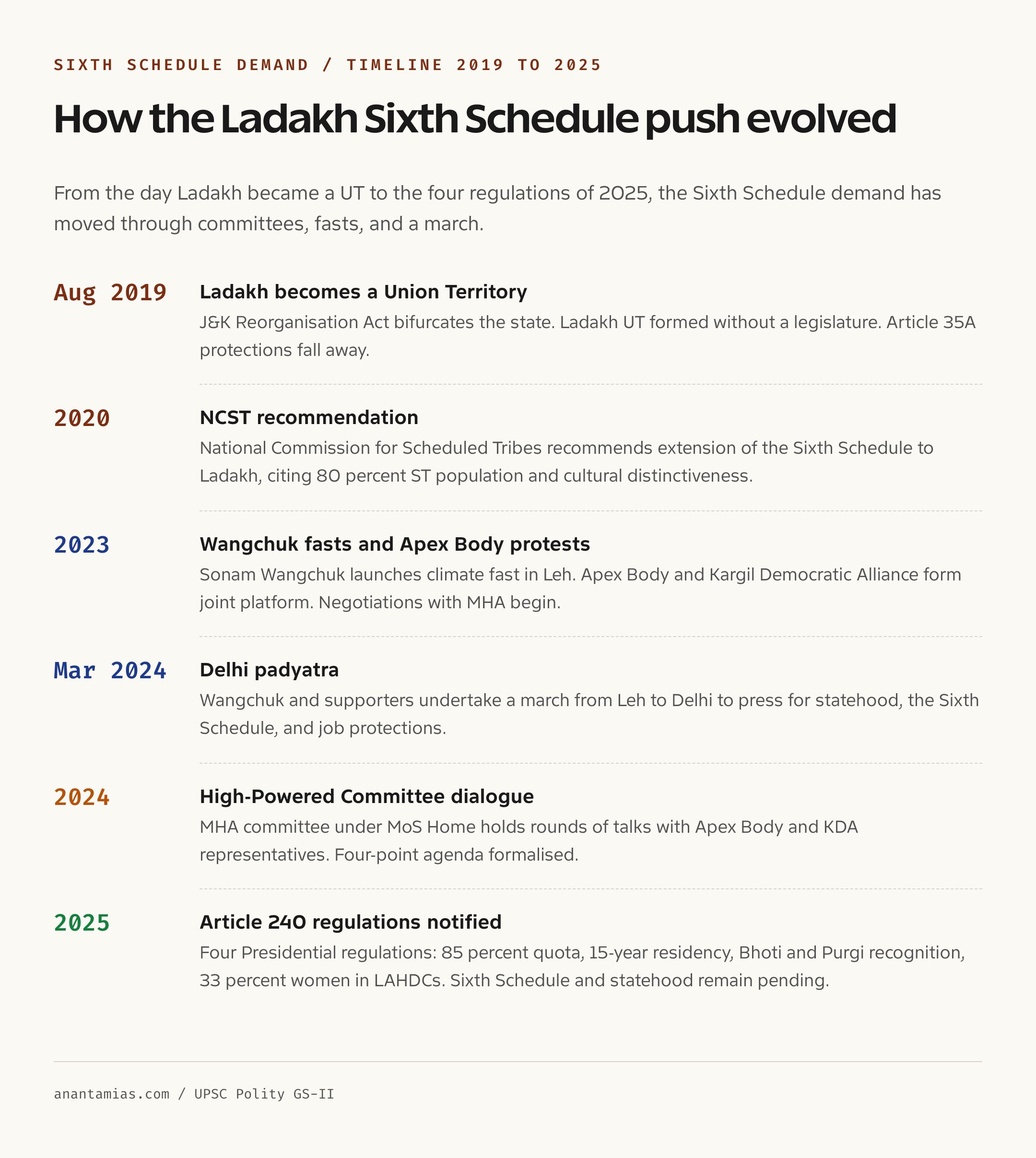
The regulations leave several questions unanswered. First, the 85% domicile quota is restricted to non-gazetted posts. Gazetted positions, including the higher rungs of the UT administration, remain open. The Ladakh demand for a separate UT-level public service commission, parallel to the UPSC route, has not been met. Second, there is no protection on land transfer. A non-resident can still buy land in Ladakh, subject only to general central laws, and tourism and commercial pressure on land remains a live concern. Third, the Sixth Schedule recommendation made by the National Commission for Scheduled Tribes in 2020 has neither been accepted nor formally rejected. Fourth, statehood remains a maximalist demand that the Centre has not entertained.
Implementation also has practical edges. The 15-year residency clock may exclude long-term residents who cannot produce documentary proof going back to 2019. Bhoti and Purgi need to be standardised in script and orthography for official use. The 33% women’s reservation in LAHDCs requires the rotation of constituencies, which can be politically sensitive in small councils. None of these are unsolvable, but each needs administrative attention.
Prelims Pointers
Article 240 of the Constitution authorises the President to make regulations for the UTs of Andaman and Nicobar Islands, Lakshadweep, Dadra and Nagar Haveli and Daman and Diu, Puducherry (only when its assembly is suspended or dissolved), and Ladakh. Regulations under Article 240 have the same force as an Act of Parliament. Article 239A applies to Puducherry’s legislative arrangement and is distinct. The Sixth Schedule of the Constitution applies to tribal areas in Assam, Meghalaya, Tripura, and Mizoram, not to Ladakh. The LAHDCs were created under the Ladakh Autonomous Hill Development Councils Act, 1997, which was originally a Jammu and Kashmir state law and now applies to the UT. The Apex Body is the umbrella organisation of Leh-based groups, while the Kargil Democratic Alliance represents Kargil. The High-Powered Committee for Ladakh is chaired by the Minister of State for Home Affairs.
Mains Practice Questions
Discuss the significance of the four regulations notified for Ladakh in 2025 under Article 240 of the Constitution. To what extent do they address the core demands of Ladakhi civil society? (15 marks, 250 words)
Examine the constitutional and policy case for extending the Sixth Schedule to Ladakh. What are the implications of the current statutory framework of the LAHDCs versus a Sixth Schedule arrangement? (10 marks, 150 words)
The 85% domicile reservation in Ladakh raises questions about the Indra Sawhney ceiling on reservations. Critically analyse the constitutional viability of this provision. (15 marks, 250 words)
Way Forward
The 2025 regulations are a sensible first move, not the final word. A durable solution for Ladakh will need three further steps. First, a clear position from the Centre on the Sixth Schedule recommendation. Second, a separate Ladakh Public Service Commission and a stable framework for gazetted posts. Third, statutory protection on land transfers, perhaps modelled on the Himachal Pradesh Tenancy and Land Reforms Act, which restricts agricultural land sales to non-Himachalis. Statehood, given the population and the strategic location of Ladakh, may take longer to deliver, but the door has not been closed.
The regulations also point at a quieter constitutional opportunity. Article 240 is a flexible instrument that the Centre can use creatively in other UTs. Combined with parliamentary scrutiny and consultation with local representatives, the route can deliver rights-based outcomes for territories that lack a legislature without waiting for a constitutional amendment. The Ladakh template, applied with care, can become a model for how the Indian federal system handles small, culturally distinct, strategically sensitive territories.
Frequently Asked Questions
What is Article 240 of the Indian Constitution?
Article 240 empowers the President of India to make regulations for the peace, progress, and good government of certain Union Territories, including Andaman and Nicobar Islands, Lakshadweep, Dadra and Nagar Haveli and Daman and Diu, Puducherry (only when its assembly is suspended or dissolved), and Ladakh. Regulations made under Article 240 have the same force as an Act of Parliament.
What does the 85% reservation in Ladakh apply to?
The 85% quota under the Ladakh Civil Services Decentralisation and Recruitment (Amendment) Regulation, 2025 applies to non-gazetted government posts. Combined with the existing 10% EWS quota, the total reservation effectively touches 95%, leaving roughly 5% for non-domiciled candidates.
Who qualifies as a Resident Ladakhi under the 2025 regulations?
A Resident Ladakhi is a person whose family has historical roots in Ladakh or who has resided continuously in Ladakh for 15 years, with the residency clock starting on October 31, 2019, the date Ladakh became a Union Territory.
What are Bhoti and Purgi?
Bhoti is the umbrella term for the Tibetan-derived language family spoken predominantly in Leh and surrounding areas. Purgi is the language spoken in most parts of Kargil district. Both have been recognised as official languages of Ladakh alongside Hindi, English, and Urdu under the 2025 regulation.
What is the difference between LAHDC and a Sixth Schedule body?
The Leh and Kargil Autonomous Hill Development Councils are statutory bodies created under the LAHDC Act, 1997, with limited administrative powers. Sixth Schedule Autonomous District Councils, found in Assam, Meghalaya, Tripura, and Mizoram, are constitutional bodies with legislative power over land, forests, inheritance, and customary law. The Sixth Schedule offers stronger and more permanent protection.
Has the Sixth Schedule been extended to Ladakh?
No. As of the 2025 regulations, the Sixth Schedule has not been extended to Ladakh. The National Commission for Scheduled Tribes recommended such extension in 2020, but the Centre has not acted on it. Ladakhi civil society groups continue to demand it.
Why did Ladakh need new regulations after 2019?
Before 2019, Ladakh was protected by Article 35A through the Jammu and Kashmir Constitution, which restricted land ownership and government jobs to permanent residents. When Article 370 was read down and J&K was reorganised, Article 35A protections fell away. Ladakh became open to outside recruitment and land purchases, creating demographic and economic anxiety that the 2025 regulations address.
Can the new regulations be challenged in the Supreme Court?
Yes. Like any law or regulation, the four regulations can be challenged on constitutional grounds, particularly the 85% reservation under Article 16’s equal-opportunity guarantee. Whether the courts read the high domicile percentage as reasonable for a small, sensitive border UT will determine the outcome of any such challenge.
Tell Google you want more of this.
Add Anantam IAS as a preferred sourceOne tap, and this site shows up more often in your own Top Stories, AI Overviews and AI Mode. Remove it any time.