The most quoted line in Indian public ethics is a paraphrase: do your duty and do not worry about the result. It appears in convocation speeches, in judgments, on the walls of training academies, and in almost every answer that reaches for an Indian ethical idea. It is also the version most likely to be wrong, because “do not worry about the result” can be read as licence for an official to file a report, tick a box and stop caring whether a scheme reached anybody.
The actual doctrine, nishkama karma, is stricter than the paraphrase and far more demanding. It does not release you from responsibility for outcomes. It removes a specific psychological attachment — to reward, to credit, to the anxiety of result — while leaving the obligation to act well completely intact. Read carefully, it is closer to a discipline for people who hold power than to a consolation for people who do not.
The Dilemma That Opens the Text
The Bhagavad Gita sits inside the Mahabharata as a dialogue on a battlefield, and its ethical seriousness comes from its setting rather than in spite of it. Arjuna, at the moment of engagement, refuses to fight. His reasons are not cowardice; they are moral. Killing kinsmen destroys the family order, produces a society in which obligations cannot hold, and leaves him personally guilty of the deaths of teachers and cousins. He would rather be killed than be the cause of this. He puts down his bow.
What Arjuna faces is a genuine conflict of duties — the situation classical texts call dharma-sankata, treated at length in the framework of dharma as an ethical system. His duty as a warrior with a just cause points one way. His duty to kin and teacher points the other. Neither can be honoured without violating the other, and doing nothing is itself a choice with consequences for everyone depending on him.
The reason this matters beyond its own tradition is that it is structurally the dilemma of office. An officer who must demolish unauthorised structures housing poor families, or divert scarce oxygen from one hospital to another, is not choosing between right and wrong. They are choosing between two obligations that both bind, where inaction is not neutral. The Gita’s response is worth studying because it addresses that shape of problem directly, rather than the easier problem of resisting temptation.
The Answer: Act, but Release the Fruit
Krishna’s response has several strands, and the ethical core is karma yoga — the path of action. The argument moves in steps.
First, withdrawal is not available. Renouncing action is impossible for an embodied person; even refusing to act is an act with effects. The choice is never between acting and not acting, only between acting well and acting badly.
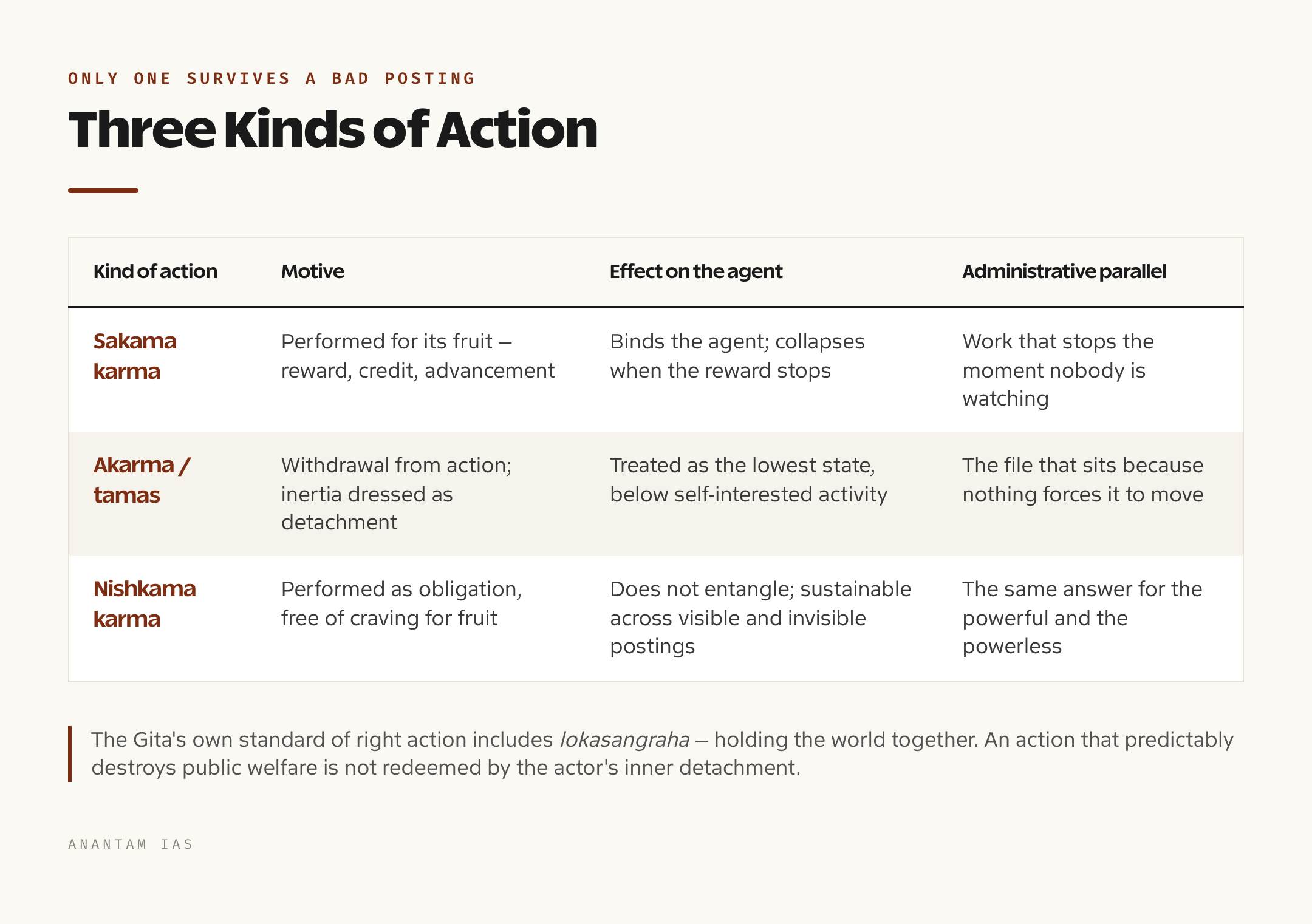
Second, the motive can be separated from the deed. What binds a person morally and psychologically is not the action but the craving attached to it — phala-trishna, thirst for fruit. Action performed as obligation, without that craving, does not entangle the agent in the way self-interested action does.
Third, the result is not wholly yours to command. Outcomes depend on causes far beyond any one agent’s control. Treating them as owed to you produces either arrogance when they arrive or collapse when they do not. The famous formulation is that one has a right to action, never to its fruits.
Fourth, the discipline is sustainable in a way that reward-seeking is not. A person who works for recognition stops when recognition stops. A person who works because the work is theirs to do continues through a posting where nobody is watching.
None of this says outcomes are unimportant. The Gita’s own standard of right action includes lokasangraha — holding the world together, acting for the welfare and cohesion of society. An action that predictably destroys public welfare is not redeemed by the actor’s inner detachment. The claim is narrower and psychologically precise: outcomes should govern how you choose the action, and should not be the thing you are emotionally trading for.
Sthitaprajna: The Steady Mind
The person who has achieved this discipline is called sthitaprajna — of settled or steady wisdom. The text describes them in terms that read almost as a job specification for high office: undisturbed by pleasure and pain alike, neither elated by praise nor deflated by censure, holding to the decision when the mood in the room turns.
Two features of that description are worth separating, because they are usually run together.
The first is equanimity as competence, not as coldness. A District Magistrate managing a communal flashpoint or a flood evacuation makes worse decisions when frightened, angry or desperate for approval. Fear narrows attention; anger selects for the aggressive option; a craving for approval makes the popular choice look like the correct one. The claim that a steady mind decides better is not mysticism. It is close to what the literature on decision-making under stress independently reports, and it is the same faculty the syllabus treats under emotional intelligence and self-regulation.
The second is stability of judgement across audiences. The steady person’s decision does not change when the observer changes — the same file gets the same answer whether the person on the other side is powerful or powerless. That is an operational definition of impartiality, reached by a different route than the Western one, and it is the property most visibly absent in the case studies that turn on political pressure.
Nishkama Karma Is Not Indifference
The most common misuse of the doctrine in public life is as a defence of passivity, so it is worth stating the distinctions plainly.
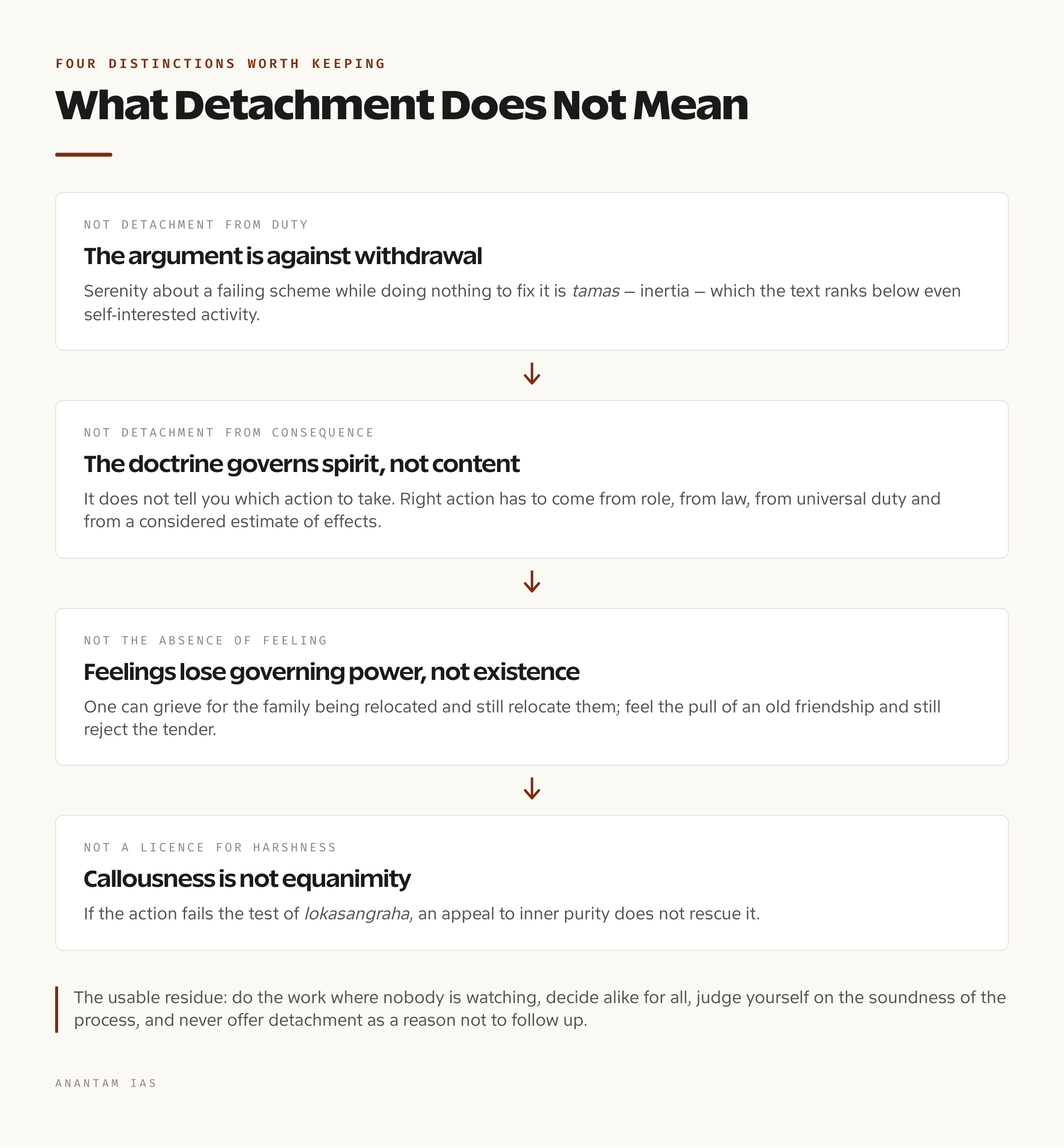
Detachment from fruit is not detachment from duty. The Gita’s entire argument is an argument against withdrawal. An official who is serene about a scheme’s failure while doing nothing to fix it has not achieved nishkama karma; they have achieved tamas — inertia — which the text treats as the worst of the three dispositions, below even self-interested activity.
Detachment from fruit is not detachment from consequence. The doctrine does not tell you which action to take. It governs the spirit in which you take it. The content of right action has to come from somewhere else — from role, from law, from universal duty, from a considered estimate of effects.
Detachment is not the absence of feeling. A person can grieve for the family they had to relocate and still relocate them, or feel the pull of an old friendship and still reject the tender. What is dropped is the governing power of those feelings over the decision, not the feelings themselves.
Detachment is not a licence for harshness. “I did my duty without attachment” has been used to describe conduct that was simply callous. If the action fails the test of lokasangraha, invoking inner purity does not rescue it.
Where It Meets and Departs From Kant
The comparison with Kant is close enough to be useful and different enough to be worth getting right. Both hold that an action’s moral worth lies in the will behind it rather than in the reward it fetches, and both are suspicious of doing the right thing for the payoff. A student who links the two is not stretching.
The differences run deep, though.
Kant grounds duty in reason — a maxim is binding because a rational being cannot consistently will its opposite as a universal law. The Gita grounds duty in role and station, which is contextual by design. Kant’s duty is the same for everyone; svadharma is not.
Kant’s account is almost entirely about the rule; nishkama karma is almost entirely about the agent’s inner state. Kant would say an action done from duty is good regardless of the mood accompanying it. The Gita cares about that mood — the same outward act done with craving is a different act.
And Kant offers a decision procedure, however contested. The Gita offers a disposition, and leaves the content of duty to the tradition, to sadachara and finally to conscience. For an answer, the honest formulation is that Kant tells you what to do and the Gita tells you how to hold yourself while doing it — and that neither is complete without the other.
The Modern Readings, Which Were Political
Nishkama karma reached twentieth-century Indian public life through interpreters who were doing political work, and their readings still shape how it is used.
Bal Gangadhar Tilak’s Gita Rahasya (written during his imprisonment in Mandalay) argued against the then-dominant devotional and renunciatory readings and insisted the text teaches karma yoga — energetic action in the world as the highest path. This was a nationalist reading with a purpose: it made the Gita a text for people who wanted to act politically rather than withdraw.
Gandhi’s anasakti yoga took the same doctrine in a different direction. He read the battlefield allegorically, made ahimsa the test of any action performed without attachment, and argued that a person genuinely free of craving for results could not use violent means, because violence is almost always driven by attachment to an outcome. His reading of duty without attachment sits underneath satyagraha and the account in the ethics of protest.
Vivekananda emphasised work as worship and service to others as service to the divine, which supplied the moral language for institutionalised social service. Aurobindo read the text as a manual for inner transformation with outward consequence.
Noting that these readings differ is not a weakness in an answer; it is the strongest thing you can do with the material. It shows the doctrine has been used both to justify militant action and to justify strict non-violence, which is exactly why the framework needs external content to be usable.
What Is Usable in Administration
Reduced to what survives contact with a real posting, four things:
- Do the work in postings where nobody is watching. The most practical consequence of releasing the fruit is consistency of effort across visible and invisible assignments. A transfer to an unglamorous department is a test of whether the motive was ever the work.
- Decide the same way for the powerful and the powerless. If the file’s answer changes with the visitor, the attachment is to consequence for yourself.
- Separate the decision from its reception. Judge your own conduct by whether the process was sound and the reasoning recorded, since the outcome depends on factors you did not control. This is also the only psychologically survivable standard in a system where good decisions frequently fail.
- Do not use it as an alibi. The moment “detachment” is offered as a reason not to follow up, not to fix, or not to feel, it has become inertia wearing the doctrine’s clothes.
The Honest Objections
Three criticisms deserve space rather than dismissal.
The first is that the doctrine’s original setting justifies killing. Arjuna is told to fight, and readers from Gandhi onward have had to allegorise the battlefield to avoid the conclusion that duty overrides the strongest moral intuition a person has. Any use of the text in public ethics has to say which reading it is using.
The second is that svadharma carried caste content. The duty of station, in the historical text, was the duty of varna, and that is the part of the framework that cannot be transferred to a constitutional order. The critique is set out at length in the article on dharma, and repeating the doctrine without it is a failure of honesty rather than a display of respect.
The third is the practical one: an unfalsifiable inner state is easy to claim. Nobody can audit whether an official acted without attachment, and the claim is available to anyone. This is the standard objection to any virtue-based framework, including virtue ethics in its Western form. The usual answer applies — the inner state is inferred from the pattern of conduct over years, not from a declaration.
FAQ
What does nishkama karma mean literally? Action (karma) without desire (nishkama) — more precisely, action performed without craving for its fruit. The related term for the craving is phala-trishna, thirst for result.
Does nishkama karma mean results do not matter? No. It means results should not be the emotional object you are working for. The Gita’s own test of right action includes lokasangraha, the welfare and cohesion of society, so an action with predictably destructive effects is not saved by the actor’s detachment.
What is sthitaprajna? The person of settled wisdom, described as unmoved by praise and blame and steady in decision under pressure. In administrative terms, someone whose judgement does not change with the audience.
How is nishkama karma different from Kant’s duty for duty’s sake? Kant derives duty from reason and universalisability and cares mainly about the rule; the Gita derives duty from role and station and cares mainly about the agent’s inner state. Both reject acting for reward.
How did Tilak and Gandhi read the Gita differently? Tilak read it as a call to energetic action in the world, against renunciatory interpretations. Gandhi read the battle allegorically and made non-violence the test of genuinely unattached action.
Is karma yoga the same as nishkama karma? Karma yoga is the path of action as a spiritual discipline; nishkama karma is its central requirement — that the action be free of attachment to fruit.
Practice Questions
Prelims MCQs
- The term phala-trishna, as used in discussions of karma yoga, refers to: (a) The duty attached to one’s stage of life (b) Craving for the fruit of action (c) Renunciation of all activity (d) The welfare of society as a standard of right action — Answer: (b) phala is fruit and trishna is thirst; the craving for result is what the doctrine asks the agent to release, not the action or the responsibility.
- Lokasangraha, in the Bhagavad Gita’s account of right action, means: (a) Obedience to scriptural injunction (b) Withdrawal from worldly duty (c) Holding the world together — acting for social welfare and cohesion (d) The four stages of individual life — Answer: (c) it is the outward standard that prevents detachment from becoming an excuse for socially destructive action.
- Gita Rahasya, which argued that the Bhagavad Gita teaches the path of action rather than renunciation, was written by: (a) Swami Vivekananda (b) Sri Aurobindo (c) Bal Gangadhar Tilak (d) Mahatma Gandhi — Answer: (c) Tilak wrote it during his imprisonment in Mandalay, and it was a deliberately activist reading of the text.
- Gandhi’s interpretation of the Gita, which he termed anasakti yoga, is best described as: (a) A literal reading endorsing just war (b) An allegorical reading in which non-violence becomes the test of unattached action (c) A devotional reading emphasising surrender over duty (d) A rejection of the text as incompatible with ethics — Answer: (b) he treated the battlefield as an inner struggle and argued that violence almost always reveals attachment to an outcome.
- Which of the following is inconsistent with nishkama karma as the Gita presents it? (a) Continuing to work diligently in an unrewarding posting (b) Recording reasons for a decision that later fails (c) Abandoning follow-up on a failing scheme on the ground that results are not one’s concern (d) Deciding a file the same way regardless of who is applying pressure — Answer: (c) the text argues against withdrawal from action, and treats inertia as a lower state than even self-interested activity.
Mains Practice Questions
- “Nishkama karma does not free the administrator from responsibility for outcomes; it frees them from working for reward.” Examine this distinction with examples from public administration. (150 words)
- Compare the Gita’s conception of duty with Kant’s notion of acting from duty. What does each supply that the other lacks? (250 words)
- The idea of sthitaprajna is often reduced to emotional detachment. Discuss its relevance to decision-making under pressure, and distinguish it from indifference. (150 words)
- Tilak and Gandhi drew opposite practical conclusions from the same doctrine of unattached action. What does this tell us about the limits of the framework as a guide to conduct? (250 words)
- “Detachment from results is the most misused ethical idea in Indian public administration.” Critically comment. (150 words)
Tell Google you want more of this.
Add Anantam IAS as a preferred sourceOne tap, and this site shows up more often in your own Top Stories, AI Overviews and AI Mode. Remove it any time.