Pitru Paksha is the sixteen-day stretch in the Hindu lunar calendar when families turn their attention to ancestors. It begins on the full-moon day of Bhadrapada and closes on the new-moon day of Ashwin, the day known as Mahalaya Amavasya. In the Gregorian calendar that window almost always falls between mid-September and early October. The period is also called Mahalaya Paksha, Pitar Pakhya, or simply Shradh in everyday speech, depending on the region.
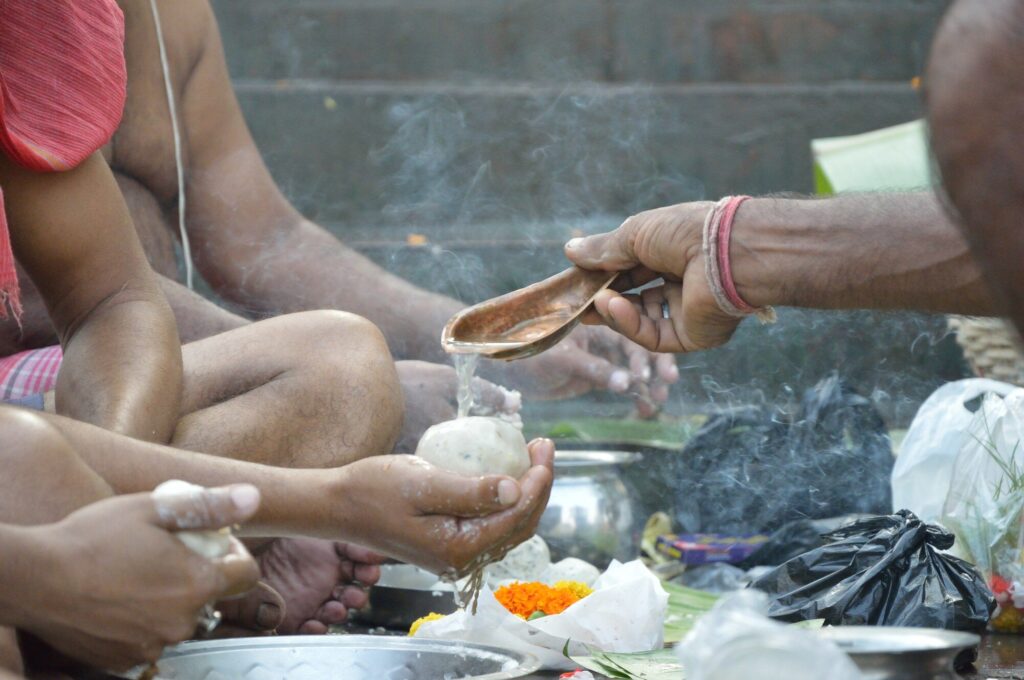
The observance sits inside the Krishna Paksha, the dark fortnight, and that placement is intentional. The waning moon is associated in Hindu cosmology with the world of the ancestors, the Pitru-loka, while the bright fortnight points toward the world of the gods. Families perform tarpan with water and sesame, offer pinda, the small rice balls that stand in for the ancestral body, and feed Brahmins and crows on the death tithi of the departed. Gaya in Bihar draws the largest pilgrim crowds during the fortnight, but the rite is performed in homes and at riverbanks across the country.
This piece walks through what Pitru Paksha means, where the practice comes from in scripture, how the rituals are structured day by day, the central role of the Gaya pilgrimage, the regional variations that an examiner is most likely to test, and the wider cultural and policy context. It’s pitched for UPSC General Studies Paper 1 on Indian heritage and culture, and for any reader trying to understand the rite past the surface.
Quick Facts at a Glance
- Duration: 16 lunar days, also called Pitru Paksha or Mahalaya Paksha
- Start: Bhadrapada Purnima (full-moon day of Bhadrapada month)
- End: Ashwin Amavasya, also called Mahalaya Amavasya or Sarvapitri Amavasya
- Gregorian window: Mid-September to early October each year
- Core rituals: Tarpan (water and sesame offering), Pind Daan (rice-ball offering), Shradh (food offering and Brahmin feeding)
- Central pilgrimage: Gaya, Bihar, on the banks of the Falgu river
- Three primary ancestors honored: Father, paternal grandfather, paternal great-grandfather (and their female counterparts)
- Source texts: Garuda Purana, Matsya Purana, Vayu Purana, Manusmriti, and the Mahabharata’s Anushasana Parva
- Astronomical placement: Krishna Paksha (waning fortnight), the cosmological fortnight of the ancestors
What Pitru Paksha Actually Is
Pitru Paksha is a fortnight of structured remembrance. The Sanskrit term joins pitru, meaning ancestor or forefather, with paksha, meaning a fortnight of the lunar month. The period is treated as a window when the souls of the departed descend closer to the earthly plane and accept offerings made by their living descendants. The Garuda Purana sets out the doctrinal foundation. It describes how a soul travels after death, what sustains it on the journey, and why food and water offered by a son or grandson make the difference between a settled and an unsettled afterlife.
The rite is performed by the eldest son of the family by default. Daughters and grandsons step in where there is no son, and modern practice has loosened the gender restriction in many households. The performer wears a single unstitched cloth, refrains from eating until the rite is complete, and offers the pinda with a darbha grass ring on the ring finger, the position prescribed for ancestor worship.
The most important practical point is that each ancestor is honored on the lunar tithi on which they died, not on a single common day. A father who died on a Chaturthi tithi receives his offering on the Chaturthi of Pitru Paksha. The Mahalaya Amavasya at the end of the fortnight is the universal day for any ancestor whose death tithi is unknown, and for forgotten or unclaimed ancestors. That is why the new-moon day is also called Sarvapitri Amavasya, the new moon of all the ancestors.
Background and Historical Context
The earliest layer of the ancestor rite is older than the Pitru Paksha calendar itself. Vedic samhitas reference offerings to the pitrs, and the Shatapatha Brahmana describes a tripartite cosmology of devas, asuras, and pitrs that anchors the later ritual structure. The Rig Veda includes hymns to the deceased fathers that ask for blessings on the living lineage. The shape of the fortnight, with sixteen days fixed in Bhadrapada and Ashwin, is post-Vedic and reaches its codified form in the Puranas.
The Mahabharata’s Anushasana Parva provides a famous narrative anchor. Karna, after his death, reaches the realm of the ancestors and finds that the gold he had given away in life has returned to him as food, but no actual nourishment is available. Indra explains that Karna had never offered food or water to his own ancestors. The episode is used in Puranic literature to argue that material charity does not substitute for ancestor offerings, and that the rite is owed by descendants as a non-transferable duty.
The Puranic codification, especially in the Garuda Purana, gave the rite its modern shape. Manusmriti chapter three lays down the technical rules for shradh, including the rules of fasting for the host, the eligibility of guests, and the prohibited foods. Medieval commentators including Vijnaneshwara in the Mitakshara, and the Madhaviya commentary on Parashara Smriti, settled the calendar disputes that still inform regional pandit traditions. By the early medieval period the basic outline used today, with tithi-wise shradh and a closing universal new-moon day, was in place across the subcontinent.
The Three Pillars of the Rite
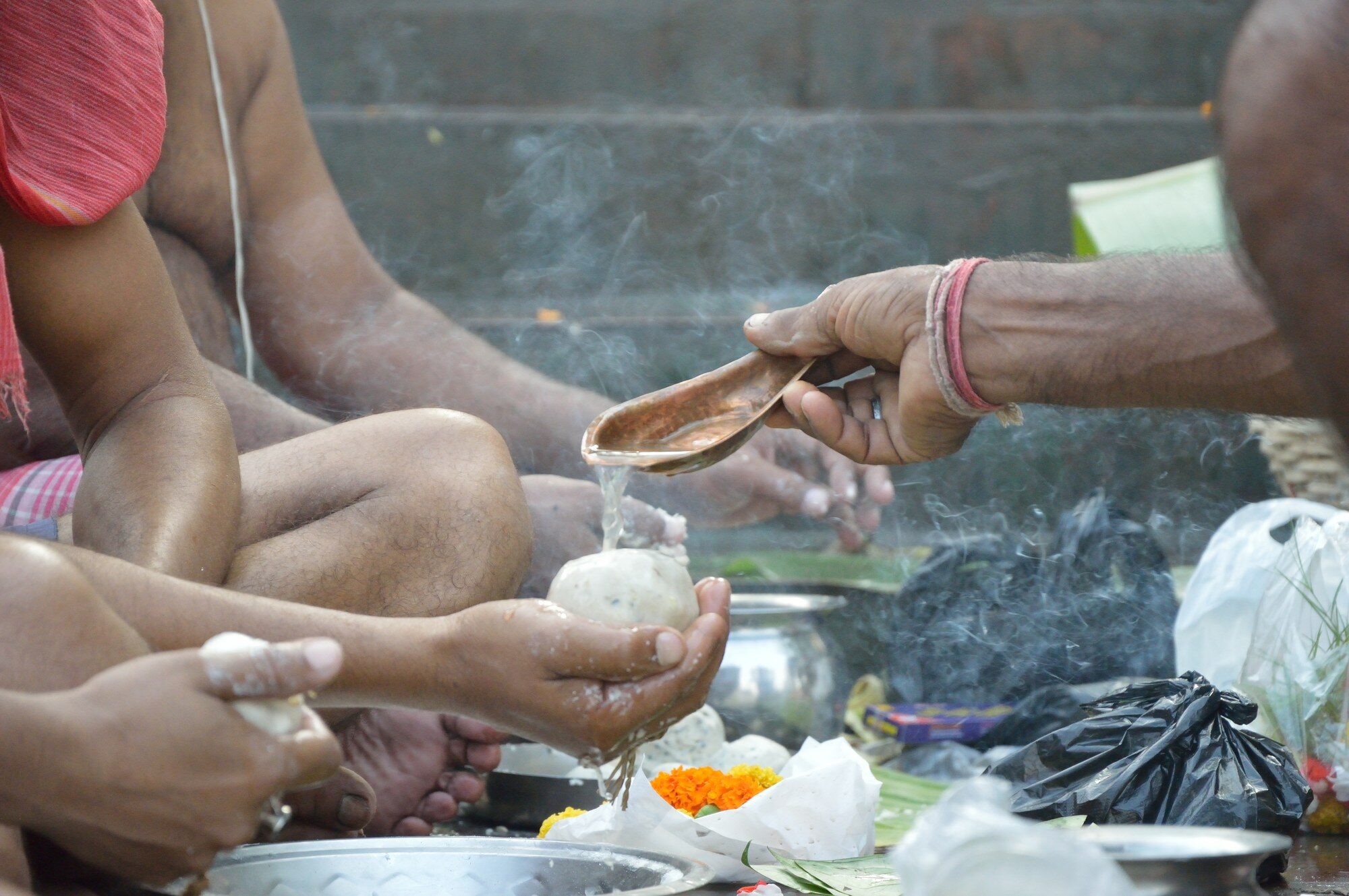
Three ritual acts run through Pitru Paksha. Tarpan is the offering of water mixed with black sesame seeds. The performer faces south, the direction associated with the ancestors and with Yama, the deity of death, and lets the water flow through the joined hands while chanting the names and gotra of the ancestor. The act is performed on a riverbank or beside a vessel of water at home. The sesame, called til, is considered the cooling agent that brings the ancestor’s presence close.
Pind Daan is the offering of pinda, a ball of cooked rice mixed with milk, ghee, honey, and sometimes black sesame. The pinda represents the symbolic body of the ancestor. The performer typically offers three pindas, one each for the father, paternal grandfather, and paternal great-grandfather, and a fourth for the maternal line in many traditions. The pinda is then released into a river, or fed to crows, who are believed to act as messengers of Yama.
Shradh is the feeding of Brahmins, the host’s family, and the poor with food first offered to the ancestors. The meal is vegetarian and avoids onion, garlic, and several other items considered unsuitable for ancestral rites. The Brahmin guest is treated as a ritual stand-in for the ancestor, accepting the food on the ancestor’s behalf. Many households also leave a small portion for cows, dogs, and crows, the three creatures named in Puranic texts as receivers of the ancestor’s share. The combined sequence of tarpan, pind daan, and shradh forms a single act, not three separate acts, and the order is fixed.
Why It Matters
The fortnight matters for three reasons that an exam answer should be ready to spell out. The first is sociological. Pitru Paksha is one of the few annual rites that pulls the dispersed Hindu joint family into a shared duty cycle. Even households that observe few other rituals tend to keep some version of shradh, and the calendar reminds people of birth tithis and death tithis that the modern Gregorian calendar tends to erase. The rite preserves lineage memory across generations.
The second is religious-philosophical. The doctrine of three debts, the rinas owed to gods, sages, and ancestors, is one of the oldest organizing ideas in dharmic thought. Pitri-rina, the debt to the ancestors, is discharged in classical theory through the production of a son who will continue the lineage and through the annual offerings of Pitru Paksha. The rite is the doctrinal counterweight to the idea that life can be lived as a purely individual project.
The third is economic and demographic. Gaya and a handful of other tirtha sites see a concentrated surge of pilgrims during the fortnight. The Bihar tourism economy turns over a measurable share of its annual receipts in these sixteen days. The pandit families of Gaya, called Gayawals, maintain genealogical registers, the bahis, that go back several generations and serve as informal archival sources for caste, lineage, and migration history. The Anthropological Survey of India has noted the bahi tradition as a documentary practice of social-historical value.
Detailed Day-by-Day Structure
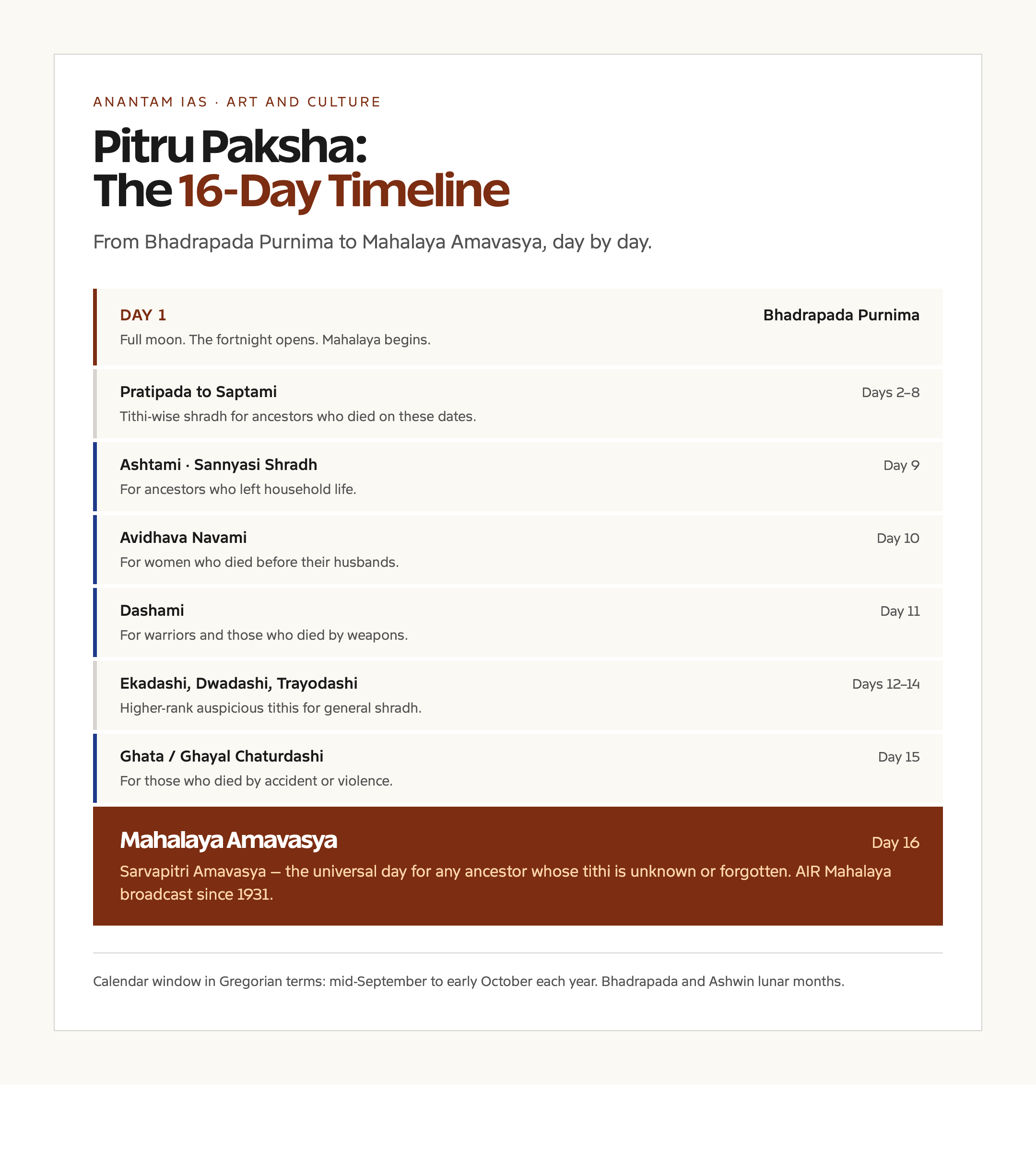
The fortnight is read by tithi, not by date. Each lunar day from Pratipada through Amavasya is associated with a class of ancestors. Pratipada through Panchami are typically used for grandparents and great-grandparents who died on those tithis. Shashthi and Saptami fall in a quieter middle stretch.
Ashtami is observed in many traditions as Sannyasi Shradh, for ancestors who left household life. Navami, called Avidhava Navami, is reserved for women who died as suhagins, that is, before their husbands. Dashami is used for warriors and persons who died by weapons. Ekadashi, Dwadashi, and Trayodashi are ranked higher among the auspicious tithis. Chaturdashi is called Ghata Chaturdashi or Ghayal Chaturdashi and is set aside for those who died by accident or violence.
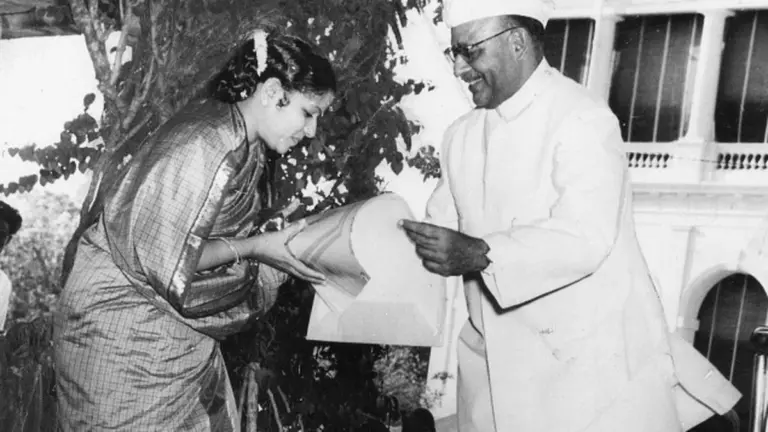
The Amavasya at the end, Mahalaya Amavasya, is the universal day. Anyone whose death tithi is unknown, anyone whose male descendant has forgotten their tithi, and anyone whose line has otherwise broken receives an offering on this day. The Mahalaya morning radio broadcast of Mahishasura Mardini, narrated by Birendra Krishna Bhadra, has been broadcast by All India Radio Kolkata since 1931 and marks the close of Pitru Paksha for Bengali Hindus and the start of Devi Paksha that leads into Durga Puja.
The Gaya Pilgrimage
Gaya in Bihar sits at the center of the Pitru Paksha map. The town is called Vishnupada Kshetra after the footprint of Vishnu set in stone at the Vishnupad temple on the bank of the Falgu river. The Vayu Purana names Gaya as the place where pind daan grants moksha to ancestors, and the Mahabharata records the kingdom of Gayasur as the site of a Vishnu intervention that anchored the soul to the spot. The result is that pind daan performed at Gaya is believed to be sufficient, in itself, to release ancestors who have been wandering, irrespective of household failings.
The Gaya pilgrimage circuit covers forty-five-odd sthals across the town and its outskirts. The classical list runs to forty-eight pinda-vedis. The Phalgu river bed, often dry above ground but flowing below, is the central site. The Akshayavat, the immortal banyan tree inside the Vishnupad complex, is the final stop. The Gayawal pandit families maintain the bahi registers that record the names of pilgrim families across generations, and the same Gayawal will often have served four or five generations of one client family. The Bihar tourism department has been working since the 2000s to upgrade the pilgrim infrastructure, with mixed results that the Comptroller and Auditor General has flagged in tourism audits.
The Bihar government’s Pitri Paksha Mela is the annual administrative event that coordinates the seventeen-day pilgrim season. Lakhs of pilgrims arrive each year, and the mela puts in place sanitation, security, and food-safety arrangements that any UPSC mains answer on managing religious tourism should reference.
Regional Variations
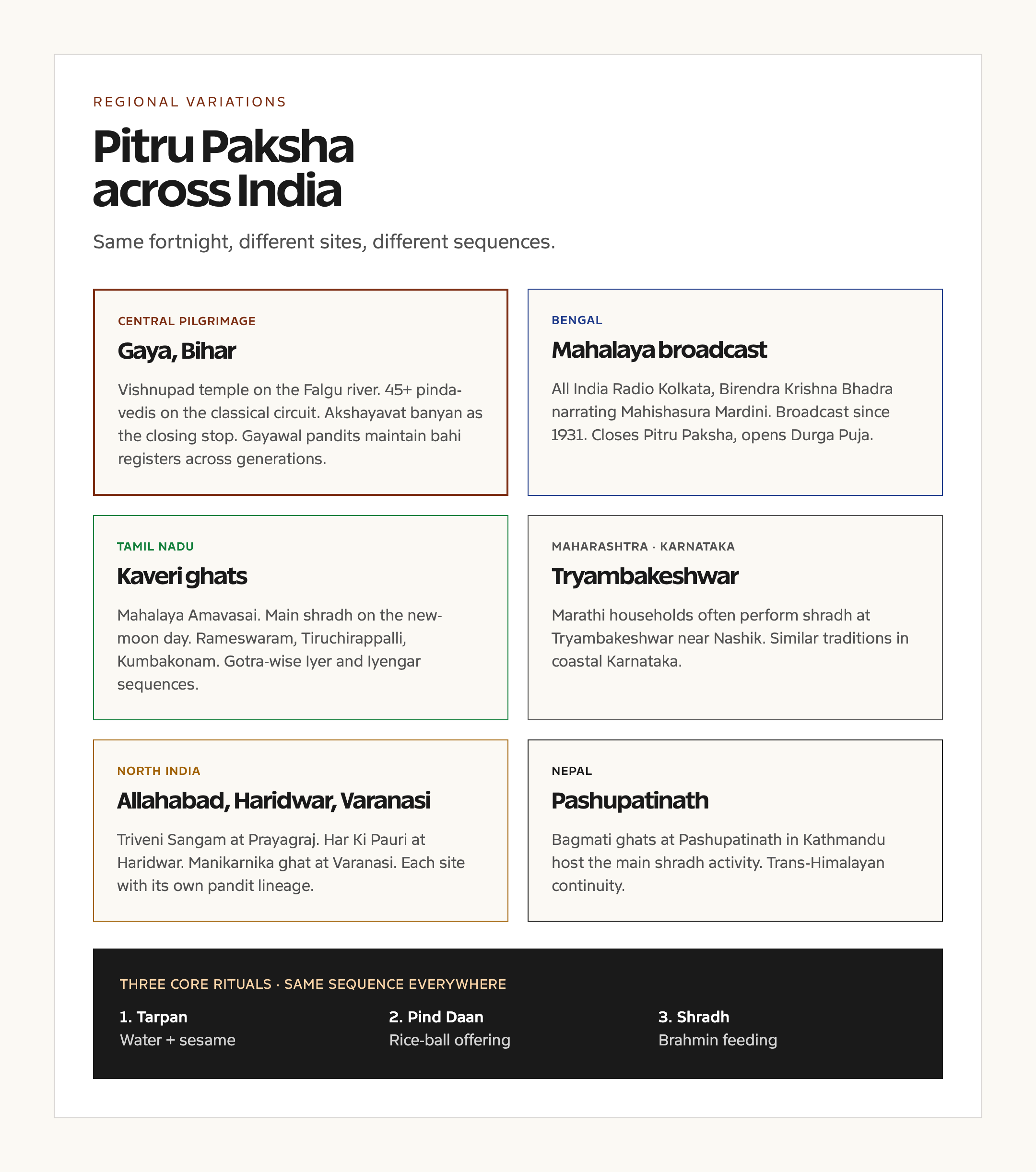
Bengal closes the fortnight with the Mahalaya broadcast and pivots straight into Durga Puja. The Pitru Paksha rituals are performed on the ghats of the Hooghly and at family residences, with a quieter intensity than in the Gangetic plains. The Bengali phrase Mahalaya is treated almost as a household word.
Tamil Nadu observes the fortnight as Aadi Amavasai or Mahalaya Amavasai. The shradh ritual is performed mainly on the new-moon day and is anchored at the Kaveri river ghats, especially at Rameswaram, Tiruchirappalli, and Kumbakonam. The Iyer and Iyengar communities maintain detailed gotra-wise procedures that differ slightly from the North Indian pandit traditions.
Maharashtra and Karnataka call the fortnight Pitru Paksha or Mahalaya. The Marathi households often go to Tryambakeshwar near Nashik for the shradh. The Triveni Sangam at Allahabad, Pushkar in Rajasthan, Haridwar on the Ganges, and Varanasi on the Manikarnika ghat round out the major non-Gaya sites. Each site has its own pandit lineage and its own version of the ritual sequence, which is why an answer that lists more than one site is generally a stronger answer.
Nepal observes the fortnight in much the same way as North India, with the Bagmati ghats at Pashupatinath in Kathmandu hosting the main shradh activity. The shared trans-Himalayan continuity is one of the standard examples of South Asian cultural diffusion. Bali in Indonesia retains a Hindu observance, Hari Raya Galungan, that is structurally close to ancestor worship but follows the Pawukon calendar and is not directly part of Pitru Paksha.
Prelims Pointers
- Pitru Paksha runs for 16 lunar days and falls in Bhadrapada and Ashwin months
- It begins on Bhadrapada Purnima and ends on Ashwin Amavasya, also called Mahalaya Amavasya
- The fortnight sits inside Krishna Paksha, the waning moon, the cosmological fortnight of the ancestors
- The three core rituals are tarpan, pind daan, and shradh, performed in that order
- Mahalaya Amavasya is also called Sarvapitri Amavasya, the universal day for any forgotten ancestor
- Gaya in Bihar is the central pilgrimage site, anchored at the Vishnupad temple and the Falgu river
- The Gayawal pandits maintain bahi registers, a documented genealogical practice of social-historical value
- The doctrine of three debts, the rinas, names Pitri-rina as the debt to ancestors discharged through Pitru Paksha
- The All India Radio Mahalaya broadcast of Mahishasura Mardini, narrated by Birendra Krishna Bhadra, has aired since 1931
- The Anushasana Parva of the Mahabharata contains the Karna episode that anchors the ritual logic
- Ghayal Chaturdashi is the tithi reserved for ancestors who died by accident or violence
- Avidhava Navami is reserved for women who died before their husbands
Mains Practice Questions
- Examine the cultural and sociological significance of Pitru Paksha in India, with particular reference to lineage memory and joint-family continuity. (GS Paper 1, 250 words)
- The Gaya Pitri Paksha Mela combines religious tourism, intangible heritage, and significant administrative challenges. Discuss the issues involved and suggest measures for sustainable management. (GS Paper 1 / GS Paper 2, 250 words)
- The Mahalaya broadcast on All India Radio has been called one of the oldest unbroken cultural traditions of modern Indian mass media. Critically assess the role of public broadcasting in preserving such intangible heritage. (GS Paper 1, 150 words)
- Compare the regional variations of Pitru Paksha across Bengal, Tamil Nadu, and the Gangetic plains. What does this comparison reveal about the unity and diversity of Hindu ritual culture? (GS Paper 1, 250 words)
Way Forward
The state has a limited but real role here. Pitru Paksha is not a state-organized festival, and it should not become one. What the state can do is make the pilgrim infrastructure at Gaya, Allahabad, Haridwar, and the other major sites safer, cleaner, and more accessible. The bahi registers maintained by the Gayawal community should be documented and digitized as a heritage archive, with the consent of the families, before the records fragment further. The Anthropological Survey of India and the Indira Gandhi National Centre for the Arts could lead a national-level intangible-heritage documentation drive that includes the rite’s regional variations.
The broader cultural opportunity is to keep the rite alive without freezing it. Younger generations should not need a translator to understand what a tarpan offering means, and the practice should remain accessible to women, to people who have lost male relatives in war and accident, and to families whose ritual continuity has broken for any of a hundred modern reasons. The doctrinal core of Pitru Paksha, the idea that memory is owed across generations, does not require any of the rigidities that have grown around it. Useful internal references include the Indian classical languages framework that supports Sanskrit liturgical study, the Brihadeeswara temple at Thanjavur as an example of living temple heritage, and the discussion of tribal issues in India where ancestor worship practices intersect with non-Hindu indigenous traditions.
Frequently Asked Questions
What does Pitru Paksha mean in Hindu tradition?
Pitru Paksha is a sixteen-day lunar fortnight when Hindus offer water, food, and rice-ball offerings to their ancestors. The Sanskrit term joins pitru, meaning ancestor, with paksha, meaning fortnight. The window is treated as a time when the souls of the departed accept offerings made by descendants, especially the eldest son.
When does Pitru Paksha fall in the Gregorian calendar?
It almost always falls between mid-September and early October. The fortnight starts on the full-moon day of Bhadrapada and ends on the new-moon day of Ashwin, also called Mahalaya Amavasya. Because the Hindu calendar is lunar, the exact Gregorian dates shift each year.
What is Mahalaya Amavasya and why is it important?
Mahalaya Amavasya is the closing day of Pitru Paksha. It is also called Sarvapitri Amavasya, the new moon of all the ancestors, because it is the universal day for any ancestor whose death tithi is unknown or has been forgotten. In Bengal it marks the start of Durga Puja preparations and is the day of the famous Mahalaya broadcast on All India Radio.
What is Pind Daan and where is it traditionally performed?
Pind Daan is the ritual offering of pinda, a ball of cooked rice mixed with milk, ghee, and honey, that represents the symbolic body of the ancestor. The performer typically offers three pindas, one for each of the previous three paternal generations. The most sacred site is Gaya in Bihar, on the banks of the Falgu river, but the rite is also performed at Allahabad, Haridwar, Varanasi, Pushkar, and Rameswaram.
What is the difference between Tarpan, Pind Daan, and Shradh?
Tarpan is the offering of water mixed with black sesame seeds. Pind Daan is the offering of rice-ball pindas. Shradh is the larger ritual that includes the feeding of Brahmins and the family. The three together form a single sequence, performed in that order, on the death tithi of the ancestor inside Pitru Paksha.
Why is Gaya considered the most important pilgrimage site for Pitru Paksha?
Gaya is the city named in the Vayu Purana and the Mahabharata as the place where pind daan grants moksha to ancestors. The Vishnupad temple, with its stone footprint of Vishnu, is the central shrine. The Falgu river bed and the Akshayavat banyan tree complete the central ritual circuit. The Gayawal pandit families maintain bahi registers that record pilgrim families across generations.
Are there regional variations in how Pitru Paksha is observed?
Yes. Bengal closes the fortnight with the Mahalaya broadcast and moves into Durga Puja. Tamil Nadu treats the new-moon day as the main shradh and anchors the rite to the Kaveri ghats. Maharashtra and Karnataka often perform the shradh at Tryambakeshwar near Nashik. North India clusters at Gaya, Allahabad, Haridwar, and Varanasi. Each site has its own pandit lineage and a slightly different sequence.
Can women and non-eldest-son family members perform Pitru Paksha rituals?
Classical texts assign the rite to the eldest son. Modern practice has loosened this rule in many households, and daughters, grandsons, and other relatives perform the rituals where there is no eligible son or where the family chooses to share the responsibility. Several major Gaya pandit families now perform rites for women clients without restriction.
What is the Mahalaya broadcast on All India Radio?
The Mahalaya broadcast is a two-hour Bengali narration of Mahishasura Mardini, the Sanskrit hymn to the goddess Durga, narrated by Birendra Krishna Bhadra. It has been aired on All India Radio Kolkata since 1931, on the morning of Mahalaya Amavasya, and is one of the longest-running unbroken cultural broadcasts in Indian public radio.
Why does Pitru Paksha sit inside Krishna Paksha, the dark fortnight?
The waning moon is associated in Hindu cosmology with the world of the ancestors, the Pitru-loka, while the bright fortnight points toward the world of the gods. Placing the rite in Krishna Paksha aligns the ritual time with the cosmological time of the ancestors, and the closing day on the darkest night, Amavasya, marks the moment of fullest contact between the two worlds.
Tell Google you want more of this.
Add Anantam IAS as a preferred sourceOne tap, and this site shows up more often in your own Top Stories, AI Overviews and AI Mode. Remove it any time.