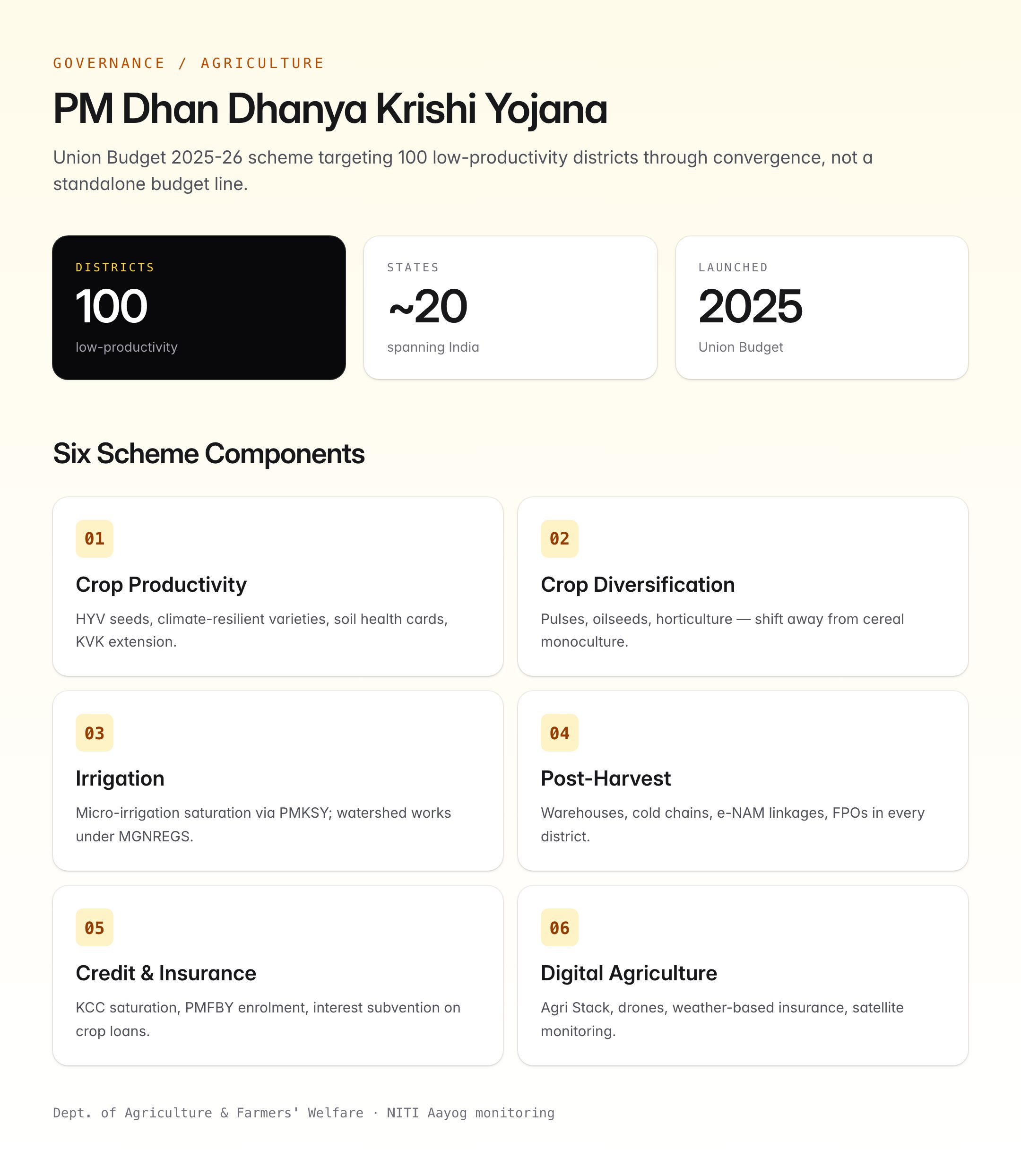
The PM Dhan Dhanya Krishi Yojana (PMDDKY) was announced during the Union Budget 2025-26 as a targeted intervention to transform 100 low-productivity, low-income districts across India into high-performing agricultural zones. The scheme aims to address persistent regional agricultural disparities by focusing on crop diversification, irrigation, credit access, post-harvest infrastructure, and technology adoption. The programme reflects the government's strategy of saturation coverage — identifying specific lagging districts and converging multiple existing schemes to achieve measurable outcomes. PMDDKY is important for UPSC Prelims and GS Paper III (Agriculture).
Background and Rationale
Despite India being the world's largest producer of milk, pulses, and spices and the second-largest producer of rice, wheat, and fruits, agricultural productivity varies enormously across districts:
- The top 50 districts contribute a disproportionate share of output.
- Over 100 districts consistently report below-national-average crop yields, farmer incomes, and crop diversification.
- These districts are concentrated in eastern India, tribal belts, rain-fed zones, and border areas.
The PMDDKY aims to bridge this gap by providing focused, time-bound interventions in identified low-productivity districts.
Key Objectives
| Objective | Description |
|---|---|
| Enhance Crop Productivity | Increase yields of key crops (cereals, pulses, oilseeds) in target districts to national-average levels |
| Crop Diversification | Shift acreage towards high-value crops — pulses, oilseeds, horticulture — to reduce cereal monoculture |
| Improve Farmer Income | Ensure remunerative prices and reduce cost of cultivation |
| Strengthen Post-Harvest Infrastructure | Build storage, cold chains, and processing facilities |
| Expand Irrigation Coverage | Achieve micro-irrigation saturation in target districts |
| Digital Agriculture Adoption | Deploy soil health cards, weather advisories, and precision farming tools |
Target Districts
The 100 districts have been identified using a composite index that includes:
- Crop productivity (yield per hectare below national average)
- Farmer income levels (per capita agricultural income)
- Crop diversification index (dependence on single crop)
- Irrigation coverage (percentage of gross cropped area under irrigation)
- Credit penetration (agricultural credit per hectare)
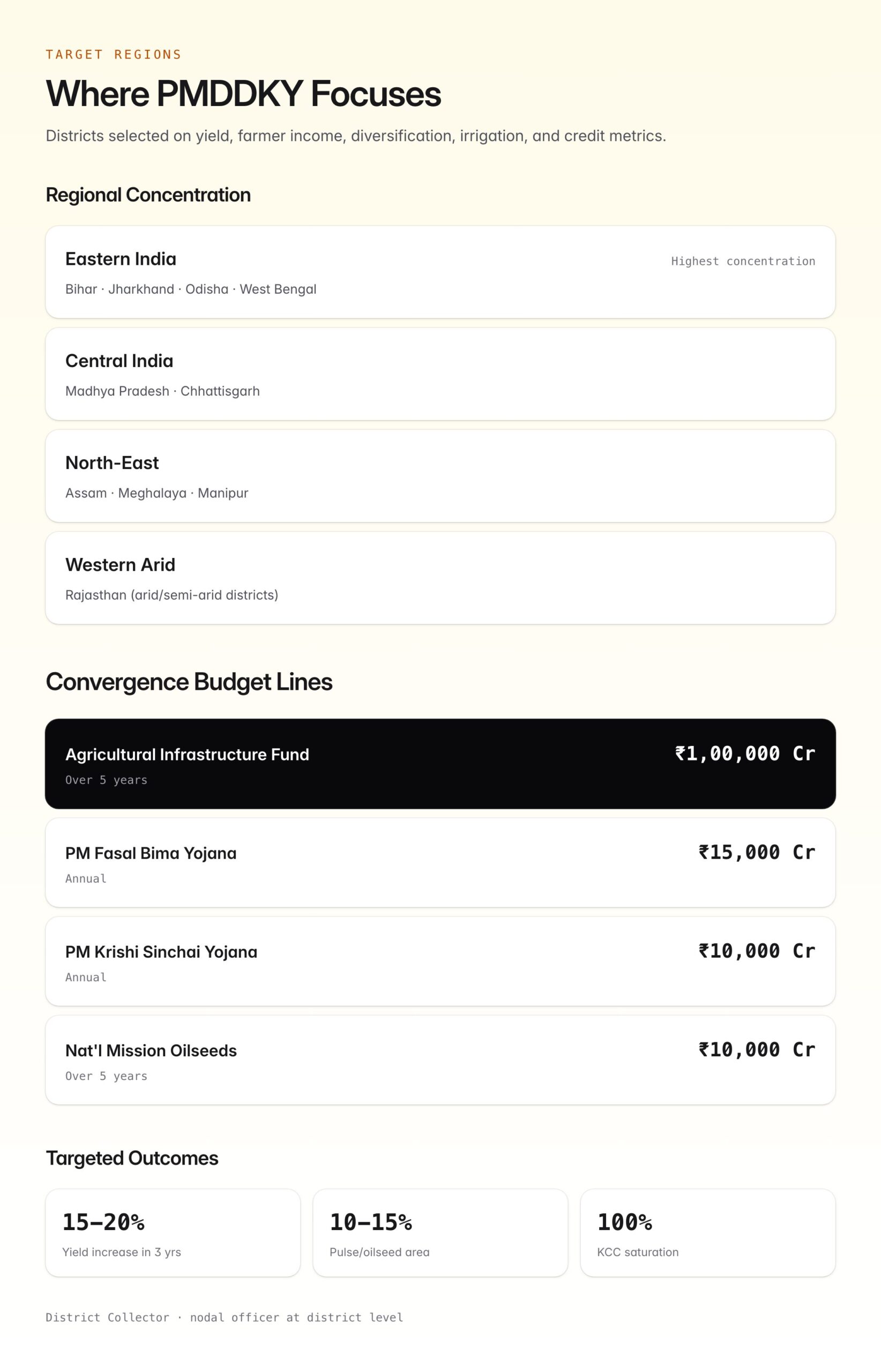
These districts span approximately 20 states, with concentration in:
| Region | States with Maximum Target Districts |
|---|---|
| Eastern India | Bihar, Jharkhand, Odisha, West Bengal |
| Central India | Madhya Pradesh, Chhattisgarh |
| North-East | Assam, Meghalaya, Manipur |
| Western India | Rajasthan (arid/semi-arid districts) |
Key Components
1. Crop Productivity Enhancement
- Distribution of high-yielding variety (HYV) seeds and climate-resilient varieties.
- Soil health card-based nutrient management — targeted fertiliser application.
- Integrated Pest Management (IPM) and Integrated Nutrient Management (INM) protocols.
- Deployment of Krishi Vigyan Kendra (KVK) extension workers for hands-on training.
2. Crop Diversification
- Target crops: Pulses (tur, moong, masoor), oilseeds (mustard, soybean, groundnut), and horticulture (vegetables, fruits).
- Minimum Support Price (MSP) awareness campaigns to encourage farmers to grow procurement-backed crops.
- Contract farming linkages with Food Processing Units (FPUs) under the PM Kisan Sampada Yojana.
3. Irrigation and Water Management
- Micro-irrigation saturation — drip and sprinkler systems under the PM Krishi Sinchai Yojana (PMKSY).
- Community irrigation assets — check dams, farm ponds, and watershed structures.
- Convergence with MGNREGS for water conservation works.
4. Post-Harvest and Market Linkages
- Warehouse and cold storage construction under the Agricultural Infrastructure Fund (AIF).
- Strengthening e-NAM (National Agriculture Market) linkages for price discovery.
- Establishing Farmer Producer Organisations (FPOs) in each target district.
5. Credit and Insurance
- Kisan Credit Card (KCC) saturation — ensuring every farmer in the 100 districts has a KCC.
- PM Fasal Bima Yojana (PMFBY) enrolment drives.
- Interest subvention on short-term crop loans.
6. Digital Agriculture
- Agri Stack integration — digital farmer IDs linked to land records.
- Weather-based Crop Insurance using satellite data.
- Drone deployment for crop health monitoring and pesticide spraying.
Implementation Framework
| Level | Responsibility |
|---|---|
| National | Department of Agriculture & Farmers' Welfare; NITI Aayog monitoring |
| State | State Agriculture Department; Chief Secretary-level monitoring |
| District | District Collector/Magistrate as nodal officer; District Agriculture Plan |
| Block/Village | KVK scientists, agriculture extension officers, FPO leaders |
The scheme operates on a convergence model — it does not create a new standalone budget line but converges existing schemes (PMKSY, PMFBY, AIF, KCC, e-NAM, MGNREGS) and adds incremental funding for gaps.
Budget and Funding
The PMDDKY was announced with an estimated incremental outlay spread across 2025-26 to 2028-29. The exact allocation is supplemented by convergence with:
| Scheme | Annual Allocation (approximate) |
|---|---|
| PM Krishi Sinchai Yojana | Rs 10,000 crore |
| Agricultural Infrastructure Fund | Rs 1,00,000 crore (over 5 years) |
| PM Fasal Bima Yojana | Rs 15,000 crore |
| National Mission on Oilseeds & Oil Palm | Rs 10,000 crore (over 5 years) |
Comparison with Similar Schemes
| Parameter | PMDDKY (2025) | Aspirational Districts Programme (2018) | PM-AASHA |
|---|---|---|---|
| Focus | Agricultural productivity in 100 districts | Multi-sector development in 112 districts | Price support for pulses, oilseeds, copra |
| Approach | Convergence + incremental funding | Convergence + ranking-based competition | Direct procurement + Price Deficiency Payment |
| Nodal Ministry | Agriculture & Farmers' Welfare | NITI Aayog | Agriculture & Farmers' Welfare |
| Target | Crop yields, farmer income | Health, education, agriculture, infrastructure | Remunerative prices for farmers |
Expected Outcomes
- Crop yield increase of 15-20% in target districts within 3 years.
- Diversification — increase in area under pulses and oilseeds by 10-15%.
- KCC saturation — 100% coverage of eligible farmers.
- Post-harvest loss reduction through warehouse and cold chain creation.
- Farmer income growth aligned with the Doubling Farmers' Income target.
UPSC Relevance
GS Paper III: Agriculture — Major Crops, Irrigation, Agricultural Marketing and Issues; Food Processing and Related Industries.
GS Paper II: Government Policies and Interventions for Development in Various Sectors.
Prelims key points:
- PM Dhan Dhanya Krishi Yojana announced in Union Budget 2025-26 for 100 low-productivity districts.
- It is a convergence-based scheme, not a standalone budget line.
- Key focus areas: crop diversification, micro-irrigation, KCC saturation, post-harvest infrastructure, digital agriculture.
- Target crops include pulses, oilseeds, and horticulture — addressing India's dependence on cereal monoculture.
- The scheme builds on the model of the Aspirational Districts Programme launched by NITI Aayog in 2018.
- District Collector is the nodal officer at the district level.
- It converges with PMKSY, PMFBY, AIF, e-NAM, and MGNREGS.
Tell Google you want more of this.
Add Anantam IAS as a preferred sourceOne tap, and this site shows up more often in your own Top Stories, AI Overviews and AI Mode. Remove it any time.