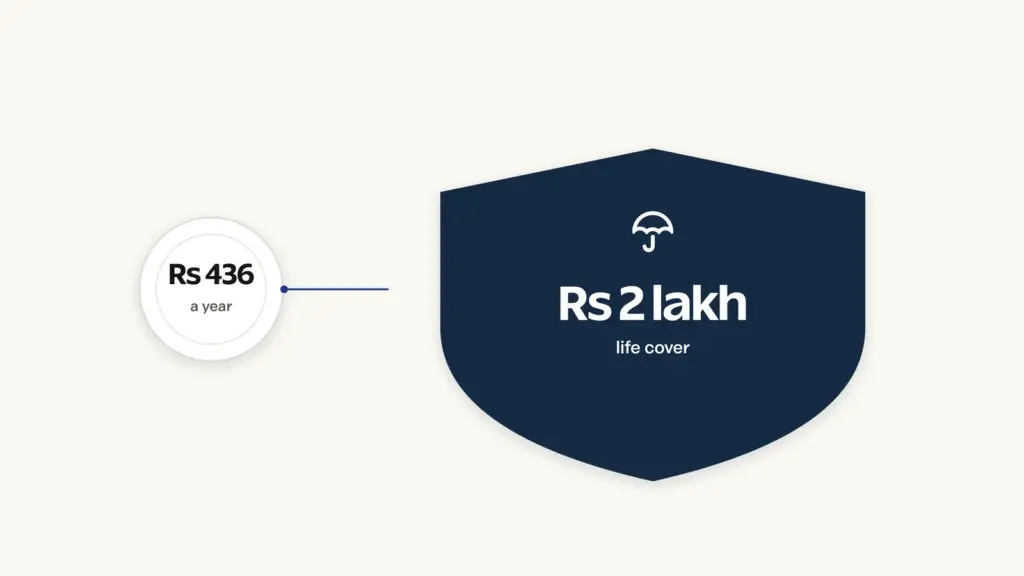
Pradhan Mantri Jeevan Jyoti Bima Yojana (PMJJBY) is a one-year life insurance cover that pays ₹2 lakh to your nominee if you die, from any cause. It costs ₹436 a year, debited automatically from your savings account, and anyone aged 18 to 50 with a bank or post office account can join. There is no medical test and no paperwork beyond a one-page consent form.
What PMJJBY actually covers
The cover is simple to the point of being blunt: ₹2 lakh is payable on the member’s death due to any cause. Illness, accident, natural causes — the reason does not change the payout. There is no maturity benefit, no bonus and no money back if you survive the year. It is pure term insurance, priced at a level the government subsidises through scale rather than through your premium.
The policy year runs from 1 June to 31 May, and the cover renews every year as long as the premium is debited on time. It is offered through the Life Insurance Corporation and other life insurers that tie up with banks and post offices, per the Department of Financial Services (verified July 2026). Your bank is the master policyholder; you are a member under its group policy.
One number gives a sense of scale: cumulative enrolment under PMJJBY had crossed 23.12 crore as reported by the Department of Financial Services.
Who can join
- Any individual account holder of a participating bank or post office aged 18 (completed) to 50 (age nearer birthday).
- Aadhaar is the primary KYC for the underlying bank or post office account.
- You may join through only one account, even if you hold accounts in several banks.
That last rule matters. If premiums get debited from two accounts, the cover is still capped at ₹2 lakh and the duplicate premium is liable to be forfeited. Enrolling twice buys you nothing.
Entry closes at 50, but the cover itself continues up to age 55 provided you keep renewing without a break.
What it costs, and the pro-rata rule
The full annual premium is ₹436. If you join part-way through the policy year, you pay a reduced pro-rata premium for the months remaining, as set out in the official PMJJBY rules.
| Month of enrolment | Premium payable | Cover |
|---|---|---|
| June, July, August | ₹436 | ₹2 lakh |
| September, October, November | ₹342 | ₹2 lakh |
| December, January, February | ₹228 | ₹2 lakh |
| March, April, May | ₹114 | ₹2 lakh |
Whatever the month, the cover ends on 31 May and has to be renewed for the next year. Of the ₹436 full premium, ₹395 goes to the insurer, ₹30 is commission to business correspondents and agents, and ₹11 is an administrative fee to the bank. If you enrol yourself electronically — through net banking or the bank’s app — the agent commission is not paid at all, and the rules require that saving to be passed on to you as a lower premium.
The 30-day lien: the one clause people miss
For anyone enrolling for the first time on or after 1 June 2021, cover for death other than by accident does not begin for the first 30 days from the date of enrolment. If the member dies of illness inside that window, no claim is payable. Death due to an accident is covered from day one.
The same lien applies again if you exit the scheme and rejoin later, or if a lapsed cover is reinstated. That is a strong argument for keeping enough balance in the account so the auto-debit never fails: a bounced ₹436 debit does not just pause the cover, it restarts the 30-day clock when you rejoin.
How to enrol, step by step
- Pick the account you want the premium debited from — a savings account with a working balance and correct KYC.
- Open the enrolment channel. Most banks now carry PMJJBY inside net banking and their mobile app, usually under “Insurance”, “Social Security Schemes” or “Jan Suraksha”. Doing it here is the cheapest route because the agent commission is waived.
- Or use the branch or a business correspondent. Collect the enrolment-cum-auto-debit consent form, available at branches and on the Jan Suraksha portal.
- Fill in the nominee’s details carefully — full name, relationship, and an appointee if the nominee is a minor. This single line decides who gets the money and how fast.
- Sign the auto-debit mandate. You can give a standing consent so the premium is debited every year without a fresh form.
- Keep the acknowledgement slip. It doubles as the certificate of insurance, and the enrolment also shows up in your bank’s app or passbook as the annual ₹436 debit.
When the cover ends
The assurance terminates, with no benefit payable, on any of these:
- On attaining age 55 (age nearer birthday), even if you keep renewing.
- On closure of the bank or post office account, or if the balance is too low for the premium to be debited.
- If you are covered through more than one account — the cover is restricted to ₹2 lakh and the extra premium may be forfeited.
A cover that lapses for insufficient balance can be reinstated on paying the appropriate premium, but it is then treated as fresh cover with the 30-day lien applying again.
How a claim is made
The claim procedure was deliberately kept thin. The nominee should approach the deceased member’s bank or post office branch, preferably within 30 days of the death, with the claim-cum-discharge form.
Documents the nominee has to attach, per the PMJJBY claims procedure:
- Proof of death — the death certificate from the registrar of births and deaths, or a hospital discharge summary or certificate, or a certificate from the last attending registered medical practitioner countersigned by a gazetted officer or a bank official.
- Aadhaar and PAN of the deceased member and of the nominee (desirable, not mandatory).
- A KYC document for the nominee — Aadhaar, voter ID, MGNREGA card, driving licence, PAN or passport.
- First two pages of the passbook, an account statement or a cancelled cheque of the nominee’s account, so the money can be credited.
- The advance receipt for discharge of claim, filled in and signed.
- If the nominee has died before the member, or there was no nomination, a succession certificate or legal heir certificate from a competent court or authority.
The bank verifies the enrolment record, confirms the premium was debited and remitted, certifies the form and forwards it electronically to the insurer — the prescribed maximum is seven days. The insurer then has seven days to approve and disburse. The amount is credited to the nominee’s account, and the insurer sends an SMS alert whether the claim is paid or rejected.
If death was by accident within the first 30 days, the nominee also needs proof of accidental death — the FIR or panchnama and the post-mortem report, or a certificate from the District Magistrate or an authorised Executive Magistrate.
PMJJBY and PMSBY are not the same thing
They are sold at the same counter and often enrolled together, which is why people confuse them. They cover different risks.
| Feature | PMJJBY | PMSBY |
|---|---|---|
| Type of cover | Life — death from any cause | Accident — death or permanent disability by accident only |
| Annual premium | ₹436 | ₹20 |
| Sum assured | ₹2 lakh | ₹2 lakh (death or total disability); ₹1 lakh (partial disability) |
| Entry age | 18–50 years | 18–70 years |
| Cover ends at | 55 years | 70 years |
| Waiting period | 30-day lien for non-accidental death | None |
Because the risks are different and the combined cost is ₹456 a year, most people who qualify hold both. The companion guide to Pradhan Mantri Suraksha Bima Yojana covers the accident side in detail. If you are also thinking about old-age income from the same bank account, the Atal Pension Yojana sits in the same Jan Suraksha family, and the wider list of government schemes shows where these fit.
Frequently Asked Questions
Is PMJJBY still ₹436 a year?
Yes. The premium was revised to ₹436 with effect from 1 June 2022 and remains ₹436 as of July 2026, per the Department of Financial Services. The rules allow it to be reviewed based on annual claims experience, so check the current figure at your bank before enrolling.
Does PMJJBY cover death by suicide?
The scheme covers death due to any cause after the lien period, and the rules do not carve out a separate suicide exclusion. During the first 30 days from enrolment or rejoining, only accidental death is covered. Individual insurers apply the master policy terms, so the bank branch is the right place to confirm a specific case.
Can I hold PMJJBY through two banks to get ₹4 lakh?
No. If premiums are debited from more than one account, the cover stays capped at ₹2 lakh and the duplicate premiums are liable to be forfeited. Enrol through one account only.
What happens if my account balance is short on the auto-debit date?
The premium fails, the cover ceases, and no claim is payable for that period. You can reinstate it by paying the appropriate premium, but the cover is treated as fresh and the 30-day lien applies again.
I am 52. Can I still join?
No. Fresh entry is not possible beyond age 50. If you joined before 50 and have renewed without a break, your cover continues until age 55.
How do I change my nominee?
Submit a fresh nomination through the bank or post office branch that holds the PMJJBY enrolment. The nomination is held in the bank’s enrolment records, not with the insurer, so the branch is the only place it can be updated.
How long does a claim take?
The prescribed timeline is seven days for the bank to forward the completed claim to the insurer, and seven days for the insurer to approve and pay after that. Delays usually come from incomplete death proof or a mismatch in the nominee’s bank details, so getting those two right speeds everything up.
Tell Google you want more of this.
Add Anantam IAS as a preferred sourceOne tap, and this site shows up more often in your own Top Stories, AI Overviews and AI Mode. Remove it any time.