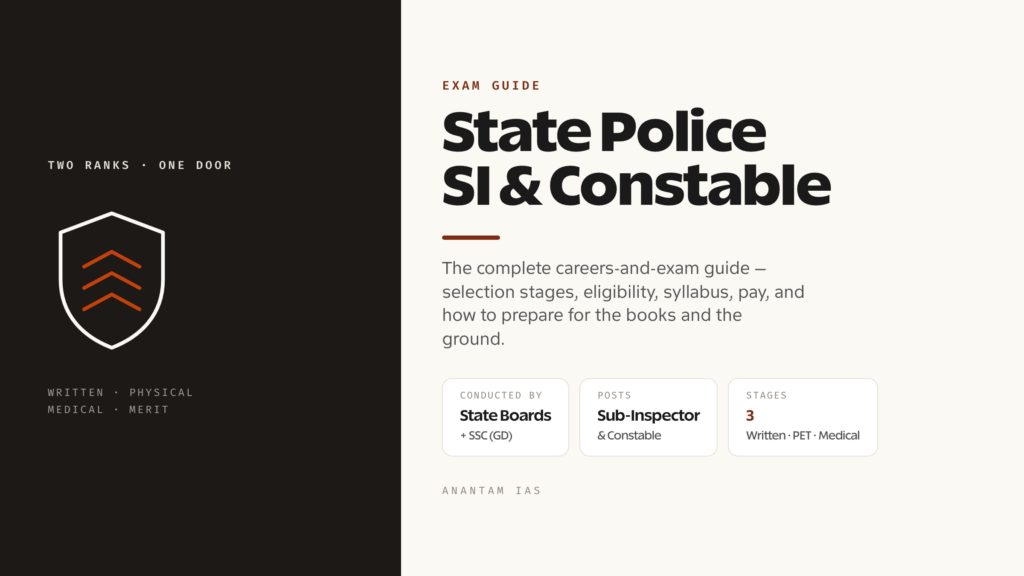
In the police, SI stands for Sub-Inspector — a graduate-level supervisory officer who leads a police-station team, registers cases (FIRs), and investigates, ranked above an Assistant Sub-Inspector and below an Inspector. Most states recruit Sub-Inspectors directly through a State Police Recruitment Board exam (written test, then a physical test, then medical), with entry pay at Pay Level 6 of the 7th CPC (about ₹35,400 basic). The other main police-recruitment track is the Constable, a 10th/12th-level field rank at Pay Level 3.
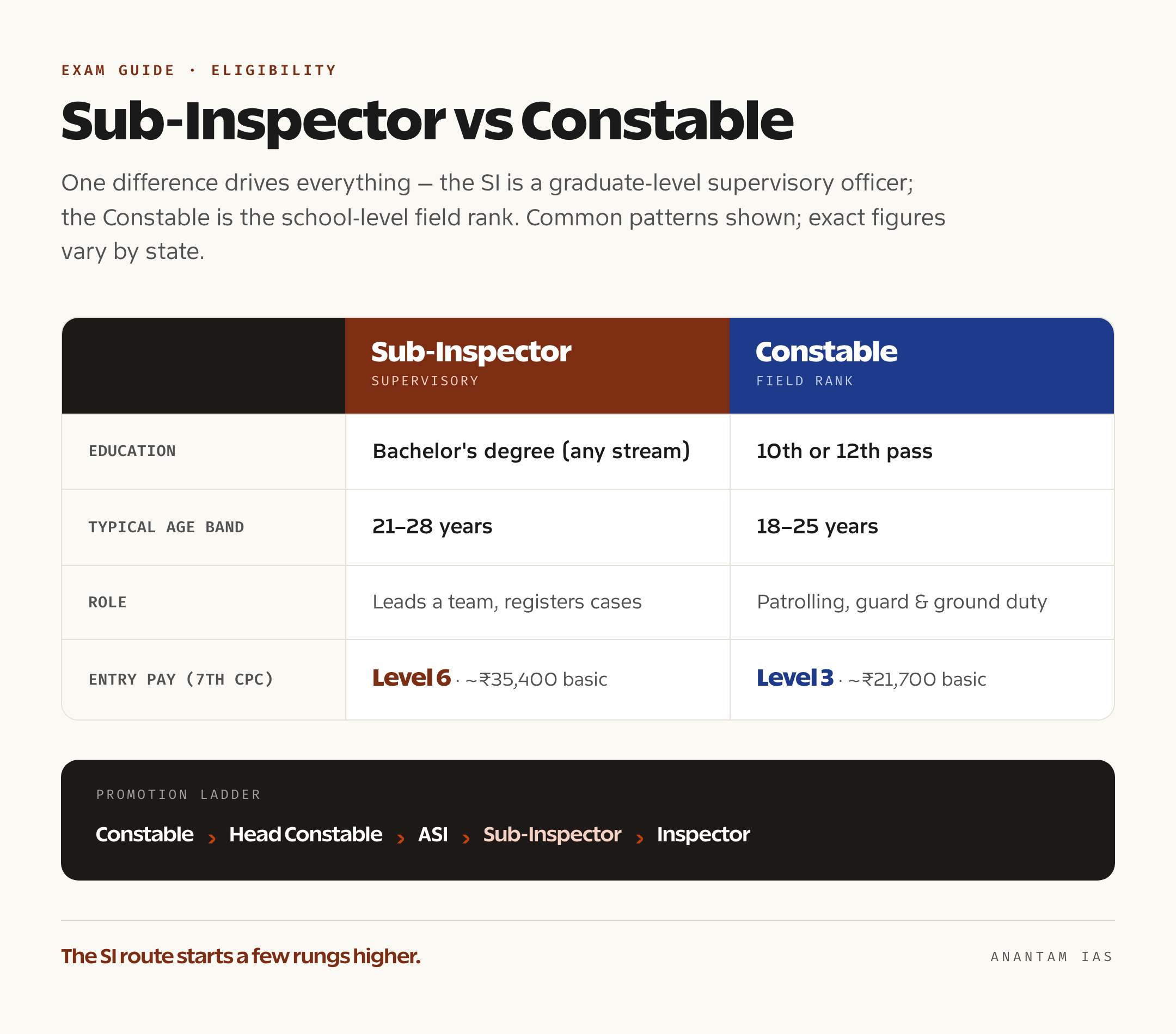
| Feature | Sub-Inspector (SI) | Constable |
|---|---|---|
| Role | Supervisory officer (leads a team, registers cases) | Field-level rank (patrol, ground duty) |
| Education | Bachelor’s degree | 10th / 12th pass |
| Age (common band) | 21–28 years | 18–25 years |
| Selection | Written + PET/PST + medical | Written + PET/PST + medical |
| Entry pay (7th CPC) | Level 6 (~₹35,400 basic) | Level 3 (~₹21,700 basic) |
A police uniform is one of the most pursued careers in India, and for most aspirants the door opens through a State Police recruitment exam. These exams fill two very different jobs — the Sub-Inspector (SI), a graduate-level supervisory officer, and the Constable, the entry-level rank that forms the backbone of every force.
What sets these exams apart from a typical desk-job test is that they ask you to clear a written paper and prove you can run, jump, and meet a height standard. This guide walks through how the Sub-Inspector and Constable exams actually work — the selection stages, who’s eligible, the syllabus, the pay, and a preparation approach that respects both halves of the job. Because policing is a State subject, the fine print varies by state, so treat the numbers here as the common pattern rather than a single fixed rulebook.
What Are the Police SI & Constable Exams?
Each state runs its own police force, and recruitment for the lower ranks is handled by a State Police Recruitment Board (names vary — Uttar Pradesh has the UP Police Recruitment and Promotion Board, Maharashtra and Rajasthan run their own boards, and the national capital is served by Delhi Police). These boards advertise vacancies, conduct the written exam, and run the physical and medical screening.
Two recruitment tracks dominate. The Sub-Inspector exam recruits a supervisory officer who leads a small team, registers cases, and is the public face of a police station’s day-to-day work. The Constable exam recruits the field-level rank that does patrolling, guard duty, and ground response. There’s also a parallel national route: the Constable (General Duty) posts in the Central Armed Police Forces — CRPF, BSF, CISF, ITBP, SSB — and Assam Rifles are filled through the Staff Selection Commission’s SSC GD examination, and Delhi Police constables have historically been recruited through the same SSC process.
Key Facts
- Conducting authority: State Police Recruitment Boards for state forces; the Staff Selection Commission (SSC) for CAPF/SSC GD constables.
- Posts: Sub-Inspector (and equivalents like Platoon Commander); Constable / Constable (GD).
- Frequency: Notification-driven — large recruitment cycles open when vacancies are sanctioned, often once a year or once every couple of years per state.
- Scale of competition: Among the highest of any government exam. Large states routinely see lakhs of applicants for a few thousand seats, and SSC GD draws well over a crore registrations in big cycles.
The core distinction to fix in your mind: SI is graduate-level and supervisory; Constable is 10th/12th-level and field-level. That single difference drives the eligibility, the syllabus depth, and the pay.
Police SI & Constable Exam Pattern
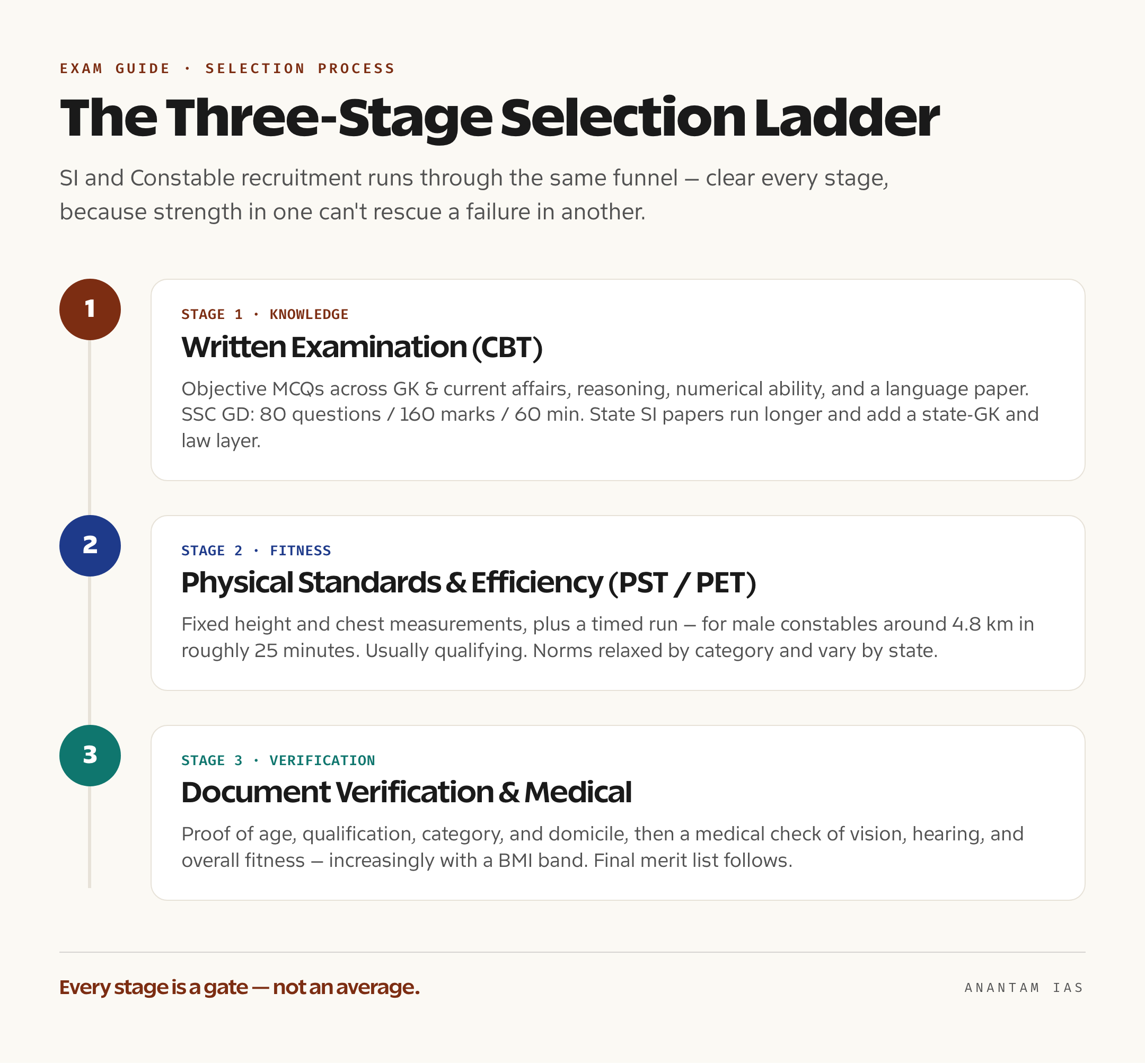
Both exams follow a multi-stage funnel: a written test that screens on knowledge, a Physical Efficiency and Standards Test that screens on fitness, and a final round of document verification and medical examination. You have to clear every stage — strength in one cannot rescue a failure in another.
Stage 1: Written Examination
The written paper is an objective, multiple-choice test, almost always a Computer-Based Test now. The sections are consistent across forces even when the marks differ:
- General Knowledge & Current Affairs — national and state events, static GK, and basic awareness.
- Reasoning / Mental Ability — series, analogies, coding-decoding, and logical puzzles.
- Numerical Ability / Quantitative Aptitude — arithmetic and data-based questions, pitched at school level.
- Language — often a Hindi or English paper, and for state forces frequently a state-language or state-GK component.
The depth scales with the post. For Constable, the SSC GD paper has 80 questions for 160 marks in 60 minutes across four sections (General Intelligence & Reasoning, General Knowledge & Awareness, Elementary Mathematics, and English or Hindi), with 0.25 marks deducted per wrong answer. State SI papers run longer and harder — Uttar Pradesh’s SI exam, for instance, uses 160 questions for 400 marks across four sections with a sectional qualifying requirement. Negative marking, sectional cut-offs, and exact marks vary by state, so the official notification is the only authority for the cycle you’re sitting.
Stage 2: Physical Efficiency & Standards Test (PET/PST)
This is the stage that distinguishes police recruitment from every clerical exam. The Physical Standards Test checks fixed body measurements — height, and chest measurement with expansion for male candidates — against category and gender norms (Delhi Police Constable, for example, sets a male height of 170 cm and female height of 157 cm, with relaxations for hill and reserved categories). The Physical Efficiency Test checks endurance through a timed run and, in some states, jumps or other events.
Running standards differ by post and by state, but the common shape is a long-distance timed run — for male constables roughly 4.8 km within about 25 minutes, and for SI candidates a similar distance in a slightly more generous window, with shorter distances (around 2.4 km) for women. Norms are relaxed for reserved categories, ex-servicemen, and certain regions. The PET is usually qualifying — you must pass it, but the time you clock generally doesn’t add to your merit score.
Stage 3: Document Verification & Medical
Candidates who clear the written and physical stages go through document verification (proof of age, qualification, category, and domicile) and a medical examination that checks vision, hearing, and overall fitness — increasingly including a Body Mass Index band. A final merit list then combines the qualifying stages as the rules prescribe.
Police SI & Constable Eligibility
Eligibility is where the two tracks separate most sharply. Every figure below is the common pattern — the deciding number is always in the state notification, because age bands, standards, and relaxations are set state by state.
- Nationality: Indian citizen (state forces additionally require domicile of that state, which is the practical reason most aspirants target their home state).
- Educational qualification: A Bachelor’s degree in any stream for Sub-Inspector. For Constable, a 10th or 12th pass depending on the force — SSC GD accepts a 10th-class pass, while Delhi Police Constable has required a 12th pass.
- Age limit: Commonly 21-28 years for SI and roughly 18-25 years for Constable (SSC GD runs an 18-23 band). Age relaxations apply for SC/ST (usually five years), OBC (three years), ex-servicemen, and other notified categories.
- Physical standards: Minimum height, and chest with expansion for men, as listed above — these are eligibility gates, not scored events.
- Attempts: Most police exams have no fixed attempt limit — you can apply in any cycle as long as you’re within the age band.
Because domicile and physical standards are set locally, an aspirant from one state will often find the chest or height norm a centimetre different across the border. Always read the specific notification.
Police SI & Constable Syllabus
Written Syllabus
The four pillars — GK/Current Affairs, Reasoning, Numerical Ability, and Language — define the bulk of preparation for both posts. A typical breakdown:
- General Knowledge & Current Affairs: Indian history, geography, polity, economy, general science, sports, and awards, plus the last 6-12 months of national and state current affairs.
- Reasoning / Mental Ability: Analogies, classification, series, coding-decoding, blood relations, direction sense, syllogisms, and non-verbal reasoning.
- Numerical Ability: Number system, percentages, ratio and proportion, averages, profit and loss, time-speed-distance, simple and compound interest, and basic data interpretation — pitched at Class 10 level.
- Language: Grammar, comprehension, vocabulary, and error-spotting in Hindi and/or English as the state prescribes.
State-Specific & Law Focus
This is the real differentiator for state forces. SI papers in particular add a state-GK and law/constitution layer — the geography, history, polity, economy, and government schemes of that state, plus basic Indian Constitution, the Indian Penal Code framework, and elementary law topics relevant to policing. Constable papers lean lighter on law but still reward state awareness. For SSC GD, the syllabus stays squarely on the four general sections with no law paper, because those constables serve central forces rather than a state’s legal machinery.
A practical note: the science-and-society overlap between police GK and the broader civil-services foundation is real. If you’re weighing several routes, our guide to the types of government exams in India maps where the police exams sit relative to UPSC, SSC, and the state services.
Police SI & Constable Preparation Strategy
The honest truth about police preparation is that it’s two campaigns at once — a study campaign and a fitness campaign — and most candidates who fail neglect one of them. Build both from day one.
Master the General Studies Core
GK and current affairs carry the most weight and reward the most consistency. Read a daily newspaper, keep a running current-affairs note for the last year, and revise static GK from a standard general-studies book. NCERT textbooks for history, geography, polity, and science give you a clean, reliable foundation without over-reading.
Make Reasoning and Numerical Ability Your Scoring Sections
These sections are learnable to near-certainty because the question types repeat. Drill a fixed set of reasoning patterns and arithmetic chapters until they’re automatic, then practice for speed — in a Constable paper you have well under a minute per question. This is where disciplined candidates build the buffer that carries them past the cut-off.
Train the Physical Test From the Start
Don’t treat the PET as something to cram in the last month. Build a running base early — most candidates can reach a 4.8 km target with a few months of progressive training, but only if they begin before the notification, not after. Work on the specific events your state tests, and confirm you comfortably meet the height and chest standards before you invest in the written prep, since the standards are non-negotiable.
Practise With Previous Papers and Mock Tests
Solve previous years’ question papers for your target exam to learn its flavour, then take full-length timed mocks under exam conditions. Mocks expose your weak sections, train your time management, and — for computer-based tests — make the interface second nature. Review every mock honestly and convert mistakes into revision notes.
Revise on a Schedule
GK and current affairs decay fast without revision. Run a weekly revision loop for current affairs and a monthly loop for static GK, and tighten both in the final weeks before the exam.
Posts, Pay & Career
A Sub-Inspector enters at Pay Level 6 of the 7th Pay Commission matrix (around ₹35,400 basic pay), and a Constable enters at Pay Level 3 (around ₹21,700 basic). Once dearness allowance, house rent allowance, and risk and other allowances are added, in-hand pay is meaningfully higher than the basic figure, and both ranks carry the security, pension benefits, and social standing of a government uniform.
The career ladder is clear and earned through seniority and departmental promotion exams. A Constable can rise through Head Constable → Assistant Sub-Inspector (ASI) → Sub-Inspector, and a Sub-Inspector can move up to Inspector and, in some forces, beyond into the gazetted ranks through limited promotion or the state PSC route. For a fuller picture of where these ranks sit and how the insignia change, see our explainer on Indian police ranks and insignia. The SI route starts you a few rungs higher, which is the main reason graduates target it directly rather than entering as a Constable.
Frequently Asked Questions
What’s the difference between the Sub-Inspector and Constable exams?
The Sub-Inspector exam is graduate-level and recruits a supervisory officer who leads a team and registers cases, entering at Pay Level 6. The Constable exam is 10th/12th-level and recruits the field rank that handles patrolling and ground duty, entering at Pay Level 3. The SI written paper is harder and longer, and the SI starts several promotion rungs above a Constable.
Do I need to be a graduate to become a police Sub-Inspector?
Yes. A Bachelor’s degree in any stream from a recognised university is the standard requirement for SI across state forces. The Constable post, by contrast, typically needs only a 10th or 12th pass — SSC GD accepts a 10th-class pass, while some forces like Delhi Police require a 12th pass.
How important is the physical test, and can it be cleared with practice?
It’s a make-or-break stage — you cannot be selected without clearing it, regardless of your written score. The good news is that the running and standards tests are trainable: most candidates can reach a 4.8 km target with a few months of progressive running, provided they start early rather than waiting until the notification drops. The height and chest standards, however, are fixed and must be met as you are.
Is the police exam the same in every state?
No, and that’s the most important thing to remember. Policing is a State subject, so each state runs its own recruitment board with its own marks, sectional cut-offs, physical standards, age relaxations, and a state-GK and law layer in the syllabus. SSC GD constables for the central forces follow a single national pattern, but for state SI and Constable posts the official notification for your state is always the final word.
Tell Google you want more of this.
Add Anantam IAS as a preferred sourceOne tap, and this site shows up more often in your own Top Stories, AI Overviews and AI Mode. Remove it any time.