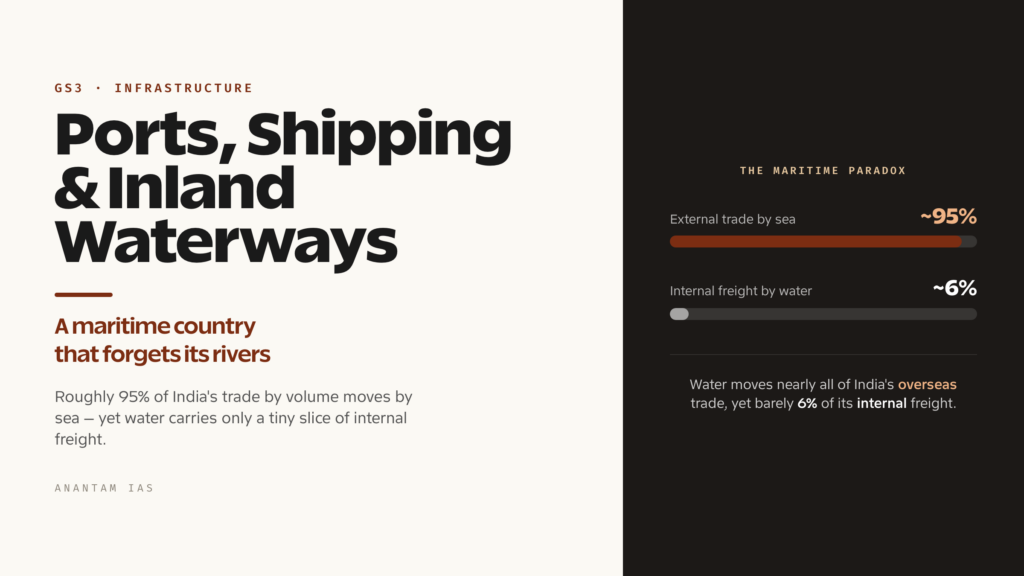
India is a maritime country that often forgets it. The coastline runs for 11,098 km — a figure the Ministry of Ports, Shipping and Waterways revised up from the long-quoted 7,516 km after a fresh survey using modern methods — and roughly 95% of the country’s external trade by volume, and about 70% by value, moves across it. Almost everything you import or export, from crude oil to smartphones to fertiliser, touches a port at some point. So the health of the ports system is not a niche infrastructure question. It’s the floor under the whole trading economy.
And yet there’s a strange contradiction at the centre of the story. Water is the cheapest, most fuel-efficient way to shift heavy cargo over long distances, but inside the country it barely gets used. Roads and railways do almost all the work, while coastal shipping and rivers sit nearly idle. Closing that gap — building deeper ports, reviving rivers as highways, and pulling trade back from foreign transhipment hubs — is now one of the central planks of India’s logistics push. For UPSC GS III, ports, shipping and inland water transport sit at the crossroads of infrastructure, trade and the blue economy, and they show up in some form almost every cycle.
How India’s Port System Is Built
Start with the architecture, because the way ports are governed explains a lot about how they perform. India splits its ports into two tiers. There are 12 major ports — wholly owned by the Union government and run under the Major Port Authorities Act, 2021 — and more than 200 non-major (or “minor”) ports that fall under the coastal states and union territories. The major ones are the heavyweights: Deendayal (Kandla), Mumbai, Jawaharlal Nehru (JNPT), Mormugao, New Mangalore, Cochin, V.O. Chidambaranar (Tuticorin), Chennai, Kamarajar, Visakhapatnam, Paradip and Syama Prasad Mookerjee (Kolkata-Haldia). They sit roughly evenly split between the western and eastern seaboards.
That two-tier split matters for the exam because it’s a Centre-versus-states governance story. The Major Port Authorities Act, 2021 was a deliberate reform — it replaced the older Major Port Trusts Act of 1963, gave each major port a leaner board with real commercial autonomy, and freed them to set their own tariffs instead of waiting on a central tariff authority. The idea was to make government ports behave more like the nimble private and state-run ones. Because non-major ports answer to state maritime boards rather than Delhi, governance is uneven across the coast, and some of the fastest-growing cargo handlers — like the privately developed Mundra in Gujarat — are technically “non-major” ports that now rival the big public ones.
Here’s a useful corrective to a common assumption: the non-major ports are not minor in any real sense anymore. Together they handle a large and rising share of national cargo, and a clutch of them on the Gujarat and Andhra coasts have grown into world-class facilities. The “major” label is a legal and administrative category, not a measure of size. Keep that distinction handy, because Prelims likes to test it.
What the Numbers Say in FY25
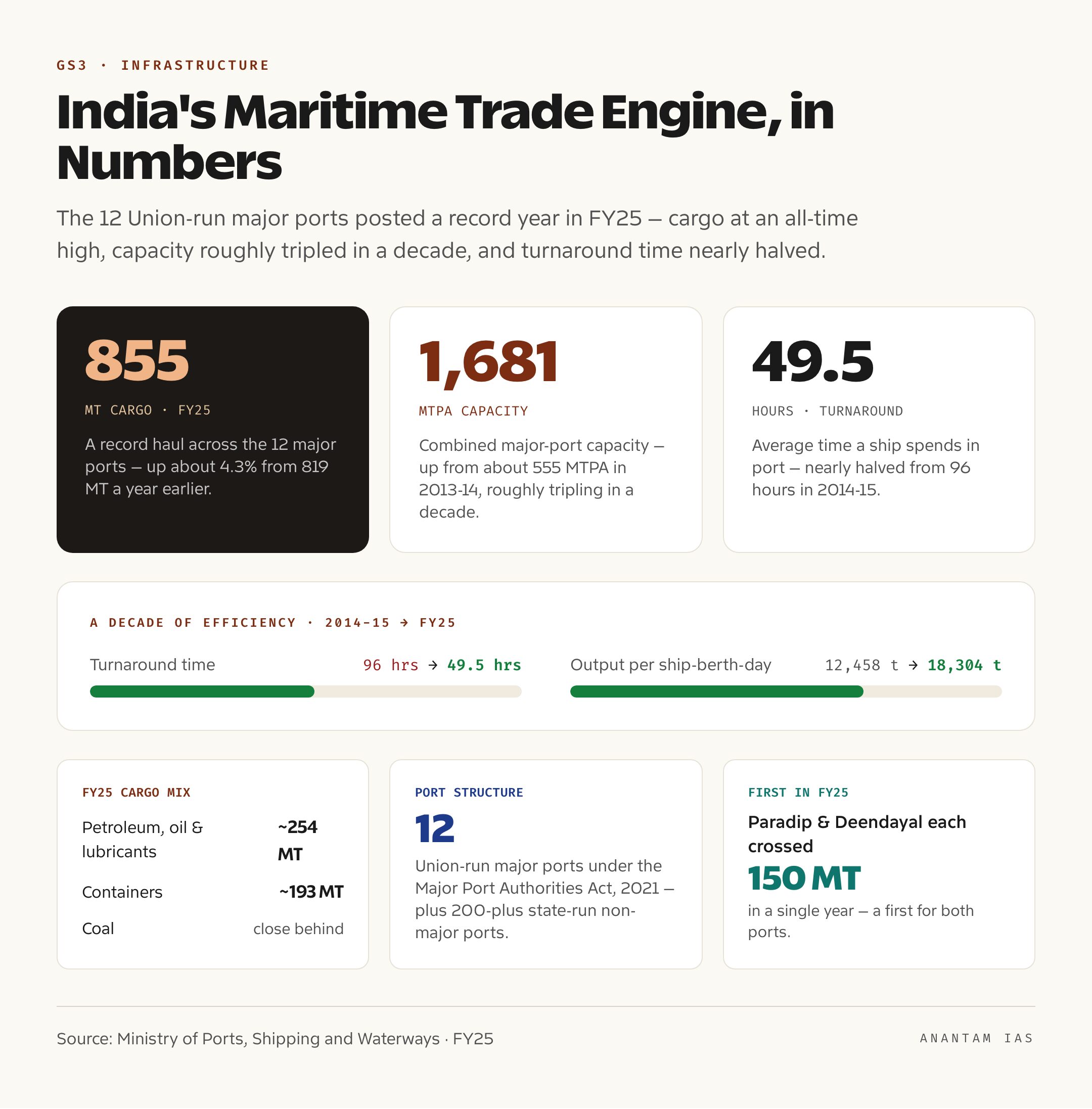
So how is the system actually doing? Better than the old narrative suggests. India’s 12 major ports handled a record 855 million tonnes of cargo in 2024-25, up about 4.3% from 819 million tonnes the year before, according to the Ministry of Ports, Shipping and Waterways. For the first time, both Paradip and Deendayal individually crossed the 150-million-tonne mark in a single year. Petroleum, oil and lubricants led the cargo mix at around 254 million tonnes, followed by containers at roughly 193 million tonnes and coal close behind.
Capacity has expanded even faster. The combined capacity of the major ports rose from about 555 million tonnes per annum (MTPA) in 2013-14 to 1,681 MTPA in FY25 — roughly tripling in a decade. That matters because spare capacity is what lets a port absorb a surge without ships queuing offshore. Efficiency has moved too: the average turnaround time — how long a ship spends in port from arrival to departure — improved by nearly half, from 96 hours in 2014-15 to about 49.5 hours in FY25, per ministry data. Output per ship-berth-day rose from around 12,458 tonnes to 18,304 tonnes over the same stretch. Those are the headline productivity numbers worth memorising.
But the efficiency story isn’t finished. Turnaround time at India’s busiest ports still trails the global best — Singapore and the leading Chinese ports clear ships faster — and congestion spikes at gateway ports during peak season. The deeper structural issue is what economists call the modal-share distortion. Water transport, coastal and inland combined, carries only a small single-digit share of India’s domestic freight; roads do roughly two-thirds and rail about a quarter. Compare that to inland waterways carrying a far larger slice in Europe and China, and you see the scale of the missed opportunity — especially since moving a tonne of cargo a kilometre by water costs around ₹1.1-1.2, against ₹1.2-1.5 by rail and ₹2-3 by road.
Sagarmala, the Visions and the Vadhavan Bet
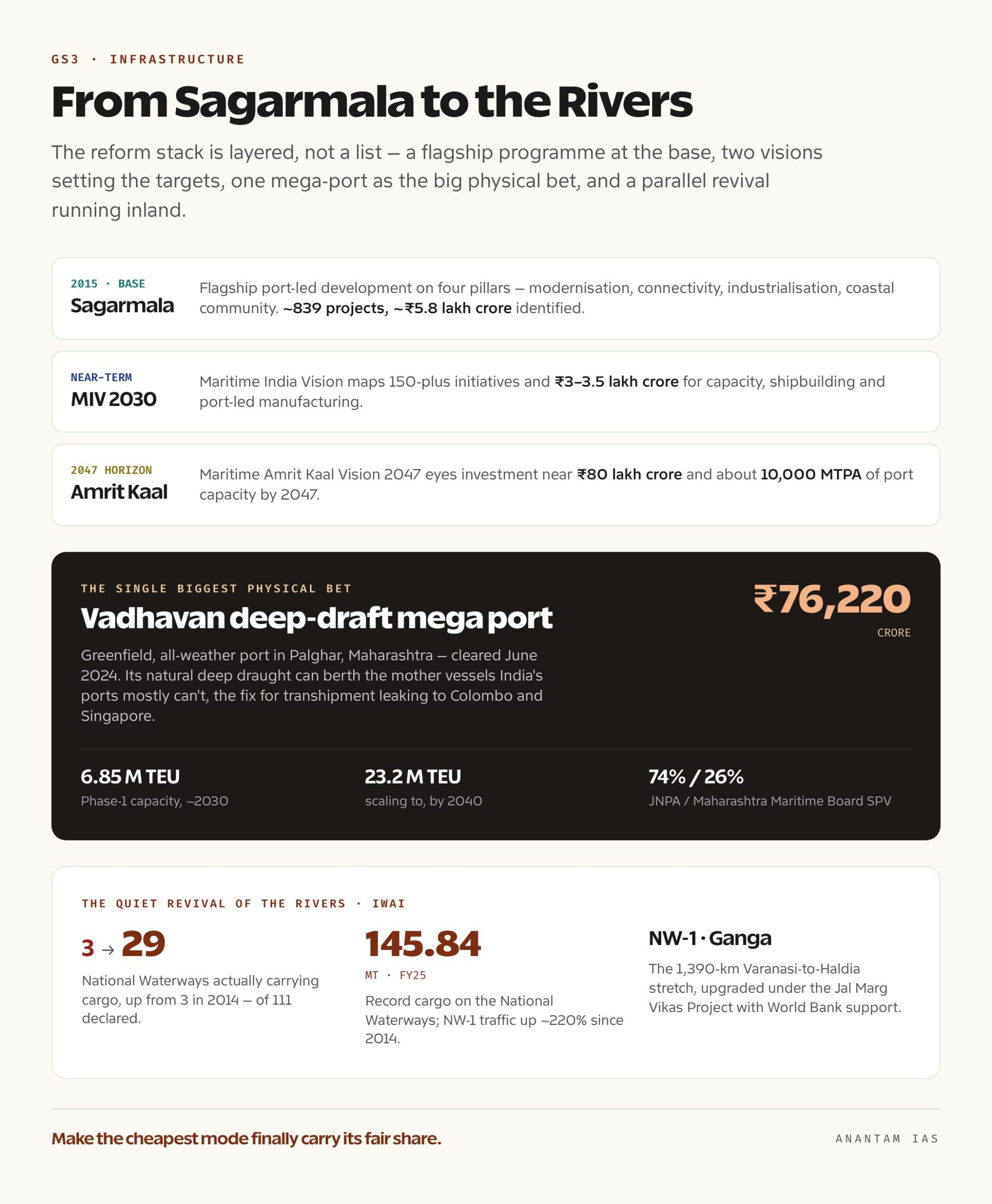
The policy scaffolding around all this is large, and it pays to know it as a layered structure rather than a list. At the base sits Sagarmala, launched in 2015 as the flagship port-led development programme. It rests on four pillars — port modernisation and new ports, port connectivity, port-led industrialisation, and coastal community development. Around 839 projects worth close to ₹5.8 lakh crore have been identified under it, of which a couple of hundred are complete and the rest are at various stages. Sagarmala is the workhorse; the visions sitting above it set the targets.
The first of those is the Maritime India Vision 2030, which maps more than 150 initiatives and projected investments of ₹3-3.5 lakh crore to lift port capacity, shipbuilding and port-led manufacturing. Above it sits the longer-horizon Maritime Amrit Kaal Vision 2047, an ambitious blueprint envisaging investments approaching ₹80 lakh crore and a target of around 10,000 MTPA of port capacity by 2047, with a near-term milestone of about 3,500 MTPA by 2030. Both visions lean hard into decarbonising shipping — green hydrogen and ammonia bunkering, carbon-neutral ports — because the International Maritime Organization’s tightening emissions rules are reshaping global shipping economics.
The single biggest physical bet is Vadhavan. Approved by the Union Cabinet in June 2024 at a cost of about ₹76,220 crore, it’s a greenfield, deep-draft, all-weather mega port coming up at Vadhavan in Palghar district, Maharashtra, roughly 150 km north of Mumbai. It’s being built by a special-purpose vehicle owned 74% by the Jawaharlal Nehru Port Authority and 26% by the Maharashtra Maritime Board. The plan is to handle about 6.85 million TEUs (twenty-foot equivalent units — the standard container measure) in its first phase around 2030, scaling to 23.2 million TEUs by 2040. Its natural deep draft is the point: it can berth the giant mother vessels that India’s existing ports mostly can’t, which is exactly what’s needed to fix the transhipment problem described below. When fully built, Vadhavan is expected to rank among the world’s top ten container ports.
Coastal Shipping and the Transhipment Problem
Now to the gap that has quietly cost India money for decades. A large share of India’s export-import containers don’t sail directly to their destination — they get carried to a nearby foreign hub like Colombo, Singapore or Klang, transferred onto a bigger ship, and sent on. That’s transhipment, and India has historically lacked a domestic hub deep enough to do it, because the megaships that aggregate cargo need 18-plus metres of draught that most Indian ports can’t offer. The result is leaked revenue, longer transit times and a strategic dependence on other countries’ ports. Vadhavan, and the planned international transhipment hub at Galathea Bay in the Andaman and Nicobar Islands, are the long-term answer.
Coastal shipping — moving cargo between Indian ports rather than across borders — is the other half of the underused-water story. It should be a natural fit for a country with an 11,098 km coastline, yet a tangle of old rules held it back. That changed with the Coastal Shipping Act, 2025, which received the President’s assent in August 2025. It replaces the relevant part of the colonial-era Merchant Shipping Act, 1958, with a cleaner, modern framework: a simplified licensing system, rules for foreign vessels in coastal trade, a mandated National Coastal and Inland Shipping Strategic Plan, and a National Database for Coastal Shipping. The aim is to lift coastal cargo to around 230 million tonnes by 2030 and, more broadly, to raise the combined inland-and-coastal share of freight from roughly 6% toward 12% by 2047.
Two more pieces complete the shipping picture. First, the Maritime Development Fund, unveiled in the 2025-26 Union Budget with a ₹25,000-crore corpus (49% from the Centre, the rest from ports and private players), which provides long-tenor, affordable finance for domestic shipbuilding and ship repair — sectors where India has long punched below its weight. Second, ship recycling: India is already the world’s largest ship-recycling nation, centred on Alang in Gujarat, and ratified the Hong Kong Convention in 2019 to bring the industry up to global safety and environmental standards.
The Quiet Revival of India’s Rivers
The most underrated part of this whole story runs inland, on the rivers. Inland water transport is governed by the Inland Waterways Authority of India (IWAI), set up in 1986. On paper India has declared 111 National Waterways, but the meaningful number is how many are actually carrying cargo — and that’s risen from just three in 2014 to 29 by FY25, according to government data, with passenger and cruise services on many more.
The flagship is National Waterway 1 — the 1,390-km Ganga-Bhagirathi-Hooghly stretch from Varanasi to Haldia — being upgraded under the Jal Marg Vikas Project with World Bank support, which builds the multi-modal terminals (Varanasi, Sahibganj, Haldia), navigation locks and assured-depth dredging that make a river usable year-round. The other priority corridors are NW-2 on the Brahmaputra, NW-3 in Kerala’s backwaters, and NW-4 and NW-5 on the eastern rivers. The payoff is showing up in the cargo numbers: total movement on National Waterways hit a record 145.84 million tonnes in FY25, with traffic on NW-1 alone up around 220% since 2014.
But the constraints are real and worth stating plainly. Alluvial rivers meander, silt up and run shallow in the dry season, so maintaining a navigable channel means constant, expensive dredging. The cost of capital for inland vessels is high, which keeps freight rates uncompetitive against subsidised road transport, and few shippers will commit cargo to a route until vessels are reliably available — a chicken-and-egg trap. Governance is fragmented across IWAI, state maritime boards and others, and many stretches are seasonal. So the revival is genuine but fragile; it depends on assured depth, assured cargo and patient money.
The connective tissue holding the whole system together is PM GatiShakti, the national master plan that maps every transport network — ports, rail, road, waterways — onto one digital platform so that a new port comes with its rail and road connectivity planned in from day one, rather than bolted on years later. Combined with the National Logistics Policy’s goal of cutting India’s logistics costs as a share of GDP, GatiShakti is the framework meant to finally fix the last-mile evacuation bottlenecks — congested port roads and low rail-evacuation shares — that have throttled Indian ports for years. Get that right, and the modal-share distortion starts to correct itself.
For Your Mains Answer
This topic is core GS Paper 3 material under infrastructure (ports, roads, airports, railways) and links naturally to the economy, the blue economy and even internal security via maritime trade routes. It also feeds GS Paper 1 geography (India’s coastline, port locations) and the Essay paper on themes of growth and connectivity. Treat it as an infrastructure-reform question: a system that has improved fast but still carries a structural distortion that reforms are now attacking.
How to Build the Answer
Open with scale and the paradox — 95% of trade by volume on water, yet water barely used for internal freight. Then move through the system: governance (12 major + 200-plus non-major ports), current performance (the FY25 numbers), the gaps (transhipment dependence, modal share, last-mile connectivity), the reforms (Sagarmala, the visions, Vadhavan, Coastal Shipping Act, Jal Marg Vikas), and a forward-looking conclusion tied to GatiShakti and the blue economy. That arc — scale, structure, gaps, reforms, way forward — works for almost any ports-and-shipping question.
Common Mistakes to Avoid
Don’t say “13 major ports” out of habit; the verified figure governed by the Major Port Authorities Act, 2021 is 12. Don’t confuse Maritime India Vision 2030 with Maritime Amrit Kaal Vision 2047 — one is the near-term plan, the other the 2047 horizon. Don’t treat non-major ports as insignificant; Mundra alone dispels that. And don’t forget the cost logic — water is cheapest per tonne-kilometre, which is the whole reason the modal gap is worth fixing.
A Compact Answer Spine
Coastline 11,098 km, 95% of trade by volume → 12 major ports (Centre, MPA Act 2021) + 200-plus non-major (states) → FY25: 855 MT cargo, 1,681 MTPA capacity, turnaround 49.5 hrs → gaps: transhipment via Colombo, modal share skewed to road/rail → reforms: Sagarmala, MIV 2030, Maritime Amrit Kaal Vision 2047, Vadhavan, Coastal Shipping Act 2025, Maritime Development Fund → inland: IWAI, 29 operational of 111 NWs, NW-1 Jal Marg Vikas, 145.84 MT in FY25 → tie together with PM GatiShakti and the blue economy.
Diagram or Flowchart Idea
Sketch India’s coastline as a simple outline with the major ports marked west and east, then a small bar chart beside it comparing road, rail and water modal share. Add an arrow labelled “transhipment leakage → Colombo/Singapore” with Vadhavan and Galathea Bay marked as the domestic fix. A clean map-plus-bar visual signals command of both geography and economics.
A Balanced-Conclusion Line
Something like: “India’s ports have grown into a genuine strength; the unfinished task is to make the cheapest mode of transport — water — finally carry its fair share of the nation’s freight.” It credits progress while naming the remaining gap, which is exactly the tone examiners reward.
How to Use Data Without Cramming
Anchor the answer with three or four numbers, not ten. The strongest set: 855 MT of major-port cargo in FY25, turnaround time down to about 49.5 hours, 29 operational National Waterways carrying 145.84 MT, and Vadhavan’s ₹76,220-crore cost. Attribute them in-prose — “according to the Ministry of Ports, Shipping and Waterways” — and you sound current without reciting a spreadsheet.
FAQ
How many major ports does India have, and who controls them? India has 12 major ports, all owned by the Union government and governed by the Major Port Authorities Act, 2021. Alongside them sit more than 200 non-major ports that fall under the coastal states and union territories. The “major” tag is a legal category, not a size ranking — some non-major ports, like Mundra, are among the country’s busiest.
What is the Vadhavan port and why does it matter? Vadhavan is a greenfield deep-draft mega port being built in Palghar district, Maharashtra, approved in June 2024 at about ₹76,220 crore. Its natural deep draught lets it berth the giant mother vessels India’s existing ports mostly can’t, which is meant to end India’s dependence on foreign transhipment hubs like Colombo and turn it into a regional hub in its own right.
Why are India’s inland waterways underused, and what’s changing? Rivers are the cheapest way to move heavy cargo, yet water carries only a small share of India’s internal freight because of shallow, silting channels, costly vessels and fragmented governance. Things are shifting: operational National Waterways rose from 3 in 2014 to 29 by FY25, and cargo on them hit a record 145.84 million tonnes, led by the Jal Marg Vikas Project on the Ganga’s NW-1.
What is the Coastal Shipping Act, 2025? It’s a 2025 law that modernises the rules for moving cargo between Indian ports, replacing the relevant part of the 1958 Merchant Shipping Act. It brings in simpler licensing, a framework for foreign vessels, a national strategic plan and a coastal-shipping database, aiming to lift coastal cargo toward 230 million tonnes by 2030.
Practice Questions
Prelims MCQs
- With reference to ports in India, consider the following: how many major ports are governed by the Major Port Authorities Act, 2021?
(a) 10
(b) 12
(c) 13
(d) 14
Answer: (b) India has 12 major ports wholly owned by the Union government and governed by the Major Port Authorities Act, 2021; the 200-plus non-major ports fall under the states. - The Major Port Authorities Act, 2021 is best described as which of the following?
(a) A law transferring major ports to state governments
(b) A law that replaced the Major Port Trusts Act, 1963 and gave port boards greater commercial autonomy
(c) A law creating a single national tariff authority for all ports
(d) A law privatising all major ports
Answer: (b) The 2021 Act replaced the 1963 Major Port Trusts Act, set up leaner boards and let major ports fix their own tariffs. - The Jal Marg Vikas Project is associated with which National Waterway?
(a) NW-2 on the Brahmaputra
(b) NW-3 in Kerala
(c) NW-1 on the Ganga-Bhagirathi-Hooghly
(d) NW-4 on the Godavari-Krishna
Answer: (c) The Jal Marg Vikas Project upgrades NW-1, the 1,390-km Varanasi-to-Haldia stretch, with World Bank support. - Consider the following statements about the Vadhavan port:
1. It is being developed in Maharashtra.
2. It is a shallow-draft river port.
3. It is being built by a special-purpose vehicle involving the Jawaharlal Nehru Port Authority. Which are correct?
(a) 1 and 2 only
(b) 1 and 3 only
(c) 2 and 3 only
(d) 1, 2 and 3
Answer: (b) Vadhavan is a deep-draft (not shallow) sea port in Palghar, Maharashtra, built by an SPV owned 74% by JNPA and 26% by the Maharashtra Maritime Board. - Which body is the statutory authority responsible for the development and regulation of inland waterways for shipping and navigation in India?
(a) Dredging Corporation of India
(b) Inland Waterways Authority of India
(c) Shipping Corporation of India
(d) Directorate General of Shipping
Answer: (b) The Inland Waterways Authority of India (IWAI), set up in 1986, develops and regulates the National Waterways.
Mains Practice Questions
- India moves nearly 95% of its trade by volume over the sea, yet water carries only a small share of its internal freight. Examine the causes of this modal-share distortion and the measures being taken to correct it. (15 marks, 250 words)
- “Port-led development has shifted from a slogan to a measurable outcome.” In light of the Sagarmala programme and recent performance data, critically evaluate the progress of India’s major ports. (15 marks, 250 words)
- Discuss how the proposed Vadhavan port and the Galathea Bay transhipment hub could reshape India’s position in global container shipping. What challenges must they overcome? (10 marks, 150 words)
- The revival of inland water transport depends on assured depth, assured cargo and patient capital. Analyse the constraints facing India’s National Waterways and suggest a way forward. (15 marks, 250 words)
- Evaluate the role of PM GatiShakti and the National Logistics Policy in integrating ports, coastal shipping and inland waterways into India’s logistics ecosystem. (10 marks, 150 words)
Tell Google you want more of this.
Add Anantam IAS as a preferred sourceOne tap, and this site shows up more often in your own Top Stories, AI Overviews and AI Mode. Remove it any time.