Uzbekistan rarely makes headlines outside Central Asia, which is precisely why aspirants miss it on the location in news questions. In May 2026, however, the country has been everywhere on the diplomatic map. The Uzbek foreign minister attended the BRICS Foreign Ministers Meeting at Bharat Mandapam as a partner country representative. The fifth round of the India Central Asia Dialogue is scheduled for the second half of 2026 with Tashkent expected to host. And Uzbekistan has formally applied to join the International North South Transport Corridor, a move with direct consequences for India’s connectivity ambitions.
The Uzbekistan location in news angle matters for more than geography drills. Uzbekistan is one of only two doubly landlocked countries in the world, alongside Liechtenstein. It sits at the historical pivot of the Silk Road, controls the headwaters of two rivers that fed the now shrunken Aral Sea, and shares borders with all four other Stans plus Afghanistan. For India, Uzbekistan is the most populous Central Asian republic, a Strategic Partner since 2011, and the regional anchor for the Connect Central Asia Policy.
This article works through the geography, the India link, the Aral Sea crisis, and the connectivity story that puts Uzbekistan firmly into UPSC location in news territory.
Quick Facts
- Capital: Tashkent.
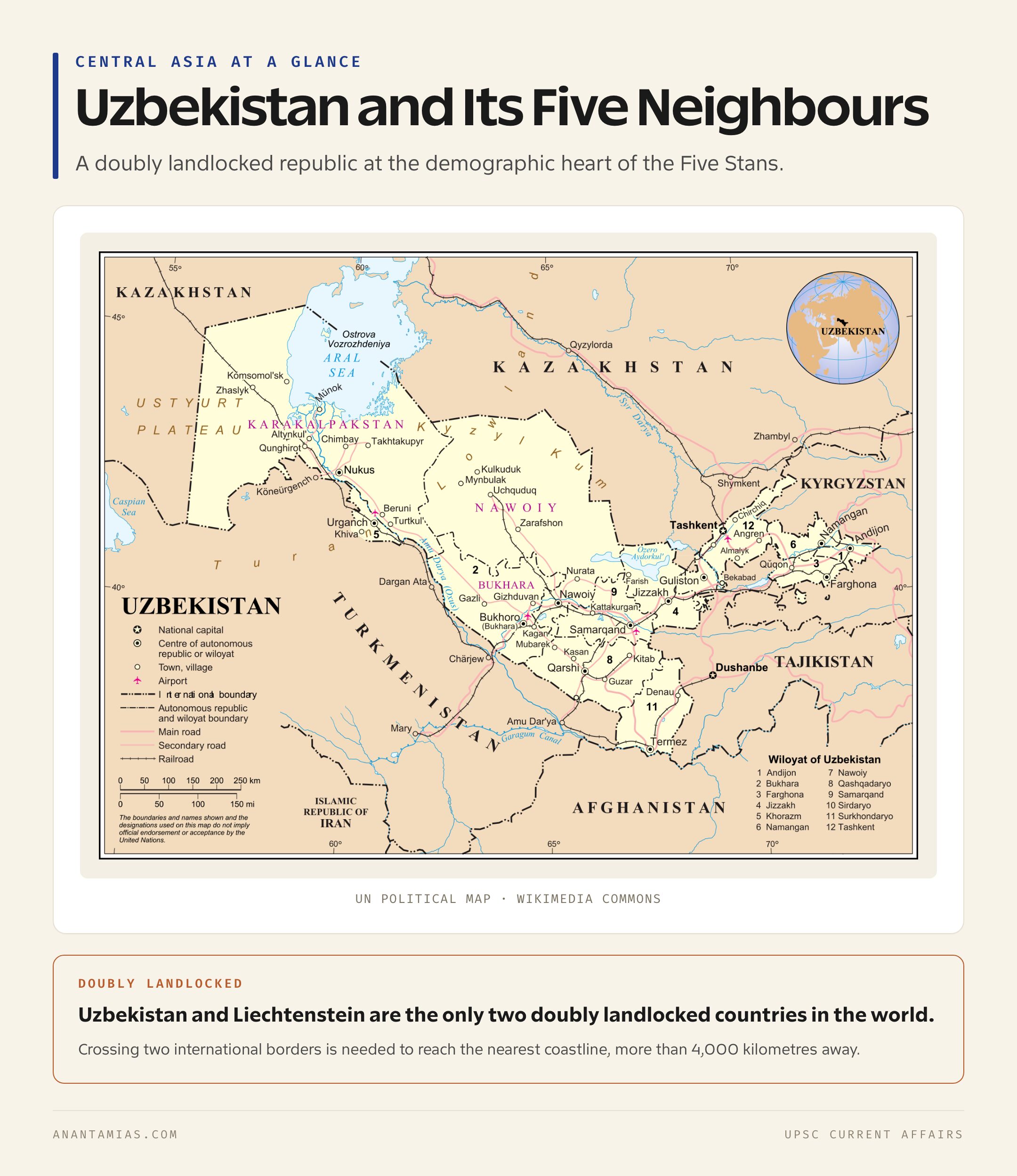
- Geographic position: Central Asia, doubly landlocked, bordered by Afghanistan, Kazakhstan, Kyrgyzstan, Tajikistan and Turkmenistan.
- Doubly landlocked: Uzbekistan and Liechtenstein are the only two doubly landlocked countries in the world.
- Population: Roughly 36 million, the most populous Central Asian republic.
- Rivers: Amu Darya and Syr Darya, the two principal rivers of Central Asia, feed Uzbekistan and the Aral Sea.
- Bilateral relationship: Strategic Partnership with India since 2011, with an active India Central Asia Dialogue framework.
- Indian investment: Approximately 451 million dollars in cumulative Indian investments in Uzbekistan.
What Just Happened
The Uzbekistan location in news file has accumulated three distinct developments through April and May 2026. First, Uzbekistan attended the BRICS Foreign Ministers Meeting in New Delhi as a recognised partner country, one of ten admitted to the second tier at the Kazan summit in 2024. Foreign Minister Bakhtiyor Saidov used the platform to push for Uzbek inclusion in BRICS working groups on connectivity and critical minerals.
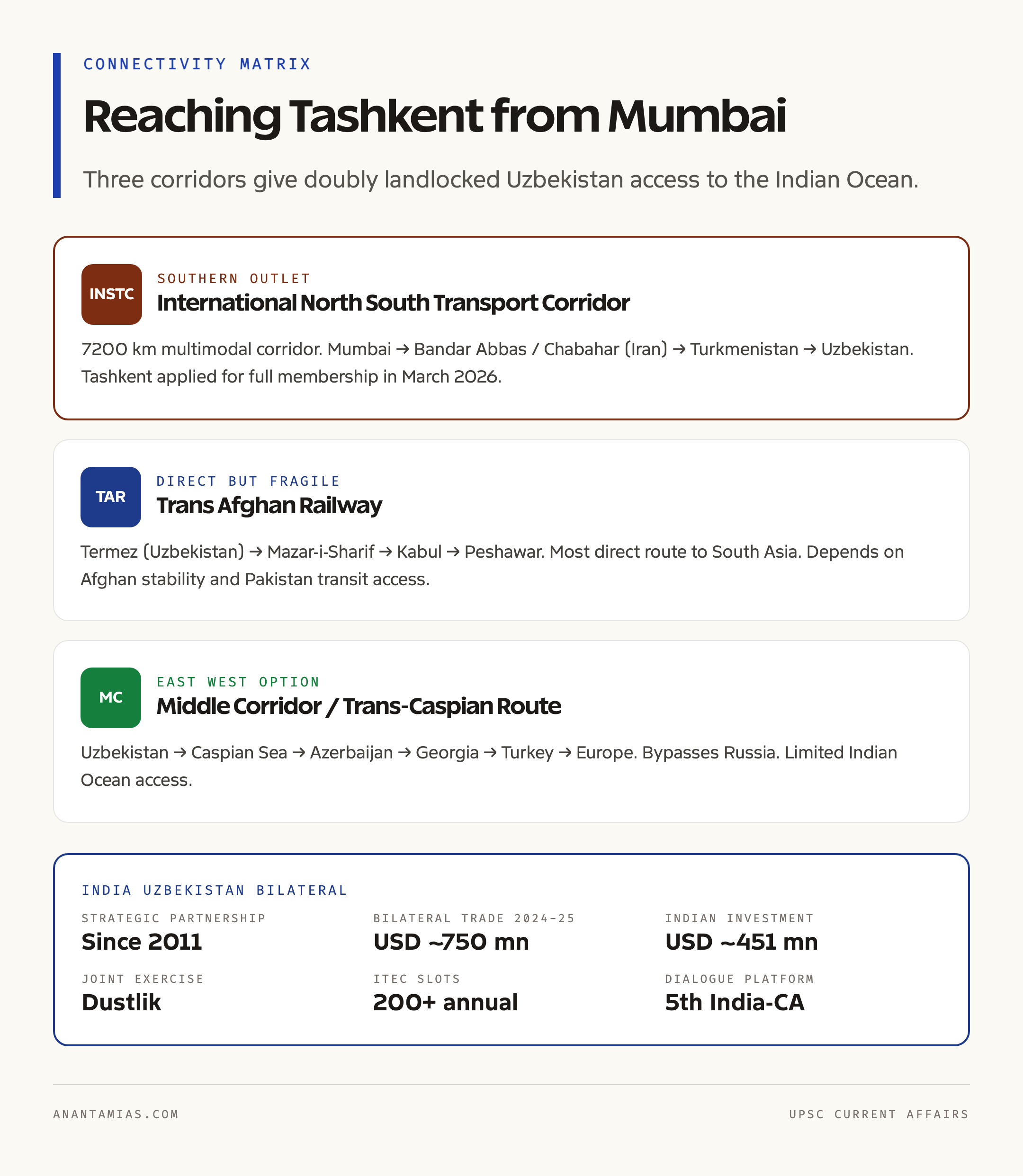
Second, Uzbekistan has formally applied to join the International North South Transport Corridor. The INSTC is a 7200 kilometre multi modal corridor that connects Mumbai through Chabahar in Iran and Bandar Abbas to the Caspian Sea and onward to Russia and Europe. Uzbekistan’s accession will give Tashkent direct multi-modal access to Indian and European markets and will give India a credible land route into the heart of Central Asia.
Third, the Indian Embassy in Tashkent has flagged 2026 as a milestone year for bilateral cooperation. The fifth India Central Asia Dialogue, the first since 2024, is expected to be held in the second half of 2026. India’s defence procurement diversification, the search for critical minerals supply, and the Connect Central Asia Policy now in its second decade have all put Uzbekistan back into Indian foreign policy attention.
Background and Historical Context
Uzbekistan’s relationship with India is older than either modern state. The land between the Amu Darya and the Syr Darya, known historically as Transoxiana or Mawarannahr, was a key node on the Silk Road. Buddhist monasteries dotted the route through Termez and Samarkand. Babur, the founder of the Mughal dynasty, was born in Andijan in the Fergana Valley of present day Uzbekistan in 1483. The shared civilisational past surfaces in language, cuisine, music and architecture.
Modern Bilateral Relations
Uzbekistan declared independence in 1991 after the dissolution of the Soviet Union. India was among the first countries to recognise it and opened an embassy in Tashkent within months. The relationship moved into Strategic Partnership in 2011 during President Islam Karimov’s visit. A virtual summit between Prime Minister Narendra Modi and President Shavkat Mirziyoyev in December 2020 produced a Treaty of Strategic Partnership covering trade, defence, science and education.
The Connect Central Asia Policy, articulated by India in 2012, identifies Uzbekistan as the regional anchor. The policy focuses on six pillars: political relations, economic engagement, capacity building, security cooperation, connectivity, and people to people ties. Bilateral mechanisms include the India Uzbekistan Joint Commission, the Defence Cooperation Working Group, and the Joint Working Group on counter terrorism. The fifth India Central Asia Dialogue, when it convenes, will be the main multilateral platform. The annual Shanghai Cooperation Organisation summit, which Uzbekistan hosted in 2022, has become another anchor.
Key Features of Uzbekistan’s Geography and Polity
Several geographic and political facts make Uzbekistan distinctive on the Central Asian map and worth mastering for the prelims.
- Doubly landlocked status: Surrounded entirely by landlocked neighbours. The nearest sea is 4000 kilometres away. Only Liechtenstein shares this status globally.
- Five neighbours: Kazakhstan to the north and northwest, Kyrgyzstan to the northeast, Tajikistan to the southeast, Afghanistan to the south, Turkmenistan to the southwest.
- Fergana Valley: A densely populated, irrigated valley shared with Kyrgyzstan and Tajikistan, often described as the demographic heart of Central Asia.
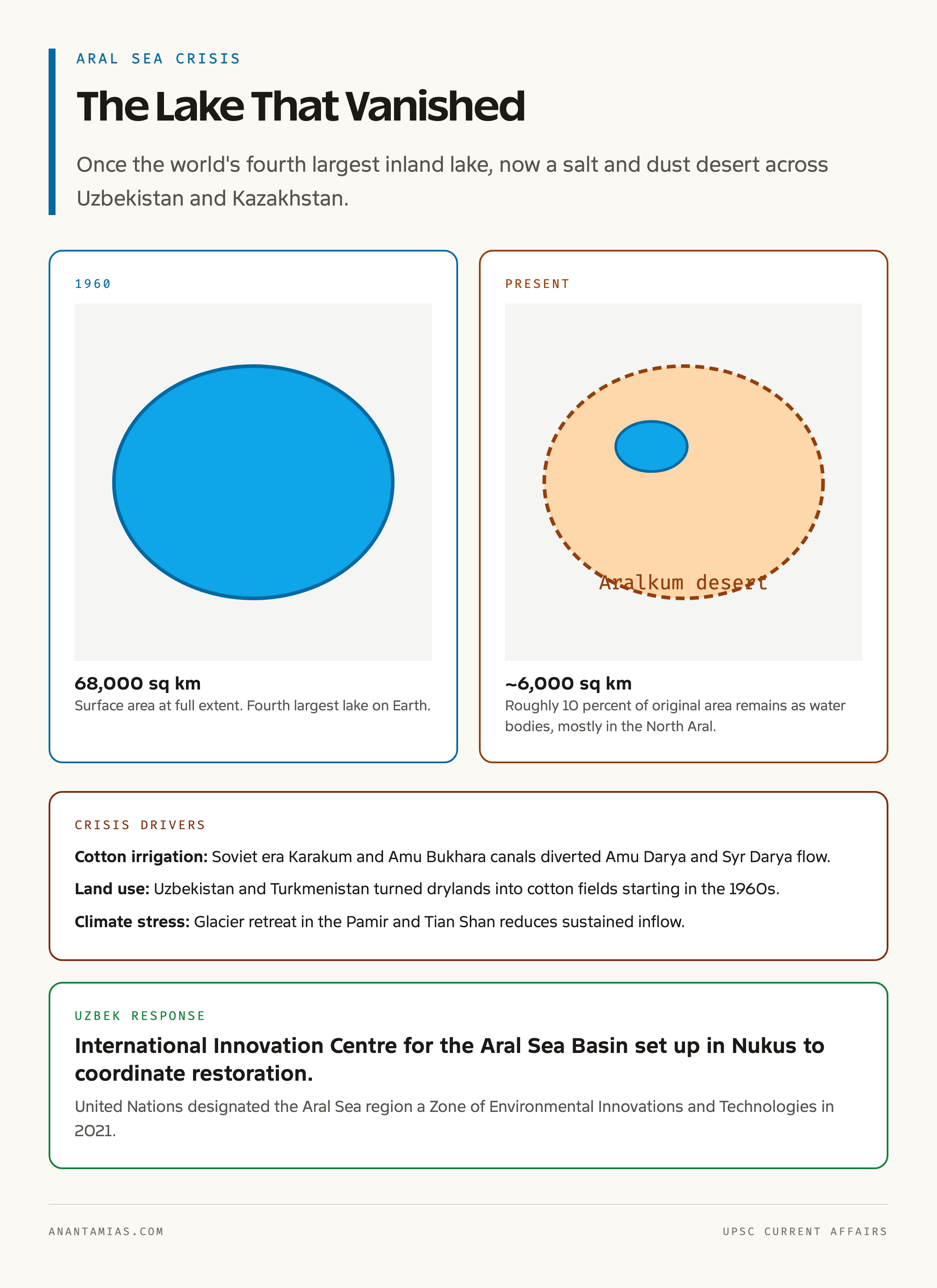
- Aral Sea: Once the world’s fourth largest inland lake, now reduced to roughly 10 percent of its 1960s extent after Soviet era cotton irrigation diverted Amu Darya and Syr Darya flow.
- Tian Shan and Kyzylkum: Mountains to the east and the Kyzylkum desert to the centre and northwest. The country has elevation extremes ranging from below sea level near the Aral Sea to 4643 metres at Khazret Sultan.
- Cities: Tashkent the capital, Samarkand, Bukhara, Khiva and Termez carry layered Islamic, Sogdian and Buddhist heritage. Three Uzbek cities are UNESCO World Heritage sites.
Why It Matters
The Uzbekistan location in news file matters for three reasons that connect to India’s foreign policy and the UPSC syllabus. First, Uzbekistan is the keystone of the Connect Central Asia Policy. The five Central Asian republics together have a population of about 80 million and combined GDP of roughly 400 billion dollars. Uzbekistan accounts for about 45 percent of population and a third of regional GDP. Tashkent is the only Central Asian capital with direct connecting flights to multiple Indian metros.
Second, Uzbekistan is a critical minerals story. The country is among the top ten producers of uranium globally, holds significant deposits of gold, copper, tungsten and rare earths, and has signed a recent agreement with India to explore joint mineral processing. India’s diversification away from Chinese supply for rare earth metals and battery materials makes Uzbekistan a useful partner.
Third, Uzbekistan is a connectivity story. Without sea access of its own, Uzbekistan depends on transit through Iran’s Chabahar port, Russia’s rail network and Turkmenistan’s pipeline corridors. India’s investment in Chabahar and its role in the INSTC give New Delhi a stake in how Tashkent connects to global trade. Uzbekistan’s INSTC application aligns Tashkent more closely with the India led connectivity vision than with the China led Belt and Road.
Detailed Analysis
The Aral Sea crisis is the single most consequential environmental story in Uzbekistan and deserves close reading. The Aral Sea once covered 68000 square kilometres. Soviet era engineers diverted the Amu Darya and Syr Darya from the 1960s onward to irrigate cotton in Uzbekistan, Kazakhstan and Turkmenistan. By the early 2000s the South Aral had largely dried up. The exposed seabed, now called the Aralkum desert, releases salt and pesticide laden dust that has affected respiratory health across the region. Uzbekistan has led the international response through the International Innovation Centre for the Aral Sea Basin headquartered in Nukus.
Connectivity is the other thread that defines Uzbekistan’s foreign relations. The country has been pursuing multiple corridor strategies in parallel. The INSTC accession through Bandar Abbas and Chabahar offers a southern outlet. The Trans Afghan railway, also called the Mazar-i-Sharif to Kabul to Peshawar route, would provide a more direct line to Pakistan and onward to the Indian Ocean. The Middle Corridor or Trans Caspian International Transport Route offers an east west option through the Caspian Sea, Azerbaijan, Georgia and Turkey. Uzbekistan’s strategy is to participate in all three rather than pick a winner.
India’s bilateral cooperation with Uzbekistan covers six concrete pillars. Defence cooperation includes joint exercises Dustlik, training of Uzbek officers in Indian military academies and an active Defence Cooperation Working Group. Trade is small but growing, with bilateral trade crossing 750 million dollars in 2024 to 2025. The Strategic Partnership Council reviews progress annually. India runs over 200 ITEC training slots for Uzbek officials and supports the Uzbek information technology sector through the India Uzbekistan Joint Entrepreneurship Development Centre in Tashkent. Indian pharmaceutical exports dominate the trade basket. Tourism flows have grown after Uzbekistan introduced e visas for Indian travellers.
Comparative Perspective
Uzbekistan’s location and demography make it the largest Central Asian republic that India needs to court. Kazakhstan to the north is larger by area, richer in oil and uranium, and a member of the Eurasian Economic Union, which gives it Russian gravity. Turkmenistan to the southwest is wealthier per capita on the back of gas exports but isolationist. Kyrgyzstan and Tajikistan are smaller and closer to Russia and China respectively.
For comparison, India runs Strategic Partnerships with all five Central Asian republics and is the only Indian Ocean power with such a comprehensive Central Asia presence. The 2022 India Central Asia Summit, convened virtually by Prime Minister Modi, formalised the leader level dialogue. The Uzbek INSTC application, if approved, will deepen Tashkent’s role as the lead Central Asian partner.
Challenges Ahead
The Uzbekistan location in news case is not without obstacles. The most obvious is geography. Doubly landlocked status keeps logistics expensive. Chabahar route capacity is constrained, the Trans Afghan railway will need Afghan stability that is not yet visible, and the Trans Caspian route depends on shipping across a lake. Multimodal connectivity is the only viable model and requires sustained financing.
Domestically, Uzbekistan has been carrying out a careful reform programme since 2017 under President Mirziyoyev. Convertibility of the som, opening of the economy to foreign investment, easing of border controls with Kyrgyzstan and Tajikistan, and outreach to international institutions have all moved fast. The political system, however, remains authoritarian and India’s people to people partnerships must navigate that reality.
Regionally, Uzbekistan sits next to Afghanistan and downstream of glacier fed rivers vulnerable to climate change. The Aral Sea dust and salinity remain a public health emergency. Water sharing with upstream Tajikistan and Kyrgyzstan continues to be contentious despite recent treaty progress.
Prelims Pointers
- Capital: Tashkent.
- Doubly landlocked partners globally: Uzbekistan and Liechtenstein.
- Five neighbours: Afghanistan, Kazakhstan, Kyrgyzstan, Tajikistan, Turkmenistan.
- Rivers: Amu Darya, Syr Darya. Both flow toward the Aral Sea.
- Aral Sea: Once the world’s fourth largest inland lake; reduced to about a tenth of its 1960s area.
- UNESCO World Heritage sites: Samarkand, Bukhara and the historic centre of Khiva (Itchan Kala) plus Shahrisabz.
- Strategic Partnership with India: Signed in 2011, upgraded by treaty in 2020.
- Connect Central Asia Policy: Articulated by India in 2012 with Uzbekistan as a regional anchor.
- INSTC application: Filed in March 2026.
Mains Practice Questions
- GS Paper 1: Discuss the strategic importance of Uzbekistan in India’s Central Asia Policy and outline the major bilateral mechanisms. (250 words)
- GS Paper 1: Examine the Aral Sea crisis as a case study in the environmental consequences of irrigation led agriculture.
- GS Paper 2: What are the key challenges for India in operationalising the International North South Transport Corridor for trade with Central Asia?
- GS Paper 2: Critically analyse the Connect Central Asia Policy in the light of regional competition from China’s Belt and Road Initiative and Russia’s Eurasian Economic Union.
Way Forward
Uzbekistan will continue to be in news through 2026. The fifth India Central Asia Dialogue, the INSTC accession process, the joint critical minerals working group, and the upcoming SCO and BRICS engagements will all keep Tashkent on the Indian foreign policy radar. For UPSC aspirants the priority is to internalise the geography, the doubly landlocked fact, the Aral Sea crisis, and the broad outline of bilateral cooperation.
A productive Indian strategy will combine Chabahar based connectivity, joint critical minerals processing, expanded ITEC training, and quiet diplomatic support for Uzbek reform. The Uzbekistan location in news case is a model for how India can engage a smaller but strategically located partner without overpromising or overcommitting.
Frequently Asked Questions
Why is Uzbekistan in news in May 2026?
Uzbekistan attended the BRICS Foreign Ministers Meeting in New Delhi as a partner country, has applied to join the International North South Transport Corridor, and is preparing to host the fifth India Central Asia Dialogue later in 2026.
What does doubly landlocked mean and which countries are doubly landlocked?
A doubly landlocked country is surrounded entirely by other landlocked countries, so reaching a coastline requires crossing at least two international borders. Uzbekistan and Liechtenstein are the only two doubly landlocked countries in the world.
Which countries border Uzbekistan?
Uzbekistan shares borders with Afghanistan, Kazakhstan, Kyrgyzstan, Tajikistan and Turkmenistan.
What is the Aral Sea crisis?
The Aral Sea, once the world’s fourth largest inland lake, has been reduced to roughly 10 percent of its 1960s extent due to Soviet era irrigation diversion of the Amu Darya and Syr Darya. The exposed seabed, called the Aralkum desert, generates toxic dust storms that affect health across the region.
What is the India Uzbekistan Strategic Partnership?
The Strategic Partnership was signed in 2011 and elevated to a Treaty of Strategic Partnership during the virtual summit between Prime Minister Modi and President Mirziyoyev in December 2020. It covers political relations, defence, trade, science and culture.
How is Uzbekistan connected to the INSTC?
Uzbekistan applied for full INSTC membership in March 2026. The corridor will give Tashkent multimodal access to the Indian Ocean through Iran’s Chabahar and Bandar Abbas ports, reducing dependence on Russian rail and the Trans Caspian route.
What is the Connect Central Asia Policy?
The Connect Central Asia Policy was articulated by India in 2012. It identifies six pillars of engagement with the five Central Asian republics including political relations, economy, capacity building, security, connectivity, and people to people ties. Uzbekistan is the regional anchor.
Which Indian companies are active in Uzbekistan?
Indian pharmaceutical companies dominate the trade basket. Sun Pharmaceuticals, Dr Reddy’s and others maintain manufacturing or distribution presence. Indian information technology firms operate through the India Uzbekistan Joint Entrepreneurship Development Centre in Tashkent.
What are the UNESCO World Heritage sites in Uzbekistan?
Samarkand, Bukhara, the historic centre of Khiva known as Itchan Kala, and Shahrisabz are inscribed on the UNESCO World Heritage list. They reflect Uzbekistan’s role on the Silk Road and its Timurid heritage.
How does Uzbekistan fit into BRICS?
Uzbekistan is one of ten BRICS partner countries inducted at the Kazan Summit in 2024. It attends BRICS meetings, participates in working groups, and is eligible to be considered for full membership through a merit based process under the New Delhi Chair’s Statement of 2026.
Tell Google you want more of this.
Add Anantam IAS as a preferred sourceOne tap, and this site shows up more often in your own Top Stories, AI Overviews and AI Mode. Remove it any time.