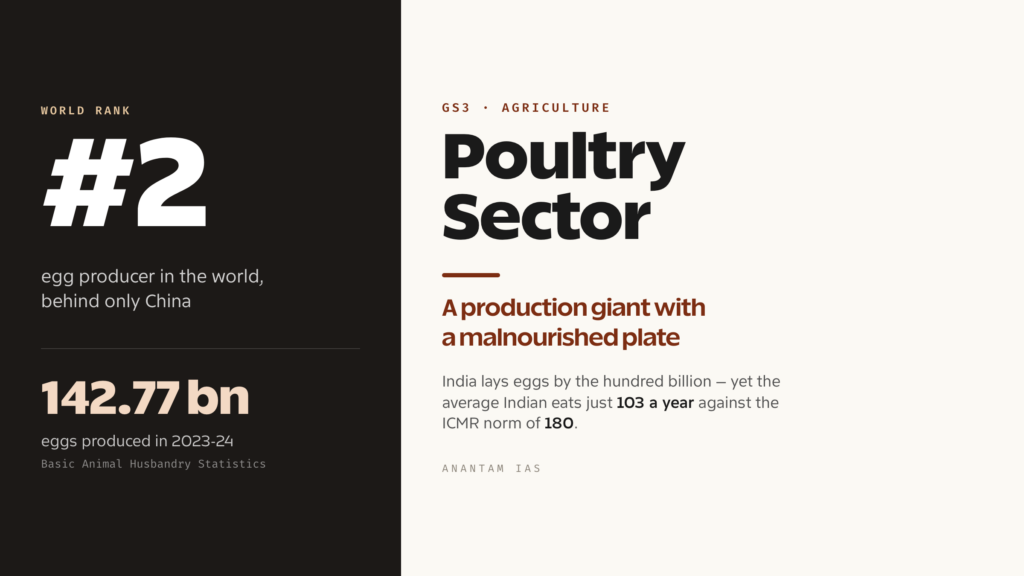
Two numbers tell the whole story of Indian poultry, and they don’t agree with each other. The first is that India laid almost 143 billion eggs in 2023-24 and ranks second in the world, behind only China. The second is that the average Indian still eats just 103 of those eggs in a year, while the Indian Council of Medical Research says a healthy adult should eat about 180. So the country produces eggs by the hundred billion and somehow still under-eats them.
That gap is the poultry sector in one line. It’s a quiet success story of animal husbandry growing at 8-10% a year, lifting protein onto rural plates and putting cash into the hands of small farmers and women. But it’s also a sector that lives one bird-flu headline or one maize price spike away from a crisis. So this is a story about abundance and fragility at the same time, and that tension is exactly what an examiner wants you to see.
How Poultry Became Big Business
Poultry in India used to mean a few desi hens scratching about behind a village hut. Over the last three decades it turned into one of the most organised, science-driven food industries in the country. And the engine of that change was a single arrangement: contract farming.
Here’s how it works. A large company called an integrator — names like Suguna, Venky’s and Sneha dominate the broiler trade — owns the parent stock, the hatcheries, the feed mills and often the processing plants. The farmer owns the shed and the labour. The integrator drops day-old chicks at the farm gate along with feed, vaccines and a vet’s number, then buys back the grown birds at a pre-agreed rate tied to weight gain, feed conversion and mortality. The farmer carries far less price risk; the integrator gets a reliable supply chain. It’s the most successful example of contract farming India has, and it’s why more than 80% of the country’s chicken now comes from organised commercial farms. By most industry estimates, contract and integrated models account for over 90% of broiler output and a large slice of egg production too.
Two very different worlds sit inside the word “poultry.” On one side is this commercial layer-and-broiler economy, concentrated in the south and west — Andhra Pradesh, Tamil Nadu, Telangana, West Bengal, Karnataka, Maharashtra and Haryana do most of the heavy lifting. On the other is backyard poultry, where tribal and marginal households rear a handful of hardy birds for eggs, occasional meat and emergency cash. The government promotes improved dual-purpose breeds for exactly this segment — Vanaraja, Gramapriya, Kadaknath, Giriraja and CARI-Nirbheek — because a desi-type bird that survives village conditions does more for a poor family than a fragile high-yield hybrid ever could. Both worlds matter, and good policy can’t pretend the sector is only one of them.
What the Numbers Actually Say
This is where you reach for hard figures, because the poultry story is unusually well documented. The Basic Animal Husbandry Statistics, released each year by the Department of Animal Husbandry and Dairying around National Milk Day, is the source UPSC expects you to cite.
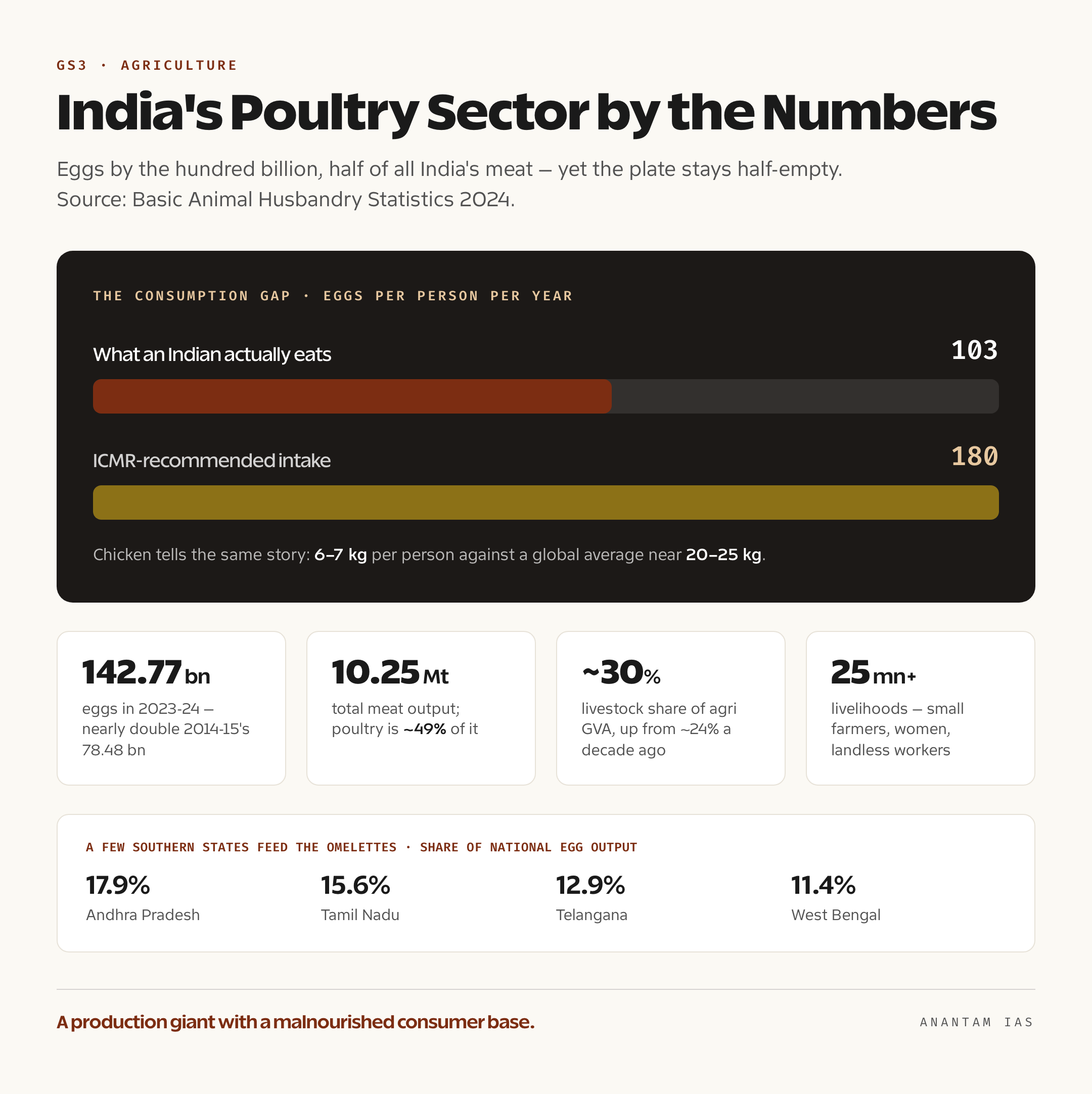
The headline from the 2024 edition: India’s egg production hit 142.77 billion in 2023-24, up about 3.2% on the previous year and nearly double the 78.48 billion of 2014-15. That keeps India firmly second in the world for eggs. Total meat output reached 10.25 million tonnes, growing close to 5%, and poultry alone made up about 49% of that meat — almost half of all the meat India produces comes from birds. Egg production is heavily concentrated: Andhra Pradesh leads with roughly 17.9% of the national total, followed by Tamil Nadu at 15.6%, Telangana at 12.9% and West Bengal at 11.4%. A handful of southern states quite literally feed the country’s omelettes.
Now the demand side, where the picture flips. Per-capita egg availability is about 103 eggs a year against the ICMR norm of 180, and per-capita chicken consumption sits at roughly 6-7 kg against a global average closer to 20-25 kg. Read those two facts together and you see both the problem and the opportunity: India is a giant producer with a malnourished consumer base. Eggs are among the cheapest complete proteins available, which is why state mid-day-meal programmes that serve eggs are quietly one of the sector’s most important institutional buyers — they push protein into exactly the children who need it while giving farmers a stable order book.
The macro frame matters too. Livestock as a whole now contributes about 30% of agriculture-and-allied gross value added, up from around 24% a decade ago, and it’s growing faster than crop farming. Poultry is one of the liveliest pieces of that, supporting livelihoods for an estimated 25 million-plus people, many of them small farmers, women and landless rural workers for whom a poultry shed is the difference between subsistence and a cash income.
Why the Sector Stays Fragile
So why does an industry this large stay this nervous? Because almost every input it depends on is volatile, and a chicken can’t wait out a bad month.
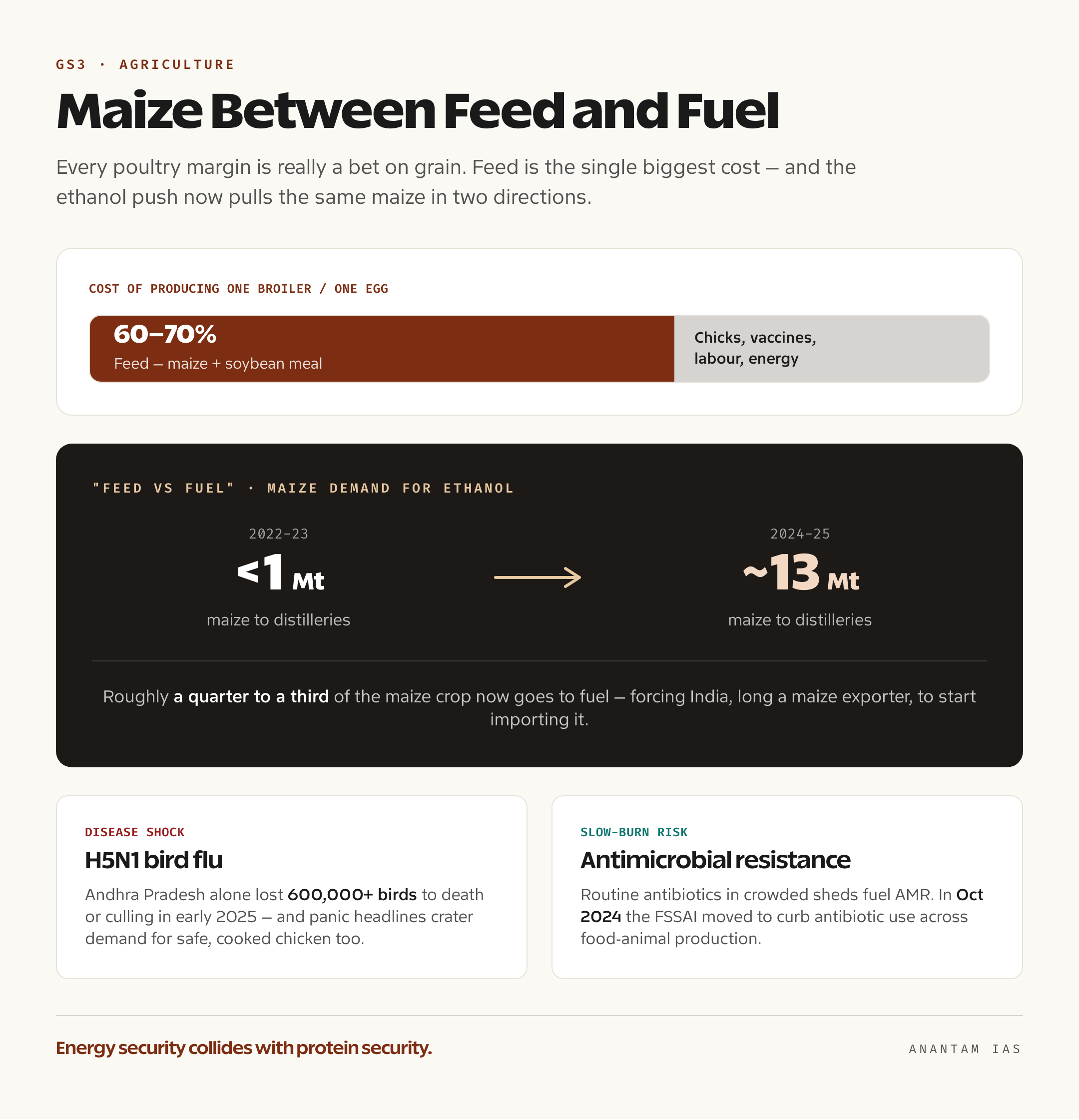
Start with feed, which is the heart of the matter. Maize and soybean meal make up 60-70% of the cost of producing a broiler or an egg, so the entire sector’s profit margin is really a bet on grain prices. And that bet just got harder. India’s ethanol-blending push has pulled enormous quantities of maize toward fuel — maize demand for ethanol jumped from under 1 million tonnes in 2022-23 to nearly 13 million tonnes by 2024-25, and roughly a quarter to a third of the maize crop is now being diverted to distilleries. The poultry and cattle-feed industry, which used to absorb the bulk of India’s maize, is suddenly competing with petrol pumps for the same grain. This “feed versus fuel” tension has forced India, long a maize exporter, to start importing maize, and rating agencies have flagged squeezed poultry margins for 2025-26 as feed costs climb. It’s a textbook example of one government goal — energy security through biofuel — colliding with another — protein security through cheap eggs.
Then there’s disease, which can wipe out a year’s work in a week. Highly pathogenic H5N1 avian influenza returned hard in early 2025, with Andhra Pradesh alone losing over 600,000 birds to death or culling across multiple outbreaks, and cases reported in several other states. Bird flu hits twice: the cull destroys stock directly, and the panic headlines crater chicken demand even where birds are perfectly safe to eat once cooked. India even recorded rare human H5N1 deaths, which keeps the consumer fear alive. Other diseases — Ranikhet (Newcastle), Infectious Bursal Disease — add to the toll, especially where small units skimp on biosecurity.
A third worry is harder to see but matters enormously: antibiotics and antimicrobial resistance. To keep birds alive in crowded sheds and push growth, some producers have leaned on antibiotics, including drugs that medicine relies on for humans. That fuels AMR — the rise of bugs that no longer respond to our medicines — which the WHO treats as a top global health threat. India has been tightening the rules: in October 2024 the FSSAI moved to prohibit antibiotic use across stages of production in meat, poultry, eggs and other food sectors, aligning with the National Action Plan on Antimicrobial Resistance and its One Health approach. Enforcement on the ground, across millions of small units, is the real test.
And underneath all this sits the smallholder’s vulnerability. Many backyard and small commercial farmers lack proper housing, cold-chain links and disease surveillance, so post-harvest losses stay high and a single shock can push a family back into debt. Demand also swings sharply with religious calendars — sales dip during Shravan and Navratri — so even healthy farms face a price roller-coaster they can’t control.
What Government Is Doing About It
Policy has caught up with the sector’s importance, and three instruments do most of the work. The first is the National Livestock Mission, which now offers up to 50% capital subsidy — commonly cited at up to about ₹25 lakh — for rural poultry entrepreneurship: hatcheries, mother units, brooding and feed units. Its Rural Backyard Poultry Development component specifically funds low-input birds for poor households, which is the inclusive-growth heart of the scheme.
The second is the Animal Husbandry Infrastructure Development Fund, launched under the Atmanirbhar Bharat package. It began as a ₹15,000 crore corpus and has since been expanded and extended — the revised outlay runs to roughly ₹29,000 crore up to 2025-26 — offering a 3% interest subvention on bank loans to private players, farmer producer organisations and cooperatives that build feed plants, processing units and cold storage. The idea is to crowd in private money where it adds value: India exports relatively little poultry today, around the low hundreds of millions of dollars, and value addition and cold chain are exactly what unlock new markets.
The third is the National Animal Disease Control Programme and the Central Poultry Development Organisations, which handle the unglamorous but vital work of vaccination, surveillance, germplasm and farmer training. Add the extension of the Kisan Credit Card to animal husbandry, and convergence with FPO promotion, and you can see the policy logic: subsidise entry, build shared infrastructure, control disease, and organise scattered farmers into groups with bargaining power.
The Road Ahead
The way forward writes itself once you’ve named the problems: de-risk the three things that scare the sector. On feed, India has to fix the maize squeeze — raising maize yields, backing oilseed cultivation, exploring alternative proteins like distillers’ grains (DDGS) and insect meal, and making sure the ethanol programme doesn’t quietly starve the feed industry. A grain-balance policy that treats feed as seriously as fuel would do more for poultry than any subsidy.
On disease, the answer is biosecurity, surveillance and faster, fairer compensation so farmers report outbreaks instead of hiding sick birds. On AMR, it’s enforcing the new antibiotic rules right down to the village shed and rewarding antibiotic-free farms, because India’s export ambitions and its public health both depend on clean meat. And on the smallholder, it’s organisation — FPOs for collective buying and selling, better cold chains, and steady institutional demand through egg-based nutrition schemes that lift consumption toward ICMR norms while guaranteeing a buyer. Get those right and the gap we opened with — 143 billion eggs produced, only 103 eaten per person — starts to close from both ends.
For Your Mains Answer
Poultry is squarely a GS Paper 3 topic — “issues related to agriculture and allied sectors,” food processing, and inclusive growth and employment — and it doubles as rich material for the Essay paper on rural livelihoods, nutrition security and the green-growth trade-offs of biofuel. Treat it as a live case study in how one allied sector touches farmer income, public health and even energy policy at once.
How to Build the Answer
Lead with the paradox, not a definition. Open with the production-versus-consumption gap (143 billion eggs produced, 103 per person eaten against ICMR’s 180), then fan out: the sector’s economic and social weight, the contract-farming model, the three big risks (feed, disease, AMR), and a way-forward that maps one solution to each risk. Anchor the body in BAHS data so the examiner sees you’re current, and close on the de-risking idea rather than a generic “government should do more.”
Common Mistakes to Avoid
Don’t treat poultry as one homogeneous thing — distinguish the commercial integrated sector from backyard poultry, because policy treats them differently. Don’t list schemes without explaining what each fixes. Don’t forget the demand side; many answers only describe production and miss that India under-consumes protein. And don’t ignore the fresh angle: the maize feed-versus-fuel tension is what separates a 2026 answer from a recycled one.
A Compact Answer Spine
Second-largest egg producer, ~143 billion eggs (BAHS 2024), poultry ≈ half of all meat → drives farmer income, women’s employment, cheap protein → built on contract farming (80%+ organised) and backyard breeds → but fragile: feed is 60-70% of cost and maize is being diverted to ethanol, plus H5N1 bird flu and AMR → policy: NLM subsidy, AHIDF infrastructure fund, NADCP, FSSAI antibiotic curbs → way forward: feed security, biosecurity, antibiotic-free farms, FPOs and egg-based nutrition to close the consumption gap.
Diagram or Flowchart Idea
Draw a simple cost-stack bar for one broiler with feed (maize + soya) filling 60-70% of it, then an arrow splitting maize toward “feed” and “ethanol/fuel.” This single visual captures the feed-cost crisis faster than a paragraph and signals you understand the core economics.
A Balanced-Conclusion Line
A line worth memorising: India’s poultry sector has solved the production problem and now faces a triple challenge of affordable feed, disease security and prudent antibiotic use — managing those, not producing more eggs, is what will turn a production giant into a nutrition and livelihood success.
How to Use Data Without Cramming
Carry four numbers, not forty: 142.77 billion eggs (2023-24), 103 vs ICMR’s 180 eggs per capita, feed = 60-70% of cost, and poultry ≈ 49% of India’s meat. Name the source — Basic Animal Husbandry Statistics — once, and let those anchors do the work. Precision on a few figures beats a blurry flood of them.
FAQ
Where does India rank in egg and poultry meat production? India is the world’s second-largest egg producer, behind China, with about 142.77 billion eggs in 2023-24 according to the Basic Animal Husbandry Statistics 2024. It’s also a major poultry-meat producer, with poultry making up roughly 49% of India’s total meat output of 10.25 million tonnes.
Why is India’s per-capita egg consumption so low? Despite huge production, the average Indian eats only about 103 eggs a year against the ICMR-recommended 180, and around 6-7 kg of chicken against a global average near 20-25 kg. The reasons are affordability, vegetarian dietary norms in parts of the country, and uneven access — which is why egg-based mid-day-meal and nutrition schemes are seen as a key lever to raise consumption.
What is the biggest challenge facing the poultry sector right now? Feed cost. Maize and soybean meal make up 60-70% of production cost, and India’s ethanol-blending programme has diverted large volumes of maize to fuel — pushing maize demand for ethanol from under 1 million tonnes in 2022-23 to nearly 13 million tonnes by 2024-25 and squeezing feed supply. Avian influenza outbreaks and antimicrobial resistance are the other major risks.
Which schemes support the poultry sector? The National Livestock Mission offers up to 50% capital subsidy for poultry entrepreneurship and backyard poultry, the Animal Husbandry Infrastructure Development Fund (now expanded to roughly ₹29,000 crore) gives interest-subvented loans for feed, processing and cold-chain infrastructure, and the National Animal Disease Control Programme handles vaccination and surveillance. The FSSAI’s 2024 move to curb antibiotic use addresses AMR.
Practice Questions
Prelims MCQs
- With reference to India’s egg production, consider the following: India is the world’s largest producer of eggs, and poultry accounts for nearly half of India’s total meat output. Which is/are correct?
(a) Only the first
(b) Only the second
(c) Both
(d) Neither
Answer: (b) — India is the second-largest egg producer (after China), but poultry does make up roughly 49% of India’s meat output. - The Basic Animal Husbandry Statistics, the official source for poultry data, is released by which body?
(a) NITI Aayog
(b) Department of Animal Husbandry and Dairying
(c) Ministry of Food Processing Industries
(d) FSSAI
Answer: (b) — The DAHD publishes the BAHS annually, around National Milk Day. - The “feed versus fuel” tension squeezing poultry margins arises mainly from the diversion of which crop?
(a) Wheat
(b) Maize
(c) Soybean
(d) Sugarcane
Answer: (b) — Maize demand for ethanol jumped from under 1 million tonnes in 2022-23 to nearly 13 million tonnes by 2024-25, pulling grain away from feed. - Vanaraja, Gramapriya, Kadaknath and CARI-Nirbheek are promoted primarily for which segment?
(a) Commercial broiler integration
(b) Layer farms for egg exports
(c) Backyard and rural household poultry
(d) Hatchery parent stock for integrators
Answer: (c) — These hardy dual-purpose breeds suit low-input backyard rearing by tribal and marginal households. - Which scheme provides up to 50% capital subsidy for rural poultry entrepreneurship and backyard poultry?
(a) Animal Husbandry Infrastructure Development Fund
(b) National Animal Disease Control Programme
(c) National Livestock Mission
(d) Kisan Credit Card
Answer: (c) — The NLM, through its Rural Backyard Poultry Development component, offers up to 50% capital subsidy (commonly cited at up to about ₹25 lakh).
Mains Practice Questions
- India is the world’s second-largest egg producer, yet per-capita egg consumption remains barely half the ICMR-recommended level. Examine the reasons for this production-consumption paradox and suggest measures to close the gap. (15 marks, 250 words)
- The contract-farming integrator model has transformed India’s broiler industry. Discuss its working, its benefits for small farmers, and its limitations as a template for other allied sectors. (15 marks, 250 words)
- “India’s ethanol-blending push has created a feed-versus-fuel dilemma for the livestock economy.” Critically analyse this statement with reference to maize diversion and poultry margins. (15 marks, 250 words)
- Avian influenza and antimicrobial resistance pose distinct but serious risks to India’s poultry sector. Evaluate these challenges and the policy response to each. (10 marks, 150 words)
- Allied sectors such as poultry now drive rural incomes, women’s employment and nutrition security. Assess the role of government schemes in de-risking the poultry sector and making its growth inclusive. (15 marks, 250 words)
Tell Google you want more of this.
Add Anantam IAS as a preferred sourceOne tap, and this site shows up more often in your own Top Stories, AI Overviews and AI Mode. Remove it any time.