
Public debt refers to the total borrowings of the central and state governments to finance fiscal deficits. India's public debt comprises internal debt (borrowed within the country) and external debt (borrowed from foreign sources). Understanding public debt is critical for UPSC Economy preparation because it connects directly to fiscal policy, government budgeting, and macroeconomic stability.
What Is Public Debt?
Public debt is the accumulated total of government borrowings over time. When government expenditure exceeds revenue, the gap — called the fiscal deficit — is financed through borrowing. This borrowing creates public debt.
The Fiscal Responsibility and Budget Management (FRBM) Act, 2003 provides the legal framework for managing India's debt. The Reserve Bank of India (RBI) manages the government's borrowing programme. The Department of Economic Affairs under the Ministry of Finance monitors debt levels.
Key terms to know:
- Debt-to-GDP ratio: Total public debt as a percentage of GDP — the primary indicator of debt sustainability
- Debt service: Annual interest payments plus principal repayments
- Primary deficit: Fiscal deficit minus interest payments — shows borrowing net of debt servicing
Constitutional & Legal Basis
Article 292 of the Indian Constitution empowers the central government to borrow on the security of the Consolidated Fund of India. Article 293 gives similar power to state governments but requires prior consent of the Centre if a state has outstanding central loans.
Types of Public Debt in India
India's public debt falls into two broad categories: internal debt and external debt. Each has distinct instruments, risks, and management strategies.
Internal Debt
Internal debt is borrowed from domestic sources in Indian rupees. It constitutes roughly 90% of total public debt. The RBI conducts auctions for government securities on behalf of the central government.
Major instruments of internal debt:
- Government Securities (G-Secs): Long-term dated securities with maturities of 5–40 years
- Treasury Bills (T-Bills): Short-term instruments with 91-day, 182-day, and 364-day maturities
- Ways and Means Advances (WMA): Temporary loans from the RBI to manage cash flow mismatches
- Small Savings: National Savings Certificates, Public Provident Fund, Kisan Vikas Patra
- State Development Loans (SDLs): Borrowed by state governments from the market
External Debt
External debt is borrowed from foreign governments, international institutions, and commercial sources in foreign currency. It carries exchange rate risk — if the rupee depreciates, repayment costs increase.
Major sources of external debt:
- Multilateral agencies: World Bank (IBRD/IDA), Asian Development Bank (ADB), New Development Bank (NDB)
- Bilateral loans: From countries like Japan (JICA), Germany (KfW)
- External Commercial Borrowings (ECBs): Loans from foreign commercial banks
- NRI Deposits: Deposits by Non-Resident Indians in Indian banks
- Foreign Institutional Investment in government bonds: Recent liberalisation has allowed limited FII participation
Internal Debt vs External Debt: Comparison
| Parameter | Internal Debt | External Debt |
|---|---|---|
| Currency | Indian Rupee | Foreign currency (mostly USD) |
| Share of total debt | ~90% | ~10% |
| Exchange rate risk | None | High |
| Major instruments | G-Secs, T-Bills, Small Savings | Multilateral loans, ECBs, NRI deposits |
| Interest rates | Market-determined via auctions | Concessional (multilateral) or market rates |
| Managed by | RBI + Ministry of Finance | DEA, Ministry of Finance |
| Crowding-out effect | Yes — competes with private borrowing | No domestic crowding out |
| Sovereignty risk | Low | Higher — conditions may apply |
India's Debt Profile: Key Numbers
India’s debt-to-GDP ratio has fluctuated significantly over the decades. After independence, conservative borrowing kept debt manageable. The 1991 balance of payments crisis exposed the dangers of excessive external borrowing. Post-liberalisation, the shift towards internal borrowing reduced external vulnerability.
The NK Singh Committee (2017) on FRBM review recommended:
- Targeting a debt-to-GDP ratio of 60% (40% Centre + 20% States)
- Using debt-to-GDP as the primary fiscal anchor
- Creating an independent Fiscal Council
The Fifteenth Finance Commission also emphasised debt sustainability as a criterion for fiscal transfers to states.
Recent Trends
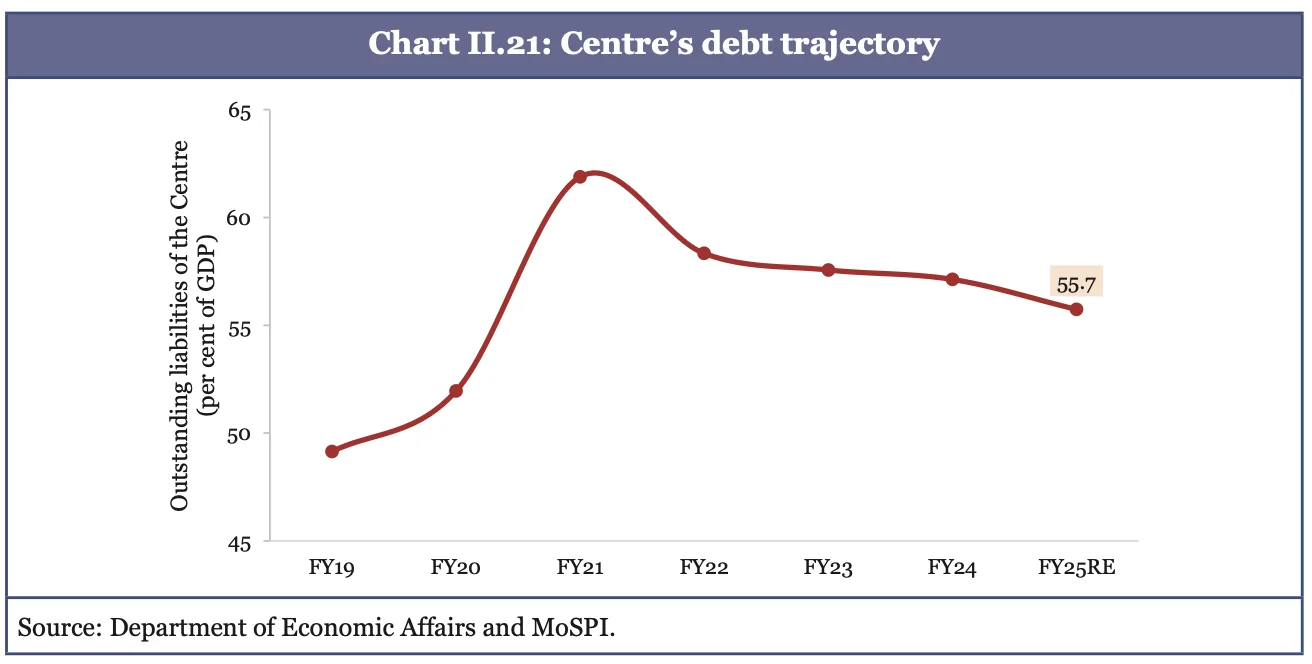
Post-COVID borrowing pushed India's central government debt above 55% of GDP. The combined Centre-State debt crossed 85% of GDP. While these levels are high by historical Indian standards, they remain comparable to other emerging economies. The government has focused on extending the maturity profile of debt to reduce rollover risk.
Debt Management Strategy
Effective debt management balances three objectives: minimising borrowing cost, managing risk, and ensuring market development.
Instruments of Debt Management
The RBI uses several tools:
- Open Market Operations (OMOs): Buying/selling G-Secs to manage liquidity and yields
- Auction calendar: Pre-announced schedule of G-Sec and T-Bill auctions for transparency
- Switch operations: Swapping shorter-maturity securities for longer ones
- Buyback of securities: Retiring high-coupon old securities
The Public Debt Management Cell (PDMC) under the Ministry of Finance was proposed to separate debt management from monetary policy. The Financial Sector Legislative Reforms Commission (FSLRC) recommended an independent Public Debt Management Agency (PDMA), though this hasn't been fully implemented.
Debt Sustainability
A country's debt is sustainable when it can meet current and future obligations without requiring exceptional financial assistance or defaulting. Key indicators include:
- Interest payment to revenue receipts ratio: Shows how much revenue goes to servicing debt
- Debt-to-GDP ratio trajectory: Whether the ratio is stable, falling, or rising
- Primary balance: If positive, the government generates enough to cover non-interest spending
The Domar condition states that debt is sustainable as long as the GDP growth rate exceeds the interest rate on government borrowing.
FRBM Act and Fiscal Discipline
The Fiscal Responsibility and Budget Management Act, 2003 was India's landmark legislation for fiscal discipline. Amended multiple times, its key provisions include:
- Eliminating revenue deficit (the government shouldn't borrow for current consumption)
- Reducing fiscal deficit to 3% of GDP
- Limiting government guarantees
- Mandating fiscal transparency through Medium-Term Fiscal Policy statements
The NK Singh Committee recommended an "escape clause" allowing deviation from targets during national calamity, war, or severe economic downturn — a provision that proved relevant during COVID-19.
Related: Fiscal Policy in India: Budget, Deficit & Revenue
Related: Government Budgeting: Types & Process for UPSC
Public Debt and Monetary Policy Linkage
The RBI's dual role as monetary authority and government's debt manager creates a conflict of interest. When the RBI manages government borrowing, it may keep interest rates lower than warranted to reduce government borrowing costs — at the expense of inflation control.
This is why the separation of debt management from the RBI has been a recurring reform recommendation. The Urjit Patel Committee on monetary policy framework also highlighted this tension.
Related: Monetary Policy of RBI: Tools & Objectives
State Government Debt
State government debt has grown faster than central government debt in recent years. Several factors drive this:
- UDAY scheme: States assumed discom debt, increasing their liabilities
- Off-budget borrowings: Through state PSUs and special purpose vehicles
- Revenue shortfalls: GST compensation gap post-2022
The Fifteenth Finance Commission recommended a debt ceiling framework for states. The Centre monitors state borrowing through the Article 293 consent mechanism and net borrowing ceiling linked to GSDP.
Frequently Asked Questions
What is the difference between public debt and national debt?
Public debt specifically refers to government borrowings. National debt is a broader term sometimes used interchangeably but may include obligations of public sector enterprises. For UPSC purposes, public debt means the total liabilities of the central and state governments as reported in the Union Budget and RBI bulletins.
Why does India rely more on internal debt than external debt?
Internal debt doesn't carry exchange rate risk and allows greater policy autonomy. After the 1991 crisis — when India nearly defaulted on external obligations — the government deliberately shifted towards domestic borrowing. Internal debt also develops the domestic bond market and provides safe assets for banks and institutional investors.
What is the FRBM Act's target for fiscal deficit?
The original FRBM Act targeted 3% of GDP as the fiscal deficit ceiling. The NK Singh Committee (2017) recommended a glide path reaching 2.5% by 2022–23. However, COVID-19 pushed actual deficits well above these targets. The government has since committed to a gradual reduction towards 4.5% and then lower levels.
How does high public debt affect the economy?
High public debt increases interest payment obligations, reducing funds available for development spending. It can crowd out private investment by pushing up interest rates. Excessive external debt creates vulnerability to currency depreciation. However, moderate debt used for productive investment — infrastructure, education, healthcare — can boost long-term growth.
Who manages India's public debt?
The RBI manages the central government's domestic borrowing programme, conducting auctions and managing the public debt office. The Department of Economic Affairs handles external debt. There have been proposals for an independent Public Debt Management Agency, but the RBI continues to play the primary role.
Tell Google you want more of this.
Add Anantam IAS as a preferred sourceOne tap, and this site shows up more often in your own Top Stories, AI Overviews and AI Mode. Remove it any time.