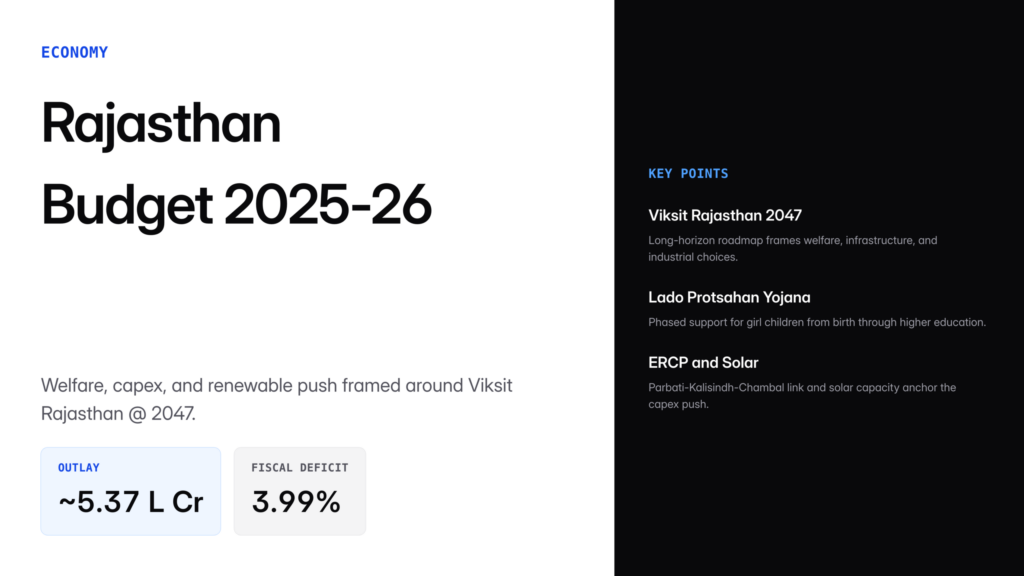
The Rajasthan Budget 2026-27 was presented by Deputy Chief Minister and Finance Minister Diya Kumari on 11 February 2026, the second full budget of the BJP government led by Chief Minister Bhajan Lal Sharma. Framed around the state's long-term vision for a "Viksit Rajasthan @ 2047", the budget laid out new welfare schemes, infrastructure commitments, and fiscal targets, while continuing many of the previous announcements. For UPSC aspirants, it offers a live case study of state fiscal federalism, subsidy economics, capex push, and centrally sponsored scheme interface in India's largest state by area.
Budget Basics and Fiscal Size
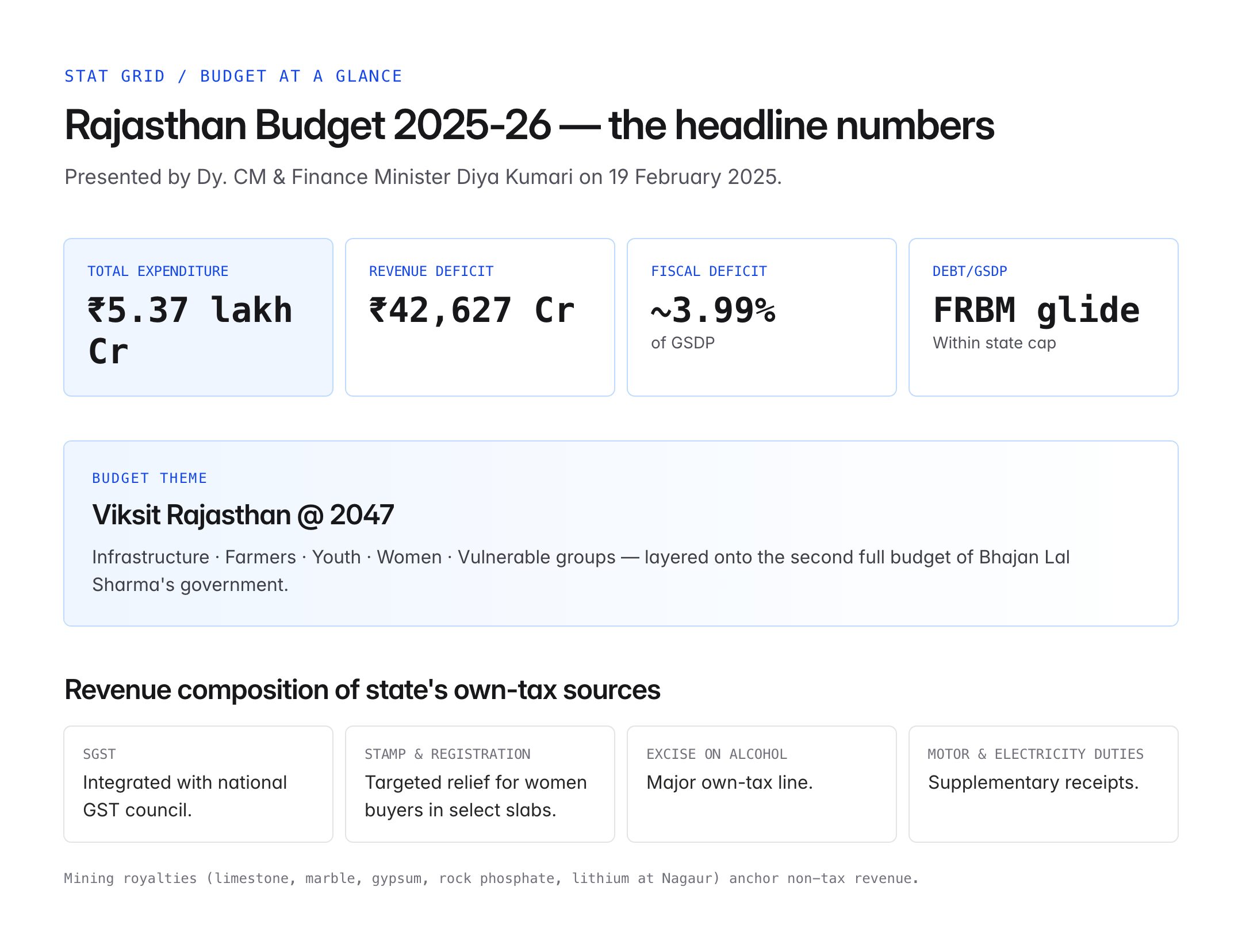
Deputy Chief Minister and Finance Minister Diya Kumari presented the Rajasthan Budget 2026-27 on 11 February 2026. The headline numbers, from the Budget Speech and Budget-at-a-Glance documents:
- Total estimated expenditure: around ₹6.11 lakh crore. Excluding debt repayment, expenditure is ₹4,05,632 crore, up 13% on the 2025-26 revised estimate.
- Revenue deficit: ₹24,314 crore, or 1.1% of GSDP, down from 1.8% in the 2025-26 revised estimate.
- Fiscal deficit: projected at 3.7% of GSDP (₹79,493 crore), within the limits permitted under the state's fiscal rules read with central guidelines.
- Debt-GSDP ratio: outstanding liabilities estimated at 36.8% of GSDP by the end of 2026-27, against the FRBM glide path prescribed for states.
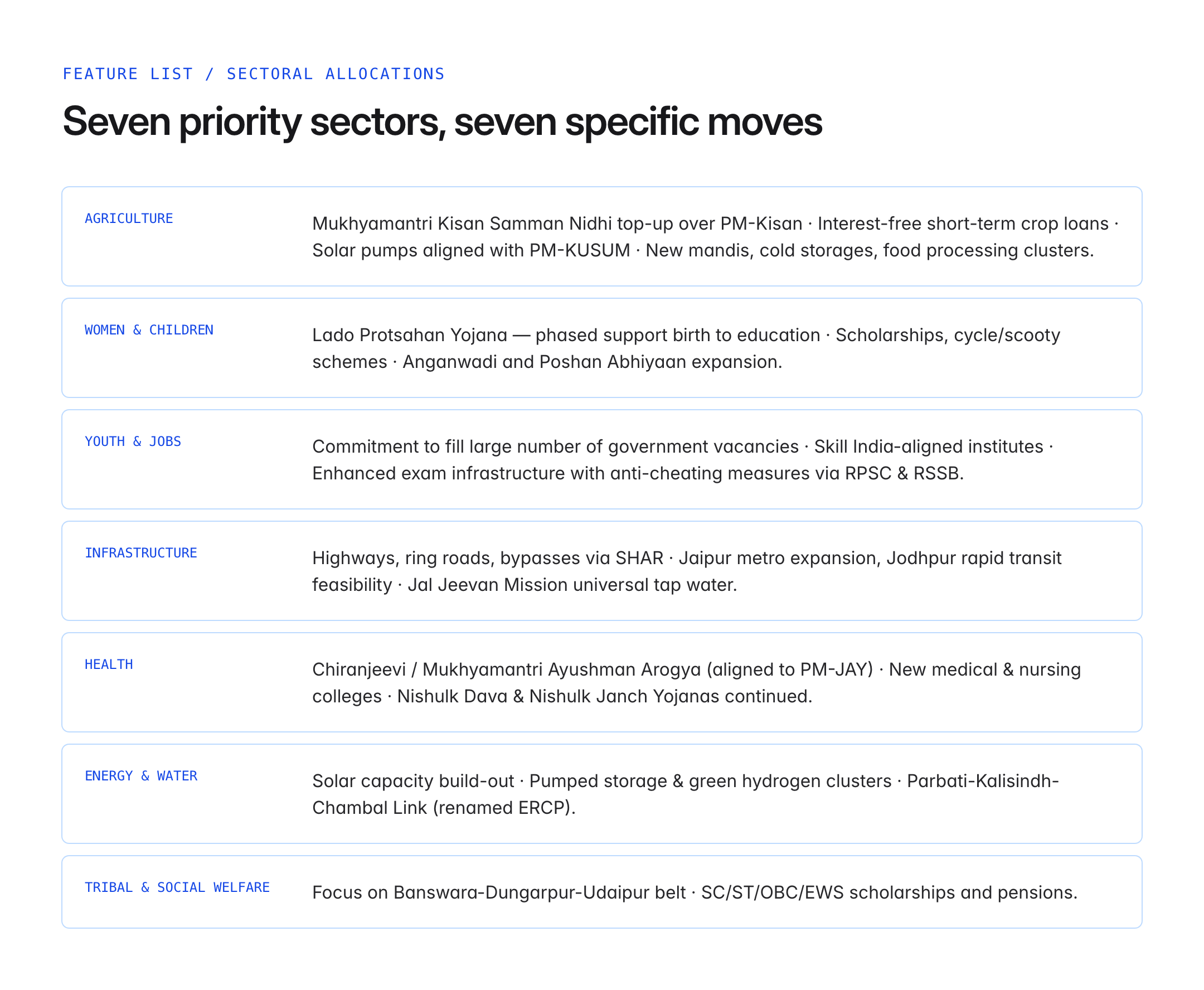
- Budget theme: Viksit Rajasthan @ 2047, with focus on infrastructure, farmers, youth, women, and the vulnerable.
- Largest departmental allocations: Education, Sports, Arts and Culture ₹68,989 crore; Energy ₹42,752 crore; Rural Development ₹32,948 crore; Health and Family Welfare ₹32,526 crore; Social Welfare and Nutrition ₹26,495 crore.
(Exact figures should always be cross-checked with the official Budget Speech and Budget Documents, since minor revisions occur between "presented" and "passed" versions.)
Flagship Schemes and Welfare Announcements
Agriculture and farmers
- Continuation and expansion of PM Kisan Samman Nidhi top-up through the state, raising state contribution for eligible farmers.
- Mukhyamantri Kisan Samman Nidhi Yojana: Additional state assistance over the central PM-Kisan.
- Interest-free short-term crop loans through cooperative banks.
- Expansion of solar pumps under a dedicated state programme aligned with PM-KUSUM.
- New and upgraded mandis, cold storages, and food processing clusters.
Women and children
- Enhanced scholarships and cycle/scooty schemes for girl students.
- Lado Protsahan Yojana for girl child, providing phased financial support from birth through education.
- Expansion of Anganwadi infrastructure and nutrition programmes aligned with Poshan Abhiyaan.
Youth and employment
- Commitments to fill a large number of government vacancies over the term of the government.
- Skill development institutes aligned with Skill India and industry-led clusters.
- Enhanced allocations for examinations conducted by RPSC and RSSB with improved anti-cheating measures.
Urban and rural infrastructure
- Continued push on highways, ring roads, and bypasses through the State Highway Authority of Rajasthan (SHAR).
- New metro expansions in Jaipur and dedicated feasibility for Jodhpur metro/rapid transit.
- Jal Jeevan Mission targets for universal tap water, with Rajasthan being a key focus state.
- Strengthening of Amrit 2.0, PMAY-U, and PMAY-G implementation.
Health
- Continuation of the state's Chiranjeevi/Mukhyamantri Ayushman Arogya Yojana, with health cover aligned to Ayushman Bharat PM-JAY.
- New medical colleges, nursing colleges, and upgraded district hospitals.
- Expansion of Mukhyamantri Nishulk Dava Yojana (free medicines) and Nishulk Janch Yojana (free diagnostics).
Energy and water
- Targets for solar power capacity addition, leveraging Rajasthan's high solar potential and its alignment with PM Surya Ghar Muft Bijli Yojana.
- Development of pumped storage projects and green hydrogen clusters in principle.
- Continued focus on Eastern Rajasthan Canal Project (ERCP), now renamed under the Parbati-Kalisindh-Chambal Link and linked to the national interlinking framework.
Sectoral Allocations and Trends
| Sector | Broad Direction in Budget 2026-27 |
|---|---|
| Education | Higher allocation, new universities, girl-child incentives |
| Health | Ayushman Arogya Yojana expansion, new medical colleges |
| Agriculture | MSP assurance, solar pumps, cooperative credit |
| Infrastructure | Highways, metro, water supply, power |
| Energy | Solar, green hydrogen, transmission upgrades |
| Social welfare | SC/ST/OBC/EWS scholarships, pensions |
| Tribal development | Focus on Banswara, Dungarpur, Udaipur belt |
The budget continues the state's pattern of capex prioritisation, using the Centre's special capex loans to states and central transfers under schemes like PMGSY, PMAY, PMKSY, and Jal Jeevan Mission.
Tax and Revenue Measures
States have limited tax headroom after GST. Rajasthan's own-tax revenue relies heavily on:
- State GST (SGST): Integrated with the national GST council framework.
- Stamp duty and registration fees: Often calibrated to support housing demand.
- Excise duty on alcohol: A major source of own-tax revenue.
- Motor vehicle and electricity duties.
The 2026-27 Budget indicated:
- Targeted relief on stamp duty for women buyers in certain slabs.
- Rationalisation of VAT where states retain it (petroleum products).
- Focus on compliance and digital monitoring to plug leakage.
Non-tax revenue improvement is sought via mining royalties (Rajasthan is a leader in limestone, marble, gypsum, rock phosphate, and recently lithium) and enhanced user charges on select services.
Fiscal Framework
- Rajasthan follows its Fiscal Responsibility and Budget Management (FRBM) Act, aligned with central FRBM and the 15th Finance Commission framework.
- The Centre permits additional borrowing linked to reforms – power sector, urban local bodies, and capex milestones.
- The state has periodically exceeded the 3% fiscal deficit ceiling, relying on the glide path announced by the N. K. Singh Committee.
Challenges for fiscal management include:
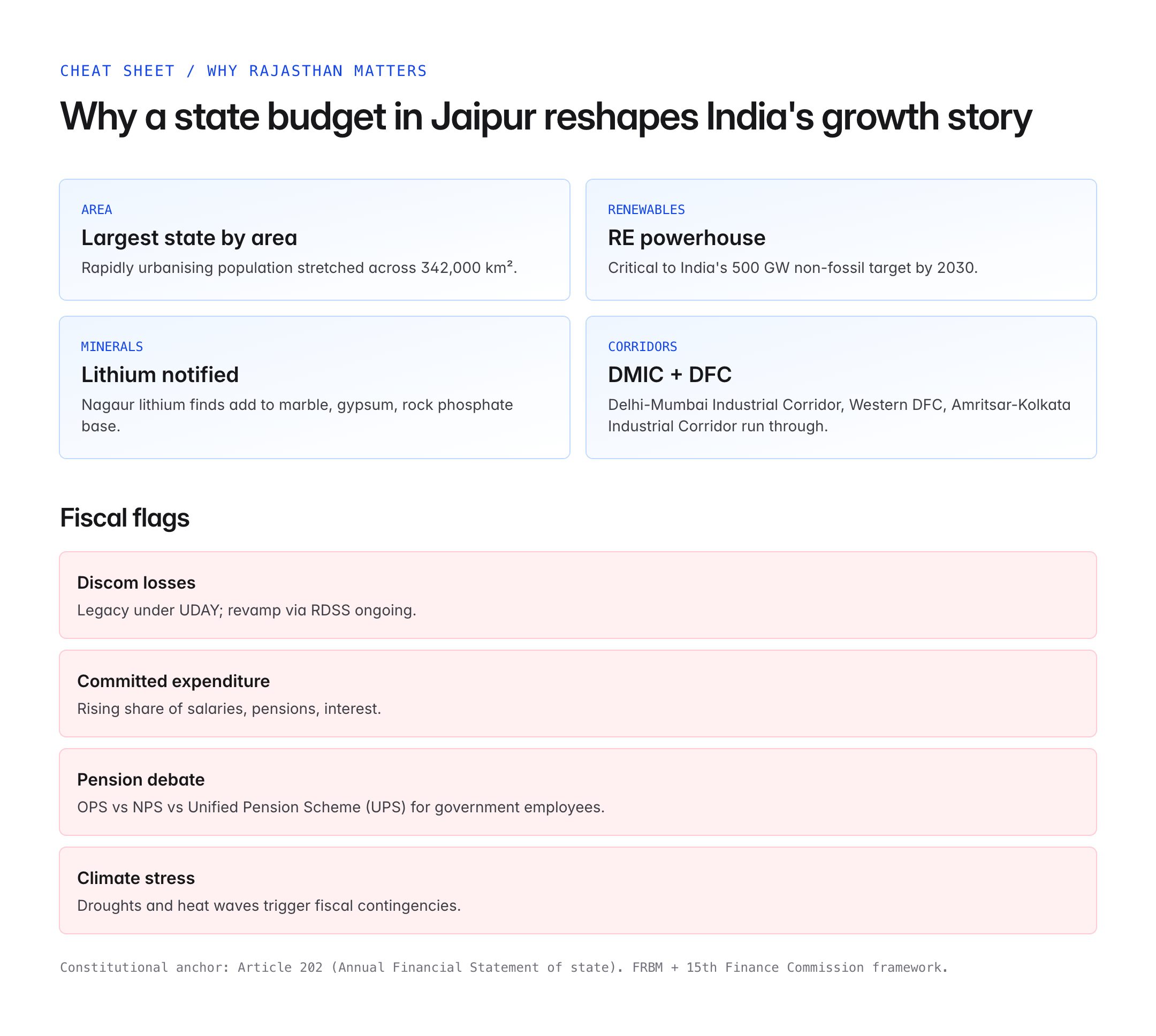
- High power sector losses of discoms and legacy debt under UDAY/RDSS.
- Rising committed expenditure (salaries, pensions, interest).
- Pension reforms, including debates around Old Pension Scheme (OPS) and Unified Pension Scheme (UPS) for government employees.
- Climate vulnerabilities – droughts, heat waves – affecting agriculture and fiscal contingencies.
Significance for the Nation
Rajasthan matters disproportionately for India's development trajectory because:
- It is the largest state by area with a rapidly urbanising population.
- It is a renewable energy powerhouse, critical for India's 500 GW non-fossil target by 2030.
- It hosts key mineral reserves, including newly notified lithium finds in Nagaur.
- It lies along the Delhi-Mumbai Industrial Corridor (DMIC), the Western Dedicated Freight Corridor, and the Amritsar-Kolkata Industrial Corridor.
Thus the Rajasthan Budget 2026-27 is not only a state fiscal document but also a data point in the broader cooperative and competitive federalism framework.
UPSC Relevance
Prelims focus:
- Who presents the state budget; constitutional provisions under Article 202 (Annual Financial Statement of the state).
- FRBM Act, Finance Commission devolution, and state borrowing under Article 293.
- Major Rajasthan schemes: Chiranjeevi/Mukhyamantri Ayushman Arogya, Lado Protsahan, Mukhyamantri Kisan Samman Nidhi.
- Renewable energy and the Parbati-Kalisindh-Chambal link (ERCP).
Mains GS-II and GS-III angles:
- State fiscal policy, state-Centre financial relations, and GST compensation.
- Evaluation of welfare schemes against fiscal sustainability.
- Role of states in energy transition, climate adaptation, and industrialisation.
- Debates on Old Pension Scheme vs NPS/UPS.
Sample PYQ angle: "Distinguish between Capital Budget and Revenue Budget. Explain the components of both these Budgets" or questions on cooperative federalism. The Rajasthan Budget 2026-27 provides concrete illustrations of revenue/capital split, central-state interface, and scheme-level policy choices.
Tell Google you want more of this.
Add Anantam IAS as a preferred sourceOne tap, and this site shows up more often in your own Top Stories, AI Overviews and AI Mode. Remove it any time.