
A child in Hyderabad is born with a genetic mutation that prevents her body from producing a single enzyme. Without that enzyme, sugar molecules accumulate in her cells and slowly destroy her organs. The disease is called Pompe disease. There are around 5,000 people in India who have it. The treatment exists. It is a synthetic version of the missing enzyme, infused into the bloodstream every two weeks for life. The cost runs into crores of rupees per year. No insurance covers it. Without intervention, the child will not survive past childhood.
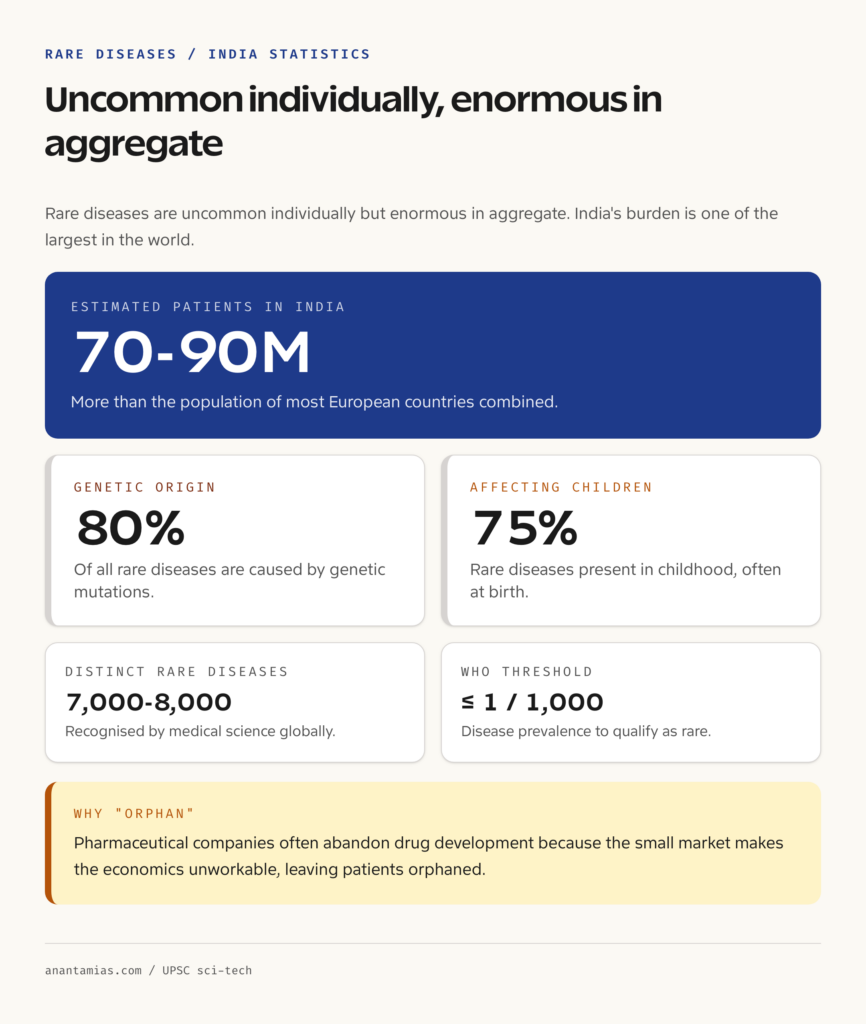
Pompe disease is one of about 7,000 to 8,000 rare diseases recognised by medical science. Each rare disease is, by definition, uncommon. Together, they affect an estimated 70 to 90 million people in India, more than the population of most European countries. Pharmaceutical companies call them “orphan diseases” because the small market for any single condition makes drug development unprofitable, leaving patients orphaned without treatment options.
For UPSC aspirants, rare diseases sit at the intersection of public health, biotechnology, intellectual property, and social justice. They test the limits of how a healthcare system serves a small but desperately needy patient population. India’s National Policy for Rare Diseases, 2021, with its 2022 amendment, is the country’s main institutional response. This explainer walks through what rare diseases are, how India defines and classifies them, the policy framework, the treatment funding flow, and where the system still falls short.
Quick Facts: Rare Diseases at a Glance
- Common term: Rare diseases or “orphan diseases”
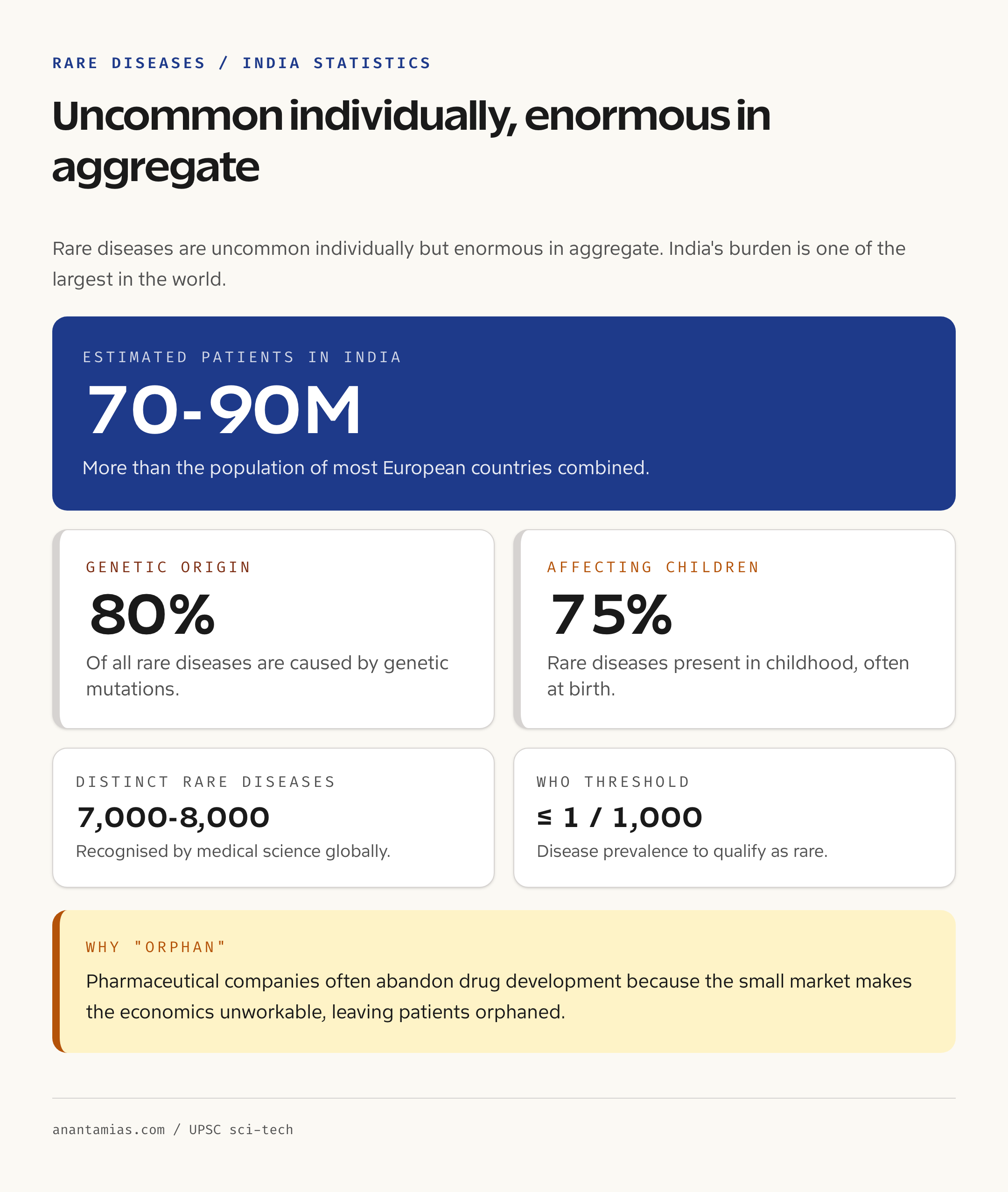
- Why orphan: Small market discourages drug development, leaving patients without commercial treatment options
- WHO definition: Disease with prevalence of 1 or fewer cases per 1,000 population
- Indian definition: Treatment-based classification rather than numerical, due to absence of comprehensive prevalence data
- Estimated patients in India: 70 to 90 million
- Genetic origin: Approximately 80 per cent of rare diseases
- Affecting children: Approximately 75 per cent
- Indian policy: National Policy for Rare Diseases, 2021 (NPRD)
- Funding ceiling per patient: Increased from 20 lakh rupees to 50 lakh rupees in the 2022 amendment
- Coverage: All three policy groups, eligible up to 40 per cent of population (PM-JAY norms plus near-poor)
- Treatment venues: Notified Centres of Excellence (CoEs)
What Are Rare Diseases?
A rare disease is a medical condition that affects a small number of people compared to the general population. The exact threshold varies by country. The World Health Organization suggests a prevalence of 1 or fewer cases per 1,000 population. The European Union defines rare as fewer than 5 in 10,000. The United States Orphan Drug Act sets the threshold at fewer than 200,000 affected persons in the country, which works out to roughly 6.4 per 10,000.
These thresholds matter because they determine which diseases qualify for special drug development incentives, accelerated regulatory pathways, and government funding. A drug developed for a disease affecting 1,000 patients globally will never recover its development cost through normal sales, so countries use the orphan drug designation to provide tax credits, longer market exclusivity, and reduced regulatory fees to encourage development.
Rare diseases as a category are anything but uniform. Cystic fibrosis, sickle cell disease, haemophilia, spinal muscular atrophy, Pompe disease, Gaucher disease, Duchenne muscular dystrophy, and Huntington’s disease are all rare. Some are genetic and present at birth. Some are autoimmune. Some are infectious or environmental. Their treatments range from one-time procedures like organ transplants to lifelong enzyme replacement therapies costing crores per year.
The orphan label captures the economic reality. A pharmaceutical company developing a drug for a rare disease faces a small patient pool, often globally distributed, and uncertain prospects for cost recovery. Without policy intervention, these diseases would attract no commercial drug development at all.
Background and Historical Context
The modern policy framework for rare diseases began in the United States with the Orphan Drug Act of 1983. Before the Act, almost no drugs were being developed for rare diseases because the economics did not work. The Act created tax credits of up to 50 per cent of clinical trial costs, granted seven years of marketing exclusivity beyond patent protection, and waived FDA filing fees. The result was transformational. In the four decades since, more than 600 orphan drugs have been approved in the United States, compared to fewer than 40 in the decade before the Act.
The European Union followed in 2000 with its Orphan Medicinal Products Regulation, which provides 10 years of market exclusivity, fee reductions, and regulatory assistance. Japan, Australia, South Korea, and several other countries have similar frameworks.
India’s response was slower. For most of the post-independence period, public health priorities centred on communicable diseases (tuberculosis, polio, HIV) and maternal and child health. Rare diseases were not on the policy agenda because the data on prevalence and burden was thin, and because the treatment costs for most rare diseases were unaffordable for any conceivable public funding model.
The first National Policy for Rare Diseases was drafted in 2017 but was withdrawn after a Delhi High Court intervention prompted by patient advocacy groups. The policy was redrafted and notified in 2021. A 2022 amendment substantially expanded the financial assistance available, raising the ceiling and broadening eligibility. The policy continues to evolve as patient groups, the pharmaceutical industry, and the Ministry of Health negotiate the boundaries.
The Indian Council of Medical Research has set up a National Registry for Rare Diseases to begin collecting prevalence data, which is the prerequisite for moving toward a numerical Indian definition similar to the WHO’s. Until that data exists, the Indian policy uses a treatment-based classification.
The Indian Definition Dilemma
India does not currently have a numerical definition of rare diseases. The reason is administrative, not scientific. To define a disease as affecting fewer than X persons in Y population, you need reliable prevalence data, which India does not have for most rare diseases. The disease registries are partial, the diagnostic capacity is concentrated in a few cities, and many patients are never diagnosed because their symptoms are mistaken for more common conditions.
The 2021 policy works around this by classifying rare diseases by treatment type rather than by numerical prevalence. The policy recognises three groups based on what kind of treatment the disease requires.
Group 1 comprises disorders amenable to one-time curative treatment. These include certain Lysosomal Storage Disorders treated by haematopoietic stem cell transplantation, osteopetrosis (often called stone bone disease), and immune deficiencies treated by transplant. The treatment is intensive and expensive but bounded in time. Once the transplant succeeds, the patient is essentially cured.
Group 2 comprises diseases requiring long-term or lifelong treatment with relatively lower costs. These include phenylketonuria (treated by a special diet), Turner syndrome (treated with hormones), and various hormonal and metabolic disorders. The annual cost per patient is in lakhs rather than crores, and the treatments are well-established.
Group 3 comprises diseases for which definitive treatment exists but at very high cost and lifelong therapy. These include Spinal Muscular Atrophy (SMA), Gaucher disease, Pompe disease, Cystic Fibrosis, and Duchenne Muscular Dystrophy. The treatments are typically enzyme replacement therapies or gene therapies costing crores per patient per year. Group 3 is the most expensive and the most morally fraught for any public health system.
The classification matters because it determines what kind of funding the patient is eligible for. Group 1 and Group 2 are administratively easier because the treatment cost is bounded. Group 3 is the policy battleground because the treatment cost can exceed any conceivable per-patient ceiling.
The 2022 Amendment: 50 Lakh Rupees and Wider Coverage
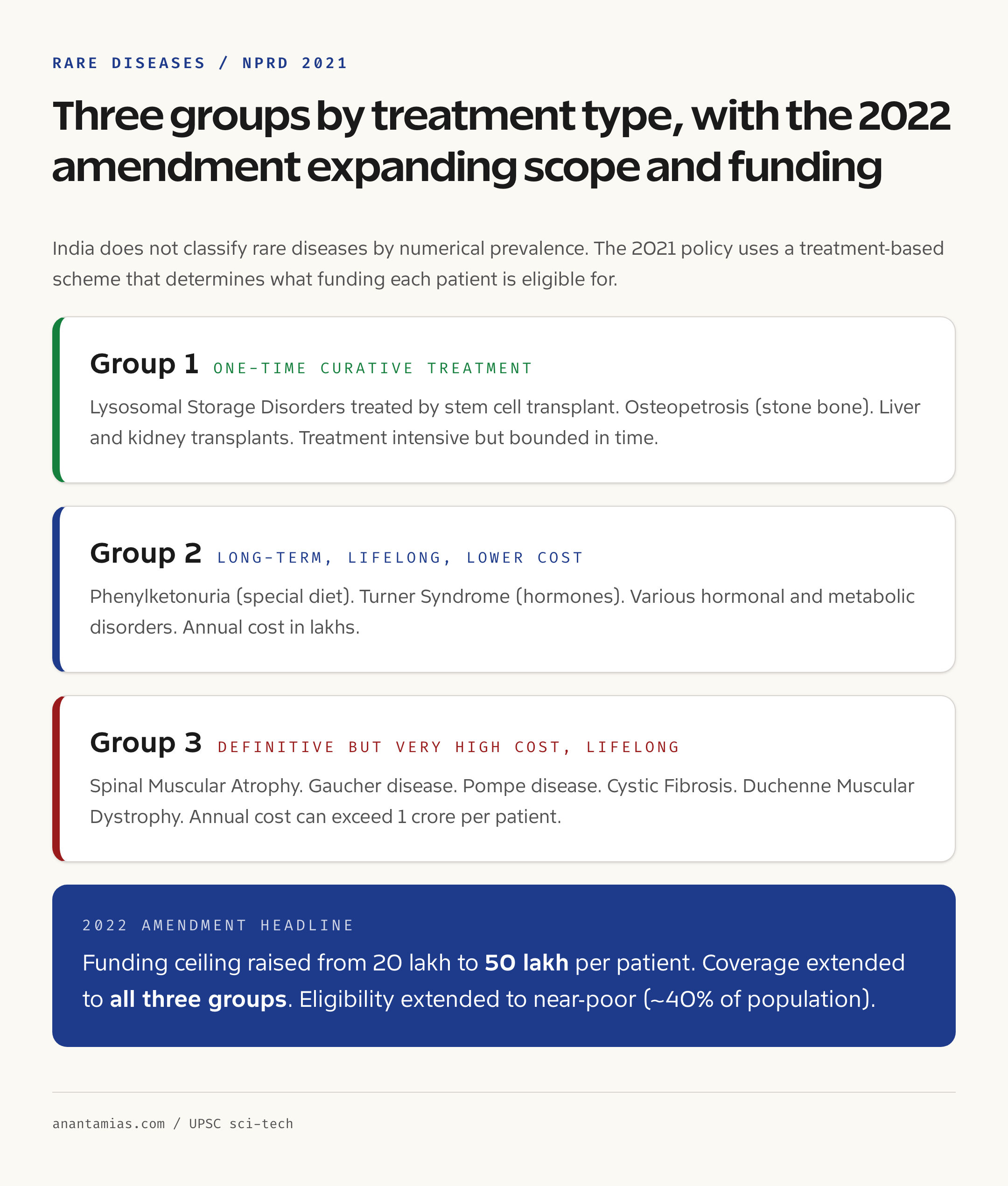
The original 2021 policy provided 20 lakh rupees per patient and only for Group 1 diseases. The cap was widely criticised as inadequate. A single year of enzyme replacement therapy for Pompe disease can cost over 1 crore rupees, and 20 lakh covers a fraction of one year of treatment for Group 3 patients.
The 2022 amendment made three substantive changes.
Amount. The funding ceiling per patient was raised from 20 lakh rupees to 50 lakh rupees. This is still well below the lifetime cost of Group 3 treatments but significantly more useful than 20 lakh.
Coverage. The funding now applies to all three groups, not just Group 1. This was the bigger shift, because it brought the most expensive treatments into the policy framework, even if the funding remains insufficient for them.
Eligibility. The funding is no longer limited to Below Poverty Line (BPL) families. It now extends to “near-poor” patients, defined approximately as those eligible under PM-JAY (the Ayushman Bharat Pradhan Mantri Jan Arogya Yojana) norms plus an extension. This covers approximately 40 per cent of the Indian population.
The condition attached to the funding is that the treatment must be taken at a notified Centre of Excellence (CoE). There are currently around 12 to 14 CoEs across India, including AIIMS Delhi, AIIMS Jodhpur, PGIMER Chandigarh, KEM Hospital Mumbai, NIMHANS Bengaluru, CMC Vellore, and a handful of others. The CoE requirement ensures quality of diagnosis and treatment but also constrains access for patients far from these centres.
Why It Matters
Rare diseases matter because they test the moral limits of any health system. A condition affecting 100 people in India does not justify a separate research programme on cost-benefit grounds. But the people affected are real, and many of them are children whose lives depend on treatment that exists but is unaffordable. How a country responds to this dilemma reveals how seriously it treats the constitutional right to life and health.
Rare diseases also matter because they are the leading edge of biomedical innovation. Gene therapy, enzyme replacement therapy, antisense oligonucleotides, and CRISPR-based treatments are all being developed and tested first against rare diseases. The therapies that are now being approved for SMA, Duchenne muscular dystrophy, and certain blood disorders are the templates for treatments of more common diseases that will follow. A country that builds capacity in rare disease treatment is building capacity in next-generation biotechnology.
The intellectual property dimension is also live. Many rare disease drugs are protected by patents that maintain prices at levels Indian patients cannot afford. The interaction between rare disease treatment and the intellectual property rights regime, including compulsory licensing and price negotiations, is a recurring policy debate. India’s National IPR Policy provides instruments to navigate this tension, but their use for rare disease drugs has been limited so far.
Detailed Analysis: How Rare Disease Treatment Actually Works in India
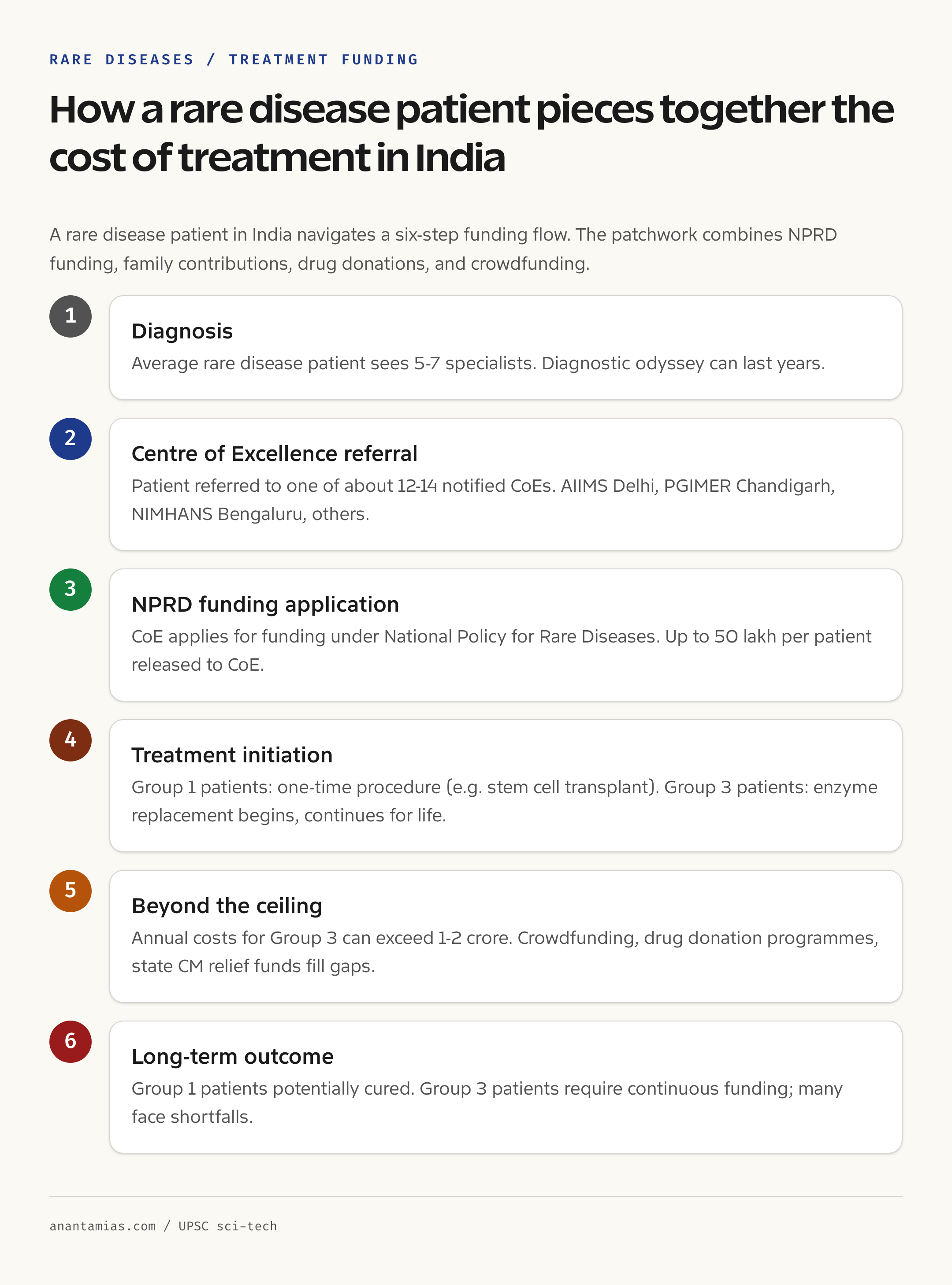
The patient journey starts with a diagnostic odyssey. Most rare diseases present with symptoms that overlap with common conditions, and the average rare disease patient sees five to seven specialists before receiving a correct diagnosis. The diagnostic delay can be years. During that time, the disease often progresses irreversibly.
Once diagnosed, the patient needs to be referred to one of the notified CoEs. For families outside major metros, this means travel and accommodation costs that can be larger than the medical costs. CoEs are concentrated in Delhi, Mumbai, Bengaluru, Chennai, and a few other cities.
At the CoE, the treatment is initiated. For Group 1 patients, this might be a one-time stem cell transplant. For Group 3 patients, it is the start of lifelong enzyme replacement therapy. The CoE applies for funding under the NPRD framework on behalf of the patient. Funding up to 50 lakh rupees is released to the CoE for the patient’s treatment.
Beyond the 50 lakh ceiling, families have to find money on their own. Crowdfunding platforms have become an unofficial but important part of the rare disease treatment ecosystem in India. Some pharmaceutical companies offer drug donation programmes for select patients. State governments occasionally provide additional funding through chief minister relief funds. The financing is patchwork, and many patients fall through the cracks.
The system also depends on advocacy. Patient organisations like the Cure SMA Foundation of India, the Lysosomal Storage Disorders Society, and several disease-specific groups have been instrumental in pushing policy changes. The 2022 amendment was largely the result of sustained advocacy in the Delhi High Court and through the media.
Comparative: India Versus Global Approaches
The United States provides orphan drug companies with substantial market exclusivity and tax incentives, and price negotiation between insurers and drug companies happens at the level of individual patients or insurance plans. The result is high prices but generally robust access for insured patients.
The European Union combines market exclusivity with EMA regulatory facilitation and member-state-level funding decisions. Most EU countries cover rare disease drugs through national health systems, with prices negotiated centrally.
Japan and South Korea both fund expensive rare disease drugs through national health insurance, with strict cost-effectiveness review.
India’s approach is closer to the United Kingdom’s NHS Specialised Commissioning model, where the central government funds treatment through designated centres, but at a much lower per-patient ceiling. The 50 lakh ceiling is roughly 60,000 US dollars, which would not buy a single year of Pompe disease treatment in the United States. India’s system is workable because it combines the public funding with patient family contributions, drug donations, and crowdfunding, but the gaps are real and patients regularly die because the patchwork failed.
Challenges in India’s Rare Disease Framework
The funding ceiling is the most-discussed problem but not the only one. The diagnostic capacity is concentrated. Most rare diseases require advanced genetic testing that is available in only a few cities and is not always covered by the policy. The CoE network is small, and rural patients face barriers reaching it. Drug import procedures for non-domestically-available treatments can take months.
The data problem persists. Without a comprehensive registry, prevalence figures remain estimates. Policy decisions are made on extrapolations from international data. The ICMR registry is a step but is not yet comprehensive.
Group 3 funding remains structurally inadequate. A 50 lakh lifetime ceiling for a disease whose annual treatment cost is 1 to 2 crores is a token gesture rather than a real solution. The longer-term answer is either price negotiation with drug companies (which India has not used aggressively for rare disease drugs), domestic manufacturing of generic versions (which faces patent barriers), or international procurement at negotiated prices.
The integration with the broader health system in India is also weak. Ayushman Bharat does not cover most Group 3 treatments. Private insurance often excludes congenital and genetic conditions. The rare disease policy operates as a separate silo rather than being integrated with the larger health financing architecture.
Prelims Pointers
- WHO definition: Prevalence of 1 or fewer per 1,000 population
- India: No numerical definition, classification by treatment type
- Estimated rare disease patients in India: 70 to 90 million
- 80 per cent of rare diseases are genetic
- 75 per cent affect children
- Indian policy: National Policy for Rare Diseases (NPRD), notified 2021
- Three groups: Group 1 (one-time curative), Group 2 (long-term low cost), Group 3 (lifelong high cost)
- 2022 amendment funding ceiling: 50 lakh rupees per patient (raised from 20 lakh)
- Coverage: All three groups, eligibility up to 40 per cent of population (PM-JAY plus near-poor)
- Treatment must be at: Centres of Excellence (CoEs), around 12 to 14 notified centres
- Examples by group: Group 1: Lysosomal Storage Disorders, Osteopetrosis. Group 2: Phenylketonuria, Turner Syndrome. Group 3: SMA, Gaucher, Pompe, Cystic Fibrosis
Mains Practice Questions
- “India’s rare disease policy is symbolic in funding scale but transformative in coverage.” Critically examine the 2021 policy and its 2022 amendment. (15 marks, 250 words)
- Discuss the ethical and economic dilemmas in funding treatments for ultra-rare diseases where annual costs exceed crore rupees per patient. (15 marks, 250 words)
- Examine the role of patent law and compulsory licensing in expanding access to rare disease treatments in India. (10 marks, 150 words)
Way Forward
The next phase of India’s rare disease policy needs to address three structural gaps. First, the funding ceiling for Group 3 diseases needs to be revisited, ideally with a different model that combines per-patient funding with negotiated drug prices and pooled procurement to bring down per-treatment costs. Second, the diagnostic capacity needs to be decentralised through district-level rare disease cells supported by CoEs, so that the diagnostic odyssey is shortened. Third, the rare disease policy needs to be integrated with Ayushman Bharat, private insurance regulation, and the broader health financing system, rather than operating as a standalone silo.
The opportunity for India is also strategic. Indian pharmaceutical companies have built world-leading capability in generic drug manufacturing. Extending that capability to biosimilars of rare disease drugs, where patents have expired or where compulsory licensing is appropriate, could substantially reduce treatment costs not just for Indian patients but for patients across low- and middle-income countries. The combination of policy support, manufacturing capacity, and patient advocacy gives India an unusual position from which to lead on rare disease access globally.
Frequently Asked Questions
Why are rare diseases called u0022orphan diseasesu0022?
Pharmaceutical companies often abandon development of treatments for rare diseases because the small patient pool makes the economics unworkable. Patients are left u0022orphanedu0022 without treatment options. The orphan drug designation in the United States, European Union, and other jurisdictions is meant to address this by providing financial incentives that bring drugs to market.
How are rare diseases defined in India?
India does not have a numerical prevalence-based definition. The 2021 National Policy for Rare Diseases classifies rare diseases by treatment type into three groups. The absence of a numerical definition reflects the absence of comprehensive prevalence data. The ICMR’s National Registry for Rare Diseases is gathering data that may eventually support a numerical definition.
How many rare diseases exist?
Medical science recognises approximately 7,000 to 8,000 distinct rare diseases. New rare diseases are being identified each year as genetic and molecular diagnostics improve.
What is the funding ceiling under the Indian policy?
The 2022 amendment to the NPRD raised the per-patient funding ceiling from 20 lakh rupees to 50 lakh rupees and extended coverage to all three groups of diseases. Eligibility was extended beyond BPL to include near-poor patients up to about 40 per cent of the population.
What is a Centre of Excellence?
A Centre of Excellence (CoE) is a hospital notified by the Ministry of Health as authorised to diagnose and treat rare diseases under the NPRD framework. There are about 12 to 14 CoEs across India, including AIIMS Delhi, PGIMER Chandigarh, NIMHANS Bengaluru, and others. Funding under the policy can be released only for treatment at a CoE.
Which rare diseases have one-time curative treatments?
Group 1 of the NPRD covers diseases amenable to one-time curative treatments. These include certain Lysosomal Storage Disorders treated by stem cell transplant, osteopetrosis, and some immune deficiencies. The treatment is intensive but the patient is effectively cured if the procedure succeeds.
Why are Group 3 diseases the hardest to treat?
Group 3 covers diseases where definitive treatment exists but the cost is very high and the therapy must continue lifelong. Spinal Muscular Atrophy, Gaucher, Pompe, and Cystic Fibrosis fall in this group. Annual costs can run into crores per patient, far exceeding the 50 lakh ceiling, which means even the funded patients face shortfalls.
Are rare diseases covered under Ayushman Bharat?
Most Group 3 rare disease treatments are not covered under Ayushman Bharat (PM-JAY) because the per-procedure costs exceed the scheme’s package rates. Some Group 1 and Group 2 treatments may be covered. The NPRD funding is separate and supplementary to Ayushman Bharat.
What is the role of crowdfunding in rare disease treatment?
When NPRD funding and other sources fall short of treatment costs, especially for Group 3 patients, crowdfunding platforms have become an important supplemental source. Many Indian rare disease patients have raised crores through platforms like Ketto, Milaap, and similar services. This is a workaround rather than a sustainable financing model.
What can a UPSC aspirant remember in one line?
India’s National Policy for Rare Diseases, 2021, classifies rare diseases into three groups by treatment type, provides up to 50 lakh rupees per patient under the 2022 amendment, covers about 40 per cent of the population, and requires treatment at notified Centres of Excellence.
Tell Google you want more of this.
Add Anantam IAS as a preferred sourceOne tap, and this site shows up more often in your own Top Stories, AI Overviews and AI Mode. Remove it any time.





