On May 10, 1857, sepoys of the Third Bengal Light Cavalry at Meerut refused orders, broke open the jail, and rode for Delhi. By the next afternoon they had reached the Red Fort and persuaded an 82-year-old Bahadur Shah Zafar to lend his name to a rebellion he had not started. The 169th anniversary of that ride falls this week, and the event still anchors school textbooks, parliamentary speeches, and a long-running academic debate about what to call what happened.
The Revolt of 1857 was the largest armed challenge to British rule in India before the twentieth century. It was simultaneously a sepoy mutiny, a peasant uprising, a feudal restoration attempt, and, in the reading that gained ground after independence, a first war of national liberation. Each of those framings is partly right. None of them captures the whole.
This article reads the Revolt of 1857 with a UPSC modern history lens. We trace the causes, follow the course from Barrackpore to Bareilly, examine consequences, and engage the historiographical debate that still shapes how India remembers 1857.
Quick Facts
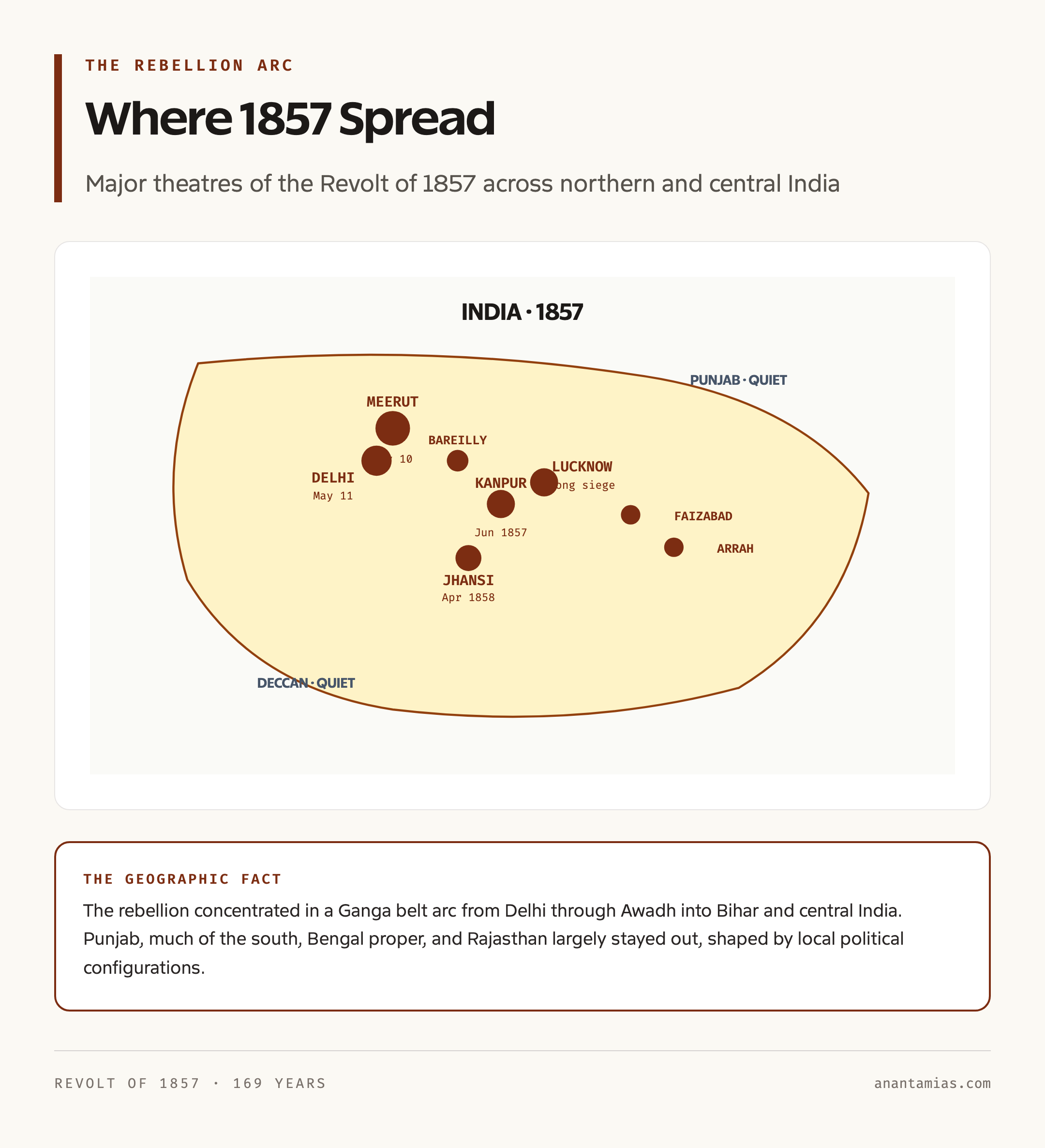
- Date of outbreak: May 10, 1857 at Meerut, with antecedent at Barrackpore on March 29, 1857.
- Immediate trigger: greased cartridges of the new Enfield rifle, rumoured to use cow and pig fat.
- Symbolic leader: Bahadur Shah II (Bahadur Shah Zafar), last Mughal emperor.
- Major centres: Delhi, Meerut, Kanpur, Lucknow, Jhansi, Bareilly, Faizabad, Arrah.
- Key leaders: Mangal Pandey, Nana Sahib, Tatya Tope, Rani Lakshmibai, Begum Hazrat Mahal, Kunwar Singh.
- Duration: May 1857 to November 1858, with sporadic resistance into 1859.
- Outcome: rebellion suppressed; British Crown takes over from East India Company.
- Constitutional consequence: Government of India Act, 1858; Queen Victoria’s Proclamation, November 1, 1858.
What Just Happened
May 10, 2026 marked the 169th anniversary of the Meerut outbreak. The Ministry of Culture, the National Archives, and several state-level cultural commissions hosted commemorations. The Archaeological Survey of India announced restoration funding for 1857-linked memorials at Meerut, Kanpur, and Jhansi. Academic institutions including the Centre for Historical Studies and several state universities convened symposia on 1857 sources, including the digitisation of regional vernacular records that have only recently entered scholarship.
The anniversary also reopened public debates that recur every year. Should 1857 be officially designated First War of Independence in school curricula, as some governments have urged. How should the memory of leaders like Mangal Pandey be balanced against the figure of Bahadur Shah Zafar, a reluctant participant. What role did peasants, women, and rural notables play, beyond the canonical lineup of sepoys and rulers.
The substantive policy question raised this anniversary cycle is preservation. Many 1857 sites are under encroachment or neglect, including the cantonment lines at Meerut, the Bibighar at Kanpur, the Residency at Lucknow, and the Jhansi Fort precincts. The Centre and states are negotiating a coordinated heritage framework.
Background and Historical Context
The East India Company’s century-long rise reshaped India structurally before the Revolt. The Battle of Plassey in 1757 set the company up as a territorial power in Bengal. The Mughal emperor’s authority shrank to the walls of the Red Fort. The Marathas were broken at Panipat in 1761, contained by 1818, and dispossessed by 1853. The Sikh empire fell in 1849. By the 1850s, the company governed directly or through subsidiary alliances across nearly all of India.
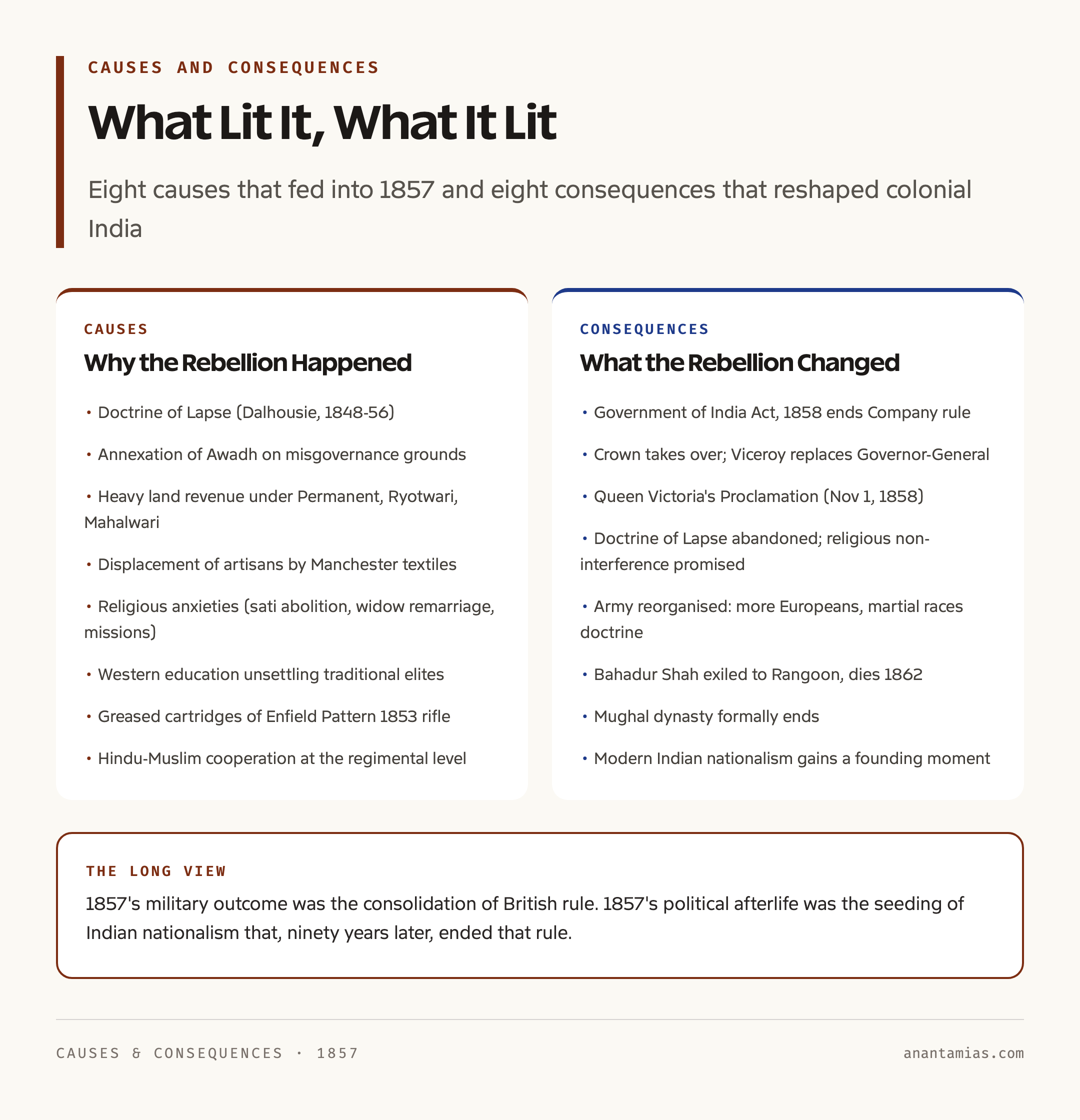
The economic and social ground had shifted in ways that fed grievance. The Permanent Settlement of 1793, Ryotwari, and Mahalwari systems extracted heavy land revenue. Traditional artisans were displaced by Manchester textiles. The Doctrine of Lapse, applied aggressively by Lord Dalhousie from 1848, annexed states without male heirs, including Satara, Jhansi, Nagpur, Sambalpur, and Awadh, the last on grounds of misgovernance.
Religious and cultural anxieties compounded these grievances. The abolition of sati in 1829, the legalisation of widow remarriage in 1856, missionary activity, and the introduction of Western education unsettled traditional elites and rural society alike. The army, where Hindu and Muslim sepoys served side by side, became the meeting place where these grievances boiled together.
The immediate trigger was the new Enfield Pattern 1853 rifle. Its cartridges had to be bitten before loading. Rumours that the grease used was beef tallow and pig fat insulted both Hindu and Muslim sepoys at once. The administration’s stumbling response, including punitive measures against soldiers who refused the cartridges, lit the fuse.
Key Course of Events
The Revolt unfolded in identifiable phases.
Phase one, March 1857: Barrackpore. Mangal Pandey of the 34th Bengal Native Infantry attacked British officers on March 29. He was court-martialled and hanged on April 8, his regiment disbanded. His act was a precursor, not the outbreak.
Phase two, May 1857: Meerut and Delhi. Eighty-five sepoys of the Third Bengal Light Cavalry at Meerut refused the cartridges on May 9 and were imprisoned. On May 10, comrades broke them out, killed officers, and rode for Delhi. On May 11, they reached the Red Fort and proclaimed Bahadur Shah Zafar emperor of Hindustan.
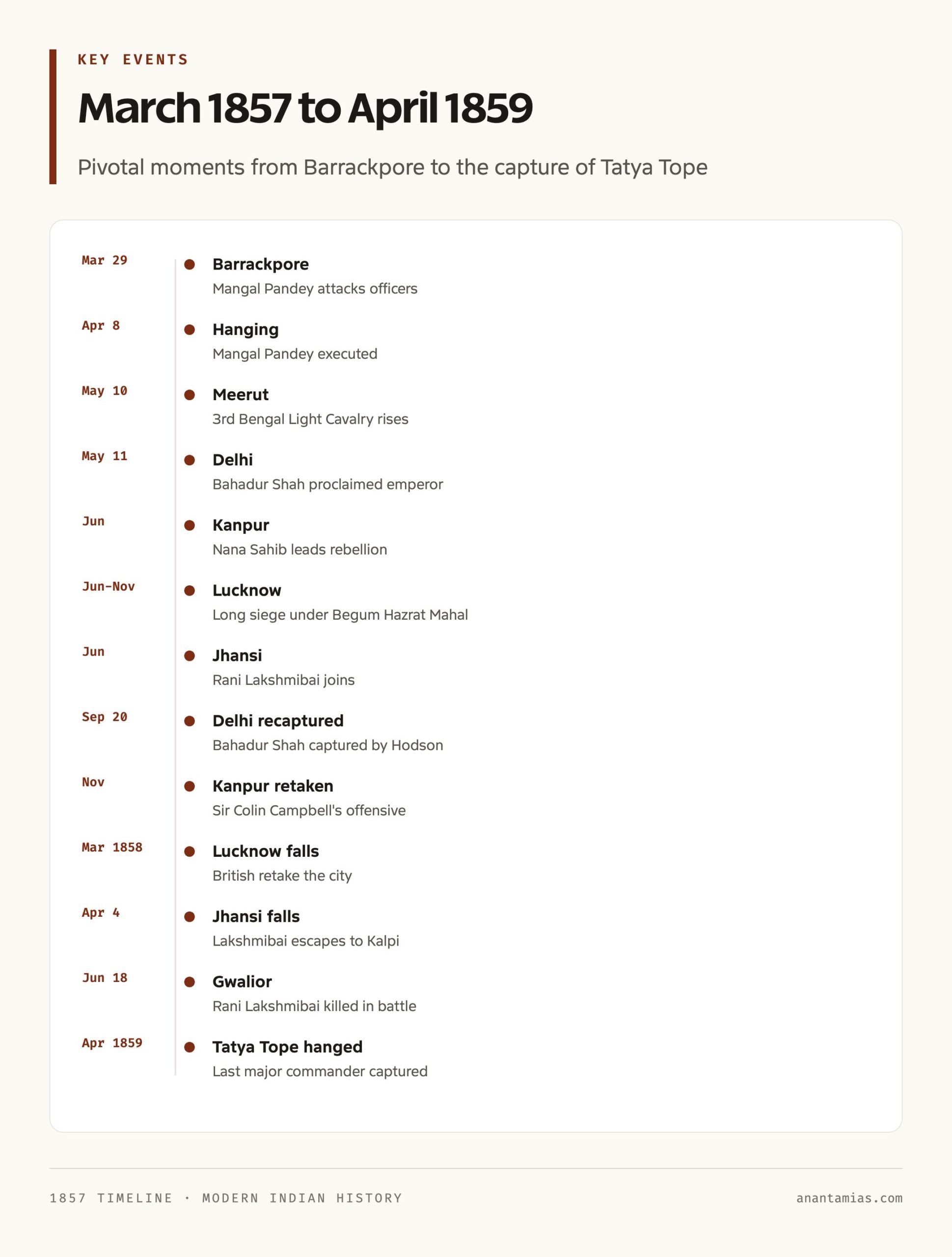
Phase three, June to September 1857: rebellion spreads. Kanpur fell under Nana Sahib and Tatya Tope. Lucknow saw a long siege with Begum Hazrat Mahal leading from inside. Jhansi rallied under Rani Lakshmibai after the British rejected her son’s adoption. Faizabad, Bareilly, Arrah, and pockets of Bihar joined. Punjab, where the Sikh population’s relations with the British had been recently reset, mostly stayed quiet. So did the south.
Phase four, September 1857 to March 1858: British counter-offensive. Delhi was retaken in September 1857 after a bloody siege. Bahadur Shah was captured, his sons executed by Captain Hodson, the emperor himself exiled to Rangoon where he died in 1862. Kanpur was retaken under Sir Colin Campbell. Lucknow fell to the British in March 1858.
Phase five, April to November 1858: pacification. Jhansi fell on April 4, 1858 with Rani Lakshmibai killed in battle near Gwalior on June 18. Tatya Tope was captured and hanged in April 1859. Kunwar Singh of Jagdishpur, well into his seventies, fought a last campaign in Bihar. The rebellion was declared over in November 1858, though sporadic resistance continued for months.
Key Features of the 1857 Rebellion
Four structural features distinguish 1857 from earlier armed protests against British rule.
- Scale. The rebellion spread across a wide arc from Delhi through the Ganga belt to central India, drawing in regiments, princely households, peasants, and urban notables.
- Coalition. Sepoys, dispossessed rulers, taluqdars, peasants, and religious figures joined around shared grievances even where their ultimate objectives differed.
- Symbolic unity. Bahadur Shah Zafar gave the rebellion a single, if frail, symbolic centre. The earlier Maratha, Sikh, and tribal uprisings did not have a pan-Indian symbol of comparable weight.
- Cross-religious mobilisation. Hindu and Muslim soldiers acted together at Meerut, Delhi, and across the rebellion. This cooperation in 1857 became a touchstone for later nationalists arguing against colonial communal narratives.
Why It Matters
The Revolt of 1857 matters as more than a historical event.
It produced the constitutional architecture of British India. The Government of India Act, 1858 ended company rule and transferred authority to the Crown. The Viceroy replaced the Governor-General. The Secretary of State for India sat in London with a Council. Queen Victoria’s Proclamation promised non-interference in religion and the abolition of the Doctrine of Lapse.
It reshaped the British army in India. The ratio of European to Indian troops was tilted upward. Artillery was concentrated in British hands. The Bengal Army was reorganised along the so-called martial races doctrine, recruiting more from Punjab, the Northwest, and the Gurkha hills, and less from the United Provinces.
It seeded modern Indian nationalism. V.D. Savarkar’s 1909 book The Indian War of Independence, 1857 reframed the rebellion as a first war of national liberation. Congress leaders, revolutionaries, and later official India accepted variants of this framing.
It complicated the relationship between memory and history. Indian, British, Marxist, subaltern, and regional historians read 1857 in incompatible ways. The contested framing is itself part of the event’s afterlife.
Detailed Analysis: The Historiographical Debate
Four major framings have shaped how India and the world read 1857.
The mutiny framing. Contemporary British accounts, including The History of the Indian Mutiny by John Kaye and George Malleson, treated the events as a military mutiny that spread because of administrative weakness. The framing emphasised sepoy grievances and downplayed broader social participation. This framing has been thoroughly criticised but still echoes in older textbooks.
The first war of independence framing. V.D. Savarkar’s 1909 work and subsequent nationalist scholarship treated 1857 as a coordinated, pan-Indian, anti-colonial war. The framing emphasises Hindu-Muslim unity, leadership by Bahadur Shah, and the rebellion’s ideological coherence. After independence, this became the dominant Indian public memory.
The Marxist and class-conflict framing. Historians including R.C. Majumdar, who eventually rejected the war-of-independence framing, and later Marxist historians like Bipan Chandra and Sumit Sarkar, emphasised the rebellion’s social composition. Peasant grievance, taluqdari interest, and the role of dispossessed groups received attention.
The subaltern framing. From the 1980s, subaltern studies historians including Ranajit Guha and Gautam Bhadra recovered the voices and politics of ordinary participants. Local rebellions, women’s roles, and tribal participation were brought into the centre of the analysis.
Each framing illuminates and obscures. The pragmatic UPSC reading recognises 1857 as multi-stranded, with sepoy mutiny, princely restoration, peasant uprising, and proto-nationalist mobilisation all present in different proportions in different theatres.
Comparative Perspective
Set 1857 against three reference rebellions.
- The American Revolutionary War, 1775-1783: A successful settler revolt with clear ideological scaffolding. 1857 lacked the printing press networks, the explicit republican ideology, and the international support that the American case enjoyed.
- The Taiping Rebellion, 1850-1864: Contemporary with 1857 in China, with millions killed. The Taiping movement had ideological coherence the 1857 coalition lacked, but also faced more determined imperial repression.
- The Polish January Uprising, 1863: A nationalist uprising against Russian rule, defeated but ideologically generative. The pattern of failure-followed-by-political-influence is similar to 1857.
The 1857 outcome was the consolidation of British rule. The 1857 legacy was the seeding of Indian political imagination that would, ninety years later, end that rule.
Challenges in 1857 Scholarship
The current state of Revolt of 1857 research and remembrance faces specific challenges.
- Source asymmetry. Most surviving sources are British. Indian voices, especially of common participants, are harder to access. Vernacular records, oral traditions, and recently digitised collections are slowly addressing the gap.
- Heritage neglect. Many 1857 sites are under-protected. The Meerut cantonment, the Bibighar at Kanpur, and Jhansi precincts need coordinated conservation.
- Polarised memory. Public commemoration sometimes flattens the rebellion into a single, sanitised narrative. The complexity, including violence on both sides, is uncomfortable but historically real.
- Curricular variance. State boards treat 1857 differently. Some emphasise national-war framing, others mutiny framing. A common scholarly baseline would help students.
- Underexplored regions. Bihar, central India, and the eastern theatre have received less attention than Delhi and Awadh. Local archives are being opened.
- Women’s history. Beyond Rani Lakshmibai and Begum Hazrat Mahal, the participation of women across rural and urban theatres is under-documented.
Prelims Pointers
- Outbreak: May 10, 1857 at Meerut; antecedent at Barrackpore, March 29, 1857 (Mangal Pandey).
- Last Mughal emperor: Bahadur Shah II, exiled to Rangoon, died 1862.
- Governor-General during the Revolt: Lord Canning (became first Viceroy in 1858).
- Doctrine of Lapse: associated with Lord Dalhousie, applied 1848-1856.
- Annexation of Awadh: 1856, on grounds of misgovernance.
- Government of India Act, 1858: ended East India Company rule, created the Office of Secretary of State for India.
- Queen Victoria’s Proclamation: November 1, 1858 at Allahabad.
- V.D. Savarkar’s 1909 work: The Indian War of Independence, 1857.
- Key leaders: Nana Sahib (Kanpur), Tatya Tope, Rani Lakshmibai (Jhansi), Begum Hazrat Mahal (Lucknow), Kunwar Singh (Jagdishpur), Maulvi Ahmadullah Shah (Faizabad).
Mains Questions
- The Revolt of 1857 was at once a sepoy mutiny, a feudal restoration, and a peasant uprising. Discuss with reference to specific theatres of the rebellion. (GS Paper I, 250 words)
- Critically examine the framing of the 1857 events as the First War of Independence. What does the framing gain, and what does it obscure? (GS Paper I, 250 words)
- The Revolt of 1857 reshaped the constitutional architecture of British India. Discuss the institutional consequences embodied in the Government of India Act, 1858 and Queen Victoria’s Proclamation. (GS Paper I, 250 words)
- Hindu-Muslim cooperation in 1857 has been cited as a defining feature of the rebellion. Discuss its scale and limits, and its later use in Indian political memory. (GS Paper I, 150 words)
Way Forward
The 169th anniversary is the right moment for three commitments.
Treat 1857 sites as a coordinated heritage cluster. Meerut, Delhi, Kanpur, Lucknow, Jhansi, Bareilly, Faizabad, and Arrah deserve an integrated conservation, interpretation, and tourism framework. The Archaeological Survey of India, the Ministry of Culture, and concerned states should sign a multi-year compact.
Open the archives wider. The National Archives, state archives, and private collections still hold material that has not entered scholarship. Digitisation with searchable metadata, especially of vernacular records, would transform research.
Update curricula honestly. The Revolt was multi-stranded. School and college texts should reflect that complexity, recognising both the sepoy and the peasant, both Bahadur Shah’s reluctance and the genuine popular mobilisation, both the violence and the legitimacy of the uprising.
For deeper context on the personalities and constitutional aftermath, see our pieces on Mangal Pandey, tribal movements of the colonial period, and the wider sweep of modern Indian history as it ran into the encounter with colonial law.
A hundred and sixty-nine years on, the Revolt of 1857 is no longer an event. It is a question that India still answers, every time the country names its founding moment.
Frequently Asked Questions
When did the Revolt of 1857 begin?
The main outbreak occurred at Meerut on May 10, 1857, when sepoys of the Third Bengal Light Cavalry rebelled and rode for Delhi. An earlier incident, the Mangal Pandey episode at Barrackpore on March 29, 1857, is treated as a precursor.
Why is 1857 called the First War of Independence?
V.D. Savarkar’s 1909 book The Indian War of Independence, 1857 popularised the framing. Subsequent nationalist scholarship and post-independence official memory adopted it. The framing emphasises pan-Indian scope, Hindu-Muslim cooperation, and anti-colonial intent.
What was the immediate trigger of the Revolt?
The introduction of the Enfield Pattern 1853 rifle, whose greased cartridges had to be bitten before loading. Rumours that the grease used beef and pig fat insulted both Hindu and Muslim sepoys. The administration’s punitive response to refusing sepoys lit the fuse.
Who was Bahadur Shah Zafar’s role in the rebellion?
The 82-year-old emperor became the symbolic head of the rebellion after sepoys reached the Red Fort on May 11, 1857. He was a reluctant participant. After Delhi fell in September 1857, he was captured, his sons executed, and he was exiled to Rangoon, where he died in 1862.
Which areas of India did not join the Revolt?
Punjab, much of the south, Bengal proper, and most of Rajasthan did not actively join. Reasons varied: recent British settlements with Sikh elites, distance from the rebellion’s epicentre, and local political configurations that did not align with the uprising.
What was the Doctrine of Lapse?
A policy associated with Lord Dalhousie (1848-1856) under which princely states without a male biological heir would lapse to the East India Company, refusing to recognise adopted heirs. Annexed states included Satara, Jhansi, Nagpur, and Sambalpur.
What were the major consequences of the Revolt?
The Government of India Act, 1858 ended East India Company rule and transferred authority to the Crown. The Indian army was reorganised. The Doctrine of Lapse was abandoned. Religious non-interference was promised. Indian nationalism received a foundational moment to build on.
Who were the women leaders of the 1857 Revolt?
The most prominent were Rani Lakshmibai of Jhansi, who fell at Gwalior in June 1858, and Begum Hazrat Mahal of Awadh, who led the Lucknow theatre and later went into exile in Nepal. Many other women participated at local levels, often under-documented.
Why did the Revolt fail?
Several factors: limited geographic reach, lack of unified command, varying objectives among coalition members, superior British logistics and reinforcements, loyal Indian regiments and princely states, and the late entry of some theatres after the British counter-offensive had begun.
Where can students read primary sources on 1857?
The National Archives of India, the British Library’s India Office records, state archives, and the digitised collections of major universities hold rebellion-era papers. Contemporary works include John Kaye’s history, William Howard Russell’s My Diary in India, and Sayyid Ahmad Khan’s Causes of the Indian Revolt.
Tell Google you want more of this.
Add Anantam IAS as a preferred sourceOne tap, and this site shows up more often in your own Top Stories, AI Overviews and AI Mode. Remove it any time.