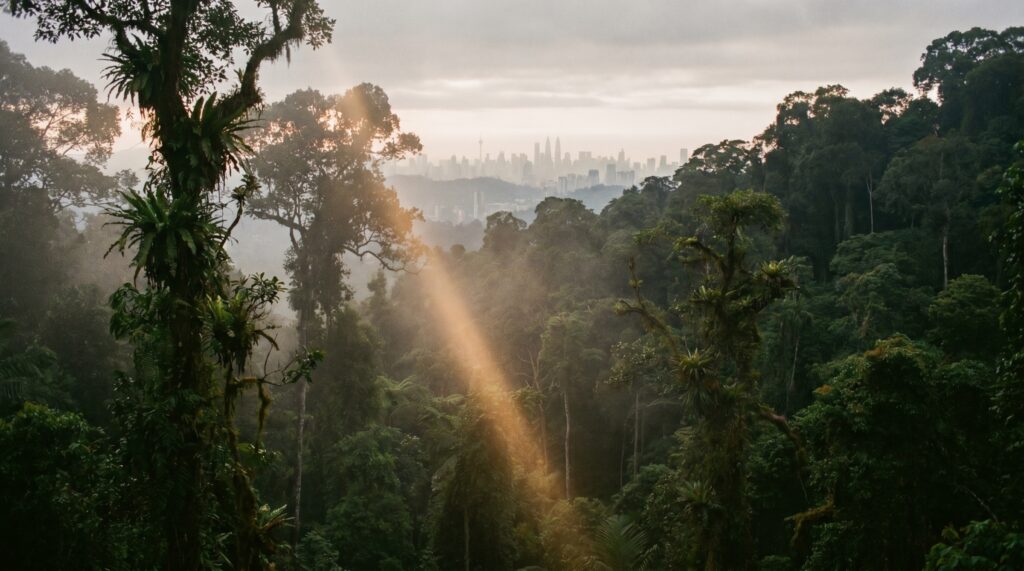
Picture a national park and you picture distance: a long drive out of the city, a forest gate somewhere past the last town, wilderness that begins where people end. Sanjay Gandhi National Park breaks that picture completely. It sits inside Mumbai, wrapped on almost every side by one of the densest urban populations on Earth, with high-rises pressing against its boundary wall and a resident population of wild leopards that share the same postal codes as roughly twenty million people. You can be on a local train platform and, a few kilometres away, a leopard is asleep in the shade.
That collision of forest and megacity is exactly why this park matters far beyond a tick on the “national parks of India” list. It is a green lung breathing for a city that struggles to breathe, a water catchment feeding lakes that once slaked Mumbai’s thirst, an archaeological site holding Buddhist caves older than the city itself, and a live laboratory for the hardest question in modern conservation: can large wild animals and a huge human population actually share the same ground? Sanjay Gandhi National Park is where India answers that question in real time.
A national park inside a megacity, and why that is rare
Sanjay Gandhi National Park is one of the very few national parks in the world that lies within the limits of a major city, occupying about 104 square kilometres in the northern suburbs of Mumbai, around Borivali. Most protected forests are set deliberately apart from settlement. This one is embedded in the settlement, which is precisely what makes it a standing exception in any list of India’s parks.
It was not always called this. The park was long known as Borivali National Park, and before that its oldest core was set aside in the mid-twentieth century as Krishnagiri National Park. It was renamed Sanjay Gandhi National Park after the politician, and the boundary was enlarged over the decades into the forested block you see today. So the “Borivali” you may find in older references and the “Sanjay Gandhi” of current maps are the same place under two names, a small point that trips up people reading across sources.
The park’s real distinction is what surrounds it. Its boundary runs directly against dense residential Mumbai, the Aarey milk colony, a film city, and expanding infrastructure, so the pressure on its edges is relentless. It also draws roughly two million visitors a year, which ranks it among the most visited national parks in Asia. When you revise the national parks of India, do not file this one as just another entry: file it as the outlier, the forest a metro city grew around instead of away from.
| Attribute | Detail |
|---|---|
| Location | Northern Mumbai (Borivali), Maharashtra |
| Former name | Borivali National Park (core once called Krishnagiri National Park) |
| Area | About 104 sq km |
| Distinction | National park inside the limits of a major city |
| Flagship animal | Indian leopard, among the highest densities recorded anywhere |
| Other mammals | Chital, sambar, barking deer, wild boar, macaque, langur, palm civet |
| Birds | Around 250 species recorded |
| Inside the park | Kanheri Caves, 109 Buddhist rock-cut caves |
| Water bodies | Tulsi Lake and Vihar Lake, part of Mumbai’s early water supply |
| Rivers rising here | Dahisar, Mithi, Poisar, Oshiwara |
| Managed by | Maharashtra Forest Department; caves protected by the ASI |
The green lung and water tower of Mumbai
The most practical thing Sanjay Gandhi National Park does for Mumbai has nothing to do with tourism: it works as the city’s green lung and water catchment, and the city would be measurably worse without it. Its dense tropical forest absorbs carbon dioxide, filters dust and pollutants, cools the surrounding air, and softens the monsoon runoff that would otherwise sheet straight off concrete into flooded streets. For a coastal megacity choking on traffic and construction dust, a 104-square-kilometre block of standing forest is not a luxury. It is infrastructure.
The water story is older and sharper. Inside the park lie Tulsi Lake and Vihar Lake, two of Mumbai’s earliest engineered water sources, with Vihar Lake commissioned in the 1860s as the city’s first piped-water reservoir. They no longer supply the bulk of a city this size, but they still feed a share of it, and the forested catchment around them is what keeps that water clean and flowing. Protect the trees and you protect the reservoir; clear them and the lakes silt and shrink.
Follow the water further and the park’s reach spreads across the city. Several of Mumbai’s rivers, the Dahisar, Poisar, Oshiwara, and the much-discussed Mithi, draw from the high ground and overflow of this forest. The Mithi in particular, whose flooding devastated Mumbai in the catastrophic deluge of 2005, is tied to the health of these upstream catchments. That single link, forest to river to flood, is the cleanest way to show why an urban forest is a flood-defence question, not just a wildlife one, and it slots neatly into any note on the Western Ghats as a biodiversity hotspot and the ecological services its northern spurs provide.
The leopards of Mumbai, and what they actually eat
The headline fact about Sanjay Gandhi National Park is that it holds one of the highest densities of leopards anywhere in the world, with recent censuses counting roughly 40 to 50 Indian leopards inside a forest ringed by around twenty million people. Nowhere else do big cats and a human megacity overlap on this scale. A leopard here may spend its night moving through the fringe of a suburb and its day sleeping a few hundred metres from an apartment block.
The instinctive assumption, that this must mean constant attacks, is where the science corrects the fear. Researchers who studied the park’s leopards, notably the work associated with biologist Vidya Athreya and the Wildlife Conservation Society, found that the cats survive mainly on stray dogs, and to a lesser extent domestic cats, rodents, and pigs, not on people. In some analyses domestic dogs made up the largest share of the leopards’ diet. That reframes the animal entirely: in an odd way, the leopards are performing a public-health service, keeping down a feral-dog population that carries rabies and bites thousands of people a year.
Conflict is real, and pretending otherwise would be dishonest. There have been leopard attacks on humans in the suburbs bordering the park, usually clustered in years and places where waste, livestock, and encroachment pull the cats into the open, and the Forest Department manages an anxious interface of warnings, rescues, and occasional relocations. The lesson the SGNP experience keeps teaching is that relocating a leopard often makes matters worse, because a displaced cat panics in unfamiliar ground. Coexistence, through waste management, awareness, and leaving the animal alone, has proved safer than removal. That finding now informs human-wildlife conflict policy across India, and it began, in large part, here.
The biodiversity packed into an urban forest
For a forest hemmed in by a city, Sanjay Gandhi National Park carries a remarkable spread of life: roughly 1,300 species of plants, more than 250 species of birds, around 40 species of mammals, some 150 species of butterflies, and dozens of reptiles and amphibians. That richness is not an accident of size; it is inherited from geography. The park sits on the northern reaches of the Western Ghats system, one of the world’s eight recognized biodiversity hotspots, and it keeps a fragment of that ancient forest alive inside the metropolis.
Below the leopard, the food web is intact enough to function. The cats are fed by prey like chital (spotted deer), sambar, barking deer, and wild boar, alongside rhesus and bonnet macaques, langurs, palm civets, mouse deer, and porcupines. The birdlife runs from raptors and paradise flycatchers to kingfishers and hornbills, and the monsoon brings out amphibians and a butterfly season that draws naturalists from across the city. A forest that can hold an apex predator and its full prey base is, by definition, still working as an ecosystem, not just a park.
The threats are the ones any island of green inside a city faces. Encroachment on the boundaries, plastic and solid waste drifting in from settlements, roadkill on the routes that clip the park, forest fires in the dry months, and the slow fragmentation of the land around it that cuts the park off from other green patches. Each of these chips at the edges of a space that cannot expand. The Wildlife (Protection) Act, 1972 gives the park its legal armour, and understanding how national-park status actually restricts activity is worth pairing with your notes on the Wildlife Protection Act and its schedules.
The Kanheri Caves: a Buddhist monastery in the woods
Tucked into a basalt hillside inside the park sit the Kanheri Caves, a complex of around 109 rock-cut Buddhist caves carved out of the living rock between roughly the first century BCE and the tenth century CE. This is one of the largest single groups of rock-cut excavations in India by sheer number of caves, and it predates the modern city around it by nearly two thousand years. The name Kanheri comes from *Krishnagiri*, “black mountain,” for the dark basalt the monks cut into.
Kanheri was a working Buddhist monastic university and pilgrimage centre, not a set of empty grottoes. The caves include *viharas* (living quarters and study cells for monks), *chaityas* (prayer halls), stone benches, cisterns cut to harvest rainwater, and inscriptions recording the merchants and patrons who funded them. Cave 3, the great chaitya hall, holds a stupa and towering standing figures of the Buddha flanking its entrance, and gives you the classic apsidal, pillared prayer hall of early Indian Buddhism in a single room. The site sat on trade routes linking the ports of the Konkan coast to the interior, which is exactly how a remote hill monastery grew rich enough to carve for a thousand years.
The caves matter for two syllabi at once, and that is their exam value. As architecture, they belong squarely in the story of Buddhist rock-cut architecture alongside Ajanta, Ellora, and Karla. As heritage, they are protected by the Archaeological Survey of India, and you can find the official listing at the Archaeological Survey of India site. So this one park hands you a national park, an ecosystem, and a monument spanning a millennium, all within the same boundary wall. Few sites in India stack that many themes on one patch of ground.
Why Sanjay Gandhi National Park is a case study in urban biodiversity
The reason this park keeps appearing in conservation debates is that it forces the central question of the coming century into a single frame: can wildlife and a dense human population genuinely coexist in the same space? Most of India’s protected areas answer by separation, drawing a hard line between forest and settlement. Sanjay Gandhi National Park cannot separate, because the city is already at the wall, so it has to make coexistence work or fail visibly in front of twenty million witnesses.
The evidence so far is cautiously encouraging, and the leopard is the proof. A large carnivore is surviving, even thriving, at the edge of a megacity, largely by feeding on the city’s own stray animals and mostly avoiding its people, so long as people avoid cornering it. That outcome overturns the old assumption that big cats and cities are simply incompatible, and it has reshaped how the Maharashtra Forest Department and researchers approach conflict, favouring waste control and public awareness over reflexive capture. The department’s work is documented through the Maharashtra Forest Department portal.
The unfinished part is honest to state. Coexistence at SGNP holds only as long as the pressures stay managed: contain the waste that draws leopards to the fringe, curb encroachment, keep the corridors to other green patches from being severed, and resist the constant temptation to shave off “unused” forest for a road, a depot, or a colony. The park is a working model of urban biodiversity, but a model under continuous strain, and its lesson is not that coexistence is easy. Its lesson is that coexistence is possible, and that the harder discipline lies with the people, not the leopards.
How to study Sanjay Gandhi National Park
The efficient way to hold this park is to build it around four assets and hang every fact on one: the city-forest itself, the leopards, the caves, and the water. Nearly every question worth asking about SGNP is a variation on one of those four.
Start with the defining tag: a national park inside a metropolis, about 104 sq km in northern Mumbai, formerly Borivali National Park. That single sentence answers the “what is unusual about it” question before it finishes. Then attach the leopards, one of the highest densities on Earth, surviving mainly on stray dogs, a coexistence story rather than a horror story.
Add the Kanheri Caves, roughly 109 Buddhist rock-cut caves from about the first century BCE onward, protected by the ASI, to cover the art-and-culture angle the park quietly owns. Add the water, Tulsi and Vihar lakes and the rivers that rise here, to cover the ecological-services angle. Four assets, four clusters, and a park that looks like a jumble of unrelated facts becomes a clean case study you can actually argue: the forest a city could not do without, and the wildlife that learned to live inside it.
Frequently Asked Questions
Where is Sanjay Gandhi National Park located?
In the northern suburbs of Mumbai, Maharashtra, around Borivali. It lies within the limits of the city, which makes it one of the few national parks in the world inside a major metropolis.
What was Sanjay Gandhi National Park called earlier?
It was known as Borivali National Park, and its oldest core was once called Krishnagiri National Park. It was later renamed Sanjay Gandhi National Park.
Why is Sanjay Gandhi National Park famous for leopards?
Because it holds one of the highest densities of leopards recorded anywhere, roughly 40 to 50 Indian leopards, living beside a human population of about twenty million. Studies show they feed mainly on stray dogs rather than people.
What are the Kanheri Caves?
A group of around 109 Buddhist rock-cut caves inside the park, carved from about the first century BCE to the tenth century CE. They served as a Buddhist monastery and pilgrimage centre and are protected by the Archaeological Survey of India.
How does the park supply water to Mumbai?
Two lakes inside it, Tulsi Lake and Vihar Lake, were among Mumbai’s earliest water sources, with Vihar built in the 1860s. The forested catchment keeps their water clean, and rivers like the Dahisar and Mithi rise from the park.
Is Sanjay Gandhi National Park part of the Western Ghats?
It lies on the northern reaches of the Western Ghats system, one of the world’s biodiversity hotspots, and preserves a fragment of that forest inside the city, which is why its species richness is so high.
Why is the park called a case study in urban biodiversity?
Because it forces wildlife and a dense human population to share the same space rather than being separated. The survival of leopards at the city’s edge shows that coexistence is possible when waste and encroachment are managed.
What are the main threats to the park?
Encroachment on its boundaries, solid and plastic waste, roadkill, dry-season fires, and the fragmentation of green corridors that connect it to other forest patches. Its legal protection comes from the Wildlife (Protection) Act, 1972.
Practice Questions
1. Sanjay Gandhi National Park is best known for being:
a) The largest national park in India
b) A national park located within a major city
c) A high-altitude cold desert park
d) A marine national park
Answer: b
2. Sanjay Gandhi National Park was formerly known as:
a) Krishnagiri Wildlife Sanctuary only
b) Borivali National Park
c) Tulsi National Park
d) Aarey National Park
Answer: b
3. The Kanheri Caves located inside the park are associated with:
a) Jainism
b) Buddhism
c) Shaivism
d) Vaishnavism
Answer: b
4. Which animal is the flagship species of Sanjay Gandhi National Park, noted for its very high density there?
a) Tiger
b) Asiatic lion
c) Leopard
d) One-horned rhinoceros
Answer: c
5. Which two lakes inside the park form part of Mumbai’s early water supply?
a) Powai and Pawna
b) Tulsi and Vihar
c) Upvan and Masunda
d) Salim Ali and Renuka
Answer: b
Mains-style questions
1. “Sanjay Gandhi National Park is less a wilderness set apart than infrastructure embedded in a city.” Discuss its role as a green lung and water catchment for Mumbai. 2. Examine the leopard population of Sanjay Gandhi National Park as a model of human-wildlife coexistence, and assess what it teaches about conflict management in India. 3. Evaluate the challenges of conserving biodiversity within an urban landscape, using Sanjay Gandhi National Park as a case study. 4. Discuss the significance of the Kanheri Caves within the tradition of Buddhist rock-cut architecture in India. 5. “Relocation of large carnivores can worsen human-wildlife conflict rather than resolve it.” Analyse this statement with reference to the leopards of Mumbai.
Sanjay Gandhi National Park rewards the aspirant who refuses to treat it as one more name in a list of protected areas. Its real value is how much it holds at once: a rare forest surviving inside a megacity, an apex predator that learned to live off the city’s own strays, a Buddhist monastery carved over a thousand years, and the reservoirs and rivers a metropolis depends on. Learn it as that bundle, keep the four assets straight, and the park becomes what it truly is, not a curiosity on the edge of Mumbai but the sharpest test India has of whether people and wildlife can share the same ground.
Tell Google you want more of this.
Add Anantam IAS as a preferred sourceOne tap, and this site shows up more often in your own Top Stories, AI Overviews and AI Mode. Remove it any time.