Introduction
Social, tribal and religious movements are the connective tissue of modern Indian history. Between the anti-colonial uprisings and the formal nationalist mobilisations lie dozens of struggles where peasants resisted zamindars, tribal communities defended forest rights, reformers challenged caste and dowry, and working classes pushed for political voice. For the UPSC aspirant, these movements together cover a large slice of GS1 Modern Indian History and Indian Society.
This article is a consolidated reference for some of the most frequently tested: the Self-Respect Movement of E. V. Ramasamy Periyar in Tamil Nadu, the Tebhaga Movement of Bengal peasants in 1946-47, the Parsi reform movement and religious reform movements of the nineteenth century, and a cluster of tribal revolts. We also touch on revolutionary nationalism so that readers can place the “vertical” and “horizontal” categories of social movements in one frame.
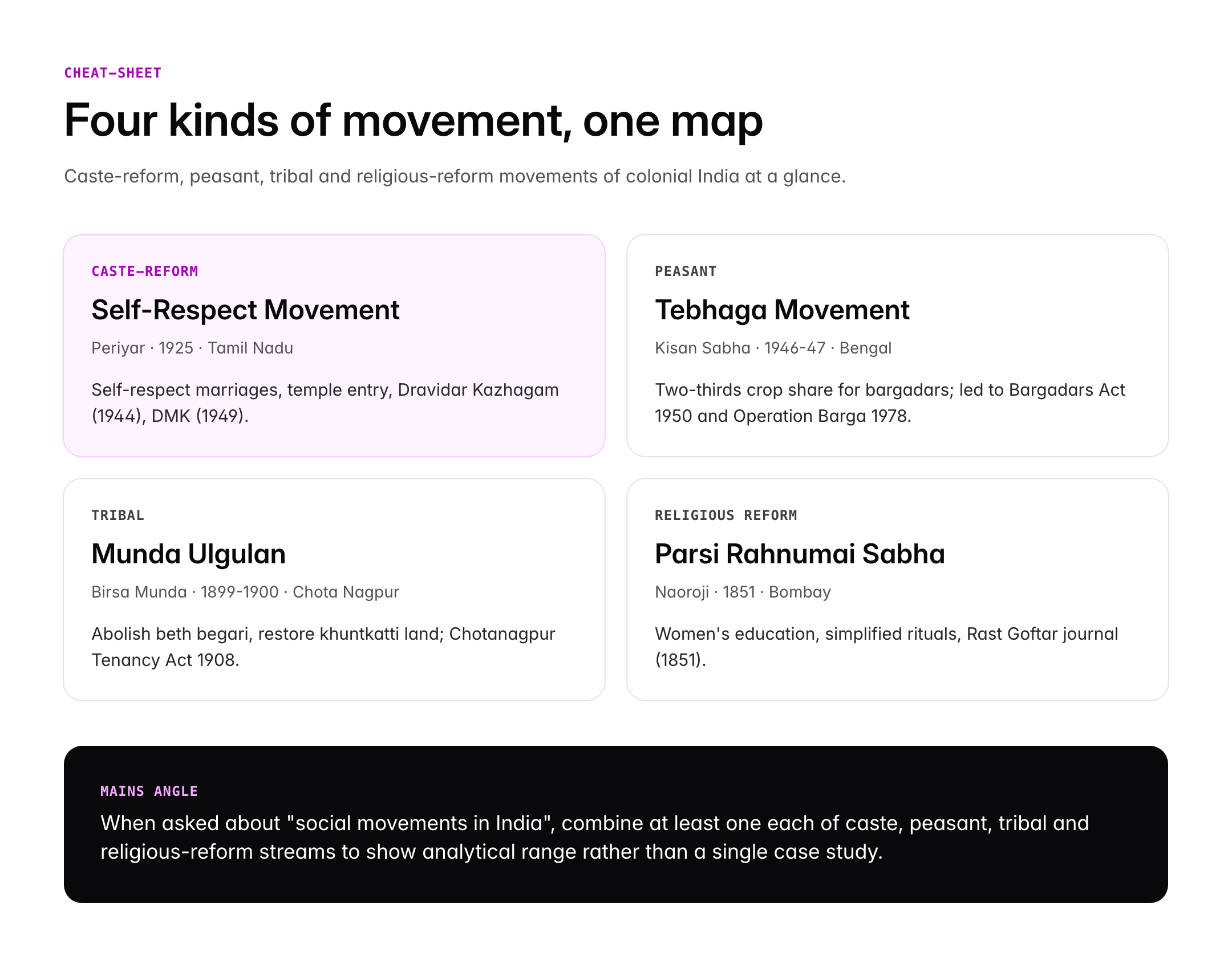
Quick Facts at a Glance
| Movement | Period | Region | Leader(s) | Core Demand |
|---|---|---|---|---|
| Self-Respect Movement | 1925 onward | Madras Presidency | Periyar E. V. Ramasamy | Caste annihilation, gender equality, rationalism |
| Tebhaga Movement | 1946-47 | Bengal | Kisan Sabha, Kompram Singh | Two-thirds of crop to sharecroppers |
| Santhal Rebellion (Hool) | 1855-56 | Chota Nagpur | Sidhu, Kanhu, Chand, Bhairav | End to zamindar and moneylender oppression |
| Munda Ulgulan | 1899-1900 | Chota Nagpur | Birsa Munda | Abolition of dikus, land restoration |
| Bhil Revolts | 1818-1913 | Western India | Sevaram, Govind Guru | Forest and land rights |
| Parsi Reform | 1851 onward | Bombay | Dadabhai Naoroji, Naoroji Furdonji | Rahnumai Mazdayasnan Sabha, women’s education |
| Brahmo Samaj | 1828 | Bengal | Raja Ram Mohan Roy | Monotheism, anti-sati, widow remarriage |
| Arya Samaj | 1875 | Punjab | Dayananda Saraswati | Return to Vedas, shuddhi |
Background and Historical Context
Colonial rule restructured Indian society in ways that provoked a wide spectrum of responses. The Permanent Settlement of 1793 and later tenancy laws created a layered rural hierarchy of zamindars, tenants, sharecroppers and landless labour. Forest laws like the Indian Forest Acts of 1865 and 1878 criminalised customary use of forests, triggering tribal resistance. The introduction of English education and print created a reformist middle class, which challenged practices like sati, child marriage and caste exclusion. Industrialisation around Bombay, Calcutta, Madras, Ahmedabad and Kanpur created a new working class and a new mercantile elite.
Social movements in this period can be read along two axes. The vertical axis describes movements that challenged hierarchical relations of caste, landlordism or colonial rule. The horizontal axis describes movements of communities trying to consolidate identity, such as Parsi reform or Muslim educational reform. Often a single movement carried elements of both. The Self-Respect Movement, for example, was vertically anti-Brahmin and anti-caste while also horizontally a Dravidian identity project.
The nineteenth-century religious reform movements laid conceptual groundwork for much that followed. Brahmo Samaj, Prarthana Samaj, Arya Samaj, Aligarh Movement, Deoband, the Singh Sabha and the Parsi Rahnumai Mazdayasnan Sabha each blended scriptural reinterpretation with practical reforms in education, women’s rights, and community organisation. Early twentieth-century movements like the Self-Respect and Tebhaga movements radicalised this inheritance, shifting emphasis from reform within tradition to structural confrontation with caste or landlordism.
Key Features of the Major Movements
Self-Respect Movement (1925)
Founded by E. V. Ramasamy Naicker (Periyar) after his break with the Congress over the Vaikom Satyagraha and the Kanchipuram Congress of 1925, the Self-Respect Movement (Suya Mariyadai Iyakkam) launched in Tamil Nadu with three connected goals: annihilation of caste, gender equality, and rationalism. It organised self-respect marriages without Brahmin priests, campaigned against dowry and child marriage, demanded temple entry, and burned texts considered casteist. In 1944 Periyar merged his cadre into the Dravidar Kazhagam, which later seeded the DMK in 1949 under C. N. Annadurai.
Tebhaga Movement (1946-47)
The Tebhaga agitation was led by the All India Kisan Sabha in Bengal, demanding that the sharecropper (bargadar) receive two-thirds (tebhaga) of the crop rather than the customary half. It followed the recommendations of the Floud Commission (1940). The movement spread across 19 districts, saw women’s participation through the Nari Bahini, and recorded major confrontations in Dinajpur and Midnapore. While suppressed in 1947, it shaped the West Bengal Bargadars Act 1950 and later Operation Barga (1978) under the Left Front.
Tribal Movements
Tribal communities were among the earliest and most sustained resisters of colonial rule. The Santhal Hool (1855-56) under Sidhu and Kanhu Murmu protested moneylender and zamindar exploitation in Chota Nagpur. The Munda Ulgulan (1899-1900) led by Birsa Munda demanded abolition of forced labour (beth begari), restoration of traditional khuntkatti land tenure and the expulsion of dikus (outsiders); it led to the Chotanagpur Tenancy Act 1908. The Bhil revolts of Khandesh and Rajputana, the Kol uprising (1831-32), the Khond uprising in Odisha, and the Rampa rebellion (1922-24) under Alluri Sitarama Raju form a continuous arc. In 1920s Assam the Jaintia and Garo movements opposed house tax and hill cultivation restrictions.
Parsi Reform Movement
Launched through the Rahnumai Mazdayasnan Sabha in Bombay in 1851, the Parsi reform movement brought together Dadabhai Naoroji, Naoroji Furdonji, K. R. Cama and S. S. Bengalee. Its agenda included women’s education, simplified wedding rituals, restoration of the Zoroastrian religion to its scriptural core, and opposition to child marriage. The journal Rast Goftar (1851) carried these ideas widely.
Religious Reform in Broader India
The Brahmo Samaj (1828) of Raja Ram Mohan Roy pioneered opposition to sati, supported the Bengal Sati Regulation 1829, and argued for widow remarriage and women’s education. The Prarthana Samaj (1867) of Atmaram Pandurang and M. G. Ranade adapted Brahmo ideas to Maharashtra. The Arya Samaj (1875) of Dayananda Saraswati called for a return to the Vedas and pioneered shuddhi reconversion. The Aligarh Movement of Syed Ahmad Khan and the Deoband Movement (1867) represented two poles of Muslim reform, modernist and traditionalist. The Singh Sabha (1873) organised Sikh reform, while the Namdhari and Nirankari movements predated it.
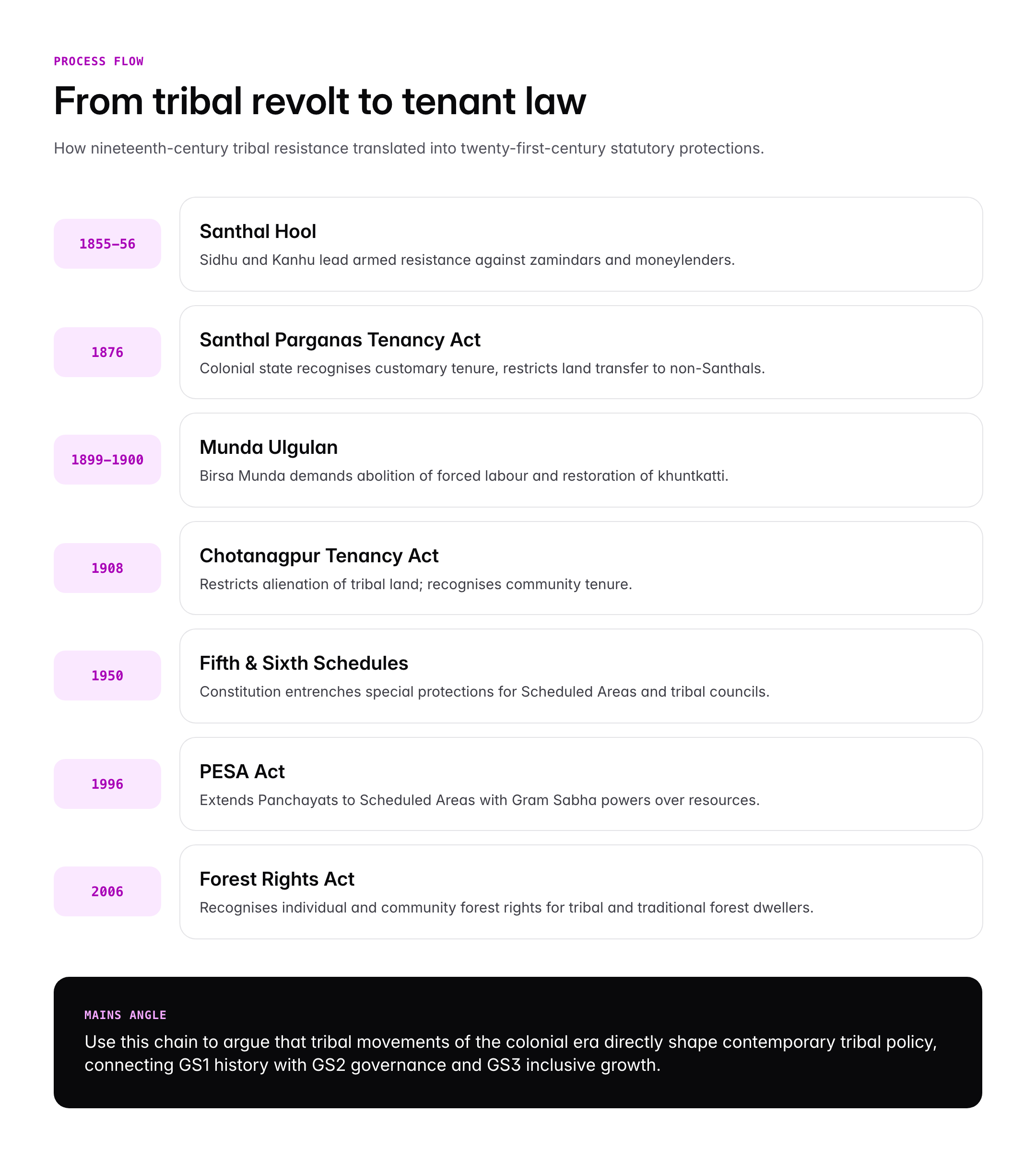
Significance for UPSC and General Knowledge
- These movements supply primary material for GS1 questions on Modern Indian History, Indian Society and Post-Independence consolidation.
- The Self-Respect Movement links pre-independence reform to post-independence Dravidian politics and is relevant to Mains questions on regional political traditions.
- Tribal movements clarify the origin of key tenancy laws (Santhal Parganas Tenancy Act, Chotanagpur Tenancy Act) and explain the Fifth and Sixth Schedules of the Constitution.
- The Tebhaga movement is the conceptual ancestor of later land reforms including Operation Barga.
- Religious reform movements are essential for understanding the social foundations of nationalism and the Constitution’s Fundamental Rights on equality and religion.
- Ethics (GS4) questions on moral courage, social reform and leadership can draw on figures like Periyar, Birsa Munda and Ram Mohan Roy.
Detailed Analysis: Outcomes and Comparisons
The movements above achieved uneven but durable outcomes. The Self-Respect Movement reshaped Tamil Nadu’s political culture, making anti-caste assertion and Dravidian identity the common sense of state politics for much of the post-independence period. Temple-entry reforms, reservations and the state’s strong record on social indicators owe something to its legacy.
Tribal movements produced specific legal protections. The Santhal Parganas Tenancy Act 1876, the Chotanagpur Tenancy Act 1908 and the later PESA Act 1996 and Forest Rights Act 2006 all stand on a legislative chain that began with nineteenth-century rebellions. The Fifth Schedule areas and Sixth Schedule autonomous councils institutionalise protections these movements demanded.
The Tebhaga movement is a clear example of how a failed agitation in the short run produced structural reform in the long run. The Bargadars Act 1950 recognised sharecropper rights in law, and Operation Barga in 1978 registered over a million bargadars and gave them inheritable cultivation rights, transforming rural West Bengal in the 1980s.
Religious reform movements shaped social consent for constitutional reform. Abolition of sati, widow remarriage legalisation, the age of consent campaign, Hindu Code reforms and the prohibition of untouchability all traverse a reformist path stretching from Ram Mohan Roy in 1829 to the Hindu Code Bills of 1955-56.
A useful synthesis for aspirants is to distinguish three phases. The first, roughly 1820 to 1870, was dominated by religious and social reform from the English-educated elite. The second, 1870 to 1920, saw tribal and peasant resistance alongside the rise of mass religious-cultural organisations. The third, 1920 to 1947, saw the merging of social movements with the national movement, as in Gandhi’s Harijan campaigns, Ambedkar’s constitutional struggle, Periyar’s Self-Respect Movement and the Kisan Sabha’s peasant agitations.
Comparative Perspective
The following table groups the movements by type for quick revision.
| Type | Example | Leader(s) | Year(s) | Outcome |
|---|---|---|---|---|
| Caste-reform (radical) | Self-Respect Movement | Periyar | 1925 onward | Dravidar Kazhagam, DMK politics |
| Peasant | Tebhaga | Bengal Kisan Sabha | 1946-47 | Bargadars Act 1950, Operation Barga 1978 |
| Tribal | Munda Ulgulan | Birsa Munda | 1899-1900 | Chotanagpur Tenancy Act 1908 |
| Tribal | Santhal Hool | Sidhu, Kanhu | 1855-56 | Santhal Parganas Tenancy Act 1876 |
| Religious reform | Brahmo Samaj | Ram Mohan Roy | 1828 | Sati Regulation 1829, women’s education |
| Religious reform | Arya Samaj | Dayananda Saraswati | 1875 | Shuddhi, Vedic schools |
| Community reform | Parsi Rahnumai Sabha | Dadabhai Naoroji | 1851 | Women’s education, ritual reform |
| Revolutionary | HSRA | Bhagat Singh, Chandrashekhar Azad | 1928-31 | Radical wing of national movement |
The comparison shows a common pattern: a phase of ideological articulation, a phase of mobilisation, a phase of repression or dilution, and a phase of legislative or political reform that captures some of the movement’s demands.
Challenges and Criticisms
These movements attract both sympathetic and critical scholarship. The Self-Respect Movement has been criticised for a sometimes instrumental relationship with Brahminical symbols and for controversial rhetoric, even as its social achievements are acknowledged. The Tebhaga movement has been read as both genuinely radical and partially co-opted by the Communist Party’s later compromises. Tribal movements are sometimes romanticised as primordial resistance, obscuring internal class differentiation and leadership disputes. Religious reform movements carried their own contradictions: Brahmo and Arya Samaj reform often retained caste and patriarchal assumptions even as they opposed specific practices. The Aligarh Movement’s loyalism, the Deoband Movement’s nationalism, and the internal debates within the Singh Sabha show that “reform” was never monolithic. For UPSC Mains answers, a balanced view that credits the gains while noting contradictions typically scores better than uncritical celebration.
Prelims Pointers
- Self-Respect Movement launched by Periyar in 1925 after Kanchipuram Congress break
- Tebhaga means “three parts” in Bengali, referring to the two-thirds crop share demand
- Floud Commission 1940 recommended the two-thirds formula later adopted as Tebhaga’s demand
- Santhal Hool 1855-56 led by Sidhu and Kanhu Murmu in Chota Nagpur
- Birsa Munda’s Ulgulan in 1899-1900 led to Chotanagpur Tenancy Act 1908
- Brahmo Samaj founded 1828 by Raja Ram Mohan Roy; supported Sati Regulation 1829
- Prarthana Samaj founded 1867 in Bombay by Atmaram Pandurang
- Arya Samaj founded 1875 in Bombay by Dayananda Saraswati
- Rahnumai Mazdayasnan Sabha founded 1851 in Bombay; Rast Goftar journal same year
- Dravidar Kazhagam formed 1944; DMK split off 1949 under C. N. Annadurai
- Alluri Sitarama Raju led Rampa rebellion 1922-24 in Andhra
- Kol uprising 1831-32 in Chota Nagpur against land dispossession
Mains Practice Questions
- “The Self-Respect Movement was simultaneously a vertical critique of caste and a horizontal Dravidian identity project.” Discuss its contribution to Indian social reform. (250 words)
- Ideological foundations: Periyar, rationalism, gender equality
- Vertical critique: self-respect marriages, temple entry, anti-caste mobilisation
- Horizontal identity: Dravidian politics, Dravidar Kazhagam, DMK legacy
- Examine the continuity between nineteenth-century tribal revolts and twenty-first-century legal protections such as PESA and the Forest Rights Act. (250 words)
- Revolts: Santhal Hool, Munda Ulgulan, Bhil and Kol uprisings
- Legislative chain: Santhal Parganas Act 1876, Chotanagpur Tenancy Act 1908, Fifth Schedule
- Modern laws: PESA 1996, FRA 2006 and the contested question of implementation
Conclusion
The Self-Respect Movement, Tebhaga agitation, tribal revolts, Parsi reform and religious reform movements are not scattered episodes but a connected history of Indians refusing the social and material arrangements that colonial rule either created or preserved. Each started from different materials and ended in different outcomes, but they share a grammar of dignity, land, faith and identity that runs through the modern Indian experience.
For UPSC preparation, the value of grouping them in one frame is analytical economy. A single clear map of actors, demands, outcomes and critiques allows the aspirant to tackle a surprising range of Prelims factual questions and Mains analytical questions. The movements also supply case studies for GS4 Ethics on moral courage, public reason and reform leadership. Read together, they reveal the slow, uneven work that gave independent India its constitutional commitments to equality, dignity and affirmative protection.
Frequently Asked Questions
What is the Self-Respect Movement?
The Self-Respect Movement (Suya Mariyadai Iyakkam) was a social reform movement launched by Periyar E. V. Ramasamy in Madras Presidency in 1925. It campaigned for the annihilation of caste, gender equality and rationalism. It pioneered self-respect marriages without Brahmin priests and eventually crystallised into the Dravidar Kazhagam in 1944, which spawned the DMK in 1949.
Why is the Self-Respect Movement important for UPSC?
It is a frequently tested GS1 topic on Modern Indian History and Indian Society. It shows how anti-caste social reform interacted with regional identity politics, laid the foundation of the Dravidian movement in Tamil Nadu, and illustrates the vertical (anti-hierarchical) and horizontal (identity-consolidating) axes of social movements in colonial India.
How is the Self-Respect Movement related to Tebhaga and tribal movements?
All three are vertical social movements from colonial India demanding structural change: Self-Respect against caste, Tebhaga against landlord exploitation of sharecroppers, tribal movements like Munda Ulgulan against forest and land dispossession. Each produced legislative reform later: Dravidian political dominance, the West Bengal Bargadars Act, and the Chotanagpur Tenancy Act respectively.
What was the Tebhaga Movement?
Tebhaga, meaning three parts, was a 1946-47 peasant agitation in Bengal led by the All India Kisan Sabha. Sharecroppers (bargadars) demanded two-thirds of the harvest instead of the customary half, reflecting the Floud Commission’s 1940 recommendation. Although suppressed in 1947, it shaped the Bargadars Act 1950 and Operation Barga in 1978 under the West Bengal Left Front government.
Who led the major tribal movements in India?
Key leaders include Sidhu and Kanhu Murmu of the Santhal Hool (1855-56), Birsa Munda of the Ulgulan (1899-1900), Tilka Manjhi of the late-eighteenth-century Bhagalpur uprising, Alluri Sitarama Raju of the Rampa rebellion (1922-24), Govind Guru of the Bhagat movement among Bhils, and Rani Gaidinliu of the Naga Zeliangrong movement in the 1930s.
What was the Parsi reform movement?
The Parsi reform movement, anchored in the Rahnumai Mazdayasnan Sabha founded at Bombay in 1851, brought Dadabhai Naoroji, Naoroji Furdonji, K. R. Cama and S. S. Bengalee together to restore Zoroastrianism to its scriptural core, reform wedding rituals, promote women’s education and oppose child marriage. The journal Rast Goftar spread its ideas.
How did religious reform movements contribute to Indian nationalism?
Brahmo Samaj (1828), Prarthana Samaj (1867), Arya Samaj (1875), the Aligarh Movement, Deoband (1867) and the Singh Sabha (1873) built institutional infrastructure for modern public life: schools, journals, associations, and reform debates. They created the social consent for constitutional reform, seeded the political consciousness that fed the Congress, and produced leaders across faiths who joined the freedom struggle.
What is a revolutionary movement in Indian freedom struggle?
Revolutionary movements were the armed wing of Indian nationalism, distinct from Congress-led satyagraha. Key streams were the Anushilan and Jugantar societies in Bengal (1906 onward), Ghadar Party abroad (1913), Hindustan Socialist Republican Association (1928) of Bhagat Singh and Chandrashekhar Azad, and Surya Sen’s Chittagong Armoury Raid (1930). They aimed at complete independence through direct action.
Tell Google you want more of this.
Add Anantam IAS as a preferred sourceOne tap, and this site shows up more often in your own Top Stories, AI Overviews and AI Mode. Remove it any time.