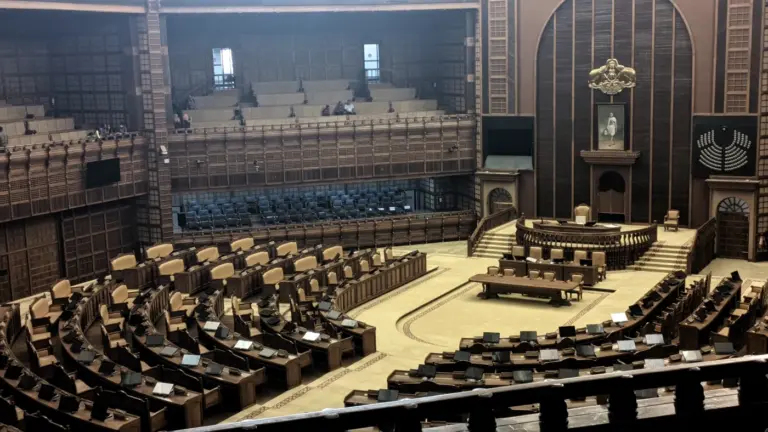
The Sixth Schedule of Indian Constitution is the special governance framework that the Constitution gives to tribal areas in four Northeast states: Assam, Meghalaya, Tripura, and Mizoram. It creates Autonomous District Councils (ADCs) and Autonomous Regional Councils (ARCs) with their own legislative, executive, judicial, and financial powers, allowing tribal communities to govern land, customary law, inheritance, and local administration with limited state and central interference. There are ten such councils today, and demands for extending the Sixth Schedule to Ladakh and parts of Arunachal Pradesh have become a recurring political issue.
For UPSC aspirants, the Sixth Schedule Indian Constitution is one of the highest-yield Polity topics. It cuts across Indian Polity (federal structure, asymmetric federalism), Governance (decentralisation, tribal administration), and GS Paper II (vulnerable sections, social justice). It is also a perennial favourite in Prelims because of the trap-worthy distinction between the Fifth and Sixth Schedules and in Mains because of its constant interaction with current affairs like the Bodo Accord, Ladakh’s statehood demand, and the Naga political dialogue.
This piece walks through what the Sixth Schedule actually contains, how its councils work, where it differs from the Fifth Schedule, why Ladakh is asking for inclusion, and what the path ahead looks like.
Quick Facts at a Glance
- Constitutional location: Sixth Schedule to the Constitution of India
- Enabling article: Article 244(2) and Article 275(1)
- States covered: Assam, Meghalaya, Tripura, Mizoram
- Total councils: 10 Autonomous District Councils and Autonomous Regional Councils
- Examples: Bodoland Territorial Council (Assam), Khasi Hills ADC (Meghalaya), Tripura Tribal Areas ADC, Chakma ADC (Mizoram)
- Members per council: Up to 30 (26 elected, 4 nominated by Governor)
- Term: Five years
- Origin: Bordoloi Sub-Committee of the Constituent Assembly
- Powers: Legislative, executive, financial, and limited judicial
- Subjects: Land, forests other than reserved forests, water resources, agriculture, village administration, inheritance, marriage, social customs, money lending, trade
- Governor’s role: Approves council laws, sets up the council, can dissolve in extreme cases
- Distinct from: Fifth Schedule (which applies to tribal areas of other states)
What the Sixth Schedule Actually Is
The Sixth Schedule of Indian Constitution is a special governance regime that grants substantial autonomy to designated tribal areas in four Northeast states. Under it, the Governor of the state, in consultation with the centre, designates tribal areas as Autonomous Districts. If different scheduled tribes live within one Autonomous District, the Governor can sub-divide it into Autonomous Regions. Each district has an Autonomous District Council (ADC), and each region has an Autonomous Regional Council (ARC).
These councils are not just consultative bodies. They are real lawmaking institutions with the constitutional authority to enact laws on a defined list of subjects, run their own courts for civil and criminal disputes between scheduled tribe members, collect specified taxes and fees, and manage land and forest other than reserved forest. State assemblies can legislate for these areas only with the agreement of the council, and certain central laws apply only after the council’s consent. The arrangement is, in effect, a third tier of federalism specifically designed for tribal self-governance in the Northeast.
Background and Historical Context
The Bordoloi Sub-Committee and Constitutional Origin
The Sixth Schedule comes from the work of the Bordoloi Sub-Committee of the Constituent Assembly, named after Gopinath Bordoloi, the first Premier of Assam. The Sub-Committee was set up in 1947 to recommend how the tribal areas of erstwhile Assam should be governed. The hill peoples there had long been administered separately by the British under the Government of India Acts of 1919 and 1935, which created “excluded” and “partially excluded” areas under direct British rule rather than provincial control.
The Bordoloi Sub-Committee’s recommendation was that this separate administration should continue in spirit but be brought inside the constitutional framework, with elected councils replacing colonial deputy commissioners. The Constituent Assembly accepted the recommendation. The Sixth Schedule was drafted, and the autonomy provisions for the Northeast were embedded directly in the Constitution rather than left to ordinary parliamentary law. The hill areas of undivided Assam, including the United Khasi-Jaintia Hills, the Garo Hills, the Mikir Hills (Karbi Anglong today), the North Cachar Hills, the Naga Hills, and the Lushai Hills (Mizoram today), were the initial coverage.
Successive reorganisations carved Meghalaya (1972), Mizoram (1987, after statehood), Arunachal Pradesh (1987), and Nagaland (1963) out of Assam, and the Sixth Schedule arrangements were retained, modified, or replaced depending on the new state’s political settlement. Nagaland is governed by Article 371A rather than the Sixth Schedule; Arunachal Pradesh has no Sixth Schedule areas at present, though entry into it and other Northeast states is regulated by the Inner Line Permit.
Key Features of Sixth Schedule Governance
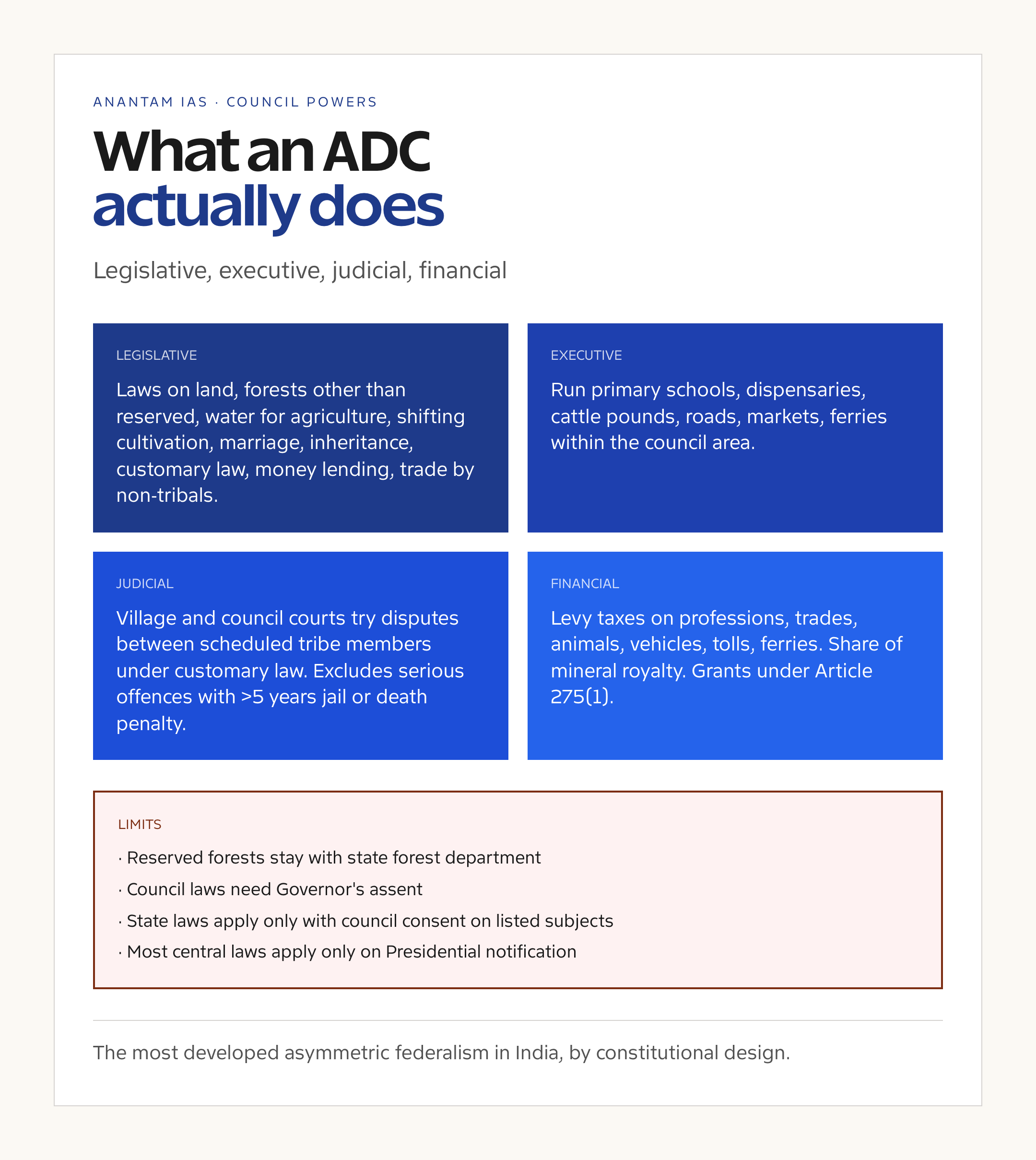
The Sixth Schedule Indian Constitution arrangement has several features that exam questions repeatedly target.
- Lawmaking power: ADCs can legislate on land, forest other than reserved forest, water for agriculture, shifting cultivation, village administration, inheritance, marriage, divorce, social customs, money lending, and trade by non-tribals within the district.
- Executive power: Councils execute the laws they make, manage primary schools, dispensaries, cattle pounds, road maintenance, and certain markets.
- Judicial power: Village councils and council courts can try civil and criminal cases between members of scheduled tribes, applying customary law. Serious offences carrying more than five years’ imprisonment or the death penalty are excluded.
- Financial power: Councils can levy taxes on professions, trades, animals, vehicles, ferry crossings, tolls on roads, and certain duties on entry of goods. They receive grants from the consolidated fund of the state under Article 275(1).
- Governor’s role: Approves the territorial extent of the council, gives assent to laws, supervises elections through state law, and can dissolve councils on the recommendation of an enquiry commission.
- Parliament and state legislature: Most central acts and state acts do not automatically apply to Sixth Schedule areas. They apply only with the President’s notification or council consent.
- Reserved forests excluded: Council jurisdiction does not extend to reserved forests, which remain under the state forest department, balancing tribal rights with national conservation needs.
- Mineral royalties: A share of mineral royalties from the council area is paid to the council.
Why the Sixth Schedule Matters
The Sixth Schedule matters because it institutionalises a form of asymmetric federalism that recognises that the Northeast tribal areas have a different historical, demographic, and legal trajectory from the rest of India. Land, customary law, and identity are interlinked in these regions in ways that ordinary state-level governance cannot easily handle. Stripping these protections would risk land alienation, demographic displacement, and political alienation of the kind that has fed insurgency in the region for decades.
The Schedule has also been the constitutional vehicle for peace settlements. The Bodo Accord of 2003 created the Bodoland Territorial Council, expanded under the 2020 Bodo Peace Accord, by amending the Sixth Schedule. The Tripura Tribal Areas Autonomous District Council was a key institution in absorbing former insurgents into mainstream politics. The Karbi Anglong Autonomous Council was strengthened under the 2021 Karbi peace agreement. Each of these is essentially the Sixth Schedule being used as a flexible constitutional tool to absorb identity-based demands without breaking the Indian federal structure.
For broader context on India’s constitutional architecture, also see 42nd amendment of Indian Constitution, Seventh Schedule of Indian Constitution, and the basic structure doctrine that limits what Parliament can change in arrangements like this one.
Detailed Analysis: The Ten Councils Today
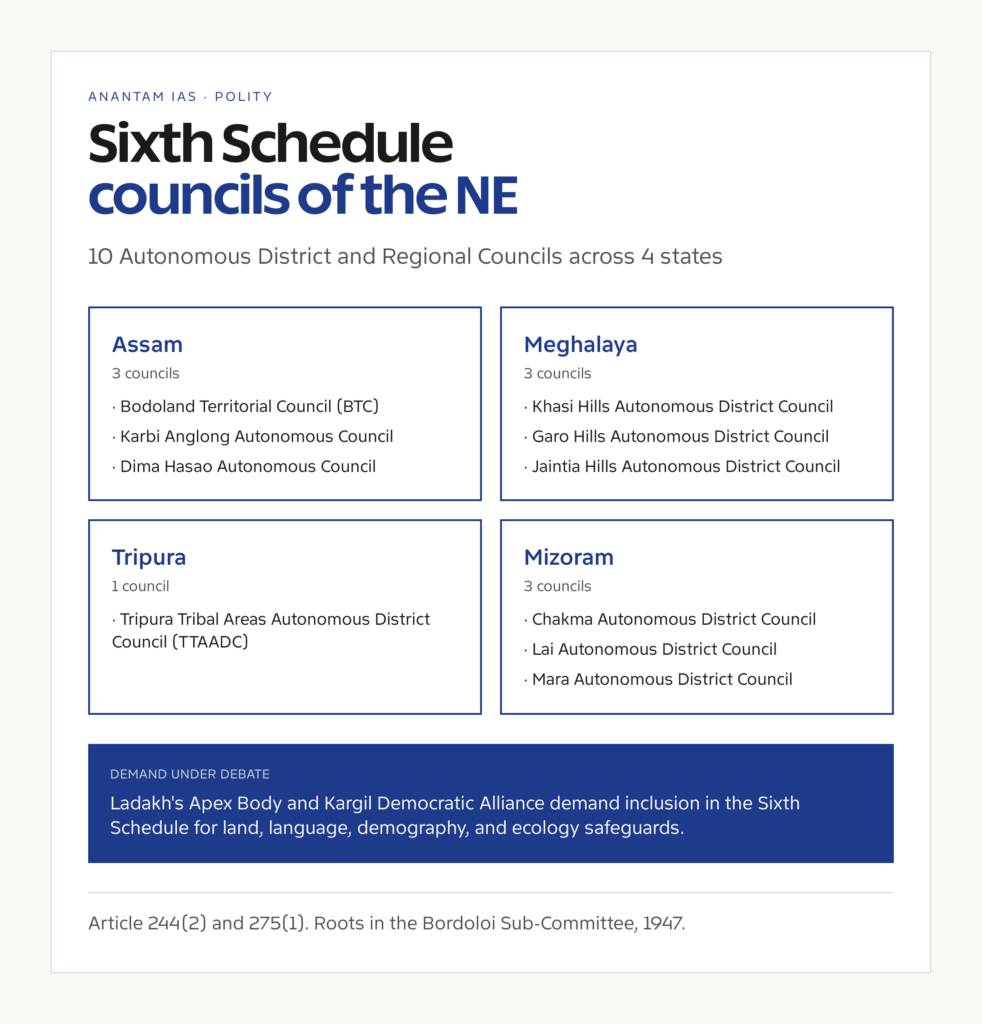
Across the four Sixth Schedule states there are ten Autonomous District Councils and Autonomous Regional Councils.
Assam (three councils): Bodoland Territorial Council (BTC), Karbi Anglong Autonomous Council, Dima Hasao Autonomous Council. BTC is the largest in scope after the 2020 accord, covering five districts grouped as the Bodoland Territorial Region.
Meghalaya (three councils): Khasi Hills Autonomous District Council, Garo Hills Autonomous District Council, Jaintia Hills Autonomous District Council. Meghalaya is effectively governed almost entirely under Sixth Schedule arrangements; the state government and the councils share authority closely.
Tripura (one council): Tripura Tribal Areas Autonomous District Council, covering most of the state’s tribal-majority hill territory.
Mizoram (three councils): Chakma Autonomous District Council, Lai Autonomous District Council, Mara Autonomous District Council, each covering a distinct ethnic minority within Mizoram’s predominantly Mizo state.
Each council has up to 30 members, of whom 26 are directly elected and four nominated by the Governor. The Chief Executive Member (CEM) heads the executive, drawn from the majority party in the council, and works with executive members holding portfolios analogous to state ministers.
Demand for additional councils is a constant feature of regional politics. The Kuki-Zo communities of Manipur, the Bru community returning to Mizoram, and several smaller groups in Arunachal Pradesh have at various points asked for autonomous council status.
Comparative: Fifth Schedule versus Sixth Schedule
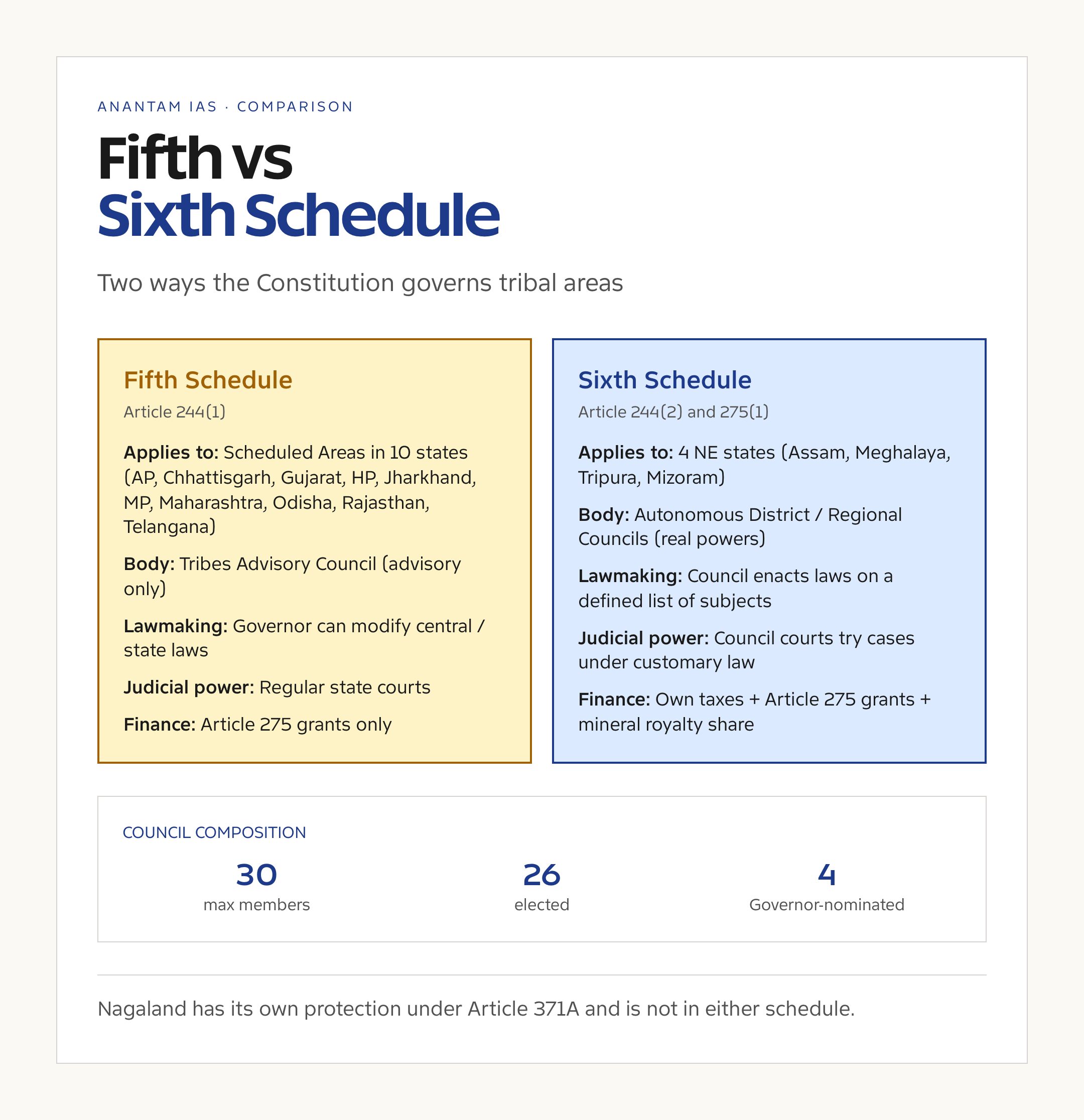
| Feature | Fifth Schedule | Sixth Schedule |
|---|---|---|
| Applies to | Scheduled areas in states other than Assam, Meghalaya, Tripura, Mizoram | Tribal areas in Assam, Meghalaya, Tripura, Mizoram |
| Constitutional article | Article 244(1) | Article 244(2) |
| Governance body | Tribes Advisory Council (advisory only) | Autonomous District / Regional Councils (executive and legislative) |
| Lawmaking | Governor can modify central / state law for scheduled areas | Council itself enacts laws on a defined list of subjects |
| Judicial power | Regular courts apply | Council courts can try cases under customary law |
| Financial autonomy | Limited; grants under Article 275 | Own tax powers plus grants under Article 275 |
| Number of states (current) | 10 states with Scheduled Areas | 4 states with Sixth Schedule areas |
The Fifth Schedule operates in states like Andhra Pradesh, Chhattisgarh, Gujarat, Himachal Pradesh, Jharkhand, Madhya Pradesh, Maharashtra, Odisha, Rajasthan, and Telangana. The Sixth Schedule is reserved for the Northeast. The two schedules together cover most tribal governance in India and reflect very different political histories. See also tribal issues India for the wider socio-economic context.
Challenges and Demands
- Demand for Ladakh inclusion: Since the 2019 reorganisation that made Ladakh a Union Territory, Ladakhi groups led by the Apex Body and Kargil Democratic Alliance have demanded inclusion in the Sixth Schedule to protect land, language, demography, and ecological balance. The demand has support across both Leh (Buddhist majority) and Kargil (Muslim majority).
- Coordination with state governments: Overlapping jurisdiction between state departments and councils creates friction, particularly around revenue, forest, and education.
- Capacity gaps: Some councils have weak administrative capacity, leading to delays in service delivery and infrastructure.
- Funding adequacy: Council own-revenue is limited; the bulk depends on state and central transfers, which can lag.
- Inclusion of non-tribal residents: Councils represent scheduled tribes; protecting the rights and political voice of non-tribal residents living in council areas remains a legal and political challenge.
- Demands from Arunachal Pradesh and Nagaland: Communities in Arunachal Pradesh ask for Sixth Schedule status; Nagaland has its own Article 371A arrangement and largely opposes Sixth Schedule incorporation.
Prelims Pointers
- The Sixth Schedule is enabled by Article 244(2) and Article 275(1) of the Constitution.
- It applies to Assam, Meghalaya, Tripura, and Mizoram.
- Recommended by the Bordoloi Sub-Committee of the Constituent Assembly.
- There are 10 Autonomous Councils at present under the Sixth Schedule.
- Each ADC has up to 30 members, with 26 elected and 4 nominated by the Governor.
- The term of a council is 5 years.
- ADC laws need the assent of the Governor to take effect.
- Council courts can try cases involving scheduled tribe members under customary law, except offences punishable by death or more than five years.
- Reserved forests are outside ADC jurisdiction.
- The Sixth Schedule was amended through accords creating the Bodoland Territorial Council in 2003 and expanded in 2020.
Mains Practice Questions
- The Sixth Schedule of Indian Constitution represents the most developed form of asymmetric federalism in India. Critically examine its design and effectiveness in the four Northeast states it covers. (GS Paper II, 250 words)
- Compare and contrast the Fifth and Sixth Schedules of the Constitution. Why are tribal areas of the Northeast treated differently from those in central and eastern India? (GS Paper II, 250 words)
- Discuss the constitutional, political, and ecological arguments for and against extending the Sixth Schedule to Ladakh. (GS Paper II, 250 words)
- The Sixth Schedule has been used as a constitutional tool to absorb identity-based demands, from the Bodo Accord to the Karbi peace agreement. Evaluate this approach with examples. (GS Paper II / III, 250 words)
Way Forward
The Sixth Schedule of Indian Constitution has proved remarkably durable for nearly seventy-five years. Its way forward is incremental rather than disruptive. First, the Ladakh demand needs a clear constitutional response, whether through a Sixth Schedule extension, a parallel constitutional safeguard, or another statehood-track arrangement. Second, council capacity has to be built through district-level training, predictable finance commission devolutions, and digital service delivery. Third, the rights of non-tribal residents in council areas should be codified to avoid the perception of exclusion. Fourth, the relationship between councils, state governments, and the Ministry of Tribal Affairs should be streamlined so that overlapping schemes do not duplicate or contradict one another.
The Sixth Schedule’s underlying logic, that the Constitution can accommodate radically different governance arrangements without abandoning its unitary core, will continue to be tested as new identity demands emerge from Manipur, Arunachal Pradesh, and the broader Northeast.
Frequently Asked Questions
What is the Sixth Schedule of Indian Constitution?
The Sixth Schedule is a constitutional framework that grants substantial autonomy to designated tribal areas in Assam, Meghalaya, Tripura, and Mizoram through Autonomous District Councils and Autonomous Regional Councils with legislative, executive, financial, and limited judicial powers.
Which states fall under the Sixth Schedule?
Four states currently have Sixth Schedule areas: Assam, Meghalaya, Tripura, and Mizoram. Together they host ten Autonomous District and Regional Councils.
What is the difference between the Fifth and Sixth Schedules?
The Fifth Schedule covers scheduled areas in ten other Indian states with a Tribes Advisory Council that is purely advisory. The Sixth Schedule covers four Northeast states with elected Autonomous District Councils that have real lawmaking, executive, and judicial powers.
How many members does an Autonomous District Council have?
Each Autonomous District Council can have up to 30 members, of whom 26 are directly elected and 4 are nominated by the Governor. The term of a council is five years.
What powers do Autonomous District Councils have?
ADCs can make laws on land, forests other than reserved forest, water for agriculture, shifting cultivation, marriage, inheritance, customary law, and trade. They also run village courts, collect specified taxes, and manage local services like primary schools and dispensaries.
Who recommended the Sixth Schedule?
The Bordoloi Sub-Committee of the Constituent Assembly, chaired by Gopinath Bordoloi, recommended the Sixth Schedule in 1947 to govern tribal areas of erstwhile Assam.
What is the Ladakh Sixth Schedule demand?
After Ladakh became a Union Territory in 2019, groups in Leh and Kargil have demanded inclusion in the Sixth Schedule to safeguard land, language, demography, and the fragile ecology of the high-altitude region.
What is the Bodoland Territorial Council?
The Bodoland Territorial Council is an autonomous council under the Sixth Schedule created by the 2003 Bodo Accord and expanded under the 2020 Bodo Peace Accord. It governs the Bodoland Territorial Region covering parts of Assam.
Are reserved forests under ADC control?
No. Reserved forests are excluded from the jurisdiction of Autonomous District Councils. They continue to be administered by the state forest department.
Why is Nagaland not under the Sixth Schedule?
Nagaland has its own special constitutional arrangement under Article 371A, negotiated through the 1960 Sixteen-Point Agreement, which protects customary law, land, and resources without using the Sixth Schedule framework.
Tell Google you want more of this.
Add Anantam IAS as a preferred sourceOne tap, and this site shows up more often in your own Top Stories, AI Overviews and AI Mode. Remove it any time.