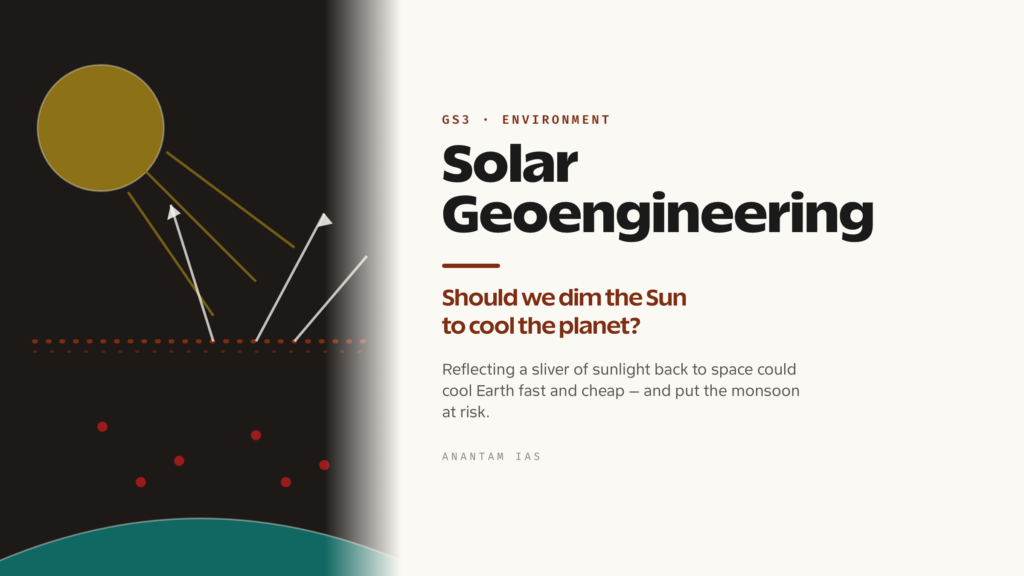
Imagine being told there’s a way to cool the entire planet for the price of a mid-sized infrastructure project — a few billion dollars a year, less than many countries spend on a single airport. No need to dismantle the fossil-fuel economy, no painful decade of emission cuts, just a fleet of high-flying aircraft spraying a fine haze into the upper atmosphere to bounce a sliver of sunlight back into space. Within a year or two, global temperatures would start to fall. That, stripped to its bones, is the promise of solar geoengineering, and it is exactly the kind of idea that sounds like science fiction until you realise serious scientists, two well-funded startups, and a growing slice of climate policy now treat it as a live option.
It has moved from the fringe to the agenda for a simple, uncomfortable reason: the world is failing to cut emissions fast enough to hold warming to safe levels, and as that failure sinks in, a planetary thermostat starts to look less mad and more tempting. But temptation is not the same as wisdom. Solar geoengineering would treat the symptom of climate change while leaving the disease — rising carbon dioxide — untouched, and it carries risks that fall hardest on monsoon-dependent countries like India. For a UPSC aspirant, this is one of the sharpest environment-and-governance debates going, sitting at the meeting point of climate science, ethics, technology and the unanswerable question of who gets to control the global sky.
What Solar Geoengineering Actually Is
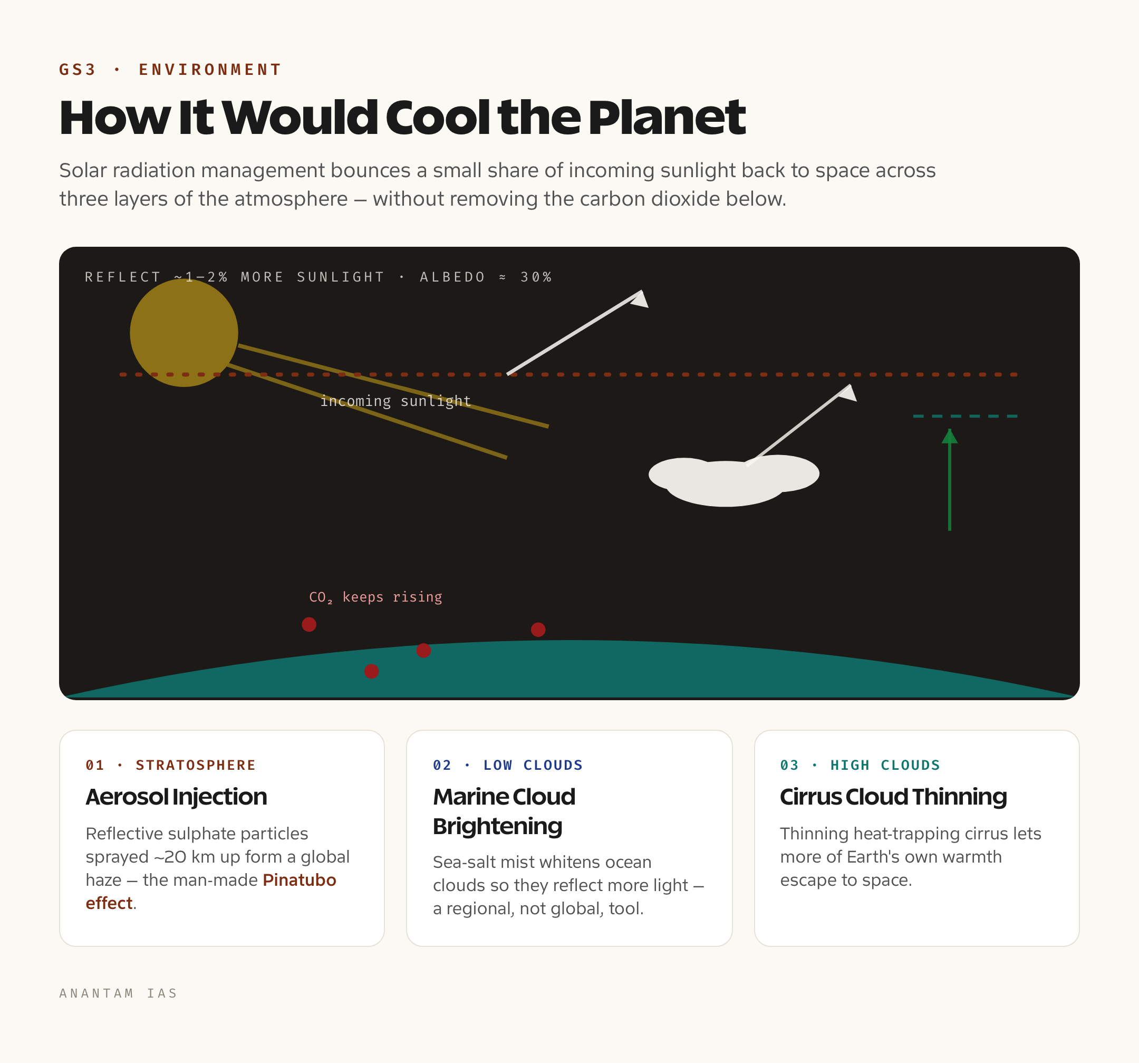
Start with the plain definition, because the name confuses people. Solar geoengineering — also called solar radiation management, or SRM — means deliberately reflecting a small fraction of incoming sunlight back to space so that less of the sun’s energy is trapped, and the planet cools. It does nothing to the greenhouse gases already in the air. It simply turns down the amount of heat arriving in the first place, the way a curtain cools a room without touching the radiator. Earth currently reflects about 30 per cent of the sunlight that hits it — that figure is called the albedo — and SRM aims to nudge that number up by a tiny amount, perhaps one or two per cent, which the physics says would be enough to offset a meaningful chunk of global warming.
There are three main ways scientists propose to do this, and they differ in altitude and ambition. The headline technique is stratospheric aerosol injection, or SAI: spraying tiny reflective particles, usually sulphate aerosols, high into the stratosphere about 20 kilometres up, where they spread into a thin global veil that scatters sunlight. The second is marine cloud brightening, which sprays a fine mist of sea salt into low ocean clouds so they grow whiter and more reflective — a regional tool rather than a global one, mimicking the bright “ship tracks” that vessel exhaust already leaves in marine clouds. The third, and least developed, is cirrus cloud thinning, which works the other way around: high, wispy cirrus clouds actually trap outgoing heat like a greenhouse, so seeding them to make them thinner would let more of Earth’s warmth escape to space.
The crucial thing to grasp is that all of this is still overwhelmingly theoretical. As the US Government Accountability Office set out in its 2026 review, the scientific concepts are understood but real-world deployment is immature — only a handful of small outdoor experiments have ever happened, including marine cloud brightening tests in Australia, and several proposed trials have been cancelled outright after public and ethical objections. One startup has been releasing small amounts of sulphur dioxide from balloons since 2022, and another raised about $75 million in 2025 to develop aircraft-based aerosol systems. So the technology is no longer pure fantasy — but nobody has come close to doing it at the planetary scale the idea actually requires, and that gap between a balloon experiment and a global veil is where most of the danger hides.
The Volcano Model and the Appeal of a Cheap, Fast Fix
To see why SAI in particular grips the imagination, look at the natural experiment that inspired it. In June 1991, Mount Pinatubo in the Philippines erupted and threw roughly 17 to 20 million tonnes of sulphur dioxide into the stratosphere. That sulphur spread into a global haze, and over the following year average global temperatures fell by about half a degree Celsius before the particles settled out and warming resumed. Nature had run the experiment for us: pump enough reflective sulphur high enough into the air, and the whole planet cools, measurably and quickly. Stratospheric aerosol injection is, in essence, a plan to recreate the Pinatubo effect on purpose and keep it running — a permanent, controllable, human-made volcano in chemical terms.
Two features make this dangerously attractive. The first is speed. Cutting emissions cools the planet only slowly, over decades, because carbon dioxide lingers in the atmosphere for centuries; SRM by contrast would start lowering temperatures within a year or two of deployment. In a genuine climate emergency — a runaway heatwave, an ice sheet tipping toward collapse — that speed could in theory shave the peak off a temperature spike and buy time. The second feature is cost. Published estimates put the price of a stratospheric programme at only a few billion dollars a year — studies suggest around $2 to $2.5 billion annually for an early deployment, and roughly $18 billion a year to suppress a full degree of warming. Against the trillions that deep decarbonisation demands, that looks almost trivial.
And that combination of cheap and fast creates what is, paradoxically, the deepest problem of all. Because SRM is so affordable, it lies within reach not just of superpowers but of a single wealthy nation, or even a determined billionaire, acting alone. That is what experts mean when they call it a technology with a “free-driver” problem rather than the usual free-rider one: with climate mitigation, everyone wants someone else to pay; with geoengineering, one actor could decide to deploy for everybody, whether the rest of the world agrees or not. A tool cheap enough to be unilateral is a tool that bypasses the slow machinery of global consent — and that should worry a country like India far more than it reassures it.

Why It Treats the Symptom, Not the Disease
Here is the objection that does the most damage to the whole idea, and it is one every aspirant should be able to state in a sentence. Solar geoengineering masks warming; it does not cure it. The root cause of climate change is the rising concentration of carbon dioxide and other greenhouse gases in the atmosphere, and SRM does absolutely nothing about that. It blocks some sunlight, so the thermometer reads lower, but the carbon keeps accumulating underneath the cooling veil, year after year. The planet ends up in a strange, fragile state — cooled on the surface, but loaded with ever more greenhouse gas, like turning up the air-conditioning in a house whose furnace is still roaring.
That fragility produces the single most cited danger in the field: termination shock. Because SRM only suppresses warming rather than removing its cause, the moment you stop spraying, all the heating that the accumulated carbon dioxide was always going to deliver arrives at once. After years of masked warming, an abrupt halt — caused by war, economic collapse, a pandemic grounding the aircraft, or simply a change of government — would unleash extremely rapid temperature rise, far faster than anything the planet would have faced without geoengineering at all. Ecosystems and societies cope poorly with slow warming; against a sudden lurch they have almost no chance to adapt. Deployment, once begun at scale, would have to be sustained without interruption for as long as the excess carbon stayed in the air — potentially a century or more, a multi-generational commitment no government can credibly guarantee.
There is a second blind spot that the cooling veil cannot touch: ocean acidification. As the oceans absorb carbon dioxide they turn more acidic, dissolving the shells and skeletons of corals, shellfish and plankton at the base of the marine food web. SRM blocks sunlight; it has no effect whatsoever on the carbon dioxide entering the sea, so the acidification — sometimes called the “other carbon problem” — would grind on unchecked even in a geoengineered world that felt pleasantly cooler. This is precisely why scientists insist that SRM is, at best, a painkiller and never a cure. It can mask the fever, but the underlying infection — and some of its worst complications — would keep advancing.
The India Problem: Monsoons, Rainfall and Moral Hazard
Now to the part that should concentrate an Indian mind, because the risks of solar geoengineering are not shared equally across the globe. The thing about dimming the sun is that it does not only lower temperature — it disturbs the great heat engine that drives the world’s rainfall. The monsoon, in particular, is powered by the temperature contrast between warm land and cooler ocean; cool the planet unevenly and you can weaken that contrast, and modelling studies repeatedly warn that large-scale SRM could suppress monsoon rainfall across Asia and Africa. A 2021 study in Scientific Reports examining the Indian summer monsoon found that solar geoengineering, and especially any sudden termination of it, could sharply disrupt the rains that more than a billion people and the bulk of Indian agriculture depend on. A cooler average planet that brings a failed monsoon is not a good trade for India.
This is the heart of the governance nightmare: SRM has different effects in different places. A deployment calibrated to suit one region — cooling the Arctic, say, or protecting North American crops — could simultaneously dry out the Sahel or shift the monsoon over the Gangetic plain. So the question “what temperature should the planet be?” has no single right answer; one nation’s optimum is another’s drought. If a country or coalition deployed SRM unilaterally and India’s monsoon then faltered, who would be blamed, and who would compensate the losers? There is no mechanism, no treaty, no court to settle it. A single thermostat for a planet of competing climates is a recipe for blame, suspicion and conflict.
Layered on top of the physical risks is a subtler, behavioural one that economists call moral hazard. The very existence of a cheap technological fix could sap the political will to do the hard, necessary work of cutting emissions. If leaders and publics believe a planetary thermostat is waiting in the wings, the pressure to decarbonise eases, mitigation slips, and carbon keeps rising — leaving the world more dependent on the very geoengineering that was meant to be a backstop. Critics call SRM a “dangerous distraction” and a “moral hazard” for exactly this reason: not because the science is impossible, but because the mere promise of it could become an excuse to keep burning fossil fuels. The cure, in other words, might quietly make the disease worse.
How the World Is Trying to Govern It
The debate over what to do has split into two broad camps, and an aspirant should be able to lay both out fairly. On one side stands a large and vocal coalition demanding a halt before deployment ever becomes thinkable. An open letter calling for an international Non-Use Agreement on solar geoengineering — signed by hundreds of academics and endorsed by thousands of civil-society organisations — asks governments to commit to five things: no public funding for SRM development, a ban on outdoor experiments, no patents on the technology, no support for it through international bodies like the UN, and no deployment of any system third parties might build. In 2025 the African Ministerial Conference on the Environment, speaking for an entire continent, rejected solar geoengineering outright and backed the call for such a non-use agreement. Their argument is blunt: the technology is too risky, too tempting as a distraction, and too easy for the powerful to impose on the vulnerable, so the safest course is to close the door now.
On the other side sits a more cautious camp that resists an outright ban while sharing many of the same fears. Its case is that warming is already dangerous, that some form of intervention might one day be needed in a genuine emergency, and that the worst possible outcome would be a desperate future government deploying SRM in a panic with no understanding of how it behaves. Better, they argue, to permit careful, transparent, internationally supervised research — not deployment — so that humanity at least knows what it is dealing with before anyone reaches for the lever. The United Nations has edged toward this middle ground: its Secretary-General’s Scientific Advisory Board has recommended a global governance forum and a scientific review mechanism for solar radiation modification, an attempt to put guardrails around the science rather than either banning or unleashing it.
For India, the stakes in this argument are unusually high and the position relatively clear. As a vast, climate-vulnerable, monsoon-dependent nation that did little to cause the crisis, India has every reason to be wary of a technology that could disrupt its rainfall and that a richer country might deploy without its consent. At the same time, India cannot afford to be absent from the rooms where the rules get written, because a global thermostat designed without it would be a thermostat designed against its interests. The sensible Indian stance — and a strong line for an answer — is to insist that no nation may unilaterally alter the planet’s climate, to push for inclusive global governance under the UN where developing countries hold real weight, and to keep the world’s focus where it belongs: on cutting emissions, the only fix that addresses the disease itself. As India’s own climate diplomacy on the broader climate change challenge has long argued, equity and the principle of common-but-differentiated responsibility must anchor any planetary decision.
For Your Mains Answer
This is a high-value topic for GS Paper 3, which covers environment, conservation, and developments in science and technology and their applications. Solar geoengineering also reaches into GS Paper 2 through global governance and international institutions, and offers a rich, ethics-laden case for the Essay and the GS Paper 4 (Ethics) themes of responsibility, the precautionary principle and intergenerational justice. The skill examiners reward is balance: explain the genuine appeal of the technology honestly, then weigh it against the risks, and land on a clear, principled position rather than a one-sided rejection.
How to Build the Answer
Move in a clean logical chain. Define solar geoengineering and distinguish it from carbon-dioxide removal. Lay out the three techniques, with stratospheric aerosol injection and the Pinatubo analogy as the anchor. State the appeal — fast and cheap — fairly. Then turn to the risks in order of weight: it treats the symptom not the cause, termination shock, monsoon and rainfall disruption (the India angle), ocean acidification, moral hazard, and the governance problem of a single thermostat for many climates. Close with the governance debate — non-use agreement versus supervised research — and India’s interest in inclusive, equity-based rules. That arc — define, distinguish, appeal, risks, governance, verdict — fits almost any framing of the question.
Common Mistakes to Avoid
Don’t confuse solar geoengineering with carbon-dioxide removal — SRM blocks sunlight and leaves carbon untouched, while CDR actually pulls carbon out of the air and tackles the root cause. Don’t treat SRM as a solution to climate change; it is at most a temporary painkiller. Don’t forget ocean acidification, which the cooling veil cannot fix. And don’t write a purely alarmist answer that ignores the real argument for cautious research — the balanced response scores higher than the one-sided one.
A Compact Answer Spine
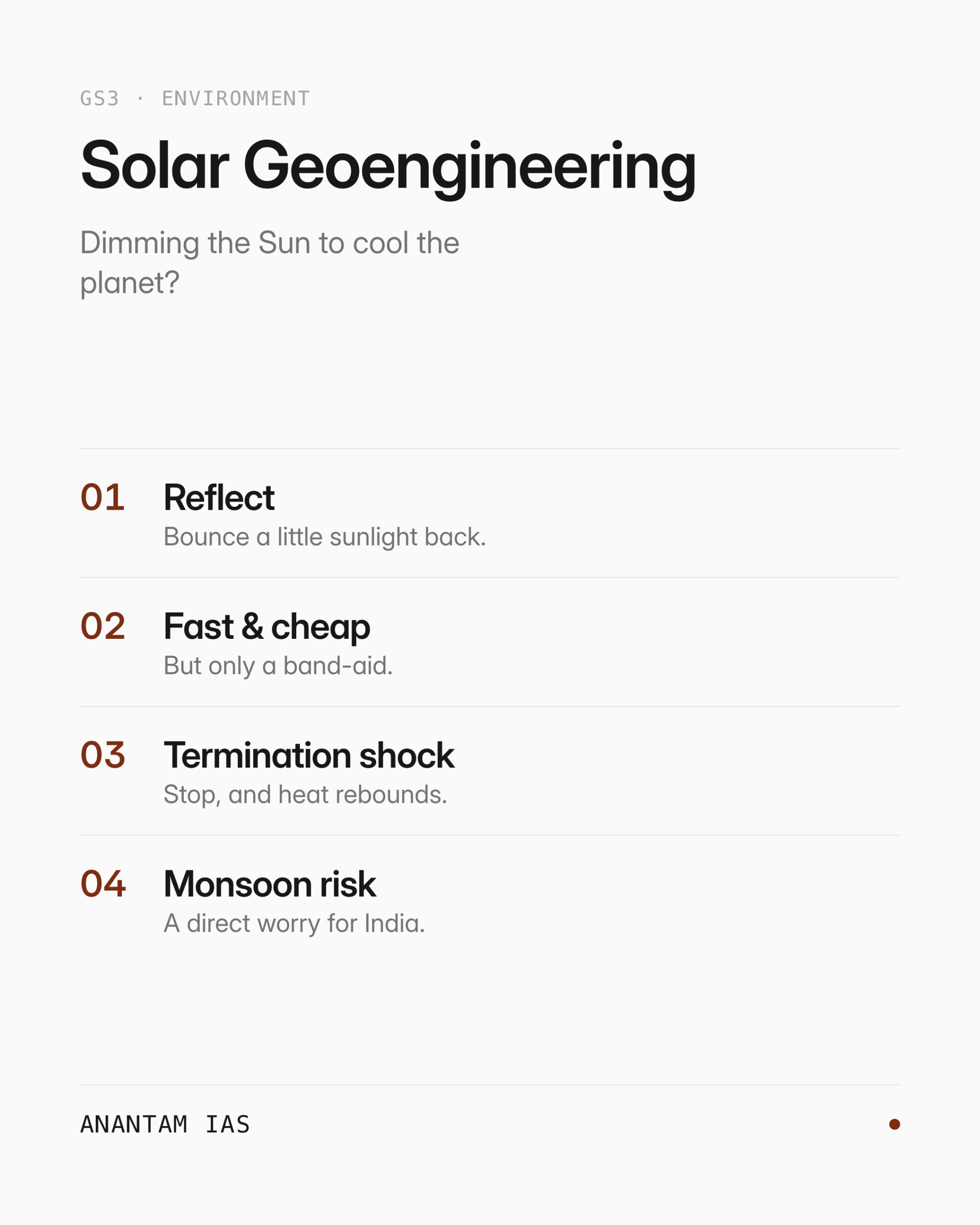
Solar geoengineering (SRM) = reflecting a little sunlight back to space to cool Earth, without removing CO2 → three methods: stratospheric aerosol injection (the Pinatubo analogy, ~0.5°C cooling in 1991), marine cloud brightening, cirrus cloud thinning → appeal: fast (cools within a year or two) and cheap (a few billion dollars a year) → risks: treats symptom not cause, termination shock if stopped suddenly, suppresses the Asian/Indian monsoon, ignores ocean acidification, moral hazard that erodes mitigation, and a “free-driver” governance problem (one actor could deploy for all) → governance: non-use-agreement camp versus cautious-research camp, UN advisory board urging a global forum → India’s stake: monsoon-dependent and climate-vulnerable, so insist on no unilateral deployment, inclusive UN governance, and primacy of emission cuts.
Diagram or Flowchart Idea
Draw a simple cross-section of the atmosphere with the sun on one side, an arrow of incoming sunlight, and a reflective layer (stratospheric aerosols high up, brightened clouds lower down) bouncing a portion of it back to space, with carbon dioxide molecules still piling up below the veil to show that the cause is untouched. Beside it, a small two-column “appeal versus risks” box. This single visual captures both how SRM works and why it is only a mask.
A Balanced-Conclusion Line
A line that lands the marks: “Solar geoengineering may one day be a painkiller for a feverish planet, but it is no cure — and for a monsoon-dependent India, the wiser course is to treat the disease at its source through deep emission cuts, while insisting that no nation be allowed to set the world’s thermostat alone.”
How to Use Data Without Cramming
You need only a few anchors, not a library. Pinatubo’s roughly 0.5°C of global cooling in 1991-92 grounds the volcano analogy; a cost of a few billion dollars a year (about $18 billion to suppress one degree) grounds the “cheap” claim; the 30 per cent albedo figure grounds the mechanism; and the 2025 African ministers’ rejection and the academics’ non-use letter ground the governance section. Attribute them plainly — “as a 2021 study on the Indian summer monsoon warned” — rather than scattering numbers loose.
Frequently Asked Questions
What is solar geoengineering in simple terms?
It is the deliberate reflection of a small fraction of incoming sunlight back into space to cool the planet, also called solar radiation management or SRM. The main proposed methods are stratospheric aerosol injection (spraying reflective sulphate particles high in the atmosphere to mimic a volcanic eruption), marine cloud brightening (making ocean clouds whiter with sea-salt spray), and cirrus cloud thinning. Crucially, it lowers temperature without removing the greenhouse gases that cause warming, so it masks the problem rather than solving it.
How is solar geoengineering different from carbon-dioxide removal?
They tackle climate change at opposite ends. Solar geoengineering blocks some sunlight so the planet feels cooler, but the carbon dioxide stays in the air — it treats the symptom. Carbon-dioxide removal, or CDR, actually extracts carbon dioxide from the atmosphere through methods like afforestation, direct air capture or enhanced weathering — it addresses the cause. CDR is slower and more expensive but durable and safe; SRM is fast and cheap but risky and only ever temporary.
What is termination shock?
Termination shock is the danger that arises if large-scale solar geoengineering is deployed and then suddenly stopped. Because SRM only masks warming while carbon dioxide keeps building up, an abrupt halt — from war, economic collapse or political change — would release all the suppressed warming at once, producing extremely rapid temperature rise that ecosystems and societies could not adapt to. It means any serious deployment would have to continue uninterrupted for a century or more.
Why is solar geoengineering a particular risk for India?
Because dimming the sun disturbs rainfall, and India depends on the monsoon. The monsoon is driven by the temperature difference between warm land and cooler ocean, and modelling studies — including a 2021 study on the Indian summer monsoon — warn that large-scale SRM, and especially its sudden termination, could suppress or destabilise these rains on which over a billion people and most Indian agriculture rely. India also faces the governance risk that another country could deploy SRM unilaterally, disrupting its climate without its consent.
Practice Questions
Prelims MCQs
- Solar geoengineering, or solar radiation management, refers to which of the following?
(a) Removing carbon dioxide from the atmosphere using direct air capture
(b) Reflecting a small fraction of incoming sunlight back to space to cool the planet
(c) Generating electricity from concentrated solar power plants
(d) Storing captured carbon dioxide in underground rock formations
Answer: (b) SRM aims to cool Earth by reflecting sunlight; it does not remove greenhouse gases, which distinguishes it from carbon-dioxide removal. - Which technique of solar geoengineering is most often compared to the cooling caused by a major volcanic eruption such as Mount Pinatubo in 1991?
(a) Marine cloud brightening
(b) Cirrus cloud thinning
(c) Stratospheric aerosol injection
(d) Ground-based afforestation
Answer: (c) Stratospheric aerosol injection sprays reflective sulphate particles into the stratosphere, mimicking the global haze that Pinatubo created in 1991, which cooled the planet by about half a degree Celsius. - The term “termination shock” in the context of solar geoengineering refers to which of the following?
(a) The sudden cooling felt immediately after deployment begins
(b) The rapid warming that would follow if large-scale deployment were abruptly stopped
(c) The financial cost of ending a geoengineering programme
(d) The depletion of stratospheric ozone by sulphate particles
Answer: (b) Because SRM masks warming while carbon dioxide keeps rising, a sudden stop would release suppressed warming all at once, causing dangerously rapid temperature rise. - Which of the following problems would NOT be addressed by solar radiation management?
(a) High surface air temperatures
(b) Extreme summer heatwaves
(c) Ocean acidification
(d) Melting of surface ice from heat
Answer: (c) SRM blocks sunlight but does nothing about the carbon dioxide entering the oceans, so ocean acidification would continue unchecked. - The proposed international “Non-Use Agreement” on solar geoengineering primarily seeks to:
(a) Standardise the safe deployment of stratospheric aerosols worldwide
(b) Restrict the funding, outdoor testing, patenting and deployment of solar geoengineering
(c) Allocate carbon credits for countries that reduce their albedo
(d) Fund large-scale marine cloud brightening over the oceans
Answer: (b) The non-use agreement, backed by hundreds of academics and many governments, calls for bans on public funding, outdoor experiments, patents, and deployment of SRM technologies.
Mains Practice Questions
- What is solar geoengineering? Distinguish it from carbon-dioxide removal and critically examine whether it can be a viable response to climate change. (15 marks, 250 words)
- “Solar geoengineering treats the symptom, not the disease.” Discuss this statement with reference to the phenomena of termination shock and ocean acidification. (15 marks, 250 words)
- Examine why solar radiation management poses a particular risk to monsoon-dependent countries like India, and outline the position India should take in international negotiations on the technology. (15 marks, 250 words)
- The cheapness and speed of solar geoengineering create a unique governance challenge. Analyse the “moral hazard” and “unilateral deployment” problems associated with it. (10 marks, 150 words)
- Compare the case for an international non-use agreement on solar geoengineering with the case for cautiously regulated research. Which approach better serves global equity and the interests of developing nations? (15 marks, 250 words)
Tell Google you want more of this.
Add Anantam IAS as a preferred sourceOne tap, and this site shows up more often in your own Top Stories, AI Overviews and AI Mode. Remove it any time.