

For sixty years ISRO did everything. It designed the rocket, built the satellite, launched the mission, regulated who else could fly, and was the only customer worth selling to. That made for a proud public-sector story and some genuinely cheap miracles. But it also meant the agency was player, referee and buyer all at once, which is no way to grow an industry. The Indian Space Policy 2023, made public on 20 April 2023, finally split those roles apart and invited private companies into the whole value chain. In November 2025 NISAR, the radar satellite India built with NASA, went operational, IN-SPACe closed its first ₹1,000-crore venture fund, and a Gaganyaan uncrewed test was being readied for the second half of 2026. So the reform is no longer a policy paper. It’s a working system you can now judge on results.
And the verdict aspirants have to write isn’t a cheer or a complaint. It’s harder than that. The architecture is sound and the early wins are real, yet a sector chasing a $44-billion future is running on a budget about a fifteenth of NASA’s and drawing barely 1.3 percent of the world’s space capital. Reform that opens the door is necessary. It just isn’t the same thing as reform that fills the room.
The Issue, Framed
The question here isn’t whether India should open space to private firms. That argument is settled. The question is whether opening participation is enough when the state still controls the demand, the capital, and the strategic core.
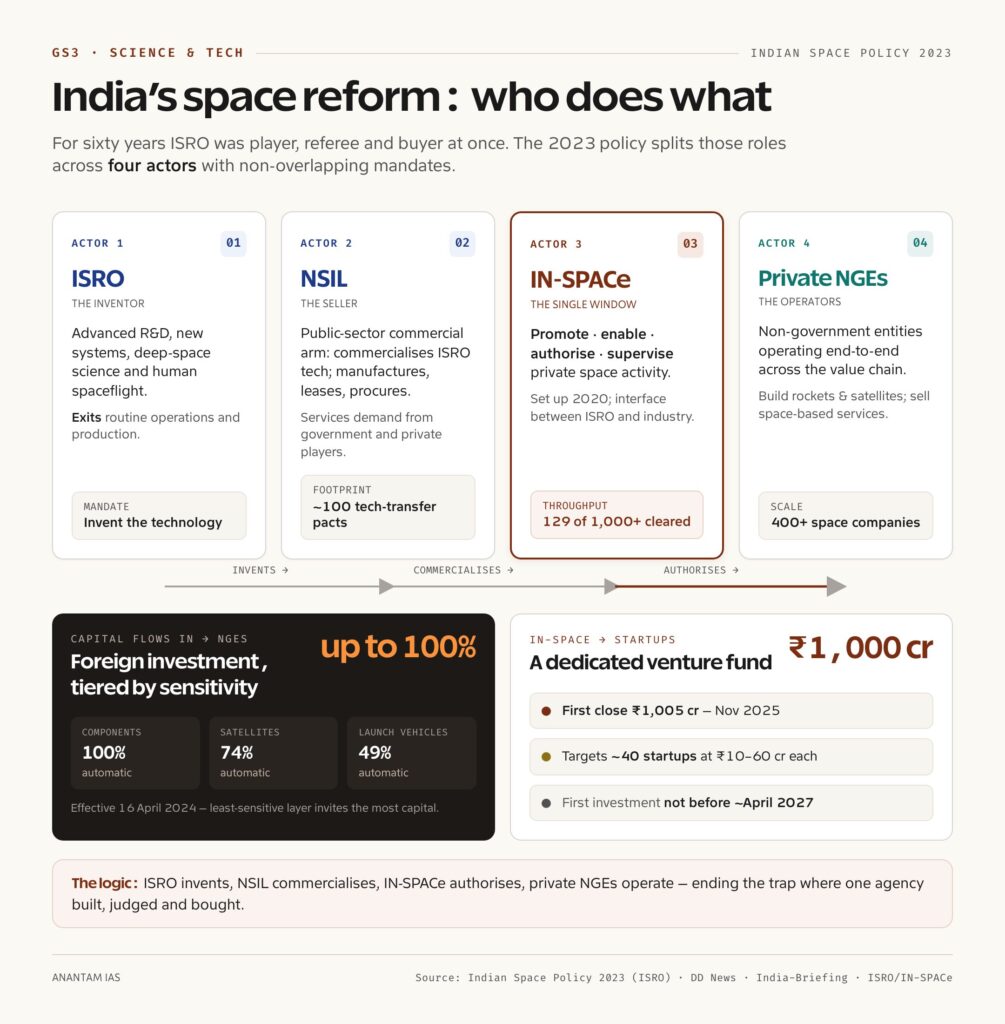
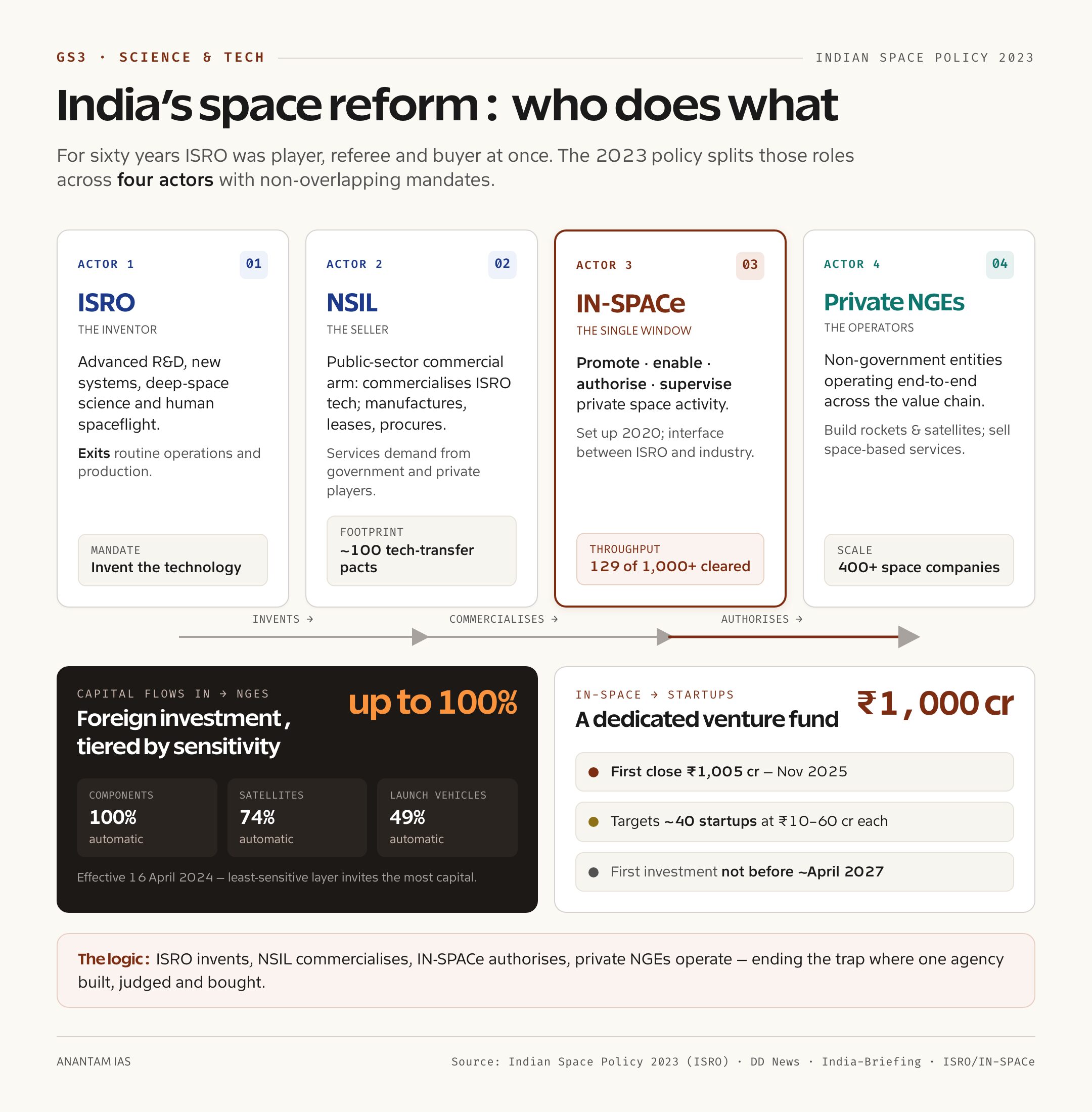
Let’s fix the vocabulary first, because most confusion on this topic comes from people treating four very different bodies as one. The Indian Space Policy 2023 builds what’s best called a four-actor model, and each actor has a job the others don’t.
ISRO stops being a do-everything agency. Under the policy it moves to advanced research and development, new systems, deep-space science and human spaceflight, and is meant to exit routine operations and production. NSIL, NewSpace India Limited, is the public-sector commercial arm: it takes technology built with public money and sells, leases or licenses it, and services demand from both government and private players. IN-SPACe, the Indian National Space Promotion and Authorisation Centre, set up in 2020 and formalised by the 2023 policy, is the single-window body that promotes, enables, authorises and supervises private activity, sitting between ISRO and industry. And the fourth actor is the new one: private non-government entities (NGEs), the companies the policy now lets operate end-to-end, building rockets and satellites and selling space-based services on their own account.
A non-government entity is just the policy’s umbrella term for a private firm in space, from a two-person startup to a telecom giant. That word matters, because the old model had no real place for them. The new one is built around them.
So the reform isn’t one decision. It’s a redrawing of who does what. ISRO invents, NSIL commercialises, IN-SPACe authorises, and private NGEs operate. Done well, that ends the conflict-of-interest trap where the same agency built, judged and bought. Whether it’s been done well enough is the whole debate.
What the Data Says
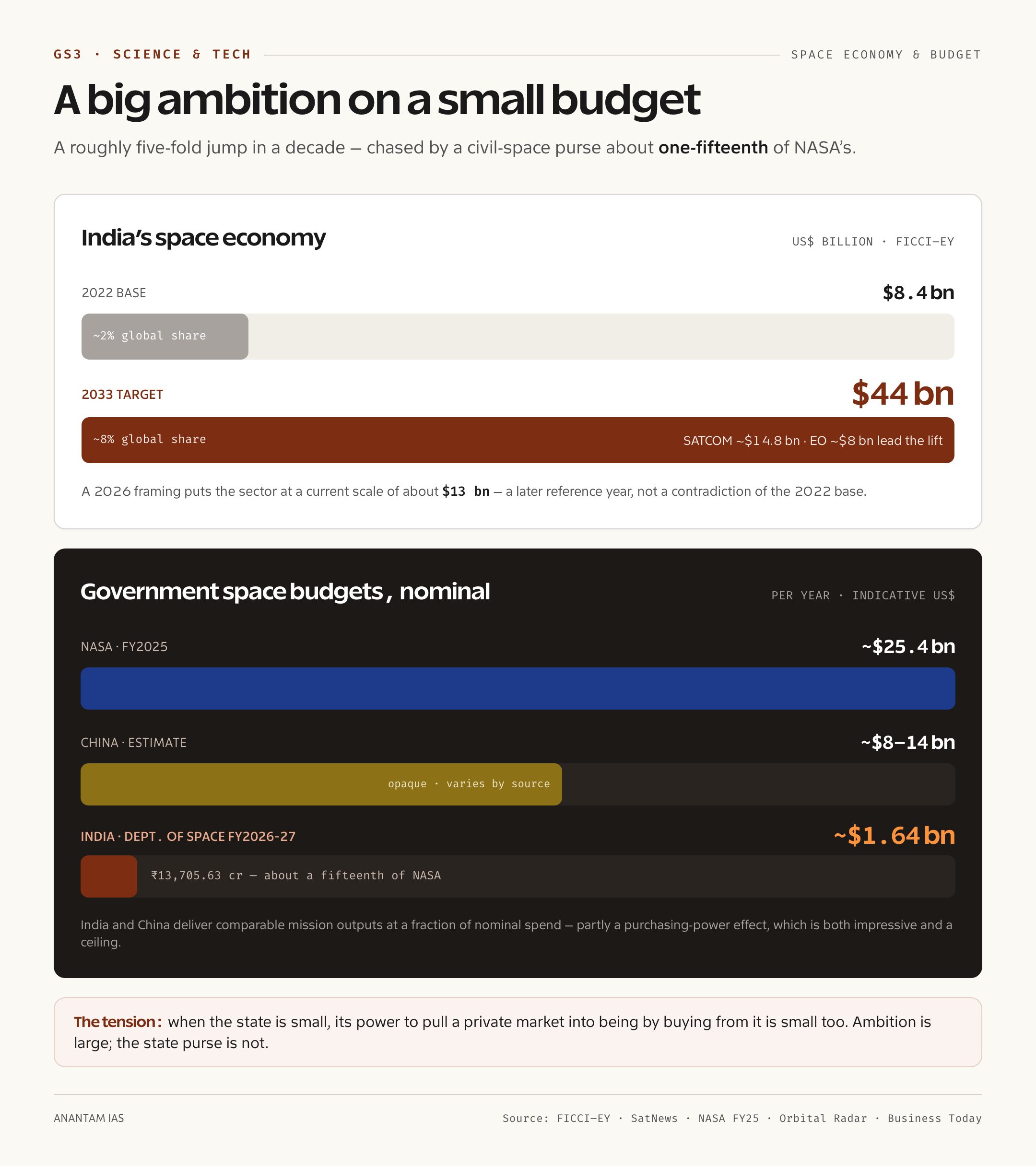
Start with the money the sector is supposed to chase, because it frames everything else. A FICCI-EY report put India’s space economy at about $8.4 billion in 2022, with a target of roughly $44 billion by 2033. The same report frames the ambition in share terms: lifting India from about 2 percent of the global space economy to about 8 percent. By 2026 reporting describes the sector at a current scale of around $13 billion – not a contradiction of the $8.4 bn figure, just a later reference year. So the headline is a roughly five-fold jump in about a decade, with satellite communications and Earth observation doing most of the lifting.
Now set that ambition against what the state actually spends. The Department of Space budget for FY2025-26 was ₹13,416.2 crore, and for FY2026-27 it rose to ₹13,705.63 crore, about $1.64 billion, with capital spending up over ₹1,000 crore year on year. Hold that next to NASA’s roughly $25.4 billion for FY2025 and the gap is stark: India’s civil space budget is about a fifteenth of NASA’s in nominal terms. China’s spend is estimated at somewhere between $8 billion and $14 billion a year, though the figures are opaque and vary by source, so treat that as a range, not a fact. The honest framing is that India delivers comparable mission outputs at a fraction of nominal spend, partly a purchasing-power effect – which is impressive and also a ceiling.
The doors to foreign money, meanwhile, have swung wide. Effective 16 April 2024, India revised its FDI rules so that up to 100 percent foreign investment is now allowed across all three space sub-sectors, with the route calibrated by how strategic each one is. Manufacturing of satellite components, systems and sub-systems is 100 percent automatic – no approval needed. Satellites and the ground/user segment allow up to 74 percent automatic, and beyond that to 100 percent by government approval. Launch vehicles and spaceports, the most dual-use of the three, allow up to 49 percent automatic, with the rest needing approval. So the design is deliberate: invite the most capital into the least sensitive layer.
And capital is arriving, if you read the counts carefully. A government review in April 2026 confirmed over $600 million of private investment across five years, said private space companies had grown from single digits in 2019 to 400-plus by early 2026, and reported IN-SPACe had granted 129 authorisations from more than 1,000 applications. Be precise with that startup number, because it shifts by definition: a separate tracker counts about 253 space-tech startups in May 2026, while “400+” is the broader space-company figure and “1,000+” is IN-SPACe registrations. So cite the figure that matches your framing, and label it. The growth is real either way.
The Case For
The case that reform is working is strong, and a lazy answer would skip it. So let’s state it at full strength, because each point rests on something that actually happened.
First, the architecture is real, not a slogan. The 2023 policy gives each of the four actors a non-overlapping mandate, which ends the old trap where ISRO built the hardware, decided who else could fly, and was the only buyer. A market needs a referee who isn’t also a player. India now has one in IN-SPACe, at least on paper.
Second, private companies are already flying hardware. Skyroot Aerospace launched Vikram-S, India’s first privately developed rocket, on a suborbital “Prarambh” flight in November 2022. Agnikul Cosmos followed with Agnibaan SOrTeD, the first flight from a privately owned launchpad at Sriharikota in June 2024, using a 3D-printed, semi-cryogenic engine with IIT-Madras roots. So this isn’t startups drawing slides. It’s startups firing engines.
Third, the capital signal is genuine. Over $600 million invested in five years, 129 IN-SPACe authorisations, and around 100 NSIL technology-transfer agreements say the ecosystem has moved from pilot to scale. And the 100 percent FDI opening tells foreign manufacturers India wants to be a supply-chain node, not just a cheap launch service.
Fourth, there’s now a dedicated pool of patient capital. The Cabinet approved a ₹1,000-crore venture fund under IN-SPACe in October 2024, aimed at roughly 40 startups at ₹10-60 crore each, and it hit its first close at ₹1,005 crore in November 2025. A sovereign fund writing early cheques is exactly the confidence signal a young deep-tech founder needs.
And fifth, the public-sector heritage de-risks the whole thing. Chandrayaan-3 soft-landed near the lunar south pole on 23 August 2023, the first mission ever to do so. Aditya-L1, India’s first solar observatory, reached its halo orbit around the Sun-Earth L1 point in January 2024. And NISAR, the dual-frequency radar satellite built with NASA, launched in July 2025 and went operational on 7 November 2025. Each gives Indian startups a credible national technology base to build on, at peer-shaming cost. So the foundation is sound. The argument against isn’t that the reform is fake. It’s that it stops short.
The Case Against
Here’s what the success story walks past. Opening a sector is the easy half. Making the capital, the demand and the certainty show up is the half that decides whether any of this scales – and on each of those, the gaps are real.
The budget is the first ceiling. About $1.64 billion a year can’t anchor a $44-billion ambition the way NASA’s $25.4 billion anchors the US private sector. When the state is small, its power to pull a private market into being by buying from it is small too. So the very lever reform depends on – government demand – is structurally underpowered.
The capital starvation is the second. India’s spacetech draws only about 1.3 percent of global space capital despite a roughly $13-billion sector, a Business Today analysis pointed out in May 2026. And the flagship fix, that ₹1,000-crore venture fund, illustrates the problem rather than solving it: approved in October 2024, first close in November 2025, but its first investment isn’t expected before about April 2027 – a two-year lag from approval to first cheque. Patient capital is good. Capital this patient is a problem.
The demand side is the third, and probably the deepest. Space startups have long product cycles and need assured buyers to be credible to investors, but they face procurement delays and repeated cross-departmental validation, and sometimes the state simply prefers its own. When the small-satellite launch vehicle technology was transferred, it went to HAL, a public-sector undertaking, rather than to a private competitor. So the missing piece isn’t enthusiasm. It’s a firm anchor-customer commitment.
The fourth gap is conceptual, and ORF puts it best: this is “commercialisation, not privatisation.” The state still owns the strategic core, so reform expands private participation without transferring control. That protects strategic assets, which is defensible. But it can also crowd out private revenue and slow the very pivot the policy promises.
The fifth is regulatory friction. IN-SPACe is promoter and regulator inside one body, and the binding constraint isn’t the policy text – it’s throughput. 129 authorisations from more than 1,000 applications, plus procurement timelines, are what actually slow founders down. A single window only helps if the window opens quickly.
Sixth, there’s the dependence-and-IP risk that 100 percent FDI invites. ORF warns that without domestic patient capital mobilised across stages, Indian startups stay “Indian” in name while control and intellectual property migrate to foreign backers. The open door cuts both ways.
And seventh, scale brings a new attack surface. A bigger, privatised, satcom-heavy ecosystem – think Jio Satellite, OneWeb, Starlink licences – is a fatter cyber target. India’s first space cybersecurity framework, released in February 2026 by CERT-In and SIA-India, mandates six-hour incident reporting, annual audits and post-quantum (quantum-resistant) encryption because satellites stay in orbit for 10-15 years and must outlast tomorrow’s code-breaking. It’s a serious start. Whether small operators can actually meet it is untested.
The Deeper Structural Read
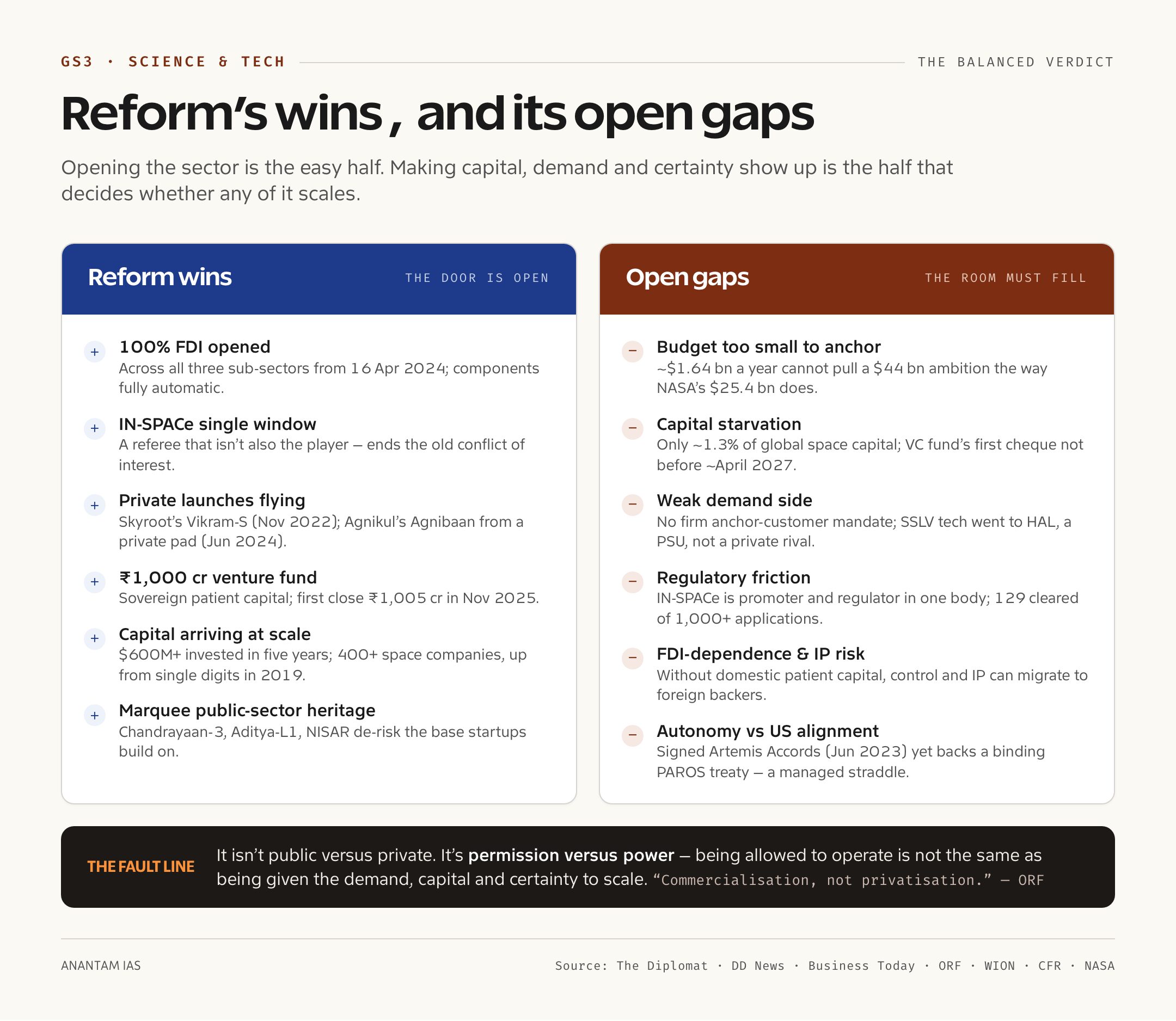
Step back from the missions and the milestones, and the real fault line shows up. It isn’t public versus private. It’s the gap between permission and power – between being allowed to operate and being given the demand, capital and certainty to actually scale.
The 2023 policy is overwhelmingly a permission document. It says who may do what. That was the missing piece for decades, so it matters. But a private space industry doesn’t grow on permission. It grows on three things the policy can only gesture at: a buyer with deep pockets, capital willing to wait, and rules that don’t change mid-mission. The state controls all three, and on all three it’s currently thin. So the structural risk is a beautifully designed architecture sitting on top of an underpowered base.
ORF’s “commercialisation, not privatisation” line is the sharpest analytical frame here, and it belongs in your answer. The Indian model deliberately keeps the strategic core in state hands – launch sovereignty, deep-space science, dual-use technology – and lets the private sector operate around it. Compared with the American model, where the state is a massive buyer from genuinely private firms, India is closer to a state that permits private firms but hasn’t yet become their anchor customer. That’s a real choice, not an accident. It guards sovereignty. It also caps the speed of the pivot.
There’s a strategic layer underneath, too, and CFR frames it as a straddle. India signed the US-led Artemis Accords in June 2023, a shift from its older preference for UN-negotiated, legally binding space rules. Yet it simultaneously backs a binding PAROS treaty – Prevention of an Arms Race in Outer Space – at the UN, and has abstained on US-aligned resolutions on anti-satellite testing and space-threat reduction. CFR describes India as an “emerging norm shaper, straddling the line between ambition and autonomy”. So the same reform that deepens NISAR-style cooperation with NASA also has to preserve strategic independence. That tension isn’t resolved. It’s managed, deal by deal.
And here’s the part that should bother you most as a future administrator. The strongest technical argument for private space – that India can’t build a $44-billion economy on a $1.64-billion state budget – is also the strongest argument that reform alone won’t deliver it. Opening the sector matters precisely because the government is too small to do it all. But that same smallness limits the government’s power to pull the private market into being by buying from it. So the policy diagnoses the problem correctly and then runs into the very constraint that made the problem real. Permission was the cheap part. Power is the expensive part, and it hasn’t been funded yet.
What Should Be Done
So what would turn a sound architecture into a scaling industry? Not a vague plea for “more support,” but a set of moves you could put in front of a policymaker tomorrow. Seven of them, and none weakens the strategic core.
- Become a credible anchor customer. The single highest-leverage fix for demand-side weakness is a multi-year government commitment to buy data, launches and services from domestic NGEs on predictable RFP timelines. A startup can raise money against a signed government contract in a way it never can against a policy promise. The reasoning behind India’s single-window space regulator was to make private activity easy; making the state a reliable buyer is the next, harder step.
- Deploy patient capital fast, and crowd in domestic money. Don’t let the ₹1,000-crore fund’s first cheque wait until 2027. Accelerate deployment, and pull pension, insurance and sovereign capital into later stages so intellectual property and control stay onshore even as 100 percent FDI brings foreign money in.
- Deliver regulatory certainty. Publish service-level timelines for IN-SPACe authorisations, firewall its promoter role from its regulator role so the referee isn’t also the cheerleader, and codify long-term spectrum, orbital-slot and liability rules. Private capital can only underwrite a 10-year product cycle if the rules will still exist in year ten.
- Scale budget and demand together. A small Department of Space budget caps the anchor-customer effect by design. Raise the allocation, and steer more of it toward procurement from NGEs rather than in-house build, so every extra rupee pulls the private market up instead of competing with it.
- Protect and grow the talent pipeline. The founders of Skyroot and others are ex-ISRO. Enable mobility between ISRO, NSIL and startups instead of treating departure as loss, and widen the academia-industry pipeline that produced an Agnikul out of IIT-Madras.
- Hedge the US partnership, don’t lock into it. Deepen the high-value cooperation – NISAR, Gaganyaan astronaut training, supply-chain access – while keeping multilateral options and an independent normative voice open through PAROS and Global-South space governance. The smart play is partnership without dependence.
- Turn the cyber guideline into an enforced standard. Move the 2026 space cybersecurity framework from advisory to mandatory, with real capacity support so small operators can actually meet post-quantum and six-hour-reporting obligations rather than just signing up to them.
Every one of these strengthens the reform rather than diluting it. A sector with an anchor buyer, fast domestic capital, predictable rules and a guarded strategic core is one a founder can build a decade-long company inside. That’s the entire point of opening the door in the first place.
For Your Mains Answer
This topic is a GS3 anchor with a clean GS2 overlay. It carries science and technology, economy, internal security, governance and international relations in a single frame, which is exactly what examiners reward.
GS paper mapping: GS3: indigenisation and development of new technology; achievements of Indians in science and technology; growth, development and mobilisation of resources; internal and external security including cyber. GS2: government policies and regulatory bodies; India and the developed world, including India-US cooperation and strategic autonomy.
Likely question frames:
- The Indian Space Policy 2023 reorganised the space sector around four actors. Examine whether opening the sector to private players has translated into a genuinely scaling space economy.
- “Commercialisation, not privatisation.” Critically analyse India’s space-reform strategy in light of the funding, demand and strategic-autonomy challenges it faces.
- India’s space programme delivers world-class missions on a modest budget. Discuss how this strength also constrains the state’s ability to anchor a private space industry.
Quotable data points:
- Space economy about $8.4 bn (2022) to a target of about $44 bn by 2033; global share roughly 2 percent to 8 percent.
- Department of Space budget about ₹13,705.63 crore (~$1.64 bn) for FY2026-27, against NASA’s roughly $25.4 bn – about a fifteenth in nominal terms.
- Up to 100 percent FDI across all three sub-sectors: components 100 percent automatic, satellites 74 percent automatic, launch vehicles 49 percent automatic.
- Over $600 million private investment in five years; 129 IN-SPACe authorisations from 1,000+ applications; 400+ space companies, up from single digits in 2019; about 253 space-tech startups by a separate tracker.
- India’s spacetech draws only about 1.3 percent of global space capital.
- ₹1,000-crore IN-SPACe venture fund: first close ₹1,005 crore (Nov 2025), but first investment not before about April 2027.
- Chandrayaan-3 (23 Aug 2023), first-ever south-pole soft landing; NISAR operational 7 Nov 2025; Gaganyaan uncrewed test targeted H2 2026, crewed flight targeted 2027.
Keywords to use: Indian Space Policy 2023, four-actor model, non-government entities, single-window authorisation, anchor customer, commercialisation versus privatisation, strategic autonomy, post-quantum security.
Syllabus linkages: developing new technology and indigenisation, achievements in science and technology, mobilisation of resources and the economy, regulatory bodies and governance, cyber security, India-US relations and strategic autonomy.
Balanced conclusion line: The Indian Space Policy 2023 got the architecture right by separating the inventor, the seller, the regulator and the operator; the unfinished work is to back that design with a state willing to buy, capital willing to wait, and rules willing to hold, so that permission to fly becomes the power to scale.
How to Build the Answer
Open with the structural shift, not a glossary. The one-line frame is that India moved from a single agency doing everything to a four-actor model – and that the real test of the move is whether private firms can scale, not whether they’re allowed to exist. That first sentence shows the examiner you’ve grasped both the policy and the live debate. The definition of the four actors can follow in the next two sentences.
Bring data in early, but ration it. A strong first body paragraph can carry three figures: the $8.4 bn-to-$44 bn target, the $1.64 bn budget against NASA’s $25.4 bn, and the 1.3 percent of global capital. Then say what they prove together – that the ambition is large, the state purse is small, and private capital is thin. UPSC rewards the move from fact to inference.
The second body paragraph should steelman the reform. Before you list gaps, give the policy its due: the non-overlapping mandates, the real private launches, the FDI opening, the venture fund. An answer that only criticises reads as a complaint. An answer that credits the design and then finds its limits reads as judgment.
Group the way forward, never scatter it. Cluster the fixes: anchor-customer procurement, faster domestic capital, regulatory certainty, budget-plus-demand, talent mobility, hedged US partnership, enforced cyber standards. Use the topic’s own vocabulary – four-actor model, anchor customer, commercialisation versus privatisation – so the answer sounds like policy analysis, not a news recap.
Close on the syllabus link and on judgment. The last line shouldn’t echo the introduction; it should resolve the tension. The reliable pattern is “the achievement is X, but the unfinished work is Y,” which lets you praise the architecture and still name what’s missing.
Common Mistakes to Avoid
- Don’t write the press-release version. Listing Chandrayaan-3, NISAR and “400+ startups” without the budget, capital and demand gaps gives the examiner a brochure, not an analysis.
- Don’t blur the four actors. Mixing up ISRO, NSIL, IN-SPACe and private NGEs is the fastest way to lose credibility on this topic. Keep each role distinct.
- Don’t quote one startup number as gospel. “400+ companies,” “253 startups” and “1,000+ applications” measure different things. Pick the one that fits your sentence and attribute it.
- Don’t treat FDI as a single figure. The whole point is the tiered route – 100 percent automatic for components, 74 percent for satellites, 49 percent for launch. The tiers are the insight.
- Don’t oversell strategic autonomy or US alignment. Present the Artemis-versus-PAROS straddle as an attributed tension, not as India “choosing sides.”
A Compact Answer Spine
- Introduction: Frame the shift from a one-agency model to the four-actor Indian Space Policy 2023; state that the test is scaling, not permission.
- The architecture: Define ISRO (R&D), NSIL (commercial arm), IN-SPACe (single-window regulator-promoter), and private NGEs (end-to-end operators).
- Evidence: Three attributed numbers – the $44 bn target, the ~$1.64 bn budget versus NASA, and ~1.3 percent of global capital – each tied to an implication.
- The case for and against: Real wins (private launches, FDI, VC fund, marquee missions) against real gaps (small budget, thin capital, weak demand, regulatory and autonomy questions).
- Way forward: Anchor-customer procurement, faster domestic capital, regulatory certainty, budget-with-demand, talent, hedged partnership, enforced cyber rules.
- Conclusion: Adapt the balanced line – right architecture, unfinished funding of demand, capital and certainty.
Diagram or Flowchart Idea
For a 15-marker, draw the four-actor flow as one clean chain: ISRO (invents technology) → NSIL (commercialises it) → IN-SPACe (authorises and supervises) → private NGEs (operate and sell services), with one arrow for FDI flowing into NGEs and one for the venture fund flowing from IN-SPACe to startups. The examiner reads the whole reform logic in five seconds.
For a 10-marker, skip the flow and use a two-column table: “Reform wins” against “Open gaps.” It’s faster to evaluate under time pressure and forces the balanced structure the question wants.
Ethics and Governance Angle
Add one governance line even in a technology answer. The live ethical-administrative question here is the dual role of IN-SPACe as both promoter and regulator. A body that’s paid to grow an industry and also to police it carries a built-in conflict, and the answer is institutional design – firewalling the two functions – not good intentions.
Then convert that into the broader principle. “Commercialisation, not privatisation” is itself an ethical-governance stance: the state keeps strategic assets in public hands while inviting private efficiency around them. Naming that trade-off – sovereignty protected, private revenue constrained – shows the examiner you see the value clash, not just the policy.
A sentence pattern that travels across topics: “The reform is sound in design, but its legitimacy and success depend on demand, capital and regulatory certainty the design alone can’t supply.” It credits the architecture without handing the state a free pass.
How to Use Data Without Sounding Mechanical
Use fewer numbers than you know. Three well-explained figures beat ten scattered ones. Lead with the scale of ambition ($44 bn by 2033), contrast it with the constraint (~$1.64 bn budget, a fifteenth of NASA’s), and justify the worry with the gap (~1.3 percent of global capital). One ambition figure, one constraint, one gap is usually enough for a paragraph.
Never leave a statistic standing alone. Follow it with “this means” or “the implication is.” The $1.64 bn budget on its own is trivia; “this means the state is too small to be the anchor buyer a private market needs” is analysis.
Finish by asking whether a tired examiner can follow the answer in one pass. If a sentence sounds impressive but does no work, cut it and put a fact, a cause or a reform in its place. For UPSC, clarity isn’t a lower standard than depth – it’s how depth becomes visible on the page.
FAQ
What is the four-actor model under the Indian Space Policy 2023?
The policy splits the sector into four roles. ISRO focuses on advanced research, new systems and human spaceflight and exits routine operations. NSIL, the public-sector commercial arm, commercialises space technology. IN-SPACe is the single-window body that authorises and supervises private activity. And private non-government entities (NGEs) operate end-to-end across the value chain, from building rockets to selling space services.
What are the FDI limits in India’s space sector after the 2024 reform?
Since 16 April 2024, up to 100 percent FDI is allowed across all three sub-sectors, but the automatic route is tiered by sensitivity. Manufacturing of satellite components and sub-systems is 100 percent automatic. Satellites and the ground/user segment allow 74 percent automatic. Launch vehicles and spaceports, being most dual-use, allow 49 percent automatic, with the balance to 100 percent needing government approval.
Is India’s space-sector reform actually working?
Partly. The architecture is sound and the early wins are real – private launches by Skyroot and Agnikul, over $600 million invested in five years, 100 percent FDI, a ₹1,000-crore venture fund, and missions like Chandrayaan-3 and NISAR. But the gaps are real too: a budget about a fifteenth of NASA’s, only about 1.3 percent of global space capital, weak assured demand, and a venture fund whose first cheque isn’t expected before 2027.
What does “commercialisation, not privatisation” mean for India’s space programme?
It’s ORF’s framing for India’s chosen model. The state keeps the strategic core – launch sovereignty, deep-space science, dual-use technology – in public hands and invites private firms to operate around it, rather than transferring control of strategic assets to the private sector. It protects sovereignty, but it can also limit private revenue and slow the pace of the reform.
Tell Google you want more of this.
Add Anantam IAS as a preferred sourceOne tap, and this site shows up more often in your own Top Stories, AI Overviews and AI Mode. Remove it any time.






