Indian sports administration has spent the past three decades caught between three pressures. The international charters of the International Olympic Committee and global federations demand autonomy from government interference. The High Courts and the Supreme Court have repeatedly ruled that National Sports Federations performing public functions are amenable to writ jurisdiction. And the Comptroller and Auditor General has routinely flagged opaque finances, unlimited tenures of office bearers, and selection disputes that end careers before they start.
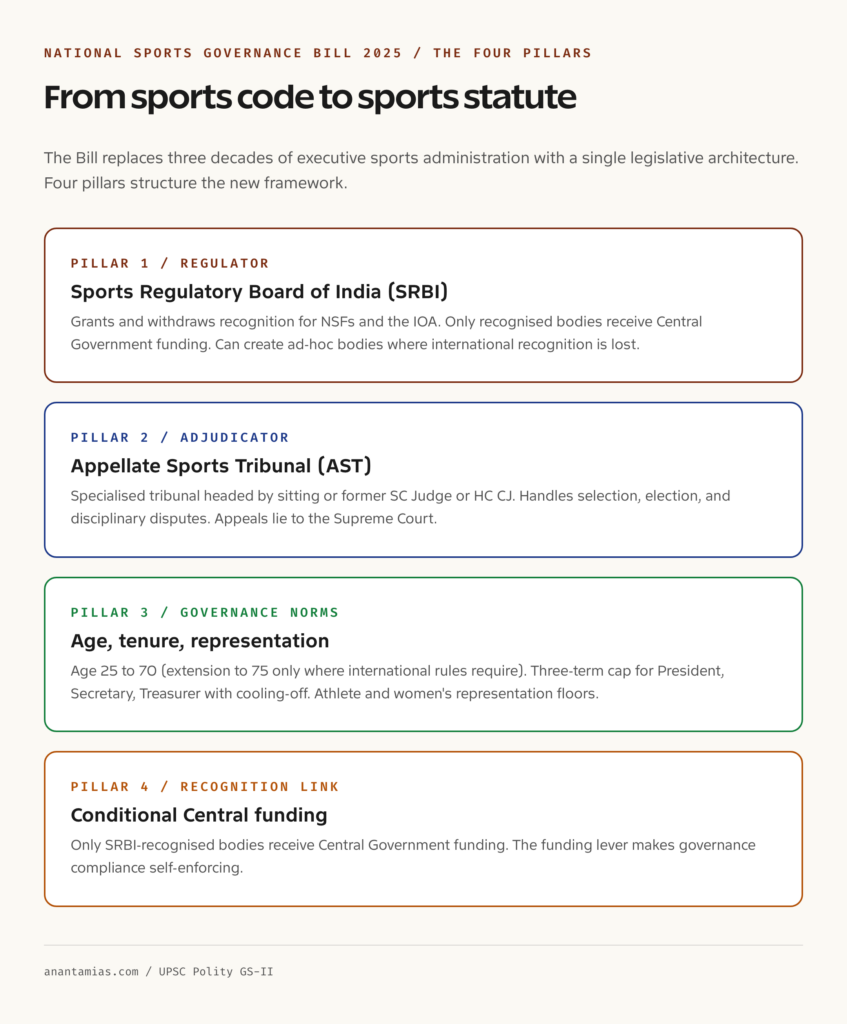
The National Sports Governance Bill, 2025, is the first comprehensive attempt to settle this triangle through statute rather than executive sports codes. It creates a Sports Regulatory Board of India with the power to grant and withdraw recognition, an Appellate Sports Tribunal to adjudicate selection and election disputes, and a uniform set of governance norms that all recognised federations must follow. The drafting tries to thread the needle between accountability to the Indian public and autonomy from political interference, the precise balance that international charters require.
This guide walks through the architecture of the Bill, the new institutions it creates, the governance reforms on age, tenure, and representation, the way the Bill interacts with parliamentary committees and the broader Indian judiciary, and the prelims and mains pointers for UPSC aspirants who are likely to see questions on this topic in the coming cycle.
Quick Facts on the National Sports Governance Bill, 2025
The National Sports Governance Bill, 2025, is a Union legislation that creates a statutory framework for the recognition and regulation of National Sports Federations and the Indian Olympic Association. Its central institutions are the Sports Regulatory Board of India, which is the new regulator, and the Appellate Sports Tribunal, which adjudicates sports disputes. The Bill caps the age of office bearers at 70 years (with an exception up to 75 for international rule compliance), limits Presidents, Secretaries, and Treasurers to three consecutive terms with a mandatory cooling-off, and requires that the Executive Committee of each federation include at least two outstanding sportspersons, at least four women, and at least 25 percent prominent sportspersons. Only recognised bodies are eligible for Central Government funding. Appeals from the Tribunal lie to the Supreme Court.
The Problem the Bill Tries to Solve
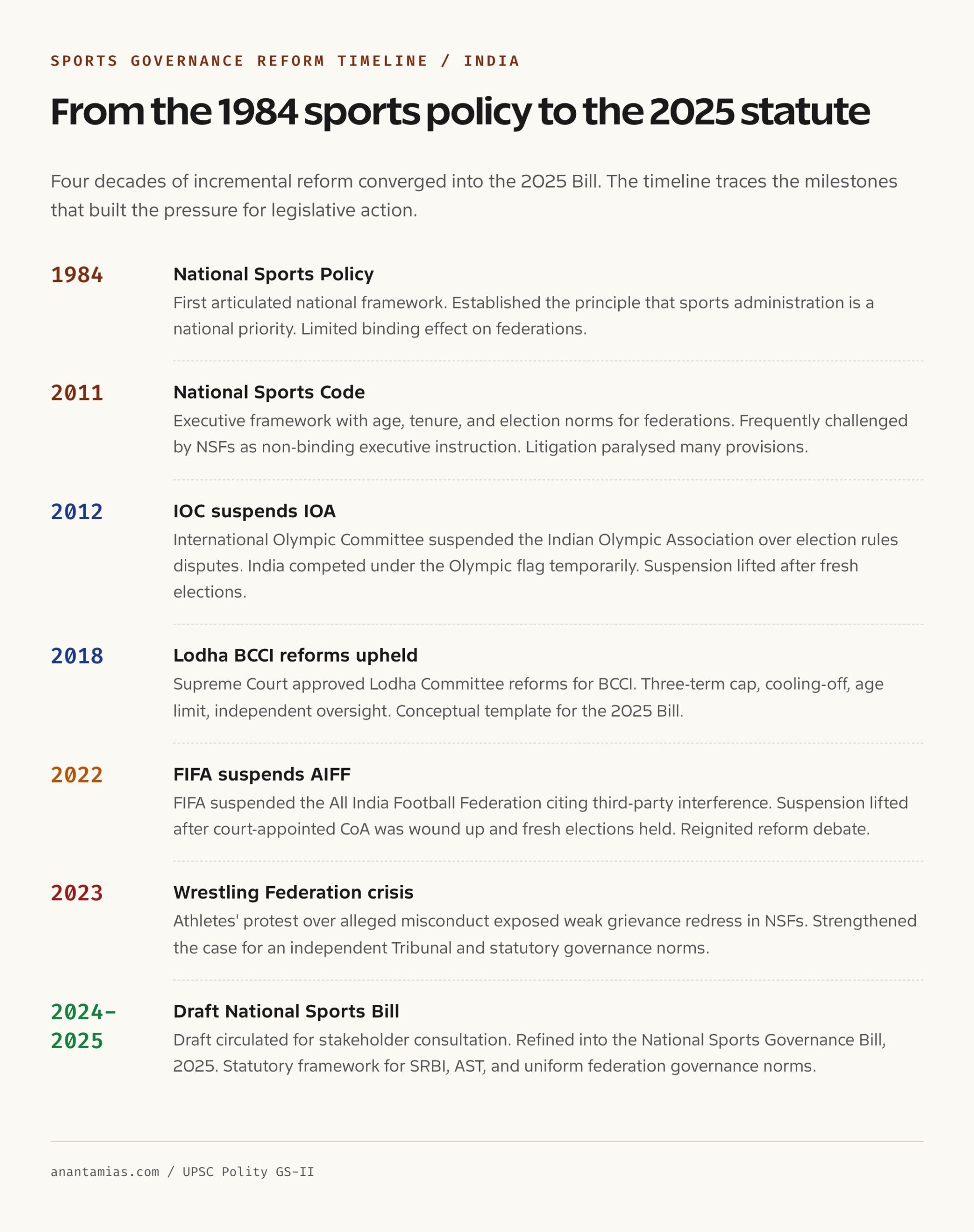
Indian sports administration has suffered three chronic ailments. The first is opacity: federations have historically operated as private clubs of office bearers, with election rules that perpetuate incumbency and finances that escape audit. The second is unlimited tenure: senior office bearers have remained in position for two and three decades, choking out fresh leadership and producing the captured-federation problem. The third is international suspension risk: the IOC and global federations have repeatedly threatened to suspend Indian recognition over governance disputes, most visibly in the 2012 IOA suspension and the AIFF crisis of 2022.
The 2011 National Sports Code attempted reform but rested on executive instructions rather than statute, and federations frequently pushed back through litigation arguing that the code did not bind their internal affairs. The 2025 Bill responds by giving the framework legislative teeth: the rules now flow from a parliamentary statute that no federation can ignore on the ground of autonomy.
Sports Regulatory Board of India: The New Regulator
The Sports Regulatory Board of India, abbreviated as SRBI, is the central institution of the Bill. It performs the recognition function: only an SRBI-recognised body is treated as an NSF or as the IOA for the purposes of Central Government funding and official representation. The Board has the power to suspend recognition where federations fail to comply with the Bill’s governance norms or with the international charter obligations that bind India through its Olympic membership.
The composition of the Board is structured to bring legal, sports administration, and athlete expertise to the table. The Chairperson and Members are appointed by the Central Government on the recommendation of a Search Committee. The Bill specifies expertise requirements, drawing on sports law, sports administration, and high-performance athletics. The Board can create ad-hoc bodies to run a sport temporarily where international recognition has been lost or where governance has collapsed, an instrument designed to handle the kind of crisis that the AIFF and the boxing federation faced in recent years.
Appellate Sports Tribunal: Specialised Adjudication
The Appellate Sports Tribunal, abbreviated as AST, is the dispute resolution organ of the new framework. The Bill provides that the Chairperson is to be a sitting or former Judge of the Supreme Court, or a Chief Justice of a High Court. The seniority requirement signals that the Tribunal is intended to be a forum of constitutional weight, not a low-level grievance redress body. Appeals from the Tribunal lie to the Supreme Court of India.
The Tribunal handles three broad categories of dispute. First, selection-related disputes where athletes challenge non-inclusion in national squads. Second, election disputes within federations where the rules of office bearer elections are contested. Third, disciplinary matters including doping-related sanctions where the federation’s internal process is challenged. The specialised forum is intended to bring expertise and speed, both of which matter when an athlete’s competitive window may be a single Olympic cycle.
Governance Reforms: Age, Tenure, and Cooling-Off
The Bill imposes a uniform age band on federation office bearers. Members must be between 25 years and 70 years. The lower bound prevents federations from being staffed entirely by senior administrators with no continuity to the playing generation. The upper bound addresses the entrenched-incumbent problem by ruling out the kind of post-retirement perches that have characterised some Indian federations. An exception allows persons aged 70 to 75 to serve where international rules of the relevant federation specifically permit. The exception is narrow: it applies only where the international charter mandates the higher age limit.
Tenure is capped through a uniform three-term limit for the President, Secretary, and Treasurer. The terms must be consecutive: the cap counts uninterrupted service in the same office. After three consecutive terms, the office bearer must observe a cooling-off period before being eligible to return. The Lodha Committee approach to BCCI reform, which the Supreme Court applied in 2018, is the conceptual template. The 2025 Bill generalises that template to all NSFs.
Athlete and Women’s Representation
The Bill mandates the structural inclusion of athletes and women on the Executive Committee of each federation. The Executive Committee can have a maximum of fifteen members. Of these, at least two must be outstanding sportspersons, at least four must be women, and at least 25 percent must be prominent sportspersons. The four-women floor and the 25 percent athlete quota together create a minimum participatory standard that no federation can dilute through its own bylaws.
The athlete representation provision aligns the Indian framework with the International Olympic Committee’s Athletes’ Commission model and with the trend in major federations such as FIFA and World Athletics, which now require active or recently retired athletes on their executive bodies. The women’s representation provision goes beyond what the IOC charter currently requires, putting India ahead of the international curve on this metric.
Recognition, Funding, and Conditional Compliance
The Bill ties Central Government funding to SRBI recognition. The funding link is the operational lever that gives the regulatory regime its real power. A federation that loses recognition loses access to government funding, to representation in international tournaments under the Indian flag, and to the Sports Authority of India’s institutional support for training, infrastructure, and coaching. The threat of recognition withdrawal is therefore credible enough to make compliance with the Bill’s norms a self-enforcing condition.
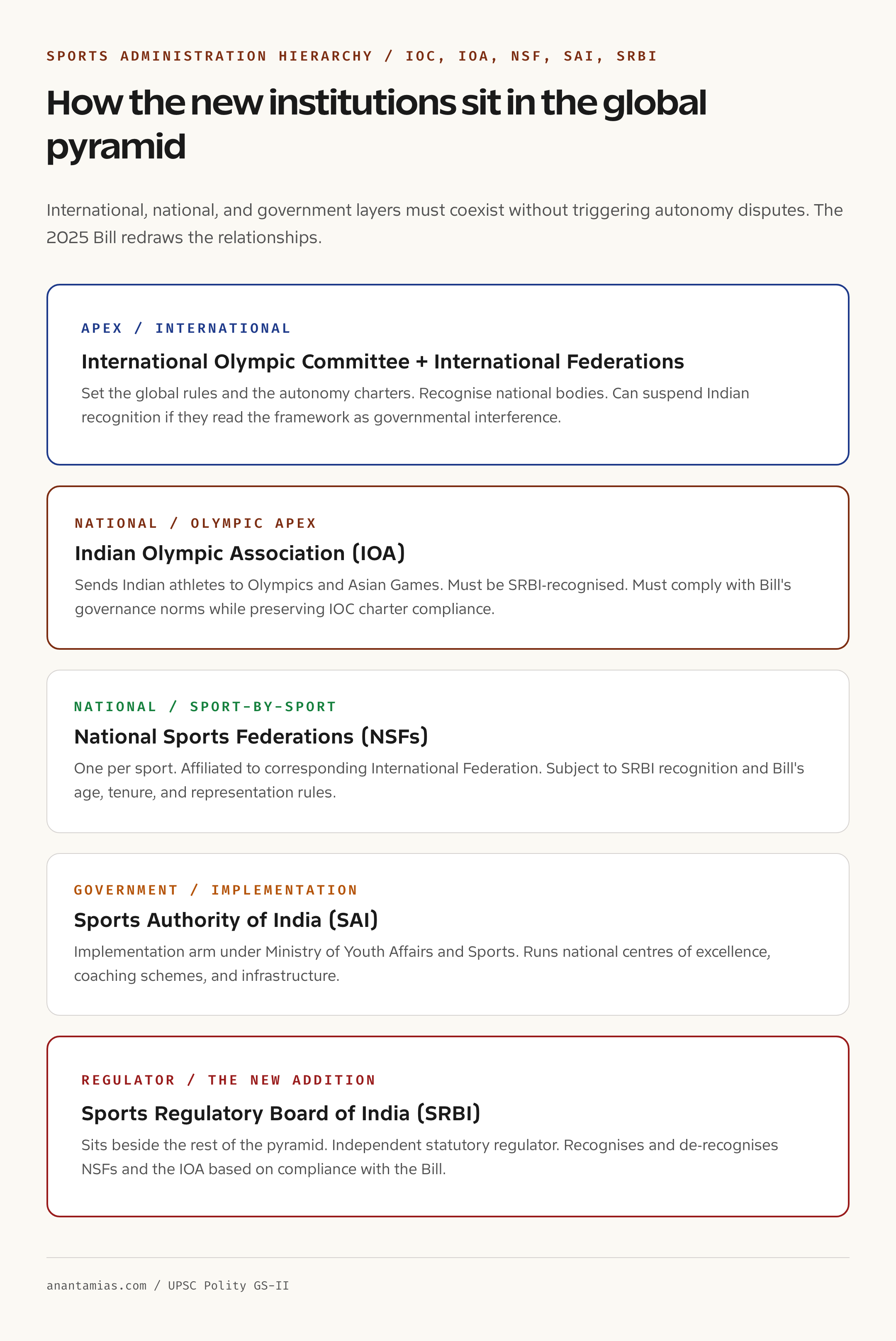
The recognition framework applies equally to the Indian Olympic Association and to NSFs. The IOA is treated as the apex body whose recognition is necessary for Indian athletes to compete at the Olympic Games and Asian Games. The Bill’s accommodation with the IOC charter is delicate: the SRBI can suspend recognition for governance failures, but the suspension must be exercised in a way that does not trigger an IOC counter-suspension of Indian Olympic participation. The drafting attempts to maintain that line through procedural safeguards.
Athlete Welfare, Anti-Doping, and Safe Sport
Beyond the institutional architecture, the Bill incorporates reforms in athlete welfare. Provisions on anti-doping align with the National Anti-Doping Act, 2022, which had already created the National Anti-Doping Agency and the National Dosage Disputes Panel. The 2025 Bill adds a Safe Sport framework requiring federations to put in place protections against sexual harassment, abuse, and other forms of misconduct in training and competition contexts. The requirement complements the POSH Act, 2013, in the specific environment of athletic training centres and team travel.
Athlete grievance redress is built into the Tribunal’s jurisdiction. An athlete who is left out of a squad, who is improperly disciplined, or who faces selection bias has a defined adjudicatory route ending in the Supreme Court. The earlier route, which depended on writ petitions before the High Courts on a federation-by-federation basis, was inconsistent and slow. The Tribunal model promises specialisation and speed in the way the Securities Appellate Tribunal does for capital markets.
How the Bill Interacts with International Charters
The IOC charter and the constitutions of major International Federations all contain autonomy clauses that prohibit governmental interference in the running of sports federations. India has experienced suspension threats under these clauses three times in recent memory: the 2012 IOA suspension over election rule disputes, the 2022 AIFF suspension over third-party interference, and the 2023 wrestling federation crisis. The 2025 Bill is drafted to comply with the autonomy principle by routing regulatory action through a quasi-independent Board, by giving the Tribunal judicial-grade independence, and by limiting government veto to the funding decision.
Whether the IOC and individual International Federations accept this design as compliant with their autonomy clauses is the open question. The Bill’s defenders argue that statutory regulation by an independent Board is precisely the kind of accountability that the IOC’s own Universality and Good Governance frameworks invite. The Bill’s critics worry that any statutory framework risks being read as government interference. The first SRBI decisions and the international response will set the practical answer.
Comparative Note: Lodha Committee BCCI Reforms and Sports Code 2011
The 2025 Bill builds on two earlier reform conversations. The Lodha Committee BCCI reforms, approved by the Supreme Court in 2018, introduced the three-term cap, the cooling-off principle, the age limit, and the requirement of independent oversight at the apex of cricket administration. The Bill adopts those principles and extends them to all federations. The 2011 National Sports Code attempted similar reforms through executive instructions but lacked statutory force. The Bill replaces the patchwork of executive directions with a single legislative architecture.
The State-level corollary is the recognition of State Sports Federations and their relationship with NSFs. The Bill leaves State framework choices to the States, but the SRBI’s recognition decisions cascade downwards through the NSF affiliations. A State federation that wishes to retain affiliation must conform to the NSF rules, which in turn must conform to the SRBI norms.
Prelims and Mains Pointers for UPSC
For prelims, four facts deserve memorisation. The Sports Regulatory Board of India is the regulator. The Appellate Sports Tribunal is the adjudicator with appeals to the Supreme Court. The age cap is 70 years (extendable to 75 only where international rules require). The tenure cap is three consecutive terms for President, Secretary, and Treasurer with mandatory cooling-off. The athlete and women’s representation floors are at least two outstanding sportspersons, at least four women, and at least 25 percent prominent sportspersons in a 15-member Executive Committee.
For mains, the question is the constitutional balance between sports federation autonomy under international charters and the Indian state’s interest in accountability and athlete welfare. The Bill is a useful case study in the basic structure doctrine approach to institutional design: independent regulator, judicial-grade tribunal, and conditional state funding. Aspirants writing on sports governance can also draw on the Lokpal model and on the comparison with the Lokpal and Lokayukta framework for institutional accountability.
Conclusion: From Sports Code to Sports Statute
The National Sports Governance Bill, 2025, marks the transition from executive sports administration to statutory sports administration in India. It places the Sports Regulatory Board of India at the centre of recognition, the Appellate Sports Tribunal at the centre of adjudication, and the conditional funding link at the centre of compliance. The age, tenure, and representation reforms borrow the Lodha Committee architecture and generalise it across all federations.
For UPSC aspirants, the Bill is a high-yield topic that combines polity, governance, ethics, and sports administration in a single piece of legislation. Whether the framework survives the IOC autonomy test will be settled in the years immediately ahead. The Bill itself is a genuine reform of long standing institutional dysfunction.
Frequently Asked Questions
What is the National Sports Governance Bill, 2025?
It is a Union legislation that creates a statutory framework for the recognition and regulation of National Sports Federations and the Indian Olympic Association, replacing the earlier executive National Sports Code, 2011.
What is the Sports Regulatory Board of India?
The Sports Regulatory Board of India, or SRBI, is the new regulator created by the Bill. It grants and withdraws recognition for NSFs and the IOA, and only recognised bodies are eligible for Central Government funding. The Board can also create ad-hoc bodies to run a sport where international recognition has been lost.
What is the Appellate Sports Tribunal?
The Appellate Sports Tribunal is the specialised dispute resolution forum created by the Bill. Its Chairperson must be a sitting or former Judge of the Supreme Court or a Chief Justice of a High Court. Appeals from the Tribunal lie to the Supreme Court.
What are the age and tenure limits under the Bill?
The age cap is 70 years, extendable up to 75 years only where international rules of the relevant federation specifically permit. The tenure cap is three consecutive terms for President, Secretary, and Treasurer, with mandatory cooling-off thereafter.
What is the athlete and women’s representation requirement?
In a 15-member Executive Committee, at least two must be outstanding sportspersons, at least four must be women, and at least 25 percent must be prominent sportspersons.
Does the Bill comply with the International Olympic Committee’s autonomy charter?
The Bill is drafted to comply with the autonomy principle by routing regulatory action through an independent Board, by giving the Tribunal judicial-grade independence, and by limiting government veto to funding decisions. Whether the IOC accepts the design as compliant will be settled in practice.
How does the Bill build on the Lodha Committee reforms?
The 2018 Supreme Court order on BCCI reforms introduced the three-term cap, cooling-off principle, age limit, and independent oversight. The 2025 Bill adopts those principles and extends them to all National Sports Federations through a single legislative architecture.
Tell Google you want more of this.
Add Anantam IAS as a preferred sourceOne tap, and this site shows up more often in your own Top Stories, AI Overviews and AI Mode. Remove it any time.