
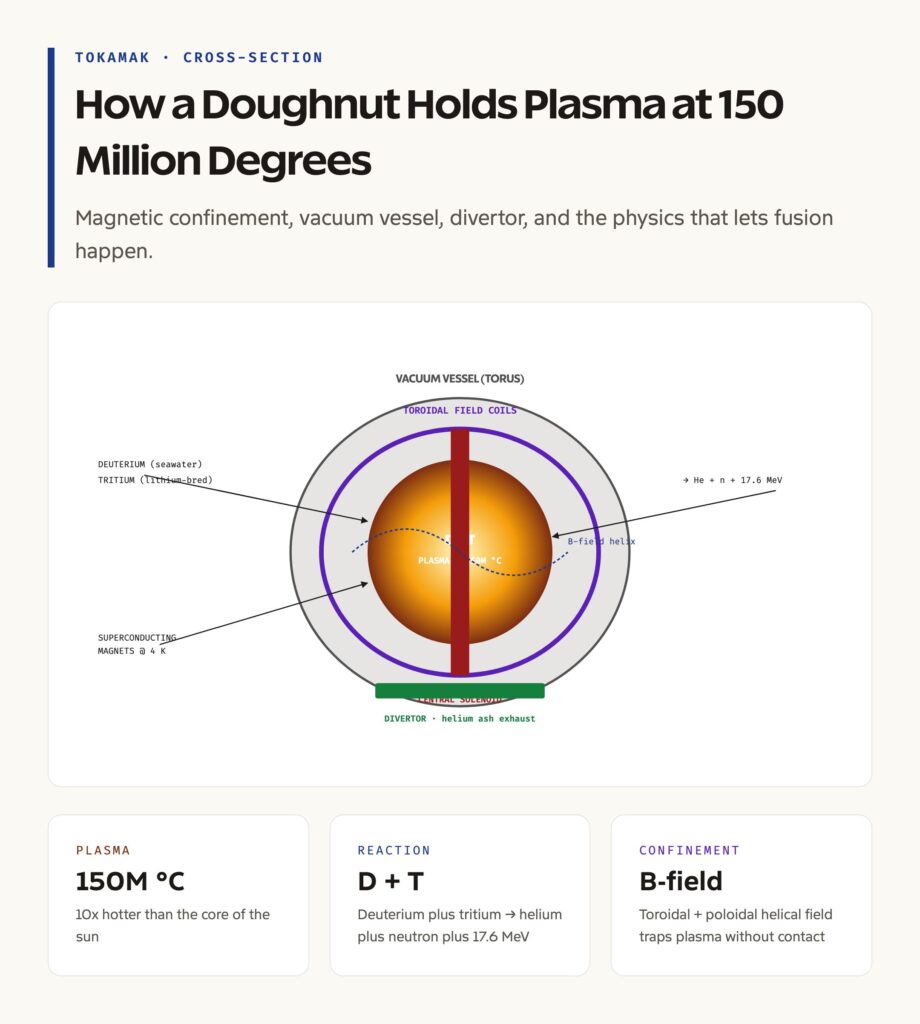
A tokamak is a doughnut-shaped machine designed to do something the sun does naturally and the rest of the universe finds extremely difficult, fuse light atomic nuclei into heavier ones and release energy in the process. The name comes from a Russian acronym for toroidal chamber with magnetic coils. The shape is the key. By bending a column of plasma into a closed ring and wrapping it in a carefully designed magnetic cage, a tokamak holds matter at temperatures hotter than the centre of the sun without melting any of the surrounding hardware.
The race to commercial fusion power has been the longest-running engineering project in modern science. The first tokamak operated in the Soviet Union in 1956. Seventy years later, no tokamak has yet produced more sustained electrical energy than it consumes. ITER, the international mega-project under construction in southern France with India as a full partner, is meant to be the machine that proves the principle. India’s own SST-1 and proposed SST-2 fit into this trajectory, and indigenous tokamak research in Gandhinagar has produced both training capability and engineering contributions to ITER.
For UPSC GS-III, the tokamak sits at the intersection of nuclear energy, big science diplomacy, energy security, and climate policy. This article walks through what a tokamak does, the physics of magnetic confinement, the deuterium-tritium fuel cycle, the major machines worldwide, India’s programme, and the path to commercial fusion.
Quick Facts on the Tokamak
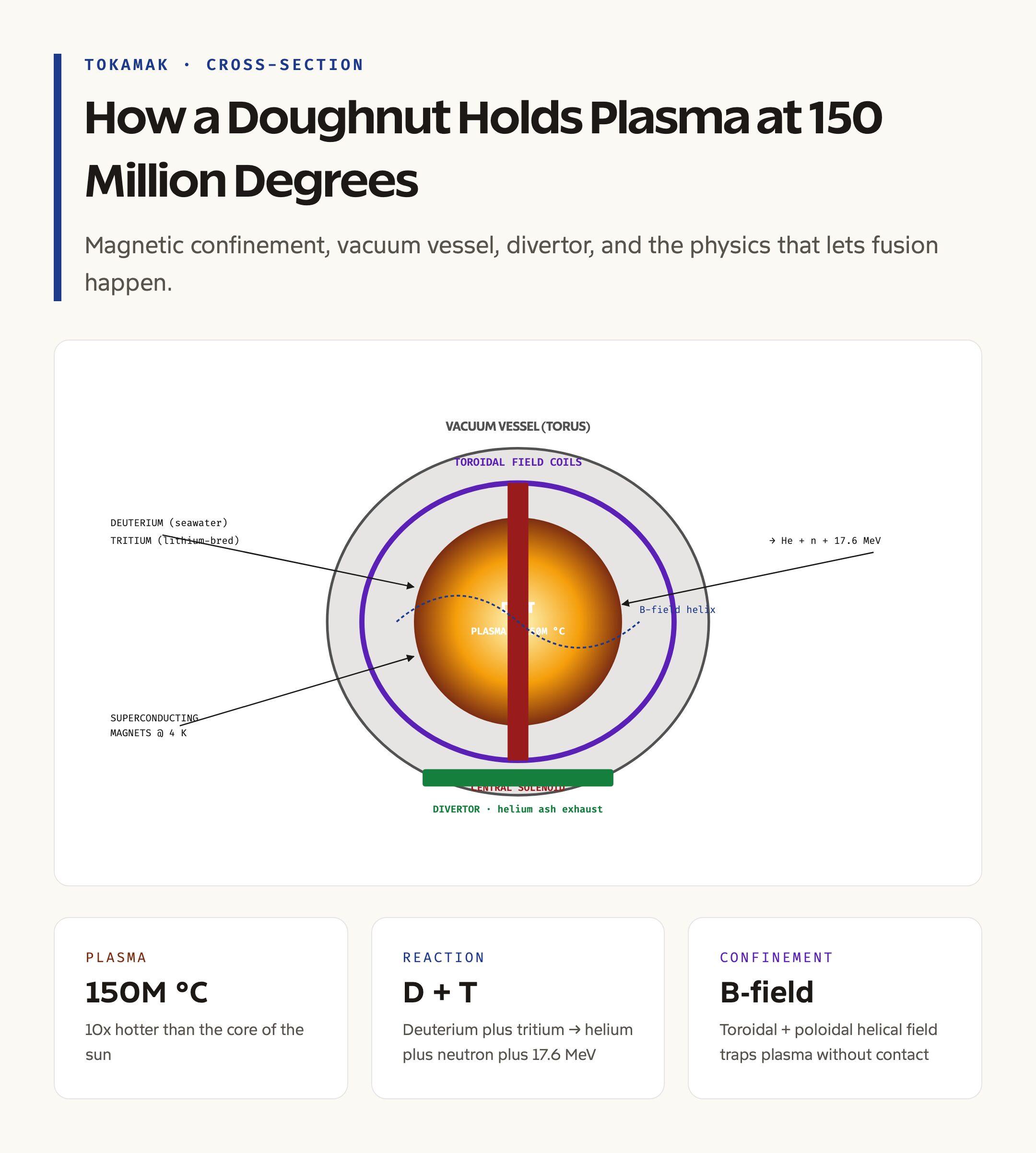
A tokamak is a magnetic confinement device used to produce controlled nuclear fusion in a plasma. It uses two superimposed magnetic fields, the toroidal field running around the long way of the doughnut and the poloidal field running around the short way. The combined helical field traps charged particles in stable orbits without letting them touch the chamber walls.
The fuel is a hydrogen plasma, usually deuterium and tritium, abbreviated D-T. Deuterium is a stable isotope of hydrogen with one proton and one neutron. Tritium is a radioactive isotope with one proton and two neutrons. When the two fuse, they produce a helium-4 nucleus, a free neutron, and 17.6 megaelectron volts of energy. The plasma must reach about 150 million degrees Celsius for the fusion reaction rate to be useful, roughly ten times hotter than the centre of the sun.
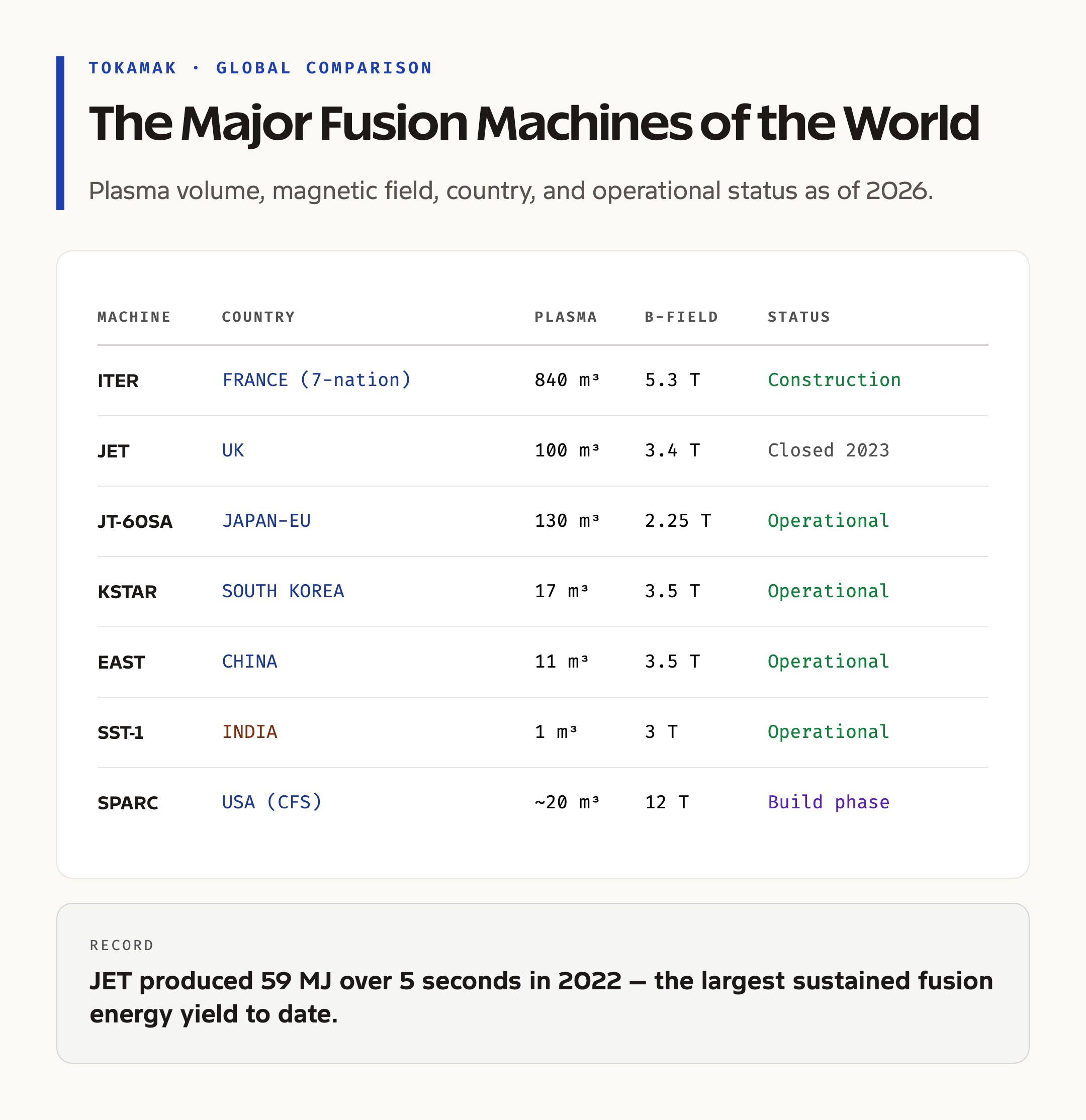
The first tokamak, T-1, operated in Moscow in 1956. The Joint European Torus, abbreviated JET, in Oxfordshire held the world record for fusion energy output until 2022, when it produced 59 megajoules over five seconds. ITER, under construction in Cadarache, France, is designed to produce 500 megawatts of fusion power from 50 megawatts of input heating, a tenfold gain.
How a Tokamak Confines Plasma
A plasma is a gas hot enough that electrons separate from atomic nuclei, leaving a soup of charged particles. Charged particles cannot cross magnetic field lines easily. They spiral along them. This is the basis for magnetic confinement.
A simple toroidal field, generated by coils wrapped around the doughnut chamber, would let particles drift outward and hit the wall. The fix is to add a poloidal field that runs perpendicular to the toroidal field. The combined field forms helical lines that twist around the torus, and charged particles spiralling along these helical lines do not drift out. The poloidal field in a tokamak is generated partly by the central solenoid, which drives a large electric current through the plasma itself, and partly by external poloidal field coils.
The plasma current that creates part of the poloidal field also heats the plasma resistively, like a wire heating up when current flows through it. This is called ohmic heating. As temperature rises, plasma resistance falls and ohmic heating becomes inefficient. Additional heating systems, neutral beam injection, ion cyclotron resonance heating, and electron cyclotron resonance heating, push the temperature higher. ITER’s heating budget is around 50 megawatts split across these systems.
Confinement is measured by the Lawson criterion, a product of plasma density, temperature, and energy confinement time. To get net energy out, the product must exceed a threshold. Modern tokamaks come close. ITER is designed to exceed it.
Why Magnetic Confinement Is Necessary
No solid material can withstand contact with plasma at fusion temperatures. Tungsten melts at around 3,400 degrees, beryllium at 1,287, and the plasma is at 150 million. Any direct contact would vaporise the chamber wall and contaminate the plasma instantly. Magnetic confinement holds the plasma suspended in vacuum, never touching the wall.
The wall is still important. Neutrons produced by fusion reactions are uncharged and not deflected by magnetic fields, so they fly straight out and hit the wall. The wall is engineered as a blanket containing lithium. Neutrons absorbed by lithium produce tritium and helium, breeding new tritium fuel for the reactor. The blanket also absorbs neutron energy as heat, which would in a power-producing tokamak drive a steam turbine to generate electricity. ITER’s blanket is a test for breeding ratio and heat extraction.
The other key wall component is the divertor at the bottom of the chamber. The divertor catches helium ash, the spent fuel, and removes it before it dilutes the burning plasma. It also handles the highest heat loads in the machine, often comparable to the surface of the sun.
The Deuterium-Tritium Fuel Cycle
Deuterium is abundant. Roughly one in every 6,400 hydrogen atoms in seawater is deuterium, which translates to a near-infinite supply. Tritium is rare. It is produced naturally only in trace amounts by cosmic rays, and is generated commercially as a byproduct of CANDU heavy-water reactors. Total global tritium inventory is in the tens of kilogrammes. ITER alone will need a few kilogrammes per year of operation at full power.
The long-term solution is breeding. Lithium-6, when struck by a fusion neutron, splits into helium-4 and tritium plus energy. Lithium-7 also breeds tritium under different reaction conditions. A power-producing tokamak surrounds the plasma with a lithium-bearing blanket and breeds its own tritium continuously. The breeding ratio must be slightly above one to sustain the fuel supply and account for losses. ITER tests breeding-blanket modules but is not itself a breeding reactor at full scale.
The D-T reaction releases 17.6 megaelectron volts of energy per fusion event, of which 14.1 MeV goes to the neutron and 3.5 MeV goes to the helium nucleus. The helium stays in the plasma and helps maintain temperature, the alpha-heating effect that becomes dominant in ignited plasmas. The neutron carries energy out to the blanket.
ITER: The International Mega-Project
ITER is the largest scientific cooperation in modern history outside CERN. The seven members are the European Union, the United States, Russia, China, Japan, South Korea, and India. Construction began in 2010 at Cadarache in southern France. First plasma is now planned for the late 2020s, with full deuterium-tritium operation in the 2030s. The machine is 30 metres tall, weighs 23,000 tonnes, and uses 10,000 tonnes of superconducting magnets cooled to 4 Kelvin with liquid helium.
We cover ITER in depth in our ITER Project explainer. The headline parameters are a plasma volume of 840 cubic metres, a fusion power of 500 megawatts, and a pulse length of 400 to 600 seconds. The Q ratio, fusion power output divided by external heating input, is targeted at 10 or higher. ITER is not designed to produce electricity. It is designed to demonstrate that the engineering integration works at scale.
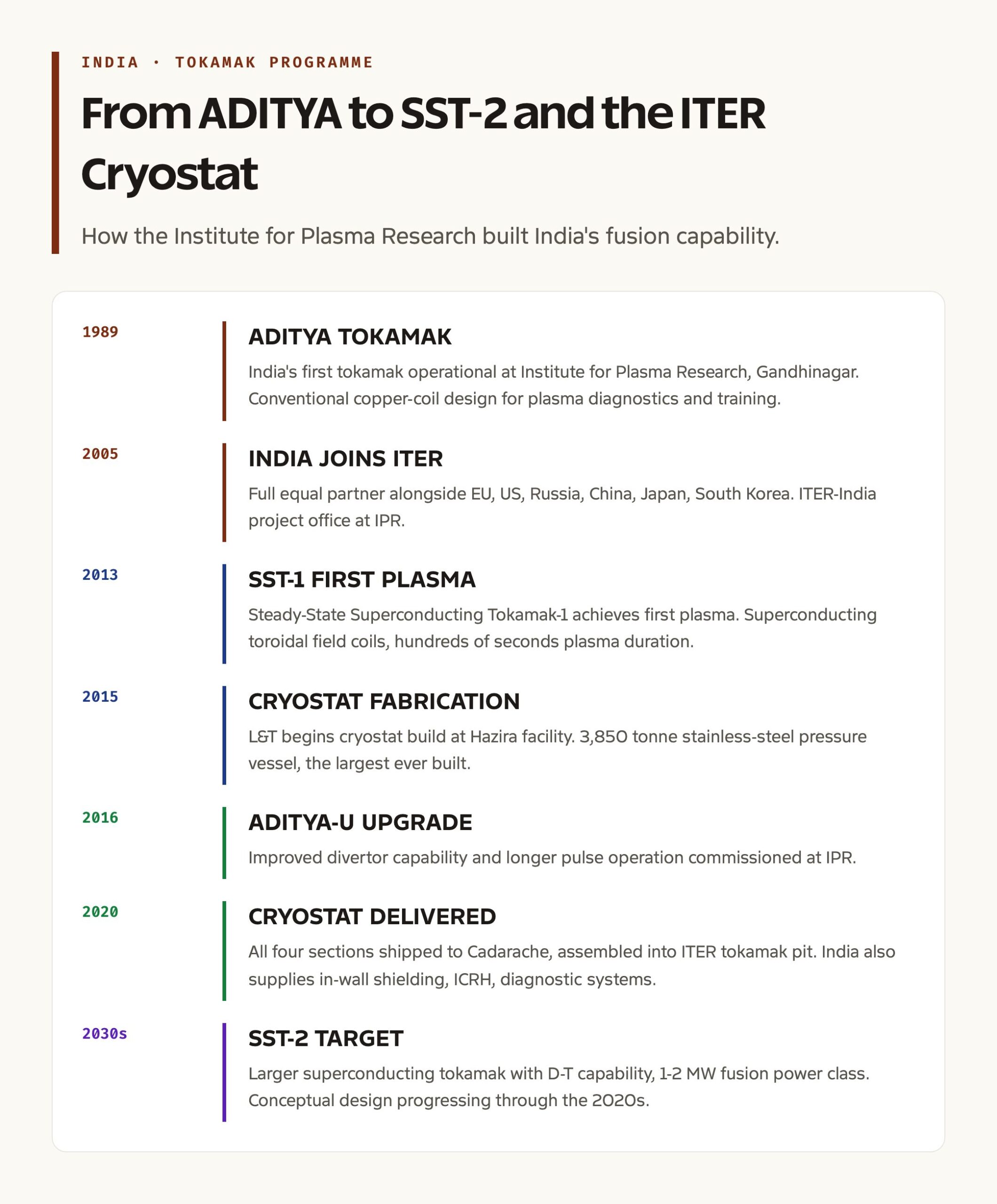
India’s contribution to ITER is substantial. ITER-India, a project under the Institute for Plasma Research at Gandhinagar, manufactures the cryostat, the giant stainless-steel vacuum vessel that surrounds the machine. The cryostat weighs 3,850 tonnes and is the largest stainless-steel pressure vessel ever built. India also supplies in-wall shielding, cooling water systems, ion cyclotron heating sources, and diagnostic neutral beam systems. The total Indian contribution is in the order of 20,000 crore rupees over the project lifetime.
India’s Tokamak Programme: ADITYA, SST-1, SST-2
India’s domestic tokamak programme runs at the Institute for Plasma Research, abbreviated IPR, in Gandhinagar, an autonomous institute under the Department of Atomic Energy. The programme has three machines covered in detail in our India fusion programme explainer.
ADITYA is the first Indian tokamak, operational since 1989. It is a small, conventional copper-coil tokamak used for plasma diagnostics, training, and experiments. ADITYA-U, the upgraded version commissioned in 2016, includes improved divertor capability and longer pulse operation.
SST-1, the Steady-State Superconducting Tokamak-1, is the more ambitious machine. It uses superconducting toroidal field coils cooled with liquid helium to maintain plasma for hundreds of seconds, which is much longer than conventional copper-coil tokamaks. First plasma was achieved in 2013 after a long development period. SST-1’s role is to develop the engineering and operational know-how for steady-state plasma, the regime relevant to power-producing tokamaks.
SST-2 is the planned successor, a larger superconducting tokamak with deuterium-tritium capability and a fusion power range up to one or two megawatts. The conceptual design has been progressing through the 2020s, with a target of first operation in the 2030s. SST-2 would be India’s first machine capable of demonstrating significant fusion energy production.
Tokamaks Around the World
The major operating tokamaks as of 2026 include JET in the United Kingdom, which set the energy-output record before its planned shutdown. KSTAR in South Korea, a superconducting tokamak that holds records for high-temperature plasma duration, having achieved 100 million Celsius for over 30 seconds. EAST in China, the Experimental Advanced Superconducting Tokamak, which set its own duration records. JT-60SA in Japan, a joint Japan-EU project that began operations in 2023 and is the largest tokamak operating before ITER comes online.
The privately funded fusion sector has expanded since 2020. Commonwealth Fusion Systems in Massachusetts, a spinoff from MIT, is building SPARC, a compact high-field tokamak using high-temperature superconducting magnets. Tokamak Energy in the UK is building the ST40 spherical tokamak. These compact tokamaks aim for shorter timelines and lower capital cost than ITER, with first plasma targets in the late 2020s.
China is building CFETR, the China Fusion Engineering Test Reactor, which would be a power-producing demonstration after ITER. The European DEMO concept and Korean K-DEMO are similar national plans. India’s SST-2 fits in this generation of post-ITER demonstration machines.
Engineering Challenges Still to Solve
Materials are the first bottleneck. Plasma-facing components face neutron fluxes that no current material can withstand for the years of continuous operation a power plant would need. Tungsten is the leading first-wall candidate, but neutron damage, erosion, and tritium retention all pose problems. The IFMIF-DONES facility under construction in Spain is meant to test materials under fusion-relevant neutron conditions.
Tritium handling is the second. Tritium is radioactive, with a half-life of 12.3 years, and difficult to contain because it diffuses through metals as a hydrogen isotope. A power-producing tokamak must breed, recover, and recycle tritium on site, with tight inventory control and minimal release. No demonstration plant has yet operated this fuel cycle at scale.
Disruptions are the third. Tokamak plasmas can lose stability suddenly, dumping their entire energy onto the chamber wall in milliseconds. Mitigation systems inject material to spread the energy or quench the plasma cleanly. ITER’s disruption mitigation is one of the riskiest engineering integrations in the project.
Cost and time are the cross-cutting constraints. ITER’s budget has roughly tripled from initial estimates, and the schedule has slipped by years. Whether the next generation of tokamaks can compress timelines, especially the privately funded compact tokamaks, will shape the commercial fusion picture.
What to Watch Going Forward
Three milestones matter for tokamak development through the rest of the 2020s. ITER’s first plasma is the largest, expected in the late 2020s. SPARC by Commonwealth Fusion Systems is targeting net energy gain by the late 2020s, which would be a private-sector demonstration. SST-2’s design freeze and procurement decisions will determine whether India has an independent power-relevant tokamak in the 2030s.
For UPSC, the policy story is the integration of fusion into India’s long-term energy strategy, the leverage that ITER membership gives India in advanced manufacturing and superconducting technology, and the spin-off into compact tokamak and high-temperature superconducting magnet capabilities. Fusion power, if it works, is carbon-free, fuel-abundant, and proliferation-resistant in a way fission power has never been. Whether the technology delivers on that promise is the open question of the rest of the century.
Frequently Asked Questions
What is the difference between a tokamak and a stellarator?
Both are magnetic confinement devices for fusion plasma. A tokamak uses a plasma current to generate part of the confining magnetic field, while a stellarator generates the whole field from external coils. Stellarators are inherently steady-state and have no disruption risk, but they are mechanically more complex. The Wendelstein 7-X in Germany is the leading stellarator. Most fusion programmes worldwide focus on tokamaks because they are simpler to scale up.
Why does fusion need such high temperatures?
Two positively charged hydrogen nuclei repel each other electrostatically. To get close enough for the strong nuclear force to take over and fuse them, they must be moving very fast, which means very hot. About 150 million Celsius is the practical operating temperature for deuterium-tritium fusion in a tokamak. The sun fuses at lower temperatures because gravity provides additional confinement that no terrestrial machine can match.
Is a tokamak the same as a nuclear reactor?
A tokamak is a fusion device. A conventional nuclear reactor uses fission, splitting heavy atoms like uranium. The two are physically and operationally very different. Fusion produces helium and a neutron, no long-lived radioactive waste, and cannot run away because the plasma simply quenches if conditions go wrong. Fission produces highly radioactive fission products and requires careful reactivity control.
What is ITER and how is India involved?
ITER is a 35-billion-euro tokamak under construction at Cadarache, France, designed to demonstrate net fusion energy at industrial scale. India is one of seven member states alongside the EU, US, Russia, China, Japan, and South Korea. India contributes the cryostat, in-wall shielding, ion cyclotron heating, and diagnostic systems through ITER-India under the Institute for Plasma Research at Gandhinagar.
When will fusion power be commercially available?
The most credible projections for commercial fusion electricity are the late 2030s for a first demonstration plant and the 2040s or 2050s for grid-scale deployment. Privately funded compact tokamaks like SPARC aim for earlier timelines, but full commercial operation, including tritium breeding, materials qualification, and grid integration, is unlikely before the 2030s at the earliest.
Tell Google you want more of this.
Add Anantam IAS as a preferred sourceOne tap, and this site shows up more often in your own Top Stories, AI Overviews and AI Mode. Remove it any time.





