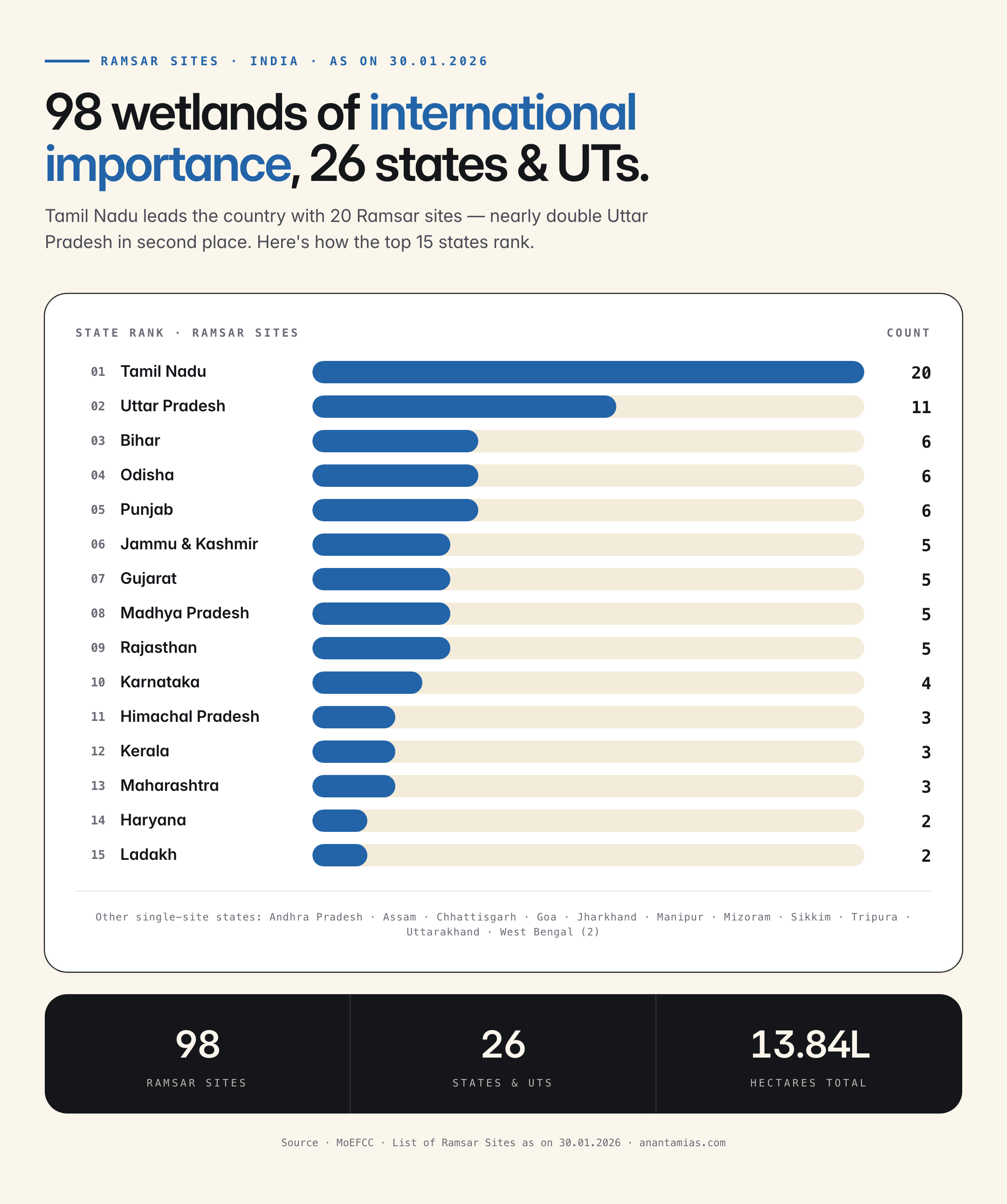
The total Ramsar sites in India now stands at 98 wetlands across 26 states and Union Territories, covering 13.84 lakh hectares (13,84,141 ha) — the largest Ramsar network in Asia. Two new sites were added on World Wetlands Day 2026: Patna Bird Sanctuary (Uttar Pradesh) and Chhari Dhand (Gujarat). Designated under the Ramsar Convention on Wetlands of International Importance (1971), these sites range from Himalayan high-altitude lakes and Ganga-plain bird sanctuaries to coastal lagoons, mangrove deltas and desert wetlands. India acceded to the Ramsar Convention on 1 February 1982, and the list has grown steeply since 2020 — from 37 sites then to 98 today — reflecting a sharper policy focus on wetland conservation and climate resilience.
What is the Ramsar Convention
The Convention on Wetlands, popularly called the Ramsar Convention, was adopted on 2 February 1971 in the city of Ramsar, Iran, and entered into force in 1975. It is the oldest of the modern global environmental treaties and the only one devoted exclusively to a single ecosystem type, the wetland.
Key features:
- Headquarters: Gland, Switzerland
- World Wetlands Day: 2 February every year
- India's accession: 1 February 1982
- Montreux Record: list of Ramsar sites facing ecological change — India has two entries: Keoladeo National Park (Rajasthan) and Loktak Lake (Manipur)
How a Site Becomes Ramsar-Listed
A wetland must satisfy at least one of the nine Ramsar criteria, grouped into two categories:
- Group A: sites containing representative, rare or unique wetland types.
- Group B: sites of international importance for conserving biological diversity — based on species, ecological communities, waterbirds (supporting over 20,000 waterbirds or 1 per cent of a population), fish or non-avian fauna.
Once designated, the country assumes obligations for wise use, national wetland policies, and reporting ecological change.
Growth of Ramsar Sites in India
India's Ramsar footprint has expanded sharply in the last five years — from 37 sites in 2020 to 98 as on 30 January 2026.
| Year | Cumulative sites |
|---|---|
| 1982 | 2 (Chilika, Keoladeo) |
| 2002 | 19 |
| 2012 | 26 |
| 2020 | 42 |
| 2022 | 75 |
| 2024 | 85 |
| 30 Jan 2026 | 98 |
This rapid expansion has been driven by the Ministry of Environment, Forest and Climate Change (MoEFCC), the Amrit Dharohar initiative (2023), the National Plan for Conservation of Aquatic Ecosystems (NPCA), and state wetland authorities working alongside community stakeholders.
The First and Largest Sites
- First Ramsar sites (designated 1 October 1981, notified 1982): Chilika Lake (Odisha) and Keoladeo National Park (Rajasthan)
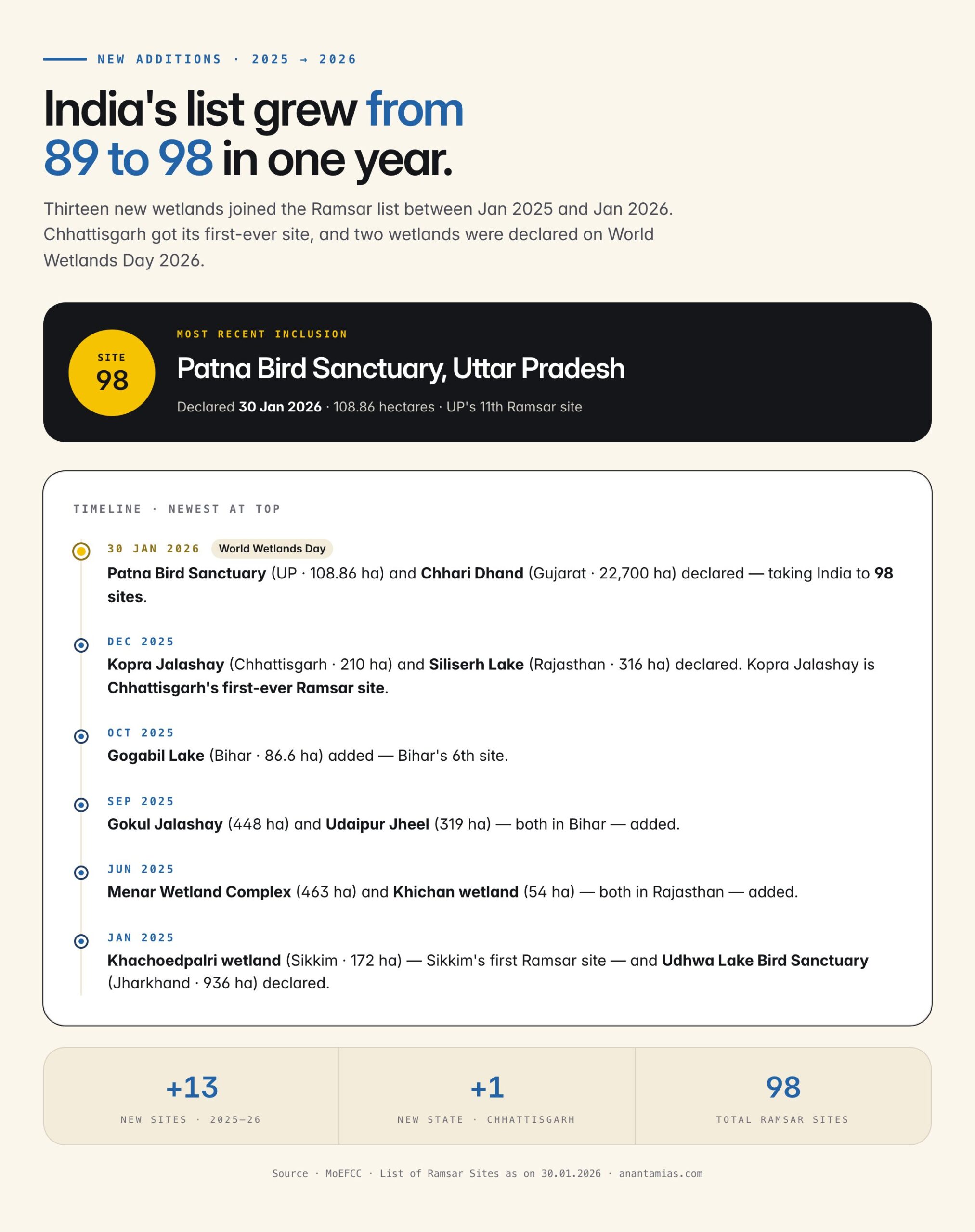
- Largest Ramsar site in India: Sundarban Wetland (West Bengal) — 4,23,000 ha, about 4,230 sq km
- Other very large sites: Vembanad-Kol (Kerala, 1,51,250 ha), Chilika Lake (Odisha, 1,16,500 ha), Satkosia Gorge (Odisha, 98,197 ha), Kolleru Lake (Andhra Pradesh, 90,100 ha)
- Smallest Ramsar sites: Renuka Wetland (HP) and Vembannur (TN) — 20 ha each
- Highest-altitude Ramsar sites: the Ladakh trio — Tsomoriri (4,595 m), Tso Kar Wetland Complex (4,500 m), and Chandertal (4,300 m, Himachal Pradesh)
- Latest additions (30 Jan 2026): Patna Bird Sanctuary (UP) and Chhari Dhand (Gujarat) — India’s 97th and 98th Ramsar sites
States with Most Ramsar Sites
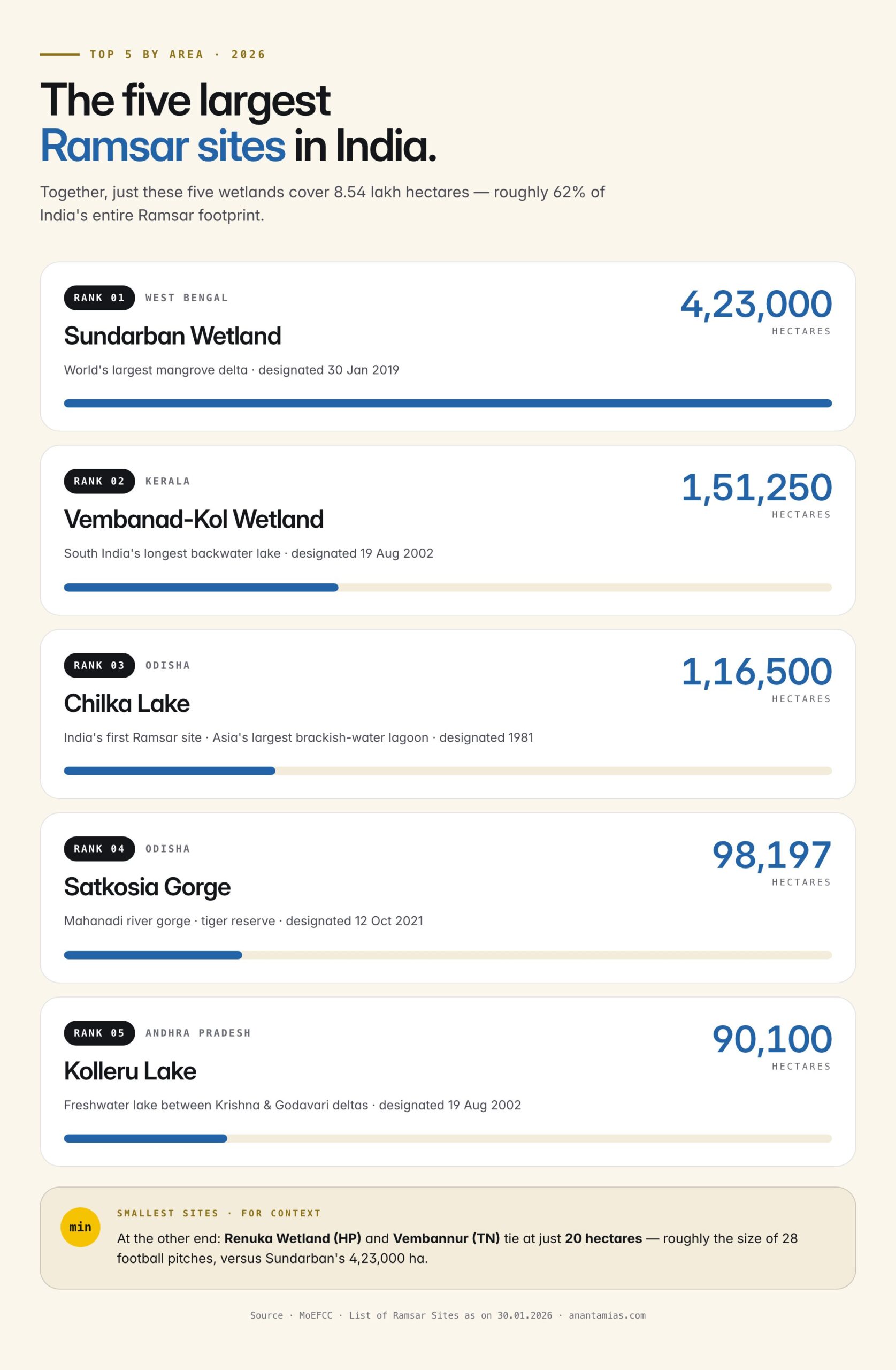
Tamil Nadu leads the country with 20 Ramsar sites — nearly double Uttar Pradesh in second place. Chhattisgarh joined the list for the first time in December 2025 (Kopra Jalashay), taking the tally to 26 states/UTs.
| Rank | State / UT | Sites |
|---|---|---|
| 1 | Tamil Nadu | 20 |
| 2 | Uttar Pradesh | 11 |
| 3 | Bihar | 6 |
| 3 | Odisha | 6 |
| 3 | Punjab | 6 |
| 6 | Jammu & Kashmir | 5 |
| 6 | Gujarat | 5 |
| 6 | Madhya Pradesh | 5 |
| 6 | Rajasthan | 5 |
| 10 | Karnataka | 4 |
| 11 | Himachal Pradesh, Kerala, Maharashtra | 3 each |
| 14 | Haryana, Ladakh, West Bengal | 2 each |
| 17 | Andhra Pradesh, Assam, Chhattisgarh, Goa, Jharkhand, Manipur, Mizoram, Sikkim, Tripura, Uttarakhand | 1 each |
Complete List of All 98 Ramsar Sites in India
What follows is a deep-dive index of every Ramsar site in India as on 30 January 2026 — location, area, designation and declaration dates, flagship species, and the reason each site was listed. Sites are grouped by state in alphabetical order and numbered in the official MoEFCC sequence.
Andhra Pradesh (1)
1. Kolleru Lake — Andhra Pradesh
Location: Krishna and Godavari deltas, Andhra Pradesh · Area: 90,100 ha · Designated: 19-08-2002 · Declared: 20.12.2002
Kolleru Lake is one of the largest freshwater lakes in India, sitting like a shallow saucer between the deltas of the Krishna and Godavari rivers. It acts as a natural flood balancing reservoir for both rivers and sustains a unique riparian ecology of marshes, reed beds and paddy-fringed shallows. The lake is internationally renowned as a wintering ground for migratory waterbirds, most famously the grey pelican and the Asian openbill stork, along with painted storks, glossy ibis and teals that arrive from Central Asia. Declared a Wildlife Sanctuary in 1999 under the Wildlife Protection Act, its Ramsar status recognises both its ecological value and the pressure it faces from aquaculture encroachment and agricultural runoff, making it a flagship case study in Indian wetland conservation.
Assam (1)
2. Deepor Beel — Assam
Location: Southwest of Guwahati, Assam · Area: 4,000 ha · Designated: 19-08-2002 · Declared: 20.12.2002
Deepor Beel is a permanent freshwater lake lying to the southwest of Guwahati, representing a former channel of the Brahmaputra river. It is the only major stormwater storage basin for the sprawling city and provides vital ecosystem services including flood buffering, groundwater recharge and livelihood support for fishing communities along its fringes. The wetland is an important staging and wintering area for migratory birds travelling along the Central Asian Flyway, hosting large congregations of ducks, storks and waders every winter. It is also home to resident Asian elephants that use its adjoining forests. Despite being declared a Wildlife Sanctuary and a Ramsar site, Deepor Beel faces severe threats from urban expansion, solid waste dumping, and the adjoining railway line, making it a priority for wetland restoration efforts in the northeast.
Bihar (6)
3. Kabartal Wetland (Kanwar Jheel) — Bihar
Location: Begusarai district, Bihar · Area: 2,620 ha · Designated: 21-07-2020 · Declared: 16.10.2020
Kabartal, also known as Kanwar Jheel, is the largest freshwater oxbow lake in north Bihar and the first Ramsar site of the state. Formed by the meandering of the Burhi Gandak and Kosi rivers, it functions as a crucial floodwater storage unit for the Gangetic plains and recharges local aquifers. The wetland supports an extraordinary biodiversity that includes five critically endangered species on the Central Asian Flyway, such as the sociable lapwing and the Baer’s pochard, alongside large flocks of migratory ducks and waders. It also sustains local fisher and farming communities through fisheries and seasonal agriculture. Its Ramsar listing recognises both ecological richness and the urgent need to manage invasive water hyacinth and shrinking water spread caused by siltation.
4. Nagi Bird Sanctuary — Bihar
Location: Jamui district, Bihar · Area: 205.817 ha · Designated: 11-10-2023 · Declared: 05.06.2024
Nagi Bird Sanctuary is a compact man-made reservoir created by the Nagi Dam across the Nagi river in the Jhajha forests of Jamui district. Originally built for irrigation, it has evolved into an important avian habitat nestled within the Kharagpur hills. During winter the reservoir becomes a winter home for bar-headed geese, one of the highest-flying migratory birds in the world, along with common pochards, ruddy shelducks and a variety of waders. The surrounding forest supports resident species including Indian peafowl and raptors. Its designation as a Ramsar site of international importance, notified on World Environment Day 2024, acknowledges its role as a critical stopover for Central Asian Flyway species and its value as a community-supported wetland in a semi-arid corner of Bihar.
5. Nakti Bird Sanctuary — Bihar
Location: Jamui district, Bihar · Area: 332.608 ha · Designated: 11-10-2023 · Declared: 05.06.2024
Nakti Bird Sanctuary adjoins its twin site Nagi in Jamui district and is built on an irrigation reservoir on the Nakti river. The sanctuary supports an open water expanse fringed by grasslands and dry deciduous forest, creating a mosaic of habitats that attract an impressive diversity of resident and migratory avifauna. It is recognised as a stopover site for migratory waterbirds using the Central Asian Flyway, hosting species such as the red-crested pochard, northern pintail, and lesser whistling duck during the winter months. Local community engagement through eco-tourism and bird festivals has made Nakti a model for grassroots conservation in southern Bihar. Its Ramsar listing, announced alongside Nagi, has elevated the sanctuary’s profile and strengthened protection against agricultural encroachment and unregulated fishing pressure.
6. Gokul Jalashay — Bihar
Location: Buxar district, Bihar · Area: 448 ha · Designated: 13.05.2025 · Declared: 26.09.2025
Gokul Jalashay is an oxbow lake formed by an abandoned meander of the Ganga river system in Buxar district of western Bihar. The wetland retains water through the year, fed by monsoon rainfall and seasonal backflow, and sustains a characteristic Gangetic floodplain ecology of lotus beds, submerged macrophytes and fringing reeds. It supports winter congregations of migratory ducks such as northern shovelers, gadwalls and pintails, while resident birds include purple swamphen, bronze-winged jacana and various egrets. For local communities the jalashay provides fisheries, fodder and irrigation water. Its Ramsar designation under the 2025 wave recognises the ecological importance of oxbow lakes in the middle Ganga basin and the need to conserve these floodplain relics against siltation, encroachment and agricultural intensification.
7. Udaipur Jheel — Bihar
Location: West Champaran district, Bihar · Area: 319 ha · Designated: 13.05.2025 · Declared: 26.09.2025
Udaipur Jheel is a traditional floodplain wetland in West Champaran district near the foothills of the Himalayas, where the Gandak river spreads into shallow depressions before rejoining its main course. The jheel is part of a chain of seasonal wetlands that collectively regulate floods and recharge the Terai aquifer. It supports the Indian roofed turtle, a freshwater species protected under Schedule I of the Wildlife Protection Act, as well as large congregations of waterfowl including whistling ducks, cotton pygmy geese and open-billed storks. The wetland also supports traditional livelihoods of makhana (fox nut) cultivation and inland fisheries. Its 2025 Ramsar listing recognises the biocultural value of Terai wetlands and the urgent need to document and protect lesser-known floodplain systems of north Bihar.
8. Gogabil Lake — Bihar
Location: Katihar district, Bihar · Area: 86.63 ha · Designated: 13.05.2025 · Declared: 30.10.2025
Gogabil Lake is a compact cut-off meander of the Mahananda river in Katihar district, forming one of the smaller but ecologically rich Ramsar sites in eastern India. The lake is a freshwater body celebrated for its extensive lotus beds, which bloom through the warmer months and provide cover and food for diverse waterbirds. It hosts resident populations of pheasant-tailed jacana, purple heron and white-breasted waterhen, and draws migratory species during winter from the Central Asian Flyway. Local communities depend on the lake for small-scale fisheries and lotus stem harvesting, tying its cultural identity to its ecological health. The Ramsar designation in 2025 marks Gogabil as Bihar’s sixth wetland of international importance and strengthens protection against siltation and agricultural encroachment on its margins.
Chhattisgarh (1)
9. Kopra Jalashay — Chhattisgarh
Location: Sarangarh district, Chhattisgarh · Area: 210 ha · Designated: 08.08.2025 · Declared: 12.12.2025
Kopra Jalashay holds the distinction of being Chhattisgarh’s first-ever Ramsar site, a landmark recognition for a state better known for its forests than its wetlands. Located in Sarangarh district in the eastern part of the state, it is a man-made reservoir that serves the dual purpose of agricultural irrigation and providing habitat for resident and migratory birds. The reservoir’s shallow margins and associated wet meadows support species such as lesser whistling ducks, open-billed storks, and common moorhens, while its catchment benefits local farming communities. Its Ramsar listing recognises the ecological value of human-made wetlands in central India and highlights the role that irrigation reservoirs can play in biodiversity conservation when managed with community participation and sensitive water-level regulation.
Gujarat (5)
10. Nalsarovar — Gujarat
Location: Between Ahmedabad and Surendranagar districts, Gujarat · Area: 12,000 ha · Designated: 24-09-2012 · Declared: 28.08.2012
Nalsarovar is the largest wetland bird sanctuary in Gujarat, a vast shallow lake strewn with small islands that lies along the ecotone between the Saurashtra peninsula and mainland Gujarat. The wetland is part of an ancient shallow sea remnant and its brackish-to-freshwater character varies with the monsoon. It is one of India’s most celebrated wintering grounds for flamingos, both greater and lesser species arriving in spectacular pink congregations, alongside pelicans, avocets, ducks and waders that follow the Central Asian Flyway. The sanctuary sustains the traditional Padhar fishing community and supports eco-tourism through local boatmen. Its Ramsar status, granted in 2012, reinforces protection of a fragile system that faces pressures from siltation, invasive species and fluctuating monsoon inflows.
11. Wadhvana Wetland — Gujarat
Location: Vadodara district, Gujarat · Area: 630 ha · Designated: 05-04-2021 · Declared: 13.09.2021
Wadhvana Wetland is a historic man-made reservoir in Vadodara district, originally built in the nineteenth century for irrigation and now recognised as a globally important birding hotspot. The reservoir’s shallow shoreline, aquatic vegetation and fringing scrub create varied microhabitats that sustain more than 80 migratory bird species during the winter months. Among its notable visitors is the endangered pallid harrier, along with common pochards, ducks, and a regular congregation of flamingos. Local Maratha-era embankments lend the site a cultural dimension that complements its ecological value. Its Ramsar designation in 2021 affirms the role of engineered wetlands in supporting biodiversity when water levels, shoreline vegetation and seasonal drawdown are managed thoughtfully by wildlife and irrigation authorities working together.
12. Thol Lake Wildlife Sanctuary — Gujarat
Location: Mehsana district, Gujarat · Area: 699 ha · Designated: 05-04-2021 · Declared: 13.09.2021
Thol Lake is a shallow freshwater reservoir set amid semi-arid plains of northern Gujarat, declared a Wildlife Sanctuary for its remarkable bird diversity. The wetland’s broad shallow bowl, with emergent vegetation and gentle mudflats, offers ideal feeding conditions for large wading birds during winter. It regularly hosts white stork, common crane, and the majestic sarus crane, the world’s tallest flying bird, alongside flamingos, ibises and numerous ducks. The sanctuary’s proximity to Ahmedabad makes it an important urban conservation asset and a popular destination for birdwatchers. Its Ramsar designation in 2021 affirms the international value of Thol as a critical node along the Central Asian Flyway and recognises the state government’s efforts to balance irrigation use with wildlife protection.
13. Khijadia Wildlife Sanctuary — Gujarat
Location: Jamnagar district, Gujarat · Area: 512 ha · Designated: 13-04-2021 · Declared: 01.02.2022
Khijadia Wildlife Sanctuary is an unusual mosaic of freshwater and saline wetlands on the Gulf of Kachchh coast near Jamnagar, where a bund built decades ago separates a brackish marine lagoon from a freshwater lake fed by rivers. This juxtaposition creates an exceptional diversity of habitats, supporting mangroves, salt pans, reed beds and open water within a small area. The sanctuary is particularly important for the Indian skimmer, an endangered waterbird of India’s rivers and coasts, alongside flamingos, pelicans, avocets, and a suite of shorebirds that use the adjacent coast as a staging area. Its Ramsar listing in 2022 recognises the rare ecological contrast of juxtaposed wetland types and their combined value for waterbird conservation on India’s western seaboard.
14. Chhari Dhand — Gujarat
Location: Kutch district, Gujarat · Area: 22,700 ha · Designated: 16-06-2025 · Declared: 30.01.2026
Chhari Dhand is a vast seasonal desert wetland in the Banni grasslands of the Kutch district, where monsoon runoff from the surrounding hills collects in a shallow depression and gradually dries out through the dry season. Declared a Conservation Reserve, the 22,700-hectare expanse is a spectacular congregation site for waterbirds in a predominantly arid landscape, attracting flamingos, pelicans, cranes and raptors including the endangered Indian vulture and Asian houbara. It is also culturally significant for the Maldhari pastoralist communities whose livestock depend on the Banni grasslands. As one of the latest additions announced on World Wetlands Day 2026, Chhari Dhand’s Ramsar designation underscores the importance of recognising ephemeral desert wetlands that exemplify the resilience of arid-zone ecosystems.
Goa (1)
15. Nanda Lake — Goa
Location: Curchorem taluka, South Goa · Area: 42 ha · Designated: 08-06-2022 · Declared: 03.08.2022
Nanda Lake is Goa’s first and only Ramsar site, a small but ecologically significant perennial freshwater lake located in Curchorem taluka of South Goa. The lake occupies a natural depression adjacent to paddy fields and is fed by monsoon rainfall and small streams, retaining water throughout the year. Its mosaic of open water, marshes and farmed paddy creates a productive habitat for resident and migratory waterfowl, including lesser whistling ducks, cotton pygmy geese, bronze-winged jacanas and various herons. The surrounding agricultural landscape gives Nanda a strong human-nature interface, with local farmers and fishers forming a community stakeholder base. Its Ramsar designation in 2022 recognises the value of small coastal wetlands and their role in biodiversity conservation along the Western Ghats foothills.
Haryana (2)
16. Sultanpur National Park — Haryana
Location: Gurugram district, Haryana · Area: 143 ha · Designated: 25-05-2021 · Declared: 13.09.2021
Sultanpur National Park is a compact but internationally celebrated wetland on the outskirts of Gurugram, famous historically as a stopover for the Siberian crane along the Central Asian Flyway. Although the Siberian crane no longer visits, the park continues to host over 250 bird species across the year, including common crane, greater flamingo, rosy starling and a host of ducks, raptors and waders during winter. A walking path around the central lake makes it one of India’s most accessible birding sites, drawing naturalists from the National Capital Region throughout the migratory season. Its Ramsar designation in 2021 acknowledges the park’s role in sustaining waterbird populations in a heavily urbanising landscape and its value as an environmental education hub for the NCR.
17. Bhindawas Wildlife Sanctuary — Haryana
Location: Jhajjar district, Haryana · Area: 412 ha · Designated: 25-05-2021 · Declared: 13.09.2021
Bhindawas Wildlife Sanctuary is Haryana’s largest wetland, a man-made freshwater storage body created by the Jawaharlal Nehru irrigation canal system in Jhajjar district. The sanctuary’s shallow water spread, fringed by reed beds and cultivated fields, supports a rich assemblage of resident and migratory birds, especially during winter. Congregations of bar-headed geese, greylag geese, northern shoveler and common pochard make Bhindawas a key node on the Central Asian Flyway. The nearby Basai Wetland and Sultanpur National Park together form a wetland triangle around the NCR, making this region ecologically significant despite intense urban pressure. Bhindawas’s Ramsar listing in 2021 reinforces protection of an engineered wetland whose biodiversity value rivals many natural systems and whose conservation requires careful management of water releases and agricultural runoff.
Himachal Pradesh (3)
18. Pong Dam Lake — Himachal Pradesh
Location: Kangra district, Himachal Pradesh · Area: 15,662 ha · Designated: 19-08-2002 · Declared: 20.12.2002
Pong Dam Lake, also known as Maharana Pratap Sagar, is a large reservoir on the Beas river in Kangra district, created by the construction of the Pong Dam in 1975. The lake stretches through the foothills of the Dhauladhar range and has matured into one of the most important bird sanctuaries in north India. Each winter it hosts spectacular flocks of bar-headed geese that cross the Himalaya from their Central Asian breeding grounds, alongside northern pintail, common teal, great cormorant and black-headed gull. The reservoir also supports a productive inland fishery and hydroelectric generation, making it a multi-use wetland. Its Ramsar status since 2002 reflects the global importance of Pong as a high-altitude reservoir that demonstrates how hydroelectric infrastructure can coexist with large-scale waterbird conservation.
19. Chandertal Wetland — Himachal Pradesh
Location: Spiti valley, Lahaul and Spiti district, Himachal Pradesh · Area: 49 ha · Designated: 08-11-2005 · Declared: 20.01.2006
Chandertal, meaning “moon lake” for its crescent shape, is a high-altitude glacial lake perched at around 4,300 metres in the Spiti valley of Himachal Pradesh. Fed by snowmelt and fringed by meadows that bloom briefly each summer, the lake is a cold desert wetland set against stark lunar peaks. It is considered sacred by Buddhists and forms part of traditional pastoral and trade routes across the trans-Himalaya. Although its bird life is limited by altitude, the wetland supports seasonal visitors such as ruddy shelduck and brown-headed gull, and its catchment is home to blue sheep, Himalayan ibex and snow leopards. Its Ramsar designation in 2005 recognises Chandertal as an outstanding example of trans-Himalayan glacial wetlands and their fragility under climate change.
20. Renuka Wetland — Himachal Pradesh
Location: Sirmaur district, Himachal Pradesh · Area: 20 ha · Designated: 08-11-2005 · Declared: 20.01.2006
Renuka Wetland is one of the smallest Ramsar sites in India by area, a compact natural lake in the Sirmaur district of Himachal Pradesh, shaped like a reclining woman and named after the goddess Renuka, mother of Parashurama. Its religious significance draws pilgrims annually to the lakeside temples during the Renuka fair. Ecologically, the lake is fed by springs and monsoon runoff, sustaining a small perennial freshwater system surrounded by subtropical forest. It supports diverse aquatic life, local amphibians, and a modest population of waterbirds including resident waterhens, ducks and kingfishers. Its Ramsar designation in 2005 recognises both the ecological and cultural significance of this tiny wetland and the importance of protecting small but distinctive water bodies in the lower Himalayas.
Jammu and Kashmir (5)
21. Wular Lake — Jammu and Kashmir
Location: Bandipora district, Jammu and Kashmir · Area: 18,900 ha · Designated: 23-03-1990 · Declared: 1990
Wular Lake is one of Asia’s largest freshwater lakes, lying in the Bandipora district of the Kashmir Valley. It was formed by tectonic activity along the Jhelum river, which both feeds and drains the lake, and sits in a broad basin ringed by willow plantations and paddy fields. Wular plays a critical role in moderating floods in the valley, recharging groundwater, and supporting an important inland fishery that sustains thousands of local households. It is a wintering and breeding ground for numerous migratory waterbirds, including bar-headed geese, mallard, and common teal. Declared a Ramsar site in 1990 among India’s earliest designations, the lake today faces pressures from siltation, encroachment and invasive weeds, which are being addressed through a comprehensive restoration programme.
22. Surinsar-Mansar Lakes — Jammu and Kashmir
Location: Jammu region, Jammu and Kashmir · Area: 350 ha · Designated: 08-11-2005 · Declared: 20.01.2006
Surinsar-Mansar are twin freshwater lakes set in the Shivalik foothills near Jammu, connected through subterranean linkages and steeped in mythology associated with the Mahabharata. Mansar, the larger of the two, is a popular pilgrimage site with temples along its banks and supports ceremonial ritual bathing, making it a classic biocultural wetland. The lakes sustain a perennial freshwater ecosystem with lotus beds, submerged plants and fringing woodlands. They are important habitats for the freshwater tortoise, along with resident waterbirds such as purple moorhen, coot and cormorant, and seasonal migrants. Their combined Ramsar designation in 2005 recognises the ecological, hydrological and cultural importance of these twin lakes and supports ongoing efforts to balance pilgrimage tourism with conservation of water quality and aquatic life.
23. Hokera Wetland — Jammu and Kashmir
Location: West of Srinagar, Jammu and Kashmir · Area: 1,375 ha · Designated: 08-11-2005 · Declared: 20.01.2006
Hokera Wetland is a natural perennial wetland lying to the west of Srinagar, fed by the Doodhganga river and forming an integral part of the Jhelum basin’s floodplain system. Its extensive reed beds, open water and shallow marshes make it one of the Kashmir Valley’s most important wetlands for waterbirds. Hokera supports 68 waterbird species including the globally threatened ferruginous pochard, along with common pochard, tufted duck, mallard and large wintering flocks of greylag geese. The wetland also performs vital flood-regulation functions for downstream Srinagar city and sustains traditional livelihoods in fisheries, fodder and reed harvesting. Its Ramsar designation in 2005 reinforces protection of this nationally significant wetland against pressures from urban expansion, siltation and invasive vegetation.
24. Hygam Wetland Conservation Reserve — Jammu and Kashmir
Location: Baramulla district, Jammu and Kashmir · Area: 802 ha · Designated: 08-06-2022 · Declared: 13.08.2022
Hygam Wetland Conservation Reserve is a floodplain wetland of the Jhelum river in Baramulla district of the Kashmir Valley. The reserve acts as a natural sponge that absorbs floodwaters during monsoon and snowmelt, making it critical for flood regulation in a region historically prone to devastating floods. Its mosaic of open water, reed beds and wet meadows supports resident and migratory waterbirds including mallard, common teal, northern shoveler and greylag goose, and provides breeding and staging habitat along the Central Asian Flyway. Local communities rely on Hygam for fodder, fisheries and water, making community stewardship an essential part of management. Its Ramsar designation in 2022 recognises both the ecological and hydrological services of the wetland and its role in valley-wide flood management.
25. Shallbugh Wetland Conservation Reserve — Jammu and Kashmir
Location: Ganderbal district, Jammu and Kashmir · Area: 1,675 ha · Designated: 08-06-2022 · Declared: 13.08.2022
Shallbugh Wetland Conservation Reserve is a perennial freshwater wetland in Ganderbal district, part of the interconnected wetland system of the Kashmir Valley that collectively buffers floods and sustains migratory waterbird populations. Characterised by extensive reed beds, open water channels and seasonally inundated meadows, Shallbugh provides a breeding ground for endangered waterbirds that are sensitive to habitat disturbance. It regularly hosts large wintering flocks of ducks, geese and gulls arriving from Central Asia and Siberia, and supports resident species including little cormorants, herons and kingfishers. Its Ramsar designation in 2022, alongside Hygam, acknowledges the importance of Kashmir’s chain of Jhelum-basin wetlands as a globally significant network and the urgent need to restore their connectivity, water quality and biodiversity.
Jharkhand (1)
26. Udhwa Lake Bird Sanctuary — Jharkhand
Location: Sahibganj district, Jharkhand · Area: 935.5 ha · Designated: 08-01-2024 · Declared: 30.01.2025
Udhwa Lake Bird Sanctuary is Jharkhand’s first and only Ramsar site, tucked along the Ganga floodplain in Sahibganj district near the Bihar border. The sanctuary comprises two interconnected freshwater lakes, Pataura and Berhale, which together form a shallow, productive wetland that swells with the monsoon flood pulse of the Ganga. Lying directly on the Central Asian Flyway, Udhwa serves as a vital wintering and stopover ground for migratory waterfowl including bar-headed geese, northern pintails, gadwalls and ferruginous ducks. The surrounding marshes sustain resident species such as lesser whistling ducks, purple swamphens and Indian cormorants, while fish, amphibians and aquatic vegetation support a complex food web. The site also underpins fisheries and irrigation for riparian communities, making conservation critical for both biodiversity and rural livelihoods.
Karnataka (4)
27. Ranganathittu Bird Sanctuary — Karnataka
Location: Mandya district, on the Kaveri river, Karnataka · Area: 518 ha · Designated: 15-02-2022 · Declared: 03.08.2022
Ranganathittu is Karnataka’s largest and most celebrated bird sanctuary, a cluster of riverine islets formed where the Kaveri braids around rocky outcrops upstream of the Krishna Raja Sagara dam. Declared a sanctuary in 1940 on the advice of ornithologist Salim Ali, it today protects a dense riparian mosaic of bamboo, ficus and pandanus thickets that host some of south India’s most important heronries. The islets serve as breeding grounds for painted storks, Asian openbills, Eurasian spoonbills, black-headed ibises, night herons and great cormorants, which nest in noisy mixed colonies during the summer monsoon. The Kaveri’s slow-moving channels also harbour mugger crocodiles, smooth-coated otters and marsh terrapins. Beyond biodiversity, the wetland supports downstream irrigation and a thriving boating-based ecotourism economy.
28. Ankasamudra Bird Conservation Reserve — Karnataka
Location: Ballari district, Karnataka · Area: 98.76 ha · Designated: 10-03-2023 · Declared: 31.01.2024
Ankasamudra is a compact man-made irrigation tank in the arid Ballari landscape of north Karnataka, notable for its disproportionately rich birdlife relative to its small footprint. The shallow, nutrient-rich waters and fringing reedbeds make it an important stopover and wintering ground for migratory waterbirds travelling the Central Asian Flyway, particularly bar-headed geese that descend in large flocks during winter. Painted storks, black-headed ibises, spot-billed pelicans, glossy ibises and a suite of ducks and waders also use the tank, while the surrounding acacia scrub shelters raptors and passerines. Declared a Conservation Reserve by the state before its Ramsar listing, Ankasamudra illustrates how modest village tanks, when protected from siltation, pollution and encroachment, can deliver outsized biodiversity and groundwater recharge benefits in drought-prone Deccan terrain.
29. Aghanashini Estuary — Karnataka
Location: Uttara Kannada district, Karnataka · Area: 4,801 ha · Designated: 14-02-2023 · Declared: 31.01.2024
The Aghanashini Estuary lies where the free-flowing Aghanashini river meets the Arabian Sea on the Uttara Kannada coast, forming one of the few relatively undammed estuaries on India’s west coast. Its brackish waters, tidal mudflats and extensive mangrove stands of Rhizophora, Avicennia and Sonneratia create a productive nursery for fish, prawns and the bivalve Meretrix casta, whose harvest underpins traditional livelihoods. Gazni rice paddies, salt pans and kandla bheries around the estuary sustain a centuries-old brackish-water farming system. Birdlife includes greater and lesser sand plovers, terek sandpipers, whimbrels and brahminy kites, while smooth-coated otters and estuarine fish species thrive in the channels. The site is also a critical carbon sink and natural buffer against coastal erosion, storm surge and salinity intrusion.
30. Magadi Kere Conservation Reserve — Karnataka
Location: Gadag district, Karnataka · Area: 54.38 ha · Designated: 14-02-2023 · Declared: 31.01.2024
Magadi Kere is a small freshwater village tank in the semi-arid Gadag district, yet it holds outsized ecological significance as one of peninsular India’s most reliable wintering grounds for bar-headed geese, which arrive in thousands from their Central Asian breeding grounds each November. Declared a Conservation Reserve by Karnataka in 2011, the tank’s shallow margins, aquatic vegetation and adjoining agricultural fields provide abundant foraging for geese, ducks, spot-billed pelicans, painted storks and demoiselle cranes. Local farmers have coexisted with the migratory flocks for generations, and community-led protection has reduced disturbance from poaching and grazing. The wetland also recharges groundwater in a drought-prone region, sustains village fisheries and demonstrates how even modest, human-made tanks can anchor flyway-scale conservation when afforded legal and social protection.
Kerala (3)
31. Ashtamudi Wetland — Kerala
Location: Kollam district, Kerala · Area: 6,140 ha · Designated: 19-08-2002 · Declared: 20.12.2002
Ashtamudi, literally “eight-braided,” is Kerala’s second-largest estuarine system and the gateway to the state’s famed backwaters. Its palm-fringed arms radiate inland from the port town of Neendakara, connecting the Kallada river to the Arabian Sea through a narrow tidal mouth. Brackish waters, mangrove patches and aquatic grass beds support a thriving short-necked clam (Paphia malabarica) fishery that earned India’s first MSC certification for a small-scale fishery. Fish such as pearl spot, mullet and prawns sustain thousands of artisanal fishers, while kingfishers, terns, whiskered pratincoles and occasional Indian skimmers patrol the waters. Houseboats, coir retting yards and cashew processing units cluster along the banks, making Ashtamudi a living example of the tight coupling between estuarine ecology and coastal Kerala’s economy.
32. Sasthamkotta Lake — Kerala
Location: Kollam district, Kerala · Area: 373 ha · Designated: 19-08-2002 · Declared: 20.12.2002
Sasthamkotta is Kerala’s largest natural freshwater lake, cupped by low hills in inland Kollam and famous for water of exceptional clarity and potability. Unlike most tropical lakes, it carries virtually no aquatic weeds or invasive macrophytes; folk tradition and limnological studies alike credit this to the endemic larva Cavaborus, which preys on bacteria and organic debris to keep the water naturally purified. The lake is the principal drinking-water source for Kollam town and surrounding panchayats, serving several hundred thousand residents. Its margins support paddy cultivation, coconut groves and a significant inland fishery of catla, rohu and tilapia. Little cormorants, darters, purple herons and migratory teal frequent the shores, while the wooded Sastha temple hillock overlooking the lake remains a protected cultural landscape integral to its identity.
33. Vembanad-Kol Wetland — Kerala
Location: Across Alappuzha, Ernakulam and Kottayam districts, Kerala · Area: 1,51,250 ha · Designated: 19-08-2002 · Declared: 20.12.2002
Vembanad-Kol is India’s longest lake and, at over 1.5 lakh hectares, the second-largest Ramsar site in the country after the Sundarbans. Stretching nearly 96 km from Alappuzha up to Kochi, the lake integrates the Kol paddy wetlands of Thrissur, the Kuttanad below-sea-level rice system and the backwater networks fed by ten rivers including the Pamba, Meenachil and Periyar. The Thanneermukkom salinity barrier splits it into freshwater and brackish halves, each supporting distinct fish communities, clam beds and prawn fisheries. The lake hosts the annual Nehru Trophy snake-boat race at Punnamada, greater flamingos, pelicans and lakhs of wintering ducks, and provides flood buffering, drinking water and tourism income for millions across central Kerala’s densely populated coastal belt.
Ladakh (2)
34. Tso Kar Wetland Complex — Ladakh
Location: Changthang plateau, Ladakh · Area: 9,577 ha · Designated: 17-11-2020 · Declared: 23.12.2020
Tso Kar, meaning “white lake” for the thick salt crust that rings its shores in summer, sits at roughly 4,500 m on the arid Changthang plateau of southeastern Ladakh. The complex combines the hypersaline Tso Kar with the adjoining freshwater Startsapuk Tso, creating a rare paired wetland within one basin. Cold-desert sedge meadows and marshes surround the lakes, sustained by glacial melt and summer rainfall. The site is one of only two regular breeding grounds in India for the vulnerable black-necked crane, and hosts bar-headed geese, brown-headed gulls, ruddy shelducks and great crested grebes during the brief summer. Kiang, Tibetan wolf, Tibetan gazelle and the occasional snow leopard use the surrounding steppe, while nomadic Changpa herders graze pashmina goats on the basin’s pastures.
35. Tsomoriri Lake — Ladakh
Location: Changthang plateau, Ladakh · Area: 12,000 ha · Designated: 19-08-2002 · Declared: 20.12.2002
Tsomoriri is a high-altitude brackish lake lying at 4,595 m in the Changthang Wildlife Sanctuary, fed by springs and snowmelt from the surrounding Ladakh and Zanskar ranges and with no surface outflow. Its deep blue waters, fringed by marshy islets near Korzok, constitute the only known regular breeding ground in India for the bar-headed goose, and also support nesting black-necked cranes, great crested grebes, brown-headed gulls and ruddy shelducks. The shallow margins host brine shrimp and the endemic Ladakh scaleless carp, providing a critical food base in an otherwise impoverished cold desert. The Changpa nomads’ Korzok monastery and rotational grazing system have shaped the landscape for centuries. Kiang, Tibetan wolf, blue sheep and snow leopard roam the escarpments above the lake.
Madhya Pradesh (5)
36. Bhoj Wetlands — Madhya Pradesh
Location: Bhopal, Madhya Pradesh · Area: 3,201 ha · Designated: 19-08-2002 · Declared: 20.12.2002
The Bhoj Wetlands comprise two contiguous man-made lakes at the heart of Bhopal: the Upper Lake, built in the 11th century by Raja Bhoj of the Paramara dynasty by damming the Kolans river, and the smaller Lower Lake created in 1794. Together they form central India’s most iconic urban wetland, supplying nearly 40 percent of Bhopal’s drinking water and sustaining fisheries, irrigation and recreation for the city. The lakes host over 150 bird species, including sarus cranes — India’s tallest flying bird — alongside painted storks, spot-billed pelicans, bar-headed geese and white-necked storks. Aquatic macrophytes, freshwater turtles and smooth-coated otters thrive in the Upper Lake’s protected Van Vihar bays. Managing eutrophication, sewage inflow and shoreline encroachment remains central to the Bhoj conservation programme.
37. Sirpur Wetland — Madhya Pradesh
Location: Indore, Madhya Pradesh · Area: 161 ha · Designated: 07-01-2022 · Declared: 03.08.2022
Sirpur is a historical man-made tank on the western outskirts of Indore, originally constructed by the Holkar rulers of Indore to supply water to the city and its textile mills. Today it functions as an urban bird sanctuary ringed by acacia and neem plantations, protected by municipal and forest department interventions from the relentless pressure of Indore’s expanding built-up area. Despite its modest size, Sirpur regularly records over 140 bird species, including wintering northern shovelers, gadwalls, common pochards, bar-headed geese and comb ducks, alongside resident purple swamphens, bronze-winged jacanas and black-winged stilts. The wetland also recharges shallow aquifers that feed neighbourhood wells. Sirpur’s Ramsar listing, alongside Yashwant Sagar, helped Indore style itself as India’s first “Ramsar City” under the global Wetland City Accreditation framework.
38. Sakhya Sagar — Madhya Pradesh
Location: Shivpuri, inside Madhav National Park, Madhya Pradesh · Area: 248 ha · Designated: 07-01-2022 · Declared: 26.07.2022
Sakhya Sagar is a picturesque man-made lake created in 1918 by damming the Manier river within what is now Madhav National Park, Shivpuri. Commissioned by the Scindias of Gwalior as part of their summer retreat, the reservoir’s teak-lined shores, island shrines and a lakeside sailing club give it a distinct heritage character. Ecologically, Sakhya Sagar sustains one of central India’s most important mugger crocodile populations, with basking aggregations visible year-round along the quieter arms. The lake also supports Indian softshell and flapshell turtles, marsh crocodile prey species such as chital and sambar, and over 70 wintering and resident waterbird species including bar-headed geese, painted storks and cotton pygmy geese. Surrounding dry deciduous forest connects the wetland to the wider Madhav tiger habitat, creating a mosaic of aquatic and terrestrial ecosystems.
39. Yashwant Sagar — Madhya Pradesh
Location: Indore, Madhya Pradesh · Area: 823 ha · Designated: 07-01-2022 · Declared: 13.08.2022
Yashwant Sagar is a large reservoir roughly 20 km west of Indore, built in 1939 across the Gambhir river by the Holkar ruler Yashwant Rao II to supply drinking water and irrigation to the Malwa plateau. Its shallow fringes, reed-fringed bays and mudflats now constitute one of Malwa’s premier birding destinations, consistently recording more than 170 species. Wintering flocks include sarus cranes, greater flamingos, northern pintails, common teals, red-crested pochards and the globally threatened sarus crane and greater spotted eagle. Resident species such as Indian spot-billed ducks, bronze-winged jacanas and pheasant-tailed jacanas breed on the floating vegetation. The reservoir continues to supply a large share of Indore’s drinking water, and its Ramsar status anchors the city’s twin-site designation that earned Indore global Wetland City Accreditation.
40. Tawa Reservoir — Madhya Pradesh
Location: Narmadapuram district, Madhya Pradesh · Area: 20,050 ha · Designated: 08-01-2024 · Declared: 14.08.2024
Tawa Reservoir is Madhya Pradesh’s largest Ramsar site, created by impounding the Tawa river just above its confluence with the Denwa inside the Satpura Tiger Reserve. Completed in 1978 primarily for irrigation of the Narmada valley’s wheat and soybean belt, the reservoir today doubles as a vast aquatic habitat embedded within one of central India’s finest tiger landscapes. Its drowned forest fringes, rocky islands and seasonal mudflats sustain mugger crocodiles, Indian softshell turtles, otters and a productive inland fishery managed by a cooperative of displaced villagers. Winter brings bar-headed geese, Asian openbills, ruddy shelducks and river terns, while ospreys and Pallas’s fish eagles patrol the open water. Tigers, leopards, gaur and sloth bears routinely drink at the shoreline, linking the wetland to the Satpura-Pachmarhi biosphere.
Maharashtra (3)
41. Nandur Madhameshwar — Maharashtra
Location: Nashik district, where the Godavari meets the Kadwa, Maharashtra · Area: 1,437 ha · Designated: 21-06-2019 · Declared: 27.01.2020
Nandur Madhameshwar is Maharashtra’s first Ramsar site, a shallow irrigation reservoir created in 1907–13 by a weir across the Godavari at its confluence with the Kadwa river in Nashik district. Decades of siltation have transformed it into a patchwork of open water, marshes, islands and fringing wet grassland, earning it the nickname “Bharatpur of Maharashtra” for its dense birdlife. The sanctuary records over 265 bird species, including wintering greater and lesser flamingos, northern shovelers, gadwalls, northern pintails, black-tailed godwits, painted storks, glossy ibises and the globally threatened Indian skimmer and sarus crane. Indian softshell turtles, mugger crocodiles and freshwater fishes support the food web. Agricultural fields and grazing lands around the site make community-based wetland management central to conservation.
42. Lonar Lake — Maharashtra
Location: Buldhana district, Maharashtra · Area: 427 ha · Designated: 22-07-2020 · Declared: 12.11.2020
Lonar is the world’s only known meteorite impact crater lake formed in basaltic rock, gouged out of the Deccan Traps roughly 35,000–50,000 years ago by a high-velocity bolide strike. The near-circular crater is about 1.8 km wide and 150 m deep, with a shallow saline-alkaline lake at its floor fed by perennial springs and a small stream. The unusual chemistry — simultaneously saline and alkaline — hosts haloalkaliphilic microbes, cyanobacteria and unique nitrogen-fixing bacteria of astrobiological interest. The crater’s forested rim and inner slopes shelter medieval Hindu temples, blackbucks, langurs and a rich avifauna including flamingos, shelducks, grebes and migratory ducks that arrive in winter. Lonar’s combined geological, microbial and cultural significance is unmatched among Indian Ramsar sites.
43. Thane Creek — Maharashtra
Location: Between Mumbai and Navi Mumbai, Maharashtra · Area: 6,521 ha · Designated: 13-04-2022 · Declared: 13.08.2022
Thane Creek is a tidal inlet of the Arabian Sea sandwiched between the island city of Mumbai and the mainland of Navi Mumbai, fed by the Ulhas river and a lattice of urban stormwater outfalls. Despite its position in one of the world’s densest metropolitan regions, the creek retains one of the largest contiguous mangrove belts on India’s west coast, dominated by Avicennia marina, with extensive mudflats and salt pans. These habitats support a staggering congregation of greater and lesser flamingos — often exceeding 1,00,000 birds in peak winter — alongside black-tailed godwits, Eurasian curlews, whimbrels and terek sandpipers. Mudskippers, fiddler crabs, shrimps and mullet sustain the food web, while the mangroves buffer the megacity against cyclonic surges, tidal flooding and accelerating sea-level rise.
Manipur (1)
44. Loktak Lake — Manipur
Location: Bishnupur district, Manipur · Area: 26,600 ha · Designated: 23-03-1990 · Declared: 1990
Loktak is the largest freshwater lake in northeastern India and the lifeline of the Manipur valley, collecting drainage from the surrounding hills before discharging through the Manipur river. Its signature feature is the phumdis — buoyant mats of decomposed vegetation, soil and organic matter that float, coalesce and even support human habitation. The world’s only floating national park, Keibul Lamjao, occupies the largest phumdi at the lake’s southern edge and is the last natural refuge of the endangered Sangai or brow-antlered deer, which has evolved to walk on these springy mats. Fishermen of the Meitei community live in thatched huts on phumdis, rear fish in circular pens called athaphums and harvest edible aquatic plants. A hydroelectric barrage has altered the lake’s hydrology, making ecological restoration a pressing priority.
Mizoram (1)
45. Pala Wetland — Mizoram
Location: Siaha district, Mizoram · Area: 1,850 ha · Designated: 31-08-2021 · Declared: 26.07.2022
Pala Tipo, or Pala Wetland, is Mizoram’s first Ramsar site and the largest natural lake in the state, tucked inside dense subtropical evergreen forest in the Phawngpui hill range of Siaha district on the Myanmar border. Legend attributes its origin to a submerged village, and the Mara community that surrounds the lake treats it as sacred, restricting fishing and extraction. The lake is ringed by tall dipterocarp and oak forests that spill down to the waterline, creating a mosaic of aquatic, swamp and hill-forest habitats. It shelters Hoolock gibbons, clouded leopards, Asiatic black bears, serows, barking deer and over 100 bird species including the rare Mrs Hume’s pheasant and Blyth’s tragopan. A rich endemic herpetofauna and numerous medicinal plants make Pala one of the biodiversity hotspots of the Indo-Burma region.
Odisha (6)
46. Chilika Lake — Odisha
Location: East coast between Puri and Ganjam districts, Odisha · Area: 1,16,500 ha · Designated: 01-10-1981 · Declared: 1982
Chilika is Asia’s largest brackish-water lagoon and, alongside Keoladeo, one of the two first-ever Ramsar sites of India. Separated from the Bay of Bengal by a long sandy spit pierced by a natural tidal inlet and later a dredged mouth at Satapada, the lagoon mixes fresh water from the Mahanadi distributaries with seawater to create a vast estuarine mosaic of open water, reedbeds, islands and mudflats. It is the only known lagoonal habitat in India for the endangered Irrawaddy dolphin, and each winter hosts over a million migratory waterbirds including bar-headed geese, northern pintails, gadwalls, Eurasian wigeons and greater flamingos. The lake sustains a livelihood for more than 2,00,000 fishers harvesting prawns, crabs and mullet. Chilika Development Authority’s lagoon-mouth dredging and community co-management are widely cited as a global wetland-restoration success.
47. Bhitarkanika Mangroves — Odisha
Location: Kendrapara district, Odisha · Area: 65,000 ha · Designated: 19-08-2002 · Declared: 20.12.2002
Bhitarkanika is India’s second-largest mangrove forest after the Sundarbans, sprawling across the deltaic fan of the Brahmani, Baitarani and Dhamra rivers in coastal Odisha. A dense network of tidal creeks, islands and mudflats shelters more than 70 mangrove and mangrove-associate plant species, the highest such diversity in India. The reserve holds the country’s largest population of saltwater crocodiles, with individuals exceeding six metres regularly recorded, and ranks among the world’s top olive ridley sea turtle rookeries at the adjoining Gahirmatha beach, where lakhs of females arrive for synchronised arribada nesting. King cobras, Indian pythons, spotted deer, fishing cats and more than 300 bird species including eight kingfisher species, black-necked storks and Asian openbills inhabit the mosaic. Mangroves here also buffer the densely populated coast from super-cyclones.
48. Satkosia Gorge — Odisha
Location: Angul district, Odisha · Area: 98,197 ha · Designated: 12-10-2021 · Declared: 03.08.2022
Satkosia is a 22-km-long gorge where the Mahanadi river cuts through the Eastern Ghats in central Odisha, forming the heart of the Satkosia Tiger Reserve. The riverine Ramsar site encompasses deep pools, rapids, sandbars and gallery forests of sal, mahua and bamboo along both banks. It is one of the last strongholds of the critically endangered gharial in eastern India, supported by a dedicated conservation breeding and reintroduction programme at Tikarpada, and shelters a healthy population of mugger crocodiles, Indian softshell and roofed turtles, smooth-coated otters and mahseer. The forested catchment adds tigers, leopards, gaur, sambar, sloth bears and dhole, while the gorge walls host black eagles, crested serpent eagles and great hornbills. Satkosia is thus a rare integrated river-forest wetland in peninsular India.
49. Tampara Lake — Odisha
Location: Ganjam district, Odisha · Area: 300 ha · Designated: 12-10-2021 · Declared: 13.08.2022
Tampara is one of the most prominent freshwater lakes in the coastal plains of Ganjam district, a shallow depression fed by rainwater and shallow groundwater, bordered by paddy fields and sparse groves of palmyra and casuarina. Its name, reportedly derived from a British-era transliteration of “tank pond,” hints at a long history of human management for irrigation and village fisheries. Despite its modest size, Tampara is an important wintering ground for migratory waterfowl on the East Asian-Australasian Flyway, regularly hosting lesser whistling ducks, northern pintails, gadwalls, common teals, garganey, purple herons and northern shovelers, alongside resident bronze-winged jacanas, pheasant-tailed jacanas and cotton pygmy geese. The lake also supports a small commercial inland fishery and recreational boating, and serves as an outdoor classroom for birdwatching communities in coastal Odisha.
50. Hirakud Reservoir — Odisha
Location: Sambalpur district, Odisha · Area: 65,400 ha · Designated: 12-10-2021 · Declared: 13.08.2022
Hirakud is one of the longest earthen dams in the world, commissioned in 1957 across the Mahanadi near Sambalpur as independent India’s first major multipurpose river-valley project. The resulting reservoir stretches for nearly 55 km upstream, with an intricate shoreline of drowned ravines, islands and seasonally exposed mudflats that collectively support an unexpectedly rich biodiversity. More than 130 bird species have been documented, including bar-headed geese, ruddy shelducks, red-crested pochards, common pochards, Asian openbills and the globally vulnerable Pallas’s fish eagle, which breeds in shoreline trees. The reservoir also sustains a major inland fishery of catla, rohu, mrigal and exotic carps, drives irrigation across western Odisha and generates hydropower. Sandbars host migratory waders, while the forested catchment and associated wildlife divisions add a layer of terrestrial habitat around this vast man-made wetland.
51. Ansupa Lake — Odisha
Location: Cuttack district, Odisha · Area: 231 ha · Designated: 12-10-2021 · Declared: 13.08.2022
Ansupa is Odisha’s largest freshwater lake, a classic oxbow formed by a meander cut off from the Mahanadi river. Shielded by the Saranda hills on one flank, its shallow waters and reed fringes sustain a remarkable avifaunal diversity, with 194 bird species recorded including lesser whistling teal, gadwall and cotton pygmy goose. The lake doubles as a fisheries resource, supporting 61 fish species and the livelihoods of surrounding communities. Concerns over siltation, weed infestation by water hyacinth and catchment degradation have triggered restoration works under the state’s wetland management authority. Its Ramsar tag has reinforced conservation financing, community participation and scientific monitoring, positioning Ansupa as a model for oxbow-lake revival in eastern India.
Punjab (6)
52. Harike Lake — Punjab
Location: Tarn Taran and Ferozepur districts, Punjab · Area: 4,100 ha · Designated: 23-03-1990 · Declared: 1990
Harike, sometimes called Hari-ke-Pattan, is a shallow man-made wetland created in 1952 by barraging the confluence of the Beas and Sutlej rivers. It is Punjab’s largest wetland and northern India’s most significant waterfowl refuge, hosting over 2.5 lakh migratory birds in winter, from bar-headed geese to northern pintails. The site is the only Indian habitat of the critically endangered Indus river dolphin outside the Beas Conservation Reserve, and also shelters smooth-coated otters, marsh crocodiles and over 360 bird species. Water from Harike feeds the Indira Gandhi Canal into Rajasthan. Water hyacinth control and effluent management from upstream Ludhiana remain ongoing conservation challenges.
53. Kanjli Lake — Punjab
Location: Kapurthala district, Punjab · Area: 183 ha · Designated: 22-01-2002 · Declared: 25.01.2002
Kanjli is a man-made wetland formed in 1870 by a headworks constructed on the perennial Kali Bein rivulet to provide irrigation. The site carries deep spiritual resonance, for the Bein is revered in Sikh tradition as the stream where Guru Nanak Dev is said to have received divine illumination. Ecologically, Kanjli supports lotus beds, reed swamps and sheltered shallows that sustain waterfowl like the purple moorhen, common coot and little grebe, along with commercially valued fish. The wetland faced severe pollution until Baba Balbir Singh Seechewal’s celebrated Kar Sewa movement restored the rivulet. Today it balances ecological, religious and agricultural functions under community-led stewardship.
54. Ropar Lake — Punjab
Location: Rupnagar district, Punjab · Area: 1,365 ha · Designated: 22-01-2002 · Declared: 25.01.2002
Ropar is a man-made, freshwater riverine wetland created in 1952 by building a headworks across the Sutlej at the point where the river emerges from the Shivaliks onto the plains. The impoundment supplies irrigation water for central Punjab’s canal system and supports mixed ecosystems of reed beds, open water and riparian woodland. Ropar is recognised for its population of the smooth-coated otter, listed as vulnerable on the IUCN Red List, along with hog deer, sambar and over 150 bird species. The archaeologically significant Harappan site of Rupar lies nearby, giving the wetland a cultural dimension. Siltation from upstream catchments and pollution from townships remain its principal threats.
55. Beas Conservation Reserve — Punjab
Location: 185 km stretch of the Beas river, Punjab · Area: 6,429 ha · Designated: 26-09-2019 · Declared: 27.01.2020
The Beas Conservation Reserve protects a 185-kilometre riverine stretch from Talwara to Harike, encompassing braided channels, sandbars, islands and floodplain wetlands. It hosts the only known Indian population of the endangered Indus river dolphin, rediscovered here in 2007 after decades of presumed absence. The reserve has also become the site for India’s most ambitious gharial reintroduction on the Indus system, with captive-bred juveniles released into the Beas since 2017. Smooth-coated otters, masheer and over 90 fish species inhabit its waters. Traditional fishing communities use sustainable gear under regulated licensing. The Ramsar tag has strengthened inter-agency coordination for dolphin monitoring, sand-mining control and floodplain conservation across Punjab’s last free-flowing river.
56. Keshopur-Miani Community Reserve — Punjab
Location: Gurdaspur district, Punjab · Area: 344 ha · Designated: 26-09-2019 · Declared: 27.01.2020
Keshopur-Miani is a natural marshland complex nestled among paddy fields of the Majha region and is managed as Punjab’s first Community Reserve under the Wildlife (Protection) Act. The wetland’s seasonal flooding supports dense reed beds, floating vegetation and shallow pools that host over 80 waterfowl species, including ferruginous duck, greylag geese and the breeding white-browed wagtail. Local villagers participate directly in patrolling, awareness drives and habitat management through a dedicated reserve committee, making it a leading example of community-led conservation in north-west India. The site also anchors environmental education programmes with nearby schools. Agricultural runoff and encroachment remain its chief ecological pressures, addressed through participatory planning.
57. Nangal Wildlife Sanctuary — Punjab
Location: Rupnagar district, Punjab · Area: 116 ha · Designated: 26-09-2019 · Declared: 27.01.2020
Nangal is a man-made reservoir formed on the Sutlej at the foothills of the Shivalik range, impounded in the 1960s as part of the Bhakra-Nangal hydropower and irrigation complex. Although compact in size, the sanctuary’s clear, cold waters and sheltered bays make it an important stopover on the Central Asian Flyway. Winter brings large congregations of bar-headed geese, great crested grebe, mallard, tufted duck and red-crested pochard. The surrounding Shivalik scrub adds terrestrial diversity with sambar, wild boar and leopard sightings. A dedicated eco-park along the reservoir’s eastern bank supports birdwatching tourism and has catalysed public engagement with wetland conservation in Punjab’s industrial belt.
Rajasthan (5)
58. Keoladeo Ghana National Park — Rajasthan
Location: Bharatpur district, Rajasthan · Area: 2,873 ha · Designated: 01-10-1981 · Declared: 1982
Keoladeo, commonly called Bharatpur, is India’s original Ramsar site, co-designated with Chilika in October 1981. Originally a royal duck-shooting reserve crafted by the Maharaja of Bharatpur in the 1850s by diverting the Gambhir and Banganga floodwaters, it became a national park in 1982 and a UNESCO World Heritage Site in 1985. The mosaic of shallow marshes, grasslands and woodlands harbours more than 370 bird species, including the painted stork, sarus crane and an array of wintering wildfowl. Keoladeo was historically famed as the sole regular wintering ground of the central population of Siberian cranes, now functionally extinct at the site. Water supply from the Panchana dam remains central to its ecological character.
59. Sambhar Lake — Rajasthan
Location: Jaipur and Nagaur districts, Rajasthan · Area: 24,000 ha · Designated: 23-03-1990 · Declared: 1990
Sambhar is India’s largest inland saline lake, a vast endorheic basin fed by the Mendha, Rupangarh, Kharian and Khandel streams with no outlet. Its hypersaline waters have been commercially exploited for salt since the sixth century, and today the Sambhar Salts works produces a significant share of the country’s inland salt. Ecologically, it is one of the most important flamingo wintering grounds in Asia, hosting tens of thousands of lesser and greater flamingos alongside pelicans, avocets and black-winged stilts. The lakebed’s salt-tolerant microbial mats have even drawn astrobiologists studying Mars analogues. Over-extraction of brine, illegal borewells and episodic mass bird die-offs have drawn urgent conservation attention.
60. Menar Wetland Complex — Rajasthan
Location: Udaipur district, Rajasthan · Area: 463.413 ha · Designated: 19-02-2025 · Declared: 04.06.2025
Menar, branded as Rajasthan’s “bird village”, is a cluster of historic village ponds — Brahma, Dhandh and Kheroda talabs — maintained for centuries by the Menaria community of Menar village. Residents have voluntarily banned hunting, loud festivities near the water and polluting activities, transforming the ponds into a thriving wintering habitat. The shallow waters attract great white pelicans, bar-headed geese, Dalmatian pelicans, greater flamingos and painted storks in tens of thousands, along with resident darters, cormorants and kingfishers. Menar is considered a textbook case of conservation through community self-governance, where religious sentiment and ecological ethics reinforce one another. Its Ramsar listing formalises a model that existed well before formal biodiversity law.
61. Khichan Wetland — Rajasthan
Location: Phalodi district, Rajasthan · Area: 54.187 ha · Designated: 19-02-2025 · Declared: 04.06.2025
Khichan is a small desert-edge wetland in western Rajasthan whose global fame rests on an extraordinary seasonal spectacle — the congregation of demoiselle cranes, known locally as kurjas, which arrive from the steppes of Central Asia each winter. What began in the 1970s with a handful of villagers feeding grain to a few passing birds has grown into a ritual that now sustains over twenty thousand cranes between August and March. The surrounding talab, feeding platforms and sand dunes form a tightly knit ecological unit. Khichan exemplifies cultural conservation, Jain ahimsa ethics and community philanthropy, and the Ramsar tag adds institutional protection against habitat encroachment and power-line collisions.
62. Siliserh Lake — Rajasthan
Location: Alwar district, Rajasthan · Area: 315.97 ha · Designated: 07.07.2025 · Declared: 12.12.2025
Siliserh is a scenic artificial lake built in 1845 by Maharaja Vinay Singh of Alwar as a water-supply reservoir for his capital, created by damming a tributary of the Ruparel river within the Aravalli fold. The lake sits on the north-eastern buffer of Sariska Tiger Reserve and forms part of its ecological corridor, supporting leopards, sambar, nilgai and occasional tiger movement along its wooded fringes. Its shallow coves host mugger crocodiles, smooth-coated otters and wintering waterbirds such as ferruginous duck and gadwall. The heritage lake palace on its bank has given Siliserh a long-standing tourism identity, and its 2025 Ramsar listing tightens the conservation framework by linking water-body protection with the Sariska landscape.
Sikkim (1)
63. Khachoedpalri Wetland — Sikkim
Location: West Sikkim district, Sikkim · Area: 172 ha · Designated: 15-07-2024 · Declared: 30.01.2025
Khachoedpalri, often spelt Khecheopalri, is Sikkim’s first Ramsar site and one of the Himalayas’ most revered sacred lakes. Perched at about 1,700 metres in a subtropical broadleaf forest, it is worshipped by Buddhists as a wish-fulfilling lake associated with Tara, and by Lepchas and Hindus as a seat of local deities. Devotees note that leaves never settle on its surface, kept clean by vigilant birds. The wetland supports a mosaic of marsh, peat and lake habitats, with endemic orchids, rhododendrons and amphibians. Community governance by the Khecheopalri Holy Lake Welfare Committee integrates pilgrimage, tourism and ecological protection, and the Ramsar listing anchors the lake within India’s high-altitude wetland conservation network.
Tamil Nadu (20)
64. Point Calimere Wildlife and Bird Sanctuary — Tamil Nadu
Location: Nagapattinam district on the Palk Strait, Tamil Nadu · Area: 38,500 ha · Designated: 19-08-2002 · Declared: 20.12.2002
Point Calimere, known locally as Kodiakkarai, is a coastal wetland mosaic at the south-eastern tip of the Cauvery delta where the Palk Strait meets the Bay of Bengal. The Ramsar site weaves together tidal mudflats, salt pans, mangroves, tropical dry evergreen forest and the Great Vedaranyam Swamp. It is a critical staging post on the Central Asian Flyway, hosting greater flamingos in five-figure counts, along with black-tailed godwits, curlew sandpipers and broad-billed sandpipers. Blackbuck, spotted deer and feral horses inhabit the drier scrub. The sanctuary suffered severe damage during the 2004 tsunami, catalysing long-term coastal restoration. It remains a cornerstone of India’s Indo-Pacific wetland network.
65. Koonthankulam Bird Sanctuary — Tamil Nadu
Location: Tirunelveli district, Tamil Nadu · Area: 72 ha · Designated: 08-11-2021 · Declared: 03.08.2022
Koonthankulam-Kadankulam is India’s largest reserve for breeding waterbirds, built around two interconnected village tanks whose shallow, seasonal waters trigger spectacular nesting colonies. Painted storks, spot-billed pelicans, open-bill storks, little cormorants and black-headed ibises return each rainy season to raise chicks in thorn trees flanking the tanks. Protected for over a century by the villagers of Koonthankulam, who treat the birds as harbingers of monsoon prosperity, the sanctuary is a classic example of community-led conservation in India’s deep south. The tank bunds, recharge channels and feeder canals are maintained by the local water-users’ association. Its Ramsar listing has strengthened funding for embankment repairs and avian disease surveillance.
66. Chitrangudi Bird Sanctuary — Tamil Nadu
Location: Ramanathapuram district, Tamil Nadu · Area: 260 ha · Designated: 08-11-2021 · Declared: 13.08.2022
Chitrangudi, locally called Chithirangudi Kanmoli, is a centuries-old irrigation tank in the semi-arid Ramanathapuram plain that serves as both a farming lifeline and a thriving birding hotspot. The shallow, bund-retained waters and dotted Babul and Prosopis stands attract breeding colonies of spot-billed pelicans, painted storks, white ibis, grey heron and Asian openbill. The tank is embedded in a traditional cascade of kanmolis or system tanks, whose hydrology ties agriculture, groundwater and biodiversity together. Protected since 1989 as a bird sanctuary, Chitrangudi draws ornithologists during the north-east monsoon. Ramsar status has elevated its profile within the southern Tamil Nadu wetland network and anchored catchment-management efforts.
67. Karikili Bird Sanctuary — Tamil Nadu
Location: Kanchipuram district, Tamil Nadu · Area: 58 ha · Designated: 08-04-2022 · Declared: 26.07.2022
Karikili is a compact freshwater tank surrounded by paddy fields roughly 75 kilometres south-west of Chennai, and is ecologically paired with the nearby Vedanthangal sanctuary. Its Babul islands and shallow margins host dense nesting colonies of Asian openbill storks, cormorants, darters, spot-billed pelicans, grey herons and little egrets during the post-monsoon breeding season. The tank’s seasonal inundation pattern, regulated through traditional tank-bed outlets, underpins both agriculture and bird breeding. Karikili has long been administered by the Tamil Nadu forest department jointly with village water-user groups. Its 2022 Ramsar designation, alongside Vedanthangal and Pallikaranai, embedded Kanchipuram’s cluster of ancient eri tanks firmly within the international wetland framework.
68. Pichavaram Mangrove — Tamil Nadu
Location: Cuddalore district, Tamil Nadu · Area: 1,479 ha · Designated: 08-04-2022 · Declared: 26.07.2022
Pichavaram is India’s second-largest contiguous mangrove forest, a labyrinth of interlinked creeks, mudflats and islets held between the Vellar and Coleroon estuaries on the Coromandel coast. Dominated by Avicennia and Rhizophora, the mangroves act as a biological shield that famously softened the blow of the 2004 tsunami for inland villages. The area supports migratory waders, egrets, herons, pelicans and kingfishers, while its waters host estuarine fish, prawns and crabs that anchor the local fisheries economy. Boat-based mangrove tourism, restoration planting by local fisherfolk and collaborative research with the M. S. Swaminathan Research Foundation have made Pichavaram a widely cited model for mangrove rehabilitation and blue-carbon conservation in peninsular India.
69. Pallikaranai Marsh Reserve Forest — Tamil Nadu
Location: Chennai, Tamil Nadu · Area: 1,248 ha · Designated: 08-04-2022 · Declared: 26.07.2022
Pallikaranai is one of the last surviving freshwater marshes within a major Indian metropolis, a shallow saucer that once spanned over 5,000 hectares before unchecked urbanisation, landfills and highway construction shrank it to a fraction of its former size. Today, the remaining marsh acts as Chennai’s natural sponge, buffering floods and recharging groundwater across the IT corridor. It hosts over 115 bird species, including glossy ibis, spot-billed pelican and the greater flamingo, alongside the vulnerable fishing cat. Its Ramsar designation followed decades of citizen advocacy, court interventions and reserve-forest notification. Pallikaranai now symbolises the difficult but possible task of defending urban wetlands from development pressure.
70. Gulf of Mannar Marine Biosphere Reserve — Tamil Nadu
Location: Ramanathapuram to Tuticorin coast, Tamil Nadu · Area: 52,672 ha · Designated: 08-04-2022 · Declared: 03.08.2022
The Gulf of Mannar is India’s richest and most diverse marine ecosystem, a 160-kilometre stretch of island-studded sea between Rameswaram and Tuticorin. Its Ramsar core covers 21 low-lying coralline islands fringed by coral reefs, seagrass meadows, mangroves, mudflats and sandy beaches. The Gulf supports over 3,600 marine species, including dugongs, sea turtles, dolphins, sea cucumbers, ornamental fish and the chank. India’s only viable dugong population grazes its seagrass pastures, now protected under a dedicated conservation reserve. The reserve overlays a UNESCO Man and Biosphere designation and anchors livelihoods of over 200,000 fisherfolk. Climate-driven bleaching, illegal coral mining and overfishing remain persistent management challenges.
71. Vembannur Wetland Complex — Tamil Nadu
Location: Kanyakumari district, Tamil Nadu · Area: 20 ha · Designated: 08-04-2022 · Declared: 03.08.2022
Vembannur is India’s smallest Ramsar site, tied with Renuka in Himachal Pradesh, a compact man-made rainwater catchment in the extreme south of the peninsula near Kanyakumari. Built as a tank to harvest monsoon runoff and recharge groundwater for surrounding agriculture, Vembannur’s shallow waters host resident and migratory waterbirds including little grebe, purple moorhen, garganey and northern pintail. Its position at the southern tip of the Central Asian Flyway makes even this tiny wetland disproportionately important for migratory staging. The Ramsar tag reinforces its protection against conversion for tourism and real estate infrastructure in the Kanyakumari coastal belt, while supporting community-managed water-harvesting traditions characteristic of southern Tamil Nadu.
72. Vellode Bird Sanctuary — Tamil Nadu
Location: Erode district, Tamil Nadu · Area: 77 ha · Designated: 08-04-2022 · Declared: 03.08.2022
Vellode is a traditional eri tank in the drought-prone plains of the Kongu region, protected as a bird sanctuary since 1997. Its shallow waters, Babul islands and reedy shallows form a prime breeding habitat for the near-threatened spot-billed pelican, which nests here in colonies alongside painted storks, cormorants, darters and open-bill storks. The tank is integral to irrigation in surrounding villages and depends on the north-east monsoon for annual recharge, with water levels directly influencing breeding success. Vellode is also a centre for environmental education, drawing schoolchildren and researchers from across western Tamil Nadu. Its Ramsar status reinforces watershed protection against sand mining and unregulated groundwater extraction.
73. Udhayamarthandapuram Bird Sanctuary — Tamil Nadu
Location: Tiruvarur district, Tamil Nadu · Area: 44 ha · Designated: 08-04-2022 · Declared: 03.08.2022
Udhayamarthandapuram, a centuries-old village irrigation tank in the Cauvery delta, was notified as a bird sanctuary in 1999 after local communities documented its importance as a waterfowl habitat. Its shallow waters, bunds and thorny islands sustain painted storks, glossy ibis, little cormorant, grey heron and spot-billed pelican, with numbers peaking during the north-east monsoon. The tank is part of an interlinked cascade system that sustains paddy cultivation downstream, tying biodiversity conservation directly to agrarian livelihoods. Local panchayats participate in bund maintenance and desilting. As one of the less-known Ramsar sites, its designation has attracted avitourism and ornithological research, highlighting the delta’s network of small wetlands as a critical flyway resource.
74. Vedanthangal Bird Sanctuary — Tamil Nadu
Location: Kanchipuram district, Tamil Nadu · Area: 40 ha · Designated: 08-04-2022 · Declared: 03.08.2022
Vedanthangal is India’s oldest bird sanctuary, granted legal protection as far back as 1798 when the Collector of Chingleput issued a cowle, or formal ordinance, at the villagers’ request to protect nesting birds. The shallow tank, fringed by Babul-clad islands, has since become a celebrated breeding ground for painted storks, cormorants, grey heron, night heron, pond heron, open-bill stork and spot-billed pelican. Each year tens of thousands of birds raise their chicks above the water’s protective sheet. Surrounding villagers view the birds as auspicious, associating their arrival with bountiful harvests. Vedanthangal remains a textbook case of continuity between traditional conservation ethics and modern Ramsar-era wetland governance.
75. Suchindram Theroor Wetland Complex — Tamil Nadu
Location: Kanyakumari district, Tamil Nadu · Area: 94 ha · Designated: 08-04-2022 · Declared: 13.08.2022
Suchindram Theroor is a chain of interconnected temple tanks and irrigation ponds spread across the Kanyakumari plain, fed by the Pazhayar river system and ancient kulams that have watered this landscape for more than a millennium. The complex forms a vital terminus of the Central Asian Flyway, hosting migrants such as garganey, northern pintail, common teal, black-tailed godwit and migratory waders alongside resident pelicans, cormorants and purple herons. Its association with the Suchindram Thanumalayan temple gives the wetland a strong cultural-religious dimension, with traditional tank management practices preserved across generations. The Ramsar listing formalises an ecosystem that knits together temple heritage, community water governance and intercontinental bird migration into a single, living landscape.
76. Vaduvur Bird Sanctuary — Tamil Nadu
Location: Tiruvarur district · Area: 113 ha · Designated: 08-04-2022 · Declared: 13.08.2022
Vaduvur is a large man-made irrigation tank in the Cauvery delta of Tiruvarur, fed by rainwater and the Kollidam system, that doubles as a critical refuge for migratory waterfowl along the Central Asian Flyway. The shallow sheet of water and surrounding thorn-scrub provide ideal feeding grounds for garganey, northern pintail, glossy ibis, painted stork and spot-billed pelican during the north-east monsoon. Local fishers harvest the tank under customary rights, and its embankment supports paddy cultivation downstream, making Vaduvur a textbook example of a working wetland that simultaneously sustains irrigation, inland fisheries and biodiversity. Its Ramsar designation in 2022 formalised decades of informal community stewardship of the tank.
77. Kanjirankulam Bird Sanctuary — Tamil Nadu
Location: Ramanathapuram district · Area: 97 ha · Designated: 08-04-2022 · Declared: 13.08.2022
Kanjirankulam is a compact temple tank near Mudukulathur in Ramanathapuram district whose thorny babul islands turn into one of the most reliable heronries in south India between October and February. Painted storks, spot-billed pelicans, grey herons, black-headed ibis and Oriental darters nest in dense mixed colonies, while migratory shovelers and garganey forage in the open water. The wetland is part of a chain of temple tanks — including Chitrangudi and Therthangal — that together anchor the Vaigai-Gundar basin ecology. Protected since 1989 as a state bird sanctuary, Kanjirankulam received international recognition in 2022 for its role as a breeding habitat for globally significant colonial waterbirds.
78. Karaivetti Bird Sanctuary — Tamil Nadu
Location: Ariyalur district · Area: 453.72 ha · Designated: 24-05-2023 · Declared: 31.01.2024
Karaivetti is one of Tamil Nadu’s largest inland freshwater tanks, spread across the flat agrarian landscape of Ariyalur near the Cauvery. Fed by the Pullambadi canal and seasonal runoff, it supports a recorded 198 bird species including bar-headed goose, northern pintail, common teal, glossy ibis and the occasional greater flamingo. Floating weed beds provide cover for purple moorhens and pheasant-tailed jacanas, while the bund is lined with tamarind and neem. Notified as a sanctuary in 1999, Karaivetti sustains downstream paddy irrigation and inland fishing cooperatives. Its Ramsar listing in 2024 recognises its dual function as an agricultural lifeline and a Central Asian Flyway wintering ground of international importance.
79. Longwood Shola Reserve Forest — Tamil Nadu
Location: Nilgiris district · Area: 116.007 ha · Designated: 24-05-2023 · Declared: 31.01.2024
Longwood Shola, perched above Kotagiri at around 2,200 metres, is a rare high-altitude shola-grassland ecosystem and the first such montane wetland in India to receive Ramsar status. The stunted evergreen canopy, perennial streams and spongy peat soils act as a natural sponge that feeds the Coonoor river and regulates water supply to tea estates below. The forest harbours the endemic Nilgiri laughingthrush, black-and-orange flycatcher, Nilgiri marten and the Nilgiri tahr on adjoining grasslands. Protected through a decade-long citizen campaign in Kotagiri, Longwood demonstrates how small hill-stream catchments qualify as wetlands of international importance under the Ramsar Convention’s broadened ecosystem definition.
80. Kazhuveli Bird Sanctuary — Tamil Nadu
Location: Villupuram district · Area: 5,151.60 ha · Designated: 16-01-2024 · Declared: 14.08.2024
Kazhuveli, lying just north of Marakkanam on the Coromandel coast, is one of south India’s largest brackish-water lagoons and second only to Pulicat in size along this stretch. A narrow sandbar separates it from the Bay of Bengal, and seasonal tidal exchange creates a mosaic of mudflats, salt marshes and seagrass patches that host greater flamingos, black-winged stilts, spot-billed pelicans and bar-tailed godwits. The lagoon is a key stopover on the Central Asian Flyway and supports traditional prawn and crab fisheries. Declared a bird sanctuary in 2021 and listed under Ramsar in 2024, Kazhuveli is central to coastal flood buffering and groundwater recharge for Villupuram.
81. Nanjarayan Bird Sanctuary — Tamil Nadu
Location: Tiruppur district · Area: 125.865 ha · Designated: 16-01-2024 · Declared: 14.08.2024
Nanjarayan, also spelled Nanjarayan Kulam, is a shallow seasonal wetland on the outskirts of Tiruppur town in the Kongu region of western Tamil Nadu. Fed by the Noyyal river’s monsoon runoff, it fills during the north-east monsoon and gradually dries by summer, exposing mudflats that draw waders. Over 180 bird species have been recorded, including spot-billed pelican, painted stork, Eurasian coot, northern pintail and the Near Threatened black-headed ibis. Surrounded by a rapidly urbanising textile cluster, the tank faces pressure from sewage and industrial effluents; its Ramsar designation in 2024 strengthens legal protection and commits the state to pollution abatement in the Noyyal basin.
82. Sakkarakottai Bird Sanctuary — Tamil Nadu
Location: Ramanathapuram district · Area: 230.495 ha · Designated: 15-07-2024 · Declared: 30.01.2025
Sakkarakottai is a sacred temple tank near Ramanathapuram that floods with the north-east monsoon and shelters one of the largest congregations of black-tailed godwit in peninsular India. Alongside the godwits, the tank hosts ruff, wood sandpiper, garganey, northern shoveler and resident breeding colonies of spot-billed pelicans and painted storks on its central babul islets. The wetland has been protected through customary temple-trust management for centuries and was notified as a state bird sanctuary in 2012. Its 2025 Ramsar listing places Sakkarakottai within the Vaigai-Gundar cluster of internationally important temple tanks and recognises its role as a wintering ground on the Central Asian Flyway.
83. Therthangal Bird Sanctuary — Tamil Nadu
Location: Ramanathapuram district · Area: 29.295 ha · Designated: 15-07-2024 · Declared: 30.01.2025
Therthangal is among the smallest Ramsar sites in India but punches well above its size as a breeding and nesting ground for painted storks, spot-billed pelicans, Oriental darters and little cormorants. The tank, fringed by babul thickets and a modest temple, floods during the north-east monsoon and retains water long enough to support colonial nesting between December and March. Part of a network of temple tanks in Ramanathapuram that also includes Kanjirankulam and Chitrangudi, Therthangal was notified as a bird sanctuary in 2010. Its 2025 Ramsar designation highlights how small, community-managed temple tanks can deliver outsized biodiversity value in the semi-arid Vaigai basin.
Tripura (1)
84. Rudrasagar Lake — Tripura
Location: Melaghar, Sepahijala district · Area: 240 ha · Designated: 08-11-2005 · Declared: 20.01.2006
Rudrasagar, also called Rudijala, is Tripura’s only Ramsar site and the sacred lake that cradles the late-Manikya-era Neermahal water palace at its centre. Fed by three perennial streams — Noacherra, Durlavnarayan cherra and Kemtali cherra — the tropical lowland lake drains into the Gomati river and sustains a commercial fishery that yields around 26 tonnes of freshwater fish annually for Melaghar’s cooperatives. It supports globally threatened species including the Baer’s pochard and the Indian peafowl on its fringes, and hosts wintering ferruginous ducks and cotton pygmy-geese. The lake’s 2005 Ramsar listing integrated cultural heritage, traditional fisheries and wintering waterbird habitat into a single conservation mandate for the north-east.
Uttar Pradesh (11)
85. Upper Ganga River (Brijghat to Narora Stretch) — Uttar Pradesh
Location: Brijghat–Narora stretch, western UP · Area: 26,590 ha · Designated: 08-11-2005 · Declared: 20.01.2006
This 82-kilometre free-flowing stretch of the Ganga between Brijghat in Hapur and Narora in Bulandshahr is the only Ramsar-listed reach of India’s national river. Its sandbars, midstream islands and deep pools harbour the Endangered Ganges river dolphin, the Critically Endangered gharial, mugger crocodile, smooth-coated otter and the Indian softshell turtle. Over 100 fish species and wintering populations of black-bellied tern, Indian skimmer and ruddy shelduck depend on the river’s seasonal flows. Notified as a wildlife sanctuary in 2005 and integrated into Project Dolphin, the stretch is also where the Narora atomic power station draws cooling water, making sustained environmental flows a test case for reconciling development with riverine biodiversity.
86. Nawabganj Bird Sanctuary — Uttar Pradesh
Location: Unnao district · Area: 225 ha · Designated: 19-09-2019 · Declared: 27.01.2020
Nawabganj, now formally renamed Chandra Shekhar Azad Bird Sanctuary, is a shallow oxbow lake on a former course of the Ganga between Lucknow and Kanpur. The marsh supports around 250 recorded bird species, among them the Vulnerable sarus crane — the state bird of Uttar Pradesh — along with wintering greylag goose, bar-headed goose, northern pintail and pochards arriving from Central Asia. Fringing reeds shelter purple swamphens, bronze-winged jacanas and nesting Indian spot-billed ducks. Managed by the UP Forest Department with a boardwalk and interpretation centre, Nawabganj balances recreation for Lucknow-Kanpur residents with protection of a classic Indo-Gangetic floodplain wetland. It was listed under Ramsar in 2020 during a mass UP designation.
87. Parvati Arga Bird Sanctuary — Uttar Pradesh
Location: Gonda district · Area: 722 ha · Designated: 02-12-2019 · Declared: 27.01.2020
Parvati Arga comprises two adjacent oxbow lakes — Parvati and Arga — on a relict course of the Ghaghra river in Gonda, eastern Uttar Pradesh. The twin wetlands are among the most important strongholds of the Vulnerable sarus crane in the Terai, alongside wintering bar-headed goose, ferruginous duck, greater spotted eagle and Indian skimmer. Aquatic vegetation dominated by lotus, water chestnut and reed beds supports traditional singhara cultivation and artisanal fisheries for villages on the bunds. Notified as a state bird sanctuary in 1990 and listed under Ramsar in 2020, Parvati Arga anchors an emerging sarus landscape conservation programme that also covers Saman, Samaspur and Sarsai Nawar.
88. Saman Bird Sanctuary — Uttar Pradesh
Location: Mainpuri district · Area: 526 ha · Designated: 02-12-2019 · Declared: 27.01.2020
Saman is a seasonal oxbow wetland in Mainpuri, lying on the old floodplain of the Ganga in west-central Uttar Pradesh. The sanctuary is one of the densest breeding grounds for the Vulnerable sarus crane — the world’s tallest flying bird — which nests on paddy bunds and forages on adjoining wet farmland. Winter visitors include bar-headed goose, greylag goose, northern shoveler and knob-billed duck. Notified in 1990 and Ramsar-listed in 2020, Saman is managed jointly with surrounding farmers under a crane-friendly agriculture model, where compensation for crop loss and protection of nest sites in paddy fields has made Mainpuri an unofficial “sarus district” of India.
89. Samaspur Bird Sanctuary — Uttar Pradesh
Location: Rae Bareli district · Area: 799 ha · Designated: 03-10-2019 · Declared: 27.01.2020
Samaspur is a perennial reservoir complex of six interconnected lakes near Salon in Rae Bareli, fed by the Sai river system and monsoon runoff. Over 250 resident and migratory bird species have been catalogued here, including bar-headed goose, greylag goose, common teal, northern pintail, pochards and the occasional Baer’s pochard — one of the rarest ducks in the world. The reed-fringed shores support breeding sarus cranes, purple herons and pheasant-tailed jacanas. Notified as a bird sanctuary in 1987 and Ramsar-listed in 2020, Samaspur also provides irrigation to surrounding villages, making it a working example of a multi-use Gangetic wetland balancing agriculture and biodiversity.
90. Sandi Bird Sanctuary — Uttar Pradesh
Location: Hardoi district · Area: 309 ha · Designated: 26-09-2019 · Declared: 27.01.2020
Sandi is a shallow freshwater marsh lying on the Garra river’s old course in Hardoi, western Uttar Pradesh. Dense stands of reed, typha and water hyacinth alternate with open water, providing habitat for the Vulnerable sarus crane, spot-billed pelican, painted stork and wintering ducks such as common teal, garganey and red-crested pochard. Purple swamphens, Eurasian coot and bronze-winged jacanas breed in the reed beds. Protected as a state bird sanctuary since 1990, Sandi suffered heavy silting in recent decades but has recovered after desiltation drives under the amrit-dharohar wetland mission. Its Ramsar listing in 2020 anchors it within the chain of Indo-Gangetic oxbow wetlands.
91. Sarsai Nawar Jheel — Uttar Pradesh
Location: Etawah district · Area: 161 ha · Designated: 19-09-2019 · Declared: 27.01.2020
Sarsai Nawar is a perennial lowland marsh in Etawah, lying on the Ganga-Yamuna doab between the two rivers. It is one of the most reliable breeding sites in India for the Vulnerable sarus crane, whose nesting pairs depend on a mosaic of shallow water, paddy and wet grassland around the jheel. Other waterbirds include bar-headed goose, greylag goose, northern pintail, glossy ibis and painted stork. The jheel is embedded in intensive agricultural land, and its conservation relies on cooperative farmers who allow nesting on bunds. Ramsar designation in 2020 formalised Sarsai Nawar’s role within UP’s sarus-landscape approach, complementing the nearby Etawah lion-safari ecosystem.
92. Sur Sarovar (Keetham Lake) — Uttar Pradesh
Location: Agra district · Area: 431 ha · Designated: 21-08-2020 · Declared: 12.11.2020
Sur Sarovar, popularly Keetham Lake, is a man-made impoundment on the Yamuna near Agra, created to supply raw water to the city. Protected since 1991 as the Sur Sarovar Bird Sanctuary, the reservoir supports over 165 bird species including greater flamingo, painted stork, spot-billed pelican and wintering bar-headed goose, alongside the resident Indian softshell turtle. The lake is best known for the adjoining Agra Bear Rescue Facility of Wildlife SOS, home to hundreds of sloth bears rescued from kalandar “dancing-bear” traditions. Ramsar listing in 2020 recognised its combined value as urban drinking-water storage, a waterbird refuge, and a globally significant wildlife rehabilitation landscape on the Yamuna.
93. Haiderpur Wetland — Uttar Pradesh
Location: Hastinapur Wildlife Sanctuary, Bijnor–Muzaffarnagar · Area: 6,908 ha · Designated: 13-04-2021 · Declared: 08.12.2021
Haiderpur is a man-made wetland created in 1984 by the construction of the Madhya Ganga Barrage at Bijnor, and nested within the Hastinapur Wildlife Sanctuary on the Ganga floodplain. The shallow basin of some 6,900 hectares supports more than 300 bird species, a resident population of the Endangered Indus river dolphin — the only one outside Punjab in India — and important populations of hog deer, smooth-coated otter and gharial reintroduced by the UP Forest Department. Black-bellied tern, Indian skimmer, Baer’s pochard and greater spotted eagle are regular winter visitors. Its 2021 Ramsar designation affirms the site’s role within both the Namami Gange and Project Dolphin programmes.
94. Bakhira Wildlife Sanctuary — Uttar Pradesh
Location: Sant Kabir Nagar district · Area: 2,894 ha · Designated: 29-06-2021 · Declared: 01.02.2022
Bakhira is the largest natural freshwater body in eastern Uttar Pradesh, lying in the Rapti-Ghaghra interfluve of Sant Kabir Nagar. The shallow floodplain lake brims during the monsoon and contracts in summer, creating feeding grounds that host more than 30,000 migratory waterbirds each winter — notably bar-headed goose, greylag goose, gadwall, northern pintail, ferruginous duck and wintering sarus cranes. The lake’s reed beds and floating vegetation sustain singhara and makhana cultivation, linking local livelihoods to wetland health. Protected as a sanctuary since 1980, Bakhira received Ramsar status in 2022 on World Wetlands Day and is now a flagship for UP’s eastern wetland restoration programme.
95. Patna Bird Sanctuary — Uttar Pradesh
Location: Etah district · Area: 108.86 ha · Designated: 04-12-2025 · Declared: 30.01.2026
Patna — not to be confused with the Bihar capital — is a tiny but exceptionally biodiverse oxbow lake near Jalesar in Etah district, and India’s 98th Ramsar site, declared on World Wetlands Day 2026. Despite covering barely a square kilometre, the lake records over 200 bird species, among them sarus crane, bar-headed goose, greylag goose, northern pintail, Eurasian coot and the Near Threatened painted stork. Floating vegetation of water hyacinth and lotus supports breeding purple swamphens and pheasant-tailed jacanas. Notified as a state bird sanctuary in 1991, Patna exemplifies how compact oxbow wetlands of the Ganga doab can concentrate globally significant waterbird diversity in very small footprints.
Uttarakhand (1)
96. Asan Conservation Reserve — Uttarakhand
Location: Dehradun district · Area: 444 ha · Designated: 21-07-2020 · Declared: 16.10.2020
The Asan Conservation Reserve is Uttarakhand’s first and so far only Ramsar site, formed on the backwaters of the Asan barrage where the Asan river joins the Yamuna near Dehradun. Built in 1967 for the Dhalipur hydroelectric project, the 3-kilometre reservoir has matured into a premier Himalayan foothill wetland hosting over 330 bird species. It is one of India’s most dependable sites for the red-crested pochard, along with wintering ruddy shelduck, ferruginous duck, northern pintail and the occasional Baer’s pochard. Notified as a conservation reserve in 2005, Asan anchors eco-tourism for Dehradun-Paonta Sahib and demonstrates how a modest hydropower backwater can evolve into an internationally important waterbird refuge.
West Bengal (2)
97. East Calcutta Wetlands — West Bengal
Location: East of Kolkata, North and South 24 Parganas · Area: 12,500 ha · Designated: 19-08-2002 · Declared: 20.12.2002
The East Calcutta Wetlands form the world’s largest natural wastewater treatment system — a 12,500-hectare mosaic of sewage-fed fish ponds (bheris), paddy fields and vegetable gardens stretching eastwards from Kolkata towards the Kulti river. Engineered by generations of fish farmers from the 1930s, the bheris use sunlight, algae and bacteria to purify the city’s raw sewage while producing roughly 10,000 tonnes of fish and 150 tonnes of vegetables daily. Locals call the complex the “kidneys of Kolkata” for its flood buffering and wastewater services. Ramsar-listed in 2002 and protected by a dedicated state law, the wetlands remain under constant pressure from encroachment, and stand globally unique as a working wastewater-fed urban ecosystem.
98. Sundarban Wetland — West Bengal
Location: Sundarbans delta, South 24 Parganas · Area: 4,23,000 ha · Designated: 30-01-2019 · Declared: 01.02.2019
At 4.23 lakh hectares, the Sundarban Wetland is India’s largest Ramsar site and part of the world’s largest contiguous mangrove forest at the mouth of the Ganga-Brahmaputra-Meghna delta. The tidal labyrinth of creeks, mudflats and halophytic forests dominated by Heritiera fomes (sundari), Avicennia and Rhizophora sustains the only mangrove population of Royal Bengal tiger, along with the estuarine crocodile, Ganges and Irrawaddy river dolphins, olive ridley turtle and fishing cat. Overlapping with a UNESCO World Heritage Site, a Tiger Reserve and a Biosphere Reserve, the Sundarbans buffer coastal Bengal against cyclones such as Amphan and Yaas. Its 2019 Ramsar designation consolidates one of the planet’s most consequential deltaic ecosystems under international protection.
Why Wetlands Matter
Wetlands occupy only around 4.6 per cent of India's geographical area but deliver ecosystem services far out of proportion to their size.
- Carbon sequestration and climate regulation — mangroves alone store up to four times more carbon per hectare than tropical forests
- Flood buffering and groundwater recharge — Kabartal, Deepor Beel, and the Ganga oxbows protect downstream cities
- Biodiversity hotspots for migratory birds along the Central Asian Flyway — nearly 370 waterbird species recorded across India's Ramsar network
- Livelihoods for fishers, farmers and pastoralists — Chilika alone supports over 1.5 lakh people
- Cultural and spiritual significance — Pushkar, Loktak, Mansar, Khachoedpalri and Renuka are sacred landscapes
Threats to Indian Wetlands
- Encroachment and urbanisation (Deepor Beel, East Kolkata Wetlands, Pallikaranai Marsh)
- Pollution from untreated sewage and industrial effluents (Bhoj, Sambhar)
- Invasive species, notably water hyacinth (Eichhornia) and Salvinia in the northeast
- Climate change altering hydrological regimes (Chandertal, Tsomoriri, Tso Kar)
- Loss of connectivity with rivers due to dams and embankments (Haiderpur, Harike)
- Unregulated aquaculture and salt farming (Pulicat, Kolleru, Sambhar)
Policy and Conservation Framework
- Wetlands (Conservation and Management) Rules, 2017 — replaced the 2010 rules; empower state wetland authorities
- National Plan for Conservation of Aquatic Ecosystems (NPCA) — integrates wetland and lake conservation funding
- Amrit Dharohar initiative (2023) — community-led conservation of Ramsar sites, building eco-tourism and livelihoods
- Mishti (Mangrove Initiative for Shoreline Habitats & Tangible Incomes, 2023) — mangrove restoration along coasts
- National Wetland Atlas prepared by ISRO-SAC — mapped over 2 lakh wetlands nationally
- Ramsar Sites Information Service (RSIS) and periodic MoEFCC notifications
UPSC Relevance
Prelims focus
- Ramsar Convention — year (1971), place (Ramsar, Iran), World Wetlands Day (2 Feb), and date of India's accession (1 Feb 1982)
- Total count as on 30 Jan 2026 — 98 sites across 26 states/UTs, 13.84 lakh hectares
- First two Ramsar sites of India — Chilika and Keoladeo (1981)
- Largest Ramsar site — Sundarban (4,23,000 ha); smallest — Renuka and Vembannur (20 ha each)
- Montreux Record Indian entries — Keoladeo and Loktak
- State leadership — Tamil Nadu (20), followed by Uttar Pradesh (11)
- Latest additions (30 Jan 2026) — Patna Bird Sanctuary (UP) and Chhari Dhand (Gujarat)
- First state additions — Chhattisgarh: Kopra Jalashay (2025), Sikkim: Khachoedpalri (2024)
Mains GS-III angle
- Conservation, environmental pollution and degradation
- Wetlands as nature-based solutions to climate change and disaster risk
- Blue carbon and coastal resilience (Sundarban, Bhitarkanika, Pichavaram)
Mains GS-II angle
- International treaties (Ramsar, CBD, CMS) and their implementation in India
- Centre-state coordination in environmental governance
Sample PYQ-style question
"Wetlands are among the most productive yet most threatened ecosystems. In the context of India's growing network of 98 Ramsar sites, examine the legal and institutional framework for wetland conservation." (GS-III, 15 marks)
Tell Google you want more of this.
Add Anantam IAS as a preferred sourceOne tap, and this site shows up more often in your own Top Stories, AI Overviews and AI Mode. Remove it any time.