The Trimbakeshwar temple at Trimbak, about 28 km from Nashik, is the jyotirlinga that stands where the Godavari begins, and its sanctum holds no raised linga at all. The Archaeological Survey of India records only a hollow pit in the pedestal, which tradition reads as three lingas for Brahma, Vishnu and Shiva. Most aspirants file Trimbakeshwar under “Godavari origin” and move on. That misses most of what can be asked about it.
The temple carries three separate threads. It’s a river-geography fact, since the Godavari rises on the Brahmagiri hill above the town. It’s a Maratha building, raised under a Peshwa in the 18th century and now a Centrally Protected Monument. And it’s a Kumbh site where, by an old arrangement, Shaiva and Vaishnava ascetics bathe in different places. Each thread sits in a different part of the syllabus.
Location and Setting: Brahmagiri and the Godavari
Trimbakeshwar sits at the foot of the Brahmagiri hill in Nashik district, Maharashtra, and that hill is where the Godavari starts. The Nashik district administration puts Brahmagiri at 3,000 feet above sea level and the temple about 28 km from Nashik city.
- The hills: the temple is ringed by Brahmagiri, Nilagiri and Kalagiri, according to Maharashtra Tourism.
- Gangadwar: a cave shrine on Brahmagiri, treated as the first visible emergence point of the river.
- Kushavarta kund: the temple tank that tradition treats as the Godavari’s symbolic origin; pilgrims bathe there before darshan.
- The stotram line: “Tryambakam Gautamitate” means Tryambaka on the bank of the Gautami, an old name for the Godavari.
The Gautami name comes from a legend Maharashtra Tourism tells in full. The sage Gautama, tricked into the sin of killing a cow, performed penance here until Shiva released the Ganga as the Godavari and appeared as a three-faced jyotirlinga. That’s why Incredible India calls the Godavari “the Ganga of the South”, and why the river’s full course, covered in the note on the Godavari river, begins with a temple rather than a spring.
Source Versus Origin
A small distinction here saves marks. The river’s physical source is on the Brahmagiri hill. Its ritual origin is Kushavarta, a temple tank. A geography answer should name Brahmagiri near Trimbakeshwar in Nashik district, and a culture answer can name Kushavarta.
Writing “the Godavari rises in the Kushavarta kund” mixes the two. An examiner who knows the river will notice.
History: An 18th-Century Temple on an Old Site
The present Trimbakeshwar temple is an 18th-century Maratha building on the site of an older shrine. The ASI records that it was built by Peshwa Balaji Bajirao, whose tenure it gives as 1740-1761, and renovated by Ahilyabai Holkar of Indore in 1779. The Nashik district administration adds that the Peshwa built it on the site of an old temple.
- Builder: Peshwa Balaji Bajirao, the third Peshwa, whose rule falls in the high tide of the Maratha Empire.
- Renovation: Ahilyabai Holkar, in 1779, a year before her better-known renovation of the Kashi Vishwanath temple in 1780.
- Ritual arrangement: the Peshwas also fixed separate bathing places for Shaiva and Vaishnava ascetics at the Simhastha Kumbh after clashes between the two, according to the Nashik district administration.
- The Varkari link: Trimbakeshwar holds the samadhi of Sant Nivruttinath, elder brother of Sant Dnyaneshwar, who took sanjivan samadhi here at the age of 24. Lakhs of Varkaris gather for the yatra on his punyatithi, part of the Maharashtra thread of the Bhakti movement.
So a question on Maratha contributions to temple building gets two patrons from one building: a Peshwa who built it and a Holkar queen who renovated it within a few decades.
Architecture: What the ASI Record Says
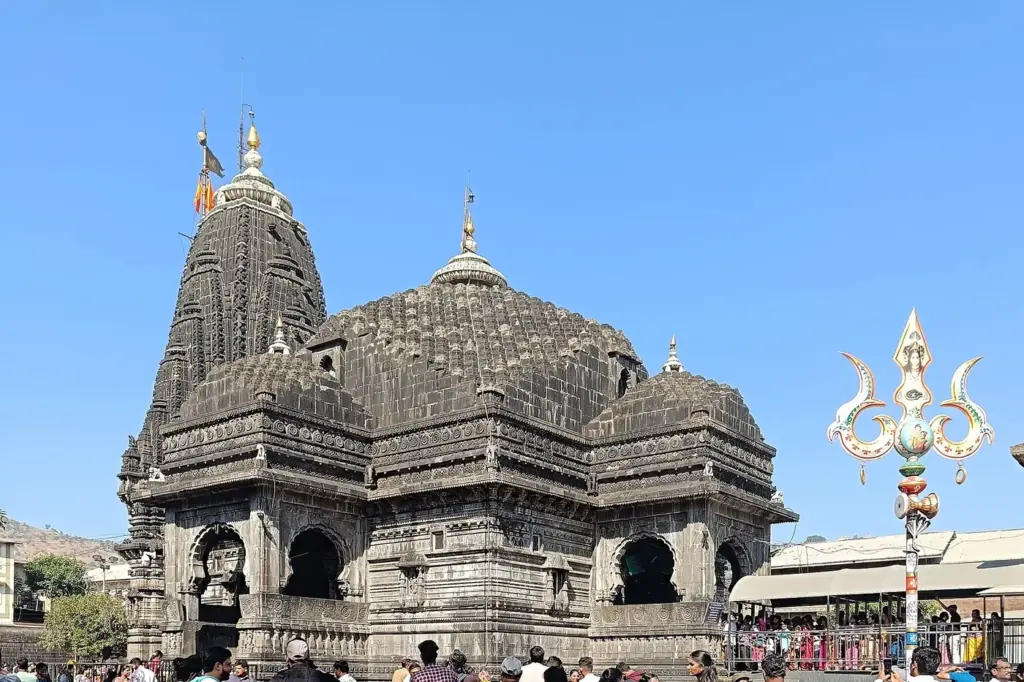
The ASI classes Trimbakeshwar as a bhumija temple built in basalt, and that single word explains its silhouette. Bhumija means roughly “earth-born”, and the ASI uses it for a shrine that rises from the ground without a plinth, crowned by a curvilinear tower built up from rows of miniature spires.
Plan and Materials
The ASI description breaks the complex into parts you can list in an answer:
- A garbhagriha, the sanctum, and a massive square hall with three porches.
- A curvilinear tower of rising miniature shikharas, with purnakumbhas (the overflowing-pot motif) at the corners, ending in an amalaka, the ribbed stone disc, capped by a gilded finial and a flag bearing Nandi.
- A separate, carved stone Nandi mandapa, and a dipmala, a tower of lamps.
- Basalt throughout, with marble members and sculptures used at selected places.
- A courtyard of 80.77 m by 66.45 m, enclosed by a rampart wall with four entrances.
Why the Style Labels Disagree
Official sources use different labels for the same building, and aspirants often copy the wrong one. Maharashtra Tourism calls the temple Hemadpanthi. Incredible India calls it a fusion of Dravidian and Hemadpanthi styles. The ASI calls it bhumija.
They’re answering different questions. Hemadpanti describes a Deccan masonry tradition of heavy stone laid without mortar. Bhumija describes the form of the tower, and it’s usually taught as a sub-style within the Nagara tradition. For an exam answer, the ASI’s term is the one to use, because it’s the conservation authority’s own classification and it names the form precisely.
The Sanctum
The sanctum is the part that surprises first-time readers. The ASI notes that a raised Shivalinga is not extant, and that only a hollow pit with a yonipitha, the pedestal base in which a linga usually stands, is present. Maharashtra Tourism describes the jyotirlinga as three-faced, standing for Brahma, Vishnu and Mahesh, and adorned with a jewelled crown believed to date from the Pandava era.
So when a question says Trimbakeshwar’s linga is “unusual”, this is what it means: the object of worship is the hollow and what it holds, not a raised stone.
Trimbakeshwar Temple Facts Table
The table below collects the facts that turn up most in objective questions.
| Feature | Detail |
|---|---|
| Location | Trimbak, Trimbakeshwar tehsil, Nashik district, Maharashtra |
| Distance | About 28 km from Nashik city |
| Setting | Foot of Brahmagiri (about 3,000 ft), with Nilagiri and Kalagiri hills |
| River | Godavari; Kushavarta kund is its symbolic origin |
| Stotram line | Tryambakam Gautamitate, on the bank of the Gautami |
| Deity | Shiva as Tryambakeshwar; by tradition three lingas in a hollow |
| Built by | Peshwa Balaji Bajirao (1740-1761), on an older site |
| Renovated by | Ahilyabai Holkar, 1779 |
| Style (ASI) | Bhumija, in basalt with marble members |
| Courtyard | 80.77 m by 66.45 m, rampart wall with four entrances |
| Status | Centrally Protected Monument (ASI) |
| Major festivals | Maha Shivaratri, Shravan, Kartik Purnima and the Simhastha Kumbh every 12 years |
| Linked saint | Sant Nivruttinath, whose samadhi is here |
The Simhastha Kumbh: Why Trimbak Bathes Separately
Trimbakeshwar and Nashik together host the Simhastha Kumbh, held every 12 years when Jupiter enters Simha (Leo), and here the ascetic orders bathe in two places. According to the Nashik district administration, Vaishnava akharas bathe at Nashik while Shaiva (Sanyasi) and Udasin akharas bathe at Trimbakeshwar, an arrangement the Peshwas made because of clashes between the sects.
- Kumbh Mela was inscribed on UNESCO’s Representative List of the Intangible Cultural Heritage of Humanity in 2017, with Allahabad (Prayagraj), Haridwar, Ujjain and Nashik named as its four sites. The wider festival is covered in the note on the Kumbh Mela.
- The last Simhastha at Nashik and Trimbakeshwar was held in 2015-16.
- At Nashik and Trimbakeshwar, the festival is held on the banks of the Godavari.
The 2027 Simhastha Schedule
Maharashtra Chief Minister Devendra Fadnavis announced the schedule on 1 June 2025 after a meeting in Nashik with saints from 13 akharas and the Purohit Sangh. The dates:
- Flag hoisting: 31 October 2026 at Trimbakeshwar and Nashik, opening a period that runs to 24 July 2028.
- Nagar Pradakshina: 29 July 2027, in Nashik.
- First Amrit Snan: 2 August 2027.
- Second Amrit Snan: 31 August 2027.
- Third Amrit Snan: 11 September 2027 at Nashik and 12 September 2027 at Trimbakeshwar.
- Works: tenders worth Rs 4,000 crore had been issued, with Rs 2,000 crore more to follow.
The separate final bath dates for Nashik and Trimbakeshwar are the Peshwa-era arrangement still at work in a 2027 calendar.
Contemporary Relevance
Trimbakeshwar is a living temple run by a trust inside a monument protected by the Union government, and that dual status has reached the courts. The Simhastha adds a second pressure: a small hill town has to absorb a festival expected to draw more than 12 crore devotees.
- The fee dispute: in a PIL in the Bombay High Court against a Rs 200 VIP darshan charge, the ASI argued in a March 2023 affidavit that only the central authority can take decisions about a protected monument. The temple trust said the amount was a voluntary donation and denied breaching the Ancient Monuments and Archaeological Sites and Remains Act, 1958.
- Crowd planning: the 2027 festival spreads its bathing dates over more than a month, and the Chief Minister urged devotees not to converge on specific days, since the event runs over a long period.
- Heritage load: the Rs 4,000 crore of Simhastha works already tendered has to be planned around a town whose main monument is protected, so each project near the temple has to be checked against the protected fabric.
There are three ways to read the governance question. One treats the trust as the temple’s only real custodian. Another treats every ritual decision as a heritage decision for the ASI. Neither extreme is a good idea. It is wise to keep worship and its customs with the trust, and anything that touches the protected building under the 1958 Act.
How the Topic Is Tested and How to Revise It
Trimbakeshwar is tested through its three threads, so revise it as three lines rather than one paragraph.
- Prelims: the origin of the Godavari (Brahmagiri, Nashik), the stotram’s “Gautamitate”, the ASI protection, and the Simhastha’s Shaiva-Vaishnava split.
- Mains culture answers: Maratha patronage (Peshwa Balaji Bajirao and Ahilyabai Holkar), regional temple styles, the Varkari tradition through Nivruttinath.
- Mains governance and heritage answers: a living temple inside a protected monument, and crowd management at a 12-year festival.
Five slips cost marks on the Trimbakeshwar temple more often than any missing fact:
- Writing that the Godavari rises in the Kushavarta kund. It rises on Brahmagiri; Kushavarta is its ritual origin.
- Calling the temple’s style Hemadpanti in an architecture answer. The ASI’s term is bhumija.
- Crediting Ahilyabai Holkar with building it. She renovated it in 1779; Peshwa Balaji Bajirao built it.
- Assuming all akharas bathe at Nashik’s Ramkund. Shaiva and Udasin akharas bathe at Trimbakeshwar.
- Mixing up the Kumbh cycle. UNESCO describes the festival moving between its four sites every four years by rotation, so each site, including Nashik and Trimbakeshwar, hosts it every 12 years.
The three-line summary: the Godavari rises on Brahmagiri above the temple; Peshwa Balaji Bajirao built it and Ahilyabai renovated it in 1779; Shaiva akharas bathe here at the Simhastha while Vaishnava akharas bathe at Nashik. For the other eleven shrines and the disputed sites, see the note on the 12 jyotirlingas.
Final Remarks
The Trimbakeshwar temple answers three kinds of question, and it’s easy to lose two of them. If you keep one line from this note, keep the split between source and origin: Brahmagiri for the geography answer, Kushavarta for the culture answer.
The Peshwa builder, the 1779 renovation and the separate Shaiva bath all hang off that one place on the map. Learn the place well, and the rest stays attached.
Frequently Asked Questions
Where is Trimbakeshwar temple located?
In the town of Trimbak in Nashik district, Maharashtra, about 28 km from Nashik city. It stands at the foot of the Brahmagiri hill, ringed by the Nilagiri and Kalagiri hills.
Who built the Trimbakeshwar temple?
The present temple was built by Peshwa Balaji Bajirao, whose tenure the ASI gives as 1740 to 1761, on the site of an older temple. Ahilyabai Holkar of Indore renovated it in 1779.
What is unusual about the Trimbakeshwar jyotirlinga?
The sanctum has no raised linga. The ASI records only a hollow pit with a yonipitha, and tradition reads the hollow as three lingas standing for Brahma, Vishnu and Shiva.
Does the Godavari originate at Trimbakeshwar?
Yes. The river rises on the Brahmagiri hill above Trimbakeshwar in Nashik district. The Kushavarta kund is treated as its symbolic origin, and Gangadwar on Brahmagiri as its first visible emergence.
Is Trimbakeshwar temple protected by the ASI?
Yes. It is a Centrally Protected Monument under the Archaeological Survey of India, while worship is managed by a temple trust. The ASI classes it as a bhumija temple built in basalt.
When is the next Kumbh at Trimbakeshwar?
The Nashik-Trimbakeshwar Simhastha is scheduled to open with flag hoisting on 31 October 2026 and run to 24 July 2028. The final Amrit Snan at Trimbakeshwar is set for 12 September 2027.
Why do Shaiva akharas bathe at Trimbakeshwar during the Simhastha?
The Peshwas separated the orders after clashes between ascetics of the two sects. Since then, Vaishnava akharas bathe at Nashik, while Shaiva and Udasin akharas bathe at Trimbakeshwar.
Practice Questions
Prelims MCQs
Q1. The Trimbakeshwar jyotirlinga is associated with the origin of which river?
(a) Krishna
(b) Bhima
(c) Godavari
(d) Tapi
Answer: (c) The Godavari rises on the Brahmagiri hill above Trimbakeshwar in Nashik district.
Q2. According to the Archaeological Survey of India, the Trimbakeshwar temple belongs to which class of temple?
(a) Vesara
(b) Bhumija
(c) Dravida
(d) Kalinga
Answer: (b) The ASI describes it as a bhumija temple rising from the ground without a plinth, with a tower of miniature shikharas.
Q3. The present Trimbakeshwar temple was built by:
(a) Chhatrapati Shivaji
(b) Ahilyabai Holkar
(c) Peshwa Balaji Bajirao
(d) Maloji Bhosale
Answer: (c) Peshwa Balaji Bajirao built it; Ahilyabai Holkar renovated it in 1779.
Q4. At the Nashik-Trimbakeshwar Simhastha Kumbh, which of the following is correct?
(a) Vaishnava akharas bathe at Trimbakeshwar
(b) Shaiva akharas bathe at Nashik
(c) Shaiva and Udasin akharas bathe at Trimbakeshwar
(d) All akharas bathe together at Nashik
Answer: (c) By a Peshwa-era arrangement, Vaishnava akharas bathe at Nashik and Shaiva and Udasin akharas at Trimbakeshwar.
Q5. Kumbh Mela was inscribed on UNESCO’s Representative List of the Intangible Cultural Heritage of Humanity in:
(a) 2015
(b) 2016
(c) 2017
(d) 2019
Answer: (c) UNESCO inscribed Kumbh Mela in 2017, naming Allahabad, Haridwar, Ujjain and Nashik as its sites.
Mains Questions
- Trimbakeshwar brings together river geography, temple architecture and living ritual. Discuss. (10 marks, 150 words)
- Examine the challenges of managing a living temple that is also a centrally protected monument, with reference to Trimbakeshwar. (15 marks, 250 words)
- The Nashik-Trimbakeshwar Simhastha separates Shaiva and Vaishnava akharas. Trace the origin of this arrangement and assess its relevance to crowd management today. (10 marks, 150 words)
- Evaluate the contribution of the Peshwas and Ahilyabai Holkar to temple building in eighteenth-century India. (15 marks, 250 words)
- Discuss the place of the Godavari in the cultural geography of the Deccan. (10 marks, 150 words)
Tell Google you want more of this.
Add Anantam IAS as a preferred sourceOne tap, and this site shows up more often in your own Top Stories, AI Overviews and AI Mode. Remove it any time.