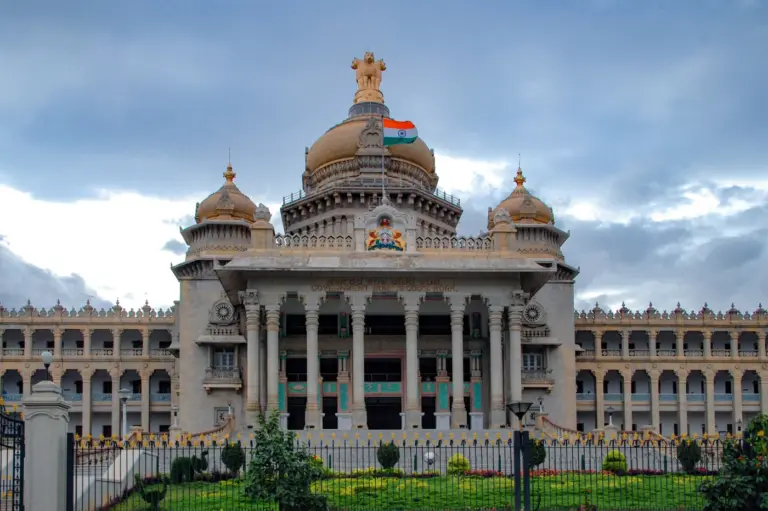
On 7 February 2024, the Uttarakhand Legislative Assembly passed the Uniform Civil Code of Uttarakhand, 2024 — making Uttarakhand the first State of independent India to enact a Uniform Civil Code. After receiving Presidential assent on 12 March 2024, the Act came into force on 27 January 2025 by a notification signed by Chief Minister Pushkar Singh Dhami, who had made UCC his flagship 2022 election pledge.
The law replaces the religion-specific personal laws — Hindu Marriage Act, Muslim Personal Law (Shariat), Indian Christian Marriage Act and Special Marriage Act — for residents of Uttarakhand, applying one uniform set of rules to marriage, divorce, succession, inheritance and live-in relationships, irrespective of religion. It is the first concrete implementation of Article 44 of the Constitution at the sub-national level since independence, apart from the pre-existing Goa Civil Code inherited from Portuguese rule.
Constitutional Backdrop: Article 44
Article 44 of the Directive Principles of State Policy (Part IV of the Constitution) reads:
"The State shall endeavour to secure for the citizens a uniform civil code throughout the territory of India."
- Drafted by Dr. B.R. Ambedkar and inspired by Article 35 of the Indian Constitution committee drafts.
- Non-justiciable (Article 37) — cannot be enforced in court.
- Personal laws fall under Entry 5 of the Concurrent List — both Centre and States can legislate.
- Supreme Court has repeatedly urged implementation: Shah Bano (1985), Sarla Mudgal (1995), John Vallamattom (2003), Shayara Bano (2017), Jose Paulo Coutinho (2019)* — the last two explicitly lamenting that Article 44 remained a dead letter.
Drafting Process
- 27 March 2022: Uttarakhand Cabinet approved the formation of a UCC drafting committee.
- Committee Chair: Justice Ranjana Prakash Desai (retired SC judge; previously chair of Delimitation Commission).
- Members: Justice Pramod Kohli (retired CJ J&K HC), Shatrughan Singh (retired IAS), Manu Gaur, Surekha Dangwal.
- Consultations: 43 public meetings, ~2.33 lakh written suggestions received over 18 months.
- Report submitted: 2 February 2024 — a 740-page document.
- Bill passed: 7 February 2024.
- Presidential assent: 12 March 2024.
- Notified: 27 January 2025.
- Rules framed: Uttarakhand UCC Rules, 2025 (Justice Shatrughan Singh Committee).
Scope — Who Does the Act Apply To?
The Act applies to:
- All residents of Uttarakhand, irrespective of religion
- Citizens of India domiciled in Uttarakhand
- Uttarakhandis residing anywhere in India — extraterritorial application (Section 1(3))
- Central/State Government employees posted in Uttarakhand
- Persons ordinarily resident for more than one year
Exclusions
- Members of Scheduled Tribes (who form ~2.9% of Uttarakhand's population — notably Jaunsari, Bhotia, Tharu, Buksa, Raji) are excluded under Section 2, to protect their customary law as recognised by Article 342, Part X and Schedules V and VI of the Constitution.
- Protected customary practices under the Hindu Marriage Act, 1955 (Section 2(2)) remain preserved for notified tribes.
Key Provisions — Marriage and Divorce
| Subject | Uniform Rule |
|---|---|
| Minimum marriage age | Male 21, Female 18 |
| Monogamy | Compulsory — polygamy banned across religions |
| Registration | Mandatory within 60 days |
| Grounds for marriage | Neither party should have a living spouse; should be of sound mind; not within prohibited degrees |
| Divorce grounds | Uniform for all religions — cruelty, adultery, desertion (≥2 years), conversion, unsoundness of mind, communicable disease, renunciation, presumption of death, no resumption of cohabitation for 1 year after judicial separation |
| Extra-judicial divorce | Banned — triple talaq, halala, iddat, talaq-e-hasan are criminalised |
| Mutual consent divorce | Available to all, minimum 1 year of marriage |
| Re-marriage | Permitted; no compulsory waiting period other than appellate timeline |
Key Provisions — Succession and Inheritance
- Equal inheritance rights for sons and daughters across all religions.
- No distinction between legitimate and illegitimate children for inheritance.
- Adopted, biologically conceived, and surrogate children treated equally.
- Abolition of differential shares for widows under personal laws — uniform one-third for widow where applicable, aligned with succession rules.
- Coparcenary as it existed in Hindu law is significantly modified; the Act introduces a uniform inheritance regime.
Live-in Relationships — The Most Debated Provision
Chapter 3, Part 3 of the Act imposes a novel statutory framework for live-in relationships:
| Requirement | Detail |
|---|---|
| Mandatory registration | Every live-in couple in Uttarakhand must register with the Registrar within one month |
| Punishment for non-registration | Up to 3 months imprisonment and/or Rs. 10,000 fine (Sec 387) |
| False information | Up to 3 months / Rs. 25,000 |
| Non-compliance after Registrar notice | Up to 6 months / Rs. 25,000 |
| Prohibitions | Cannot register if married, minor, related within prohibited degrees, or if relationship is obtained by coercion/fraud |
| Intimation to parents | If either partner is below 21 years, their parents must be informed |
| Child legitimacy | A child born of a live-in relationship is legitimate and entitled to inheritance |
| Maintenance | Deserted female live-in partner can claim maintenance |
Concerns raised: privacy (Article 21 as read in Puttaswamy, 2017), surveillance of consenting adults, risk of outing LGBTQ+ couples, chilling effect on young adults.
Penalties and Enforcement
The Act creates:
- A hierarchy of Registrars and Sub-Registrars
- A digital UCC Portal (ucc.uk.gov.in) for online registration of marriages, divorces and live-ins
- Designated officers in every district
- Appeals to the District Registrar → Registrar General (Home Secretary)
Comparison with Goa Civil Code
Goa is the only other Indian jurisdiction with a UCC-style framework — inherited from the Portuguese Civil Code of 1867 extended to Goa in 1870 and preserved after liberation in 1961 under the Goa, Daman and Diu Administration Act, 1962.
| Feature | Goa Civil Code | Uttarakhand UCC |
|---|---|---|
| Origin | Portuguese, 1867 | Indian legislature, 2024 |
| Polygamy | Banned except rare Hindu exception (no male child by 30) | Banned absolutely |
| Live-in registration | Not required | Mandatory |
| Communion of assets (marital property shared 50:50) | Yes | Not incorporated |
| Mandatory registration of marriage | Yes | Yes |
| Application to ST | Applies | Excluded |
Arguments in Favour
- Gender equality — ends disparate treatment of women across personal laws.
- National integration — one code for one citizenry, as envisaged in Article 44.
- Simplification — ends the complex overlap of personal laws, codified Hindu law, Special Marriage Act.
- Justice to women in divorce, inheritance, maintenance across communities.
- End of discriminatory practices — triple talaq, halala, iddat.
- Constitutional continuity with SC rulings urging uniformity.
Criticisms and Concerns
- Federalism — family law is Concurrent; a state law may conflict with future Union legislation.
- Minority religious freedom (Article 25) — Muslim, Christian and Sikh organisations argued the Act overrides personal laws.
- Tribal exclusion raises equity questions — why exempt some communities but not others.
- Live-in provisions argued to violate the right to privacy (Puttaswamy, 2017) and Article 21.
- Implementation burden — Registrars, IT infrastructure, training of personnel.
- Risk of selective application — critics argue Hindu customs (gotra, sapinda) are retained while Muslim customs are abolished.
Legal Challenges
As of April 2026, multiple writ petitions are pending before the Uttarakhand High Court and the Supreme Court:
- Jamiat Ulama-i-Hind — challenging overrides of Muslim Personal Law
- All India Muslim Personal Law Board
- Public interest petitions on live-in registration violating privacy
- Appeals concerning ST exclusion as under-inclusive classification under Article 14
The Supreme Court in February 2025 refused interim stay but issued notices and tagged matters for hearing.
Other States Following Uttarakhand
- Gujarat — appointed a UCC committee in February 2024 under Justice Ranjana Desai.
- Assam — CM Himanta Biswa Sarma announced in 2024 that Assam would adopt UCC; Draft Bill under preparation as of 2026.
- Madhya Pradesh, Maharashtra, Uttar Pradesh — publicly expressed intent.
- Rajasthan — state-appointed panel in 2024.
UPSC Relevance
GS2 (Polity): Directive Principles, Article 44, Article 25, Concurrent List, federal structure, minority rights.
GS1 (Society): Gender justice, personal laws, social reform movements, communal harmony.
GS4 (Ethics): Conflict between religious freedom and gender equality; ethics of state intervention in private lives.
Key Prelims facts:
- UCC Uttarakhand passed: 7 February 2024
- Presidential assent: 12 March 2024
- Came into force: 27 January 2025
- First state to enact UCC post-independence: Uttarakhand
- Chief Minister who implemented: Pushkar Singh Dhami
- Drafting committee chair: Justice Ranjana Prakash Desai
- Marriage age: Male 21 / Female 18
- Live-in registration: Mandatory, within 30 days
- Excluded: Scheduled Tribes under Section 2
- Constitutional basis: Article 44 (Part IV, Directive Principles)
- Pre-existing UCC jurisdiction: Goa (Portuguese Civil Code of 1867)
- Key SC cases advocating UCC: Shah Bano (1985), Sarla Mudgal (1995), John Vallamattom (2003), Jose Paulo Coutinho (2019)
- Personal laws fall under: Entry 5, Concurrent List
Tell Google you want more of this.
Add Anantam IAS as a preferred sourceOne tap, and this site shows up more often in your own Top Stories, AI Overviews and AI Mode. Remove it any time.