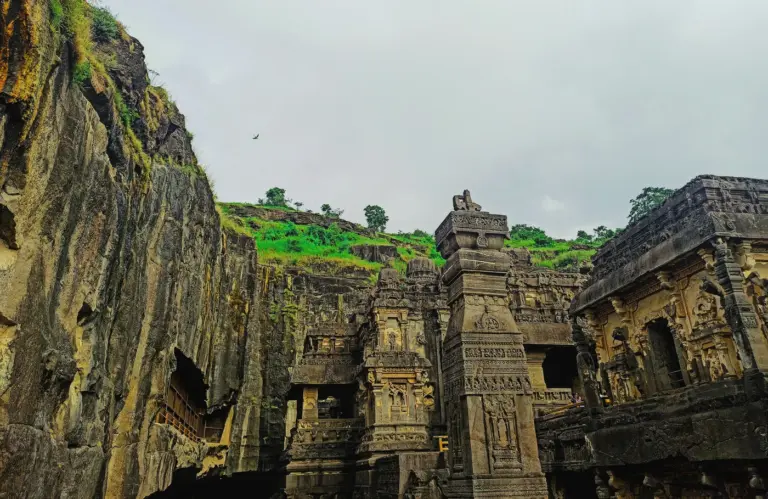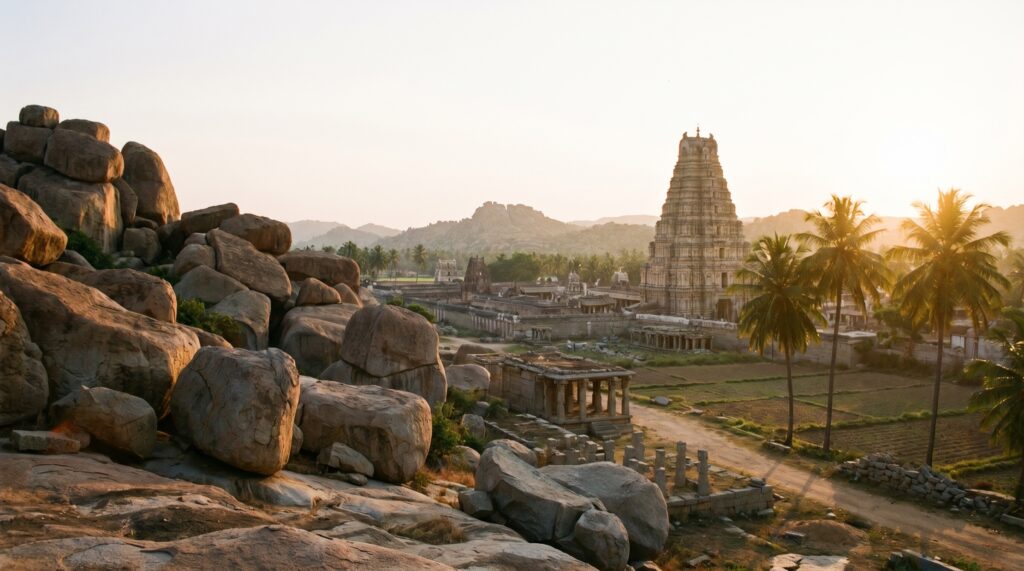
Hampi gets sold to you as a ruin field. Boulders the size of houses, broken colonnades, a stone chariot, an empire that lost one battle and never got up. Then you walk to the Virupaksha Temple and the story breaks in your hands. A priest is working. A bell is ringing. Someone at the gate is haggling over flowers. This isn’t a monument being preserved behind a rope. It’s a temple that has never stopped, and it was already old when the Vijayanagara Empire was founded.
Hold that before you look at a single carving. Everything else at Hampi is archaeology. Virupaksha is a Tuesday morning. The city around it was sacked in 1565 and never recovered, yet the worship inside these walls carried on without a break, which puts it among the oldest continuously functioning temples in India. Learn the building through that one fact and the tiers, the murals, and even the famous upside-down shadow stop being trivia and start being evidence.
What the Virupaksha Temple is, and why it never closed
The Virupaksha Temple sits at Hampi in Karnataka’s Vijayanagara district, on the south bank of the Tungabhadra river, and it’s dedicated to Virupaksha, a form of Shiva, with the local river goddess Pampa as his consort. Its worship runs unbroken from roughly the 7th century CE, which means it predates the Vijayanagara Empire by about six hundred years and has outlasted it by four and a half centuries more.
Start with the names, because they do half the teaching. *Virupaksha* breaks into *vi-rupa-aksha*, literally “the odd-eyed one,” a Shiva epithet that points at the third eye on his forehead. The temple’s other name, Pampapathi, is simpler: “lord of Pampa.” And Pampa isn’t a minor character. She’s the goddess of the river itself, *Pampa* being the Tungabhadra’s older name, and Hampi is just her name worn down by centuries of speech: Pampa to Hampe to Hampi.
So the town is named after the goddess, the goddess married the god, and the god’s house is the only building in town that still has someone living in it. That’s the whole orientation. Everything below is detail hung on it.
| Attribute | Detail |
|---|---|
| Location | Hampi, Vijayanagara district, Karnataka (south bank of the Tungabhadra) |
| Deity | Virupaksha, a form of Shiva, worshipped as a lingam; consort Pampa |
| Other name | Pampapathi Temple |
| Origins | Small shrine from about the 7th century CE; worship unbroken since |
| Major expansion | Vijayanagara period, 14th to 16th centuries |
| Key patron | Krishnadevaraya (reigned 1509 to 1529) |
| Main gopuram | East-facing, 9 tiers, about 50 m tall |
| Architecture | Dravidian (South Indian), Vijayanagara idiom, local granite |
| Signature hall | Ranga mandapa, added 1510 CE, with painted ceiling |
| UNESCO status | Part of the Group of Monuments at Hampi, inscribed 1986 |
| Still in worship | Yes, the only major Hampi temple in continuous active worship |
Older than the empire it’s famous for
The temple’s earliest known mention dates to about the 7th to 8th centuries CE, when the site was tied to the worship of the goddess Pampa, and inscriptions naming Shiva show up in the 9th and 10th centuries. Structural additions came through the late Chalukya and Hoysala periods, well before Vijayanagara existed. What began here was a modest shrine, not a complex.
The empire arrives late in that story. Vijayanagara was founded in 1336, with its capital at Hampi, by Harihara I and Bukka I of the Sangama dynasty, and by 1500 the city had grown into what historians reckon was the second-largest city in the medieval world after Beijing. The rulers didn’t build Virupaksha. They found it, adopted it, and then spent two centuries making it enormous. The huge temple complex you walk through was raised by Lakkana Dandesha, a chieftain under Deva Raya II (reigned about 1422 to 1446), and the finishing touches came a century later.
Now the smart objection, because it lands every time: if this is a 7th-century temple, why does none of it look 7th century? Because almost none of it is. The old shrine is the seed at the centre; the gateways, halls, colonnades and courtyards wrapped around it are Vijayanagara work. That’s how living temples grow, and it’s the exact opposite of how Konark worked, where a single ruler built one thing once and the sea and the centuries took it apart. One temple was built and abandoned. This one was never finished, because it was never left alone.
The gopuram: how to read a fifty-metre gateway
The main eastern gopuram rises nine tiers to about 50 metres, and it’s the tallest thing standing at Hampi, visible long before you reach the bazaar street beneath it. Krishnadevaraya (reigned 1509 to 1529), the empire’s most capable ruler, is credited with building it, and it does exactly what a Dravidian gateway tower is supposed to do: it announces the god to the whole valley.
Look at how it’s made, because the construction is the lesson. The two lower storeys are stone, load-bearing and severe. Everything above is brick and mortar dressed in carved stucco figures, tier on tier, each one shorter than the last so the silhouette tapers. That split is deliberate engineering, not laziness. Stone at the base carries the weight; light brick and plaster up top let the tower go high without crushing itself. Once you notice it, you’ll notice it on every big South Indian gopuram you ever see.
Four words unlock the rest of the plan, and they’re the same four that work across the whole Dravidian tradition. The garbhagriha is the sanctum, the dark inner room holding the lingam, guarded here by two four-armed dvarapalas standing about 2 metres tall. A mandapa is a pillared hall, and Virupaksha has several, including a hundred-pillared one. A prakara is a walled enclosure, and the complex has courtyards nested inside courtyards. A gopuram is the gateway tower over a prakara wall. There’s a second big one on the north, the Kanakagiri gopura, and a smaller inner gateway.
Here’s the inversion that catches everyone out: the tower over the sanctum is small, and the giant is out at the public gate. Sacred intensity climbs as the architecture shrinks. If that pattern already sounds familiar from Srirangam, good, it’s the same grammar at a different scale, and it’s what separates the Dravidian temple from the Nagara temple of the north, where the tallest tower sits directly over the god.
One more thing you can still walk. Running east from the gopuram is the Hampi Bazaar, also called the Virupaksha Bazaar, a colonnaded street about a kilometre long where merchants once sold horses and gems in the open. Vijayanagara’s chroniclers wrote about diamonds being traded by the heap on this road. It’s a temple street, a market, and a processional avenue in one, and it tells you that the temple was the town’s economic engine, not just its shrine.
Krishnadevaraya’s hall and its painted ceiling
The ranga mandapa, the great pillared hall in front of the sanctum, was added in 1510 CE by Krishnadevaraya, and it’s the single most decorated space in the temple. The occasion is usually read two ways: it went up to mark his accession (his coronation falls in January 1510), and it’s also linked to his campaign against the Gajapati kingdom of Odisha. Either way, this is a king putting his victory on the ceiling of a god’s house, which is what temple patronage in this period actually was.
Look up, and don’t rush it. The ceiling is divided into eight unequal registers, laid out as square panels separated by strips of geometric and floral design, filled with scenes from the lives of Hindu deities. The temple’s paintings span the 14th and 16th centuries, so you’re looking at more than one campaign of work in one glance. The recurring subjects include the wedding of Virupaksha and Pampa, Shiva as Tripurantaka destroying the three cities, episodes from the Ramayana, and a procession of Vidyaranya, the sage tied to Vijayanagara’s founding tradition, carried in a palanquin.
That last panel is worth pausing on. It puts a historical figure and the empire’s own origin story into a ceiling otherwise full of gods. The murals aren’t decoration; they’re the empire arguing, in paint, that its rule and Shiva’s are the same project. Mural survival in Indian temples is rare, and this ceiling is one of the reasons Vijayanagara painting is a subject at all rather than a footnote.
The tower that hangs upside down on a wall
Inside a dim chamber behind the sanctum, a small aperture in the wall throws an inverted image of the main eastern gopuram onto the opposite surface: the tower complete, in colour, standing on its head. Guides demonstrate it daily. It’s the temple’s best-known oddity, and unlike most temple legends, this one is straightforward physics.
The principle is the pinhole camera, or *camera obscura*. Light travels in straight lines. Rays leaving the top of the gopuram pass through the tiny hole and continue downward, landing on the lower part of the far wall; rays from the base of the tower travel upward through the same hole and land near the top. Every ray crosses at the aperture, so the whole picture arrives flipped. Any dark room with one small hole in a sunlit wall will do this. Punch a pinhole in a shoebox and you’ve built the same instrument.
Where honesty matters is the intent. Whether the effect was designed or is a happy accident of the temple’s geometry isn’t settled, and you’ll see confident claims in both directions from people who have no way of knowing. What’s beyond argument is the observation itself and the physics behind it. Treat it as a demonstrated phenomenon of the building, not as proof that the architects were secretly optical engineers. That distinction is worth keeping, because it’s the difference between a fact and a flourish.
The temple that outlived its city
In 1565, a coalition of Deccan sultanates defeated Vijayanagara at the Battle of Talikota, and the capital was sacked over months and then abandoned. This is one of the more complete destructions of a major city in Indian history: the empire limped on elsewhere, but Hampi as a living metropolis simply ended. The palaces went. The markets went. The population went.
Virupaksha didn’t. Worship here continued through the destruction and after it, which is why it stands today as the only well-preserved and actively maintained temple at Hampi, while its neighbours are conserved ruins. The most likely reason is unglamorous and convincing: a shrine sacred to local people for eight centuries before the empire arrived didn’t stop being sacred to them when the empire left. The temple outlived its patrons because it never depended on them in the first place.
The living-temple status shows up on the calendar, not just in the stones. The wedding festival of Virupaksha and Pampa is celebrated in December, and a chariot festival rolls through the bazaar in February. A temple elephant, Lakshmi, blesses visitors at the gate and bathes in the Tungabhadra. None of this is heritage re-enactment. It’s the same institution, still running, and that continuity is the temple’s real claim on your attention. Fold it into your notes on the Vijayanagara Empire as the one piece of the capital that refused to become a ruin.
What the World Heritage listing at Hampi actually protects
The Group of Monuments at Hampi was inscribed as a UNESCO World Heritage Site in 1986 under cultural criteria (i), (iii) and (iv), and the listing covers roughly 1,600 surviving monuments across about 4,100 hectares, not one building. Virupaksha is one entry in a landscape site, and getting that scope right matters, because the property is the whole ruined capital: temples, gateways, royal enclosures, water tanks, aqueducts and market streets scattered across a granite valley. Details are on the UNESCO World Heritage Centre listing.
The listing has teeth, and Hampi has felt them. The site was placed on the List of World Heritage in Danger from 1999 to 2006, largely over construction, including bridge work and unregulated building, that threatened the setting. It came off the danger list after the state acted. That episode is the most useful thing about Hampi for anyone thinking about heritage governance: inscription isn’t a trophy, it’s a standing obligation, and it can be enforced by embarrassment when nothing else works. The Archaeological Survey of India manages the monuments on the ground, and you can see its remit at asi.nic.in.
How to study Virupaksha without drowning in detail
Build it around three questions and let every fact answer exactly one: what it is, how it’s built, and why it matters. Almost nothing about this temple falls outside those three, and the reason most notes on Hampi collapse is that they’re a heap of impressive facts with no shelves to sit on.
For what it is, lock one sentence: a Shiva temple at Hampi on the Tungabhadra, dedicated to Virupaksha with the goddess Pampa, in unbroken worship since about the 7th century and hugely expanded under Vijayanagara. That sentence answers most factual questions before they finish being asked. Add the name chain (Pampa to Hampe to Hampi) because it links the town, the river, and the goddess in one move.
For how it’s built, learn the four Dravidian words as a set: garbhagriha, mandapa, prakara, gopuram. Then attach the two headline specifics: the 9-tier, 50-metre eastern gopuram with its stone base and stucco superstructure, and Krishnadevaraya’s ranga mandapa of 1510 with its painted ceiling. The pinhole effect belongs here too, filed under how the building works rather than what it looks like. If you can label a photograph of the temple with those four terms, you’re ahead of most.
For why it matters, hold three markers: continuous worship since the 7th century, survival through the sack of 1565, and UNESCO inscription in 1986 as part of the Group of Monuments at Hampi, including the danger-listing episode. Those are the hooks that connect this temple to the wider World Heritage list in India, to Vijayanagara history, and to live questions about protecting a heritage landscape people still live and worship in. Three questions, three answers, and the temple stops sliding out of your memory.
Frequently Asked Questions
Which god is the Virupaksha Temple dedicated to?
Shiva, worshipped here in the form of Virupaksha, with the local river goddess Pampa as his consort. The temple is also called the Pampapathi Temple, meaning “lord of Pampa.”
How old is the Virupaksha Temple?
Its earliest known mention goes back to about the 7th to 8th centuries CE, and worship has continued without a break since then. That makes it several centuries older than the Vijayanagara Empire, which was founded in 1336.
Who built the Virupaksha Temple at Hampi?
There isn’t one builder. It started as a small shrine and grew over centuries. The large complex was raised by Lakkana Dandesha, a chieftain under Deva Raya II, and Krishnadevaraya added the eastern gopuram and the ranga mandapa in 1510.
How tall is the Virupaksha Temple gopuram?
The main eastern gopuram is about 50 metres tall with nine tiers. Its two lower storeys are stone, and the superstructure above is brick and mortar covered in carved stucco figures.
What is the inverted shadow at Virupaksha Temple?
A small aperture in a wall behind the sanctum projects an upside-down image of the main gopuram onto the opposite wall. It’s a natural pinhole camera, or camera obscura, working on the straight-line travel of light. Whether it was designed that way is debated.
Why is Virupaksha the only temple still in worship at Hampi?
The site was sacred to local people for centuries before Vijayanagara adopted it, so when the capital was sacked in 1565 and abandoned, the temple’s local following outlasted its royal patrons. Everything else at Hampi became a conserved ruin; Virupaksha stayed a working temple.
Is Virupaksha Temple a UNESCO World Heritage Site?
It’s part of one. The Group of Monuments at Hampi was inscribed in 1986 and covers about 1,600 monuments across roughly 4,100 hectares. The site was also on the List of World Heritage in Danger from 1999 to 2006.
What are the paintings inside the Virupaksha Temple?
The ranga mandapa ceiling carries scenes from the lives of Hindu deities, arranged in eight unequal registers of square panels. Subjects include the wedding of Virupaksha and Pampa, Shiva as Tripurantaka, Ramayana episodes, and a procession of the sage Vidyaranya. The paintings span the 14th and 16th centuries.
Practice Questions
1. The Virupaksha Temple at Hampi is dedicated to which deity?
a) Vishnu
b) Shiva
c) Surya
d) Kartikeya
Answer: b
2. Which ruler is credited with adding the ranga mandapa and the eastern gopuram to the Virupaksha Temple in 1510 CE?
a) Deva Raya II
b) Harihara I
c) Krishnadevaraya
d) Rama Raya
Answer: c
3. The Virupaksha Temple stands on the bank of which river?
a) Krishna
b) Kaveri
c) Godavari
d) Tungabhadra
Answer: d
4. The Group of Monuments at Hampi was inscribed as a UNESCO World Heritage Site in:
a) 1984
b) 1986
c) 1993
d) 2004
Answer: b
5. The famous inverted image of the gopuram seen inside the Virupaksha Temple is explained by which principle?
a) Total internal reflection
b) Diffraction of light
c) The pinhole camera, or camera obscura
d) Polarisation of light
Answer: c
Mains-style questions
1. “Virupaksha is the one part of Vijayanagara’s capital that never became a ruin.” Examine why the temple survived the destruction of Hampi and what its survival tells us about the relationship between royal patronage and popular devotion. 2. Discuss the features of Vijayanagara temple architecture, using the Virupaksha Temple to illustrate the gopuram, the mandapa, and the use of local granite. 3. Evaluate the significance of the ranga mandapa ceiling paintings at Hampi as a source for the cultural and political history of the Vijayanagara Empire. 4. The Group of Monuments at Hampi was placed on the List of World Heritage in Danger from 1999 to 2006. Analyse the challenges of conserving a heritage landscape in which people continue to live and worship. 5. Compare the treatment of the sanctuary tower in Dravidian and Nagara temple architecture, taking the Virupaksha Temple as your Dravidian example.
Virupaksha earns its place in your preparation for a reason that has nothing to do with being pretty. It’s the control case. Every other monument at Hampi shows you what happens when patronage stops, and this one shows you what happens when devotion doesn’t. Nine tiers of stone and stucco, a painted ceiling commissioned by a king celebrating a war, a gateway tower that hangs upside down in a dark room, and a lingam that has been washed every morning since before the Cholas peaked. Learn the four Dravidian words, keep 1336 and 1565 straight, and remember the thing the guidebooks bury: at Hampi, the ruins are the exception.
Tell Google you want more of this.
Add Anantam IAS as a preferred sourceOne tap, and this site shows up more often in your own Top Stories, AI Overviews and AI Mode. Remove it any time.