Most people say “temple” and picture a single building you walk up to, photograph, and walk away from. That word fails almost completely at Srirangam. What sits on this island in the Kaveri near Tiruchirappalli is not a building but a walled temple-city, seven concentric enclosures deep, with shops, streets, and houses living inside the outer rings and the god at the dead centre. You do not visit the Sri Ranganathaswamy Temple so much as walk into it, gate after gate, until the crowds thin and the last golden tower rises over the sanctum.
Get that one idea and the numbers stop being trivia. This is widely counted as the largest functioning Hindu temple complex in the world, spread across roughly 156 acres, ringed by 21 gopurams, and crowned by a Rajagopuram that stands among the tallest temple towers in Asia. The god inside is not seated or standing but reclining, stretched full length on a coiled serpent, facing south. Every strange detail here, the reclining posture, the south-facing sanctum, the town inside the walls, has a reason. This is how you learn them.
Where Srirangam sits, and why an island shaped the temple
Srirangam is a river island in the Kaveri, formed where the river splits around it and its distributary the Kollidam (Coleroon) rejoins downstream, sitting just north of Tiruchirappalli (Trichy) in Tamil Nadu. That island setting is not a scenic footnote. It made the site sacred long before it made it defensible, and it is the reason the temple grew outward in rings rather than upward as one tower.
The name says as much. Srirangam joins *Sri* with *Ranga*, and the temple’s deity is Ranganatha, “lord of the ranga,” the stage or arena, understood as the whole island cradled by the river. Water on every side marked the ground as pure and set-apart, an obvious home for a god who reclines as if resting on the cosmic ocean.
There is a working detail worth holding here. Because the Kaveri floods and the town lived inside the temple, the complex was built to absorb a population, not just pilgrims. The outer prakaras, the enclosure walls, hold Chittirai Street and other named streets, homes, and markets to this day. That is why “walking into the temple” and “walking into the town” are, at Srirangam, the same act. When you revise the Cauvery river system and its disputes, file Srirangam as the great cultural node sitting midstream, the sacred island the water made.
| Attribute | Detail |
|---|---|
| Location | Srirangam island, Tiruchirappalli, Tamil Nadu (on the Kaveri) |
| Deity | Ranganatha, a reclining form of Vishnu, with consort Ranganayaki |
| Posture | Reclining on the serpent Adishesha, facing south |
| Scale | About 156 acres; often called the largest functioning Hindu temple |
| Enclosures | Seven concentric prakaras (walled enclosures) |
| Gopurams | 21 gateway towers |
| Rajagopuram | About 73 m (roughly 240 ft), 13 tiers; completed 1987 |
| Architecture | Dravidian (South Indian) temple style |
| Tradition | Foremost of the 108 Divya Desams; capital of Sri Vaishnavism |
| Key figure | Ramanuja, whose preserved remains are enshrined here |
| Chief festival | Vaikunta Ekadashi (Tamil month of Margazhi, Dec to Jan) |
The god who reclines, and why he faces south
The deity at Srirangam is Ranganatha, a form of Vishnu shown lying full length on the coils of Adishesha, the thousand-hooded serpent, in the pose Sanskrit calls *anantashayana*, “resting on the endless one.” This is Vishnu at rest between cycles of creation, floating on the cosmic ocean, and the sanctum reproduces that image in stone rather than showing a god seated on a throne. Name the posture once and it stops being just an unusual idol: it is a theological statement about Vishnu as the sustainer who reclines, dreaming the universe.
Now the detail that puzzles first-time visitors. The sanctum faces south, which is unusual, and the standard explanation is a story from the Ramayana’s aftermath. In the legend, the presiding image was worshipped by Brahma, passed down the solar dynasty, and finally given to Vibhishana, Ravana’s righteous brother and the new king of Lanka. Carrying it home, Vibhishana set it down on the Kaveri island, and it refused to be lifted again, choosing Srirangam as its permanent seat. As a boon, Ranganatha agreed to lie facing south, so he could keep looking toward Vibhishana and Lanka. Whether or not you take the story literally, it fixes two exam-worthy facts at once: the south orientation and the temple’s deep link to Vaishnava mythology.
That mythic weight is why Srirangam is not just one temple among many. For the Sri Vaishnava tradition it is the foremost of the 108 Divya Desams, the holy abodes of Vishnu praised by the Alvars, the twelve Tamil poet-saints of the Bhakti movement. Devotees call it simply “Koil,” *the* temple, the way you would name the one place that needs no further description. No other Divya Desam carries more hymns in the Alvars’ canon, the Naalayira Divya Prabandham, than this one.
Seven walls and twenty-one gopurams: a temple you enter like a city
The single most important structural fact about Srirangam is that it is built as seven concentric rectangular enclosures, called prakaras, nested one inside the next like the rings of an onion, with the sanctum at the core. You cross from the outermost ring toward the centre through a sequence of gateway towers, and the sacred intensity rises as the walls close in. This is what makes the complex feel like a fortified town, because in its outer rings it literally is one.
Here is how the rings sort themselves. The outer two or three prakaras are effectively part of Srirangam town, lined with houses, shops, hotels, and the broad temple streets that host the chariot festivals. Only from roughly the fourth enclosure inward does the space become purely religious, filled with shrines, halls, and sacred tanks. The innermost enclosure holds the sanctum of Ranganatha, entered by the fewest and reached last. So a pilgrim’s walk is a graded passage from the everyday world outside to the god at the still centre, and the architecture teaches that journey without a word.
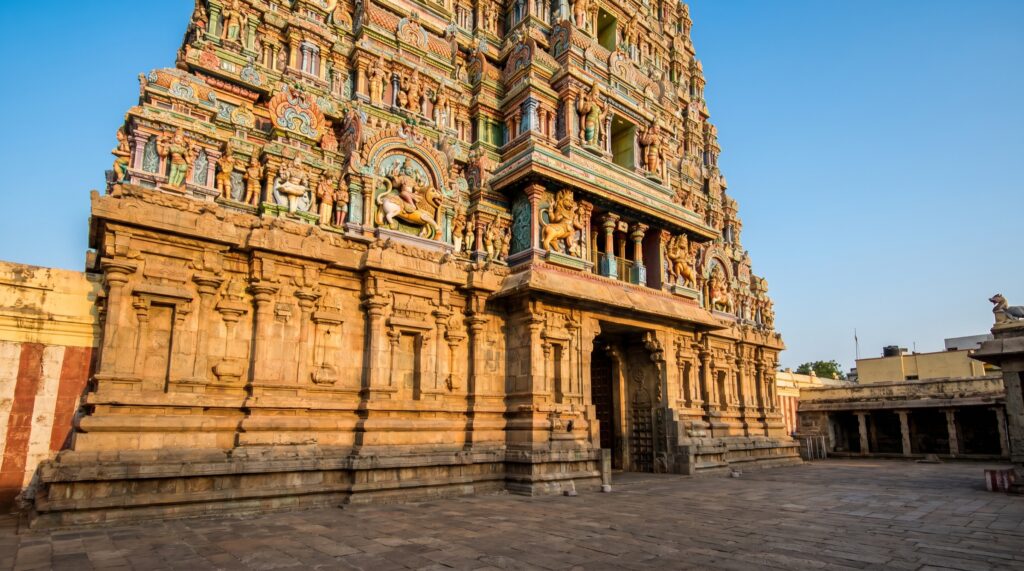
The gateways mark every crossing. The complex has 21 gopurams, the tall pyramidal towers that stand over the entrances in each wall, and their scale grows as you move outward, which is the opposite of what newcomers expect. The tower over the sanctum is modest and golden; the giants are on the outer walls. That inversion, small at the holy core and colossal at the public edge, is a hallmark of the mature Dravidian temple, and Srirangam is its largest living example. Keep the temple architecture of India straight by remembering this one site, because almost every South Indian term has a textbook instance here.
The Dravidian grammar you can read on the walls
Srirangam is a working dictionary of Dravidian (South Indian) temple architecture, and four terms unlock nearly everything you see. Learn them as a set, because they describe the parts of almost every major Tamil temple, from the Cholas onward.
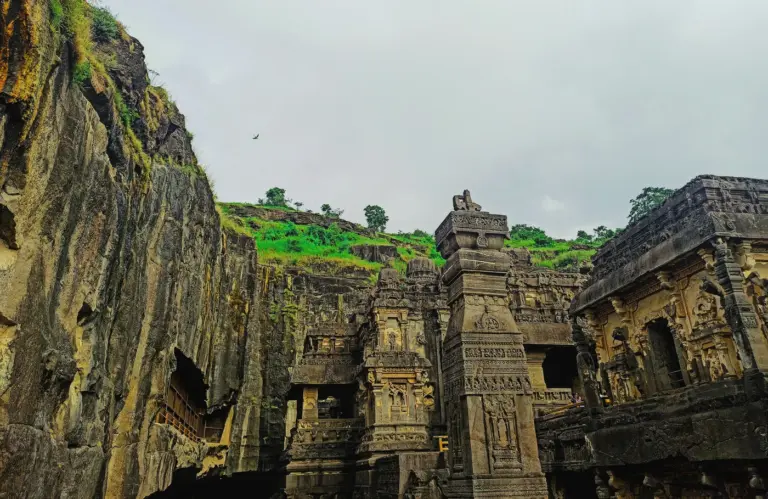
The gopuram is the towering gateway over an entrance in a prakara wall, pyramidal and stacked with tiers of sculpture, the feature that dominates the South Indian skyline. The vimana is the tower directly over the sanctum, usually smaller than the gopurams in a big temple. At Srirangam this is the Pranava Vimana, gold-plated and shaped like the syllable Om, rising over Ranganatha himself, so the holiest tower is also the least tall, exactly as the Dravidian scheme intends. The mandapa is a pillared hall, and the prakara is the enclosure wall, the ring, that you already met. Gopuram, vimana, mandapa, prakara: four words, and the whole plan becomes readable.
The mandapas are where the stone-carvers show off. Srirangam’s celebrated “thousand-pillared hall” (the *Aayiram Kaal Mandapam*) is a vast Vijayanagara-era assembly hall that actually carries close to 953 granite pillars in a strict grid, a forest of stone you walk through. Nearby, the Sheshagiri Raya Mandapam carries the famous rearing-horse pillars, warriors mounted on leaping *yali* beasts cut almost fully in the round from single blocks. These are not decoration bolted on; they are the Nagara, Dravida, and Vesara styles made concrete, the Dravida branch at its most confident. Much of this expansion came under the Cholas, the Pandyas, the Hoysalas, and above all the Vijayanagara kings and the Nayaks of Madurai, each dynasty adding rings and halls over roughly a thousand years.
The Rajagopuram: Asia’s towering gateway, finished in living memory
The Rajagopuram, the “royal tower” on the temple’s southern outer wall, rises about 73 metres (roughly 240 feet) across 13 tiers, which places it among the tallest temple towers in Asia and, by many counts, the tallest in India. Stand at its foot and the top storey is a distant smudge of white and colour; the tower is visible for miles across the Kaveri plain, the first sign of Srirangam long before you reach it.
Its story carries a lesson about how these temples were actually built. The base of the Rajagopuram was laid centuries ago, in the Vijayanagara period, and then left unfinished, a broad stone stump that stood incomplete for generations. The soaring superstructure above it was only completed in 1987, under the guidance of the Ahobila Matha, using modern engineering to raise the brick-and-mortar tiers the medieval builders never finished. So the single most photographed feature of this ancient temple is, in its upper reaches, younger than most of the people reading this. That is worth remembering when you are tempted to treat a “historic” monument as frozen: great temples were, and are, works in progress across centuries.
Ramanuja and why Srirangam is the capital of Sri Vaishnavism
Srirangam is inseparable from Ramanuja (traditionally 1017 to 1137 CE), the philosopher who systematized Vishishtadvaita, “qualified non-dualism,” the school holding that the individual soul is real and distinct yet wholly dependent on God, against Shankara’s stricter monism. Ramanuja made Srirangam his base, reorganized the temple’s worship and administration, and turned it into the intellectual and devotional headquarters of the Sri Vaishnava tradition. When people call Srirangam the “capital” of Sri Vaishnavism, this is why.
The temple holds a startling relic of that association. A shrine within the complex enshrines what devotees venerate as the actual preserved body of Ramanuja, seated, its surface periodically recoated with saffron and camphor to protect it, and shown to worshippers on fixed occasions. Whether one reads it as a genuinely mummified body or as a much-restored image, the tradition itself, that the founder-teacher physically remains in his temple, tells you how central he is to the place. There is no comparable claim at most Indian temples, and it is the kind of specific, verifiable-by-visit detail that sticks.
This lineage matters beyond one temple. The Sri Vaishnava movement that Ramanuja shaped fed the wider Bhakti current of devotional Hinduism, carried in the Tamil hymns of the Alvars and the Sanskrit theology of the *acharyas*. Srirangam is where that stream was gathered, codified, and sent outward. Learn the temple and you have a physical anchor for an otherwise abstract chapter on medieval devotional philosophy.
Vaikunta Ekadashi and the Gate of Paradise
The temple’s greatest festival is Vaikunta Ekadashi, falling in the Tamil month of Margazhi (December to January), and its signature ritual is architectural. On this one day, a special doorway on the northern side of the sanctum, the Paramapada Vasal or “Gate of Paradise” (also called the Vaikunta Vasal), is thrown open, and hundreds of thousands of devotees file through it, believing that passing through on this day carries the promise of *Vaikuntha*, Vishnu’s heaven. For the rest of the year the gate stays shut.
Around it runs a 21-day festival cycle in Margazhi, the *Adhyayana Utsavam*, when the Alvars’ hymns are chanted before the god and performed in the temple’s distinctive Araiyar Sevai, a sung-and-gestured recital preserved by a small hereditary group of performers. Crowd figures on Vaikunta Ekadashi run into the hundreds of thousands in a single day, which places Srirangam among the largest annual religious gatherings in South India. The other great festival is the Chithirai Brahmotsavam in spring, when the deity is drawn through the temple streets on towering wooden chariots. If you are mapping India’s major temple festivals, tie Vaikunta Ekadashi to Srirangam the way you tie Rath Yatra to Puri.
A history of plunder, and the award for its restoration
Srirangam’s grandeur hides a violent history, and it is the honest part of the story. In the early fourteenth century the temple was raided by the armies of the Delhi Sultanate, most destructively around 1311 under Malik Kafur and again in the 1320s, when tradition records a massacre of thousands of Sri Vaishnavas defending it and the removal of its festival deity to safety in the hills. The main image was hidden and the utsava murti carried away for decades, recovered and reinstalled only after the Vijayanagara rise restored order in the south. That episode, treasure and idol hidden from an invading army, is why so much of what stands today is Vijayanagara-and-later rebuilding over an older Chola-Pandya core.
In the modern era the temple has been recognized less for age than for care. Its restoration work won the UNESCO Asia-Pacific Award of Merit for Cultural Heritage Conservation in 2017, cited for repairs that stayed faithful to traditional materials and craft. Note the precise claim: this is a conservation award, not a World Heritage inscription, and the temple remains a living place of worship administered by the Tamil Nadu Hindu Religious and Charitable Endowments department rather than a museum monument. You can read the department’s official listing at the HR&CE Tamil Nadu site, and slot the temple beside the Chola and Vijayanagara chapters when you revise the Vijayanagara empire and the broader UNESCO recognition of India’s heritage.
How to study Srirangam without drowning in detail
The efficient way to hold Srirangam is to answer four questions and let every fact attach to one: what it is, how it is built, who it belongs to, and what happened to it. Almost nothing you need falls outside those four.
For what it is, lock one sentence: the largest functioning Hindu temple, on a Kaveri island at Tiruchirappalli, dedicated to Vishnu as the reclining Ranganatha, and the foremost of the 108 Divya Desams. That line answers most factual questions before they finish. For how it is built, learn the Dravidian four, gopuram, vimana, mandapa, prakara, then hang the specifics on them: seven prakaras, 21 gopurams, the roughly 240-foot Rajagopuram finished in 1987, and the gold Pranava Vimana over the sanctum.
For who it belongs to, remember Ramanuja, Vishishtadvaita, and the temple’s role as the capital of Sri Vaishnavism, with his preserved remains as the memorable hook. For what happened to it, pair the medieval Delhi Sultanate raids and Vijayanagara restoration with the modern 2017 UNESCO conservation award. Four questions, four clusters, and a sprawling temple-city becomes something you can actually explain rather than merely list.
Frequently Asked Questions
Where is the Ranganathaswamy Temple located?
On Srirangam island in the Kaveri river, just north of Tiruchirappalli (Trichy) in Tamil Nadu. The island is formed by the Kaveri and its distributary, the Kollidam.
Which deity is worshipped at Srirangam?
Vishnu in the form of Ranganatha, shown reclining on the serpent Adishesha and facing south. His consort here is Ranganayaki. It is counted as the foremost of the 108 Divya Desams.
Why is the Srirangam temple called the largest Hindu temple?
Because it is the largest functioning Hindu temple complex, spread over about 156 acres with seven concentric prakaras and 21 gopurams. Some non-functioning complexes, like Angkor Wat, cover more ground, but Srirangam is the largest still in active worship.
How tall is the Rajagopuram at Srirangam?
About 73 metres, roughly 240 feet, across 13 tiers, which makes it one of the tallest temple towers in Asia. Its base is old, but the upper structure was completed in 1987.
What is the connection between Ramanuja and Srirangam?
Ramanuja, the great exponent of Vishishtadvaita philosophy, based himself at Srirangam, reorganized its worship, and made it the headquarters of the Sri Vaishnava tradition. A shrine in the temple enshrines his preserved remains.
What is Vaikunta Ekadashi at Srirangam?
The temple’s main festival, in the Tamil month of Margazhi (December to January), when the “Gate of Paradise” (Paramapada Vasal) is opened for one day and lakhs of devotees pass through it. It anchors a 21-day festival of hymn recitation.
Is Srirangam a UNESCO World Heritage Site?
Not as an inscription. Its restoration work won the UNESCO Asia-Pacific Award of Merit for Cultural Heritage Conservation in 2017, which recognizes conservation, not World Heritage status.
What are the seven prakaras of Srirangam?
They are seven concentric enclosure walls, nested one inside the next, with the sanctum at the centre. The outer enclosures contain the streets, homes, and shops of Srirangam town, while the inner ones are purely religious.
Practice Questions
1. The Ranganathaswamy Temple at Srirangam is dedicated to:
a) Shiva as Nataraja
b) Vishnu as the reclining Ranganatha
c) Devi as Meenakshi
d) Surya, the Sun God
Answer: b
2. The Srirangam temple complex is enclosed by:
a) Three concentric prakaras
b) Five concentric prakaras
c) Seven concentric prakaras
d) Nine concentric prakaras
Answer: c
3. In Dravidian architecture, the tower directly over the sanctum is called the:
a) Gopuram
b) Vimana
c) Mandapa
d) Prakara
Answer: b
4. Srirangam is closely associated with which philosopher of Vishishtadvaita?
a) Adi Shankara
b) Madhvacharya
c) Ramanuja
d) Nimbarka
Answer: c
5. The chief festival of the Srirangam temple, when the Gate of Paradise is opened, is:
a) Rath Yatra
b) Vaikunta Ekadashi
c) Maha Shivaratri
d) Brahmotsavam at Tirupati
Answer: b
Mains-style questions
1. “The Ranganathaswamy Temple at Srirangam is best understood not as a building but as a walled temple-city.” Discuss with reference to its seven prakaras and the growth of the complex over successive dynasties. 2. Explain the key elements of Dravidian temple architecture, using Srirangam to illustrate the gopuram, vimana, mandapa, and prakara. 3. Assess the role of Ramanuja and the Sri Vaishnava tradition in shaping Srirangam as a centre of devotional Hinduism. 4. Trace the impact of medieval invasions and later restoration on major South Indian temples, taking Srirangam as a case study. 5. Compare the architectural priorities of the Dravidian style, where outer gateways tower over the sanctum, with those of the Nagara style of North India.
Srirangam earns its place in your preparation because it refuses to be a single fact. It is the largest living Hindu temple, a textbook of Dravidian architecture, the seat of a major philosophical school, the site of a survived medieval catastrophe, and a modern conservation success, all held together on one river island. Learn it as that convergence, keep the four Dravidian words and the seven walls straight, and remember that the “temple” you picture is really a city built ring by ring around a god who lies down, facing south, watching the horizon toward Lanka.
Tell Google you want more of this.
Add Anantam IAS as a preferred sourceOne tap, and this site shows up more often in your own Top Stories, AI Overviews and AI Mode. Remove it any time.