
When most people pick up a phone or open a laptop, the wireless network they connect to feels invisible. The router blinks in a corner, the signal bar fills, and that’s the end of the story. Behind that blinking router sits a stack of wireless standards that have been rewritten roughly every five years for the past quarter century. The latest two chapters in that story are Wi-Fi 6 and Wi-Fi 7, and the gap between them is wider than most generational jumps that came before.
Wi-Fi 6, formally known as 802.11ax, was finalized in 2019 and reached most consumer devices by 2021. It was designed for a world where the average home suddenly held thirty connected devices and where stadium and office crowds could break older networks. Its job was efficiency. Wi-Fi 7, the 802.11be standard ratified in 2024, was designed for the next problem. Streaming has moved from 4K to 8K. Augmented and virtual reality headsets demand latencies that older Wi-Fi could not promise. Cloud gaming pushes packets in both directions every few milliseconds. Wi-Fi 7 was built to handle these workloads, and it does so with a set of new tools the older standards do not have.
For UPSC, the topic sits at the intersection of GS-III science and technology, communications policy and digital infrastructure. The Department of Telecom’s January 2026 decision to delicense the lower 6 GHz band for indoor use moves India from a country where Wi-Fi 6E and Wi-Fi 7 routers had to throttle their best feature to one where they can use it legally. That is the policy hook that makes a question on Wi-Fi 6 vs Wi-Fi 7 testable in mains and prelims alike.
Quick Facts: Wi-Fi 6 vs Wi-Fi 7 at a Glance
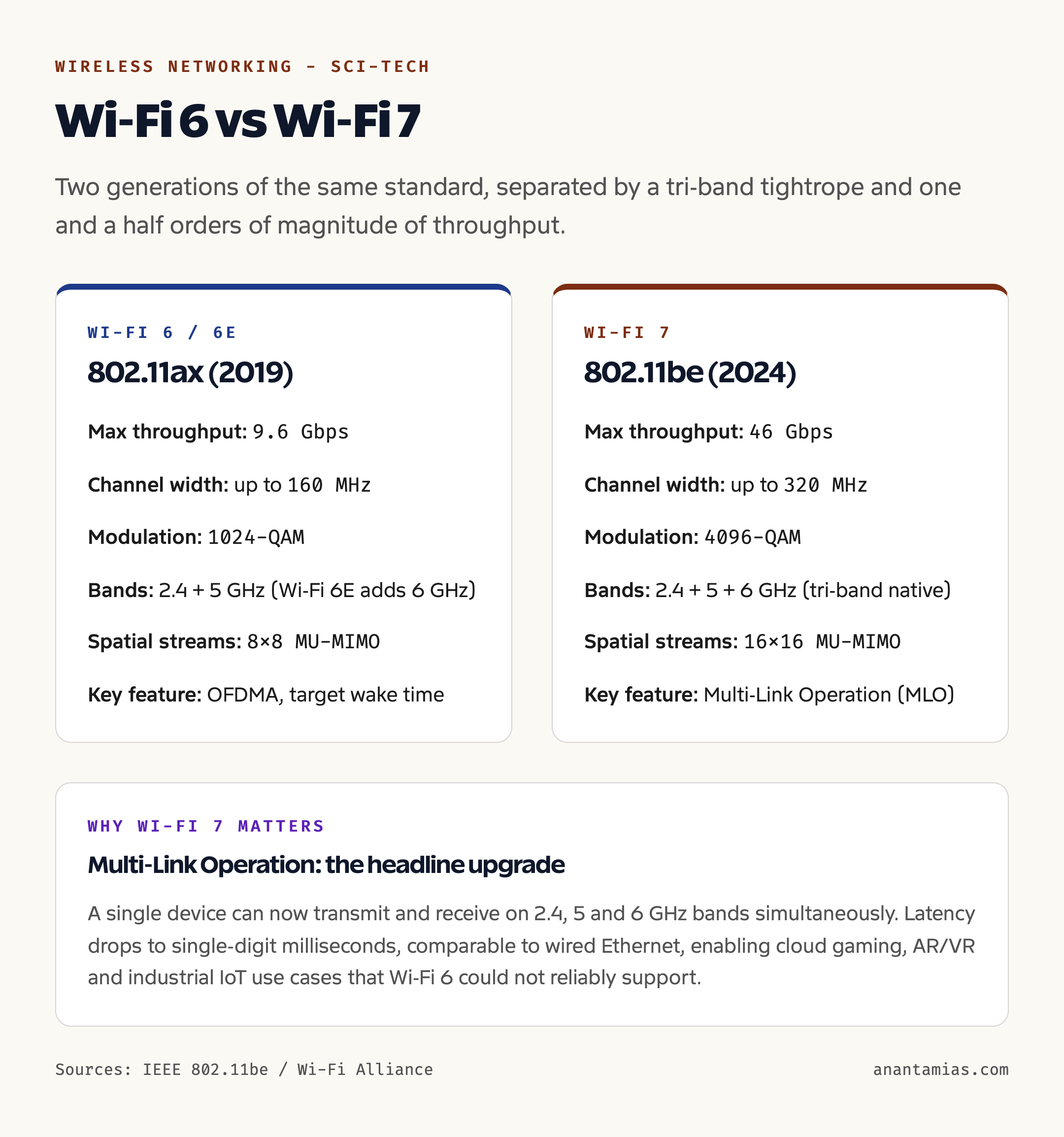
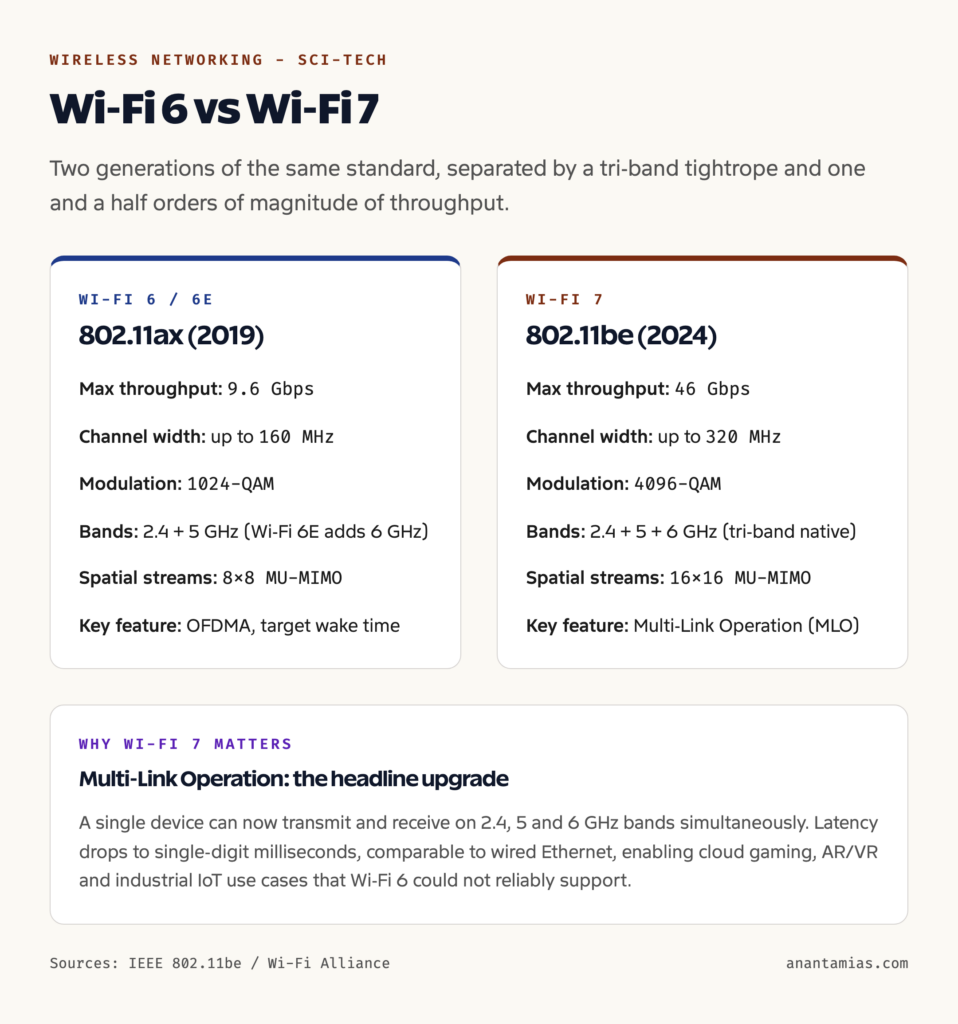
- Wi-Fi 6 IEEE name: 802.11ax, also branded as High Efficiency Wi-Fi (HE)
- Wi-Fi 7 IEEE name: 802.11be, also branded as Extremely High Throughput Wi-Fi (EHT)
- Peak theoretical speed: Wi-Fi 6 around 9.6 Gbps; Wi-Fi 7 around 46 Gbps
- Maximum channel bandwidth: Wi-Fi 6 is 160 MHz; Wi-Fi 7 doubles it to 320 MHz
- Modulation: Wi-Fi 6 uses 1024-QAM; Wi-Fi 7 uses 4096-QAM
- Marquee Wi-Fi 7 feature: Multi-Link Operation (MLO) across two bands at once
- 6 GHz band status in India: Lower 6 GHz (5925 to 6425 MHz) delicensed for indoor use in January 2026
- Wi-Fi 6 release year: 2019; Wi-Fi 7 release year: 2024
- Regulatory body in India: Department of Telecommunications under the Ministry of Communications
What Are Wi-Fi 6 and Wi-Fi 7?
Wi-Fi is a family of wireless local area network standards developed by the Institute of Electrical and Electronics Engineers and certified by the Wi-Fi Alliance. Each generation goes by an IEEE technical name and a friendlier marketing name. Wi-Fi 6 is 802.11ax. Wi-Fi 7 is 802.11be. The numbered marketing names were introduced by the Wi-Fi Alliance in 2018 to make generation comparisons easier for ordinary users.
Wi-Fi 6 is described by its branding as High Efficiency Wi-Fi. The defining problem it solved was congestion. As the number of connected devices in homes, offices, factories and public venues climbed, older Wi-Fi standards struggled because they treated a wireless channel as a single shared pipe. One device transmitted, others waited. Wi-Fi 6 introduced a technique called Orthogonal Frequency-Division Multiple Access, or OFDMA, that splits each channel into smaller resource units and lets the access point talk to many devices in parallel. The effect is most noticeable in crowded settings.
Wi-Fi 7 is described as Extremely High Throughput Wi-Fi. It still cares about efficiency, but its real focus is raw speed and ultra-low latency. It widens the channels that can be used, doubles the density of the modulation and adds a feature that lets a device use multiple frequency bands at the same time. The difference is similar to going from a multilane highway with smart traffic management to a multilane highway with smart traffic management plus a parallel express track that can run alongside it.
Background and Historical Context
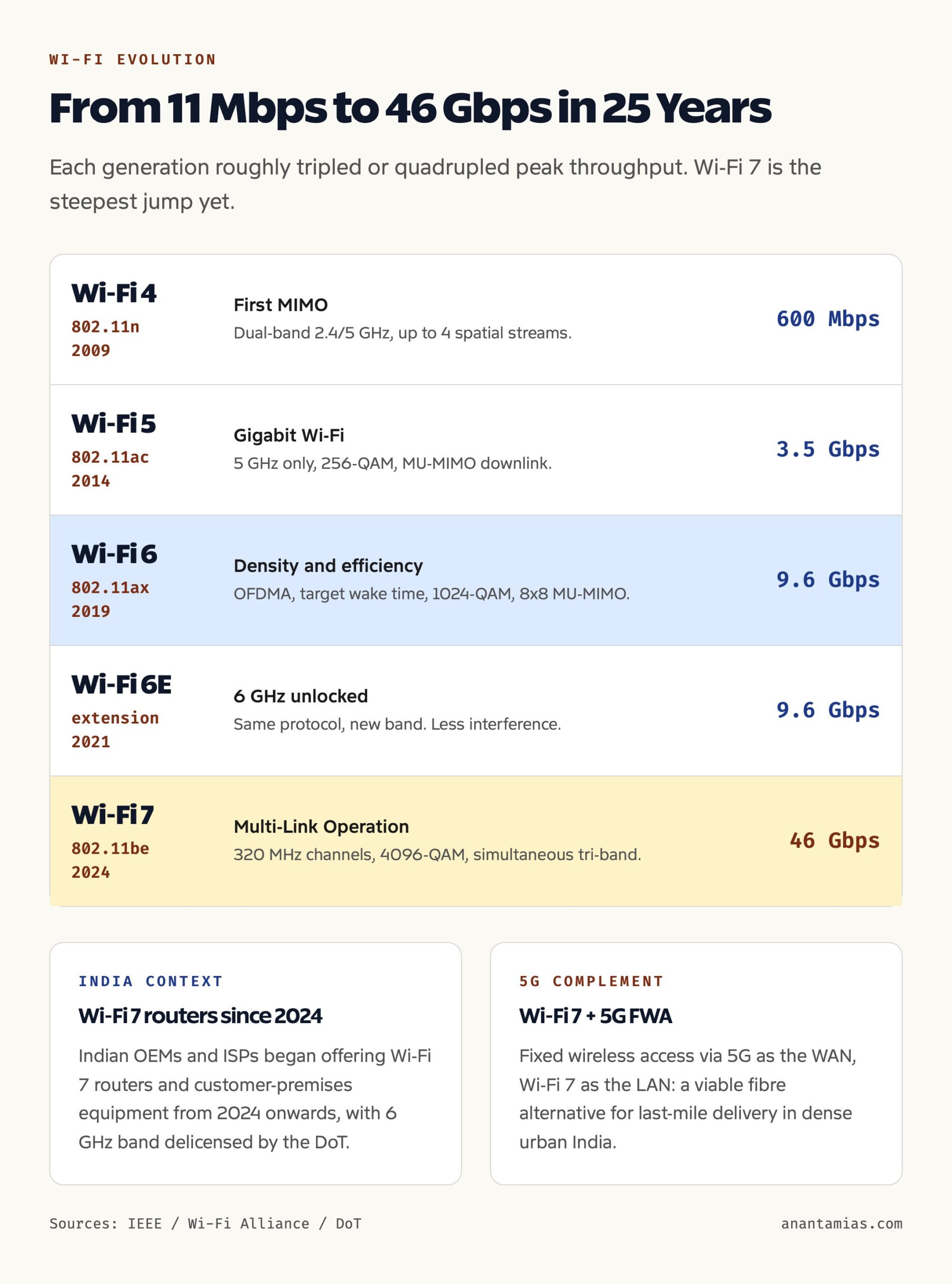
Wi-Fi started in 1997 with the original 802.11 standard, which offered up to 2 Mbps over the 2.4 GHz band. Each subsequent generation added speed, spectrum or efficiency. 802.11b in 1999 reached 11 Mbps. 802.11a moved to the 5 GHz band. 802.11g pushed 2.4 GHz to 54 Mbps. 802.11n, marketed as Wi-Fi 4, introduced multiple-input multiple-output antennas and reached hundreds of megabits per second. 802.11ac, or Wi-Fi 5, became the long-running standard from 2014 through the late 2010s and brought gigabit-class speeds to the 5 GHz band.
By the mid-2010s, two pressures shaped the next generation. The first was the explosion of the Internet of Things, which meant a typical household network had to manage dozens of low-bandwidth devices alongside the laptops and televisions. The second was 5G, the cellular standard that promised gigabit speeds with low latency. Wi-Fi could not afford to look slow next to the cellular network it usually paired with. The IEEE 802.11ax task group that produced Wi-Fi 6 began work in 2014. The standard was finalized in 2019 and certified by the Wi-Fi Alliance soon after.
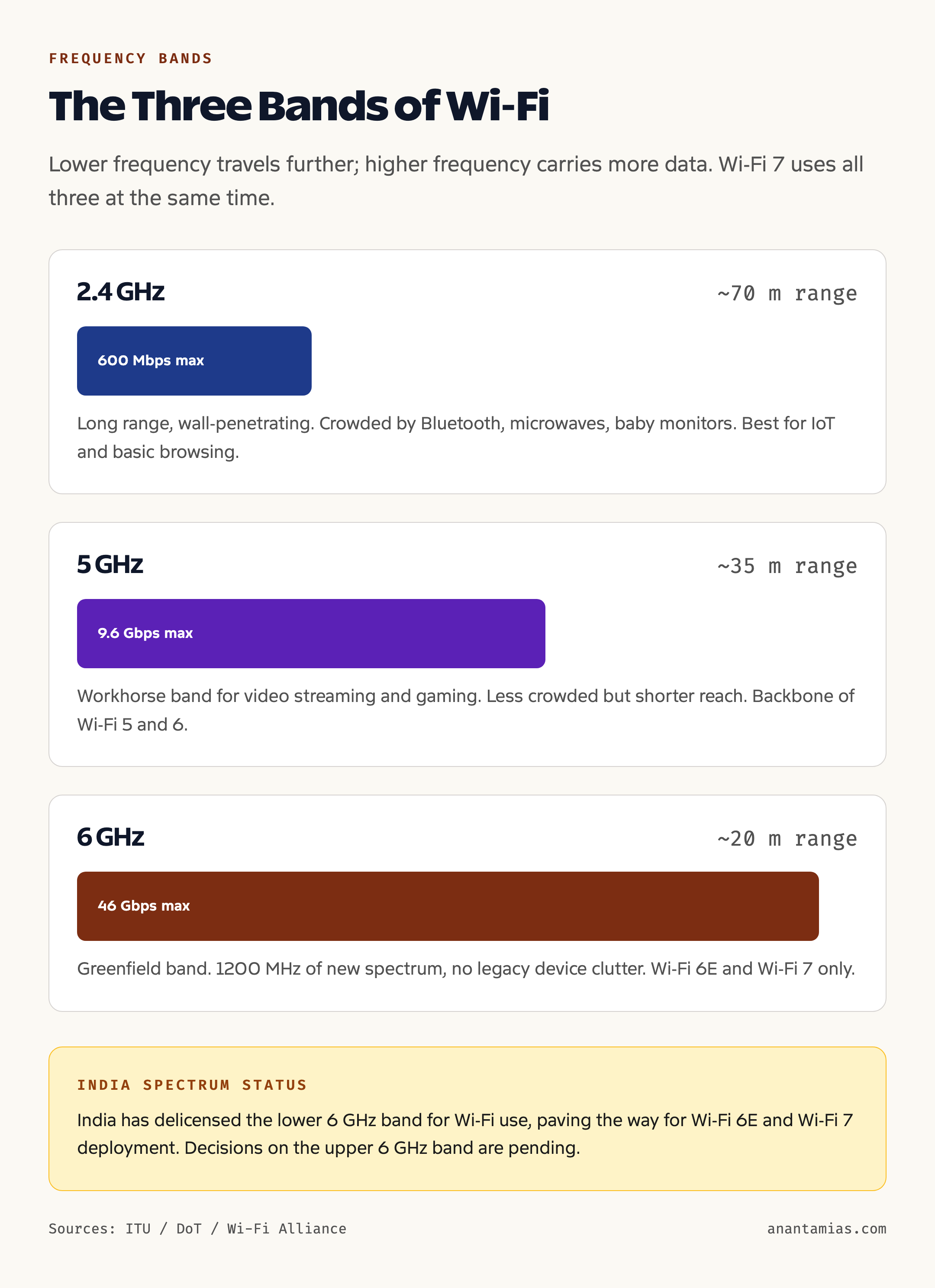
The 6 GHz band entered the picture during this period. In 2020, the United States Federal Communications Commission opened the entire 6 GHz band, from 5925 MHz to 7125 MHz, for unlicensed Wi-Fi use, an extra 1200 MHz of clean spectrum. The Wi-Fi Alliance branded routers that could use this band as Wi-Fi 6E. The European Union and several other regulators followed, opening the lower 6 GHz portion. India debated the question for almost six years before delicensing the lower 6 GHz band in January 2026.
Wi-Fi 7 work overlapped with the late stages of Wi-Fi 6 deployment. The IEEE 802.11be task group started in 2019. The first Wi-Fi 7 chips and routers shipped in 2023. The standard was formally completed in 2024. Adoption is now at the early-mainstream stage in flagship phones, premium laptops and high-end home routers, with mass-market diffusion expected to take another two to three years. For broader context on India’s spectrum and connectivity push, see our coverage of 6G mobile communication and the National Quantum Mission.
Key Features of Wi-Fi 6 (802.11ax)
The defining feature of Wi-Fi 6 is OFDMA. In older Wi-Fi, the access point used Orthogonal Frequency-Division Multiplexing, which split the channel into many subcarriers, but it talked to only one device at a time. OFDMA reuses the same frequency pieces and assigns them to different devices simultaneously. Each device gets a slice of the channel, and the slice can be sized to match the data the device actually needs. A smart bulb sending a one-byte status message gets a tiny resource unit. A laptop streaming a video gets a larger one. In a stadium with twenty thousand phones, this is the difference between a network that works and one that collapses.
Wi-Fi 6 also introduced uplink Multi-User MIMO, which lets multiple devices transmit to the access point in parallel by using different spatial streams. Earlier MU-MIMO worked only on the downlink. Target Wake Time is another important feature. It lets battery-powered devices schedule when to wake up and check for data, instead of staying awake to poll the network. For sensors, fitness bands and IoT modules, this dramatically improves battery life.
The modulation in Wi-Fi 6 is 1024-QAM, which packs ten bits into each signal symbol. That is a 25 percent increase over the 256-QAM used by Wi-Fi 5. Maximum channel width is 160 MHz, which can be assembled by combining contiguous or non-contiguous 80 MHz blocks. In practice, very few real-world deployments use 160 MHz channels because of interference from neighbouring networks in the 5 GHz band. The peak theoretical speed of Wi-Fi 6 is 9.6 Gbps, but typical real-world performance for a single device is in the range of 1 to 2 Gbps under good conditions.
Key Features of Wi-Fi 7 (802.11be)
Wi-Fi 7 keeps everything Wi-Fi 6 introduced and adds three big new tools. The first is Multi-Link Operation, often called MLO. In every previous generation, a Wi-Fi device chose one band and stuck to it. If the 5 GHz band was congested, the device might switch to 2.4 GHz, but only one band at a time. MLO lets a single device use two bands simultaneously. It might send data on the 5 GHz band while receiving on the 6 GHz band, or aggregate the throughput of both bands for higher speed, or use one band as a low-latency backup if the primary band degrades.
The second is wider channels. Wi-Fi 7 supports channels up to 320 MHz, double the maximum width of Wi-Fi 6. A 320 MHz channel only fits inside the new 6 GHz band, since the older bands are too narrow to hold one. This is a key reason 6 GHz access matters so much for getting full Wi-Fi 7 performance.
The third is denser modulation. Wi-Fi 7 uses 4096-QAM, which packs twelve bits per symbol, a roughly 20 percent increase over 1024-QAM. Combined with the wider channels and MLO, the headline theoretical peak rate of Wi-Fi 7 reaches 46 Gbps, almost five times that of Wi-Fi 6. In practice, real-world consumer speeds are well below the theoretical peak, but flagship Wi-Fi 7 routers and clients have already demonstrated sustained throughput of several gigabits per second in laboratory and reviewer tests. Latency is also more predictable than in earlier Wi-Fi, which is critical for cloud gaming, video calls and AR/VR.
Why It Matters: Workloads That Need Wi-Fi 7
Most domestic internet connections in India are still well below Wi-Fi 6’s theoretical ceiling, so a casual user might wonder why Wi-Fi 7 matters at all. The answer lies in the workloads that have moved into homes and small offices in the past three years. 8K video streaming requires sustained throughput of around 100 Mbps and tolerates almost no buffering. AR and VR headsets render at high frame rates and need round-trip latencies under 10 milliseconds, ideally under 5, to avoid motion sickness. Cloud gaming services such as those from Microsoft, Nvidia and Sony stream the actual frames of a video game from a remote data centre, then send keyboard or controller inputs back, and they break down the moment latency spikes.
Wi-Fi 7 also matters for backhaul. As fixed wireless access services become a serious competitor to fibre in dense and semi-urban areas, the wireless link between the customer-premises equipment and the indoor router needs to keep up. Wi-Fi 7 provides headroom for fibre-to-the-home plans of multiple gigabits and for new fixed wireless plans riding on 5G mid-band and millimetre-wave spectrum.
For enterprises, the multi-link feature opens up applications that older Wi-Fi could not touch. Industrial automation in factories, automated guided vehicles in warehouses and high-density video deployments in offices all gain from a network that can fail over between bands in milliseconds rather than seconds.
Detailed Analysis: How OFDMA, MLO and 4K-QAM Work
OFDMA borrows directly from cellular standards, particularly LTE. The wireless channel is divided into resource units that can be as small as 26 subcarriers and as large as the entire channel. The access point’s scheduler assigns resource units to client devices for each transmission opportunity. Small resource units suit small packets and low-power devices. Large resource units handle bulk data. This is why a Wi-Fi 6 access point can serve forty smart devices and one streaming TV better than a Wi-Fi 5 access point with the same number of antennas and the same channel width.
Multi-Link Operation comes in three flavours. Single-radio MLO, which switches between bands quickly but does not use them simultaneously. Multi-radio simultaneous MLO, which actively transmits and receives on two bands at the same time. Multi-radio non-simultaneous MLO, which activates one radio at a time but can use either. The simultaneous mode is the one that delivers the headline benefits, including aggregated throughput and seamless link failover. Implementing it requires more sophisticated and more expensive hardware, which is one reason Wi-Fi 7 is rolling out from premium devices downward.
4K-QAM, or 4096-QAM, packs twelve bits per signal symbol by encoding them in the amplitude and phase of the carrier wave with very fine precision. Each step up in modulation density requires a stronger and cleaner signal-to-noise ratio. 4K-QAM works only at relatively short ranges and on clean channels. It is most effective in the 6 GHz band, which is currently uncrowded compared with 2.4 and 5 GHz, and at distances of a few metres from the router. At longer ranges, the radio falls back to 1024-QAM, 256-QAM or even lower modulations to keep the link working.
Comparative Snapshot: Wi-Fi 6 vs Wi-Fi 7 vs Wi-Fi 5
| Parameter | Wi-Fi 5 (802.11ac) | Wi-Fi 6 (802.11ax) | Wi-Fi 7 (802.11be) |
|---|---|---|---|
| Branding | Very High Throughput | High Efficiency Wi-Fi | Extremely High Throughput |
| Year finalized | 2014 | 2019 | 2024 |
| Bands supported | 5 GHz only | 2.4 and 5 GHz; 6 GHz with Wi-Fi 6E | 2.4, 5 and 6 GHz |
| Maximum channel width | 160 MHz | 160 MHz | 320 MHz |
| Modulation | 256-QAM | 1024-QAM | 4096-QAM |
| Multiple access | OFDM | OFDMA | OFDMA |
| Multi-band concurrency | None | None | Multi-Link Operation |
| Peak theoretical speed | 6.9 Gbps | 9.6 Gbps | 46 Gbps |
| Typical latency target | Best effort | Improved | Ultra-low and stable |
| Best suited for | HD streaming, basic gaming | Dense networks, IoT, 4K | 8K, AR/VR, cloud gaming |
Challenges and Constraints
The first challenge with Wi-Fi 7 is hardware cost. A Wi-Fi 7 router with full 6 GHz support and three radios for simultaneous MLO is significantly more expensive than a Wi-Fi 6 router. The chipsets are newer and the volume is lower. Mid-range pricing is unlikely before 2027.
The second is regulatory variation. The full 1200 MHz of the 6 GHz band is available only in countries that have adopted the entire range, primarily the United States and South Korea. The European Union, the United Kingdom, and as of January 2026 India, have opened only the lower portion, from 5925 to 6425 MHz, which leaves room for two 320 MHz channels rather than three or four. This is enough for Wi-Fi 7’s marquee features in indoor use but limits very high-density deployments.
The third is spectrum coexistence. The 6 GHz band is also used by satellite uplinks, fixed microwave links and certain other licensed services. Regulators have therefore mandated low-power indoor use only for unlicensed devices in the lower portion, with stricter rules for outdoor and high-power use. Devices must comply with Automated Frequency Coordination systems where required to avoid interference with incumbents.
The fourth is end-to-end performance. A Wi-Fi 7 router connected to a 100 Mbps broadband line cannot deliver multi-gigabit speeds to a client device. The wired backhaul, the broadband subscription and the home wiring all have to keep up. Many homes and offices have not yet caught up with these requirements.
Prelims Pointers
- Wi-Fi 6 is IEEE 802.11ax. Wi-Fi 7 is IEEE 802.11be.
- Wi-Fi 6 introduced OFDMA for parallel multi-device communication.
- Wi-Fi 7 introduced Multi-Link Operation, allowing simultaneous use of two bands.
- 4K-QAM in Wi-Fi 7 packs twelve bits per symbol; 1024-QAM in Wi-Fi 6 packs ten.
- Maximum channel width in Wi-Fi 7 is 320 MHz, double that of Wi-Fi 6.
- Wi-Fi 6E is Wi-Fi 6 extended to the 6 GHz band.
- The 6 GHz band lies between 5925 and 7125 MHz globally.
- India delicensed the lower 6 GHz band, 5925 to 6425 MHz, for indoor use in January 2026.
- The Department of Telecommunications under the Ministry of Communications regulates spectrum policy in India.
- Wi-Fi standards are defined by IEEE; product certification is handled by the Wi-Fi Alliance.
Mains Practice Questions
- Discuss the technological differences between Wi-Fi 6 and Wi-Fi 7. How do these differences map to emerging use cases such as augmented reality, cloud gaming and industrial automation? (250 words, GS-III)
- India’s January 2026 decision to delicense the lower 6 GHz band has been described as overdue. Critically evaluate the costs and benefits of partial versus full 6 GHz delicensing, with reference to international practice. (250 words, GS-III)
- Examine the role of unlicensed spectrum in India’s digital infrastructure. How can Wi-Fi standards complement 5G and forthcoming 6G networks in extending broadband reach? (150 words, GS-III)
- “Spectrum is a finite public resource and its allocation is a matter of public policy.” In light of recent Wi-Fi and cellular developments, comment on the principles that should guide India’s spectrum management framework. (150 words, GS-III)
Way Forward
India’s adoption of Wi-Fi 7 will track three things. First, how quickly the lower 6 GHz delicensing translates into devices, routers and certified deployments in the field. Regulatory clarity is necessary but not sufficient. Hardware availability, BIS-equivalent compliance procedures and operator engagement matter just as much. Second, whether the upper 6 GHz portion is eventually opened to unlicensed use. The 5925 to 6425 MHz block is enough to start, but full benefits require the larger range. Third, how Wi-Fi 7 integrates with India’s domestic semiconductor and electronics manufacturing push, including the Production-Linked Incentive scheme targets and the broader push for India to become a chip and connectivity-products hub.
The policy lesson is broader. Spectrum that sits unused yields no public benefit. India spent six years debating 6 GHz delicensing while neighbouring jurisdictions captured the early advantages of Wi-Fi 6E. The decision to delicense in January 2026 was the right one. The next set of decisions, around the upper 6 GHz, around AFC for outdoor use and around fast-tracking certification of Wi-Fi 7 hardware, will determine whether India is a follower or a leader on the next wireless generation.
For students, the Wi-Fi 6 vs Wi-Fi 7 question is a small window into a large theme: how engineering standards, spectrum policy and consumer experience interact. Connect this to the broader story of semiconductor manufacturing and India’s digital economy ambitions, and the answer becomes more than a comparison table.
Frequently Asked Questions
Is Wi-Fi 7 backward compatible with Wi-Fi 6 and older devices?
Yes. Wi-Fi 7 access points support all earlier Wi-Fi generations, including Wi-Fi 6, Wi-Fi 5 and Wi-Fi 4. Older devices connect at their own maximum speed and do not benefit from Wi-Fi 7 features such as Multi-Link Operation or 320 MHz channels. Only Wi-Fi 7 client devices on a Wi-Fi 7 network unlock the full set of new capabilities.
Do I need Wi-Fi 7 if my home internet plan is 100 Mbps?
For most home use today, a Wi-Fi 6 router is more than enough. Wi-Fi 7 becomes meaningful when you have multi-gigabit broadband, when you use AR/VR or cloud gaming heavily, or when many high-bandwidth devices share the network at the same time. As broadband speeds in Indian metros rise toward and past 1 Gbps over the next two to three years, Wi-Fi 7 will become the recommended baseline.
What is the difference between Wi-Fi 6 and Wi-Fi 6E?
Wi-Fi 6 is the 802.11ax standard operating on the 2.4 and 5 GHz bands. Wi-Fi 6E is the same standard with the addition of the 6 GHz band. The chips are similar; the difference is access to the cleaner, less crowded 6 GHz spectrum. India’s January 2026 delicensing of the lower 6 GHz band is what made Wi-Fi 6E and Wi-Fi 7’s 6 GHz features legally usable in the country.
How does Multi-Link Operation actually work in practice?
A Wi-Fi 7 device with multi-radio MLO maintains two simultaneous links to the same access point, typically one on the 5 GHz band and one on the 6 GHz band. It can split traffic across the two links to double throughput, mirror traffic to reduce latency by taking whichever packet arrives first, or fall back instantly if one link is interfered with. The feature requires support on both the access point and the client device.
What is OFDMA and how is it different from OFDM?
OFDM is Orthogonal Frequency-Division Multiplexing, a technique used since Wi-Fi 4 that splits a wireless channel into many parallel subcarriers. OFDM still serves one device at a time. OFDMA, introduced in Wi-Fi 6, lets the access point assign different groups of subcarriers, called resource units, to different devices simultaneously. The result is much better efficiency in dense networks where many devices need small slices of bandwidth.
Is the 6 GHz band the same as 5G?
No. The 6 GHz band is unlicensed Wi-Fi spectrum. 5G operates on different licensed bands assigned to mobile network operators, including low-band, mid-band and high-band millimetre wave. Some confusion arises because both technologies push for higher speeds and lower latency, but they use different spectrum and different protocols. They are complementary, not interchangeable.
Why did India take so long to delicense the 6 GHz band?
The 6 GHz band in India was historically used for fixed satellite service uplinks and for licensed microwave links. The Department of Telecommunications had to weigh the benefits of opening the band for unlicensed Wi-Fi against the concerns of incumbents. The eventual decision to delicense the lower portion, from 5925 to 6425 MHz, in January 2026 was a compromise that aligned India with European Union practice while leaving the upper portion under review.
Does Wi-Fi 7 use more power than Wi-Fi 6?
Wi-Fi 7 routers and chips use somewhat more power because they support wider channels, denser modulation and additional radios for MLO. For client devices, the picture is mixed. Higher peak performance can mean higher peak power, but features such as Target Wake Time inherited from Wi-Fi 6 keep idle power low. Battery-powered IoT and sensor devices are typically not the target market for Wi-Fi 7.
Will Wi-Fi 8 follow soon?
The IEEE has begun preliminary work on the next standard, sometimes referred to informally as Wi-Fi 8 or 802.11bn. The likely focus areas are even better reliability, ultra-low latency for industrial and AR/VR applications, and tighter integration with 5G and 6G networks. A finalized standard and the first products are unlikely before 2028.
Where can I find official information on India’s Wi-Fi spectrum policy?
The Department of Telecommunications under the Ministry of Communications publishes notifications on spectrum delicensing and use cases. The National Frequency Allocation Plan, periodically updated, lists the bands and their assigned uses. The Telecom Regulatory Authority of India also issues consultation papers and recommendations on spectrum policy, which inform DoT decisions.
Tell Google you want more of this.
Add Anantam IAS as a preferred sourceOne tap, and this site shows up more often in your own Top Stories, AI Overviews and AI Mode. Remove it any time.





