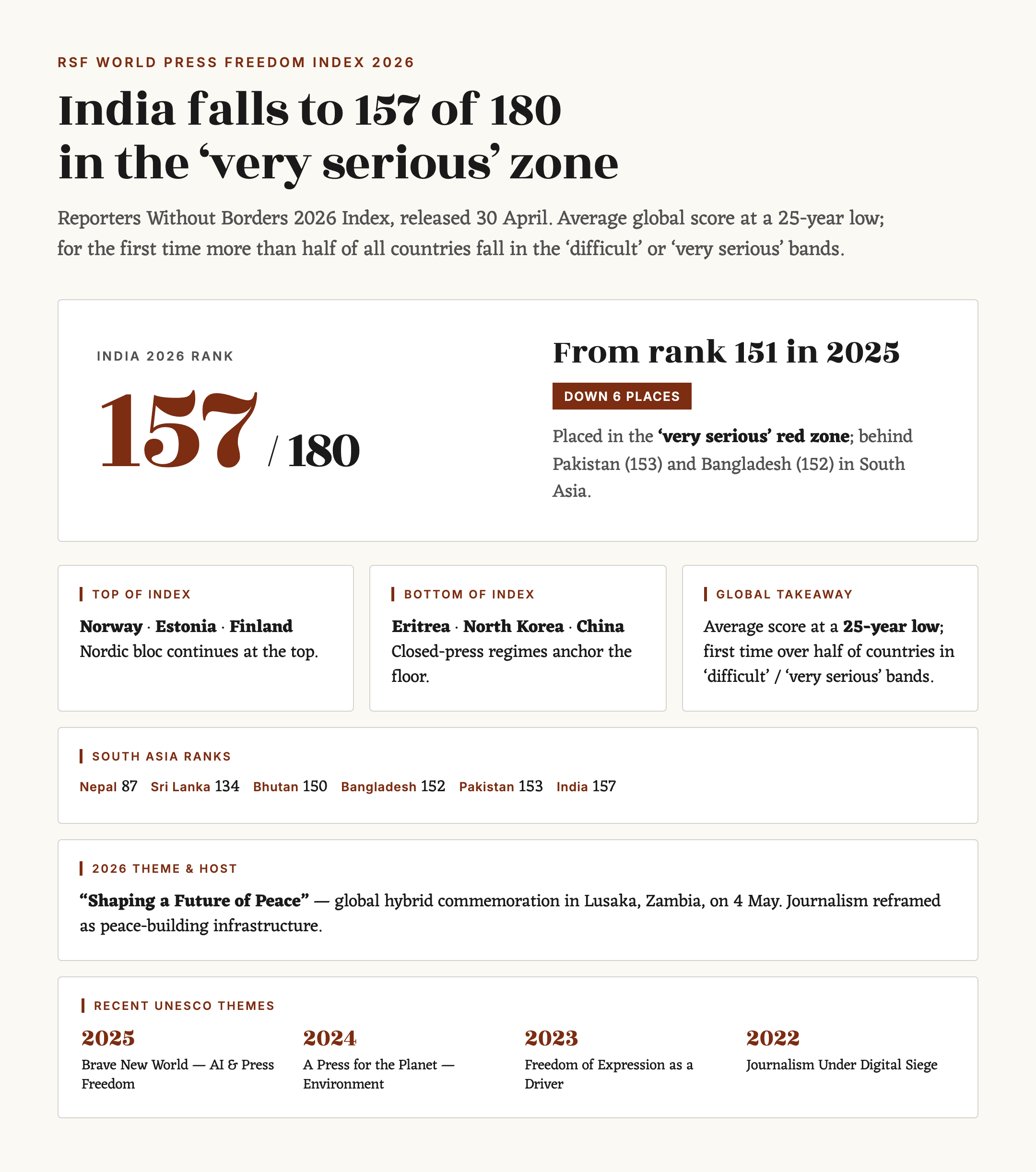
World Press Freedom Day is observed every year on 3 May to defend independent journalism, honour journalists killed in the line of duty and remind governments of their constitutional duty to protect a free press. In 2026, the day falls on a Sunday, and the UNESCO global theme is "Shaping a Future of Peace", with the global commemoration anchored online and a hybrid in-person event in Lusaka (Zambia) on 4 May. Most importantly for India, the 2026 Reporters Without Borders (RSF) World Press Freedom Index released on 30 April places India 157 out of 180 countries — a six-place drop from rank 151 in 2025 — in the "very serious" category, behind Pakistan (153) and Bangladesh (152). The day commemorates the Windhoek Declaration of 3 May 1991 and was formally proclaimed by the UN General Assembly through Resolution 48/432 of December 1993.
Quick Facts at a Glance
- Observed on: 3 May every year (since 1994)
- 2026 falls on: Sunday, 3 May 2026
- Proclaimed by: UNESCO General Conference 26th session (1991) → UN General Assembly Resolution 48/432, December 1993
- First observed: 3 May 1994
- Why 3 May: Anniversary of the Windhoek Declaration on Promoting an Independent and Pluralistic African Press, adopted at the UNESCO seminar in Windhoek (Namibia) on 3 May 1991
- 2026 UNESCO theme: "Shaping a Future of Peace"
- 2026 host event: Lusaka, Zambia (4 May, hybrid)
- 2026 RSF Index — India: 157 / 180 ("very serious" zone), down from 151 in 2025
- Top of 2026 RSF Index: Norway, Estonia, Finland, Netherlands, Sweden (Nordic bloc continues at the top)
- Global takeaway: RSF says the global average score is at a 25-year low; for the first time, over half of all countries fall in the "difficult" or "very serious" zones
- UNESCO/Guillermo Cano World Press Freedom Prize: annual award (since 1997) honouring outstanding contribution to press freedom; named after Colombian editor Guillermo Cano Isaza, killed in 1986
Historical Background — From Windhoek to Resolution 48/432
The roots of the day lie in a UNESCO-sponsored seminar held in Windhoek (Namibia) from 29 April to 3 May 1991, where African journalists adopted the Windhoek Declaration on Promoting an Independent and Pluralistic African Press. The Declaration affirmed that an "independent, pluralistic and free press is essential to the development and maintenance of democracy in a nation, and for economic development".
Building on this, the 26th session of the UNESCO General Conference (1991) recommended that the UN proclaim a World Press Freedom Day. The UN General Assembly accepted the recommendation through Resolution 48/432 of December 1993, designating 3 May — the anniversary of the Windhoek Declaration — as World Press Freedom Day. The day was first observed in 1994.
Three figures recur in the institutional history of the day: Christophe Deloire (Reporters Without Borders Secretary-General, 2012–2024, who built the modern Index methodology); Guillermo Cano Isaza, the Colombian editor whose 1986 assassination is commemorated through the UNESCO/Guillermo Cano World Press Freedom Prize instituted in 1997; and the rotating UNESCO Director-General, who delivers the annual message.
Why 3 May — The Windhoek Declaration
The Windhoek Declaration is treated as the founding document of the modern global press-freedom movement. It enshrined three principles that still anchor international press-freedom policy:
- Independence — press freedom is impossible without economic and editorial independence from the state and dominant capital.
- Pluralism — multiple, competing voices in print, broadcast and online.
- Diversity — gender, regional and linguistic diversity in newsrooms and ownership.
The Declaration was followed by regional sister declarations — Alma-Ata (1992) for Asia, Santiago (1994) for Latin America and the Caribbean, Sana'a (1996) for the Arab states, and Sofia (1997) for Europe — extending the Windhoek principles globally.
2026 Theme — "Shaping a Future of Peace"
The 2026 UNESCO theme, "Shaping a Future of Peace", frames journalism as a peace-building infrastructure: independent reporting that documents conflict, counters disinformation and de-escalates polarisation. The 2026 global conference is structured as an online programme with a hybrid in-person event in Lusaka, Zambia, on 4 May 2026. The UNESCO/Guillermo Cano Press Freedom Prize ceremony is scheduled at UNESCO headquarters in Paris later in the year.
This builds on a five-year arc of themes:
| Year | Theme | Host City |
|---|---|---|
| 2026 | Shaping a Future of Peace | Lusaka (Zambia) |
| 2025 | Reporting in the Brave New World — Impact of AI on Press Freedom and Media | Brussels (Belgium) |
| 2024 | A Press for the Planet — Journalism in the Face of the Environmental Crisis | Santiago (Chile) |
| 2023 | Shaping a Future of Rights — Freedom of Expression as a Driver for All Other Human Rights | New York (USA) |
| 2022 | Journalism Under Digital Siege | Punta del Este (Uruguay) |
| 2021 | Information as a Public Good | Windhoek (Namibia) |
RSF World Press Freedom Index 2026 — India 157/180
The Reporters Without Borders (RSF) World Press Freedom Index 2026 was released on 30 April 2026. It evaluates 180 countries across five contextual indicators — political, economic, legislative, social, and security — and a quantitative survey of attacks on journalists.
India's 2026 verdict — rank 157/180, in the "very serious" red zone. This is a fall of six places from rank 151 in 2025, and follows 159 in 2024 and 161 in 2023. RSF cited:
- A rise in physical violence and online harassment against journalists, particularly women and Muslim reporters.
- Highly concentrated media ownership, with a few business houses controlling a disproportionate share of broadcast and digital news.
- Growing political alignment of mainstream outlets with the ruling establishment.
- Judicial harassment through criminal defamation, sedition (now BNS s.152), the Unlawful Activities (Prevention) Act (UAPA), and the Prevention of Money Laundering Act (PMLA).
For regional context, India in 2026 ranks below Pakistan (153) and Bangladesh (152), alongside Bhutan (150) and Sri Lanka (134); Nepal at 87 is the only South Asian country in the upper half of the table.
Globally, RSF says the average press-freedom score across 180 countries is at its lowest in 25 years of the Index, and for the first time over half of all countries fall in the "difficult" or "very serious" zones. Norway, Estonia and Finland lead the Index; Eritrea, North Korea and China are at the bottom.
India's Constitutional Framework — Article 19(1)(a) and 19(2)
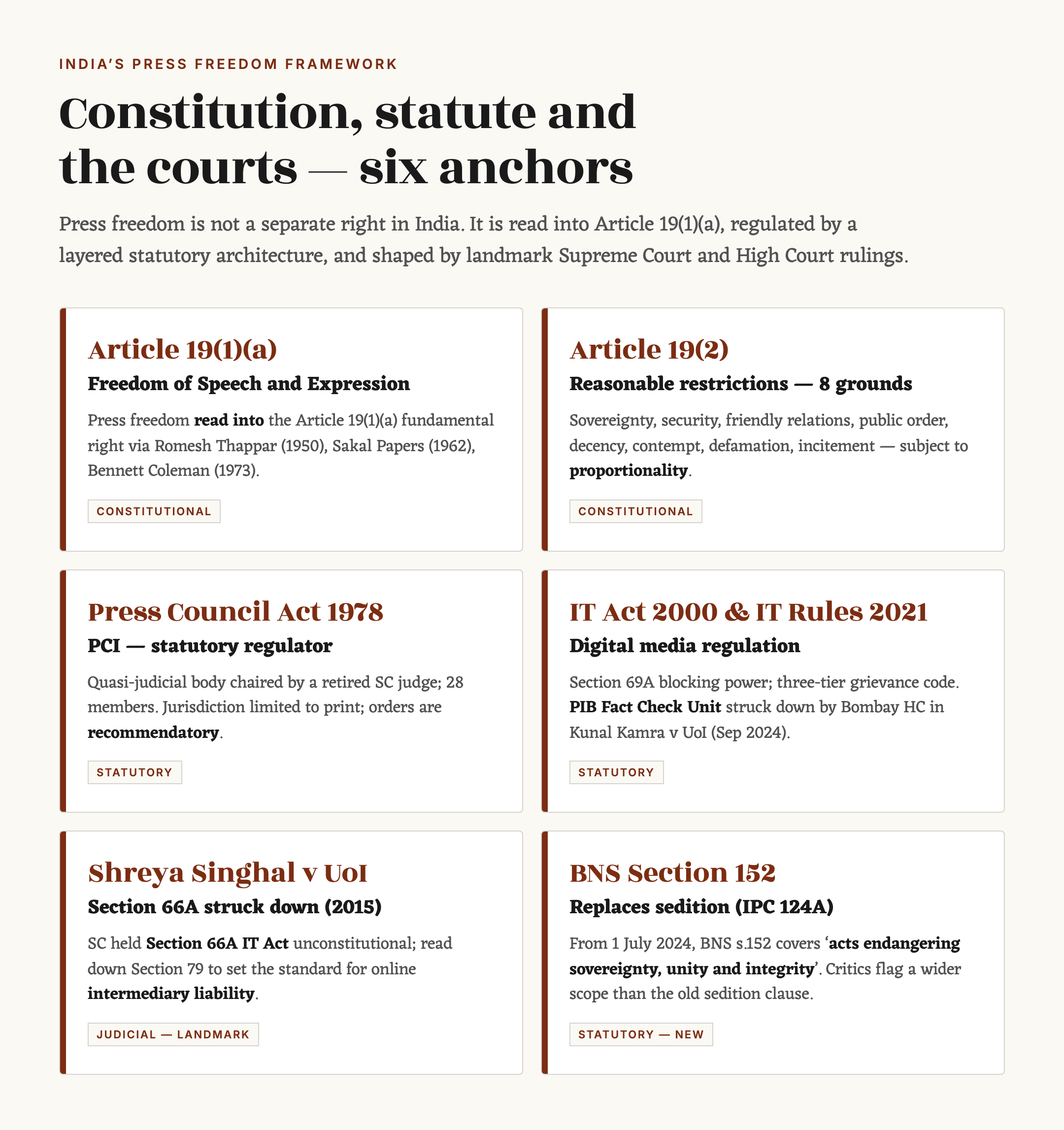
The Indian Constitution does not contain a separate "freedom of the press" clause. Press freedom is read into Article 19(1)(a) — the fundamental right to freedom of speech and expression — guaranteed to every citizen.
The Supreme Court (SC) has affirmed this in successive judgments, including Romesh Thappar v State of Madras (1950), Sakal Papers (P) Ltd v Union of India (1962), and Bennett Coleman & Co v Union of India (1973).
Article 19(2) allows the State to impose "reasonable restrictions" on this right on eight grounds:
- Sovereignty and integrity of India
- Security of the State
- Friendly relations with foreign States
- Public order
- Decency or morality
- Contempt of court
- Defamation
- Incitement to an offence
The reasonableness of any restriction is tested judicially — both procedurally (manner of imposition) and substantively (proportionality).
Statutory and Regulatory Architecture
India's press regulation is layered across statute, self-regulation and digital rules.
- Press Council of India (PCI): A quasi-judicial body established under the Press Council Act 1978 (replacing the earlier 1965 Act). It is chaired by a retired SC judge and has 28 members representing journalists, editors, owners, MPs and academia. Jurisdiction is limited to print and is purely recommendatory.
- News Broadcasting & Digital Standards Authority (NBDSA): Self-regulatory body of the News Broadcasters & Digital Association (NBDA, formerly NBA), chaired by a retired SC judge. Handles complaints against private satellite news channels.
- Cable Television Networks (Regulation) Act, 1995 and the Programme Code under it govern broadcast content.
- Information Technology Act, 2000 — Section 69A allows blocking of online content; the IT (Intermediary Guidelines and Digital Media Ethics Code) Rules, 2021 extended a three-tier grievance framework to digital news publishers.
- Press and Registration of Periodicals Act, 2023 replaced the colonial-era Press and Registration of Books Act, 1867.
- Cinematograph (Amendment) Act, 2023 and the Telecommunications Act, 2023 affect adjacent media.
- Foreign Contribution (Regulation) Act (FCRA), 2010 — increasingly invoked against independent newsrooms receiving foreign grants.
Landmark Supreme Court Judgments
A short list of the cases every UPSC aspirant should remember:
- Romesh Thappar v State of Madras (1950): Pre-censorship of a journal struck down; press freedom located in Article 19(1)(a).
- Sakal Papers v Union of India (1962): Newsprint price-and-page order struck down for indirectly throttling press freedom.
- Bennett Coleman & Co v Union of India (1973): Newsprint Control Order struck down; "freedom of press is freedom of circulation".
- Indian Express Newspapers v Union of India (1985): Customs duty on newsprint struck down as a disguised restriction.
- Shreya Singhal v Union of India (2015): Section 66A of the IT Act 2000 struck down as unconstitutional; the judgment also read down Section 79 and clarified the standard for online intermediary liability.
- Anuradha Bhasin v Union of India (2020): Internet shutdowns must satisfy the proportionality test; indefinite shutdowns are unconstitutional.
- Kunal Kamra v Union of India (2024): The Bombay High Court (3-judge bench, 26 September 2024) struck down the Fact Check Unit (FCU) provision of the IT Rules 2021 amendment, after the Supreme Court had earlier stayed the notification on 8 March 2024. The Court held that the rule was vague, disproportionate and violated Articles 14, 19(1)(a) and 19(1)(g).
Sedition, BNS and the Press
Section 124A of the Indian Penal Code (IPC) — sedition — was the most controversial criminal provision used against journalists. In S G Vombatkere v Union of India (2022), the SC kept the operation of Section 124A in abeyance.
With the Bharatiya Nyaya Sanhita (BNS), 2023 replacing the IPC from 1 July 2024, sedition has been reformulated as BNS Section 152: "acts endangering sovereignty, unity and integrity of India". Critics argue the new provision is broader than the old. The press has also faced UAPA charges in cases involving journalists like Siddique Kappan, the NewsClick newsroom, and others; the Mohammed Zubair case illustrated the use of multiple FIRs against a fact-checker.
UNESCO/Guillermo Cano World Press Freedom Prize
Instituted by UNESCO in 1997 and named after Colombian editor Guillermo Cano Isaza — who was assassinated in 1986 outside his newspaper El Espectador — the prize honours a person, organisation or institution that has made an outstanding contribution to press freedom, especially in the face of danger. Past laureates include Anna Politkovskaya (2007, posthumous), Mauri König (2012), and the imprisoned journalists of Belarus (2022).
UPSC Relevance
- Prelims: 3 May, Windhoek 1991, UN Resolution 48/432 (December 1993), first observed 1994, 2026 theme "Shaping a Future of Peace", host Lusaka, RSF 2026 India rank 157/180, Press Council Act 1978, IT Rules 2021, BNS s.152.
- GS-II (Polity & Governance): Article 19(1)(a) and 19(2) jurisprudence; press regulation architecture; Shreya Singhal, Anuradha Bhasin, Kunal Kamra; debate on FCU and intermediary liability; comparative practice (US First Amendment, Article 10 ECHR).
- GS-III (Internal Security): Use of UAPA and PMLA against journalists; balance between national security and press freedom; Anti-Defection of professional ethics; disinformation and AI-generated content.
- GS-IV (Ethics): Journalistic ethics, conflict of interest, public interest journalism, the duty to report in conflict zones.
Mains Practice Questions
- "Press freedom in India is read into Article 19(1)(a), but it is hollowed out by the way Article 19(2) is operationalised." Critically examine in light of recent judicial interventions. (250 words)
- The Reporters Without Borders Index 2026 ranks India 157/180. Discuss the structural reasons for this ranking and suggest reforms that can restore the credibility of Indian media without compromising national security. (250 words)
Conclusion
World Press Freedom Day 2026 is more than a calendar event. It is a checkpoint for India to read its own democratic vital signs. The 2026 RSF rank of 157 is not just a diplomatic embarrassment; it is a measurable signal that the chain of independence — editorial, economic, judicial, technological — is fraying. The constitutional architecture is sound — Article 19(1)(a), the Shreya Singhal line of cases, the 2024 Kunal Kamra ruling — but the statutory and political environment continues to push journalists into the dock. The 2026 theme, "Shaping a Future of Peace", reframes journalism as peace-infrastructure. For India, the implication is direct: a free, plural, well-funded press is not a luxury — it is the early-warning system for the world's largest democracy.
Frequently Asked Questions
Why is World Press Freedom Day on 3 May?
Because 3 May 1991 was the day the Windhoek Declaration on Promoting an Independent and Pluralistic African Press was adopted at a UNESCO seminar in Windhoek, Namibia. The UN General Assembly designated this date as World Press Freedom Day through Resolution 48/432 in December 1993.
What is the theme of World Press Freedom Day 2026?
The 2026 UNESCO theme is "Shaping a Future of Peace". The global commemoration is held primarily online with a hybrid in-person event in Lusaka, Zambia, on 4 May 2026.
What is India's rank in the 2026 World Press Freedom Index?
India is ranked 157 out of 180 countries in the 2026 RSF World Press Freedom Index released on 30 April 2026 — a fall from rank 151 in 2025. India is in the "very serious" red zone.
Which countries top the 2026 Press Freedom Index?
Norway, Estonia and Finland lead the 2026 Index, with the Nordic countries continuing to dominate the top ranks. Eritrea, North Korea and China are at the bottom.
What is the Windhoek Declaration?
The Windhoek Declaration of 3 May 1991 is the founding charter of the modern press-freedom movement. Adopted at a UNESCO seminar in Windhoek, Namibia, it asserts the principles of independence, pluralism and diversity for the African press, later extended globally through the Alma-Ata, Santiago, Sana'a and Sofia declarations.
How is press freedom protected in the Indian Constitution?
Press freedom is not a separate right in the Indian Constitution. It is read into Article 19(1)(a) — the right to freedom of speech and expression — and is subject to the eight reasonable restrictions in Article 19(2) (sovereignty, security, public order, decency, contempt, defamation, incitement and friendly relations with foreign States).
What is the Press Council of India?
The Press Council of India (PCI) is a quasi-judicial statutory body set up under the Press Council Act, 1978. It is chaired by a retired Supreme Court judge and has 28 members. Its remit is limited to the print press and its orders are recommendatory.
What did the Kunal Kamra v Union of India judgment do?
On 26 September 2024, the Bombay High Court in Kunal Kamra v Union of India struck down the Fact Check Unit (FCU) provision of the IT Rules 2021 amendment as unconstitutional. The Supreme Court had earlier stayed the FCU notification on 8 March 2024.
What replaced sedition under Indian law?
The Bharatiya Nyaya Sanhita (BNS), 2023, in force from 1 July 2024, replaced the IPC. BNS Section 152 — "acts endangering sovereignty, unity and integrity of India" — has effectively replaced the old IPC Section 124A sedition.
What is the UNESCO/Guillermo Cano Press Freedom Prize?
Instituted by UNESCO in 1997, it is named after Colombian editor Guillermo Cano Isaza, assassinated in 1986. It is awarded annually to a person, organisation or institution making an outstanding contribution to press freedom, particularly under threat.
Tell Google you want more of this.
Add Anantam IAS as a preferred sourceOne tap, and this site shows up more often in your own Top Stories, AI Overviews and AI Mode. Remove it any time.