
Xenobots are the first organisms on the planet that were not the product of evolution. They were designed by a computer, built from the stem cells of a frog, and tested in a Petri dish. They walk, they swim, they push tiny pellets around, they heal when cut, and, most remarkably, they reproduce by gathering loose cells and assembling them into copies of themselves. They are not robots in the conventional sense. They contain no metal, no plastic, no transistors. They are not animals in the conventional sense either. They have no nervous system, no organs, no digestive tract. They occupy a category that did not exist before 2020.
The team that built them, led by computer scientist Joshua Bongard at the University of Vermont and biologist Michael Levin at Tufts University, calls them xenobots, after the African Clawed Frog Xenopus laevis from which the source cells are taken. The work has unfolded across three publications in the Proceedings of the National Academy of Sciences, in 2020, 2021, and 2022. Each paper has tightened the case that xenobots are a genuinely new class of organism and a genuinely new platform for biological computing and remediation.
This article explains what xenobots are, how they are built, what they can do, where the applications lie, and what regulatory and ethical questions they raise for India and for the world.
Quick Facts on Xenobots
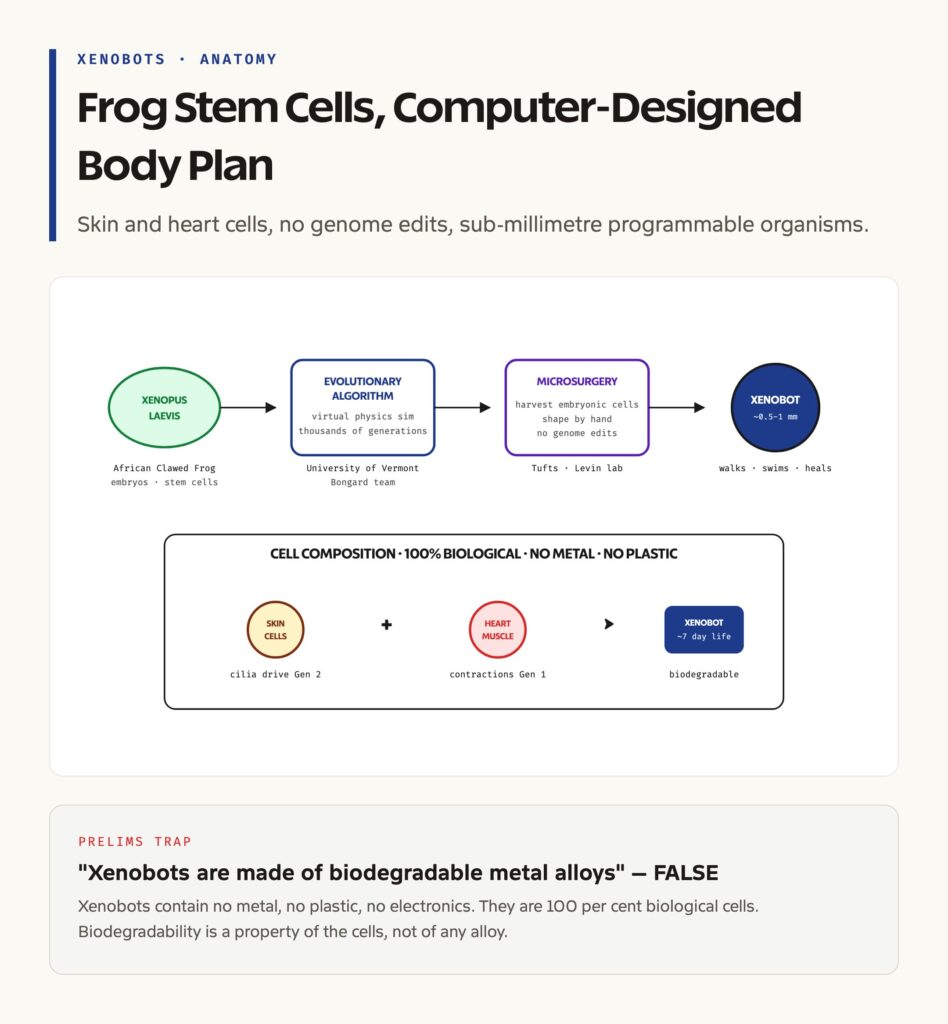
Xenobots are programmable biological machines, often described as the world’s first living robots. They were first reported in January 2020 by a team from the University of Vermont, Tufts University, and the Wyss Institute at Harvard. The source material is stem cells from the embryos of the African Clawed Frog, Xenopus laevis. The body plans are designed by a computer running an evolutionary algorithm on a virtual physics simulator, and the resulting designs are built by hand in the laboratory using microsurgical tools.
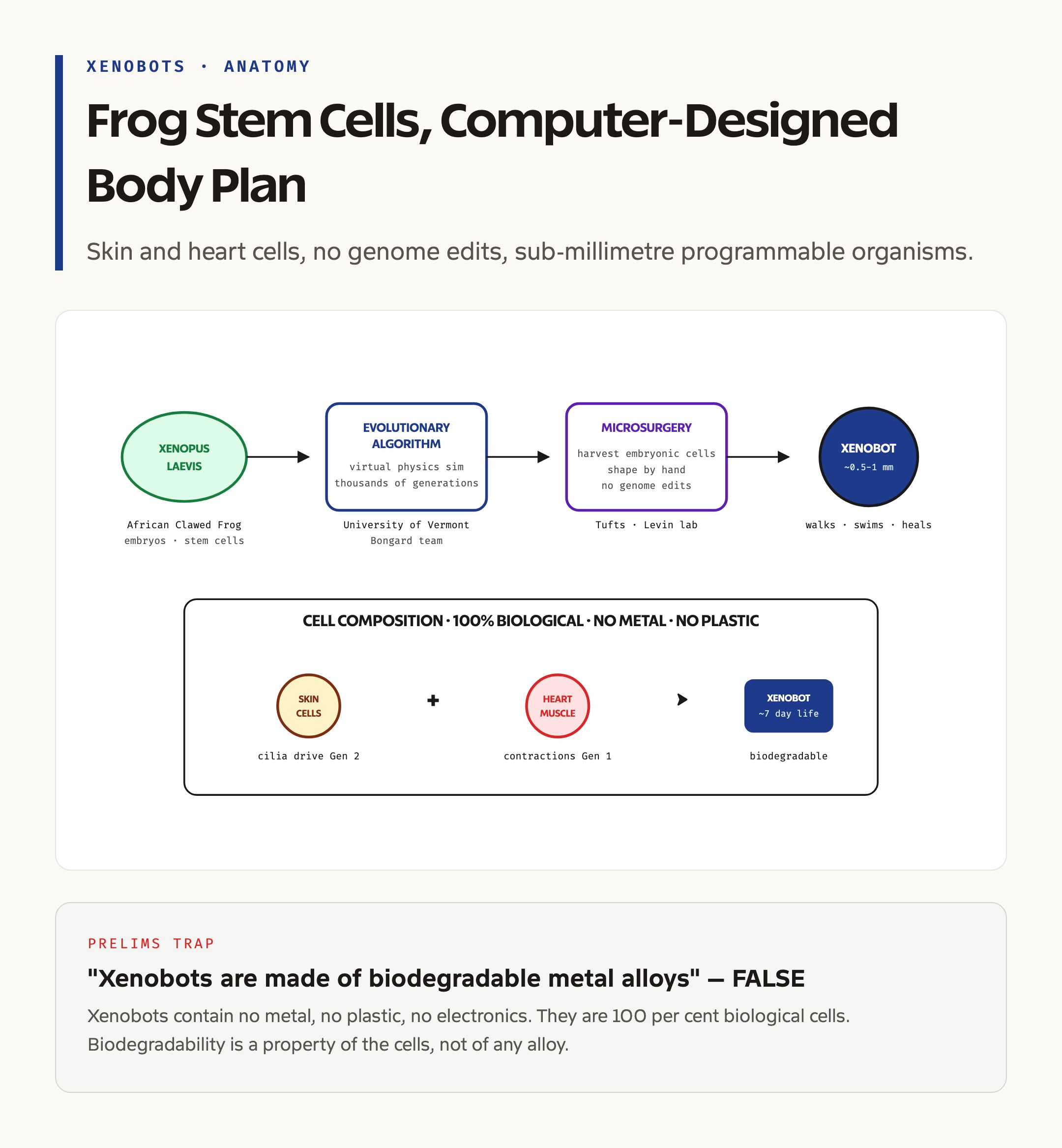
Xenobots are made entirely of biological cells. The first generation used skin cells. The second generation added heart muscle cells, which contract rhythmically and provide the locomotion. The third generation, reported in 2021, added a self-replication mode in which a swarm of xenobots gathers loose cells from the environment and assembles them into new xenobots, a behaviour the team calls kinematic self-replication.
The cells themselves are mortal. Each xenobot lives for about a week in fresh water, on the energy stored in the original embryonic cells, after which the cells deplete their reserves and die. The xenobots biodegrade completely.
A common prelims trap states that xenobots are made of biodegradable metal alloys. This is false. Xenobots are made entirely of biological cells, and their biodegradability is a property of the cells, not of any metal.
What a Xenobot Actually Is
The intellectual move that defines xenobots is that the body plan is computed, not evolved. The University of Vermont team built a virtual physics simulator that models the behaviour of clusters of two cell types, the contractile heart muscle cells and the passive skin cells. The simulator runs an evolutionary algorithm. It generates random body plans, scores them on a target task such as walking forward, mutates the best, and iterates over thousands of generations. The output is a small set of designs that perform well on the target task.
The Tufts team then takes those computer-designed body plans and builds them by hand. Embryonic cells are harvested from a Xenopus laevis embryo, separated, and shaped into the computed body plan using microsurgical tools. Within hours of assembly, the heart cells start to contract, the cilia on the skin cells start to beat, and the xenobot begins to move.
Each xenobot is between half a millimetre and a millimetre across, smaller than a poppy seed. It is dense with cells but visible only as a tiny pink dot to the naked eye. Under a microscope, it has a recognisable shape, a steady gait, and a clear behaviour profile.
The Three Generations
The first-generation xenobots, reported in 2020, walked. The body plans were optimised for forward locomotion. Heart muscle cells contracted in coordinated patterns, and the xenobot moved across the bottom of a Petri dish at roughly a body length per minute. The team showed that pairs of xenobots could push small pellets cooperatively and that cut xenobots healed within minutes.
The second-generation xenobots, reported in early 2021, swam. The team replaced the heart muscle drive with cilia-driven propulsion. Skin cells, which carry hair-like cilia on their surface, were used to assemble swimming xenobots that moved through fluid by coordinated cilia beating. The new xenobots were faster, more manoeuvrable, and could navigate small mazes.
The third-generation xenobots, reported in late 2021, reproduced. The team observed that swarms of xenobots in a Petri dish full of loose cells would gather the cells into piles, and that some of those piles would themselves become functional xenobots. The phenomenon is called kinematic self-replication. It is not the same as biological reproduction. The xenobots do not replicate their own genome. They scoop up other cells and shape them into copies of themselves. The behaviour is rare in nature and had never been seen at the scale of organisms before.
Self-Healing and the Cell-Level Intelligence Question
A xenobot cut with a microblade closes the wound within minutes. The cells flow toward the cut, reattach, and resume coordinated motion. The behaviour is not programmed in any conventional sense. It emerges from the cells’ default tendency to maintain a coherent body, a property that Levin’s lab has long argued is a kind of distributed cellular intelligence.
This observation has reshaped some debates in developmental biology. The cells of a xenobot are genetically identical to the cells of a normal frog tadpole. They have not been genetically modified. They have only been arranged into a different starting configuration. The cells then build a coherent organism with a function the genome did not specify. The implication is that the genome alone does not encode body plan, and that the rules for assembling cells into bodies are partly bioelectrical and partly mechanical.
Levin and Bongard’s papers describe xenobots as a platform for studying these rules. The platform produces organisms whose body plans can be specified independently of their genome, which is exactly what is needed to test theories about how cells coordinate to build a body.
Applications Already in View
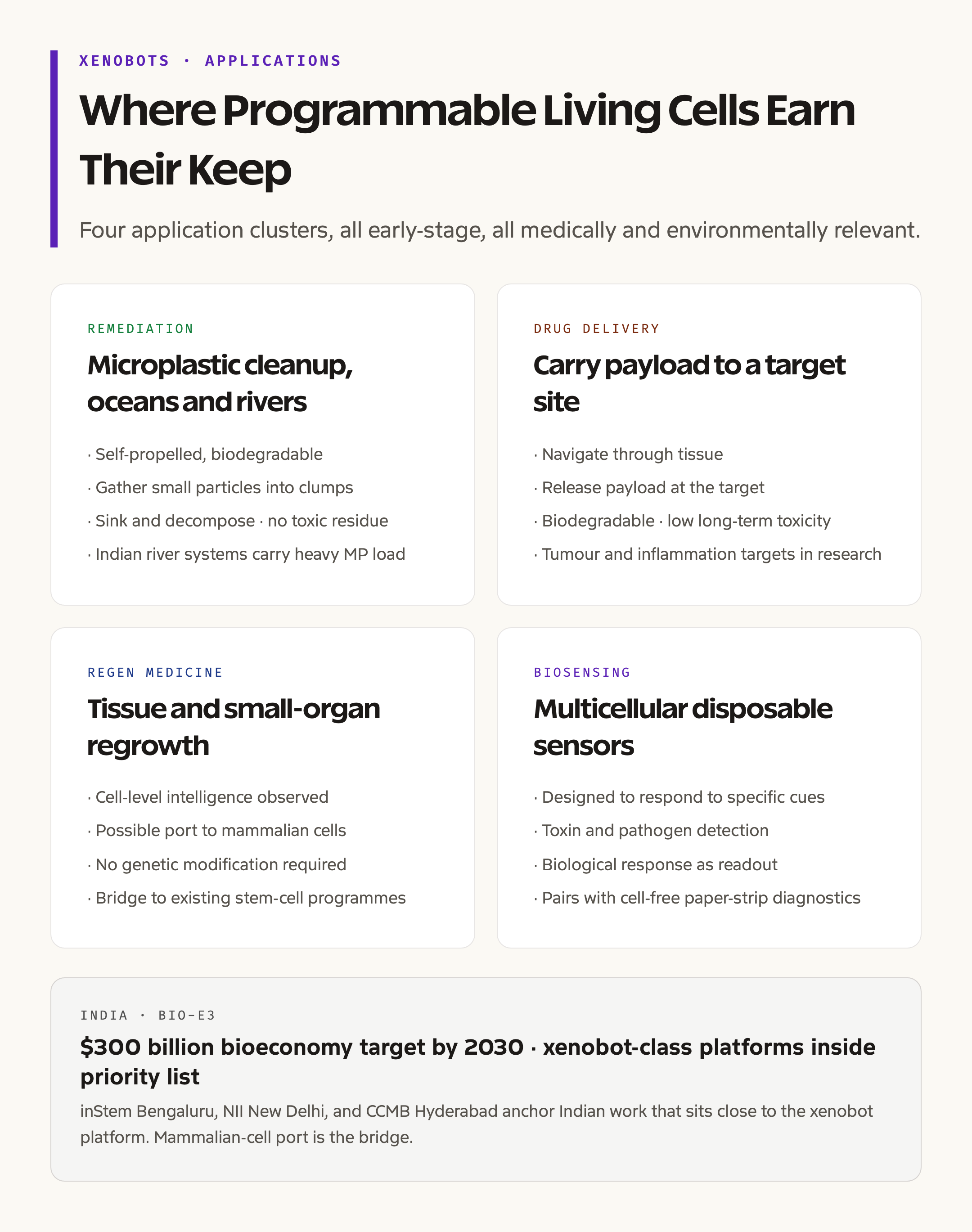
Four application clusters drive the policy interest. The first is environmental remediation. Xenobots are biodegradable, are propelled by their own metabolism, and can be designed to gather small particles. Microplastic cleanup in oceans, river systems, and water treatment plants is the headline application. A swarm of disposable xenobots scattered into a contaminated water body would gather microplastics, sink, and biodegrade.
The second is targeted drug delivery. Xenobots can be designed to carry payloads, navigate through tissue, and release the payload at a target site. They are biodegradable, which removes the long-term toxicity concern that limits inorganic nanoparticles. Inflammation-targeting xenobots and tumour-targeting xenobots are both in active early-stage research, including in collaborations with Indian research institutes working on regenerative medicine.
The third is regenerative medicine. The cell-level intelligence observed in xenobots suggests that human cells, given the right starting configuration, could regrow tissue or even small organs without genetic modification. The Tufts and Vermont teams are exploring whether the principles can be ported to human-derived cells.
The fourth is biosensing. Xenobots can be designed to respond to specific environmental cues, such as the presence of a toxin or a pathogen. The biological response provides a readout. The xenobot acts as a small, disposable, multicellular sensor.
The links to neighbouring areas of the syllabus are dense. Stem cell research, synthetic biology, nanotechnology, and biotechnology all intersect with the xenobot platform.
Why It Matters for India
India has a strong applied stem cell research community, anchored in institutes such as the inStem in Bengaluru, the National Institute of Immunology in New Delhi, and the CSIR Centre for Cellular and Molecular Biology in Hyderabad. Several Indian groups are working on regenerative medicine and on cellular reprogramming, both of which sit close to the xenobot platform.
The applied case for India is in three sectors. The first is water and environmental remediation. India’s surface waters carry one of the world’s heaviest microplastic loads. A biodegradable cleanup platform that does not require expensive engineered nanoparticles is a strong candidate for pilot deployment.
The second is precision medicine. The Indian organ shortage and the burden of chronic disease both create high demand for new biological therapies. Xenobot-style platforms, once they are ported to mammalian cells, could feed into existing programmes on regenerative medicine and gene therapy.
The third is the bioeconomy push under the Bio-E3 policy. India’s stated ambition to expand the bioeconomy to USD 300 billion by 2030 includes precision biotherapeutics and bio-manufacturing. Xenobot research is small in absolute terms today, but it sits inside the priority list of next-generation biotechnologies.
Ethical and Regulatory Questions
Three ethical questions are live. The first is the moral status of the xenobot. The xenobot has no nervous system and no plausible capacity for suffering. The standard sentience-based moral framework places it close to a Petri-dish cell culture rather than to an animal. The harder question is whether new categories of organism, designed by humans for the first time, deserve a separate ethical treatment.
The second is the biosafety question. The xenobots that have been made so far are short-lived, fresh-water-bound, and reliant on starting energy stocks. They cannot survive in the open environment in their current form. The question is whether more durable variants would create a release risk. Most biosafety experts treat the current xenobots as low risk and call for adaptive regulation as the platform develops.
The third is the dual-use question. The same platform that designs a microplastic cleanup xenobot could, in principle, design a xenobot with harmful behaviour. The dual-use risk is comparable to the dual-use risk of synthetic biology more broadly and is treated under the same biosecurity frameworks.
In India, the regulatory machinery for novel biological constructs runs through the Genetic Engineering Appraisal Committee and the Review Committee on Genetic Manipulation, with institute-level Institutional Biosafety Committees doing the day-to-day work. The 2022 amendment that exempted SDN-1 and SDN-2 gene-edited crops from full GEAC clearance opened a regulatory pathway for some classes of genetically modified organism. Xenobots are not genetically modified, which makes their regulatory classification ambiguous under existing rules. A clarification will be needed before any field-scale work begins.
Why This Matters for the UPSC Syllabus

For prelims, the safe set of facts is the Xenopus laevis source cells, the 2020 first publication, the use of computer-designed body plans, the absence of any metal or plastic in the xenobot, the cell-only composition, the self-healing behaviour, and the kinematic self-replication observed in 2021. The trap statement that xenobots are made of biodegradable metal alloys is false.
For mains, xenobots fit into answers on emerging biotechnologies, on the bioethics of programmable life, and on the regulatory frame for novel biological agents. They pair with gene therapy vs gene editing, with stem cells, and with biotechnology in agriculture.
Frequently Asked Questions
What are xenobots made of?
Xenobots are made entirely of biological cells. The first generation used skin and heart muscle cells from the African Clawed Frog. They contain no metal, no plastic, and no electronic components.
Are xenobots genetically modified?
No. The cells in a xenobot are genetically identical to the cells of a normal frog tadpole. The novelty is in the body plan, which is designed by a computer, not in the genome.
What is kinematic self-replication?
A behaviour first reported in 2021 in which xenobots in a dish full of loose cells gather the cells into piles, some of which become functional xenobots. It is not biological reproduction. The xenobots do not copy their genome. They assemble copies of themselves from cells they collect.
How long does a xenobot live?
About a week in fresh water, on the energy stored in the original embryonic cells. After that, the cells deplete their reserves and the xenobot biodegrades.
What are the main applications of xenobots?
Environmental remediation, especially microplastic cleanup; targeted drug delivery; regenerative medicine; and biosensing. All are at the early research stage as of 2026.
Tell Google you want more of this.
Add Anantam IAS as a preferred sourceOne tap, and this site shows up more often in your own Top Stories, AI Overviews and AI Mode. Remove it any time.





