The 104th Constitutional Amendment Act, 2020 made two significant changes to the Indian Constitution: it extended the reservation of seats for Scheduled Castes (SCs) and Scheduled Tribes (STs) in the Lok Sabha and State Legislative Assemblies by ten years (from 2020 to January 25, 2030), and it discontinued the provision for nomination of Anglo-Indian members to the Lok Sabha and State Assemblies. The amendment was passed by Parliament in December 2019 and received Presidential assent on January 25, 2020.
For UPSC, this amendment is a high-priority topic under Indian Polity (GS Paper II), covering reservation in legislatures, Article 334, and the treatment of the Anglo-Indian community.
Constitutional Background
Original Provisions
The Constitution of India, as adopted in 1950, made specific provisions for the political representation of SCs, STs, and the Anglo-Indian community:
| Article | Original Provision |
|---|---|
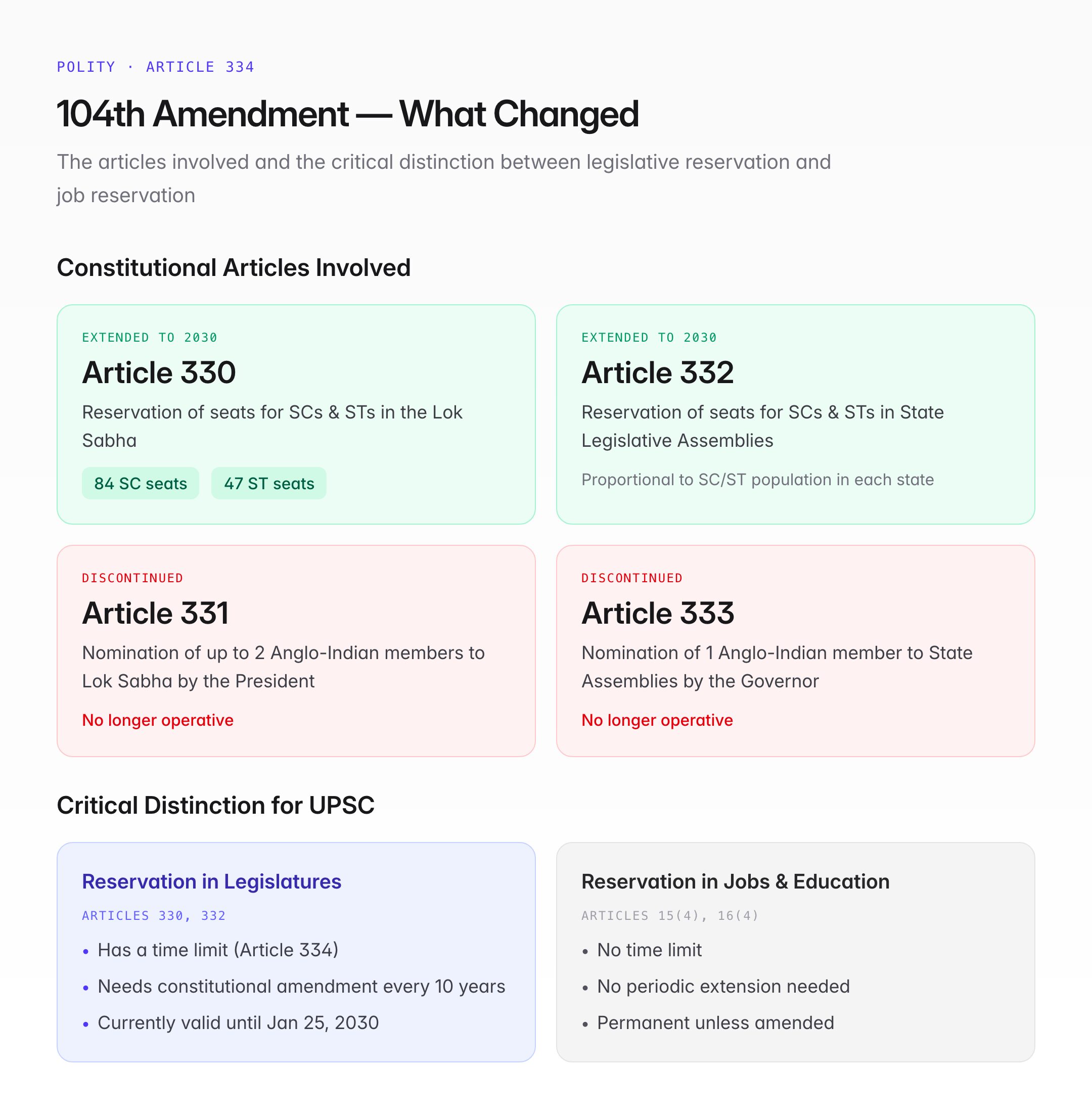
| Article 330 | Reservation of seats for SCs and STs in the Lok Sabha |
| Article 332 | Reservation of seats for SCs and STs in State Legislative Assemblies |
| Article 331 | Nomination of not more than 2 Anglo-Indian members to the Lok Sabha by the President |
| Article 333 | Nomination of 1 Anglo-Indian member to State Legislative Assemblies by the Governor |
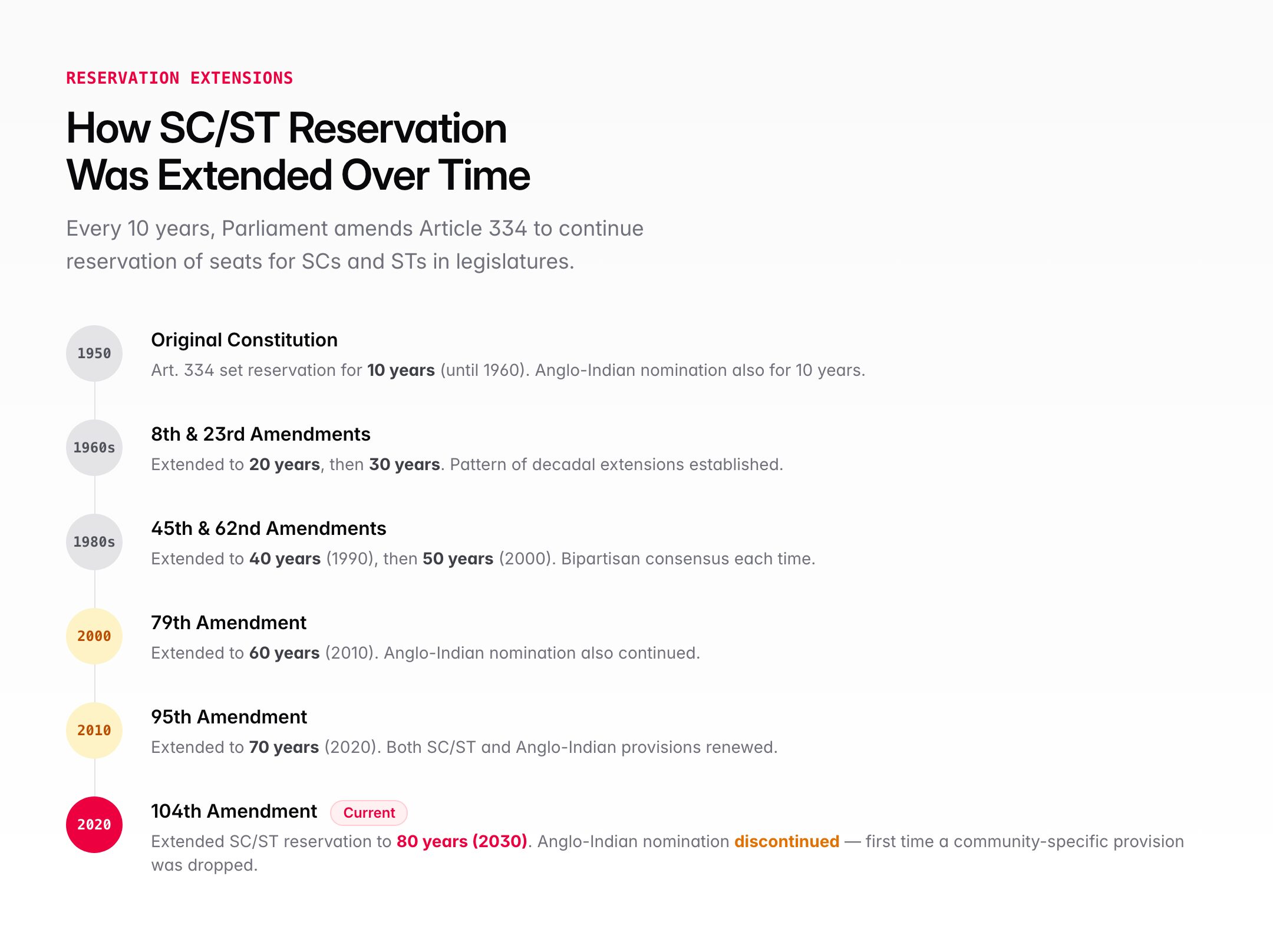
| Article 334 | Set a time limit for the above reservations and nominations — originally 10 years (i.e., until 1960) |
The Time Limit Under Article 334
The Constituent Assembly deliberately made the reservation of seats for SCs and STs temporary rather than permanent. Article 334 originally stated that the provisions of Articles 330, 332, 331, and 333 would cease to have effect on the expiration of ten years from the commencement of the Constitution (i.e., January 26, 1960).
The rationale was that reservations were a transitional measure — as social equality progressed, the need for reserved seats would diminish.
History of Extensions
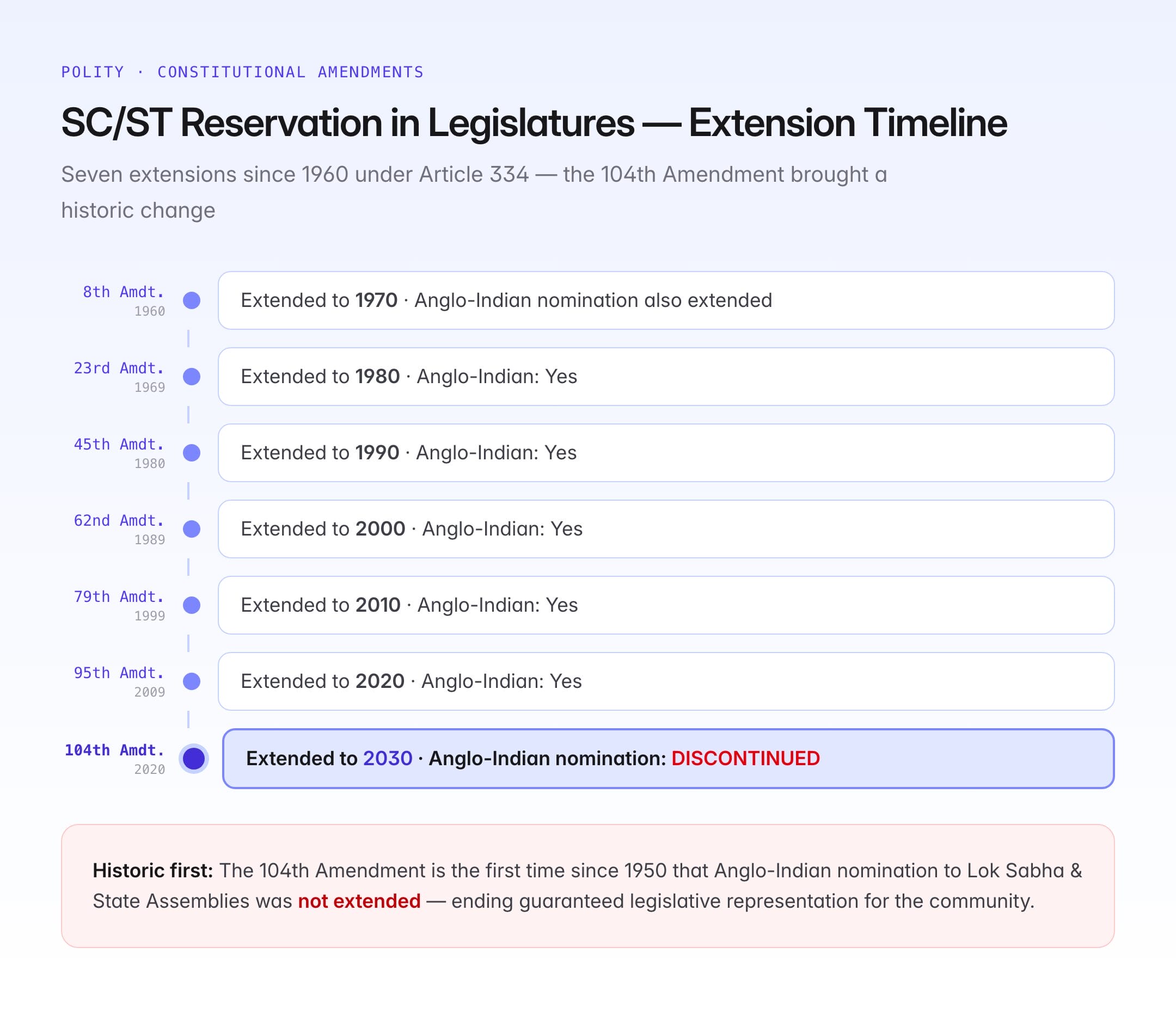
However, every ten years since 1960, the reservation period has been extended through constitutional amendments:
| Amendment | Year | Extended Until | Also Extended Anglo-Indian Nomination? |
|---|---|---|---|
| 8th Amendment | 1960 | 1970 | Yes |
| 23rd Amendment | 1969 | 1980 | Yes |
| 45th Amendment | 1980 | 1990 | Yes |
| 62nd Amendment | 1989 | 2000 | Yes |
| 79th Amendment | 1999 | 2010 | Yes |
| 95th Amendment | 2009 | 2020 | Yes |
| 104th Amendment | 2020 | 2030 | No — Anglo-Indian nomination discontinued |
What the 104th Amendment Changed
1. Extension of SC/ST Reservation (Articles 330 and 332)
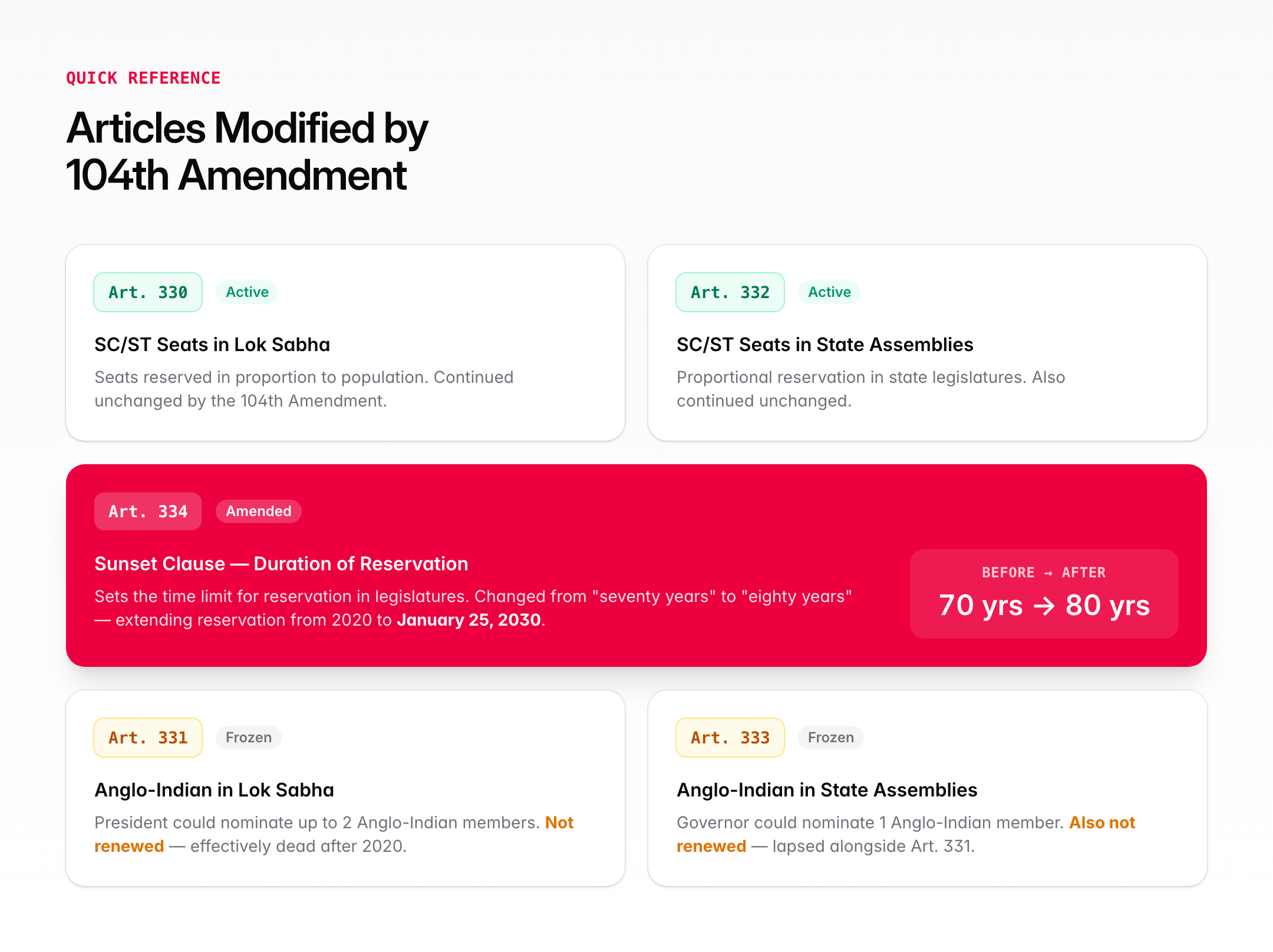
The amendment substituted the words "seventy years" with "eighty years" in Article 334, thereby extending the reservation of seats for SCs and STs in the Lok Sabha and State Legislative Assemblies for another ten years, until January 25, 2030.
Key point: This extension applies only to reserved seats in legislatures (Lok Sabha and State Assemblies). It does not relate to reservations in government jobs and educational institutions, which are governed by separate provisions (Articles 15(4), 16(4), etc.) and have no such time limit.
2. Removal of Anglo-Indian Nomination (Articles 331 and 333)
For the first time since independence, the amendment did not extend the provision for nomination of Anglo-Indian members. It effectively removed Articles 331 and 333 from active operation by not including them in the extension clause of Article 334.
This means:
- The President can no longer nominate Anglo-Indian members to the Lok Sabha
- Governors can no longer nominate Anglo-Indian members to State Legislative Assemblies
- The Anglo-Indian community lost its guaranteed legislative representation
The Anglo-Indian Community
Who Are Anglo-Indians?
Article 366(2) of the Constitution defines an Anglo-Indian as: "a person whose father or any of whose other male progenitors in the male line is or was of European descent but who is domiciled within the territory of India and is or was born within such territory of parents habitually resident therein and not established there for temporary purposes only."
Why Was Nomination Discontinued?
The government's rationale for discontinuing Anglo-Indian nomination included:
| Reason | Detail |
|---|---|
| Declining population | Census data showed a very small Anglo-Indian population (estimated at less than 500,000, though exact figures are debated) |
| Adequate representation | The government argued Anglo-Indians could contest elections in general seats |
| Constitutional principle | Nomination undermined the democratic principle of elected representation |
| Delimitation basis | The Delimitation Commission based on the 2001 Census did not find a basis for continued separate representation |
Criticism of the Removal
Critics argued that:
- The Anglo-Indian community is a vulnerable minority that benefits from constitutional protection
- Removing nomination without ensuring alternative representation marginalises the community further
- The decision was taken without adequate consultation with the Anglo-Indian community
- Other provisions for small communities (such as nominated members in the Rajya Sabha) continue to exist
Article 334 — Text After the 104th Amendment
After the amendment, Article 334 reads (in effect):
"Notwithstanding anything in the foregoing provisions of this Part, the provisions of this Constitution relating to the reservation of seats for the Scheduled Castes and the Scheduled Tribes in the House of the People and in the Legislative Assemblies of the States shall cease to have effect on the expiration of a period of eighty years from the commencement of this Constitution."
The references to Anglo-Indian nomination (Articles 331 and 333) were omitted from the operative clause.
How SC/ST Reservation in Legislatures Works
Lok Sabha
- Out of 543 elected seats, 84 seats are reserved for SCs and 47 seats are reserved for STs (based on 2008 Delimitation)
- Only candidates belonging to the SC or ST community can contest from reserved constituencies
- All voters in the constituency vote — reservation applies to candidature, not to the electorate
- Constituencies are reserved based on the proportion of SC/ST population in the area
State Legislative Assemblies
- Each state has seats reserved for SCs and STs in proportion to their population
- The same principle applies — reserved candidature, open electorate
- The Delimitation Commission determines which constituencies are reserved
Important Distinction
| Feature | Reservation in Legislatures (Art. 330/332) | Reservation in Jobs/Education (Art. 15/16) |
|---|---|---|
| Time limit | Yes — Article 334 (currently until 2030) | No time limit |
| Extended by | Constitutional amendment required every 10 years | No extension needed |
| Basis | Population proportion in constituencies | Varies — backwardness criteria |
Significance of the 104th Amendment
- Continuity of political representation — SCs and STs continue to have guaranteed seats in Parliament and state legislatures, ensuring their political voice
- Historic discontinuation — first time since 1950 that a category of constitutional reservation/nomination was not extended
- Constitutional amendment procedure — the amendment was passed as an ordinary constitutional amendment (special majority in Parliament) without requiring ratification by state legislatures, since it did not affect the federal structure
- Debate on permanence — each extension raises the question of whether SC/ST reservation in legislatures should be made permanent rather than requiring decadal renewal
UPSC Relevance
GS Paper Mapping
| Paper | Topic | Connection |
|---|---|---|
| GS Paper II | Indian Polity — Constitutional Amendments | Article 334, amendment procedure, reservation provisions |
| GS Paper II | Indian Polity — Representation | SC/ST reservation in legislatures, Anglo-Indian representation |
| GS Paper II | Governance — Social Justice | Political empowerment of marginalised communities |
| GS Paper I | Indian Society | Anglo-Indian community, minority rights |
Key Points for Prelims
- The 104th Constitutional Amendment Act was passed in 2020 (Presidential assent: January 25, 2020)
- It extended SC/ST reservation in Lok Sabha and State Assemblies by 10 years to January 25, 2030
- It discontinued Anglo-Indian nomination to Lok Sabha (Article 331) and State Assemblies (Article 333)
- The amendment modified Article 334 — the article that sets the time limit for reservations
- SC/ST reservation in legislatures has been extended seven times since 1960 (8th, 23rd, 45th, 62nd, 79th, 95th, and 104th Amendments)
- This reservation applies to candidature only — all voters in a reserved constituency can vote
- In the Lok Sabha: 84 seats reserved for SCs and 47 seats reserved for STs (current delimitation)
- Reservation in government jobs and education (Articles 15, 16) has no time limit and does not require periodic extension
- The amendment did not require state legislature ratification
Tell Google you want more of this.
Add Anantam IAS as a preferred sourceOne tap, and this site shows up more often in your own Top Stories, AI Overviews and AI Mode. Remove it any time.