Layers of Atmosphere: Composition, Characteristics and UPSC Notes
The atmosphere is a thin blanket of gases surrounding the Earth, held in place by gravity. Without it, there would be no weather, no climate, no life. For UPSC, the layers of the atmosphere — their boundaries, characteristics, and what happens in each — are a standard topic in both Prelims and Mains (GS Paper 1 — Physical Geography).
Composition of the Atmosphere
The atmosphere is a mixture of gases, water vapour, and solid/liquid particles. The composition by volume in dry air (excluding water vapour):
| Gas | Symbol | Percentage by Volume |
|---|---|---|
| Nitrogen | N₂ | 78.09% |
| Oxygen | O₂ | 20.95% |
| Argon | Ar | 0.93% |
| Carbon dioxide | CO₂ | ~0.042% (421 ppm as of 2024) |
| Neon | Ne | 0.0018% |
| Helium | He | 0.0005% |
| Methane | CH₄ | ~0.00018% |
| Krypton | Kr | 0.0001% |
| Hydrogen | H₂ | 0.00005% |
| Ozone | O₃ | Variable (0.00006% avg, concentrated in stratosphere) |
| Water vapour | H₂O | 0–4% (highly variable) |
Key points:
- Nitrogen and oxygen together make up ~99% of the atmosphere
- CO₂ has been rising steadily since industrialization (pre-industrial: ~280 ppm; today: ~421 ppm in 2024)
- Water vapour is the most variable component — 0% in dry desert air to 4% in humid tropics
- Ozone (O₃) exists throughout the atmosphere but is concentrated in the stratosphere (the ozone layer)
Why Each Gas Matters
- Nitrogen (N₂): Provides atmospheric pressure; dilutes oxygen to safe concentrations; nitrogen cycle essential for life
- Oxygen (O₂): Respiration; supports combustion; absorbed by living organisms
- Carbon dioxide (CO₂): Greenhouse gas; essential for photosynthesis; primary driver of climate change
- Water vapour: Key greenhouse gas; drives weather (evaporation, condensation, precipitation)
- Ozone (O₃): Absorbs UV-B and UV-C radiation in the stratosphere, protecting life on Earth
- Argon: Inert; used industrially
The Five Layers of the Atmosphere
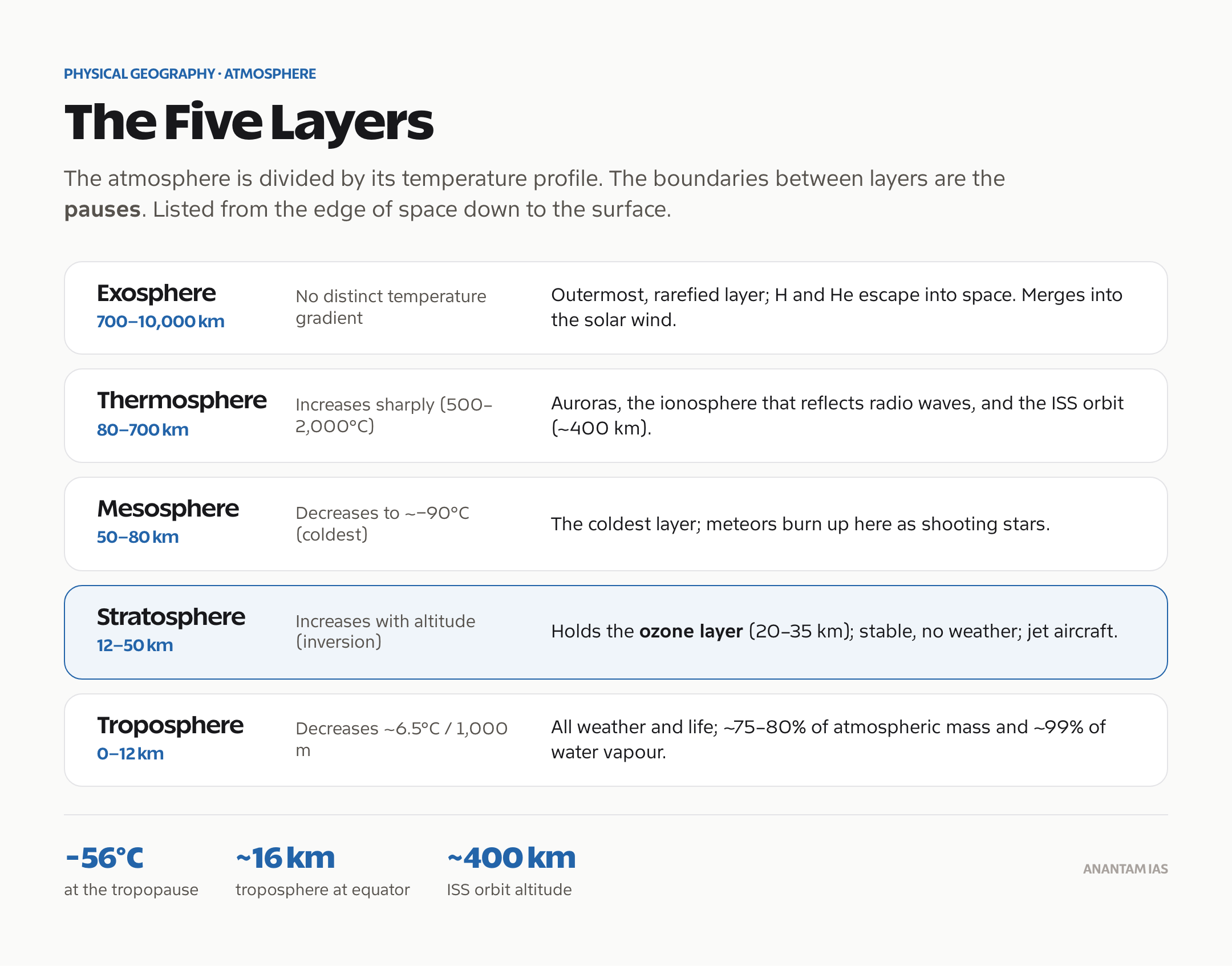
The atmosphere is divided into layers based on temperature profile (whether temperature increases or decreases with altitude). The boundaries between layers are called pauses.
Layers at a Glance
| Layer | Altitude | Temperature Trend | Key Feature |
|---|---|---|---|
| Troposphere | 0–12 km (avg) | Decreases with altitude | Weather; life; most mass |
| Stratosphere | 12–50 km | Increases with altitude | Ozone layer; jet aircraft |
| Mesosphere | 50–80 km | Decreases with altitude | Meteors burn up |
| Thermosphere | 80–700 km | Increases sharply with altitude | Aurora; ISS; radio waves |
| Exosphere | 700–10,000 km | No distinct gradient | Merges into space |
Layer 1: Troposphere
Altitude: 0 to ~12 km (varies: 8 km at poles, 16 km at equator)
The troposphere is the most important layer for life and weather. It contains:
- ~75–80% of the atmosphere’s total mass
- ~99% of all water vapour
- All weather phenomena — clouds, rain, cyclones, thunderstorms, fog
Temperature
Temperature decreases with altitude at the Normal Lapse Rate of approximately 6.5°C per 1,000 m (or about 6.4°C/km). This is why mountaintops are cold — Everest summit temperature can be -60°C.
At the top of the troposphere, temperature is approximately -56°C.
The Tropopause
The boundary between troposphere and stratosphere is the tropopause. Here, temperature stops decreasing — an inversion occurs. The tropopause acts as a “lid” on weather — thunderstorms and convective clouds cannot usually penetrate it (though severe thunderstorms can reach it).
- At equator: ~16 km (warmer troposphere, rises higher)
- At poles: ~8 km
- Temperature at tropopause: ~-56°C at equator
Key Features of Troposphere
- All weather occurs here
- Jet streams flow near the tropopause
- Commercial aircraft fly just below or at tropopause level (~10–12 km)
- Temperature decreases uniformly upward (normally)
- Strong vertical mixing; well-stirred layer
Seasons in India: Climate and Monsoon
Layer 2: Stratosphere
Altitude: ~12 km to ~50 km
In the stratosphere, temperature increases with altitude — the opposite of the troposphere. This temperature inversion means the stratosphere is extremely stable — no vertical mixing, no convective weather.
Why Temperature Increases
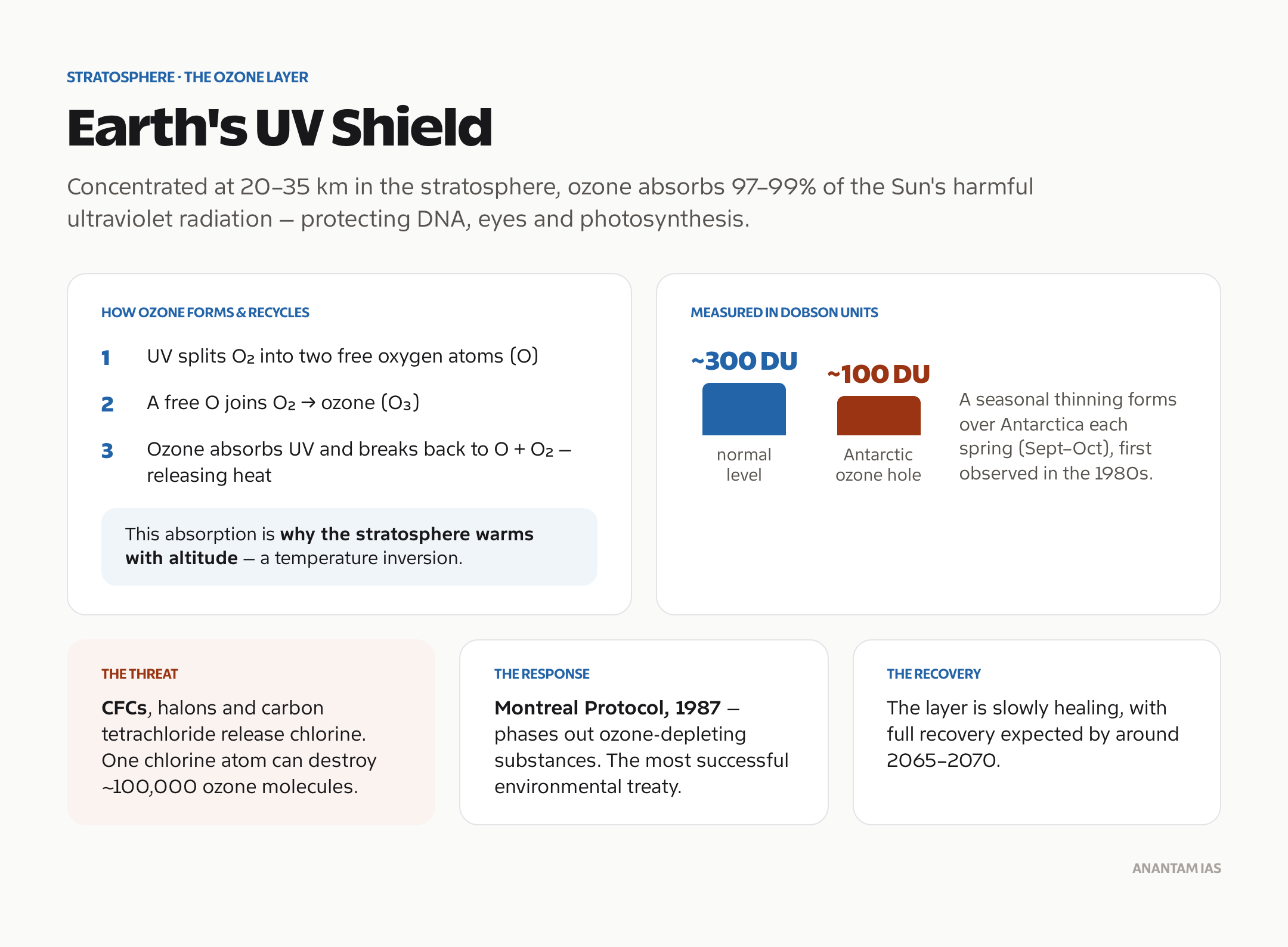
The stratosphere contains the ozone layer (peak concentration 20–35 km). Ozone absorbs UV-B and UV-C radiation from the Sun, converting it to heat. This absorption warms the stratosphere from above.
The Ozone Layer
The ozone layer is the stratosphere’s most important feature.
Location: Peak ozone concentration at 20–35 km altitude.
How ozone forms:
- UV radiation splits O₂ into two oxygen atoms (O)
- Free oxygen atom (O) combines with O₂ → O₃ (ozone)
- Ozone also absorbs UV radiation and breaks back down to O + O₂
Why ozone matters:
- Absorbs 97–99% of the Sun’s ultraviolet radiation (especially UV-B and UV-C)
- Without ozone, UV radiation would damage DNA, cause skin cancer, cataracts, and destroy photosynthesis
- Ozone is measured in Dobson Units (DU); normal levels ~300 DU; Antarctic ozone hole can drop to ~100 DU
Ozone depletion:
- Caused by chlorofluorocarbons (CFCs), halons, carbon tetrachloride, and other human-made chemicals
- CFCs (refrigerants, aerosols, foam blowing) release chlorine in the stratosphere
- One chlorine atom can destroy ~100,000 ozone molecules
- Montreal Protocol (1987): International agreement to phase out ozone-depleting substances; considered the most successful environmental treaty
- Ozone layer is slowly recovering — full recovery expected by ~2065–2070
- Antarctic Ozone Hole: A seasonal thinning of ozone over Antarctica each spring (September-October), first observed in the 1980s
Key Features of Stratosphere
- Temperature increases with altitude (temperature inversion)
- No weather, no clouds (except rare Nacreous clouds / Polar Stratospheric Clouds)
- Extremely stable, no vertical mixing
- Commercial supersonic aircraft flew here (Concorde)
- Stratopause (top boundary): ~50 km, temperature ~0°C
Layer 3: Mesosphere
Altitude: ~50 km to ~80 km
In the mesosphere, temperature decreases with altitude again — falling to the coldest temperatures in the entire atmosphere.
Temperature and Features
- Temperature drops from ~0°C at the stratopause to approximately -90°C to -100°C at the mesopause (80 km)
- The mesosphere is the coldest layer of the atmosphere
- Almost no ozone, so no UV-absorption warming
- Very little air — too thin for aircraft, but dense enough to cause friction
Meteors Burn Up Here
When space rocks and debris enter Earth’s atmosphere, they burn up in the mesosphere due to friction with air molecules. This creates the shooting stars (meteors) visible at night. The mesosphere is where most meteors are destroyed before reaching the surface.
Noctilucent Clouds
The mesosphere hosts the highest clouds on Earth: Noctilucent clouds (NLC) — thin, wispy clouds at ~80 km, made of ice crystals on smoke particles from meteors. They’re only visible in twilight from high latitudes.
Key Features of Mesosphere
- Coldest layer (-90°C at mesopause)
- Meteors burn up here
- Studied by sounding rockets (too high for aircraft, too low for satellites)
- Mesopause (top boundary): ~80 km, coldest point in atmosphere
Layer 4: Thermosphere
Altitude: ~80 km to ~700 km
The thermosphere is where temperature increases dramatically with altitude — reaching 500°C to 2,000°C or higher, depending on solar activity. But this is very different from heat as we experience it.
Why It’s “Hot” but Not Burning
At thermospheric altitudes, air molecules are so sparse that they move at very high speeds (hence high temperature by the physics definition) but there are so few of them that they transfer very little heat energy. A satellite in the thermosphere would actually be cold because there’s not enough gas to warm it by conduction.
The Ionosphere
Much of the thermosphere is ionized — solar UV and X-ray radiation strips electrons from atoms, creating ions and free electrons. This ionized region is called the ionosphere.
Layers of the ionosphere:
| Layer | Altitude | Role |
|---|---|---|
| D layer | 60–90 km | Absorbs low-frequency radio waves; disappears at night |
| E layer | 90–150 km | Reflects medium-frequency radio waves |
| F1 layer | 150–250 km | Daytime; reflects high-frequency (HF) radio |
| F2 layer | 250–400 km | Most persistent; reflects HF radio; night/day |
The F2 layer is why AM radio stations can be heard from thousands of kilometres away at night — radio waves bounce between the ionosphere and Earth’s surface.
Applications:
- Long-distance HF radio communication
- GPS signals are affected by ionospheric disturbances
- Space weather (solar flares) disturbs the ionosphere, disrupting communications
Aurora Borealis and Aurora Australis
The Northern Lights (Aurora Borealis) and Southern Lights (Aurora Australis) occur in the thermosphere (mostly 100–300 km altitude).
Mechanism:
- Solar wind (charged particles from the Sun) is deflected by Earth’s magnetic field
- Near the poles, some particles enter the atmosphere along magnetic field lines
- They collide with oxygen and nitrogen molecules in the thermosphere, exciting them
- When excited molecules return to ground state, they emit light — green (oxygen at 100–150 km), red (oxygen at >150 km), blue/purple (nitrogen)
The ISS and Satellites
The International Space Station (ISS) orbits at ~400 km — within the thermosphere. Most low Earth orbit (LEO) satellites operate here.
Key Features of Thermosphere
- Hottest layer (500–2,000°C) — but low gas density
- Ionosphere (D, E, F layers) — reflects radio waves
- Aurora phenomena
- ISS orbits here
- Thermopause: Top of thermosphere (~700 km)
Layer 5: Exosphere
Altitude: ~700 km to ~10,000 km (or beyond)
The exosphere is the outermost, most rarefied layer of the atmosphere. It gradually merges into outer space.
Key Features
- Gas molecules here are so sparse they rarely collide with each other
- Atoms travel in elliptical trajectories — some escape into space (atmospheric escape)
- Primarily hydrogen and helium (lightest elements, can escape Earth’s gravity)
- No clear boundary — fades into the solar wind
- The Van Allen Radiation Belts (torus-shaped regions of trapped charged particles) begin in the upper exosphere
The exosphere has no weather, no sharp boundary, and essentially no density. It’s the transition zone between Earth’s atmosphere and interplanetary space.
Atmospheric Pressure
Atmospheric pressure is the weight of the air column above a point. It decreases with altitude because there’s less air above.
| Altitude | Pressure | Notes |
|---|---|---|
| Sea level | ~1013 mb (1 atm) | Standard sea level pressure |
| 5 km | ~500 mb | Approximately half of sea level pressure |
| 10 km (tropopause) | ~265 mb | Jet aircraft level |
| 50 km (stratopause) | ~1 mb | Very low |
| 80 km (mesopause) | ~0.01 mb | Negligible |
At ~5.5 km altitude, half of the atmosphere’s mass is below you. At the tropopause (~12 km), about 80% of the atmosphere is below.
Pressure is measured with a barometer (units: millibar/mb, Pascal/Pa, or mmHg). Low pressure = rising air = clouds/rain. High pressure = sinking air = clear skies.
Heat Balance of the Atmosphere
Earth maintains a heat balance (energy balance) — incoming solar radiation equals outgoing radiation over time.
Incoming Solar Radiation (Insolation)
Of the solar energy reaching the top of the atmosphere (taken as 100 units):
- Reflected by clouds: ~25 units
- Reflected by Earth’s surface: ~5 units
- Absorbed by atmosphere and clouds: ~20 units
- Absorbed by Earth’s surface: ~50 units
Total albedo (reflectivity): ~30 units reflected to space.
Outgoing Radiation (Earth’s Long-Wave Radiation)
Earth absorbs ~70 units and must radiate the same amount back to space to maintain equilibrium. It does so as long-wave infrared radiation (heat radiation).
The greenhouse effect: Greenhouse gases (CO₂, water vapour, methane, N₂O) in the troposphere absorb this outgoing long-wave radiation and re-radiate it back toward Earth’s surface, keeping Earth warmer (~15°C mean) than it would otherwise be (~-18°C without greenhouse effect).
Enhanced greenhouse effect = more greenhouse gases (due to human activity) trap more heat → global warming.
Jet Streams
Jet streams are narrow bands of fast-moving air in the upper troposphere and lower stratosphere, flowing from west to east.
| Jet Stream | Location | Speed | Significance |
|---|---|---|---|
| Polar Jet Stream | ~60°N/S, ~10–12 km | 120–240 km/h | Drives mid-latitude weather systems |
| Subtropical Jet Stream | ~30°N/S, ~12 km | 120–200 km/h | Governs Indian monsoon onset/retreat |
| Somali Jet | Near Somalia coast, ~2 km | 150+ km/h | Drives Arabian Sea moisture to India |
| Tropical Easterly Jet | ~15°N, over India, ~14 km | ~100 km/h | Maintains Indian SW monsoon |
Jet streams influence weather, aircraft flight times, and monsoon behaviour. The displacement of the westerly jet stream north of the Tibetan Plateau is one trigger for the onset of the Indian monsoon.
Monsoon in India: Mechanism and Impact
Frequently Asked Questions
Q1. What are the 5 layers of the atmosphere in order from Earth?
The five layers of the atmosphere in order from Earth’s surface outward are: (1) Troposphere (0–12 km) — all weather occurs here; (2) Stratosphere (12–50 km) — contains the ozone layer; (3) Mesosphere (50–80 km) — meteors burn up here, coldest layer; (4) Thermosphere (80–700 km) — ionosphere, aurora, ISS; (5) Exosphere (700–10,000 km) — outermost layer, merges into space. Each layer is separated from the next by a u0022pauseu0022 (tropopause, stratopause, mesopause, thermopause).
Q2. Which is the coldest layer of the atmosphere?
The mesosphere is the coldest layer of the atmosphere. At its upper boundary (the mesopause, ~80 km altitude), temperatures can drop to -90°C to -100°C — the coldest temperatures anywhere in the atmosphere. This is because the mesosphere lacks any heat-absorbing agents (no ozone like the stratosphere, insufficient air density like the troposphere).
Q3. What is the ozone layer and where is it located?
The ozone layer is a region of the stratosphere where ozone (O₃) is concentrated, found at approximately 20–35 km altitude. It absorbs 97–99% of the Sun’s harmful ultraviolet (UV-B and UV-C) radiation, protecting life on Earth from radiation damage, DNA mutation, and skin cancer. The ozone layer is being repaired following the Montreal Protocol (1987), which phased out ozone-depleting substances like CFCs. Full recovery is expected by around 2065.
Q4. What is the ionosphere and why does it matter?
The ionosphere is the ionized portion of the upper atmosphere, extending from about 60 km to 1,000 km (spanning the mesosphere-thermosphere boundary through the thermosphere). Solar radiation ionizes gas molecules, creating a region of free electrons that can reflect radio waves. This is why AM radio broadcasts can travel thousands of kilometres — the waves bounce between the ionosphere and Earth’s surface. GPS signals are affected by ionospheric disturbances, making this layer important for communication and navigation systems.
Q5. What is the normal lapse rate and what is a temperature inversion?
The Normal Lapse Rate (or Environmental Lapse Rate) is the rate at which temperature decreases with altitude in the troposphere — approximately 6.5°C per 1,000 m. A temperature inversion is when this normal pattern reverses — temperature increases with altitude instead of decreasing. The tropopause is the most significant temperature inversion in the atmosphere (dividing the troposphere from the stratosphere). Inversions near the surface trap pollutants, causing smog events in cities.
Tell Google you want more of this.
Add Anantam IAS as a preferred sourceOne tap, and this site shows up more often in your own Top Stories, AI Overviews and AI Mode. Remove it any time.