Most aspirants can recite that the aurora borealis is “caused by charged particles from the Sun hitting the Earth’s atmosphere” and then go completely blank when asked why it happens only near the poles, why it is usually green, or how on earth people in Ladakh photographed it in 2024. That one-line answer is not wrong, it is just missing every step that matters. The real story is a chain: the Sun throws out charged particles, the Earth’s magnetic field catches and steers them, and the atmosphere lights up like a neon sign when those particles crash into it. Get the chain in order and the aurora stops being a pretty fact you memorise and becomes a piece of space physics you can actually explain, which is exactly what a good answer needs.
What an aurora actually is
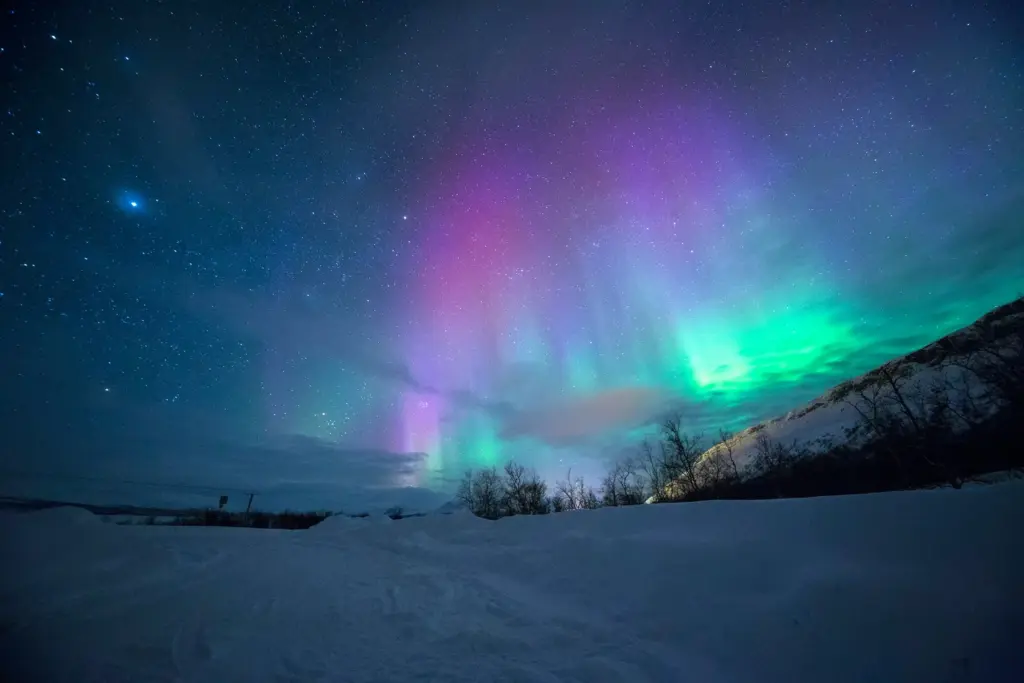
An aurora is light emitted by gases in the Earth’s upper atmosphere when they are struck by charged particles that have travelled from the Sun and been funnelled toward the poles by the planet’s magnetic field. The aurora borealis is the version seen around the North Pole, the “northern lights,” and the aurora australis is its southern twin. That is the whole phenomenon in one sentence, but each part of it hides the mechanism, so hold onto three words: particles, magnetism, and atmosphere.
Think of it like a television screen from the era before flat panels. In an old cathode-ray tube, a beam of electrons was fired at a coated screen, and wherever the electrons hit, the coating glowed. An aurora is the same trick on a planetary scale: the Sun supplies the electron beam, the Earth’s magnetic field aims it at the polar regions, and the upper atmosphere is the screen that glows. This analogy is worth auditing before you trust it, because the physics is genuinely close. The atmosphere glows for the same reason the old screen did, an atom absorbs energy from an incoming particle and then releases that energy as a flash of light. What differs is only the scale and the fact that nature, not an engineer, is doing the aiming.
The glow happens high up, not at cloud level. Auroras form mostly between about 100 and 300 kilometres above the ground, in the thin upper air of the thermosphere, far above where aeroplanes fly and even above where most satellites in low orbit circle. So when you picture the northern lights, do not picture them draped over mountains like fog. Picture a curtain of light hanging in near-vacuum, tens of kilometres tall, with its lower edge still higher than the top of the atmosphere most people think of as “sky.”
How an aurora forms, step by step
The aurora is the end of a journey that begins on the Sun, and the sequence is the part examiners love because each link has a name. Start at the source.
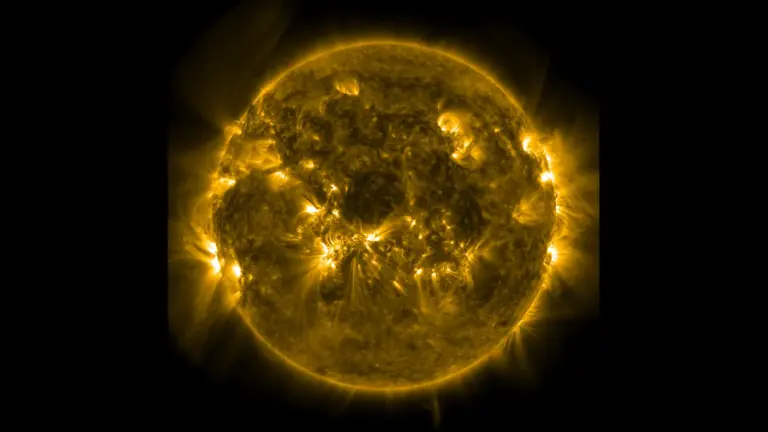
The Sun constantly streams out a thin flow of charged particles called the solar wind, mostly electrons and protons, at speeds of hundreds of kilometres per second. On a quiet day this wind is enough to produce faint auroras at the highest latitudes. The dramatic displays come from something bigger: a coronal mass ejection, or CME, a huge bubble of magnetised plasma that the Sun flings out during a burst of activity, often alongside a solar flare. A single CME can carry billions of tonnes of charged particles, and when one is aimed at the Earth it slams into the planet’s magnetic environment a day or two later, which is why space-weather forecasters can warn of a coming storm. India’s own solar observatory, Aditya-L1, was built partly to watch these eruptions leave the Sun, and it has already returned a close look at coronal mass ejections from its vantage point between the Earth and the Sun.
Now the Earth’s defence system takes over. The planet has a magnetosphere, the region of space dominated by its magnetic field, which acts like an invisible shield deflecting most of the solar wind around the planet the way a boulder splits a river. But the shield is not sealed. On the night side the magnetic field is stretched out into a long tail, the magnetotail, and there the incoming solar magnetic field can link up with the Earth’s field in a process called magnetic reconnection. Reconnection snaps the stretched field lines like a released elastic band and hurls trapped particles back toward the Earth, accelerating them as they go. Those particles spiral down the magnetic field lines that converge on the two magnetic poles, which is the single reason auroras cluster near the poles rather than spreading evenly across the sky.
The last step is the collision. As the accelerated electrons plunge into the upper atmosphere, they crash into atoms and molecules of oxygen and nitrogen. Each collision knocks an atom into an “excited” state, meaning one of its electrons jumps to a higher energy level. That excited state is unstable, so a fraction of a second later the electron drops back down and the atom releases the extra energy as a photon, a particle of light. Multiply that by trillions of atoms across a vast sheet of sky and you get the shimmering curtain. The colour of that curtain is not random, and it is the next thing worth getting exactly right.
Why auroras are green, red, and sometimes purple
The colour of an aurora is set by which gas is glowing and at what altitude, so the palette is really a map of the upper atmosphere. Learn the three main cases and you can read an aurora photograph like a chart.
The familiar green aurora, the most common colour, comes from atomic oxygen at altitudes of roughly 100 to 150 kilometres, emitting light at a wavelength of about 557.7 nanometres. Oxygen up there is thin enough that an excited atom has time to release this particular green glow before another collision cancels it. Higher up, above about 200 kilometres, atomic oxygen instead emits a deep red light at around 630 nanometres. This red glow is fainter and slower, and because the atmosphere is so sparse at that height it needs very calm, low-energy conditions to appear, which is exactly why the rare red auroras matter for the Indian story below. Lower down, below about 100 kilometres where the air is denser, molecular nitrogen produces blue and purple-pink fringes, often seen along the lower edge of an active display.
| Colour | Emitting gas | Approximate altitude | What it tells you |
|---|---|---|---|
| Green | Atomic oxygen (557.7 nm) | 100–150 km | The common, bright aurora |
| Red | Atomic oxygen (630 nm) | Above 200 km | Faint, high, needs low-energy particles |
| Blue / purple | Molecular nitrogen | Below 100 km | Lower fringes of strong displays |
Here is the part that trips up almost everyone: the colour is not about how strong the storm is in any simple way, it is about which atoms get excited at which height and whether they have time to glow before the next collision snuffs them out. That is why a poleward observer under an intense storm sees mostly green, while a distant, low-latitude observer catching only the very top of the auroral curtain, hundreds of kilometres up, tends to see red. The same storm, viewed from different distances, wears different colours.
Aurora borealis and aurora australis: the same light at two poles
The aurora borealis and the aurora australis are the same physical phenomenon occurring simultaneously at the two ends of the Earth, and the only real difference is which hemisphere you are standing in. Borealis is the northern lights, seen from places like Norway, Iceland, Canada, and Alaska. Australis is the southern lights, seen from Antarctica, southern New Zealand, and the far south of Australia and Chile.
The names carry a small bit of history worth a line in an answer. Aurora was the Roman goddess of the dawn, and the term aurora borealis, from *Boreas*, the Greek name for the north wind, is usually credited to the astronomer Galileo Galilei in 1619. Aurora australis simply swaps in the Latin for “of the south.” Because both auroras are driven by the same solar particles funnelled down the same planetary magnetic field, they are near mirror images of each other, often lighting up in matching patterns at the same moment, a symmetry that satellites have photographed directly. If you can state that they are two visible ends of one global process, rather than two separate events, you have understood the geometry.
The auroral oval: where the lights actually sit
Auroras do not form a neat cap over the geographic pole, they form a lopsided ring called the auroral oval centred on each geomagnetic pole, which sits a fair distance away from the true geographic pole. This is why the aurora is best seen not at the North Pole itself but in a band a little south of it, over northern Scandinavia, Iceland, and northern Canada, where the oval usually passes overhead.
The oval is not fixed. During quiet space weather it is a thin ring hugging the high latitudes, but when a strong CME arrives the oval swells and pushes equatorward, sliding toward the tropics. In an extreme storm it can bulge so far south that people who never expect an aurora suddenly find one over their heads. This expansion is the entire reason a viewer in India could ever see the northern lights: the oval did not come to India in any ordinary sense, it stretched abnormally far from the pole during a once-in-decades storm, until its faint red outer edge reached latitudes it almost never touches. That sets up the most striking recent chapter in the whole subject.
When India saw the northern lights: Ladakh and Hanle
In May 2024 observers in Ladakh recorded the northern lights over India, something so rare that it made the aurora a live topic for Indian readers rather than a distant-country curiosity. The trigger was one of the strongest space-weather events in living memory, and knowing its specifics turns a vague “aurora seen in India” into a proper, dated case study.
Between 10 and 13 May 2024, a cluster of powerful coronal mass ejections from a single giant sunspot region struck the Earth and produced a geomagnetic storm that NOAA rated G5, its “extreme” top category, the first G5 storm in about two decades and the most powerful to hit the planet since March 1989. Scientists later named it the Gannon storm, after the space physicist Jennifer Gannon. Its strength, measured by the Dst index that tracks how far the Earth’s magnetic field is disturbed, reached about −412 nanoteslas, the largest such disturbance of any storm in this class since 1989. Auroras were reported worldwide at latitudes that normally never see them, from Mexico and Spain to Japan and South Africa.
In India, the sky cameras at the Indian Astronomical Observatory at Hanle, in Ladakh, captured a red glow on the northern horizon. That location is not an accident. Hanle sits at high altitude in a cold desert with almost no light pollution, which is exactly why it was designated the core of India’s first dark sky reserve, and clean dark skies are what let an extremely faint, low-latitude aurora register at all. The colour was the giveaway. What Ladakh saw was not the bright green curtain of the Arctic but a diffuse red arc, the high-altitude oxygen glow described earlier, sometimes classed as a stable auroral red (SAR) arc, a related red emission that appears at the very edge of the auroral zone during big storms. India was catching only the topmost, faintest fringe of a curtain whose bright base lay thousands of kilometres to the north, and it took the strongest storm in a generation to push even that fringe this far south.
The lesson for an exam answer is precise: India does not have “an aurora season.” It saw a red, low-latitude aurora because an extreme geomagnetic storm inflated the auroral oval far beyond its normal reach, and because a genuinely dark, high-altitude site like Hanle was watching. Both conditions were necessary. Take away either the once-in-a-generation storm or the pristine dark sky and the sighting does not happen.
Solar maximum and why auroras keep making the news
Auroras have been unusually frequent and widespread lately because the Sun is near the peak of its activity cycle, a phase called the solar maximum. The Sun runs on a roughly 11-year cycle of rising and falling activity, and the current one, Solar Cycle 25, reached its maximum around 2024 and 2025, which is precisely when the big storms and the global aurora sightings clustered. Understanding this cycle is what connects a single dramatic night in Ladakh to a predictable, physical rhythm.
At solar maximum the Sun has the most sunspots, the most solar flares, and the most coronal mass ejections, so the raw supply of aurora-causing eruptions is at its highest. This is why the years around a solar maximum reliably bring more intense and more far-reaching auroras than the quiet years of solar minimum, and why forecasters expected an active stretch through the mid-2020s. The mechanics of this rhythm, and why the Sun’s “tantrums” ripple all the way to the Earth’s magnetic field, are worth studying alongside the broader field of space science, because the same solar activity that paints the sky can also disrupt satellites, GPS, radio, and power grids. The solar maximum and the 11-year solar cycle is the frame that ties the aurora to real-world stakes, and a strong solar storm is the specific event that delivers both the light show and the disruption. This is exactly the kind of dual-use fact, beautiful and hazardous at once, that examiners like to build a question around.
How to study auroras for the exam
Study the aurora as a causal chain, not a single fact, because every question about it is really asking you to reconstruct that chain. Memorise the sequence in order and the details hang off it naturally.
The spine to lock down is: the Sun emits the solar wind and, during storms, coronal mass ejections; the Earth’s magnetosphere deflects most of it but, through magnetic reconnection in the magnetotail, funnels charged particles down the field lines to the poles; those particles excite oxygen and nitrogen in the upper atmosphere, which glow as they release the energy; oxygen gives green and red, nitrogen gives blue and purple; the display sits in the auroral oval around each geomagnetic pole, and it pushes equatorward during strong storms. If you can say that without notes, you own the concept.
For value addition, keep three specifics ready. First, the colour-altitude map, oxygen green at 100 to 150 km, oxygen red above 200 km, nitrogen blue and purple lower down, which lets you explain why distant observers see red. Second, the India case, the G5 Gannon storm of May 2024 and the red arc over Hanle in Ladakh, which you can deploy whenever a question touches space weather, dark-sky sites, or the reach of geomagnetic storms. Third, the cycle context, that these events cluster around the Solar Cycle 25 maximum of the mid-2020s, which links the aurora to satellite and grid hazards and to India’s solar-observation effort. In Prelims, aurora questions test the mechanism and the colours; in Mains and interviews, the aurora is a vivid hook for a wider answer on space weather and its economic risks. Learn it as physics with two or three dated Indian anchors and it will serve you far beyond a single fact card, in the same way the broader story of ISRO’s missions anchors the space-technology section.
Frequently Asked Questions
What causes the aurora borealis?
The aurora borealis is caused by charged particles, mostly electrons, from the Sun striking oxygen and nitrogen atoms in the Earth’s upper atmosphere. The Earth’s magnetic field funnels these particles toward the poles, and when they excite the atmospheric gases, those gases release the energy as light.
Why are auroras usually green?
The common green colour comes from atomic oxygen at altitudes of about 100 to 150 kilometres, which emits light at a wavelength of 557.7 nanometres. At that height the oxygen is thin enough for the excited atoms to release this green glow before further collisions cancel it out.
What is the difference between aurora borealis and aurora australis?
They are the same phenomenon at opposite ends of the Earth. The aurora borealis is the northern lights, seen near the North Pole, and the aurora australis is the southern lights, seen near the South Pole. Both are driven by the same solar particles guided by the Earth’s magnetic field, and they often light up in matching patterns.
Can the northern lights be seen from India?
Only very rarely, and only during extreme geomagnetic storms. In May 2024 the Indian Astronomical Observatory at Hanle in Ladakh recorded a faint red aurora during the G5 Gannon storm, one of the strongest in decades. India normally lies far too close to the equator to see auroras.
Why did the aurora over Ladakh look red rather than green?
Because India catches only the very top of the auroral curtain, hundreds of kilometres up, where atomic oxygen emits red light at 630 nanometres. The bright green base of the aurora sits at lower altitudes over the far north. Distant, low-latitude observers therefore see the high red glow rather than the green.
What is the auroral oval?
The auroral oval is the ring-shaped zone around each geomagnetic pole where auroras usually occur. It is centred on the magnetic pole, not the geographic pole, and it expands and shifts toward the equator during strong solar storms, which is how auroras occasionally reach low latitudes.
How is the aurora linked to the solar cycle?
The Sun follows a roughly 11-year cycle of activity. Near its peak, called the solar maximum, there are more sunspots, flares, and coronal mass ejections, so auroras become more frequent and more widespread. Solar Cycle 25 reached its maximum around 2024 to 2025, which is why auroras have been unusually common recently.
Practice Questions
1. Auroras are caused primarily by the interaction of solar particles with which atmospheric gases?
a) Carbon dioxide and methane
b) Oxygen and nitrogen
c) Hydrogen and helium
d) Ozone and argon
Answer: b
2. The green colour of the aurora is produced mainly by:
a) Molecular nitrogen at low altitude
b) Atomic oxygen at about 100 to 150 km
c) Hydrogen at high altitude
d) Water vapour in the stratosphere
Answer: b
3. The region of space around the Earth dominated by its magnetic field, which funnels solar particles toward the poles, is called the:
a) Ionosphere
b) Ozone layer
c) Magnetosphere
d) Stratosphere
Answer: c
4. In May 2024, a faint red aurora was recorded in India from which location?
a) Nainital
b) Hanle, Ladakh
c) Kodaikanal
d) Mount Abu
Answer: b
5. Auroras become more frequent and widespread during the solar maximum because it brings the most:
a) Solar eclipses
b) Sunspots, flares, and coronal mass ejections
c) Meteor showers
d) Lunar phases
Answer: b
Mains-style questions
- Explain the process by which the aurora borealis forms, tracing the chain from the Sun to the Earth’s upper atmosphere.
- Why are auroras normally confined to high latitudes, and under what conditions can they be seen at low latitudes such as in India?
- Discuss how the colours of an aurora reveal the composition and structure of the upper atmosphere.
- Geomagnetic storms produce beautiful auroras but also serious hazards. Examine their impact on modern technological systems.
- Analyse the significance of dark-sky sites like Hanle for astronomy and space-weather observation in India.
The aurora rewards anyone willing to trade the one-line answer for the chain behind it. Learn the sequence from solar wind to glowing oxygen, keep the colour-altitude map and the Gannon-storm sighting over Hanle in your pocket, and place it all inside the rhythm of the solar cycle, and you will be able to do what most candidates cannot: explain not just that the northern lights exist, but why they are green in Norway, red over Ladakh, and suddenly, briefly, an Indian story at all.
Tell Google you want more of this.
Add Anantam IAS as a preferred sourceOne tap, and this site shows up more often in your own Top Stories, AI Overviews and AI Mode. Remove it any time.