Buddhism appears across Indian history syllabi as a religion, a set of councils, a sculptural tradition and a chapter in Ashoka’s reign. It appears almost nowhere as an ethical framework, which is a loss, because its structure is unusually well suited to the kind of question a paper on ethics actually asks. It does not begin with commandments. It begins with a diagnosis, offers a training programme, and specifies which mental states to cultivate — including one that functions almost exactly as administrative impartiality.
The tradition also carries something no other Indian school does: a worked example of a ruler trying to govern by it. Ashoka’s edicts are a primary source on what happens when an ethical doctrine meets the problem of running an empire, and their record is instructive in both directions.
The Four Noble Truths as a Moral Diagnosis
The Four Noble Truths are usually recited as doctrine. Read as a piece of practical reasoning, they follow the structure of any competent problem statement: name the condition, identify its cause, assert that the cause is removable, and specify the method.
Dukkha — there is suffering, dissatisfaction, a persistent unsatisfactoriness in ordinary experience. Samudaya — it has a cause, and the cause is tanha, craving or thirst, together with aversion and ignorance. Nirodha — the cause can cease. Magga — there is a path by which it ceases.
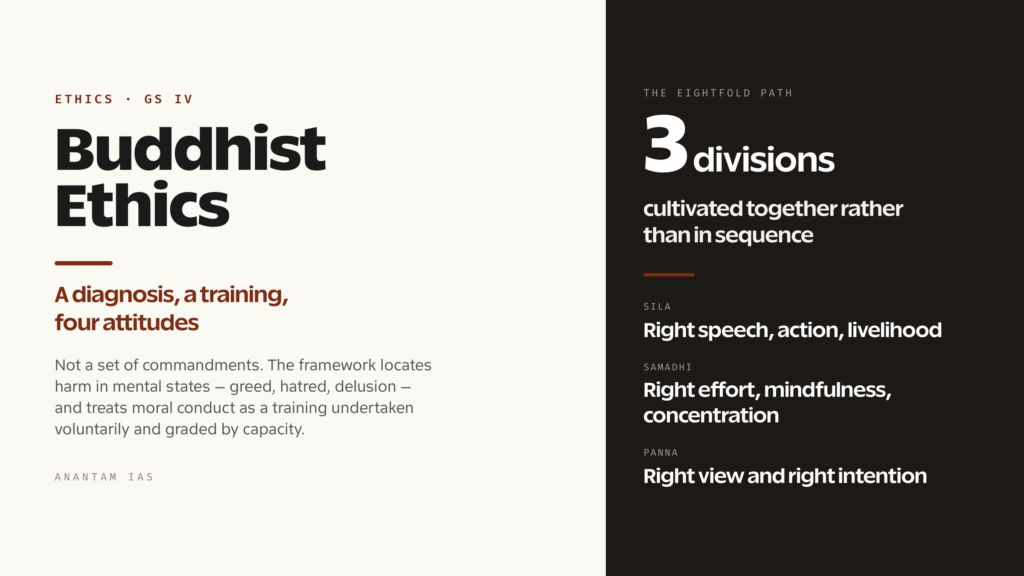
Two features matter for ethics. First, the framework locates the source of harm in a mental state rather than in an external prohibition. Greed, hatred and delusion are the three roots; every specific wrong is treated as a manifestation of one of them. An anti-corruption doctrine built on this footing would treat the bribe as a symptom and the craving as the target, which is roughly what the shift from punishment-only to systemic reform in the Second ARC’s report on ethics in governance attempts institutionally.
Second, the diagnosis is universal rather than tied to station. Where the framework of dharma makes duty contextual, Buddhist ethics applies the same analysis of craving to a monk, a merchant and a king. That makes it easier to transplant into a constitutional setting.
The Eightfold Path and Its Three Divisions
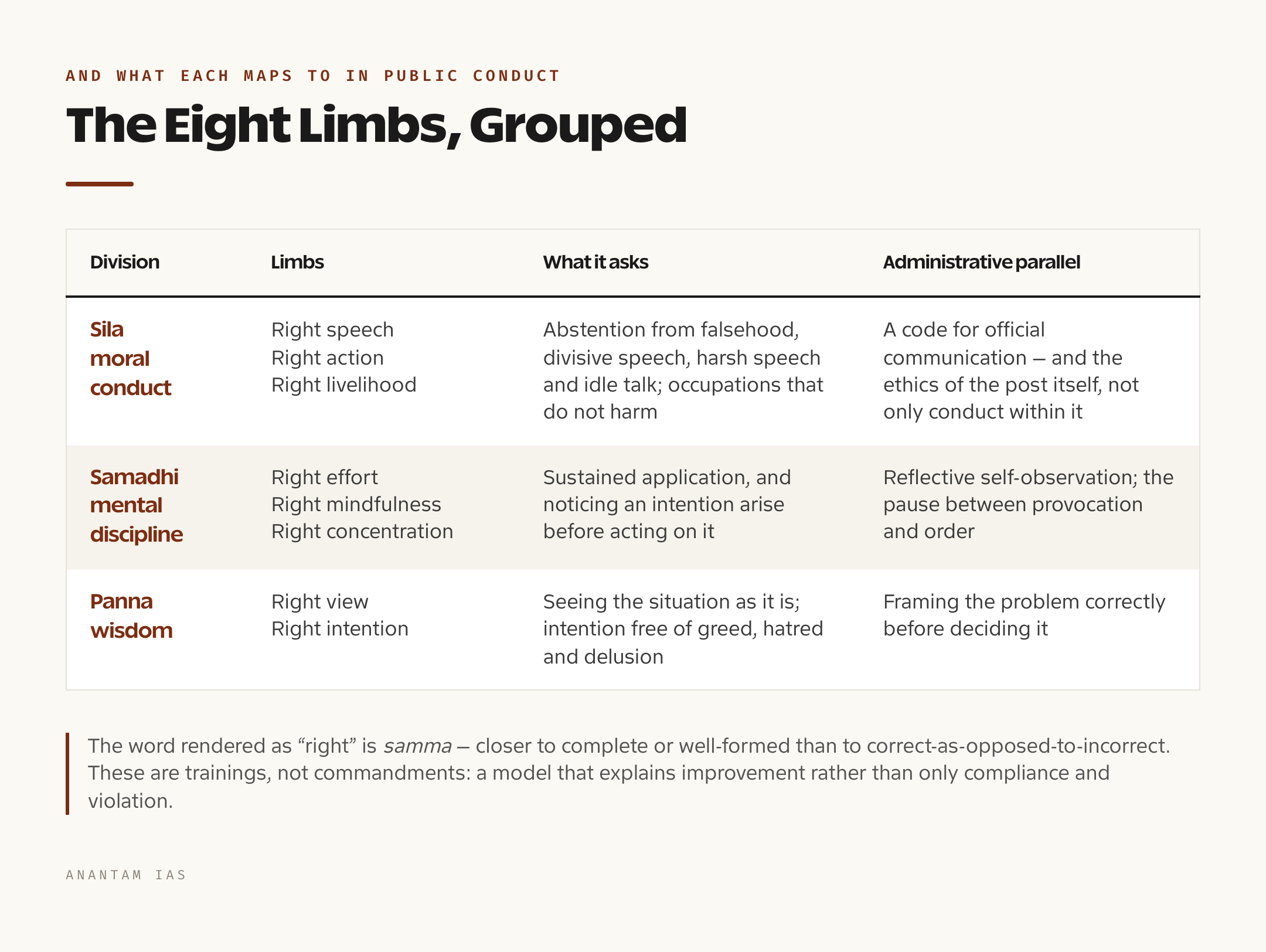
The eight limbs are conventionally grouped into three trainings, and the grouping is more useful than the list.
Sila — moral conduct. Right speech, right action, right livelihood. Right speech is specified in detail: abstention from falsehood, from divisive speech, from harsh speech, from idle talk. Right livelihood excludes occupations that harm — trade in weapons, in living beings, in intoxicants, in poison. This is the only major ancient tradition that treats what you do for a living as a first-order ethical question.
Samadhi — mental discipline. Right effort, right mindfulness, right concentration. Mindfulness here is close to reflective self-observation: noticing the arising of an intention before acting on it.
Panna — wisdom. Right view and right intention, which sit first in the list but depend on the other two to develop. The ordering is deliberately non-linear; the limbs are cultivated together.
The word usually translated as “right” is samma, closer to complete, integrated or well-formed than to correct-as-opposed-to-incorrect. These are described as trainings, not commandments — undertaken voluntarily, graded by capacity, with failure treated as a lapse in practice rather than as sin. For an ethics paper, that distinction is worth keeping: a training model explains improvement, while a commandment model only explains compliance and violation.
The Five Precepts
For laypeople the operative code is the pancha-sila: abstention from taking life, from taking what is not given, from sexual misconduct, from false speech, and from intoxicants that cloud judgement. The word panchsheel was later borrowed for India’s five principles of peaceful coexistence in the 1954 agreement with China, and the borrowing was deliberate rather than accidental — a state reaching for a vocabulary of restraint.
Three points repay attention. The precepts are negatively framed as abstentions, which makes them checkable in a way that positive injunctions are not. The last one is unusual: clouded judgement is itself an ethical problem, independent of any harm caused, which is a defensible position for anyone holding decision-making power. And they are undertaken as personal commitments rather than imposed, so violation is a failure of one’s own resolution rather than an offence against authority.
The Four Brahmaviharas, and Their Counterfeits
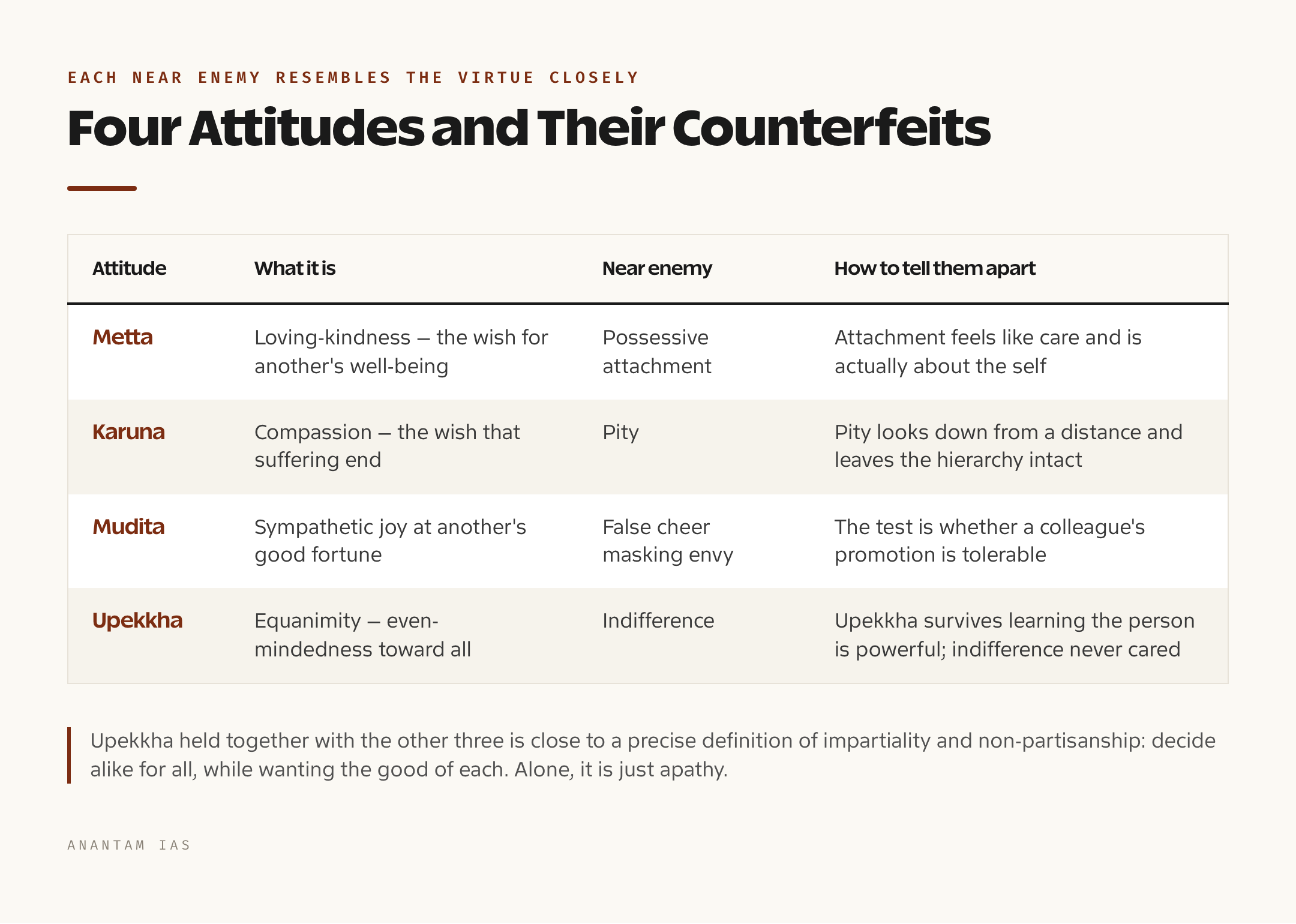
The most administratively useful part of the tradition is its account of four attitudes to be cultivated toward others — the brahmaviharas or immeasurables. Each is paired in the commentarial literature with a “near enemy”: a state that resembles it closely enough to be mistaken for it.
Metta — loving-kindness, the wish for another’s well-being. Its near enemy is possessive attachment, which feels like care and is actually about the self.
Karuna — compassion, the wish that suffering be relieved. Its near enemy is pity, which looks down from a distance and leaves the hierarchy between the helper and the helped intact. The distinction is exactly the one drawn by the ethics of care between attentive responsiveness and condescending benevolence, and it is the difference between a grievance officer who solves the problem and one who is gracious about it.
Mudita — sympathetic joy at another’s good fortune. Its near enemy is a false cheerfulness that masks comparison and envy. Rare enough to be worth naming: it is the disposition that makes a colleague’s promotion tolerable.
Upekkha — equanimity. Its near enemy is indifference, and the two are confused constantly. Upekkha is even-mindedness that survives the discovery that the person in front of you is powerful, or hostile, or a relative. Indifference is not caring who they are because you do not care at all. Upekkha with the other three intact is close to a precise definition of what the syllabus calls impartiality and non-partisanship — decide alike for all, while wanting the good of each.
Karuna is also the corrective to a common misuse. Compassion in this framework is not a feeling to be enjoyed; it is defined by the wish that suffering end, which entails doing something. Serenity in the presence of a solvable problem is upekkha’s counterfeit, not its achievement.
Ashoka’s Dhamma: A Ruler’s Experiment
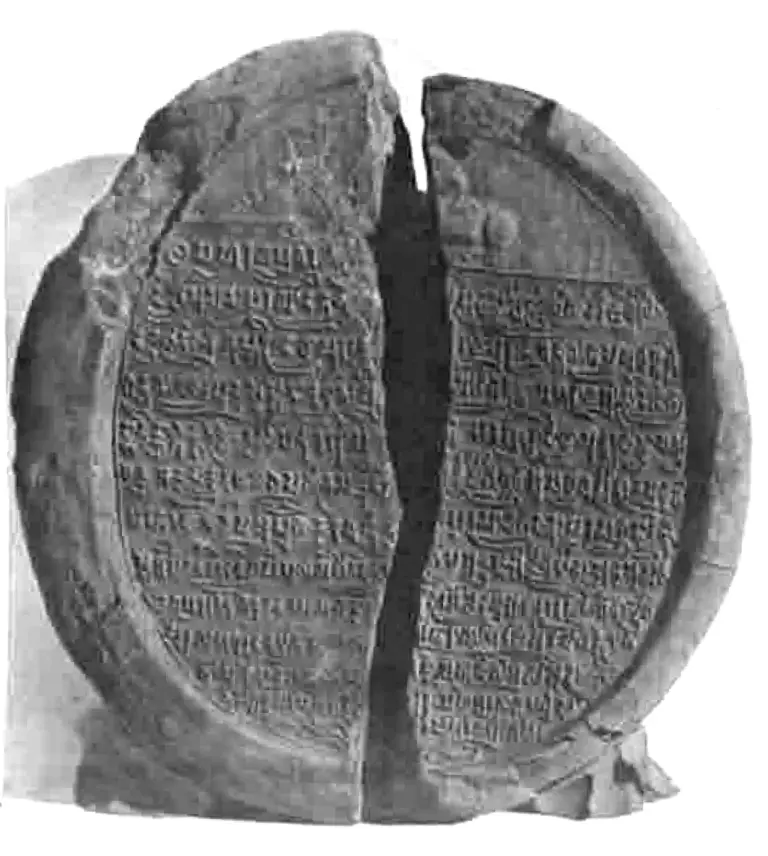
Ashoka’s edicts, inscribed on rock and pillar in the third century BCE, are the earliest surviving record of an Indian ruler articulating a public ethic — and worth reading as administrative documents rather than as piety.
Their content is more civic than doctrinal. The edicts urge obedience to parents and elders, generosity to ascetics of all sects, kindness to servants and slaves, non-injury to living beings, moderation in expenditure, and truthfulness. They announce restraint of animal slaughter in the royal kitchen, medical facilities and rest-houses, wells and shade trees along roads, and a class of officers — dhamma-mahamatras — charged with propagating this ethic and looking into the welfare of prisoners and of women.
Two features are strikingly modern. The Twelfth Rock Edict advocates restraint in praising one’s own sect and disparaging others, and states that honouring other sects honours one’s own — a doctrine of principled tolerance rather than mere permission. And the Thirteenth Rock Edict, recording remorse after the Kalinga campaign, is a ruler publishing an admission of the harm his own policy caused, which is not a common genre in any century.
The honest reading also notes the limits. Ashoka did not abolish capital punishment or dismantle the army; the empire fragmented within about fifty years of his death; and a ruler-propagated ethic administered by state officers raises the question of whether it was moral instruction or a legitimating ideology. Both readings are defensible, and an answer that holds them together is stronger than one that only celebrates.
Ambedkar’s Reading, Which Changed the Question
Buddhist ethics re-entered Indian public life in 1956 through B. R. Ambedkar’s conversion and his posthumous The Buddha and His Dhamma. His reading was deliberately reconstructive, and it matters because it is the version now operating in Indian politics.
He set aside what he saw as later accretions and made three principles central: prajna (understanding, against superstition), karuna (compassion), and samata (equality). The last is the intervention. Ambedkar chose Buddhism precisely because it offered an Indian ethical tradition that did not derive duty from inherited status — the objection he pressed against the varna content of svadharma, set out in the discussion of dharma’s caste problem. He also read the Buddha’s method as fundamentally rational and anti-authoritarian: doctrines to be tested rather than accepted.
Whether this is historically faithful is contested by scholars. That it is a coherent ethical position, and an unusually clear statement of what a tradition must supply to be usable in a constitutional democracy, is not.
What Is Usable in Administration
- Right speech, taken literally. Abstention from falsehood, from divisive speech, from harsh speech and from idle talk is an implementable code for official communication, and three of the four are routinely violated in ordinary official life.
- Right livelihood as a live question. The tradition treats the ethics of the occupation itself as prior to conduct within it — the frame needed for conflict-of-interest and post-retirement questions.
- Upekkha as impartiality. Even-mindedness toward all parties, held together with active goodwill, rather than the detachment that is really indifference. This is also the practical content of what accountability and responsibility require of a decision-maker facing unequal parties.
- The near-enemy discipline. Ask which counterfeit your virtue might be. Is this compassion or condescension? Equanimity or apathy? Prudence or timidity? It is the fastest self-audit in this tradition.
- The Middle Path as a design principle. The doctrine originates in a rejection of both indulgence and severe asceticism, and generalises into a preference for proportionality over the dramatic extreme — the same instinct that governs proportionality tests in the use of force.
The Honest Limits
The framework was built for renouncers. Its highest form is monastic, and the householder code is a graded concession. A doctrine whose ideal is withdrawal supplies limited guidance on how to wield power, which is precisely what an administrator must do.
Non-injury is under-specified for coercive office. A police officer, a magistrate ordering a demolition, or a state defending a border cannot avoid inflicting harm. Buddhist ethics gives strong reasons for restraint and little machinery for choosing between harms — the work done by proportionality doctrines elsewhere.
Anatta complicates responsibility. If there is no permanent self, the question of who bears responsibility for an act across time needs an answer the tradition supplies only with difficulty. Different schools resolve it differently.
Institutional history diverges from doctrine. Buddhist establishments held land, accumulated wealth and were implicated in political power in most societies where they took root. A framework must be judged on both its content and its record.
Stated with those limits, the tradition contributes something the syllabus otherwise lacks: an ethic organised around the training of attention and intention rather than around rules, and a set of four attitudes precise enough to be checked against their counterfeits.
FAQ
What are the three divisions of the Eightfold Path? Sila (moral conduct: right speech, action, livelihood), samadhi (mental discipline: right effort, mindfulness, concentration) and panna (wisdom: right view and right intention). They are cultivated together rather than in sequence.
What is the difference between karuna and pity? Karuna is compassion defined by the wish that suffering end, which entails action. Pity observes from a position of superiority and leaves the hierarchy between helper and helped intact. Commentarial tradition treats pity as compassion’s “near enemy”.
What are the four brahmaviharas? Metta (loving-kindness), karuna (compassion), mudita (sympathetic joy) and upekkha (equanimity). Each has a near enemy: attachment, pity, false cheer and indifference respectively.
What was Ashoka’s Dhamma? A civic ethic propagated through inscribed edicts — respect for elders, generosity to ascetics of all sects, kindness to servants, non-injury, moderation, truthfulness — administered partly through officers called dhamma-mahamatras, alongside public works such as wells, rest-houses and medical facilities.
Why did Ambedkar choose Buddhism? Because it offered an Indian ethical tradition that did not derive obligation from inherited status. He reconstructed it around prajna, karuna and samata — understanding, compassion and equality.
How is upekkha relevant to public administration? It is even-mindedness toward all parties while still wanting the good of each, which is close to the syllabus requirement of impartiality and non-partisanship. Its counterfeit, indifference, is the failure mode to watch for.
Practice Questions
Prelims MCQs
- In the Eightfold Path, right speech, right action and right livelihood together constitute: (a) Panna (b) Samadhi (c) Sila (d) Nirodha — Answer: (c) sila is the division covering moral conduct; samadhi covers mental discipline and panna covers wisdom.
- The “near enemy” of karuna, in Buddhist ethical commentary, is: (a) Indifference (b) Pity (c) Possessive attachment (d) Envy — Answer: (b) pity resembles compassion but observes from above and preserves the distance between helper and helped; indifference is the near enemy of upekkha.
- Which of Ashoka’s edicts is associated with the appeal for restraint in praising one’s own sect and disparaging others? (a) The Seventh Pillar Edict (b) The Twelfth Rock Edict (c) The Thirteenth Rock Edict (d) The Minor Rock Edict at Maski — Answer: (b) the Twelfth Rock Edict states that honouring other sects honours one’s own; the Thirteenth records remorse over the Kalinga campaign.
- The three principles Ambedkar placed at the centre of his reconstruction of Buddhism were: (a) Ahimsa, satya and aparigraha (b) Prajna, karuna and samata (c) Dana, sila and bhavana (d) Metta, mudita and upekkha — Answer: (b) understanding, compassion and equality; the last was his specific intervention against duty derived from inherited status.
- In Buddhist ethics, the three roots from which specific wrongdoing is said to arise are: (a) Ignorance, pride and fear (b) Greed, hatred and delusion (c) Desire, anger and attachment to the body (d) Falsehood, theft and violence — Answer: (b) the framework locates harm in mental states, treating particular wrongs as manifestations of these three.
Mains Practice Questions
- “Upekkha, held together with metta, is a better description of administrative impartiality than neutrality is.” Examine. (150 words)
- The Eightfold Path treats right livelihood as an ethical question prior to conduct within an occupation. Discuss the relevance of this idea to conflict of interest and post-retirement employment in public service. (250 words)
- Ashoka’s edicts have been read both as a genuine public ethic and as a legitimating ideology. Evaluate both readings. (250 words)
- Explain the doctrine of “near enemies” of virtue, and show how it can be used as a self-audit by a public official. (150 words)
- A framework whose ideal is renunciation offers limited guidance to those who must exercise coercive power. Critically examine this objection to Buddhist ethics in the context of public administration. (250 words)
Tell Google you want more of this.
Add Anantam IAS as a preferred sourceOne tap, and this site shows up more often in your own Top Stories, AI Overviews and AI Mode. Remove it any time.