Almost everyone who studies Indian art knows the Brihadisvara temple at Thanjavur. Far fewer can name the temple its builder’s son put up a generation later, in a brand new capital he founded to mark the day his army reached the Ganga. That temple is Gangaikonda Cholapuram, and the reason it slips through revision is simple: the capital city around it vanished, so the temple sits today in a quiet village with no obvious grandeur to hint that this was once the seat of one of the largest empires in Indian history. Learn it as a pair with Thanjavur and it stops being a stray name to memorize and becomes the second act of a very deliberate imperial statement.
Why Rajendra Chola built a whole new capital
The short answer: to freeze a military triumph in stone and stucco. Rajendra Chola I (reigned about 1014 to 1044 CE) inherited an empire already at its peak from his father, Rajaraja Chola I, the man who built the Thanjavur temple. Rajendra’s problem was the classic one for the heir of a great conqueror: how do you prove you are more than your father’s shadow? His answer was to march north.
Around 1023 CE, Rajendra sent an army on a long expedition up the eastern seaboard, through the Kalinga country in present Odisha and into the Ganga plains, defeating the Pala ruler Mahipala of Bengal on the way. The generals carried Ganga water back south in pots, and Rajendra had it poured into a giant tank he dug near his new city. He took the title Gangaikonda Chola, “the Chola who brought the Ganga,” and named the capital after it. So the place name is literally a boast: Gangaikonda Cholapuram means “the city of the Chola who conquered the Ganga.”
Think of it the way a modern head of state might name a new administrative capital after a war they won, then build the country’s tallest monument there. The city was not a natural trade hub or an old sacred site he inherited. It was a purpose built political capital, laid out from scratch around 1025 CE in what is now Ariyalur district, Tamil Nadu, and it served as the Chola capital for roughly the next 250 years, longer than Thanjavur held that role. If you have already read about the Chola dynasty and its administration, this is the moment their power physically relocated.
The Cholagangam tank: a victory you could irrigate
Here is the detail that separates a coaching note from real understanding. Rajendra did not just build a temple. He dug an enormous irrigation reservoir beside the capital called the Cholagangam, sometimes described in inscriptions as his “liquid pillar of victory.” It stretched for miles, was fed by the Kollidam river, and was symbolically topped up with the Ganga water his soldiers had carried home.
That single act tells you how a great medieval Indian state actually worked. Prestige and productivity were welded together. The tank was a war memorial and a public works project at the same time, watering the paddy fields that fed the population and paid the taxes that funded the temple. This is the same logic you see across South Indian kingship: the temple was not a private chapel but the beating economic heart of the settlement, employing masons, dancers, accountants, and farmers, and redistributing grain. Miss the tank and you miss why the Cholas could afford any of this.
The maritime empire this capital ruled
To grasp why Gangaikonda Cholapuram mattered, you have to see the size of the empire it governed, because this was not a regional kingdom with a fancy temple. It was the capital of a sea power. The northern march to the Ganga was only one of Rajendra’s projects. Around 1025 CE he did something almost unheard of for an Indian ruler: he launched a large naval expedition across the Bay of Bengal against the Srivijaya empire, the Sailendra maritime state that controlled the Strait of Malacca in what is now Indonesia and Malaysia.
The Chola fleet sacked Kadaram, present-day Kedah, along with a string of ports across the Malay peninsula and Sumatra, and Rajendra added the title Kadaram-kondan, “conqueror of Kadaram,” to his name. The motive was hard-headed commerce. Srivijaya sat astride the sea lanes that carried the lucrative trade between South India and Song China, and the Cholas wanted that route open and friendly. This is the context in which a capital was worth building on this scale. Gangaikonda Cholapuram administered a state whose reach ran from the Ganga in the north to the ports of Southeast Asia in the east, funded by a booming Indian Ocean trade and by the agrarian wealth of the Kaveri delta.
Hold that scale in mind and the temple reads differently. It is not the vanity project of a comfortable king. It is the ceremonial centrepiece of one of the very few genuinely thalassocratic, or sea-based, empires in Indian history. The Ganga water in the Cholagangam tank, the northern title, the eastern naval title, and the temple’s descending-Ganga imagery all belong to a single, coordinated language of imperial claim. When you write about this monument, that imperial reach is the argument that makes every architectural fact land.
The temple at Gangaikonda Cholapuram
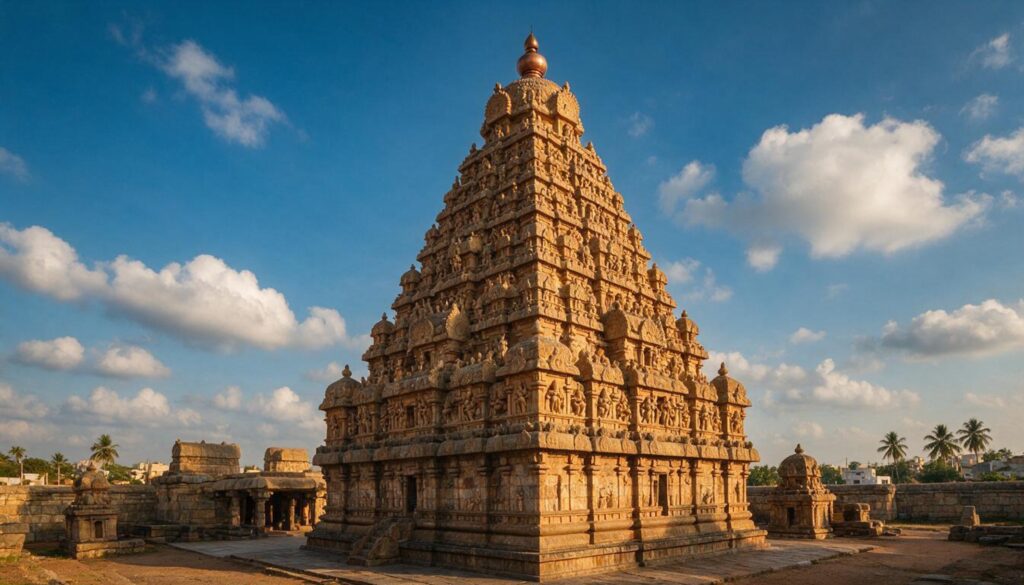
The main monument is a Shiva temple, the Brihadisvara temple of Gangaikonda Cholapuram, its presiding deity called Gangaikondacholisvarar. Rajendra completed it around 1035 CE, and it was consciously designed as a companion and a rival to his father’s temple 70 kilometres away at Thanjavur. Same god, same colossal scale, same Dravida vocabulary, but not a copy. Where Thanjavur is austere and severe, this temple is softer and more ornate, as if the second generation could afford to relax into decoration.
The layout follows the mature Dravidian temple architecture plan: a towering vimana over the sanctum, a long pillared hall or mandapa in front, a subshrine for the goddess, and a huge Nandi bull facing the Shiva linga. A colonnaded wall, the prakara, once enclosed the whole complex, though much of it is gone.
Vimana: why it is shorter than Thanjavur but not smaller in ambition
The single fact examiners love here is the comparison of the two towers, so learn it precisely rather than vaguely. The Gangaikonda Cholapuram vimana rises about 55 metres (roughly 182 feet) over nine tiers. The Thanjavur vimana is taller, about 66 metres (roughly 216 feet). A quick reading calls the son’s temple the lesser one. That is the wrong lesson.
The point is the shape, not just the height. Thanjavur’s tower is a straight sided pyramid, steep and stern, climbing in near straight lines to its capstone. Gangaikonda Cholapuram’s tower curves. Its sides are gently concave, the tiers swell outward and taper in, giving it a graceful, almost feminine profile that art historians routinely contrast with Thanjavur’s “masculine” rigidity. Rajendra’s architects deliberately chose elegance over sheer altitude. If you remember only one thing, remember this: the two towers are a matched pair, one severe and one lyrical, built a generation apart to say the dynasty had arrived and could now be beautiful as well as mighty. It is the same leap you can trace when you compare an early tower like the Lingaraja temple, Bhubaneswar with the later confidence of full-blown regional styles.
| Feature | Brihadisvara, Thanjavur | Brihadisvara, Gangaikonda Cholapuram |
|---|---|---|
| Builder | Rajaraja Chola I | Rajendra Chola I |
| Completed | c. 1010 CE | c. 1035 CE |
| Vimana height | ~66 m (216 ft) | ~55 m (182 ft) |
| Tower profile | Straight, pyramidal, austere | Curved, concave, ornate |
| Setting today | Living temple in a town | Living temple in a village, lost capital |
| UNESCO status | Inscribed 1987 | Added 2004 |
The sculpture worth walking up to
The stucco and stone work at Gangaikonda Cholapuram is where the temple quietly outshines its parent. The most celebrated panel is the Chandikeshvara Anugraha, a relief showing Shiva and Parvati garlanding the boy saint Chandikeshvara, read by many scholars as an allegory of Shiva blessing Rajendra himself. Nearby stands a superb Ardhanarishvara, the half-Shiva half-Parvati form, and dancing Nataraja and Gangadhara panels where Shiva receives the descending Ganga in his hair, a pointed choice of subject for a king who had just claimed the Ganga.
Two features on the ground reward a second look. There is a monolithic Nandi, and a curious lion well called the Simhakinaru, a stepwell whose entrance is guarded by a carved lion, from which priests once drew water for rituals. These are the details that make the temple feel like the product of a specific proud moment rather than a generic Shiva shrine.
The temple also keeps a separate shrine for the goddess, and its outer walls carry rows of deity niches, from Durga and Vishnu to a graceful Saraswati, that turn the plain granite into a controlled gallery of the Chola pantheon. What strikes most visitors is how restrained the whole thing is compared with the later, gateway-heavy temples of the Tamil country. There is no forest of towering gopurams here; the eye is pulled to the single great vimana and the sculpture on the wall directly below it. That discipline is itself a date marker. Gangaikonda Cholapuram belongs to the moment before the gopuram-dominated phase took over South Indian temple design, so its clean, vimana-focused silhouette is a useful visual clue to its eleventh-century vintage. If Chola bronze and stone interest you, the bigger story of how this style matured runs through the earlier Tamil kingdoms covered in early historical Tamilakam.
The Great Living Chola Temples on the UNESCO list
Gangaikonda Cholapuram is not listed on its own. It belongs to a single UNESCO World Heritage property called the Great Living Chola Temples, inscribed under one entry, number 250 on the World Heritage List. The word that carries the exam weight is “living”: all these temples are still active places of worship, not ruins or museums, which is part of why UNESCO valued them.
The inscription happened in two stages, and the sequence is the part people get wrong. In 1987, UNESCO listed a single temple, the Brihadisvara temple at Thanjavur. In 2004, the property was extended to add two more Chola temples: the Brihadisvara temple at Gangaikonda Cholapuram, and the Airavatesvara temple at Darasuram near Kumbakonam, built later by Rajaraja Chola II in the twelfth century. So the correct mental model is one property, three temples, two dates. Thanjavur came first in 1987; Gangaikonda Cholapuram and Darasuram joined it in 2004. The site meets the UNESCO criteria for representing a masterpiece of creative genius and an outstanding example of Chola architecture, art, and bronze casting. It is worth filing this beside India’s other temple World Heritage Sites, such as the Konark Sun Temple, so you can tell them apart under pressure.
Why the capital vanished but the temple survived
This is the haunting part of the story and the answer to the question every attentive reader eventually asks: if this was the imperial capital for two and a half centuries, why is there almost nothing left of the city?
The empire itself declined through the thirteenth century as the resurgent Pandyas and then other powers ate into Chola territory, and by around 1279 CE the imperial line had effectively ended. A capital only survives if a state keeps investing in it. Once the Cholas fell, Gangaikonda Cholapuram had no reason to exist. Its palace, the mud-brick and timber complex excavated by the Archaeological Survey of India at a mound still called Maligai Medu (“palace mound”), was abandoned and decayed, because unlike the granite temple it was never built to last centuries.
Then came the slow cannibalising of the site. Later rulers and, in the colonial period, engineers quarried the fort walls and dressed stone for other projects, including building material reportedly carted off for the Lower Anicut, a river dam on the Kollidam, in the nineteenth century. Brick was robbed for local construction. What could be carried away was carried away. Only the temple, too sacred to demolish and too massive to move, stood its ground.
So the lesson is structural, not sentimental. Stone temples endowed with land and ritual survive because a community keeps using them; secular capitals die when the power that funded them dies. That contrast, the durable sacred core and the perishable political shell, is one of the most quietly examinable ideas in the whole topic. It is the same reason a still-worshipped shrine like the Ranganathaswamy temple at Srirangam has grown over centuries while palace cities around India lie in mounds.
How to study Gangaikonda Cholapuram for exams
Do not learn this temple in isolation, because on its own it is just a name and a height. Learn it as one point in a three point line.
First, anchor it to the two people. Rajaraja Chola I builds Thanjavur; his son Rajendra Chola I conquers north to the Ganga, takes the title Gangaikonda Chola, and builds this capital and temple. That father-son, Thanjavur-to-Gangaikonda-Cholapuram pairing is the spine of the whole answer. If you have read the profile of Rajendra Chola I, you already have the naval and northern campaigns that give this temple its meaning.
Second, memorize the three comparison facts that distinguish it from Thanjavur: it is slightly shorter (about 55 metres against 66), its tower is curved rather than straight, and it is the later, more ornate of the two. Those three points answer almost any comparison question.
Third, lock down the UNESCO chronology as one property, three temples, two years: Thanjavur in 1987, Gangaikonda Cholapuram plus Darasuram in 2004, all under “Great Living Chola Temples.” Add the economic angle, the Cholagangam tank, so you can write about the temple as an economic and administrative centre and not only as architecture. That last move is what lifts an answer from a list into an argument. For the broader classification of towers and styles, keep the general temple architecture in India framework handy so you can slot the Cholas into the Nagara-Dravida-Vesara scheme without hesitation.
The whole topic is smaller than it looks once you see it as a sequel. Thanjavur is the debut; Gangaikonda Cholapuram is the follow-up in a new city, softer in style, built to say the dynasty had gone from powerful to imperial. That is the sentence to walk into the exam hall with.
Frequently Asked Questions
Who built Gangaikonda Cholapuram and why?
Rajendra Chola I built it around 1025 CE as a new Chola capital, to commemorate his northern military expedition that reached the river Ganga. The name means “city of the Chola who conquered the Ganga,” and it replaced Thanjavur as the seat of the empire for about 250 years.
Is the Gangaikonda Cholapuram temple bigger than the Thanjavur temple?
No. Its vimana is about 55 metres tall, shorter than Thanjavur’s roughly 66 metres. But its tower has a graceful curved, concave profile compared with Thanjavur’s straight pyramidal one, and it is generally the more ornate and decorated of the two.
Which deity is the temple dedicated to?
Lord Shiva, worshipped here as Gangaikondacholisvarar, with a massive Shiva linga in the sanctum and a large Nandi bull facing it, in the standard mature Dravida plan.
Is Gangaikonda Cholapuram a UNESCO World Heritage Site?
Yes, as part of the Great Living Chola Temples (World Heritage List number 250). The property was first inscribed in 1987 with the Thanjavur temple, then extended in 2004 to add Gangaikonda Cholapuram and the Airavatesvara temple at Darasuram.
What is the Cholagangam tank?
It is the enormous irrigation reservoir Rajendra Chola dug beside the capital, symbolically filled with Ganga water carried home by his army. It worked as both a war memorial and a public irrigation work that watered the surrounding farmland.
Why is the city gone if it was the imperial capital?
The temple was durable granite and remained in worship, but the palace and fort were brick, timber, and dressed stone. After the Chola empire fell around 1279 CE the city was abandoned, and its building material was later quarried away for other projects, so only the temple survives intact.
Where is Gangaikonda Cholapuram located?
In Ariyalur district, Tamil Nadu, roughly 70 kilometres north-east of Thanjavur, near the town of Jayankondam.
Practice Questions
1. Gangaikonda Cholapuram was established as a capital by which Chola ruler?
a) Rajaraja Chola I
b) Rajendra Chola I
c) Rajaraja Chola II
d) Kulottunga Chola I
Answer: b) Rajendra Chola I
2. The Great Living Chola Temples were first inscribed on the UNESCO World Heritage List in which year, and extended in which year?
a) Inscribed 1984, extended 2004
b) Inscribed 1987, extended 2004
c) Inscribed 1987, extended 2014
d) Inscribed 2004, extended 2014
Answer: b) Inscribed 1987, extended 2004
3. Which three temples together form the Great Living Chola Temples World Heritage property?
a) Thanjavur, Gangaikonda Cholapuram, Srirangam
b) Thanjavur, Gangaikonda Cholapuram, Darasuram
c) Thanjavur, Chidambaram, Darasuram
d) Gangaikonda Cholapuram, Darasuram, Kumbakonam
Answer: b) Thanjavur, Gangaikonda Cholapuram, Darasuram
4. Compared with the Brihadisvara temple at Thanjavur, the vimana at Gangaikonda Cholapuram is:
a) Taller and straight-sided
b) Shorter and curved (concave) in profile
c) Identical in height and shape
d) Shorter and pyramidal like Thanjavur
Answer: b) Shorter and curved (concave) in profile
5. The Cholagangam, associated with Gangaikonda Cholapuram, was:
a) A large temple gateway
b) A royal coronation hall
c) A huge irrigation tank symbolically filled with Ganga water
d) A Chola naval dockyard
Answer: c) A huge irrigation tank symbolically filled with Ganga water
Mains-style questions
- “The shift of the Chola capital from Thanjavur to Gangaikonda Cholapuram was a political statement as much as an administrative decision.” Examine.
- Compare the two Brihadisvara temples at Thanjavur and Gangaikonda Cholapuram in terms of architecture and artistic sensibility, and explain what the differences reveal about Chola kingship.
- Discuss the significance of the “Great Living Chola Temples” as a UNESCO World Heritage property, with particular attention to the criterion of being a living heritage.
- “Chola temples were centres of economic and administrative life, not merely places of worship.” Analyse with reference to Gangaikonda Cholapuram.
- Account for the survival of the Gangaikonda Cholapuram temple alongside the near-total disappearance of the Chola imperial capital that surrounded it.
Gangaikonda Cholapuram deserves better than the single line it usually gets. It is the physical proof that the Cholas thought of themselves as an imperial power on a subcontinental scale, confident enough to abandon a working capital and raise a new one purely to house a victory. Learn it as the second half of the Thanjavur story, keep the three comparison facts and the two UNESCO dates ready, and you will have one of the most quietly rewarding topics in Chola history under full control.
Tell Google you want more of this.
Add Anantam IAS as a preferred sourceOne tap, and this site shows up more often in your own Top Stories, AI Overviews and AI Mode. Remove it any time.